The TSL’s Horror Grindhouse: Raiders of the Living Dead (dir by Samuel M. Sherman and Brett Piper)


Wow, were to even begin?

The 1986 film Raiders Of The Living Dead is not an easy movie to describe.  It’s a film that somehow manages mix terrorists, zombies, journalists, movie theaters, a sociopathic kid who somehow invents a death ray, and the Three Stooges.  If that makes it sound like something you want to see …. well, good.  You should see this movie, just so you can say that you’ve had the experience.

On the plus side, Raiders of the Living Dead opens with one of the most brilliant songs that I’ve ever heard.  Seriously, take a listen and then ask yourself why Olivia Cooke was covering Bob Dylan in Life Itself instead of this song:

So, I know what you’re asking.  “What’s this movie about?”

I’m not really sure.  Here’s what I can tell you.

The movie opens with a truck apparently being hijacked.  At least, I think it was a hijacking.  A guy jumped in a truck and drove off with it and then some police cars started following him down a country road so I’m going to assume that some sort of law was broken.  Anyway, the truck gets away because a dump truck pulls in front of the police cars.  The dump truck driver isn’t an accomplice or anything.  He’s just having engine trouble.  I guess the cops just decided they had wasted enough time chasing the other truck so they decided to just sit around and watch the dump truck driver work on his engine.

Suddenly, we’re in a nuclear power plant!  Oh my God, a terrorist is trying to blow the place up!  That will lead to an environmental catastrophe and …. oh never mind.  Two SWAT guys just showed up and shot the terrorist with a taser and then the terrorist stumbled into a circuit box and got electrocuted so I guess that’s a god thing.

Now, I’m not sure how either of these scenes are connected to the rest of the film.  In fact, we soon abandon the nuclear power plant so that we can send time with Jonathan (Scott Schwartz, the same kind who got his tongue stuck to the flag pole in A Christmas Story) and his grandfather, Dr. Corstairs (Robert Allen).  Dr Corstairs is having trouble with whatever the 80s equivalent of a DVD player is and he gives it Jonathan to see if he can fix it.  Somehow, Jonathan turns it into a death ray and accidentally atomizes his pet hamster.  Jonathan never seems to be too upset over killing his pet, which leads me to suspect that Jonathan is a sociopath.

Meanwhile, there’s a reporter named Morgan (Robert Deveau), who drags his girlfriend with him to an old farmhouse in the middle of the night.  He says that he’s investigating something for a story but I think he just has a thing for farmhouses.  Anyway, they get attacked by zombies.  Morgan escapes.  His girlfriend doesn’t.  Morgan never seems to be too upset about it, proving that Morgan is as much of a sociopath as Jonathan.

Anyway, Morgan goes into hiding, which in this case means getting a room in a nearby boarding house and looking for clues at the library.  He also gets a new girlfriend named Shelley (Donna Asali).  They go to a Three Stooges film festival together.  They watch a Three Stooges short which means that viewers of Raiders of the Living Dead also have to watch it.  This actually happens more than once.

Anyway, it’s all somehow connected to a mad scientist who is creating zombies out in a deserted prison somewhere.  I’m not really sure how it all connects and neither is the film.  Jonathan’s death ray does kind of play a role in resolving the whole zombie subplot but to be honest, I was so curious about why no one was freaking out about a kid having a death ray that it was sometimes hard to focus on just what exactly was going on at the prison.

So, this is a very strange film.  Apparently, it was shot over a lengthy period of time, with footage being shot until the production ran out of money and then filming resuming whenever some more money came in.  That probably explains why Raiders of the Living Dead seems to actually be five or six films in one.  As bad as the film is, I am going to give it a cautious recommendation just because it’s so damn weird that I think everyone should experience it at least once.

Plus, I love that theme song!

Faust Goes Metal: Shock ‘Em Dead (1991, directed by Mark Freed)


Spastic Colon, an up-and-coming metal band, desperately needs a new guitarist, so much so that they allow a nerdy pizza boy named Martin (Stephen Quadros) to come in off the street and audition.  Martin, with his thick glasses and his total lack of talent, blows the audition and is told to leave and never return.  Not only does Martin lose his chance to be a rock star but he also loses his job when his boss (Aldo Ray) fires him for leaving work to audition.  While wandering around dejected, Martin runs into the local voodoo priestess (Tyger Sodipe), who offers to make him a rock star in exchange for his soul.

Martin agrees and after a ceremony involving a double neck guitar, Martin wakes up to discover that he is now an extremely talented guitarist who lives in a gigantic mansion with three outrageously hot groupies.  Martin now has big, heavy metal hair and no longer needs to wear his glasses.  Renaming himself Angel Martin, he not only becomes Spastic Colon’s new guitarist but he also pulls the band’s manager (Traci Lords) away from her boyfriend.  The only problem is that Martin cannot eat normal food and has to regularly feast on the souls of his groupies in order to stay alive.

Shock “Em Dead is the 1000th retelling of the old Faust legend, about the man who gets everything that he desires but loses his soul in the process.  A real product of its time, it’s impossible to watch Shock “Em Dead without thinking about how Martin sold his soul to become the type of musician that, in just a few months, would be made obsolete by Kurt Cobain and Nirvana.  I have fond memories of Shock “Em Dead because it always used to air on HBO back when I was growing up but, for the most part, this is a really crummy movie, with a bad script, bad acting, and bad special effects.  Shock “Em Dead does prove that Traci Lords had enough talent that, if not for her background as an underage porn star, she probably could have had a mainstream film career.  The film also provided small roles for Aldo Ray and Troy Donahue while the legendary Michael Angelo Batio served as Angel’s “guitar double.”

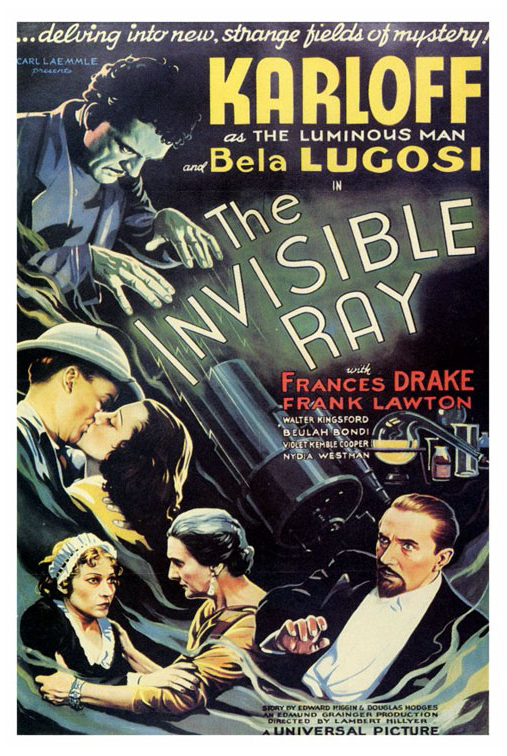
Halloween Havoc!: THE INVISIBLE RAY (Universal 1936)


gary loggins's avatarcracked rear viewer


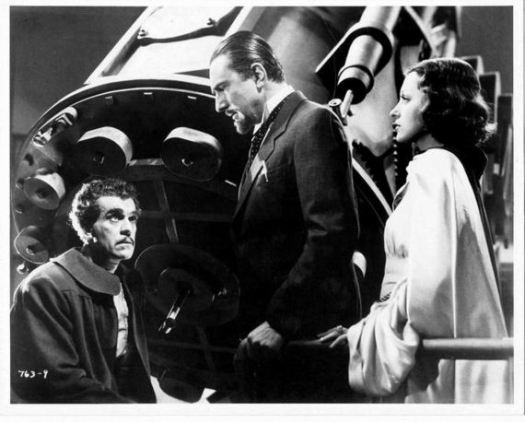
THE INVISIBLE RAY, the third Universal teaming of Boris Karloff and Bela Lugosi , is probably the least discussed of their seven films together. And I don’t quite know why, because I find it an entertaining meld of horror and science fiction that holds my interest for its 80 minute running time. The two stars are well spotlighted, with Bela as one of the good guys (for a change!) and Boris giving a hammy but well crafted performance as a scientist unhinged by his newest discovery.

A curly-haired Karloff stars as Dr. Janos Rukh, awaiting the arrival of a group of his fellow scientists for a demonstration of his Invisible Ray as a storm rages outside. Rukh’s wife Diana and blind Mother Rukh greet them: Sir Francis Stevens and his wife Lady Arabella, French astro-chemist Dr. Felix Benet, and Lady Arabella’s nephew Ronald Drake, who’s along for the ride. Rukh…

View original post 426 more words

Italian Horror Showcase: A Lizard In A Woman’s Skin (dir by Lucio Fulci)


The 1971 film A Lizard In A Woman’s Skin is a story of greed, love, lust, repressed desires, bloody murder, and two rather hateful hippies.  It’s a surreal tale that manages to combine LSD, politics, therapy, and a good old-fashioned whodunit.  It’s a film that clearly a product of the late 60s and the early 70s and yet, it’s also a film that is so shamelessly sordid and wonderfully strange that it feels timeless.

And not surprisingly, it was directed by Lucio Fulci.

Over the course of his career, Lucio Fulci was credited with directing 56 films and one television miniseries.  Though we tend to primarily think of Fulci as being a horror director, he actually worked in every genre.  He directed peplums.  He was responsible for some of the best and most violent spaghetti westerns ever made.  He even directed comedies and an adaptation of Jack London’s White Fang!

Still, it is for his horror films that Fulci is best-remembered and his non-compromising and frequently surreal style was perfect for the genre.  Though 1979’s Zombi 2 is frequently cited as Fulci’s first excursion into the horror genre, he had actually dabbled in it before with a set of stylish and violent giallo films that he directed in the early 70s.

For example, A Lizard In A Woman’s Skin deals with a horrific crime and features some of Fulci’s most striking and disturbing images.  The film deals with Carol Hammond (Florida Bolkan), who is the daughter of a politician (Leo Genn) and the wife of a wealthy attorney (Jean Sorel).  Carol is haunted by bizarre dreams involving her decadent neighbor, Julia Durer (Anita Strindberg).  In her latest dream, Carol not only has a sexual encounter with Julia but also stabs her to death immediately afterward!  It’s only after Julia’s dead that Carol realizes that she’s being watched by two hippies, who appear to be amused by the whole thing.

After telling her therapist about the dream, Carol learns that Julia Durer has indeed been murdered.  In fact, she was stabbed in exactly the same way that Carol saw in her dream!  Was it just a dream or did Carol really murder of Julia?  Or did someone find out about her dream (which she recorded in her journal) and then murder Julia in order to frame her?  But who would want to do that?  Could it be maybe her weaselly husband, who is having an affair with his secretary?  Or maybe someone looking to embarrass her father?

And what about the two hippies?  It turns out that they’re real and they have a story of their own tell….

The mystery at the heart of A Lizard In A Woman’s Skin is a convoluted one and while the film’s plot did hold my interest, this film is less about the story and more about the way that Fulci tells it.  Dealing with hippies, visions, LSD, and a potentially unstable protagonist gave Fulci whatever excuse he needed to turn Lizard In A Woman’s Skin into a surrealistic carnival ride of psychedelic images and sexually-charged dream sequences.  From Carol’s nightmares to the scene where an intruder chases Carol through a sanitarium, A Lizard In A Woman’s Skin is full of strange images that are designed to keep the viewer just as off-balance as Carol.  The film’s most shocking scene — which involves Carol coming across four dogs being used in a medical experiment — actually led to Fulci and special effects artist Carlo Rambaldi being taken to court and forced to prove that the dogs in the scene weren’t real.  (Fortunately, Rambaldi brought his dog props to court with him.)  It’s a shamelessly sordid film, one from which you will not be able to divert your eyes.

Florinda Bolkan gives a great and sympathetic performance was Carol while Antia Strindberg is properly decadent as Julia.  Penny Brown and Mike Kennedy plays perhaps the most hateful and callous hippies of all time and Kennedy especially makes a strong impression.  Trust Lucio Fulci to make a film where the hippies are just as frightening as the zombies who populated his later work!

A Lizard in A Woman’s Skin is a classic giallo and one of Fulci’s best.

Horror Film Review: Invaders From Mars (dir by William Cameron Menzies)


The aliens have arrived!  They landed one night in the middle of a thunderstorm and now, they’re hiding underground in a sandpit.  Only David McClean (Jimmy Hunt) was awake to witness their arrival.  He was supposed to be asleep but who could sleep through all that thunder and lightning?  (Not to mention the sound of the flying saucer!)  Unfortunately, no one’s going to believe David because he’s only 12 years old!

That’s the premise at the heart of Invaders from Mars, a nicely surreal science fiction film from 1953.

In order to humor David, a few people do go to the sandpit to look for this supposed UFO.  They include his scientist father (Leif Erickson) and a few local cops.  They all return saying that they found nothing.  They also all return in a really bad mood.  David’s formerly loving and humorous father is suddenly distant and rather grumpy.  And he no longer speaks like himself.  Instead, he is now rigidly formal, like someone still getting used to speaking a new language.  Maybe it has something to do with the strange mark on the back of his neck….

David goes into town and soon discovers that several townspeople are acting just like his father.  It’s almost as if something is controlling them!  Well, what else can David do but go to the local observatory and get the U.S. Army involved!?

Invaders from Mars may be disguised as a children’s film about a flying saucer but it actually deals with some very adult issues.  What do you do when you know that you’re right but no one is willing to listen to you?  Do you stubbornly cling to what you believe or do you just become a mindless and unquestioning zombie like everyone else?  Do you remain independent or do you get the mark on your neck?  Of course, it should also be pointed out that Invaders From Mars was made at a time when people were very much worried that America was being invaded from within by communists and subversives, all of whom would rob Americans of their individual freedoms just as surely as the aliens in David’s town.  Invaders From Mars came out two years before Invasion of the Body Snatchers but they both deal with very similar issues.

What sets Invaders From Mars apart is that it’s told from a child’s point of view.  It plays out like a nightmarish fairy tale.  The film was directed by the famous production designer, William Cameron Menzies and he gives the entire film a nicely surreal look.  The town is just a little bit too perfect while the inside of the spaceship is a maze of corridors, all overseen by a ranting head in a crystal ball.

The film’s ending was probably chilling to audiences in 1953.  For modern audiences, it’s a bit of groan-inducing cliché.  Still, the ending itself makes sense when viewed in the context of the entire film.  (It’s literally the only ending that makes sense.)  Still, ending aside, Invaders From Mars is a classic sci-fi film and one well worth watching this Halloween season.


Horror on the Lens: Robot Monster (dir by Phil Tucker)


Today’s horror film is a true classic of its kind, the 1953 science fiction epic Robot Monster.

Now, I should admit that this is not the first time that I’ve shared Robot Monster in October.  I share it every year and, every year, YouTube seems to pull the video down in November.  That sucks because Robot Monster is one of those weird films that everyone should see.  So, I’m going to share it again.  And, hopefully, YouTube will let the video stay up for a while.

As for what Robot Monster is about…

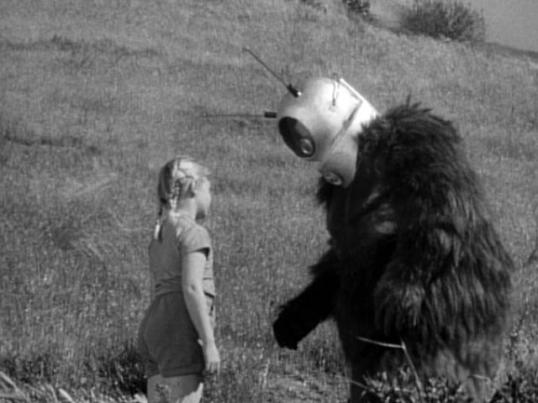
What happens with the Earth is attacked by aliens?  Well, first off, dinosaurs come back to life.  All of humanity is killed, except for one annoying family.  Finally, the fearsome Ro-Man is sent down to the planet to make sure that it’s ready for colonization.  (Or something like that.  To be honest, Ro-Man’s exact goal remains a bit vague.)

Why is Ro-Man so fearsome?  Well, he lives in a cave for one thing.  He also owns a bubble machine.  And finally, perhaps most horrifically, he’s a gorilla wearing a diver’s helmet.  However, Ro-Man is not just a one-dimensional bad guy.  No, he actually gets to have a monologue about halfway through the film in which he considers the existential issues inherent in being a gorilla wearing a diver’s helmet.

Can humanity defeat Ro-Man?  Will Ro-Man ever get his intergalactic supervisor to appreciate him?  And finally, why are the dinosaurs there?

All of those questions, and more, are cheerfully left unanswered but that’s a large part of this odd, zero-budget film’s considerable charm.  If you’ve never seen it before, you owe it to yourself to set aside an hour and two minutes in order to watch it.

You’ve never see anything like it before.

Enjoy!

The TSL’s Horror Grindhouse: Rasputin, The Mad Monk (dir by Don Sharp)


In turn of the century Russia, there lived a man named Grigori Rasputin.

He was a monk, though some considered him to be more a servant of the devil than of God.  Legend has it that he was a man who rarely bathed and who made it a point to live in the wild, a part of nature.  His hair was long and unkempt and he was known for his wild eyes.  Depending on who is telling the story, Rasputin’s stare is described as either being seductive or frightening.  Rasputin had a reputation for being a great healer, as well as a great seducer.  (It is said that Rasputin offered up as his defense that it was necessary to sin so that he could be forgiven by God.)

Despite being a controversial figure (and, in the eyes of same, an instrument of the devil), the charismatic Rasputin became well-known in Russian social circles.  In fact, the stories of his powers as a healer eventually reached the household the Tsar.  The Tsar’s son suffered from hemophilia and was frequently ill.  Rasputin was brought into the royal palace to cure him and, according to contemporary accounts, he was somehow able to do just that.  It was said that only Rasputin could stop the boy’s bleeding.

It was also said that Rasputin grow to have a good deal of influence over the Tsarina.  In fact, he was seen as having so much influence that certain members of the royal court started to view him as being a threat to their own power.  On December 30th, 1916, Rasputin was murdered.  There are many stories about how Rasputin was murdered but it’s generally agreed that the conspirators first tried to poison him, just to discover that Rasputin was apparently immune to cyanide!  Eventually, Rasputin was shot twice and then dumped in the Malaya Nevka River.  Stories about how difficult it had been to kill Rasputin only added to his legend.

After his death (and the subsequent communist revolution that led to the murders of the Tsar and his family), Rasputin became a legendary figure.  Because of his connection to the occult, it’s perhaps not surprising that he’s also been the subject of a number of biopics.  Everyone from Klaus Kinski to Lionel Barrymore to Alan Rickman has played the mad monk.  (Apparently, Leonardo DiCaprio has been attached to an up coming film about Rasputin.)

And then there’s Christopher Lee.  Christopher Lee played Rasputin in the 1966 Hammer Film, Rasputin, The Mad Monk.  It’s probably one of Lee’s best performances, as well as one of his most lively.  Lee plays Rasputin as being a cunning charlatan, one who may act like a madman but who always know exactly what he’s doing.  The film makes perfect use of Lee’s imposing physical presence and, when Rasputin uses his powers of hypnotism, Lee stares with such intensity that you never doubt that he’s a man who knows how to get exactly what he wants.  Lee makes you believe that, through sheer willpower, Grigori Rasputin very well could have become one of the most important men in Russia.

As for the film itself, it’s a briskly paced retelling of Rasputin’s final years, hitting all of the expected points without ever digging too far beneath the surface.  Rasputin cures the sick and seduces their mothers, wives, and sisters and uses his powers of hypnotism to hold most of St. Petersburg under his control.  Many of the usual Hammer performers (including Barbara Shelley, as the Tsarina’s servant and Joss Ackland as a bishop) make an appearance and the fact that no one makes the least bit of effort to sound Russian just adds to the film’s charm.  It’s an entertaining look at a fascinating historical story and, most importantly, it features Christopher Lee at his chilling best.

Rock and Roll Creation: Zombie Nightmare (1986, directed by Jack Bravman)


When muscle-bound teen baseball player Tony (Jon-Mikl Thor) does a good deed by stopping a grocery store robbery, he’s rewarded by getting run down by a bunch of stupid teenage joyriders.  Luckily, there’s a voodoo priestess in the neighborhood and, while she can’t revive Tony permanently, she can bring him back as a zombie so he can kill those who killed him.  Soon, Zombie Tony is killing all of the teens (including Tia Carrere) and Detective Tom Churchman (Adam West) is on the case.  Detective Churchman, however, has a previous connection to both the voodoo priestess and the murder of Tony’s father.

Zombie Nightmare is best known for later being shown on Mystery Science Theater 3000.  It was one of the best episodes of MST 3K but Zombie Nightmare is just as great even without commentary from Mike and the Bots.  This film features Jon-Mikl Thor, Adam West, Tia Carrere, zombies, and a heavy metal soundtrack that features Girlschool, Virgin Steel, Thor, and Motorhead!  What more do you need?  Jon-Mikl Thor is actually really convincing as the zombie and it’s always interesting to see Adam West play a role straight.  West even gets to be the bad guy here, and he does it without winking at the camera once.

Jon-Mikl Thor followed up Zombie Nightmare with the even better Rock ‘n’ Roll Nightmare.  He was also the subject of a recent and revealing documentary, I Am Thor, which should be required viewing for anyone who thinks they want to be a star.

Halloween Havoc!: WEREWOLF OF LONDON (Universal 1935)


gary loggins's avatarcracked rear viewer

Lon Chaney Jr.’s Lawrence Talbot wasn’t Universal’s first Wolf Man . That honor goes to Henry Hull in WEREWOLF OF LONDON, a chilling but lesser film in the Universal canon. This one reminds me more of DR. JEKYLL & MR. HYDE than any of Chaney’s lycanthropic outings, and Jack Pierce’s makeup job is a little light in the hirsute department (more on that later).

British botanist Wilfred Glendon travels to Tibet to search for the rare mariphasia lumina lupina, a flower that only blooms in moonlight. Trekking into a forbideden valley, he is attacked and bitten by a werewolf. Returning to London with his find, Glendon is confronted by the mysterious Dr. Yogami, who says they’ve met before. Unbeknownst to Glendon, Yogami is the werewolf in question, who wants the phosphorescent moonflower as an antidote for his own lycanthropy. Yogami manages to steal the two blooms, leaving Glendon to transform…

View original post 373 more words

Italian Horror Showcase: The Long Hair of Death (dir by Antonio Margheriti)


This 1964 Italian horror film takes place in a feudal village in the 15th century.  It’s a time of fear, corruption, and ignorance, which is a dangerous combination.  The village is ruled over by the corrupt Count Humboldt (Giulliano Raffaelli).  With his villagers panicking about every day problems like poor crops, banditry, and disease, the Count understand that the best thing to do is just blame it all on a witch.  Of course, it doesn’t do much good to blame a witch unless you also burn her and that’s exactly what the count decides to do Adele Karnstein.  When Adele’s daughter, Helen (Barbara Steele), goes to the castle to make an appeal for her mother’s life, the Count responds by raping her and then tossing her over the edge of a cliff.

Adele’s other daughter, Lisabeth (Halina Zalewska), is adopted by the Count and grows up in his castle.  Eventually she is married off to the count’s evil and greedy nephew, Kurt (George Ardisson).  Knowing fully well what Kurt’s family did to her mother and her sister, Lisabeth is not all happy about the arrangement but what can she do?  She has absolutely no one to help her.

And then, one night, lightning strikes Helen’s grave.  Not only does the grave fly open but Helen is now suddenly walking around the village and heading for the castle.  Except, of course, she is now calling herself Mary.  When Mary arrives at the castle, Kurt is immediately taken with her, so much so that he starts to plot the murder of Lisabeth.  However, is it possible that this is all a part of Mary’s plan?

Meanwhile, the black plague has once again struck the village and again, the villagers are starting to demand a sacrifice….

Obviously, the main reason to see The Long Hair of Death is for Barbara Steele’s performance in the dual roles of Helen and Mary.  In the early 60, Steele appeared in several Italian gothics and she almost inevitably always seemed to play a character who, after being unjustly killed by a member of the upper class, returned from the dead to get revenge.  (This was a template that was set down by her best-known Italian film, Mario Bava’s Black Sunday.)  While I’ve read that it’s a role that Steele got tired of playing, that doesn’t change the fact that she was very good at it.  Steele’s characters always returned to punish the men who had previously used and abused her, which is one reason why her performances remain popular to this day.

That’s certainly the case with The Long Hair of Death, in which the entire film is basically leading up to Kurt being punished for both his sins and the sins of his uncle.  George Ardisson gives a wonderful performance as Kurt, effortlessly going from arrogant and lecherous to terrified and helpless without missing a beat.  Director Antonio Margheriti plays up the story’s gothic atmosphere, giving the film an occasionally dream-like feel.  He emphasizes not just the villainy of the Humboldts but also the superstition of the villagers, making clear that evil cannot prosper without ignorance.

The Long Hair of Death is hardly perfect.  The middle part of the film drags and the low-budget is occasionally a hindrance.  (The village often looks like it’s made out of cardboard.)  But the film comes alive whenever Barbara Steele is on-screen and the ending is a brilliantly macabre.  Lovers of Italian gothic horror will find much to appreciate about The Long Hair of Death.