Lisa Reviews An Oscar Nominee: The Pied Piper (dir by Irving Pichel)


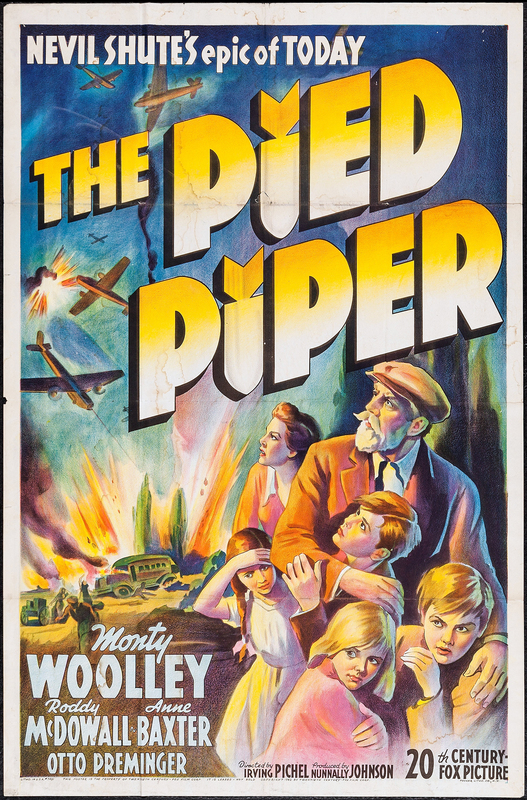
The 1942 Best Picture nominee, The Pied Piper, opens in Eastern France, shortly after the outbreak of World War II.

John Sidney Howard (played by Monty Woolley) is an Englishman on holiday.  He says that he just wants to enjoy some fishing before the entire continent of Europe descends into chaos.  He knows that France is going to be invaded at some point and he even suspects that the country will probably fall to the Nazis.  In his 70s and still mourning the death of his son (who was killed during an air battle over occupied Poland), Mr. Howard just wants to enjoy France one last time.  Despite the fact that the bearded Howard bears a resemblance to a thin Santa Claus, he’s quick to declare his dislike of both children and humanity in general.  He’s a misanthrope, albeit a rather friendly one.

Howard’s plans change when the Nazis invade France sooner than he expected.  With his vacation canceled, Howard just wants to get back to England.  Complicating matters is that a diplomat named Cavanaugh (Lester Matthews) has asks Howard to take his children, Ronnie (Roddy McDowall) and Sheila (Peggy Ann Garner), back to England with him.  Despite his self-declared dislike of children, Howard agrees.  However, it turns out that getting out of France won’t be as easy as Howard assumed.  After their train gets diverted by the Nazis, Howard, Ronnie ,and Sheila are forced to take a bus.  After almost everyone else on the bus is killed in a surprise Nazi attack, Howard and the children are forced to continue on foot and rely on the kindness of a young French woman, Nicole Rougeron (Anne Baxer).

Throughout the journey, Howard keeps collecting more and more children.  Everyone wants to get their children to a safe place and Howard soon has a small entourage following him.  Unfortunately, he also has Gestapo Major Diessen (an excellent Otto Preminger) watching him.  How far is Howard willing to go to ensure the safety of the children?

The Pied Piper is an interesting film, in that it starts out as something of a comedy but it then gets progressively darker as events unfold.  At the beginning of the film, it appears that the whole thing is just going to be Howard getting annoyed with the precocious Ronnie and Sheila.  But then that bus is attacked and Howard find himself accompanied by a young boy who has been left in a state of shock by the attack.  When the group is joined by a young Jewish child named Pierre, it’s a reminder that, though the film itself may have been shot on an American soundstage, the stakes and the dangers in occupied Europe were all too real.

The Pied Piper was nominated for Best Picture of the year.  Viewed today, it may seem like an unlikely nominee.  It’s a well-made movie and Monty Woolley gives a good performance as John Sidney Howard.  It’s the type of film that, due to the sincerity of its anti-Nazi message, should bring tears to the eyes of the most hardened cynic but, at the same time, there’s nothing particularly ground-breaking or aesthetically unique about it.  Still, from a historical point of view, it’s not a surprise that this competent but conventional film was nominated.  With America having just entered the war, The Pied Piper was a film that captured the national spirit.  Other World War II films nominated in 1942 included 49th Parallel, Wake Island, and the eventual winner, Mrs. Miniver.

In fact, one could argue that The Pied Piper is almost a cousin to Mrs. Miniver.  Both films are not only anti-German but also unapologetically pro-British.  Just as Greer Garson did in Mrs. Miniver, Monty Woolley is meant to be less of an individual and more of a stand-in for Britain itself.  When both Mrs. Miniver and Mr. Howard refused to surrender in the face of German aggression, these movies were proudly proclaiming that the British would never lose hope or surrender either.

Thankfully, the movies were correct.
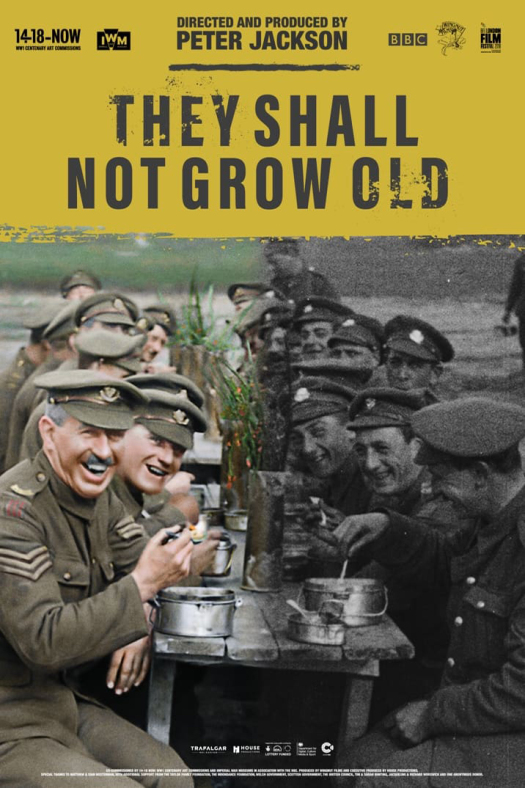
Living History: Peter Jackson’s THEY SHALL NOT GROW OLD (Warner Brothers 2018)


gary loggins's avatarcracked rear viewer

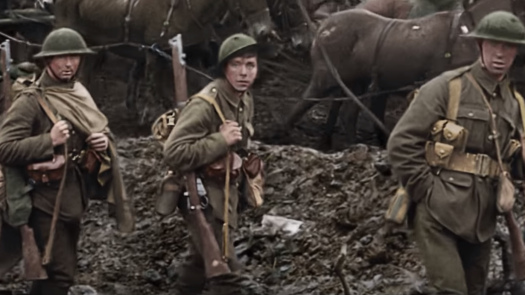
If you like history as much as old movies, Oscar-winning New Zealander Peter Jackson has a treat for you – THEY SHALL NOT GROW OLD, a World War I documentary utilizing 100+ year old footage from the Imperial War Museum (most of it never viewed outside there) to tell the story of the British Empire’s infantry during The Great War. Jackson was given access to hundreds of hours of actual film and audio and commissioned to create something “unique and original”, and with the aid of modern technology he certainly succeeded in his mission.

Jackson’s narrative is told through the eyes of the young men and boys (some as young as 15) as they go through enlistment and boot camp, training to kill the enemy, then follows them to the Western Front, where they encountered not only battles in the trenches, but dysentery, rats gnawing at their fallen comrades, lice…

View original post 343 more words

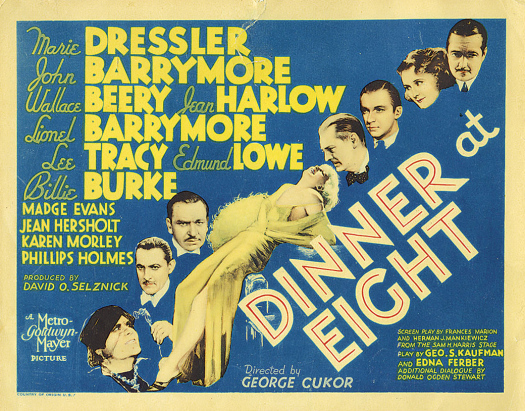
Pre Code Confidential #25: The Stars Are Out for a Delicious DINNER AT EIGHT (MGM 1933)


gary loggins's avatarcracked rear viewer

After the success of 1932’s all-star GRAND HOTEL, MGM studio boss Louis B. Mayer kept his sharp eyes peeled for a follow-up vehicle. The answer came with DINNER AT EIGHT, based on the witty Broadway smash written by George S. Kaufman and Edna Ferber. Mayer assigned his newest producer (and son-in-law) David O. Selznick, fresh from making hits at RKO, who in turn handed the director’s reigns to another MGM newcomer, George Cukor. Both would have long, prosperous careers there and elsewhere. Frances Marion and Herman Mankiewicz adapted the play to the screen for the studio with “more stars than there are in heaven”, and those stars truly shine in this film (in the interest of fairness, the stars will be presented to you alphabetically):

John Barrymoreas Larry Renault 

The Great Profile plays aging, alcoholic former silent star Larry Renault in a role that surely hit close to home. 

View original post 929 more words

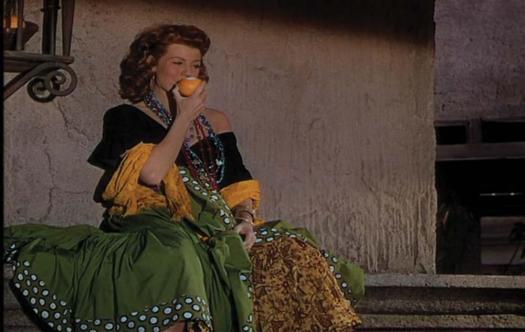
Dark Valentine: THE LOVES OF CARMEN (Columbia 1948)


gary loggins's avatarcracked rear viewer


Love takes many strange forms, none more strange than the obsessive love Don Jose has for the Gypsy temptress Carmen in THE LOVES OF CARMEN, Columbia Pictures’ biggest hit of 1948. The film, based on Prosper Merimee’s 1845 novella and Georges Bizet’s famous opera, reunites GILDA stars Rita Hayworth and Glenn Ford with director Charles Vidor, and though it’s in glorious Technicolor and set in 1800’s Spain, it’s got a lot of film noir elements going for it: there’s the protagonist caught in a rapidly moving downward spiral, the amoral femme fatale, crime, murder, and a bleak, downbeat ending. Think I’m stretching a bit? Let’s take a look…

Young nobleman Don Jose arrives in Seville with a dragoon squadron, a corporal with political ambitions and a bright future ahead of him… until he meets Carmen, a gorgeous red-haired Gypsy who is an expert manipulator. Jose is enchanted by this free-spirited…

View original post 623 more words

Film Review: The Fall of the Roman Empire (dir by Anthony Mann)


Why did the Roman Empire fall?

Well, historically, there were several reasons but they can all basically be boiled down to the fact that the Empire got too big to manage and that having two separate capitols certainly didn’t help matters.  The Empire got so large and overextended that the once fabled Roman army was no match for the barbarians.

Of course, if you’ve ever watched a movie about the Roman period, you know exactly why the Empire fell.  It all had to do with decadence, gladiators, human sacrifices, and crazed emperors with unfortunate names like Caligula and Commodus.  The Roman Empire fell because the imperial government descended into soap opera, complete with love triangles, betrayals, and whispered plotting inside the Senate.

Another thing that we’ve learned from the movies is that the fall of the Roman Empire was damn entertaining.  Between the orgies and the men wearing those weird helmets with the brushes on top of them, there’s nothing more fun that watching the Roman Empire fall.

Case in point: the 1964 film, The Fall of the Roman Empire.

This three and a half hour epic begins with the last of the good Roman emperors, Marcus Aurelius (Alec Guiness), battling to keep the Germanic barbarians from invading the empire.  Marcus is a wise man and a great leader but he knows that his time is coming to an end and he needs to name a successor.  His daughter, Lucilla (Sophia Loren), is an intelligent and compassionate philosopher but, on the basis of her sex, is not eligible to succeed him.  His son, Commodus (Christopher Plummer), may be a great and charismatic warrior but he’s also immature and given to instability.  Marcus’s most trusted adviser, Timonides (James Mason), would never be accepted as a successor because of his Greek birth and background as a former slave.  (Add to that, Timonides is secretly a Christian.)

That leaves Livius (Stephen Boyd).  Livius is one of Marcus’s generals, a man who is not only renowned for his honesty and integrity but one who is also close to the royal family.  Not only is he a former lover of Lucilla’s but he’s also been a longtime friend to Commodus.  Unfortunately, before Marcus can officially name Livius as his heir, the emperor is poisoned.  Commodus is named emperor and things quickly go downhill.  Whereas Marcus ruled with wisdom and compassion, Commodus is a tyrant who crushes anyone who he views as being a potential threat.  Lucilla is married off to a distant king (Omar Sharif).  Timonides is declared an enemy after he suggests that the conquered Germans should be allowed to peacefully farm on Italian land.  Rebellion starts to ferment in every corner of the Empire and Livius finds himself trapped in the middle.  Which side will he join?

Despite all the drama, Commodus is not necessarily an unpopular emperor.  One of the more interesting things about The Fall of the Roman Empire is that Commodus’s popularity grows with his insanity.  The crueler that he is, the more the people seem to love him.  Soon, Commodus is fighting as a gladiator and having people burned at the stake.  While some Romans are horrified, many more love their emperor no matter what.  People love power, regardless of what it’s used for.  Perhaps that’s the main lesson and the main warning that the final centuries of the Roman Empire have to give us.

The Fall of the Roman Empire is surprisingly intimate historical epic.  While there’s all the grandeur that one would normally expect to see in a film about the Roman Empire, the film works best when it concentrates on the characters.  While Boyd and Loren do their best with their thinly drawn roles, the film is stolen by great character actors like Alec Guinness, James Mason, and Christopher Plummer.  Plummer, in particular, seems to be having a blast playing the flamboyantly evil yet undeniably charismatic Commodus.  Even with the Empire collapsing around then, both Plummer as an actor and Commodus as a character seems to be having a blast.  Add to that, there’s all of the usual battles and ancient decadence that you would expect to find in a film about the Roman Empire and the end result is a truly enjoyable epic.

As I watched The Fall of the Roman Empire, it was hard for me not to compare the film to Ridley Scott’s Gladiator.  That’s because they’re both basically the same damn movie.  The main difference is that The Fall of the Roman Empire is far more entertaining.  The Fall of the Roman Empire, made in the days before CGI and featuring real people in the streets of Rome as opposed to animated cells, feels real in a way that Gladiator never does.  If Gladiator felt like a big-budget video game, The Fall of the Roman Empire feels like a trip in a time machine.  If I ever do go back to 180 A.D., I fully expect to discover James Mason giving a speech to the Roman Senate while Christopher Plummer struts his way through the gladiatorial arena.

Finally, to answer the question that started this review, why did the Roman Empire fall?

It was all Christopher Plummer’s fault, but at least he had a good time.

Film Review: The Last Days of Pompeii (dir by Ernest B. Schoedsack and Merian C. Cooper)


The summer after I graduated high school, I took a trip to Italy.

I absolutely loved it.  There’s nothing more wonderful than being 18 and irresponsible in one of the most beautiful and romantic countries in Europe.  I also loved it because everywhere I looked in Italy, I saw the remains of history.  When I was in Rome, I visited the Colosseum.  When I was in Southern Italy, I visited Comune di Melissa, the village where some of my ancestors once lived.  When I visited Florence, I became so overwhelmed by the beauty of it all that I nearly fainted.

And then there was Pompeii.  I spent a day visiting the ruins of Pompeii and it was an amazing experience.  The eruption of Mt. Vesuvius in 79 AD may have been horrific for the Romans but it’s also gave history nerds like me a chance to step right into the past.  Beyond just the thrill of seeing how the world once was, I have two main memories of Pompeii:

First, there was the visit to Pompeii’s brothel.  An Australian tourist lay down on one of the stone slabs so that his family could take pictures of him.

Secondly, there was the fact that I wore a really pretty red dress for my visit but I failed to take into account that 1) the area around Pompeii is very hilly and 2) it was a very windy day.  So, I can say that I’ve not only visited but I’ve flashed Pompeii as well.

The destruction of Pompeii has inspired several books and more than a few films, as well.  One of the earliest was the 1935 film, The Last Days of Pompeii.

The Last Days of Pompeii opens with Marcus (Preston Foster), an extremely bitter blacksmith who lives in the bustling city of Pompeii.  Marcus is bitter because he’s not rich and his family has been just been run down by some jackass in a chariot.  Marcus does find brief fame as a gladiator but he’s stricken with guilt after he kills a man and then discovers that he’s made an orphan out of the man’s son.  Marcus adopts young Flavius, just to then discover that the boy is seriously ill.  A fortune teller informs Marcus that Flavius will be healed by “the greatest man in Judea.”  Marcus naturally assumes that this is a reference to the Roman governor, Pontius Pilate (Basil Rathbone).  However, upon traveling to Judea, Marcus meets a different great man and then watches as his adopted son is healed.

Jump forward about two decades.  Marcus is now a rich man and is in charge of Pompeii’s gladiatorial games.  Flavius (now played by John Wood) has grown up to be an idealistic young man who barely remembers the day that he was healed. What Marcus doesn’t know is that Flavius has been helping slaves escape from Pompeii.  When Flavius is arrested, it appears that Marcus is doomed to watch his own son be killed in the arena.

But wait a minute — what’s that coming down the mountain?  It’s kinda smoky and red and it looks like it might be really hot and …. oh damn.

Now, there’s two problems here.  First off, from a historical point of view, the film’s timeline doesn’t work out.  Jesus was crucified in 33 AD.  Pompeii was destroyed 46 yeas later, in 79 AD.  Therefore, there’s no way that Flavius should only be in his early 20s.  Secondly, just the fact that the film takes place in Pompeii pretty much gives away the ending before the story even begins.  Since you know that the volcano is eventually going to kill everyone, it’s hard to get too caught up in any of the drama.  You just find yourself sitting there and going, “When isssssssssss the volcano going to eeeeeeeeeeeeerupt!?”

On the plus side, Preston Foster is one of the more underrated of the Golden Age stars and he does a pretty good job here.  Plus, you have to love any film that features Basil Rathbone as a semi-decadent Roman.  Rathbone plays Pilate as both a bored libertine and a guilt-stricken convert and, both times, he’s impressive.

Despite being directed by the team behind the original King Kong, The Last Days of Pompeii is a bit slow but, if you’re specifically a fan of old sword-and-sandal epics, it’s entertaining enough.  See it for Foster, Rathbone, and the ghosts of old Pompeii.

Lisa Reviews An Oscar Nominee: Quo Vadis (dir by Mervyn LeRoy)


The 1951 best picture nominee, Quo Vadis, is actually two movies in one.

The first movie is a rather stolid historical epic about life in ancient Rome.  The handsome but kind of dull Robert Taylor plays Marcus Vinincius, a Roman military officer who, after serving in Germany and Britain, returns to Rome and promptly falls in love with the virtuous Lygia (Deborah Kerr).  Complicating Marcus and Lygia’s relationship is the fact that Lygia is a devout Christian and a friend to Peter (Finlay Currie) and Paul (Abraham Sofaer).

Marcus’s uncle, meanwhile, is Petronius (Leo Genn), a government official who has a reputation for being a bon vivant.  In real-life, Petronius is believed to have been the author of the notoriously raunchy Satyricon.  You would never guess that from the way that Petronius is portrayed in Quo Vadis.  We’re continually told that Petronius is a notorious libertine but we don’t see much evidence of that, beyond the fact that he lives in a big palace and he has several slaves.  In fact, Petronius even falls in love with one of his slaves, Eunice (Marina Berti).

The second movie, which feels like it’s taking in a totally different cinematic universe from the adventures of Marcus and Lygia, deals with all of the intrigue in Nero’s court.  Nero (Peter Ustinov) is a giggling madman who dreams of rebuilding Rome in his image and who responds to almost every development by singing a terrible song about it.  Nero surrounds himself with sycophants who continually tell him that his every idea is brilliant but not even they can resist the temptation to roll their eyes whenever Nero grabs his lyre and starts to recite a terrible poem.  Nero is married to the beautiful but evil Poppaea (Patricia Laffan) and there’s nothing that they love more than going to the arena and watching people get eaten by lions.  It disturbs Nero when people sing before being eaten.  “They’re singing,” he says, his voice filled with shock an awe.

It’s difficult to describe just how different Ustinov’s performance is from everyone else’s in the film.  Whereas Taylor and even the usually dependable Deborah Kerr are stuck playing thin characters and often seem to be intimidated by playing such devout characters, Ustinov joyfully chews on every piece of scenery that he can get his hands on.  Nero may be the film’s villain but Ustinov gives a performance that feels more like it belongs in a silent comedy than a biblical epic.  Ustinov bulges his eyes.  He runs around the palace like he forgot to take his Adderall.  While Rome burns, Nero grins like a child who has finally figured out a way to outsmart his parents.  “You won’t give me more money?  I’ll just burn down the city!”

And the thing is — it all works.  The contrast between Ustinov and the rest of the characters should doom this film but, instead, it works brilliantly.  Whenever Ustinov’s performance gets to be too much, Robert Taylor and Leo Genn pop up and ground things.  Whenever things start to get too grounded, Ustinov throws everything back up in the air.  The conflict between the early Christians and the Roman Empire is perfectly epitomized in the contrast between Robert Taylor and Peter Ustinov.  It makes for a film that is entertaining almost despite itself.

Quo Vadis was nominated for best picture but lost to An American In Paris.

Film Review: Simon of the Desert (dir by Luis Bunuel)


1965’s Simon of the Desert opens deep in the Syrian desert, where a man named Simon (played by Claudio Brook) stands atop a column.  He’s spent 6 years, 6 weeks, and 6 days at the top of that column.  Simon spends his days praying, not only for himself but also the world.  We’re told that he’s the son of St. Simeon Stylites, who spent 37 years atop a small column outside of Aleppo.

(Of course, St. Simeon died in 459 and Simon appears to be living in the 19th century so maybe Simon has been misinformed.)

Sometimes, people gather around the column and beg Simon to perform a miracle.  Strangely, when Simon does what they want and heals an amputee, no one is particularly impressed or grateful.  Occasionally, priests gather around the pole and offer to make Simon one of them.  Simon, however, always refuses.  He’s not worthy, he says.  Plus, he feels that the local priest is a bit too vain.

What quickly becomes obvious is that, while Simon is a man of great faith, he’s also a bit of a self-righteous jerk.  Simon is quick to pass judgment on those who come to stare at him but, at the same time, one gets the feeling that he would equally offended if nobody stared.  Simon may claim that standing on the column has brought him closer to God but, over the course of the film, it’s only the devil (played by Silvia Pinal) who comes to visit him.

In order to taunt and tempt Simon, Satan takes on different forms.  At one point, she appears as a teenage girl skipping across the desert.  At another point, she appears as Jesus.  Towards the end of the film, she rides a coffin across the desert.  Simon proves to be stubborn in his faith, or at least he is until Satan offers him a glimpse of his future and the film’s present….

Directed by the Mexican surrealist Luis Bunuel, Simon of the Desert is a 45-minute look at faith, stupidity, and rock music.  (That’ll make sense if you watch the film.  It’s on YouTube.)  An outspoken atheist, Bunuel goes beyond merely criticizing organized religion and instead further suggests that Simon is an idiot for spending six years praying to a God who doesn’t care about him.  Bunuel does not even allow Simon to reach the status of “holy fool.”  Instead, Simon is portrayed as being just a fool.

Not surprisingly for a Bunuel film, Simon of the Desert is full of striking images, from that coffin moving across the desert to Simon standing atop the column and waiting for some sort of sign.  Claudio Brook and Silvia Pinal both give great performances and have enough chemistry that you can’t help but suspect that Simon and Satan might secretly be in love with each other.  The film ends on a properly surreal note, one that suggests that the all the contemplation of the world cannot bring a stop to the inevitable dance of death.

Dream-like and sharply satiric, Simon of the Desert is a film that you won’t forget.

Lisa Reviews An Oscar Nominee: Ivanhoe (dir by Richard Thorpe)


Welcome to England in the 12th century!

That’s the setting of the 1952 best picture nominee, Ivanhoe.  It’s a green and healthy land, full of chivalrous knights and corrupt royalty and outlaws who steal from the rich and give to the poor.  King Richard the Lion Heart (Norman Wooland) left on a crusade and he hasn’t been seen for a while.  Richard’s evil brother, the cowardly King John (Guy Rolfe), rules the country and has little interest in making sure that Richard returns.  Even when Wilfred of Ivanhoe (Robert Taylor) discovers that Richard is being held for ransom, John declines to do anything about it.

Ivanhoe is determined to raise the money to pay the ransom and restore Richard to the throne of England, even if he has to secretly compete in a tournament to do it.  Of course, before he can do that, he’ll have to buy a horse and some armor.  Fortunately, he comes across Isaac (Felix Aylmer) and his daughter, Rebecca (Elizabeth Taylor).  Isaac and Rebecca give Ivanhoe the money necessary to purchase a good horse and equipment.  Rebecca falls in love with Ivanoe, despite the fact that Ivanhoe is in love with Rowena (Joan Fontaine, who spends most of the movie looking rather bored).

Speaking of love, the king’s favorite knight — the hot-headed but honorable Sir Brian De Bois-Guilbert (George Sanders) — has fallen in love with Rebecca.  That, of course, complicates matters when the anti-Semitic King John attempts to have the Jewish Rebecca burned at the stake for witchcraft.  When Ivanhoe invokes the “wager of challenge,” in an effort to save Rebecca’s life, Sir Brian is chosen as the court’s champion.  Needless to say, this leads to some awkward moments….

Listen, I would be lying if I said that it was easy for me to follow the plot of Ivanhoe.  It seemed like every few minutes, someone else was plotting against either Ivanoe or King John and it got a bit difficult to keep track of what exactly everyone was trying to accomplish.  By the time Robin Hood (Harold Warrender) showed up, I have given up trying to make sense of the plot.

Instead of worrying about the exact details of the plot, I decided to just enjoy the film as a spectacle.  If nothing else, Ivanhoe is gorgeous to look at.  The colors are lush and full and the costumes and the sets are all wonderfully ornate.  Apparently, 12 Century England was a very colorful place.  There’s a lot of battles and jousts and sword fights.  I couldn’t always keep track of who was fighting who but at least the film moved at a steady pace.

Robert Taylor and Joan Fontaine make for a dull leading couple but a young Elizabeth Taylor is stunning in the role of Rebecca and George Sanders transforms Sir Brian into a truly tragic figure.  Guy Rolfe is memorably evil as King John, though he’s perhaps not as much fun as Oscar Isaac was in Robin Hood.  Everyone in the movie looks good in their period costuming.  Really, that’s the most important thing.

Ivanhoe was nominated for Best Picture but lost to The Greatest Show On Earth.

Film Review: Westworld (dir by Michael Crichton)


“Draw,” says Yul Brynner.

“Whatever,” says a tourist who has spent a lot of money to spend their vacation at the Delos amusement park.

BANG!  Down goes the tourist, as the robot revolution of 1983 begins.

Recently, TCM broadcast the 1973 science fiction thriller, Westworld.  Since I am absolutely obsessed with the more recent HBO revival, there was no way I could resist watching the original film.  It was an interesting experience.  While the film is far more simpler and straight-forward than the television series, they both essentially tell the same story.  A bunch of rich humans pay a lot of money to pretend to be either cowboys or knights or Roman citizens for a week.  Everyone has a great time until, eventually, the robots stop doing what they were supposed to do and instead, begin to fight back.

One thing that the movie and the series definitely shared is a less-than-positive view of humanity.  The movie focuses on two businessmen.  Peter (Richard Benjamin) is the nerdy one.  John (James Brolin) is the hypermasculine one.  Peter is visiting Westworld for the first time.  John is a frequent guest who loves gunning down any robots who looks at him the wrong way.  Neither one of these characters is particularly likable.  Peter starts out as a self-righteous hypocrite who ends up sleeping with a sexbot, despite being married.  John brags about how easy it is to kill the robots, mostly because the robot’s are programmed to not fight back.

Meanwhile, the human engineers who work behind-the-scenes and keep Delos running are all blandly incompetent.  When the robots start to malfunction, the engineers can only shrug and wonder why.  They’re so ineffective that, halfway through the movie, they get sealed up in their own control room, slowly suffocating to death while the park collapses around them.

As opposed to the TV series, the robots in Westworld never achieve any sort of real consciousness.  Even when they malfunction, it doesn’t lead to a true rebellion as much as it just causes them to ignore any previous directives about killing the guests.  When the Gunslinger (Yul Brynner) starts stalking Peter and John across the park, it’s not an act of ideology or, for that matter, even revenge.  It’s simply that the Gunslinger has been programmed to be a killer and this is what a killer does.

It all leads to an extended chase sequence involving the Gunslinger and Peter and, despite the fact that it doesn’t have much of a personality, it’s hard not to be on The Gunslinger’s side.  If nothing else, the Gunslinger is at least good at what it does.  Peter, on the other hand, is perhaps one of the most incompetent heroes to ever show up in a movie.  After spending the first half of the movie being smug and dealing with robots programmed not to fight back, Peter now has to try to win on an even playing field.

Westworld was the directorial debut of writer Michael Crichton.  The film’s flaws are largely the flaws that you would expect from a first-time director.  Occasionally, the pacing falters and the first half of the film sometimes moves a bit too slowly.  (There’s one saloon fight that seems to go on forever.)  During the first half of the film, there’s several scenes involving another tourist (played by Dick Van Patten) who seems like he’s going to play a major role in the film but, after the first hour, the character literally vanishes from the film.

Despite those flaws, Westworld remains an exciting mix of suspense and science fiction.  Though his actual screentime is rather limited, Yul Brynner easily dominates the entire film.  In the role of the Gunslinger, Brynner is a relentless killing machine.  What makes the character especially disturbing is that Brynner plays him without a hint of emotion or expression.  The Gunslinger gets no pleasure out of killing nor does he seek to accomplish any sort of identifiable goal.  The Gunslinger simply kills because that’s what he was programmed to do.

While I prefer the HBO series, the original Westworld is still an exciting and entertaining film, one that probably seems a lot more plausible today than when it was first released 46 years ago.  Watch it the next time your home robot gets bored.