Though they’re not quite as ever-present as people up north seem to assume, rodeos are still a pretty big deal down here in the Southwest. Now, I have to admit that I have mixed feelings about the rodeo, largely due to the fact that I spent the early part of my life constantly moving from the city to the country to the city and then back to the country again. The city girl side of me looks at the rodeo and says, “That’s a silly tradition that’s dangerous to both the animals and the participants and there’s no way that I would ever let any future child of mine have anything to do with it.” However, the country girl side of me hears the words “rodeo,” and shouts, “Hell yeah!” Seriously, there’s nothing more exciting than watching a handsome cowboy try to ride a bull without getting killed.
And believe me, rodeos can be dangerous. There’s an episode of King of the Hill in which Hank and Peggy take Bobby to the rodeo and Peggy mentions that one of her relatives was sent home from Vietnam because he was having rodeo nightmares. I could believe it. Rodeos are not petting zoos, despite what some people may think. Bulls and broncos can be dangerous when they’re angry and a rodeo clown can only provide so much protection. In fact, there’s some towns that have actually considered baning the rodeo.
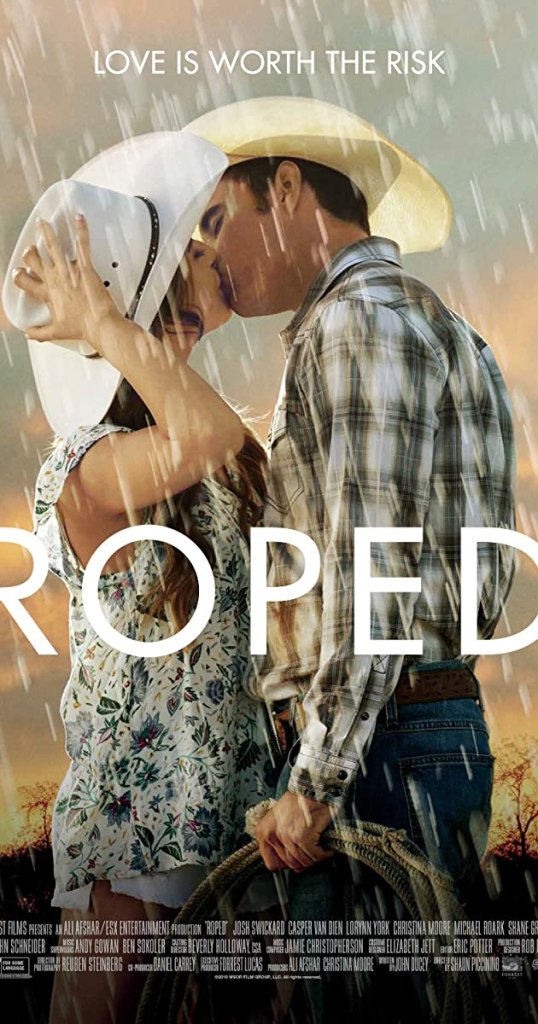
Roped takes place in one such town. City councilman Robert Peterson (Casper Van Dien) doesn’t want the rodeo coming anywhere near his home. He argues that the rodeo is unfair to animals and that it corrupts the youth. It’s kind of like Footloose, except instead of banning dancing, the councilman wants to ban a rather foul-smelling carnival in which people are occasionally killed.
Of course, what the councilman doesn’t know is that his own teenage daughter, Tracy (played by Lorynn York) is falling in love with a rodeo cowboy! Colton Burtenshaw (Josh Swickard) is a up-and-coming star on the rodeo circuit and it’s pretty much love at first sight as soon as he and Tracy meet. Of course, this means that Tracy is going to have to defy her father and Colton’s going to have to prove that the rodeo isn’t as bad as everyone thinks that it is. It’s time for laughs, tragedy, love, and sheep. Yes, you read that right.
Anyway, you can probably guess everything that happens in Roped. This is a low-budget movie that’s designed for the “I wish they still made movies like they used to do” crowd and, for what it is, it’s not that bad. It’s hardly a great or even a memorable film but it gets the job done and it’ll appeal to people who have nostalgic memories of the rodeo. There’s not an edgy moment to be found in the film but people looking for edgy movies probably won’t be watching Roped in the first place. It’s a nice-looking film and Lorynn York and Josh Swickard make for a cute couple, in both the film and real life. (York and Scwickard married shortly after making this movie.) Plus — hey, Casper Van Dien’s in the movie! Van Dien’s always fun to watch, especially when he’s playing a well-meaning but misguided authority figure.
As I wrap up this review, one final word about the rodeo: it’s pronounced “roe-dee-oh.” Don’t come down here and say you want to see a “ro-day-oh.” Those clowns can turn on you quickly.
The Trial of the Chicago 7, the latest film from Aaron Sorkin, is a fairly mediocre and rather forgettable film. Because of that mediocrity, it stands a pretty good chance of doing very well at the Oscars later this year.
Aaron Sorkin specializes in political fan fiction. He writes plays, movies and television shows that address big and controversial issues in the most safely liberal way possible. Whenever Sorkin writes about politics, there’s not a single debate that can’t be won by one long, overdramatic speech, preferably delivered in an office or a conference room while everyone who disagrees nervously stares at the ground, aware that they’ll never be able to match the rhetorical brilliance of their opponents. It’s a rather dishonest way to portray the ideological divide but it’s one that’s beloved by people who want to be political without actually having to do much thinking. Sorkin is the poet laureate of the keyboard activists, the people who brag about how their cleverly-worded tweets “totally owned the MyPillow guy.” (One sure sign of a keyboard activist is the excessive pride over rhetorically owning people who are ludicrously easy to own. These are the people who think that Tom Arnold arguing about the electoral college with Kirstie Alley is the modern-day equivalent of the Lincoln/Douglas debates.)
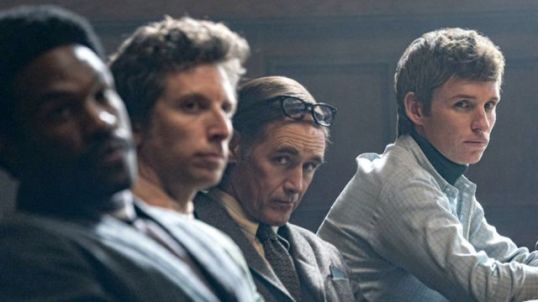
The Trial of the Chicago 7, which Sorkin not only wrote but also directed, deals with a real-life event, the 1969 trial of eight political activists who were charged with conspiracy and crossing state lines with the intention of inciting riots at the 1968 Democratic National Convention in Chicago. (Black Panther Bobby Seale was ultimately tried separately from the other defendants, leading to the Chicago 8 becoming the Chicago 7.) Sacha Baron Cohen plays Abbie Hoffman, the fun-loving activist who delights in upsetting the establishment. Eddie Redmayne played Tom Hayden, who takes himself and his activism very seriously and who worries that Hoffman’s antics in the courtroom are going to discredit progressives for generations to come. Hoffman ridicules Hayden for being a rich boy who is rebelling against his father. Hayden attacks Hoffman for not thinking about how his actions are going to be perceived by the rest of America. Sorkin the screenwriter is clearly on Hayden’s side while Sorkin the director keeps finding himself drawn to Hoffman, if just because Hoffman is the more entertaining character. Hoffman gets to make jokes while Hayden has to spend the entire film with a somewhat constipated expression on his face.
As is typical of Sorkin’s political work, the film raises issues without really exploring them. We learn that the defendants were all arrested during anti-war protests but the film never really explores why they’re against the war. It’s mentioned that David Dellinger (John Carroll Lynch) is a pacifist who even refused to fight in World War II but at no point do we learn what led to him becoming a pacifist. When Hoffman and Jerry Rubin (Jeremy Strong) talk about how they feel that the government holds people like them in contempt and that they shouldn’t have to fight in a war that they don’t believe in, Sorkin’s script has them speak in the type of simplistic platitudes that could just as easily have been uttered by a MAGA supporter talking about the war in Afghanistan. If all you knew about these men was what you learned in this film, you would never know that Hayden, Hoffman, and the rest of the Chicago 7 were activists both before and after the Vietnam War. You’d never know that there was more to their ideology than just opposition to the Vietnam War. The film never really digs into anyone’s beliefs and motivations. Instead, everyone might as well just have “Good” or “Evil” stamped on their forehead.
Sorkin’s simplistic approach is most obvious when it comes to Bobby Seale (Yahya Abdul-Mateen II). With Seale, the film is more interested in how other react to him than in the man himself or his activism. The film’s most shocking moment — when Judge Hoffman (Frank Langella) orders Seale to be literally bound and gagged in the courtroom — actually did happen but the film mostly seems to use it as an opportunity to show that even the lead prosecutor (played by Joseph Gordon-Levitt) is disgusted by the government’s heavy-handedness. Seale and the Black Panthers are used more as symbols than as actual characters.
Since this is an Aaron Sorkin film, the action is male-dominated. It’s justified as the Chicago 7 and their lawyers were all men. Still, it’s hard not to notice that the only prominent female characters are an undercover cop who betrays the protestors and a receptionist who is frequently reprimanded by the men in the film. One black woman in a maid’s uniform does get a chance to reprimand Hayden for not speaking out when Bobby Seale was gagged but she’s never even given a name. As often happens with women of color in films like this, she’s only there to remind the white heroes to do the right thing.
Watching The Trial of the Chicago 7, I found myself thinking about how lucky Aaron Sorkin was to get David Fincher as the director of The Social Network. A smart director with a strong and unique style, Fincher was able to temper Sorkin’s tendency toward pompousness. Unfortunately, as a director, Aaron Sorkin is no David Fincher. While Sorkin has definitely established his own style as a writer, he directs like someone who learned how to stage a crowd-pleasing moment from watching Spielberg but who, at the same time, never noticed the sense of playfulness that Spielberg, especially early in his career, infused within the best of those scenes. It’s all soaring rhetoric and dramatic reaction shots and cues to let us know when we’re supposed to applaud. As a director, Sorkin never challenges the audience or lets the film truly come to any sort of spontaneous life. Instead, he adopts a somewhat cumbersome flashback-laden approach. The story never quite comes alive in the way that the similar courtroom drama Mangrove did. It’s all very safe, which is one reason why I imagine The Trial of the Chicago 7 is as popular as it is. It’s a film that allows the viewers to celebrate the fantasy of activism without having to deal with the messy reality of all the complications that come along with taking an actual stand. It’s a film that encourages you to pat yourself on the back for simply having watched and agreeing that people have the right to protest.
I will say that Sorkin made some good casting choices. Langella is memorably nasty of the judge and Joseph Gordon-Levitt does a good job as the prosecutor. Eddie Redmaye is a bit of a drag as Tom Hayden but Alex Sharp is likable as Hayden’s friend, Rennie Davis. Michael Keaton has an effective cameo as Ramsey Clark. The film presents Clark as being a bit of a wise liberal and the film’s epilogue doesn’t mention that Clark went on to a lucrative career of providing legal aide to murderous dictators and anti-Semites. (Lyndon LaRouche was one prominent Ramsey Clark client.)
The Trial of the Chicago 7 will probably do well come Oscar-time. In many ways, it almost feels like a generic Oscar movie. It’s about a historical event, it’s political without being radical, and it presents itself as being far more thoughtful than it actually is. That’s been a winning combo for many films over the years.
This is a film that I think a lot of people expected to be an Oscar contender because it was directed by industry favorite Ron Howard, it was based on a genuinely moving best seller, and the cast included Amy Adams and Glenn Close, two actresses who are more than overdue for their first Academy Award. I don’t think anyone expected it to win much, largely because Ron Howard isn’t exactly the most groundbreaking director working in Hollywood, but it was still expected to be contender.
Even before it was released, there were a few signs that Hillbilly Elegy might not be the award-winning film that some were expecting. The first images from the film featured Glenn Close and Amy Adams looking like characters from some sort of ill-conceived SNL sketch. Then the trailer came out and it was so obviously Oscar bait-y and heavy handed that it was hard not to suspect that the film was trying just a bit too hard. By the time the film itself finally premiered in November, I think a lot of people were specifically waiting for their chance to skewer it.
Make no mistake about it, Hillbilly Elegy deserves a certain amount of skewering. Its a bit of a tonal mess and, far too often, it feels as if Ron Howard is inviting us to gawk at the film’s characters as opposed to showing them any sort of real empathy. Those critics who have claimed that the film occasionally feels like “poverty porn” have a point.
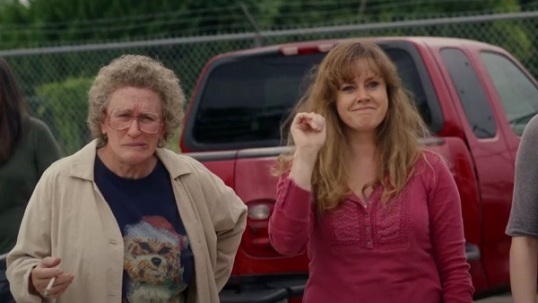
And yet, despite all of those legitimate complaints, I would argue that the film is partially redeemed by the performance of Glenn Close. Close plays Meemaw, who always seems to be carrying a lit cigarette and who has no hesitation about threating to beat the Hell out of her children and her grandchildren. Meemaw lives in a cluttered house that probably reeks of smoke. The TV is almost always on. Meemaw is a fan of Arnold Schwarzenegger. If you’ve ever wanted to hear Glenn Close say, “Hasta la vista, baby,” this is the film for you. Meemaw is a somewhat frightening character (during one flashback, she sets her drunk husband on fire) but she’s also the most caring character in the film. When it becomes obvious that her drug addict daughter, Bev (Amy Adams), is incapable of taking care of J.D. (played by Owen Aszatlos as a teen and Gabriel Basso as an adult), Meemaw essentially kidnaps J.D. and take him home with her. Close’s performance is undeniably theatrical but it works. She communicates that underneath all the bluster and the profanity and the anger and the cigarette smoke, Meemaw truly does love her family. Glenn Close transcends the film’s flaws and brings some real heart to the story.
Hillbilly Elegy opens with J.D. as a student at Yale Law School, hoping to get accepted for a prestigious summer internship. Meanwhile, all the other Ivy Leaguers treat J.D. like some sort of alien on display because he’s originally from Kentucky, he served in the army, and he went to a state school. Though ambitious and intelligent, J.D. still feels likes an outsider. When he goes to a banquet and discovers that he’ll be required to use different forks throughout the meal, he calls his girlfriend (Frieda Pinto) and gets a quick lesson on which fork to use when.
Unfortunately, before the meal even starts, J.D. gets a call from his sister, Lindsay (Haley Bennett), telling him that Bev has overdosed on heroin and is at the hospital. J.D. has to drive all the way to Ohio so that he can try to get his mother into a drug rehab. Because Bev doesn’t have medical insurance and would rather just stay with her good-for-nothing boyfriend, that turns out to be a bit more difficult than J.D. was anticipating. The film becomes a race against time to see if J.D. can get his mom taken care of and still make it back to Connecticut so that he can interview for a prestigious internship. Along the way, there are frequent flashbacks to Meemaw telling the young J.D. that he can be something better than just a hillbilly. All he has to do is try and not give up.
By structuring his film as a series of flashbacks, Ron Howard ensures that there’s really not any suspense about whether or not J.D. is going to be able to escape from Appalachia. Since we’ve already seen that the adult J.D. is going to be end up going to Yale, it’s hard to get worried when we see the teen J.D. smoking weed and hanging out with a bunch of losers. We know that J.D. is going to get over his adolescent rebellion and get his life straightened out. The film tries to create some tension about whether or not J.D. is going to be able to make his internship interview but, again, J.D. is going to Yale and living with Frieda Pinto. From the minute we see J.D., we know that he’s going to be just fine regardless of whether he gets that internship or not. In fact, his constant worrying about missing his interview starts to feel a bit icky. While Bev is dealing with her heroin addiction, Ron Howard is focusing on J.D. driving back to Connecticut as if the audience is supposed to be saying, “Oh my God, has he at least reached New Jersey yet!?” This is the type of storytelling choice that could only have been made by a very wealthy and very comfortable director. It reminded me a bit of The Post and Steve Spielberg’s conviction that, when it came to the decision to publish the Pentagon Papers, audiences would naturally be more interested in the owner of the newspaper than the people who actually did the work breaking the story. Here, Howard seems to be saying, “Yes, Bev might overdose and die having never reconciled with her son but the real tragedy is that J.D. might have to settle for his second choice as far as prestigious summer internships are concerned.”
Along with the story’s structural issues, the film also suffers because the usually wonderful Amy Adams is miscast as Bev. Adams acts up a storm as Bev but the performance itself a bit too obvious and on-the-surface. While Glenn Close disappears into the role of Meemaw, you never forget that you’re watching Amy Adams playing a character who is a bit more troubled than the usual Amy Adams role. You don’t think to yourself, “Oh my God, Bev is losing it.” Instead, you think, “Amy Adams sure is yelling a lot in this movie.” Somehow, Hillbilly Elegy makes Amy Adams feel inauthentic, which is something that, before I watched this film, I wouldn’t have believed to be be possible.
Aside from Glenn Close’s performance, Hillbilly Elegy doesn’t quite work and that’s a shame because I do think that a good film could have been made from Vance’s book. Unfortunately, Ron Howard doesn’t bring any sort of grittiness to the film’s depiction of what it’s like to be poor and forgotten in America. Instead, the film feels just a bit too slick. It attempts to be both a film about poverty and a crowd pleaser. When the movie should be showing empathy for its characters, it puts them on display. When it should be challenging the audience, it pats us on the back as if we should feel proud of ourselves merely because we spent two hours watching J.D. and his family. The film just doesn’t work. No wonder Meemaw prefers watching The Terminator.
As I watched David Fincher’s latest film, Mank, my main feeling was one of wanting to like the film more than I actually did.
I mean, really, the film sounds like it was specifically made to appeal to me. It’s a film about the Golden Age of Hollywood, which is an era that has always fascinated me as both a film lover and history nerd. Even more specifically, it’s a film about the writing of Citizen Kane, which is one of my favorite movies. (On one of our first dates, Jeff and I snuck into a showing of Citizen Kane at the Magnolia. The crime was fun and finally getting to see the movie on the big screen was even better.) It’s a film that features a host of historical figures, everyone from Louis B. Mayer to Irving Thalberg to Orson Welles to William Randolph Hearst to Marion Davies to the title character himself, the self-destructive screenwriter Herman J. Mankiewicz.
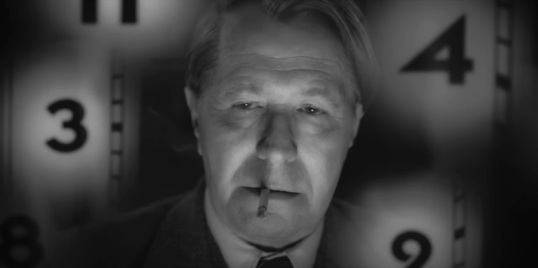
Those historical figures are played by a truly impressive collection of actors, almost all of whom give memorable performances. Gary Oldman plays Mankiewicz, lurching about Hollywood in a drunken haze and calling out the system while, somewhat hypocritically, also attempting to profit from it. Charles Dance is compellingly arrogant as William Randolph Hearst. Tom Burke captures Orson Welles’s trademark voice and charisma, making an impression despite having surprisingly little screen time. Ferdinand Kingsley plays Irving Thalberg and steals nearly every scene in which he appears. Arliss Howard is a marvel as the manipulate Mayer while Amanda Seyfried gives the best performance of her career so far as Marion Davies. The film portrays Davies as being intelligent, witty, and perhaps the only truly honest person in Hollywood. If it can be argued that Citizen Kane robbed Davies of her dignity, it can also be argued that Mank makes a sincere attempt to give it back to her. With the exception of a distracting cameo from Bill Nye (yes, the science guy), Mank is perfectly cast.
And yet, despite all of that, the film never really engaged me on either an emotional or an intellectual level. The black-and-white cinematography is gorgeous but the film plods from one incident to another, skipping back and forth in time and trying to convince us that Herman J. Mankiewicz was a more fascinating figure than he comes across as being. For the most part, Mankiewicz comes across as being a bit of a bore and the film makes the classic mistake of assuming that we’ll naturally like him just because he’s the main character. Gary Oldman is as charismatic as ever but the film doesn’t give him much of character to play. Mankiewicz stumbles from scene to scene, searching for a drink and always complaining about one thing or another. A little bit of Herman J. Mankiewicz goes a long way and, once it becomes apparent that he’s going to spend the entire film perpetually annoyed, Mankiewicz becomes a rather uninteresting character. Long before this film even reached the halfway mark, I was on the side of everyone who wanted Mankiewicz to stop talking and just finish writing the damn script.
If you’re one of the ten or so people who is still outraged over the failure of Upton Sinclair’s 1934 gubernatorial campaign, you’ll probably enjoy this film. For those of you haven’t read Greg Mitchell’s The Campaign of the Century: Upton Sinclair’s Race for Governor of California and the Birth of Media Politics, Upton Sinclair was a writer and longtime socialist activist who won the 1934 Democratic nomination to run for governor of California. Despite garnering a lot of national attention with his End Poverty In California (EPIC) platform, Sincliar was overwhelmingly defeated by Republican Frank Merriam. Mank argues that Sinclair’s defeat was largely due to dirty tricks and negative campaigning, most of it masterminded by Mayer and Hearst. Mankiewicz is a Sinclair supporter who is angered by the underhanded efforts of Mayer and Hearst. The script for Citizen Kane is, at least partially, Mankiewicz’s revenge on Hearst and Mayer for working against Sinclair and it’s something that Mankiewicz feels so strongly about that he’s willing to demand that Orson Welles give him credit for his work on the screenplay. It’s a legitimate theory, but the film’s exploration of it feels rather shallow and intellectually lazy. Just as it did with the character of Mankiewicz, the film makes the mistake of assuming the audiences will automatically find the candidacy of Upton Sinclair to be as inspiring as the film does. The film continually insists that we should care but, when it finally has a chance to show us why Upton Sinclair’s campaign was important, all it can provide is Bill Nye The Science Guy, standing on a platform and complaining about religious hypocrisy. It’s the cinematic equivalent of a casual acquaintance demanding to know why his twitter feed didn’t convince you to vote for Bernie Sanders.
From a historical point of view, the film does itself no favors by creating a fictional friend of Mankiewicz’s, one who is so consumed with guilt over his part in defeating Upton Sinclair that he ends up committing suicide. It feels rather cheap and predictable, an easy way to give Mankiewicz some sort of motivation beyond being infatuated with Marion Davies. Historically, the truth of the matter is that Frank Merriam turned to the left as soon as he was elected and Upton Sinclair went on to win the Pulitzer Prize for writing a series of now-unreadable books about an international do-gooder named Lanny Budd. Meanwhile, director Felix E. Feist (who was responsible for shooting many of the anti-Sinclair newsreels that MGM released into cinemas) went on to have a very long career and never indicated that he felt any guilty for playing a part in Sinclair’s defeat.
Like many of David Fincher’s film, Mank works best as an exercise in style. The black-and-white cinematography is to die for. Some of the shots — especially early in the film — are breathtaking. Mankiewicz may spend the majority of the film railing against the excesses of Hollywood but, visually, Fincher can’t get enough of them. Indeed, much as with The Social Network, Fincher seems to be spend the majority of the film at odds with the the film’s overwritten and rather pompous script. (Of course, Mank was written by Fincher’s late father while The Social Network was written by Aaron Sorkin. While there’s a lot to criticize about Jack Fincher’s script, one can still be thankful that he wrote the script instead of Sorkin. One can only imagine how Marion Davies would have been portrayed if Aaron Sorkin had been involved.) Mank is narratively deficient but visually stunning. The film’s script rather snarkily dismisses Orson Welles as being a mere “showman” but, as film, Mank proves that sometimes a showman is exactly what’s needed.
You have to feel a little bit bad for The Social Dilemma, a well-intentioned documentary that makes several good points but which runs into one huge problem. The documentary takes a look at social media and, more specifically, how society’s addiction to social media has led to a world where people are more divided, more angry, more anxious, and more volatile. Featuring interviews with the people worked for the companies and who created the social media sites that currently dominate our culture, The Social Dilemma shows how the algorithms that were initially designed to keep people clicking have now led to a world where everyone is living in their own separate reality. The film makes the case that this is not a good thing and that the heads of Twitter and Facebook are potentially more powerful than any world leader. Considering that the film was released months before the social media-directed riot at the capitol and Big Tech’s subsequent decision to ban President Trump (while, of course, continuing to allow both Chinese propaganda and the Ayatollah’s calls for the destruction of Israel), it’s hard not to feel that The Social Dilemma‘s case has been proven. It’s a prophetic film.
The problem, however, is that most people already know that social media is addictive and that it’s potentially harmful and that Google has way too much data on file about its users. Everyone already knows this. It’s just that most people don’t care. That’s the nature of addiction. Even though you know it’s probably going to kill you, you also know that there’s a good chance that you’re next fix might be the best feeling you’ve ever experienced.
I know that it’s not a coincidence that YouTube is always trying to get me to watch videos about kittens. I also know that it’s not a coincidence that, for several months last year, every internet ad that I saw was for lingerie. And yes, I guess it’s a little bit creepy that both YouTube and Facebook managed to figure out my political leanings, despite the fact that I hardly ever post anything political online. I would be outraged if I wasn’t so busy clicking on stuff. What’s that YouTube? There’s a video of two kittens at a meeting of libertarian Catholics and it ends with a La Perla ad? I’ll be right over. Just let me finish writing this review….
The Social Dilemma is full of interviews with people who once worked for companies and services like Google, Facebook, Twitter, and Instagram. Most of them wear the shell-shocked expressions of people who are still grappling with feelings of “My God, what have I done?” They discuss not only how the algorithms behind social media work but also how those algorithms eventually turned out to be more powerful and more destructive than any of their creators imagined. One former Facebook engineer discusses how “likes’ were originally viewed as being a way to encourage people to be positive but, instead, they quickly turned Facebook into a competition. One particularly sobering segment discusses how the social media boom also brought with it a surge of teenage girls going to the emergency room as a result harming themselves as their self-worth became linked to getting likes, retweets, hearts, shares, and all the rest. It’s a sobering film, though its impact is lessened by the decision to include some dramatizations involving a fictional family. The message of the film come through well enough via interviews without the film including scenes of Vincent Kartheiser literally playing a character named Artificial Intelligence. (That said, it’s always good to see Vincent Kartheiser in a film. He’s an actor who deserves to work more.)
To the film’s benefit, it acknowledges that giving up social media is not a realistic solution for most people. At this point, asking people to totally give up social media is the equivalent of asking someone to voluntarily cut themselves off from the world. (As one interviewee points out, social media manages to be both a utopia and a dystopia at the same time.) The documentary makes the argument that the Big Tech monopoly needs to be better regulated and perhaps broken up. (The film’s right but, considering how many former Silicon Valley executives and Big Tech lobbyists are going to be involved with the Biden administration, none of that’s not going to happen any time soon.) The film ends with a series of suggestions about how to use social media without allowing it to control or destroy your life. Most of them are common sense stuff — seek out opposing view points, don’t click on clickbait, don’t blindly retweet or share, do not give devices to children, turn off notifications, etc., etc. — and I’m happy to say that I do most of them.
That said, social media is addictive. I’ve tried to take breaks from twitter but it’s rare that I can ever go more than a day without checking. Seeing those mentions, seeing those likes, seeing those retweets; even after all these years, it’s still a rush. When I first started watching The Social Dilemma, I hopped on twitter just to let people know that I was watching the movie. When the movie ended, I checked to see if anyone had commented on the fact that I was watching it. That’s the world that we all live in right now.
And, as one interviewee says during The Social Dilemma, it could very well be the end of the world. What’s sad, though, is that most people are too busy looking at their phones and devices to even enjoy the ride.
For all of his skill as an actor, George Clooney is a remarkably mediocre director.
Yes, I know. Clooney was nominated for an Oscar for directing Good Night, and Good Luck but that film was honored more for what it was about than what it actually was. All of Clooney’s directorial efforts — from the Oscar-nominated to the Razzie-embraced — have suffered from two huge problems.
Number one, George Clooney can occasionally set up an interesting shot but he appears to have no idea how to create or maintain narrative momentum. His films tend to lay flat, with incidents piled on top of each other but you never get the feeling that there’s some sort of internal motor moving the action along. It’s not easy creating and maintaining a narrative flow but it’s something that all good film directors can do. It’s also something that Clooney has never managed to master. Instead, he seems to assume that his own good intentions and broader concerns will provide the film with whatever momentum it needs. Unfortunately, good intentions are not the same as storytelling talent and, as a director, Clooney rarely brings any of the nuance that’s makes him such a good actor. George Clooney could play Michael Clayton but he could never direct the film named for him.
This bring us to Clooney’s other problem as a director, which is that he approaches his films with this sort of dorky earnestness that feels incredibly old-fashioned. On the one hand, dorky earnestness can be a likable trait. On the other hand, when watching his directorial efforts, you do find yourself wondering if George Clooney has seen any films made after 1989. There’s nothing terribly subversive about George Clooney’s artistic vision. He’s not a director who takes you by surprise nor is he a director who is capable of making you look at the world in a different way. While other filmmakers are challenging preconceived notions and attempting to reinvent the cinematic language, Clooney is busy trying to revive live television productions and making the type of stolid films that haven’t been relevant since the end of the studio system. It’s a shame because, as an actor in films like Michael Clayton and Up In The Air, Clooney expertly revealed the insecurity that lurked underneath the seemingly perfectly façade of the seemingly successful alpha male. But as a director, he’s a third-rate Taylor Hackford. And while it’s true that not every director can be Martin Scorsese, is it too much to ask for a director who at least tries to do something unique or different? For someone who has enough money and international clout that he can basically get away with just about anything and who has worked multiple times with the Coen Brothers and Steven Soderbergh, Clooney is an oddly risk-adverse filmmaker.
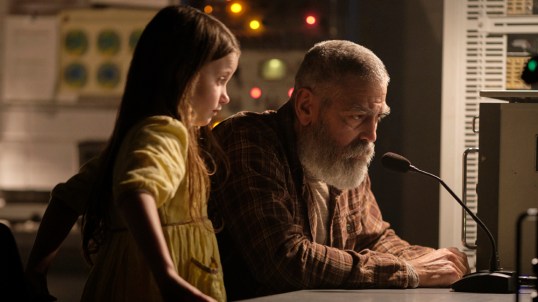
Unfortunately, all of Clooney’s directorial weaknesses are on display in The Midnight Sky, a rather slow science fiction film that would have made a good episode of The Twilight Zone but which falls flat as a movie. In this one, the world is ending and George Clooney is basically the last man left in the Arctic. Clooney is playing an astronomer who has spent his life searching for habitable planets and who is now dying of a terminal disease. He thinks he’s alone but then he comes across a mysterious girl named Iris. Iris rarely speaks and when she does speak, it’s to ask questions like, “Did you love her?” While Clooney is trying to figure where the little girl came from, he’s also trying to get in contact with a space mission so that he can warn them that the Earth is no longer inhabitable and they should relocate to one of Jupiter’s moon.
The space mission, meanwhile, is made up of Felicity Jones, David Oyelowo, Kyle Chandler, Demian Bircher, and Tiffany Boone. They’re stuck in space and trying to figure out why they can’t communicate with Earth. There’s a scene where their station gets bombarded by asteroids. The special effects are impressive (and this is a film that, despite being released on Netflix, really is meant to be viewed on a big screen) but during the whole scene, I was like, “Hey, it’s Gravity all over again!” Clooney never makes the familiar material his own. Instead, you find yourself thinking about all of the other sci-fi films that you’ve seen about the end of the world. Clooney doesn’t have the eccentricity of Alfonso Cuaron nor does he have the frustrating but intriguing megalomania of Christopher Nolan. Instead, he’s still same the director who thought that Edward R. Murrow was never more compelling than when he was complaining about people wanting to be entertained.
Lest anyone think that I’m going overboard in my criticism, allow me to say that The Midnight Sky isn’t really terrible as much as it’s just incredibly bland and forgettable. As I said before, the special effects are impressive. Clooney manages a few properly desolate shots of the Arctic, though making the Arctic look like the end of the world isn’t exactly the most difficult task in the world. As an actor, Clooney wears a beard in The Midnight Sky. Whenever the beard makes an appearance, you know that Clooney means for us to take him seriously and he gives an okay performance. He delivers his lines convincingly but his character is a bit dull and you can’t help but feel that Clooney the director wasted the talents of Clooney the actor. The film probably would have been improved if he and Kyle Chandler had switched roles.
The Midnight Sky didn’t really work for me. The end of the world should never be this boring.
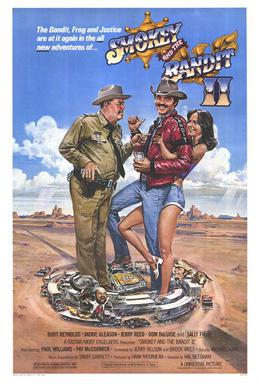
Smokey and the Bandit II (1980, directed by Hal Needham)
The gang’s all back in this sequel to Smokey and the Bandit! Burt Reynolds is the Bandit! Jackie Gleason is Sheriff Buford T. Justice and his two brothers, Reginald and Gaylord! Jerry Reed is Snowman! Sally Field is Carrie! Pat McCormick and Paul Williams are Big and Little Enos! Mike Henry is Junior! Dom DeLuise is an Italian doctor! Terry Bradshaw and Mean Joe Greene play themselves! There’s an elephant!
You get the idea. Smokey and the Bandit II promises more of the same. In some ways, it delivers. There are some entertaining stunts. The finale features what was, at the time, the biggest car chase ever filmed. But Smokey and the Bandit II fails at the most important part. It fails to recreate the fun of the first film. Everyone is just going through the motions. Burt Reynolds later said that he only made the film as a favor to Hal Needham while Sally Field said that she agreed to appear in the film as a favor to Burt Reynolds. Jackie Gleason did the movie because he needed the money but, because he was also in poor health, he requested that his scenes be filmed first and that they be filmed quickly. That the three stars didn’t have much enthusiasm for the project is obvious while watching the movie.
This time, Big Enos wants the Bandit to transport an elephant to the Republican National Convention in Dallas. The Bandit, however, has been an alcoholic wreck ever since Carrie left him to, for some reason, get back with Junior. Snowman manages to sober up the Bandit and, after they help Carrie run out on her wedding for a second time, it’s time to transport an elephant.
In hot pursuit, Sheriff Justice gets help from his brothers, all of whom are also played by Gleason. Reginald Justice is a Canadian Mountie who speaks with a posh accent that is in no way Canadian. Gaylord Justice is a flamboyant state patrolman. Whenever the brothers talk to each other, doubles are used. There are a few split screen shots that are so ineptly handled that it ends up looking like a page from a comic book with each Gleason standing in a separate panel. The end credits list Gaylord as having been played by “Ms. Jackie Gleason,” just in case you’re wondering the level of this film’s humor.
Dom DeLuise gets some laughs as an Italian doctor who is recruited to take care of the elephant but otherwise, this is a depressing movie. Burt Reynolds and Sally Field were on the verge of breaking up when this film was made and neither one of them acts their scenes with much enthusiasm. Watching the movie, it’s impossible not to compare their strong chemistry in the first movie to their total lack of it in the second movie. There’s a subplot about the Bandit trying to prove that, even though he’s getting older, he’s still a legend and, for those who know anything about Burt Reynolds’s career, it hits too close to home. Combining that with the sight of an obviously unwell Jackie Gleason and you’ve got a surprisingly depressing comedy.
There is one cool thing about Smokey and the Bandit II. After the critics thoroughly roasted the film, Hal Needham took out a one-page ad in Variety. The ad was a picture of Needham sitting in a wheel barrow full of money. That’s one way to answer your critics!
Smokey and the Bandit 3 (1983, directed by Dick Lowry)
Smokey and the Bandit 3 is even more depressing than the second film. Not surprisingly, Sally Field is nowhere to be found. She had broken up with Burt after the second film and was busy pursuing a career as the type of actress who didn’t appear in car chase films. Burt does appear in the film but he only makes a cameo appearance, showing up for a few minutes at the end with a resigned look on his face as if he realized that he was never going to escape being typecast as an aging good ol’ boy. Also not returning was Hal Needham. Needham was busy directing Stroker Ace so he was replaced by Dick Lowry. What type of director was Dick Lowry? Other than Smokey and the Bandit 3, Lowry’s best known credit is for Project Alf.
Jackie Gleason, Jerry Reed, Pat McCormick, Mike Henry, and Paul Williams all return but none of them look happy to be there. The plot is that Sheriff Buford T. Justice has retired to Florida but he just can’t turn down a challenge from Big Enos and Little Enos to drive a stuffed shark from Miami to Dallas. Smokey is the Bandit! (That was originally the title of this film.) When it looks like Buford is doing too good of a job of transporting the shark, the Enoses hire Snowman to chase Buford and slow him down. It doesn’t make any sense and Jerry Reed and Jackie Gleason don’t share any scenes together despite co-starring in the film. Supposedly, Gleason was originally cast as two characters — Buford and the man hired to slow Buford down — but when preview audiences were confused by the film, the studio demanded reshoots. Jerry Reed was brought back and all of the scenes featuring Gleason as the new Bandit were reshot with Reed. Reed even grew a mustache, wore a red shirt, and broke the fourth wall just like Burt did in the first film.
Not surprisingly, Smokey and the Bandit 3 is a disjointed mess that doesn’t even have any spectacular car crashes to justify its existence. Jerry Reed is as amiable as he was in the first two films but Jackie Gleason’s Buford Justice was never meant to be a lead character. In small doses, he was funny but Buford was too one-dimensional of a character to build an entire film around.
Smokey and the Bandit 3 was a failure with critics and at the box office so the Bandit’s adventures came to a temporary end. Years later, Hal Needham produced four made-for-TV prequels the starred Brian Bloom as a young Bandit. I haven’t seen them. If I ever do, I’ll review them.
I’ll just be honest here. Trying to balance receiving reports of the U.S. Capitol being stormed by rioters with watching and reviewing the 2020 Lifetime film, Sorority Secrets, was not easy. In fact, I’m not really sure that I succeeded.
Most Lifetime films work best if they’re watched in just one sitting. You sit down on the couch. You watch the film. Assuming that you’re watching it on your DVR, whenever a commercial pops up, you hit the fast forward button and you skip over it. (That’s especially true if you’re watching something you recorded early in 2020 because there’s seriously only so many Michael Bloomberg commercials you can sit through. Fortunately, Sorority Secrets aired in late August, after Bloomberg had dropped out but before the presidential campaign commercials really fired up.) By skipping those commercials, you also manage to maintain a sense of narrative momentum. You get wrapped up in the story and you don’t get distracted by the semi-annual sale and, as a result, you don’t spend too much time thinking about plot holes or anything like that. The important thing is not to let your momentum get disrupted. Unfortunately, earlier today, it was a bit more difficult than usual to maintain that momentum.
Still, I enjoyed Sorority Secrets. Perhaps I would have enjoyed it more if I hadn’t been worried that a revolution was about to break out but still, it was an enjoyably over-the-top melodrama. Lifetime is well known for airing films about cheating husbands and stalker ex-boyfriends but it’s also aired its share of dangerous sorority films. In a dangerous sorority film, a smart young college student from a poor family always ends up getting a chance to join the biggest sorority on campus. The student is always hesitant until she finds out that she’ll get free room and board and she’ll also get a chance to get a summer internship out of it all. Of course, the sorority always turns out to be full of secrets. There’s usually a murder or two, along with scenes of the student’s overprotective mother worrying that her daughter has gotten in over her head. These are fun movies.
In Sorority Secrets, the student is Cassie (Bryntee Ratledge) and she’s shocked when she’s invited to join the snootiest sorority in campus. She’s not even into the whole sorority thing but, you know …. free room and board and a chance to connect with influential people. Cassie decides to go for it but she eventually discovers that her sorority is basically just a front for an escort service. If that’s not bad enough, it appears that someone has murdered Cassie’s sorority sister, Kerrie (Shayna Benardo). Kerrie, who bore a resemblance to Cassie, was also wearing Cassie’s jacket when she fell in front of an train. Could she have been pushed? Well, we know that she was because we saw the hand that gave her a shove.
Anyway, the fun thing about Sorority Secrets is that members of the sorority all basically got their own personal clothing allowance and, as a result, everyone in the film was absurdly overdressed. Both the clothes and the sorority house were to die for and really, that’s probably the most important thing when it comes to a deadly sorority film. Though the plot undoubtedly had its holes, the film embraced the melodrama and went happily over the top and it provided a nice distraction for a few hours. What more can you ask for?
My Daughter’s Psycho Friend aired in March of 2020 on the Lifetime. I DVR’d it. I’m not sure why I didn’t watch it when it aired. I’d have to go back and look through all my journals to piece together what I was doing on that date in March and, quite frankly, I’m feeling a little bit too rushed to take the time to do that. I’ve got a lot of movies to watch and review of the next few days and, in the end, it really doesn’t matter. What does matter is that I DVR’d it and I finally sat down and watched it earlier tonight.
Now, before anything else, I should point out that My Daughter’s Psycho Friend is a brilliant title. You see a title like that and you automatically have to watch, which makes it all the stranger that it took me so long to get around to it. It’s not just a good Lifetime title but it’s a good title period. I think anytime when you include the word “psycho” in the title, you’re going to catch someone’s attention. Psycho is just such an extreme term. The full title, “My Daughter’s Psycho Friend,” links it to what I assume would be every parent’s nightmare. What if your child’s best friend did turn out to be a psycho? What if they led them astray or, even worse, put them in danger?
Unfortunately, the title isn’t quite accurate. While Lexi (Avery Kristen Pohl) does invite Sierra (Taylor Blackwell) to hang out with her after Sierra transfers into Lexi’s high school, it’s a bit of a stretch to really call Lexi and Sierra friends. From the start, Sierra seems to be somewhat weary of Lexi and Lexi seems to know that eventually, she’s going to end up having to frame Sierra for all sorts of misdeeds. Also, though Sierra does have a mother, she’s really not that important to the plot. The film pretty much revolves around Sierra. A more proper title for the film would have been My Psycho Acquaintance.
However, the title does get the psych part right. Lexi has some definite issues that go far beyond just being a mean girl in high school. She lives in a nice, big house and she had a glamorous mother (albeit one who makes a big deal about always having to “clean up” after Lexi’s mistakes) and everyone at school wants to be her friend but Lexi still can’t be happy unless she’s playing a cruel joke on someone. For instance, at one party, Lexi drugs someone’s drink and then has a good laugh as that person stumbles away. Of course, once he turns up dead in Lexi’s swimming pool, it’s time for a cover up! And if Sierra is determined to discover the truth about what happened at the party …. well, Lexi’s just going to have to take care of that, as well.
Anyway, this was a typical Lifetime film about teenagers gone wild. Lexi’s house was nice and Avery Kristen Pohl did a good job playing up the whole psycho part of Lexi’s personality. If you’re into Lifetime melodrama, you should enjoy this one.
The location is beautiful. The weather is nice. The romance is in the air. The bridesmaids dresses aren’t hideous. The groom, Mark (Greg Perrow), is handsome and charming and no one seems to be too concerned with his mysterious past. In fact, Mark is such a romantic that he even insisted on not seeing Leah (Brittany Underwood) the night before the wedding. He is that dedicated to making sure that they have both the perfect wedding and the perfect honeymoon! Even his future mother-in-law likes him, though that seems to have more to do with his abs than his romantic nature.
Again, it should be the perfect wedding. There’s only one problem. No one can find the bride! Leah has yet to arrive for her own wedding. Is it possible that she got cold feet and hopped on a plane for tropical island? (That’s what her father suspects, as Leah apparently has a history of doing impulsive stuff like that.) Or could it be something more serious? Leah’s friends are concerned enough to call the police.
And, indeed, Leah has no absconded to the tropics. Instead, she’s being held prisoner by Faith (Camila Banus), a mentally unstable woman who insists that Leah is making a mistake by marrying “Brian.” But wait a minute …. Leah is marrying Mark! Who is this Brian that Faith keeping going on about? Has Leah mistaken Mark for another ex-boyfriend or is there something more sinister going on?
Well, you can probably guess the answer to all of those questions. Apparently, this film was originally entitled A Deadly Bridenapping, which is a bit of unwieldy title but which, at the same time, doesn’t reveal as much about the plot as a title like Fatal Fiancé does. As you can guess from the new title, Mark does have some secrets of his own and there’s a bit more to the kidnapping than just Faith being hung up on an ex-boyfriend. You’ll figure all of that out long before Leah does but that’s okay. That’s one of the pleasures of watching a Lifetime film, after all. We always want to be a step or two ahead of the leading character, the better for us to our shake our heads whenever they make a big and obvious mistake. Leah makes quite a few of them over the course of Fatal Fiancé.
Fatal Fiancé was a fun movie to watch. If the best Lifetime films can be described as being about beautiful people finding themselves in ugly situations, Fatal Fiancé delivered. Leah’s wedding dress was to die for and so were all the houses. There was plenty of melodrama and plenty of eye candy and really, what else do you need? Brittany Underwood was a sympathetic main character and Camilia Banus did a good job as the unstable Faith. Greg Perrow was both charming and menacing as Mark and he got to deliver a rant about pine nut allergies that really had to be seen to be believed. All in all, this was an entertaining movie about a wedding gone wrong.




 Through the Shattered Lens