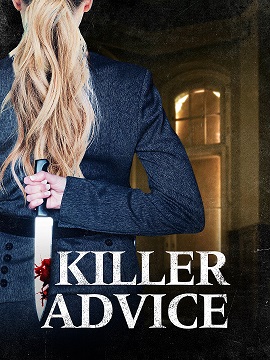
Lifetime Film Review: Killer Advice (dir by Jared Cohn)


Beth (Kate Watson) is not having an easy time dealing with her seemingly perfect life.

She’s worried about whether or not her teenage daughter, Jess (Gigi Gustin), is going to be able to get into a good college. She’s worried about whether or not her husband, Nick (Steve Richard Harris), is going to be able to hold onto his job. She’s also overworked at her own job. That’s a lot of stress to deal with. Of course, what’s really causing Beth the most trouble is the fact that she was recently the victim of a terrifying attack. In an underground parking garage, a man in a mask tried to attack her and chased her all the way to her car. Beth is having trouble recovering from the trauma. Eventually, she ends up seeing a highly praised therapist named Marsha (Meredith Thomas).

At first, Marsha seems like the perfect therapist. She listens to what Beth has to say. She gives good advice. She seems to genuinely care about Beth’s well-being. Then, one night, Nick announces that his firm has a rich new client and that this new client specifically asked to work with him. He goes on to explain that the client is coming to dinner and that it’s very important that everything go perfectly because, otherwise, the client might go to another firm. Beth works all day, preparing the perfect meal. When the client shows up, it turns out to be …. MARSHA!

Marsha claims to be shocked to discover that Nick and Beth are married. Why, Marsha just had no idea! What a coincidence! Later, Marsha hears Beth’s best friend, Simone (Gina Hiraizumi), saying that Marsha should be reported for violating her professional ethics by hiring a patient’s husband. Marsha, needless to say, isn’t happy to hear that and promptly looks for a rock that she can use to bash in Simone’s head….

That’s right! This is one of those type of films! Airing on Lifetime, Killer Advice is another film in which a woman with a perfect family finds herself being stalked by someone who is obsessed with her. This a frequent Lifetime genre and it’s one that centers around a fear that we all have, that fear that our new best friend might actually be a knife-wielding psycho. If you’re not paranoid after watching a Lifetime film, then you’re just not paying attention.

With it’s plot of a dangerous therapist, it’s tempting to compare this film to the Stalked By My Doctor films. Making that comparison even more tempting is the fact that Eric Roberts (the doctor of the Stalked By My Doctor franchise) has a small but key role as Nick’s boss. (It’s always fun to see Eric Roberts and, personally, I like the fact that he’s reinvented himself as a Lifetime mainstay.) However, the Stalked By My Doctor films tend be almost parodies of the classic Lifetime formula. Much like A Deadly Adoption, the Stalked By My Doctor franchise comments on the Lifetime style while also celebrating it. Killer Advice is a bit less meta, content to be a straight-forward story about an unlikely but dangerous stalker.

Kate Watson, Meredith Thomas, and Gigi Gustin all give good performances. Thomas stalks with style, which is really the most important thing when it comes to a film like this. The 2nd most important thing, of course, is the house where it all takes place and Killer Advice features a beautiful one. Living in a house that nice might make being stalked by a therapist almost worth it!
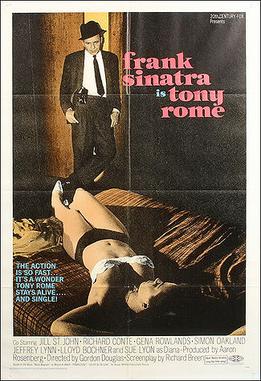
Cleaning Out The DVR: Tony Rome (dir by Gordon Douglas)


The 1967 film, Tony Rome, is about a detective named …. can you guess it?

That’s right! Tony Rome!

Tony works out of Miami and, because he’s played by Frank Sinatra, you can be sure that he’s a tough guy who knows how to throw a punch but who, at the same time, also knows how to have a good time. He’s got a bottle of liquor in the glove compartment. He’s got his own boat. He’s got a snappy quip for every occasion and a properly cynical sense of humor but at the same time, he also cares about doing the right thing. He says what’s on his mind and if that hurts your feelings, tough. Again, none of this should be a surprise, considering that he’s played by Frank Sinatra and Sinatra could play these type of sentimental tough guys in his sleep.

That’s not to say that Sinatra sleepwalks through the role, of course. Far from it. As played by Sinatra, Tony comes across as an authentic tough guy, as someone who has seen it all and who, as a result, understands that importance of stopping to have a drink and appreciate the world around him. Tony Rome might be a Rat Pack-style private investigator but that doesn’t mean he can’t solve the case and, even while Tony’s having a good time, Sinatra never lets you forget that he takes his job very seriously.

As for the film, it’s a story that beings when Tony is hired to drive a passed out rich girl back to her home. This leads to him investigating a jewelry theft and eventually discovering an extortion plot. Sue Lyon plays the rich girl. Gena Rowlands plays her stepmother while Simon Oakland (the psychologist at the end of Psycho) plays her father. Richard Conte, who played bad gangster Barzini in The Godfather, plays Tony Rome’s best friend on the police force. (Every good private eye has a best friend on the police force.) Jill St. John plays Ann Archer, who helps Tony out with his investigation. Ann is recently divorced. Will Tony claim her heart or will she go back to her husband? It wouldn’t be a Sinatra film without a little heartbreak. (To a large extent, St. John’s performance here feels like a slightly more serious version of the performance she would later give as Tiffany Case in Diamonds are Forever, which is perhaps as close as we’ll ever get to a Rat Pack-style James Bond film.)

The story itself is surprisingly easy to follow. This is not one of those detective stories that will leave you shocked over who turns out to be the bad guy. For a film that often takes something of a light-hearted approach to Tony’s efforts to solve the mystery, it’s also a rather violent film. More than a few people get killed. Tony gets kicked in the ribs at one point and the sound of the 50-something Sinatra groaning in pain is disconcerting. Of course, Tony recovers quickly and immediately gets his revenge. When you watch the scene, you think to yourself that anyone who would try to beat up Frank Sinatra has to be a fool. That’s largely because Tony is Sinatra and Sinatra is Tony.

It’s an entertaining film, one that works well as a time capsule of what it was like to cool and swinging and middle-aged in 1967. Tony Rome is smart enough to focus more on Sinatra’s charisma than on trying to impress the viewers with its own cleverness. If I ever have to hire a private detective, I hope he’s like Tony Rome. I hope he gets the job done. I hope he has a good time while doing it. And I hope he comes with his own Nancy Sinatra-sung theme song. That’s not too much to ask, is it?

Cleaning Out The DVR: The 300 Spartans (dir by Rudolph Mate)


King Xerxes (David Farrar), the ruler of Persia, is leading his armies across the ancient world, conquering every nation that he comes to. Xerxes is quick to proclaim that his vision is to have “one world ruled by one master” but really, he’s mostly just trying to prove that he’s as fearsome a conqueror as his father was. Like most authoritarians, he’s really just dealing with his own psychological issues.

When Xerxes sets his eyes on Greece, he assumes that he’ll easily be able to conquer the country. Greece, after all, is divided into several city states and everyone knows that the cities are rarely willing to work together. However, 300 Spartan warriors — led by King Leonidis (Richard Egan) — are willing to stand their ground and hold off Xerxes’s forces for as long as possible. Despite the fact that they’re outnumbered and have no way of knowing if reinforcements will ever arrive, the 300 Spartans are willing to do whatever it takes to protect their freedom. They know that they probably won’t survive the battle but none of them are going to surrender. Better to die than be enslaved.

If the plot of 1962’s The 300 Spartans sounds familiar, that’s probably because it’s based on the same historical events that inspired 300. The 300 Spartans essentially tells the same story and even has many of the same themes as Zack Snyder’s later film. The main difference, of course, is that The 300 Spartans tells it story in a much less stylized manner. Indeed, while 300 tended to kind of take place in a dream-world, one that was designed to highlight the legendary elements of the story, The 300 Spartans very much takes place in the real world, with the actors playing the ancient warrions standing on the same ground that Leonidis and his 300 Spartans once stood upon. It’s a choice that works well, giving The 300 Spartans a far more authentic feel than a lot of the other historical epics that came out in the 50s and 60s.

The 300 Spartans has everything that you might expect from a film like this: dancing, harems, swords, armor, a lot of talk of omens and honor, and of course several speeches about the importance of freedom. That said, even if some elements of the story are predictable, the film is well-acted with Richard Egan giving a strong performance as Leonidis while David Farrar turns Xerxes into a villain who you’ll enjoy rooting against. Anne Wakefield is also well-cast as Artemesia, Xerxes’s consort and his main advisor. Perhaps best of all is Ralph Richardson, playing the general Themistocles with the grim determination of a warrior who has learned better than to depend on omens and prophecy.

At the end of the film, the narrator grandly declares that the actions of the 300 Spartans were more than an example of Greek bravery. They were also, “a stirring example to free people throughout the world of what a few brave men can accomplish once they refuse to submit to tyranny!” Maybe a few years ago, I would have said that the narration went a bit overboard but, after the past few years, I’m now more convinced than ever that a lot of people would be fine living in an authoritarian state as long as their side was the one with all of the authority. At a time like this, any film that celebrates freedom is to be appreciated.

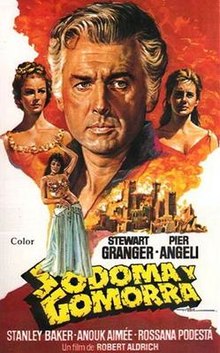
Cleaning Out The DVR: Sodom and Gomorrah (dir by Robert Aldrich)


I think we all know the story of Sodom and Gomorrah.

As told in the book of Genesis, Sodom and Gomorrah were two of the wickedest cities in what was then the civilized world. God grew so sick of their wickedness that he decided to wipe both of the cities and all of their inhabitants out of existence. However, because Abraham’s son, Lot, was living in Sodom with his family, God sent two angels to Sodom to warn Lot. Lot tried to argue that, if he could find 10 good people in the city, Sodom should be spared. However, then the people of Sodom showed up and demanded to “know” the angels and that pretty much sealed their fate. Lot and his family were told to leave the city and to not look back while it was being destroyed. Unfortunately, Lot’s wife just couldn’t resist the temptation and she ended up turning into a pillar of salt.

The 1962 film, Sodom and Gomorrah, recreates the Biblical story, though it takes a lot of liberties with the established narrative. Stewart Granger plays Lot. Anouk Aimee plays Bera, the decadent queen of Sodom who refuses to believe that the incoming destruction of her city is anything more than a dust storm. Pier Angeli plays Lot’s wife, who is imagined here as formerly being one of Bera’s slaves. Though she loves Lot, she loves her former life more and …. well, we all know the story. And then there’s several characters who were created specifically for the film. The most prominent of these is Astaroth (Stanley Baker), who is Bera’s scheming brother and who later is attracted to one of Lot’s daughters. The film was directed by Robert Aldrich. If you know anything about Aldrich’s filmography (Kiss Me Deadly, Twilight’s Last Gleaming, and Hustle among others), he’s not exactly the first name that comes to mind when you think of a director who you would expect to find directing a Biblical epic. And indeed, when compared to his other films, Aldrich often does seem to just be going through the motions when it comes to telling the film’s story.

Sodom and Gomorrah suffers from a problem that afflicted many Biblical epics. It takes forever to get to the good stuff. We’re all watching because we want to see the cities get destroyed and we want to watch Lot’s wife get transformed into a pillar of salt. However, this film — which has a running time of two and a half hours — takes forever to reach that point. First, we have to spend a lot of time listening to Astaroth plotting against his sister and scheming how to take over the Salt Trade, which is the source of the wealth of both of the cities. Then we spend an endless amount of time with Lot and his family wandering through the desert. There are a few good battle scenes but the film still feels dragged out. It takes forever to get to the destruction of Sodom and Gomorrah and it’s a bit of a let down when it finally does happen. The ground shakes, Dust fills the sky. Buildings start falling on people. Throughout it all, the Sodomites continue to behave wickedly, which leads to a few odd moments. (A man and a woman stop fleeing for a few minutes to make out against a wall. Naturally, the wall is the next thing to collapse.) After all of that build-up, the destruction scenes are maddeningly pedestrian.

Lot is probably one of the most interesting characters in Genesis, an imperfect man who tried to do the right thing but who often seemed to have terrible luck. Unfortunately, Stewart Granger is a bit of a stiff in the lead role and he’s never convincing as someone who could lead his people through the desert. He doesn’t have the innate authority that Charlton Heston had in The Ten Commandments. Far more successful are the performances of Stanley Baker and Anouk Aimee. Aimee, in particular, seems to being having a blast being bad. Or at least, she is until the walls come tumbling down.

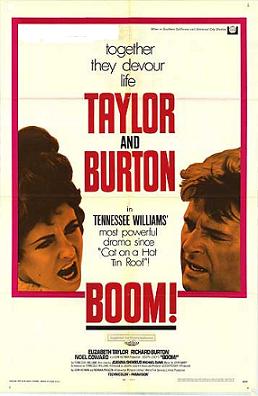
Film Review: Boom! (dir by Joseph Losey)


“Boom!” says poet Chris Flanders (Richard Burton) in the 1968 film of the same name. Boom, he goes on the explain, is the sound of life being lived. Every minute that we’re reminded that we’re still alive is a “Boom!” It’s the type of thing that 18 year-old artists say to get laid, though the film treats Chris’s comment with an almost supernatural reverence.

Chris has just shown up on an island that’s owned by Flora Goforth (Elizabeth Taylor), who is the richest woman in the world and who is apparently dying of one of those diseases that makes you lie in bed and yell a lot. Flora lives on the island with an entourage that includes a secretary named Miss Black (Joanna Shimkus) and a head of security named Rudi (Michael Dunn). Rudi is a dwarf and he dresses like a Nazi and often does a stiff-armed salute, just in case we missed the fact that he’s supposed to be a fascist. Why exactly Flora, who were supposed to sympathize with, would employ a Nazi, we never really find out. The film seems to think that there’s something extremely daring about casting a person of short statue as the head of Flora’s security though, ultimately, it’s about as profound as uttering “Boom!” every few minutes.

Anyway, Flora is dying but she’s also dictating her autobiography. It turns out that she’s rich because she married a lot of wealthy men, all of whom died and left her all of their money. Flora’s always in a bad mood but things improve a little when Chris mysteriously shows up on the island and starts saying, “Boom!” all the time. Flora and Chris have several conversations about life and the meaning of it all, the majority of which are full of obscure statements and half-baked attempts at being profound. The dialogue is pretentious but it’s also not very memorable, which is a shame. One can survive being pretentious but being forgettable is simply unforgivable.

Eventually, a friend of Flora’s shows up. Famed playwright Noel Coward plays The Witch of Capri, a flamboyant friend to the rich and famous. He loves to gossip and has a bitchy comment for every occasion. One could argue that Coward is merely playing himself, though one imagines that the real-life Coward could have also come up with a few genuinely witty lines. The Witch informs Flora that Chris has a habit of showing up at the bedside of rich women right before they die. Some people think that Chris is a gigolo while others believe Chris to be …. THE ANGEL OF DEATH!

(Dramatic music)

Which is it? Don’t worry, the answer is revealed by the end of the movie. Of course, it takes a while to get to the end. Boom! is two hours long but it feels much longer. Storywise, Boom! feels like it would be ideal as a 30-minute episode of some old anthology show but director Joseph Losey keeps the story moving at a very slow pace and there are so many dramatic pauses and unnecessary zoom shots that the film itself becomes a bit of an endurance test. Just when you think the movie is finally going to get moving, Chris says, “Boom!” or there’s an extreme close-up of Flora’s ring and everything slows down again.

Boom! is one of the many films that Richard Burton and Elizabeth Taylor made together in the 60s. Unfortunately, both actors are miscast in the lead roles. Flora is described as being old and sickly. Elizabeth Taylor was in her 30s and appeared to be in robust health during the shooting of the film. Chris Flanders is supposed to be in his 20s and a seeker of truth and enlightenment. Burton was in his 40s and looked like he was in his 60s. He spends most of the film looking and sounding as if he’s just come off a weekend bender, which makes him look all the more ludicrous when he hears the ocean and says, “Boom!”

On the plus side, the film is lovely to look at. Flora’s house is big and beautiful. The island scenery is gorgeous. Flora’s costumes are ludicrously ornate but still, they are what you would want to see an international movie star wearing in 1968. As such, the film is always nice to look at. In fact, perhaps the best way to watch Boom! is to turn down the sound so you don’t have to listen to any of the dialogue.

Boom! was based on a Tennessee Williams’s play called The Milk Train Doesn’t Stop Here Anymore. The filmmakers decided to change the name to Boom! and I really can’t blame them for that. This was Elizabeth Taylor’s third film to be based on a Tennessee Williams play. Unfortunately, it matched neither the critical nor the commercial success of Cat On A Hot Tin Roof or Suddenly, Last Summer.

Boom!

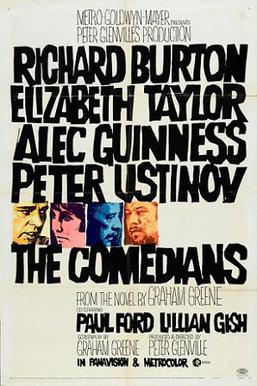
Cleaning Out The DVR: The Comedians (dir by Peter Glenville)


Not to be mistaken for the Taylor Hackford-directed, Robert De Niro-starring disaster from a few years back, The Comedians is a film from 1967 that follows several different people as they attempt to survive day-to-day life in Haiti, back when Haiti was ruled by the dictator, Papa Doc Duvalier.

Richard Burton stars Mr. Brown (Richard Burton), a deeply cynical and world-weary Englishman who owns what passes for a luxury hotel in Haiti.  Though Mr. Brown hopes to be able to sell the hotel and get out of Haiti, he is also having an affair with Martha (Elizabeth Taylor), the German wife of Pineda (Peter Ustinov), the ambassador from Uruguay.  Mr. Brown tries to avoid politics, which it turns out is not easy to do when you’re living under a murderous regime.

Complicating Mr. Brown’s life is Major Jones (Alec Guinness), a retired British army officer who has come to Haiti to do business but who is promptly imprisoned when it’s discovered that he was invited to come to the island by a minister who was subsequently declared to be an enemy of the state.  The fascist Captain Concasseur (Raymond St. Jacques) arrests Major Jones and Mr. Brown takes it upon himself to try to get Jones released.  Unfortunately, Major Jones doesn’t quite understand how serious his situation is and he’s convinced the Haitians that he’s not only a brilliant military leader but that he can also arrange for them to receive a cache of weapons, which he claims he has hidden in a Miami warehouse.

Meanwhile, Mr. and Mrs. Smith (Paul Ford and Lillian Gish) have also arrived on the island, hoping to set up a vegetarian center in Haiti.  (Mr. Smith even once ran for President of the U.S. as the candidate of the Vegetarian Party.)  In many ways, Mr. and Mrs. Smith serve as a stand-in for clueless American activists, obsessing over minor issues while ignoring the larger problems that are right in front of their faces.

From the start, The Comedians establishes Haiti as being a dangerous place, a country where the people live in fear of the brutal police and where the poor struggle to survive day-to-day while their rulers live a life of luxury.  It’s a place where political dissidents regularly disappear, though the police aren’t above murdering people in public as well.  It’s a country where the State rules supreme, controlling the citizens through both fear and a fierce cult of personality.  Rebels like Dr. Magiot (James Earl Jones) only want the country to be free but they know that, as long superpowers like America are supporting the regime, there’s little that the rebels can realistically hope to accomplish.

A major theme running through The Comedians is that the real suffering of the Haitian people is often overshadowed by the strategic concerns of the United States.  Unfortunately, pretty much the same thing happens within the film itself.  While there’s several black actors in supporting roles, the story focuses on the white characters and, as a result, it sometimes feels like the film’s message is less about the people being oppressed and more about how unfortunate it is that people like Brown, Jones, and the Smiths are being inconvenienced by it all.  Like many similarly well-intentioned political films from the late 60s, The Comedians get so bogged down in all of the personal dramas that it loses sight of what’s actually the important part of the story.  The film is often seems more interested in Brown and Martha’s affair than in the conditions that would lead to people like Dr. Magiot risking their lives to bring about change.

For the most part, it’s a well-acted film.  Richard Burton’s natural self-loathing is put to good use and Alec Guinness has a few poignant scenes as a pathological liar who doesn’t realize how much trouble he’s actually in until it’s too late.  (Guinness also has a scene where he wears blackface and pretends to be Burton’s maid.  He does this in order to escape from the secret police and the film doesn’t treat it as being a joke but it’s still rather cringey to watch.)  Elizabeth Taylor is miscast as Martha and her German accent comes and goes but Paul Ford and Lillian Gish do a good job playing clueless Americans.  Perhaps the film’s strongest performance comes from Zakes Mokae, who doesn’t say much as a member of the secret police but who exudes menace every time that he’s on screen.  Still, as well acted at it may be, the film is slowly paced and always seem hesitant about taking any position beyond a general sense that dictatorships are bad.

That said, there’s nothing wrong with reminding people that dictatorships are bad.  That’s especially an important message today.  The past few years have left me convinced that a lot of people secretly yearn for a dictatorship and would be willing to trade their freedoms for a false sense of security.  Though the film may struggle dramatically, it’s still works as a warning about what true authoritarianism actually is.


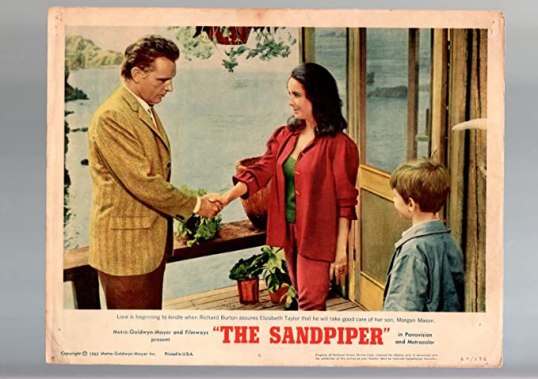
Cleaning Out The DVR: The Sandpiper (dir by Vincente Minnelli)


I recorded The Sandpiper that last time that it aired on TCM.  This 1965 film is one of the many films that Elizabeth Taylor and Richard Burton made together after they fell in love during the making of Cleopatra.  And while it’s true that Who’s Afraid of Virginia Woolf? won Taylor an Oscar and probably should have won one for Burton as well, the majority of the Taylor/Burton films were overproduced melodramas that often seemed as if they’d been rushed into production in order to capitalize on the couple’s tabloid popularity.  Unfortunately, Virginia Woolf aside, neither Taylor nor Burton seemed to bring out the best in each other as actors.

The Sandpiper finds Taylor playing Laura Reynolds, an artist who lives in a California beach house with her young son, Danny (Morgan Mason).  Laura is a free spirit who believes that everyone, including her son, should have the freedom to make their own choices.  She is resistant to any and all authority.  She’s a bohemian, a rebel, the type who doesn’t care what society has to say and who flaunts her refusal to follow the dictates of respectability.  Good for her!  However, she’s also Elizabeth Taylor, which means that she’s impossibly glamorous and even her “cluttered” beach house looks like it’s a hundred times more expensive than anything that anyone viewing the film will ever be able to afford.  Though Taylor tries hard, there’s nothing convincingly bohemian about her.

Richard Burton plays Dr. Edward Hewitt, who runs the nearby Episcopal school.  Dr. Hewitt is not a free spirit.  Instead, he and his wife, Claire (Eva Marie Saint), very much believe in structure and playing by the rules.  They believe in a traditional education and, when a judge orders Danny to be enrolled at their school, that’s what Hewitt plans to give him.  This, of course, brings Hewitt into conflict with Laura.  Both of them have differing ways of looking at the world and Laura is not a fan of religion in general.  However, since they’re played by Burton and Taylor, they’re destined to fall in love and have a scandalous affair.

Dr. Hewitt is one of the many religious figures that Burton played throughout his career.  In fact, Burton played so many alcoholic priests that I spent most of the movie assuming that Hewitt was an alcoholic as well.  However, he’s not.  He’s just Episcopalian.  That said, Burton delivers every line of dialogue in his trademark “great actor” voice and every minute that he’s onscreen just seems to be full of self-loathing.  Even before he cheats on his wife, Hewitt seems to hate himself.  Of course, once Burton does start cheating on his wife, it only gets worse.  The film presents Hewitt as being something of a hesitant participant, someone who knows that he’s doing the wrong thing but he simply cannot stop himself.  Laura, meanwhile, is presented as being someone who is fully willing to break up a marriage to get what she wants.  One gets the feeling that 1965 audiences probably just assumed they were watching the true story of how Taylor and Burton fell in love during the making the Cleopatra.  That said, it’s all pretty tame.  Just like Taylor, director Vincente Minnelli was too much of a product of the old Hollywood to truly embrace this story for all of its sordid potential.

If you’ve ever wanted to watch Charles Bronson debate religion with Richard Burton, this is the film for you.  Bronson plays a sculptor and an atheist who upsets Hewitt by calling him “reverend.”  Bronson is actually more convincing in the film than either Burton or Taylor, bringing a rough authenticity to his role.  Whereas Burton and Taylor both seem to be going through the motions, Bronson comes across as if he actually has a personal stake in the film’s story.  It’s not enough to save the movie, of course.  Fortunately, a year later, Liz and Dick would be used to better effect in Who’s Afraid of Virginia Woolf?


Cleaning Out The DVR: The V.I.P.s (dir by Anthony Asquith)


The 1963 film, The V.I.P.s, is about a group of very important people who have all shown at Heathrow Airport at the same time, all in an effort to get the Hell out of England.  They’ve all got their own individual reasons for wanting to leave the country but the important thing is that they all want to leave.  Unfortunately, a fog has rolled onto the runway and the plane can’t take off.  Because this film was made in 1963, all the passengers are allowed to leave the plane and wait, overnight, in a hotel.

Among the Very Important People:

Flamboyant film producer Max Buda (Orson Welles, playing a version of himself) needs to leave London before he receives a gigantic tax bill.  Accompanying him is his latest discovery, Gloria Gritti (Elsa Martinelli).  Max is the type who does things like barging into the plane’s cockpit and demanding to know why the pilots aren’t willing to risk crashing the plane.  That may sound self-centered on Max’s part but Welles is such a charmer that you forgive him.  Add to that, he’s trying to avoid paying taxes and that’s something that I can definitely get behind.

The Duchess of Brighton (Margaret Rutherford) is an eccentric but impoverished noblewoman who is going to lose her home if she doesn’t fly to Florida and take on a somewhat demeaning job.  The Duchess is the type who struggles to find room in the overhead compartment for her ludicrous oversized hatbox.  She’s never really been out in the real world before.  Margaret Rutherford won an Oscar for her performance, which is occasionally amusing but never particularly subtle.  (Have you seen Airport?  Rutherford has the Helen Hayes role, basically.)

Lee Mangrum (Rod Taylor) is a businessman who is on the verge of losing his business.  Miss Mead (Maggie Smith) is his secretary.  Miss Mead is secretly in love with Lee, who somehow hasn’t noticed.  We’re supposed to sympathize with Lee but he’s so incredibly clueless that it’s hard not to feel that Miss Mead could do better.

Finally, we have Frances Andros (Elizabeth Taylor).  Frances is one of the most popular film stars in the world.  She’s married to Paul Andros (Richard Burton), who is very wealthy and who, like most Burton characters, is also very moody.  Frances has decided to leave Paul and go to America with her lover, Marc Champselle (Louis Jourdan).  However, the fog gives Paul a chance to come to the airport and try to talk Frances out of leaving him.

Make no mistake about it, Liz Taylor and Burton are the main attraction here.  Welles, Rod Taylor, Rutherford, and Smith all get plenty of scenes but it’s obvious that the people behind The V.I.P.s understood that most of the audience would be there to watch Liz and Burton acting opposite each other.  This was, I think, the first film that they made together after falling in love on the set of Cleopatra.  Due to Cleopatra’s legendarily difficult production, it was released around the same time as The V.I.P.s, despite going into production years before the latter film.  Audiences could go watch Liz and Dick fall in love in Cleopatra and then head over to a different theater and watch the two of them fight in The V.I.Ps.  Elizabeth Taylor may be playing Frances Andros and Richard Burton may be playing Paul Andros but they really might as well be playing themselves.

The V.I.P.s is a big and glossy film, the type of movie that the Hollywood studios used to make as their way of saying, “See!  You won’t get this on TV!”  It’s frequently silly but it’s also undeniably watchable.  While Burton and Taylor’s later films tended to feature the two of them at their worst, they’re both actually really good in The V.I.P.s and the scenes where they argue have an emotional heft to them that, with the exception of Who’s Afraid of Virginia Woof?, wasn’t found in their other films.  For once, you watch the film and you really do hope that Liz and Dick will work things out and stay together.  The V.I.P.s may be dated (just try to chase someone through an airport or get off a delayed flight now) but it’s still entertaining.

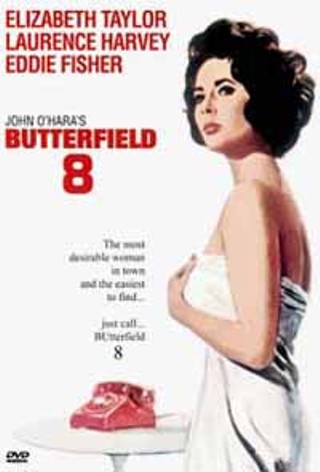
Cleaning Out The DVR: BUtterfield 8 (dir by Daniel Mann)


“Mama, face it,” Gloria Wandrous (Elizabeth Taylor) announces in the 1960 film, BUtterfield 8, “I was the slut of all time!”

Personally, I think Gloria is being a little bit too hard on herself. Certainly the film suggests, in its 1960 way, that she’s promiscuous and that she only sleeps with men for money but that doesn’t necessarily make her the slut of all time. For one thing, I would think that the slut of all time would have more options than just a wimpy pianist played by Eddie Fisher or a depressing, self-absorbed businessman played by Laurence Harvey.

“I still say it stinks,” Elizabeth Taylor said, almost immediately after winning her first Oscar for her performance in BUtterfield 8 and she’s kind of right. BUtterfield 8 is not a particularly good film, though not quite as bad as Taylor seemed to believe it to be.

Taylor won the Oscar after suffering a near fatal bout of pneumonia and having to undergo a tracheotomy. Along with saying that the film stunk, Taylor also often said that she only won her first Oscar because she nearly died. That may or may not be true but the thing is, Taylor’s the best thing in this overwritten and overheated mess of a movie. She certainly gives a better and more sympathetic performance than Laurence Harvey, who is cast as her married lover, Wilson Liggett. We’re meant to sympathize with Ligget but Harvey plays him as if he’s in a permanently sour mood and, after just a few minutes of listening to him bitch about every little thing, the viewer will get sick of him. It’s hard to really see what Gloria Wandrous sees in this whiny alcoholic.

Then again, the only other option that the film gives Gloria is Steve Carpenter, the pianist played by Eddie Fisher. Steve can’t decide if he’s in love with his boring girlfriend, Norma (Susan Oliver) or if he’s in love with Gloria. However, Steve has no problem letting Gloria borrow one of Norma’s dresses so that she can wear it when she goes home to visit her mother and I have to say that if I was Norma, Steve would be finding a new bed to sleep in after that. Gloria tells Steve that he needs to decide who he’s in love with but Steve jut can’t do it. Of course, in real life, Eddie Fisher left Debbie Reynolds so that he could marry Elizabeth Taylor. (A year or so later, Taylor left Fisher so that she could marry Richard Burton.)

BUtterfield 8 is one of those films that was undoubtedly considered to be daring when it was first released, seeing as how it acknowledged that people had sex without getting married first. (GASP!) Of course, though the film acknowledges that people have sex, it still makes sure to let us know that no one’s happy afterwards and that promiscuity eventually leads to death. (I mean, BUtterfield 8 may have taken risks but it still knew better than to defy the production code.) Seen today, the entire film is rather tame, talky, and slow but the star power of Elizabeth Taylor still comes through. The film opens with a lengthy sequence of Gloria getting ready for her day and, as you watch it and, more importantly, as you watch Elizabeth Taylor, you find yourself thinking that this is what a movie star is supposed to be. She dominates the film and she manages to credibly deliver even the most overheated pieces of dialogue. (Just try to imagine Jennifer Lawrence delivering the “slut of all time” line and you’ll immediately understand the difference between the movie stars of the past and the movie stars of the present. Of course, you could also say the same thing about trying to imagine a young Elizabeth Taylor in Silver Linings Playbook or The Hunger Games.) In fact, one could argue that Taylor’s performance is almost too good for the material. The film, in its 1960 way, suggests that Gloria would be better off if she just settled down but it’s impossible to imagine Taylor’s Gloria Wandrous settling for the stiffs played by Laurence Harvey and Eddie Fisher.

Though Elizabeth Taylor was correct about BUtterfield 8‘s overall quality, it’s still a good example of what star power can do for an otherwise mediocre film.

Film Review: Tom & Jerry (dir by Tim Story)


Kayla Forester (Chloe Grace Moretz) has recently arrived in Manhattan, fleeing her go-nowhere hometown in Pennsylvania.  She’s determined to finally do something with her life, spurred on by the feeling that there are other people who are just as young as she is but who have already managed to get their lives together.  She doesn’t have much work experience but she has endless ambition and she’s also willing to lie, cheat, and steal if it means finding a better life.

Tom Kat (played by himself) is an aspiring pianist and creator of ludicrously elaborate mouse traps who finds his ambitions hampered by the fact that he’s a cartoon cat who can’t talk and who has a habit of getting involved in elaborate mishaps.  Even his attempts to make a meager living by playinf piano in Central Park are continually thwarted by all of the other cartoon animals that are lurking around New York City.  (“Look!” a little boy announces, “that cat’s playing a piano!”  His father explains that it’s common to see all sorts of strange things in New York.)

Jerry Mouse (playing himself) is Tom’s longtime rival.  A cartoon mouse who is also a plucky kleptomaniac, Jerry has recently arrived in Manhattan.  He’s looking for a home and he wastes no time in reigniting his decades old feud with Tom and, of course, engaging in countless acts of petty thievery.

Together, they solve crimes!

Well, no, actually, they don’t.  Instead, they commit a few.  Kayla gets things started by stealing someone else’s resume and getting a job working at a luxury hotel.  Under the mistrustful eye of event manager Terence Mendoza (Michael Pena), Kayla tries to make sure that two celebrities, Ben (Colin Jost) and Preeta (Pallavi Sharda ), have the perfect wedding in the hotel’s ballroom.  Despite being in no way qualified for her job, Kayla proves to be a quick learner and she even manages to deal with the hotel’s temperamental head chef, Jackie (played, somewhat inevitably, by Ken Jeong).  The only problem is that Jerry has moved into the hotel as well.  Realizing that a mouse could ruin the entire wedding, Kayla hires Tom to track the little rodent down.  Tom and Jerry better work out their differences before the wedding because Ben and Preeta are scheduled to ride two cartoon elephants down the aisle and you know how elephants feel about mice!

Tom & Jerry is a hybrid film, a mix of live action and animation.  New York City is real.  All of the human characters are played by actual humans.  However, every single animal — from the title characters to the elephants to Ben’s bulldog to the pigeons that fly over Central Park and provide a chorus to the action — is a 2D cartoon character.  It’s actually a pretty cute idea and, to the film’s credit, it doesn’t waste anyone time with elaborate excuses for why this is.  Everyone in the film simply accepts that they live in a world with cartoon animals.  No one is particularly surprised with Kayla hires a cartoon cat to take care of the cartoon mouse problem.

Tom & Jerry works whenever it focuses on the title characters.  It’s actually a lot of fun to watch the two of them chasing each other through a live action New York City and never suffering any injuries regardless of how many mallets they hit each other with.  Unfortunately, the film slows down whenever it focuses on the human characters.  Chloe Grace Moretz is one of the best actresses of her generation and it’s always nice to see her playing a character who isn’t being stalked or having to deal with some sort of unimaginable tragedy but still, Kayla’s story is never really interesting enough to justify taking the focus away from Tom and Jerry.  For most of the movie, poor Michael Pena gets stuck playing the film’s designated villain, even though Terrence is basically just doing his job.  In the end, of course, everyone learns an important lesson and they’re all the better for it but most viewers would probably trade the lesson for more of the mouse and the cat.

Still, whenever it’s just Tom and Jerry doing their thing, this is a cute movie.  I just wish the movie hadn’t gotten bogged down with everything else.