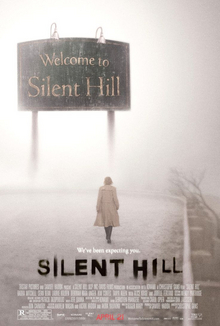
Horror Film Review: Silent Hill (dir by Christophe Gans)


Oh, Silent Hill.

I first saw this movie way back in 2006, when it was first released into theaters.  At the time, I knew nothing about Silent Hill, beyond the fact that it was based on a video game that a lot of my friends seemed to like.  I have to admit that I had a really hard time following the plot and yet the film still totally creeped me out.  The film was one of those movies that created such an atmosphere of impending doom that the real world looked and felt different when I left the theater.  For the rest of that night, I found myself feeling paranoid about any sudden shadows.

I’ve watched Silent Hill or, at the very least, parts of Silent Hill a few more times over the years.  The plot still makes little sense to me, though I am now a bit more familiar with the game that inspired the film.  Over the years, a handful of the special effects have aged a bit poorly, with many of the once-fearsome monsters now looking somewhat cartoonish.  And yet, when the film works, it really, really works. There are certain scenes in this film that still surprise and frighten me, even though I’ve already seen them.  One character, for instance, is burned alive and I still have to look away when the fire consumes them.  The thing is that, even if the CGI now looks a bit cartoonish, the atmosphere remains.  That feeling dread continues to snake its way through every scene in the film and into the consciousness of the viewer.

I rewatched the film earlier today.  I’m feeling nervous tonight.  Maybe it’s just because I’ve got a lot of writing to do and we’ve got some home repair people coming by tomorrow to do some work.  Or maybe, it’s because I’m worried that I’m suddenly going to find myself in some sort of shadow world, being menaced by blind but stabby nurses.

The film opens with Rose (Radha Mitchell) and her husband, Christopher (Sean Bean) trying to figure out why their adopted daughter, Sharon (Jodelle Ferland), is sleepwalking and having nightmares about a town called Silent Hill.  Silent Hill is in West Virginia and was abandoned after a mysterious natural disaster.  Rose decides that visiting the town is the best way to solve the mystery.  However, after an automobile accident, Sharon disappears and Rose finds herself wandering around the town and getting attacked by monsters and occultists.  Meanwhile, Christopher is also wandering around Silent Hill, accompanied by a helpful deputy (Kim Coates), but it’s hard not to notice that his Silent Hill seems to be signifcantly difficult from the Silent Hill that Sharon and motorcycle police officer Cybil (Laurie Holden) have found themselves in.

It’s a confusing plot but director Christopher Gans does such a good job of creating and maintaining the film’s creepy atmosphere that it doesn’t matter that you’re not always sure what’s going on.  And while it’s true that there’s perhaps too many scenes of Sharon walking from place to place, there’s also some truly frightening scenes, like the one with all of those killer nurses.  The film plays out like a dream and, as we all know, you don’t question dream logic.  Instead, you just go with it.

And so, 15 years after the film was first released, I’m usually willing to just go with Silent Hill.  I’m at peace with never quite understanding it.  Instead, I appreciate it for what it is: a creepy and surreal experience that will make you think twice before stepping out into the fog.
Sledgehammer (1983, directed by David A. Prior)


Long ago, an adulterous couple was beaten to death by someone weilding a sledgehammer while one of the victm’s 8 year-old son watched.  Ten years later, a bunch of stupid college kids decide that the farmhouse would be a great place to throw a party.  Great idea!  After a lot of filler, including a length foodfight, one of the partiers tells the story of the murder and then suggests holding a seance so that they can talk to “ghosts and goblins.”  Everyone agrees.  At first, it seems like the seance is just an extended practical joke but soon, a killer with a sledgehammer shows up.

Sledgehammer was an early direct-to-video slasher film.  It was directed by David A. Prior, who later went on to become one of the buseist DTV directors of the 80s and 90s.  Starring in the film was Ted Prior, brother of David.  Ted plays Chuck, who is not sure whether or not he wants to marry his fiancee, Joni (Linda McGill).  There’s a scene where Chuck and Joni walk through a fied in slow motion.  It adds nothing to the plot but it did add to the running time, which I imagine was the intent.  There are, in fact, several slow motion sequences in the film.  There’s so much slow motion that it’s hard not to laugh whenever the frames start to slow down.  It’s an 87 minute film but it feels like at least 20 minutes of that is due to the slow motion.

Sledgehammer is slow and dumb but it’s hard to really dislike it.  The cast may be amateurish but they also appear to be having a good time and the decision to film almost the entire movie in what was then David Prior’s apartment is actually likable in a low-rent, anyone-can-make-a-movie way.  The opening credits are written in generic 80s computer font and the movie ends with a lengthy “You have been watching” style montage of the cast.  It’s like bad 80s synthesizer music, cheesy but impossible to hate.  As for the killer, he’s stuck wearing a cheap mask but the sledgehammer is a good weapon and it actually makes him more threatening than many of his knife and axe wielding comrades.

Sledgehammer is not great.  It’s not even the best thing from the 80s to be called Sledgehammer.  (David Rasche rules!)  But it’s better than many other direct-to-video slashers.  What it lacks in creativity, it maes up for with ethusiasm.

One Hit From Home (2012, dir. by Johnny Meier and David Aaron Stone)


The MLB regular season has come to an end and right now, I’m so thankful for the Orioles.

Why?  Because I’m a Rangers fan and the Orioles 52-110 record is the only thing keeping my Rangers from havin the worst record in the American League.  This season, the Rangers went 60-102.  In all of major league baseball, only the Orioles and the Diamondbacks managed to do worse.  The Rangers will not be going to the World Series this season.  We won’t be anywhere close.  The Astros might make it.  They’re playing White Sox later today.

I’m a true baseball fan, though.  True baseball fans have faith.  It’s been a long since the Rangers had a winning season and many of my favorite players have been traded to other teams.  (I’m still crying about Elvis playing for the Athetlics.  ELVIS!)  We’ve been struggling for a while but next season, we’ll turn things around.  I have faith.

Faith is also the main theme of One Hit From Home, a baseball movie that I watched last night.  One Hit From Home is about Jimmy Easton (David Aaron Stone), a baseball player who was the best curve ball hitter in the league until career was cut short by a knee injury.  When Jimmy gets into a bar fight, he’s given two options.  He can either go to jail or he can coach a college baseball team.  Deciding to coach, Jimmy returns to his hometown, hooks up with his ex-girlfriend, mentors a troubled a player, deals with his part, and does a lot of praying.

One Hit From Home was really predictable and, because it was a Pureflix film, more into religion than baseball.  I don’t mind religious films but it bothered me that One Hit From Home didn’t even seem to care much about the game.  There was no strategy or talk about teamwork or anything else that makes baseball special.  Jimmy never told anyone to bunt or to hit a sacrifice fly to bring another player home.  After a rough start, the team goes on a winning streak but the movie never shows how Jimmy adjusted his coaching style or what he taught the players.  Instead, Jimmy helps his star player get along better with his father and, after one of the movie’s many tragic car accidents, Jimmy goes to church.  I watched One Hit From Home because I wanted to see a baseball movie and I felt cheated.

The worst part of the movie was when Jimmy’s ex-girlfriend stopped by to welcome him back to town and she got offended when she discovered that Jimmy had spent the night with another woman, despite the fact that she was the one who dropped by the house unannounced and it had been years since she and Jimmy had even seen each other.  That made her seem very judgmental and hypocritical but the movie acted like Jimmy was the one who should apologize.

One Hit From Home wasn’t what I was looking for but it won’t make me give up on baseball movies.  I have faith in them, just like I have fath in my Rangers.

Horror on the Lens: Faust (dir by F.W. Murnau)


Today’s Horror on the Lens is a silent German film from 1926. Based on the legend of the alchemist who sold his soul to the Devil, Faust was dismissed by European critics when it was intially released but it has since been recognized as one of the great cineamtic examples of German Expressionism.

It was after directing this film that Murnau traveled to Hollywood and directed his masterpice, Sunrise: A Story of Two Humans. (Murnau was also responsible, many years earlier, for directing Nosferatu.) The role of Fasut was played by Swedish actor Gosta Ekman, who tragicaly developed an addiction to cocaine while making the film and who would die as a result in 1938. Playing the role of Mephisto is German actor Emil Jannings, who would later go to win the very first Academy Award for Best Actor. Unfortunately, with the advent of sound, Jannings — who had no interest in learning English — returned to Germany and, after making some classic films with Marlene Dietrich, spent the rest of his career appearing in Nazi propaganda films. Whether or not Jannings was a committed Nazi or just an opportunist remains a point of cotention but it’s still undoubtedly not the career path that one would hope for one of the very first Oscar winners.

Here, for the first time on the Shattered Lens, is Faust:

Hellgate (1989, directed by William A. Levey)


In what we’re told is supposed to be the 1950s (even though everybody looks and dresses as if they’re from 1989, the year this film was shot), a group of bikers murder a young waitress named Josie (Abigail Wolcott).  Josie’s father hacks the biker’s to death with an axe and, years later, uses a magic blue crystal to bring Josie back to life.  However, Josie is inow a succubus who wanders along the highway and waits to be picked up by random travelers.  She brings them back to a ghost town called Hellgate, where her father uses the gem to turn them into zombies or ghosts or something.  Jose’s latest target is a college student named Matt (Ron Palillo), who is heading up  to the mountains to meet up with his girlfriend and another couple.  When Matt gets distracted by Josie, will he be able to escape or will he lose his mortal soul or whatever is that supposed to be going on in the town of Hellgate?

This is a confusing film.  It actually feels like a hodgepodge of outtakes from several other films which were just put together in an attempt to salvage something and hopefully make some money from the undemanding direct-to-video market.  That Hellgate still has a cult following despite being an incoherent mess is proof that the film’s producers were not totally clueless.  People will watch almost anything if there’s a promise of nudity.  Hellgate delivers that, though much of the nudity comes from Ron Pallilo so I can only imagine how the film’s target audience of teenage horror fans reacted to that back in 1989.

This movie does indeed star Ron Palillo, better known for playing Arnold Horseshack on Welcome Back, Kotter.  (In the Gabe Kaplan stand-up routine that inspired the show, Arnold’s last name was actually Horseshit but they had to clean it up for network TV.)  Pailillo was in his 40s when he was cast as a college student and he looked closer to 50.  Still, every woman in the film falls all over herself at the sight of Ron Palillo, even the ones who aren’t trying to steal his soul or whatever it is that Josie is actually doing in this film.  Ron Palillio tries really hard to convince us that he’s a college stud but it’s impossible to look at him without thinking, “That’s Horseshack with a few extra years on him.”

If the story and the acting aren’t bad enough for you, Hellgate was also filmed in South Africa in the late 80s, at a time when Apartheid was still the law of the land and Nelson Mandela was still imprisoned.  Most of the supporting actors are South African.  They try and struggle to sound like they live in the American southwest.  It’s hard to see what the film got out of being filmed in South Africa, other than the fact that it was cheap.

Like most really bad movies, Hellgate has got a cult following but it’s not worth the trouble.  Unless you’re the world biggest Ron Pallilo fan (no judgment here!), this is one you can skip.

International Horror Film Review: Manhattan Baby (dir by Lucio Fulci)


“Manhattan, baby!”

That’s what a friend of mine yelled a few years ago.  Jack was a choreographer who had just received a call from someone in New York City, offering him the chance to come work on an off-Broadway show.  He accepted, of course and then he hugged everyone who had been standing nearby, listening to the call.

“Manhattan, baby!” he shouted.

Now, the show itself didn’t really work out but Jack did get a trip to Manhattan out of it and really, I think that’s what everyone was excited about.  No matter how many bad things you may hear about New York City, it’s hard not to get excited when you hear the word Manhattan.  For many, Manhattan represents culture, sophistication, and wealth.  For others, Manhattan represents crime, inequity, and alienation.  Across the world, Manhattan stands for everything that is both good and bad about America.  Just the word Manhattan carries a power to it.  You would never get excited if someone announced that they had gotten a job in Minnesota, for instance.  If Jack had shouted, “Minnesota, baby!,” we all would have been concerned about him.  Minnesota?  Who gives a fuck?  But Manhattan …. Manhattan has power, baby!

Manhattan also lent its name to one of Lucio Fulci’s post-Zombi films and the title just happened to duplicate Jack’s proclomation, Manhattan Baby.  Released in 1982, Manhattan Baby is often cited as being the last of Fulci’s “major” productions.  While his career was reinvigorated by the success of the films he made with producer Fabrizio De Angelis (including Zombi 2 and the Beyond trilogy), Fulci and De Angelis had a falling out over Manhattan Baby.  Fulci claimed that De Angelis essentially forced him to make the movie, despite the fact that Fulci himself did not have much interest in the script.  Initially, the film was to be a special effects spectacluar with a large budget but, after the controversy surrounding Fulci’s The New York Ripper, the budget was drastically scaled back and the special effects were done on the cheap.  Fulci later said that he felt the movie was terrible and that it set back his career.

As for what the film is actually about, Manhattan Baby deals with …. well, the plot is not easy to describe.  Fulci’s films were always better known for their surreal imagery than their tight plots and, even by his standards, Manhattan Baby is all over the place.  The film opens in Egypt, where archeologist George Hacker (Christopher Connelly) is struck blind when he enters a previously unexplored tomb. Meanwhile, his daughter, Susie (Brigitta Boccoli), is given an amulet by another blind woman.

Back in Manhattan, George waits for his sight to return and Susie and her little brother, Tommy (Giovanni Frezza, who played Bob In The House By The Cemetery) start to act weird.  It turns out that their bedroom is now some sort of demensional gateway, from which snakes sometimes emerge.  At the same time, the gateway occasionally sucks people through and they end up stranded in the Egyptian desert.  Why?  Who knows?  Is Susie possessed or does the gateway operate independently from her?  Why does she occasionally glow a weird blue color?  Why do she and her brother suddenly seem to hate their nannny (played by Cinzia De Ponti, who was also in The New York Ripper)?  It all has something to do with the amulet but the exact details of how it all works seems to change from scene-to-scene.  Eventually, it turns out that the owner of the local antique shop knows about the amulet and its evil designs.  Unfortunately, all of his stuffed birds come to life and peck his eyes out.  Meanwhile, Susie’s parents and her doctors wonder why her latest x-ray seems to indicate that Susie has a cobra living inside of her and….

Like I said, it doesn’t really make any sense and, despite the power of the name, the meaning behind Manhattan Baby as a title is never really explained.  In fact, more time is probably spent in Egypt than in Manhattan.  It’s easy to assume that the film was called Manhattan Baby because it was felt that the title would appeal to American audiences but, when then the film was released in the U.S., it was actually retitled Eye of the Evil Dead in an attempt to disguise it as being a sequel to Sam Raimi’s classic shocker.  (This was actually a common practice as far as the Italian film industry was concerned.  Many films were retitled to disguise them as being a sequel.  Fulci’s Zombi 2, for instance, recieved that title because, in Europe, Dawn of the Dead was released under the title Zombi.)

One can understand Fulci’s frustration with Manhattan Baby but, at the same time, is it really as bad as he often said it was?  Yes, the plot is incoherent but that’s to be expected with a Fulci film.  Yes, the special effects are cheap but again, that’s kind of part of the charm when it comes to Italian exploitation films.  While Manhattan Baby never duplicates the ominous atmosphere of Zombi 2 or achieves the same sort of surreal grandeur as The Byond trilgoy, there are still enough memorable, if confusing, moments to make it watchable.  The sequece where a shot of a man standing in a doorway cuts to a shot of him lying dead in the desert works surprisingly well.  The scene where the shop owner is attacked by reanimated birds is both ludiscrous and scary, in the grand Fulci tradition.  With their emphasis on foolhardy explorers ignoring curses, the Egyptian scenes feel almost as if they could have been lifted from one of the Hammer mummy films.   Manhattan Baby may not be Fulci’s best but it’s hardly his worst.

In fact, with its obsession with blindness, Manhttan Baby is actually one of Fulci’s more personal films.  Fulci was diabetic and reportedly lived in fear that he would someday lose his eyesight.  Many critics, including me, have suggested that he dealt with this fear by having people lose their eyesight in his movies, often in the most violent ways possible.  Manhattan Baby is full of people losing the ability to see.  George Hacker is rendered blind in Egypt.  The mysterious Egyptain woman hands out amulets to people who she cannot see.  The store owner loses his eyes.  One of George’s colleagues falls on a bed of spikers and, of course, one spike goes straight through an eye.  Manhattan Baby is all about blindness and only be getting rid of the amulet can George hope to once again truly see the world and the people that he loves.  If only illness could be tossed away as easily as an amulet.

Despite Fulci’s disdain for the final result, Manhattan Baby is hardly the disaster that it’s often made out to be.  Those who aren’t familiar with Fulci’s unique aesthetic will undoubtedly confused by the film but, for those of us who know the man’s work, Manhattan Baby may be a minor Fulci film but it’s still an occasionally intriguing one.

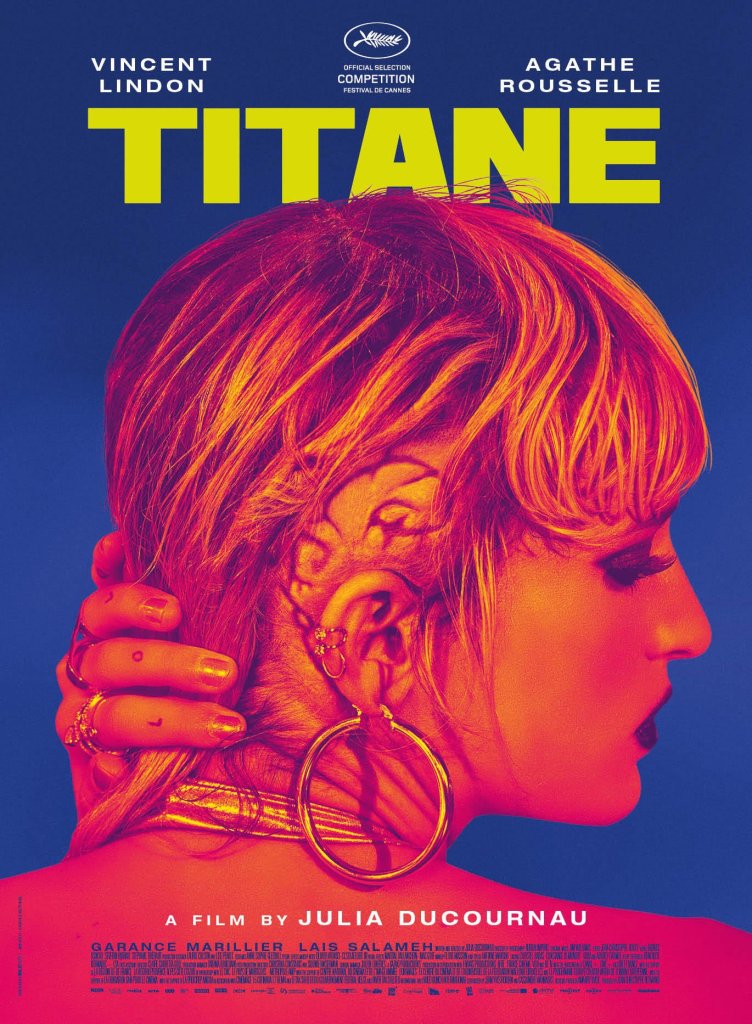
Horror Film Review: Titane (dir. by Julia Ducournau)


I like to think a person’s love of film reflects who they are. Please bear with me on this one.

The movies that move us, make us smile or laugh or cry tend to paint a picture. In some ways, this works out well. When your friend sits you down, shows you The Shawshank Redemption, watches you ball your eyes out and then laugh by the end, you get that slow nod that says..”This fellow, they understand.” The movie love spreads like that tape in The Ring. I’ve had this happen on separate occasions my Live Tweet experiences. The Manitou was an an absolute blast that had me laughing and asking myself just what the hell I was watching. A Field in England was a weird, wild trip that made me flinch at times. They may be stranger films, but they were were also great experiences. Without them, I wouldn’t have my eyes opened to what’s out there in terms of cinema.

I also believe the idea of loving anyone unconditionally is possible under the right conditions, but is a difficult concept. I’ve found that people are usually ready to “ride or die” with you as long as you are both moving along the same path, sharing the same mindset. However, there will always be something that puts a relationship (family/friends/lovers) to the test and maybe a line is drawn that can’t be crossed. It takes a lot for someone to bear all of their flaws before another person, just as it does to see them and say, “You’re cool with me.” It’s no different from having a family that loves you right up until that moment where your political or religious views diverge and you suddenly find yourself disowned because of it. That’s just my opinion.

I caught Julia’s Ducournau’s Titane last Thursday Night in a near empty theatre in Midtown Manhattan. I’ve been thinking about it in some form or another ever since. I went to catch it because I needed to get out and about for a little while, and I enjoyed Raw immensely. Just like Malignant, I went in blind, only really knowing it was a Ducournau film and seeing an image of a girl laying across a car. Maybe it was because by the end, I applauded like a seal and caught some strange looks from people on the way out of the theatre, but I kind of feel weird for enjoying this film as much as I did. I didn’t know what the hell I just watched, but it made me feel something, and that was enough. I’m not entirely sure of what that says about me as a person.

Agathe Rousselle as Alexia in Julia Ducournau’s Titane

Alexia (Agathe Rousselle, in her first full length film) is a live wire. Introduced to the audience as a child, we can see she works off of pure instinct. She also has a love for cars. When she sustains major injuries from a car accident, Alexia has to have a titanium plate (hence the movie’s title in one form) put into her skull that leaves a wild pattern on her skin. Alexia’s instincts carry with her into adulthood, but I saw her as being very feral. Whether it’s food or drink, or darker desires, she throws herself fully into it. Vincent (Vincent Lindon), is a leader and a rescue specialist coping with the loss of his son, who went missing some time ago. When their lives intersect, the plot for Titane seemed to change and for me, became a story about unconditional love. There is horror throughout Titane, suffer no illusions. Blood, broken limbs and all kids of fluids, but there’s also a sense of acceptance and forgiveness despite how dark things really get. Much like the automobile Alexia dances alongside, the plot felt like it shifted gears to the point I wasn’t sure what I really watching. Mind you, I didn’t really see a trailer or anything, so I didn’t have recognizable snippets to reference and say “Ah, I remember that from the trailer.” It may make the film a little hard for some audiences to follow. What I enjoyed, though I list it as a possible con, is that the film never bothers to tell you any of the how’s or why’s for anything you’re seeing. No explanations on why Alexia is who she is or how certain elements are possible. There’s no clear cut answer, like in Malignant.

It just is what it is.

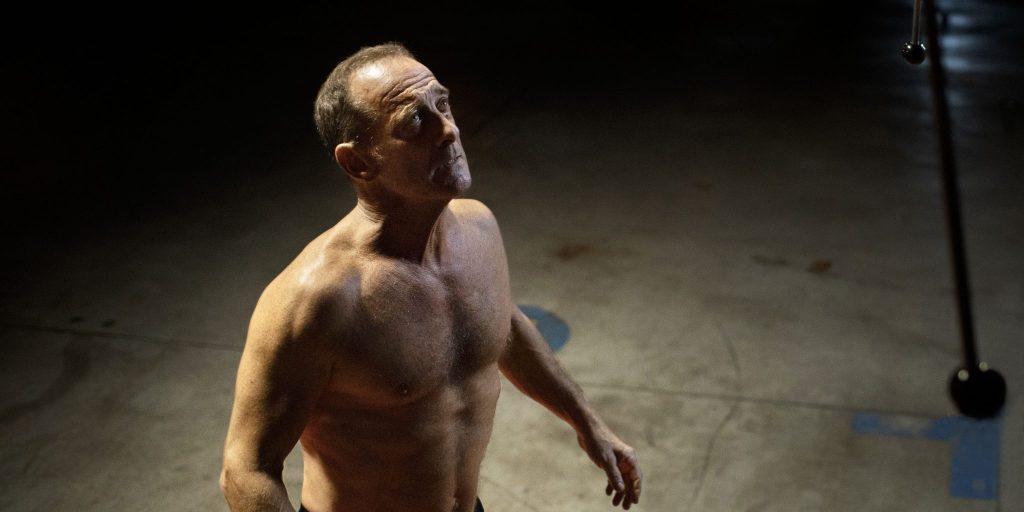
Vincent (Vincent Lindon), testing his limits in Julia Ducournau’s Titane

Both actors carry their roles very well. Rousselle’s Alexia moves between passion, violence and vulnerability in the blink of an eye and I hope that Titane serves as a launchpad for her in future roles. Lindon also goes through the same process, though his character is more nurturing (though just as broken). It’s really hard to imagine other actors doing all of this. Garance Marillier (Raw) reunites with Ducournau as Justine, one of the other dancers Alexia knows. This also brings up something I found interesting. With the exception of Vincent, the names of all of the principal characters are the same character names from Raw. I have to wonder if that’s just coincidence or maybe Ducournau just has a fondness for those names.

During the New York Film Festival, Ducournau said in the post movie Q&A that the film was based on a nightmare she had. She doesn’t play around at all here, and puts it all on view. Titane could easy sit on a shelf among Antonia Bird’s Ravenous, Mary Harron’s American Psycho, and Coralie Fargeat’s Revenge. The blood flow is vicious and mostly brutal. There was at least once sequence that made me flinch in my seat and say..”Oh damn!” while instinctively reaching for a body part. While the movie does contain some sexual scenes and nudity, they’re not terribly explicit. The sound quality in my theatre was loud and rich, so the squishes and breaks were pretty impacting. Ruben Impens returns to work with Ducournau as the Director of Photography and for the most part, the visuals were solid. Colors were vibrant and there weren’t any scenes that seemed like they didn’t work.

So, overall, I truly enjoyed Titane. Did I fully get it? I don’t know. A lot of it is up to interpretation, but I guess that can be said of any film. I give Ducournau and the actors credit for making something that felt strange. When I get a physical copy, I’ll probably sit it next to Jean-Luc Godard’s Weekend, easily one of the most confusing films I’ve seen (that I love).

Still, I have to wonder what that all says about me.

On a side note, I was about to publish this when I realized that Titane is also the winner of this year’s Palme D’or, which is the highest recognition given to a film at the Cannes Film Festival. While I haven’t enough personal knowledge to fully explain how good or bad that may be, Cannes has been in existence since the the mid 1940s. The Shattered Lens has followed Cannes for some time now. Titane shares the win with other films over the years such as Francis Ford Coppola’s Apocalypse Now, Martin Scorsese’s Taxi Driver, Bob Fosse’s All That Jazz and as recently as Jong Boon Ho’s Parasite. Ducournau’s only the second woman to have won the prize, along with Jane Campion for The Piano.

Horror Film Review: When A Stranger Calls (dir by Fred Walton)


“Have you checked the children?” the stranger on the phone asks the terrified babysitter, who is unaware that the children are already dead and that the call is …. COMING FROM INSIDE THE HOUSE!

That’s the premise behind both an oft-repeated urban legend and the opening of the 1979 film, When A Stranger Calls.  I’ve often seen the original When A Stranger Calls described as being one of the scariest films ever made.  That’s not quite true, of course.  The first 20 minutes or so are effective.  The final scene has a few intense moments.  The majority of what lies in-between feels like filler, albeit well-acted filler.

When A Stranger Calls opens with Carol Kane as Jill, a teenage babysitter who is terrified one night by a caller who keeps asking her if she’s checked on the children.  This sequence — really, a mini-movie all of its own — is so well-executed and suspenseful that many people assume that the entire film is just Jill dealing with the mystery caller.  Actually, that’s just the first few minutes and, once the location of the killer has been revealed, Kane disappears from the film for an extended period.  That’s a shame since Kane’s empathetic performance is perhaps the best thing that When A Stranger Calls has going for it.  She’s so convincing as the emotionally shattered babysitter that it doesn’t matter that, at the start of the film, she’s obviously not a teenager.

Instead, the middle part of the film focuses on John Clifford (Charles Durning).  Clifford is a former policeman-turned-private investigator.  He is obsessed with Duncan (Tony Beckley), the man who called Jill at the start of the film.  Duncan has just escaped from a mental institution and Clifford has been hired to track him down.  Clifford is convinced that Duncan will try to find Jill.  Duncan, meanwhile, wanders through the sleaziest sections of downtown Los Angeles, briefly living with a pathetic alcoholic named Tracy (Colleen Dewhurst).  Clifford, of course, is right about Duncan wanting to find Jill.  And Clifford is so determined to kill Duncan that he might even be willing to use Jill as bait….

After the brilliantly horrific opening sequence, it’s impossible not to be disappointed with the drawn-out middle section of When A Stranger Calls.  Durning, Dewhurst, and especially Beckley all give good performances and downtown Los Angeles is so repellent that you’ll want to take a shower afterwards but, narratively, there’s really not much happening.  Clifford finds Duncan. Duncan runs away.  Duncan acts like a jerk and gets in a fight.  Tracy drinks.  The old school cop Clifford scowls at the sleaziness of the world while Duncan continues to lose what little sanity he has left.  Give the film some credit for not portraying Duncan as being some sort of charming, loquacious master criminal.  He’s a total loser, as all serial killers are despite the later popularity of fictional characters like Hannibal Lecter.  Duncan hates both himself and the world with equal fury.  But, that said, the narrative stalls during the middle part of the film.  There’s only so many time you can watch two men chase each other down a trash-strewn street before it gets dull.

Fortunately, Jill does eventually show up again and, after an hour of relentless sleaziness, you’re happy to see Carol Kane, again.  Jill is now married and has children of her own.  And soon, she’s again getting a phone call asking if she’s checked on the children….

And, again, the closing sequence is scary, even if it’s not quite as intense as the opening.  (The opening was scary because we didn’t know what the killer looked like.  By the time Duncan finds Jill a second time, we now know that Duncan is a sickly-looking alcoholic who can’t handle himself in a fair fight.)  The film does have one great jump scare left in its arsenal of tricks.  And yet, it’s impossible to watch When A Stranger Calls without wishing that the whole thing had just focused on Jill instead of getting sidetracked with Clifford searching Los Angeles.

When A Stranger Calls will always have a place in horror history.  “Have you checked the children?” will always produce chills.  It’s just unfortunate that the film spends a good deal of its running time ignoring what makes it scary in the first place.

Horror on the Lens: Baffled! (dir by Philip Leacock)


Leonard Nimoy is a race car driver who can see into the future and who uses his powers to solve crimes!

Seriously, if that’s not enough to get you to watch the 1973 made-for-TV movie Baffled!, then I don’t know what is.  In the film, Nimoy takes a break from racing so that he and a parapsychologist (played by Susan Hampshire) can solve the mystery of the visions that Nimoy is having of a woman in a mansion.  This movie was meant to serve as a pilot and I guess if the series had been picked up, Nimoy would have had weekly visions.  Of course, the movie didn’t lead to a series but Baffled is still fun in a 70s television sort of way.  Thanks to use of what I like to call “slow mo of doom,” a few of Nimoy’s visions are creepy and the whole thing ends with the promise of future adventures that were sadly never to be.

Enjoy Baffled!  Can you solve the mystery before Leonard?

ORIGIN, Film Review, by Case Wright


I have a love/hate relationship with short films because there isn’t a middle ground. Film school is starting to look like a place to go to get in from the rain. When they’re done well, it’s so moving and amazing because in this short period of time, I cared about these characters and was sad to see them fail or overjoyed to see them win. What a lot of filmmakers fail to understand about the short is how challenging they are and really it should inform them that maybe they should try something else. Painting? Sculpting? Insurance? Mail Carrier? Many terrible short-filmmakers will evolve into terrible feature-length story tellers. They have to be stopped!

The short film becomes the proving ground for their bad habits: trading a shocking shot for narrative, trading grittiness for character likeability, trading story structure for a lazy jumbled mess masquerading as realism.

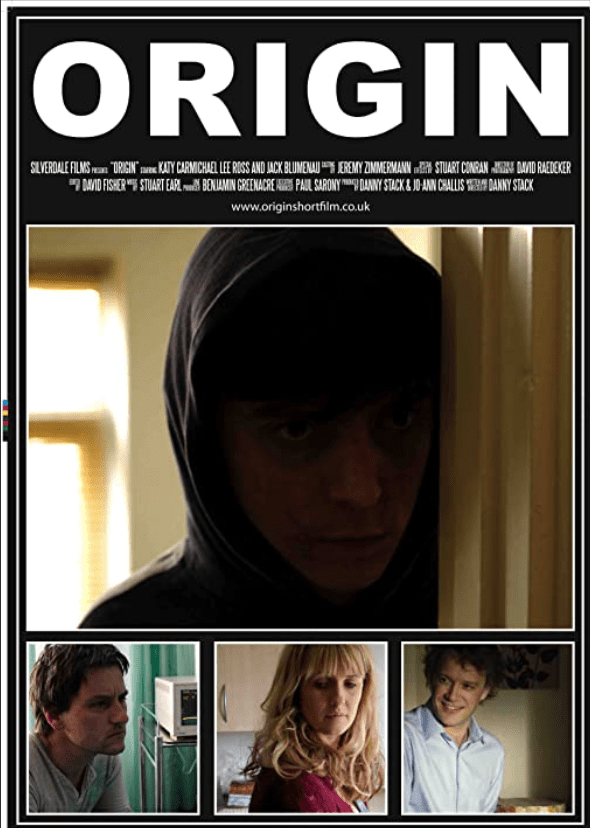
ORIGIN is the worst short that I’ve ever seen. It’s good in that it shows what NOT to do. The story is derivative and boring. The characters are unlikeable, which might trick a teacher into saying great realism, but in reality – banal unlikeable characters lower your stakes and destroy your final act. The dialogue is predictable. The emotion is stilted and unbelievable. Sadly, it was thirteen minutes too long (runtime 13 minutes).

ORIGIN depicts a banal and horrible family dealing with their son being attacked and slowly transforming into a monster. The son doesn’t speak and we learn nothing about him; so, I didn’t care when he died. The father was gross, boring, and annoying; so, I didn’t care when he had to put his monster son down. The mom was a boring/cheating whiner. Her dull and uncaring boyfriend was just sort of there sometimes like a mailbox. The mom and her boyfriend added nothing and slowed an already terrible story down.

What was really insulting was the hamfisted violins at the end that were way too loud to let me know- this is where you should feel……sad. Well, I didn’t and no one should. Don’t tell me how to feel. You have to earn concern. You have to earn stakes. Just having a bunch of unlikeable people running around is boring. We need a show on TLC called filmmaker intervention! This person must be stopped!