Stepfather III (1992, directed by Guy Magar)


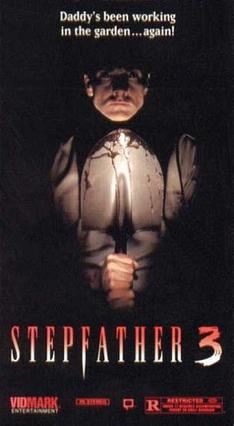
As if Stepfather II was not bad enough on its own, 1992 saw the release of Stepfather III.
Once again, Jerry Blake/Gene Clifford manages to survive being mortally wounded at the end of the previous film.  After he recovers, he is sent to the exact same institution that he previously escaped from.  Guess what happens?  He escapes again!  Now using the name Keith, he marries Christine Davis (Priscilla Barnes) and become stepfather to her son, Andy (David Tom).  Andy is in a wheelchair.  Keith is convinced that Andy is faking his condition and keeps calling him “slugger.”  When Andy doesn’t respond, Keith prepares to move on to another single mother (Season Hubley).  But, before he can move on, Keith needs to take care of his current family.  Good thing that he has a woodchipper.

Terry O’Quinn did not return for Stepfather III.  The Stepfather is played by Robert Wightman, who looked and sounded nothing like Terry O’Quinn.  The film tries to explain it away by saying that the Stepfather got plastic surgery after he escaped from the institution but, unless the plastic surgeon was God, there’s no way that Jerry/Gene could ever have become Keith.

Stepfather III goes through the motions and even repeats the first film’s “buckle up for safety” gag.  By repeating all of the key scenes from the first (and even the second) movie, the third movie only succeeds in reminding us that The Stepfather doesn’t work without Terry O’Quinn’s performance and Joseph Ruben’s intelligent direction.  Keith becomes a standard movie slasher with a wood chipper.  He does inspire Andy to get out of his wheelchair, in a scene that will inspire more laughter than cheers.

One positive note: Season Hubley is in this movie!  Much as with Jill Schoelen in the first movie and Meg Foster in Stepfather II, this franchise had a way of attracting actresses who deserved better.

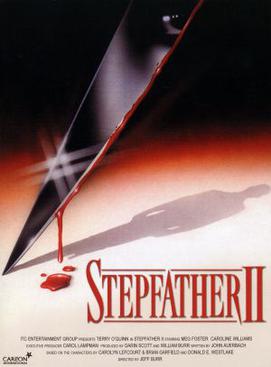
The Stepfather II: Make Room For Daddy (1989, directed by Jeff Burr)


Remember how, at the end of the first Stepfather film, Jerry Blake (played, in a classic horror performance, by Terry O’Quinn), was killed by the family that he was planning on murdering for not living up to his expectations?

It turns out that he wasn’t dead after all.  He was shot.  He was stabbed in the back.  Somehow, he wasn’t killed.  Also, despite being a mass murderer, he was sent to a mental institution where the security is so lackadaisical that he manages to murder a psychologist and a guard and then escape once again.

Taking on the name of Gene Clifford and passing himself off as a family therapist, the Stepfather continues his search for the perfect family.  He meets and becomes engaged to Carol (Meg Foster), who doesn’t find it weird that Gene is always whistling Camden Races.  Before he can marry Carol, Gene is going to need to dispose of her ex-husband and her best friend.  And, of course, Carol and her son Todd (Jonathan Brandis) are going to have to live up to Gene’s ideal of the perfect American family.

This is a disposable sequel, which eliminates all of the humor of the first film and just turns Jerry/Gene into another generic slasher.  The strength of the first film was that Jerry seemed likable up until the moment that his idealized vision of the perfect family was threatened.  Then he snapped and ended up in the basement, ranting and raving.  In Stepfather II, Gene is obviously dangerous from the start and a lot less interesting.  The movie is unfortunate and unnecessary and even Terry O’Quinn seems to be bored.  Give the film some credit, though, for giving Meg Foster a sympathetic role.  Gene may be crazy but no one could blame him for falling for Carol.  How could anyone resist those eyes?

International Horror Review: Don’t Deliver Us From Evil (dir by Joel Seria)


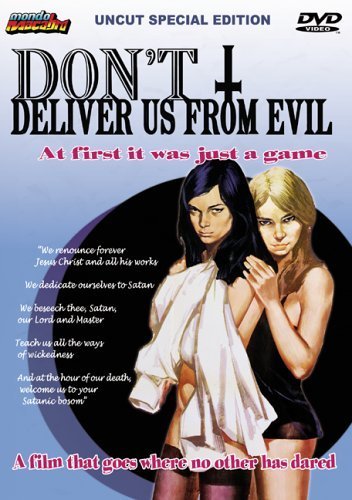
Reportedly, when this 1971 film was released in Europe, it was advertised as being “The French film that was banned in France.”

That wasn’t just hyperbole.  Don’t Deliver Us From Evil was so controversial that it was accused of promoting “blasphemy” and it was barely released in its native country.  It would be thirty years before the film was finally released in the United States and, even then, it would just be a DVD release.  The United States and France may not have agreed on much but apparently, they both agreed that Don’t Deliver Us From Evil was just too dangerous to be released into theaters.

The film is loosely based on a true story, the same 1954 Parker-Hulme murder case that would later inspire Peter Jackson’s Heavenly Creatures.  In Don’t Deliver Us From Evil, Pauline Parker and Juliet Hulme are reimagined as Anne de Boissy (Jeanne Goupil) and Lore Fournier (Catherine Wagener), two 15 year-old girls who meet at boarding school and become fast friends.  Together, they read sordid novels, they spy on the nuns, and they taunt the priest with fictional confessions.  (Anne has erotic fantasies about the priest during Mass.  Are you starting to get why some people considered this film to be blasphemous?)  During the summer, Lore stays at Anne’s estate.  Spending all of their time together, they start to play games that become increasingly dangerous and cruel.  For instance, they playfully taunt a pervy goat herder until the man attempts to rape Lore.  Lore and Anne manage to escape and they get their revenge by burning down the man’s home.  Meanwhile, they also find the time to cruelly taunt their mentally disabled gardener, pledge their souls to Satan, and eventually kill a stranger.  Uh-oh, summer’s over!  Time to go back to school.  Hopefully, Lore and Anne were able to successfully hide the stranger’s body because there certainly are a lot of police around.  It all leads to a shocking and rather disturbing finale.

The question running through the film is whether the girls are evil or if they’re just playing a game.  Many of their actions are undeniably cruel, especially when it comes to taunting the gardener.  But there are other times when Anne and Lore are revealed to be painfully naïve.  Having been raised by nuns and often ignored by their wealthy parents, Anne and Lore’s knowledge of sex and sexuality is largely the result of the “forbidden” books that they read late at night when everyone else is asleep.  For most of the movie, neither seems to care that their “games” have real world consequences but is that due to them being evil or is it due to them being completely sheltered and cut-off from the rest of the world?  When they pledge their souls to Satan, is it because they truly want to be evil or is it just something to do for a laugh?  Anne is undeniably the dominant personality in their friendship.  Anne has a near breakdown when she spends two days apart from Lore but, at the same time, it’s Anne who is constantly instructing Lore to do things that put her safety at risk.  Lore herself seems to be a follower, one who follows Anne even when Anne is putting Lore’s life at risk.

Don’t Deliver Us From Evil has enough sex, violence, and nudity (though Lore and Anne are both 15, the actresses playing them were 19 and 20) that it’s not surprising that the film was controversial.  That said, it’s not a bad film.  Much as Peter Jackson did when he told his version of the Parker-Hulme Murder Case, Don’t Deliver Us From Evil refuses to pass easy judgment on either of the girls.  Instead, it’s left to the viewer to try to figure out if Anne and Lore are evil or if they’re just immature and confused.  Director Joel Seria directs most of his ire not at the girls but at the Church and at Anne’s upper class parents.  Having pushed her off on the Church to raise, Anne’s parents never seem to be particularly interested in what their daughter is doing.  Even during the film’s apocalyptic finale, Anne’s parents (and really, just about every adult in the film) is clueless as to what’s actually happening right in front of them.

Watching the film, I could imagine the controversy that it caused when it was first released.  While some of the once-shocking scenes are tame by today’s standards, there are still a few moments that retain their power to shock.  Ultimately, though, Don’t Deliver Us From Evil is an intelligent exploration of la mauvaise caractère.

Horror Film Review: The Collector (dir by Marcus Dunstan)


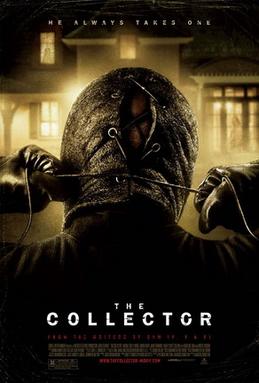
There are a few horror films that I dislike as much as I dislike 2009’s The Collector.

I guess that should be considered fair warning about how this review is going to go.

I’ve only watched this movie two times and, both times, it was as a part of a live tweet group.  The first time that I watched it, I absolutely hated it because I found it to be incredibly mean-spirited and lacking in any sort of wit.  It just felt like a rip-off of the Saw movies, with a bit of Hostel tossed in.  I felt that it was the least imaginative torture show that I had ever watched,

The second time I watched, I know what was coming so my reaction was not quite as viscerally negative as the first time.  I still didn’t like the film but I could at least see that there was some craft involved in the making of the film and there were even a few hints of wit at the start of the film.  I could even respect the fact that the film stayed true to its dark worldview.  The Collector was a truly creepy character, even if his motivations and his techniques made absolutely no sense.

That said, I simply cannot get beyond the death of the cat.

A cat is killed in the film and it’s such a gratuitous and mean-spirited scene that I simply cannot look past it.  There was absolutely no reason to kill the cat, beyond wanting to show off that this film was so hardcore that it was even willing to kill cute pets.  The way the cat died was sadistic.  It was unnecessary and the scene went on forever.  Sorry, The Collector.  You lost me.

What’s interesting, though, is that it’s not just the cat that dies in the film.  At least seven or eight people die over the course of this film.  Of the two main, non-villainous characters who are still alive at the end of the film, one only has a future of physical and mental torture to look forward to while the other is going to be psychologically scarred for the rest of their lives.  And yet, none of the human death and suffering bothered me as much as the death of the cat.  I guess some of that is because the humans were played by recognizable actors and I’ve seen enough behind-the-scenes documentaries to know how all of the gore effects are done.  I didn’t particularly enjoy the many scenes of people being tortured but I knew they weren’t really being tortured and that everyone was getting paid.  Of course, it also helped that none of the human characters were particularly likable or interesting.  The cat, meanwhile, was just an innocent house pet who was killed for absolutely no reason.

And yes, I know they didn’t kill a real cat.  Still, it was way too graphic and drawn-out for me.

So, maybe I just don’t like seeing animals suffer in horror movies.  But it really didn’t bother me when an attacking dog was killed towards the end of the film so maybe I just like cats.

Anyway, I didn’t like The Collector.

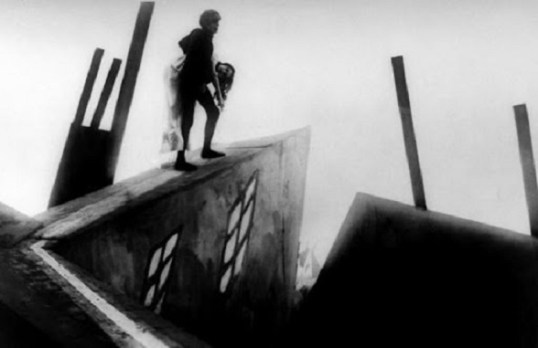
Horror on the Lens: The Cabinet of Dr. Caligari (dir by Robert Wiene)


The Cabinet of Dr. Caligari (1920, dir by Robert Wiene, DP: Willy Hameister)

The Cabinet of Dr. Caligari is a film that I’ve shared many times previously on the Shattered Lens.  The first time was in 2011 and then I shared it again in 2014, 2015, 2016, 2017, 2018, 2019, 2020, and 2021!  Well, you know what?  I’m sharing it again because it’s a classic, it’s Halloween, and everyone should see it!  (And let’s face it — it’s entirely possible that some of the people reading this post right now didn’t even know this site existed in any of those previous years.  Why should they be deprived of Caligari just because they only now arrived?)

Released in 1920, the German film The Cabinet of Dr. Caligari is one of those films that we’ve all heard about but far too few of us have actually seen.  Like most silent films, it requires some patience and a willingess to adapt to the narrative convictions of an earlier time.  However, for those of us who love horror cinema, The Cabinet of Dr. Caligari remains required viewing.  Not only did it introduce the concept of the twist ending (M. Night Shyamalan owes his career to this film) but it also helped to introduce German expressionism to the cinematic world.

My initial reaction to The Cabinet of Dr. Caligari was that it simply wasn’t that scary.  It was certainly interesting to watch and I was happy that I was finally experiencing this film that I had previously only read about.  However, the film itself was obviously primitive and it was difficult for my mind (which takes CGI for granted) to adjust to watching a silent film.  I didn’t regret watching the film but I’d be lying (much like a first-year film student) if I said that I truly appreciated it after my first viewing.

But you know what?  Despite my dismissive initial reaction, the film stayed with me.  Whereas most modern films fade from the memory about 30 minutes after the end credits,The Cabinet of Dr. Caligari has stuck with me and the night after I watched it, I even had a nightmare in which Dr. Caligari was trying to break into my apartment.  Yes, Dr. Caligari looked a little bit silly staring through my bedroom window but it still caused me to wake up with my heart about to explode out of my chest.

In short, The Cabinet of Dr. Caligari passes the most important test that a horror film can pass.  It sticks with you even after it’s over.

For the curious with an open mind to watch with, here is Robert Wiene’s The Cabinet of Dr. Caligari!

Enjoy!

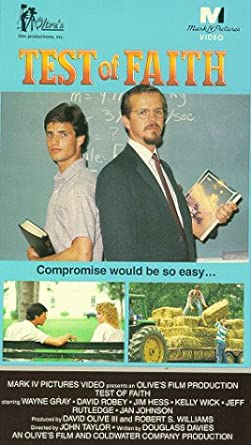
October Positivity: Test of Faith (dir by John Taylor)


The 1987 film, Test of Faith, tells the story of Taylor Mitchell (Wayne Gray) and Prof. Heinlien (David Robey).

Taylor is a religious farm kid who wants to be a scientist.  He’s received a scholarship to a prominent university!  The only catch is that Taylor has to maintain at least a 3.5 GPA or he’ll lose his scholarship.  That shouldn’t be too hard for Taylor.  He’s a smart kid and serious student.  Who could possibly give him a failing grade?

Prof. Heinlien is a Physics professor who is notorious for failing students who disagree with his views on religion, the Big Bang Theory, and evolution.  If a student wants to pass Heinlien’s class, they better be willing to set aside their backwards beliefs and just agree with everything that Heinlien says.  Every student on campus is terrified of Prof Heinlien.  Maybe it’s because Prof. Heinlien has a beard and a goat-tee that makes him look like Satan.

Taylor takes the professor’s class and together….

THEY FIGHT CRIME!

No, actually, they don’t.  Instead, Prof. Heinlien tries to teach about things like the Big Bang Theory and the Theory of Evolution and Taylor keeps interrupting him to argue that there is a scientific basis to the theory of Creationism as well.  Heinlien gets kind of annoyed with him and, if Taylor’s college is anything like my college, I imagine that the other students in the class got pretty annoyed as well.  Most students just want to take the notes, study the right chapters, pass their tests, and move on from the class.  There’s nothing more annoying than when there’s one person in the class who always wants to have a conversation with the teacher.  As I watched Test of Faith, I was reminded of how, in every English class I ever took, there was always one student who had to make a big deal about how “no one would read this book if it wasn’t required!”  Everyone would groan when he started talking but he never seemed to notice.

When it comes to faith-based films, the dilemma of religious students being mocked by atheistic professors has always been a popular subject.  The people behind God’s Not Dead has built an entire franchise out of the idea of Christian students challenging their professors.  Compared to the more recent examples of the genre, Test of Faith is actually rather low key.  Prof. Heinlien, for instance, may disagree with Taylor but, at the same time, he doesn’t bully him.  He doesn’t demand that the students sign a paper declaring that there is no God.  Unlike a typical professor in a film like this, he doesn’t rant and rave about how God didn’t save the life of his wife or mother.  Compared to the way that professors are usually portrayed in films like this, Prof. Heinlien actually comes across as being fairly reasonable.  For that matter, Taylor is not quite as self-righteous as viewers might initially expect.  In fact, Taylor and Heinlien are so reasonable that they’re actually a bit dull.  This is a film that could have used a little melodrama.

I have to admit that films like this, where a student has to stand up to a professor, are always a bit strange to me.  I always assumed that none of my professors knew what they were talking about so I never really worried about whether or not I agreed with them.  I’ve always assumed that most people were the same way.  When did people start respecting their professors enough to debate them?

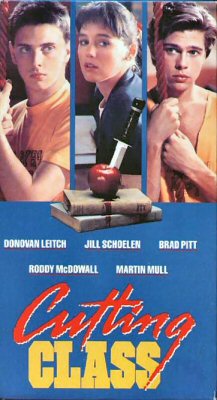
The TSL’s Horror Grindhouse: Cutting Class (dir by Raspo Pallenberg)


Someone is murdering the students and the teachers at the local high school and it’s up to Paula Carson (Jill Schoelen), the studious daughter of the local DA (Martin Mull), to figure out who is responsible!

Though the principal (Roddy McDowall, who seemed to be cast as a lot of bizarre school employees during the latter half of his career) is a perv and the janitor (Robert Glaudini) fancies himself as being some sort of bizarre ninja with a mop, it soon becomes apparent that there’s really only two viable suspects. One of them is Brian Woods (Donavon Leitch), who has just returned home after spending several months in a mental hospital where he was regularly given electroshock therapy. The other is Dwight Ingalls (Brad Pitt), the alcoholic jock who is under tremendous pressure to win a basketball scholarship and who also happens to be Paula’s boyfriend! Brian and Dwight were friends when they were younger. Now, Dwight spends all of his time bullying Brian and Brian spends all of his time staring at Paula. Who could the murderer be!?

Actually, you won’t be surprised at all when the identity of the murderer is revealed. You’ve probably already guessed who the killer is. A campy slasher film from 1989, Cutting Class doesn’t exactly win any points for originality. If Cutting Class is remembered for anything, it’s for providing Brad Pitt with an early leading role. Pitt, it should be said, is totally convincing as Dwight. On the one hand, he’s such a jerk that it’s difficult to really like him but, on the other hand, he looks like Brad Pitt so you totally can’t blame Paula for putting up with him. For that matter, both Leitch and Schoelen give convincing performances as well. When you’ve got a trio as talented as these three, it’s kind of a shame that Cutting Class wasn’t a better film.

Cutting Class tries to mix horror and comedy but the comedy is too broad (Roddy McDowall leers like a cartoon wolf) while the horror is not quite horrific enough and, as such, the film never really settles on a consistent or an interesting tone. Whenever the film starts to get into a horror grove, Martin Mull shows up like a character in an overplayed Saturday Night Live skit. Whenever the film starts to find itself as a comedy, someone is horribly murdered and you’re totally taken out of the mood. This is also another one of those films where the characters randomly switch from being ludicrously stupid to unnaturally intelligent from scene-to-scene. The killer, for instance, is diabolically clever until the film’s final moments, at which point the murderer suddenly gets very talky and very easily fooled.

Cutting Class is occasionally interesting as a time capsule. It’s from 1989, after all. And it’s interesting to see Brad Pitt playing the type of character one would more likely expect to see on a very special episode of Saved By The Bell. Otherwise, this one is fairly forgettable.

Retro Television Reviews: The City (dir by Harvey Hart)


Welcome to Retro Television Reviews, a feature where we review some of our favorite and least favorite shows of the past!  On Sundays, I will be reviewing the made-for-television movies that used to be a primetime mainstay.  Today’s film is 1977’s The City.  It  can be viewed on YouTube!

“Civilization began when man realized that he could not survive alone. He left the wilderness and built his citadels, security against intruders and erosion from within. The cities of the world have since become the crossroads of trade and ideas. Ideas that have made the human race more powerful than primitive man could ever have dreamed. Among these was an invention, a machine that conquered to contemporary enemies of man: time and distance….”

So goes the opening narration of 1977’s The City.  The narrator is the veteran character actor (and television producer) William Conrad and, as he speaks, we sees images of the California desert eventually being conquered by the growing city of Los Angeles.  It’s a bit of a portentous opening for a film that turns out to be fairly standard police procedural but it makes sense when you consider that The City was apparently meant to be a pilot for an anthology series about the people of Los Angeles.

The City features Mark Hamill, shortly before Star Wars would turn him into a cultural icon.  Hamill plays Eugene Banks, a sweaty, wild-eyed petty criminal who has made his way to Los Angeles from Texas.  Banks manages to get a nice apartment and a job working at a gas station.  One day, after a lawyer demands that Banks fill the tank of his Porsche, Banks snaps.  He grabs a wrench and attacks the car.  Then, he attacks the lawyer, beating the man until he dies.  Banks proceed to go on a crime and killing spree across Los Angeles, flashing a particularly scary-looking knife whenever he gets the chance.

Searching for Banks are two mismatched cops.  Matt Lewis (Robert Forster) is the tough-as-nails, emotionally reserved veteran with a bad knee and a determination to catch the bad guys.  The case becomes personal for Lewis after Banks kills his partner.  Brain Scott (Don Johnson) is a shaggy-haired country boy, much like Banks.  Brian comes from a wealthy family and is a bit more idealistic in his approach than Lewis.

Banks, it turns out, is obsessed with a country singer named Wes Collins (Jimmy Dean).  Banks not only resents the fact that Collins has everything that Banks has ever wanted but he’s also convinced that Collins is actually the father who abandoned him when he was a baby.  Banks wants to get revenge and he’s not going to let anyone, whether they be a bystander, a cop, or a dog, stand in his way.

Yes, Eugene Banks kills a dog in this film.  Fortunately, it happens off-screen but it’s still an indication of just how different this role is from Hamill’s best-known live action role.  As the two cops, Forster and Johnson work well together and bring their somewhat stereotypical characters to life but the main reason most people will watch this film will be for the chance to see Mark Hamill play an absolute lunatic.  With the exception of his somewhat dodgy Texas accent, Hamill does a good job with the role.  He’s got the crazy eyes down and he’s actually frightening when he attacks the lawyer at the start of the film.  The film itself is a bit predictable (i.e., the mismatched partners learn to work together, the bad guy gives a speech at an inopportune time) but The City is worth watching for the cast.

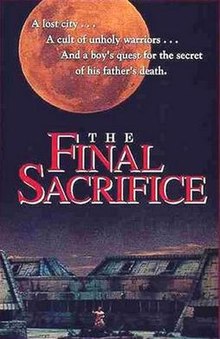
International Horror Film Review: The Final Sacrifice (dir by Tjardus Greidanus)


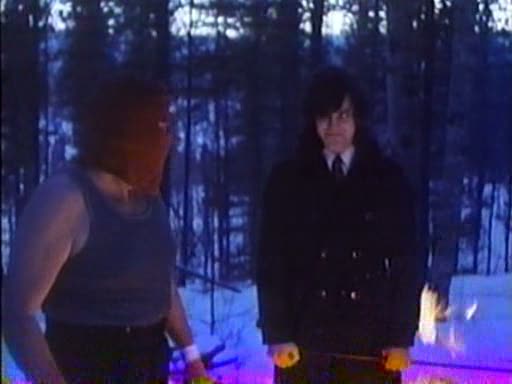
The 1990 Canadian film, The Final Sacrifice, opens in the snowy northern wilderness.  A man who I can only assume is a pro wrestler is hanging out with another man, who I can only assume is the lead singer for an emo band.  According to the film, the man in the suit is named Satoris (Shane Marceau) and he’s the leader of a cult.  All the other members of the cult wear a mask, even when they’re wandering about in broad daylight.  Why doesn’t Satoris wear a mask?  I’m not sure.

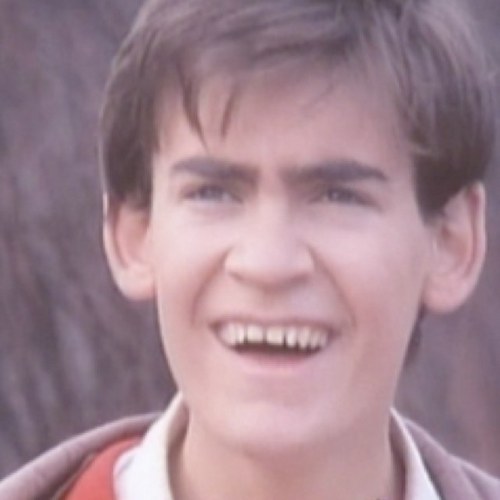
This is Troy McGreggor (Christian Malcolm), a teenager who looks like a mash-up of Anthony Perkins and Roddy McDowall.  For some reason, seven years ago, Troy’s father was murdered by Satoris and the cult.  Troy’s father was an archaeologist who was searching for a lost city that apparently used to exist a few miles outside of Toronto.  Now, for reasons that are never exactly clear, the cult is after Troy.  In order to escape from the army of masked men who are after him, Troy runs into the wilderness of Canada.

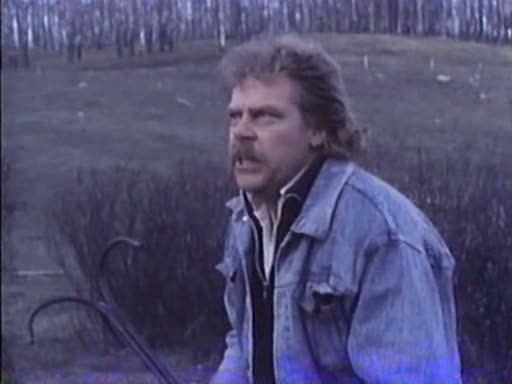
He’s going to need help to survive!  Preferably help with a mullet and a denim jacket…

This is Zap Rowsdower (Bruce J. Mitchell), whose name might as well just be Zap Canadian.  Zap not only rescues Troy from the cult but it also turns out that Zap is a former member!  It’s up to Zap and Troy to not only defeat Satoris’s evil plans but also to find this lost city.  It’s never quite clear what Satoris’s plan is, other than it involves taking over the world.  Speaking for myself, if Satoris can be defeated by a gawky teenager and an aging hockey fan, I really have to wonder if Satoris is actually as powerful as everyone assumes that he is.

This is my favorite character in the entire film, Mike Pipper (Ron Anderson).  Mike used to know Troy’s father and lives in a cabin in the woods.  Mike has a grizzled old prospector’s voice, which makes it impossible to understand what he’s saying but he was still fun to listen to.

Anyway, it’s not always easy to keep up with what exactly is going on with The Final Sacrifice.  The film’s low budget is obvious in every single shot and the poor sound quality often makes it difficult to keep track of what the characters are actually talking about.  The film has a sort of “make it up as you go along” feel to it.  Interestingly enough, that low budget is both the film’s biggest weakness and its great strength.  It may not be any good but you have to kind of respect the fact that a bunch of Canadian college students with no money still managed to make a movie.

The Final Sacrifice is one of those movies that works best if you watch it with a group of friends.  I watched it a few years ago with the members of the Late Night Movie Gang and we had a blast trying to figure out just what exactly was supposed to be going on.

The Final Sacrifice: Don’t watch it alone!

Horror Film Review: The Craft (dir by Andrew Fleming)


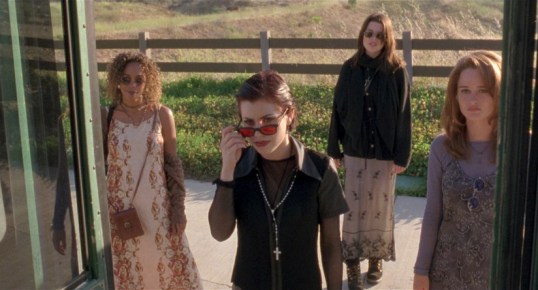
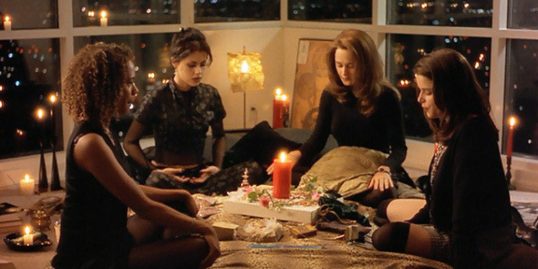
This 1996 film tells the story of four witches, all of whom attend the same very judgmental high school.

Nancy (Fairuza Balk) is their leader, the one who is most dedicated to worshiping the ancient deity “Manon.” Nacy dressed in black, like all good people. She also lives in a trailer park with her pervy stepfather and her chainsmoking mother. Sarcastic and quick with an insult, Nancy is an outcast and she’s proud of it.

Bonnie (Neve Campbell) is the quiet witch. She’s the one who wears baggy clothes and hardly ever seems to wash her hair. She’s insecure because her back is covered in scars, the result of a car accident. Bonnie follows Nancy’s orders.

Rochelle (Rachel True) is the witch who never seems to get to do much. As one of the only black students at the high school, she faces constant discrimination. She likes to swim. To be honest, we don’t find out much about Rochelle beyond that.

And then there’s Sarah (Robin Tunney). She’s the new girl at school, having just moved from San Francisco to Los Angeles. Bonnie is the first one who notices that Sarah has powers of her own. Even though Sarah is, at first, freaked out by Nancy’s talk of Manon, she eventually joins the group after a male student, the loathsome Chris Hooker (Skeet Ulrich), starts to spread rumors about her.

Together …. they solve crimes!

No, actually, they don’t. Instead, they cast spells. Fortunately, now that Sarah has joined the group, they’re finally powerful enough to actually make their spells mean something. Soon, each girl is getting exactly what she wants but they’ve forgotten the Rule of Three — every action returns to you threefold.

And, even worse, Nancy’s starting to act just a little bit crazed….

I love The Craft. In fact, to be honest, I have yet to meet anyone who doesn’t love the film. That doesn’t mean that the film is flawless, of course. There’s actually a whole lot of things that I could point out that don’t quite work about this film. For instance, the character of Rochelle is totally underdeveloped. Robin Tunney, as good an actress as she is, sometimes seems to be miscast as Sarah. (It’s hard not to feel that she and Neve Campbell should have switched roles.) The film starts out as a clever and sharp-tongued satire but it kind of loses its way towards the end, becoming a far more conventional supernatural thriller.

But no matter! Sometimes, the flaws just don’t matter. The Craft works because anyone who has ever felt like an outcast — and, let’s just be honest, that’s pretty much everyone — can relate to the film. At some point in their life, everyone has felt ostracized. Everyone has felt like they were on the outside looking in. Everyone has wished that they had the ability to cast a spell whenever they wanted. Everyone has felt like Sarah, Bonnie, and Rochelle and, even more importantly, everyone has felt like vengeful Nancy.

Perhaps appropriately, it’s the actress who plays Nancy, Fairuza Balk, who steals the entire film. It’s not that the other actors are bad. Indeed, the strong and likable cast is one of this film’s main strengths. But no one can quite match Balk’s intensity as Nancy. Balk manages to remain believable even while going totally over the top. In the end, Nancy is the most compelling character in the film. She may be a villain. She may kill a few people. But she’s also the only character willing to stand up for herself. Sarah’s magic may be powerful but she never seems to be having much fun with it. Nancy, on the other hand, is all about showing off what one can do with enough power.

I rewatched The Craft a few Halloweens ago and I’m glad that I did. It provided the perfect conclusion to that year’s October holiday. I look forward to watching it again in the future.