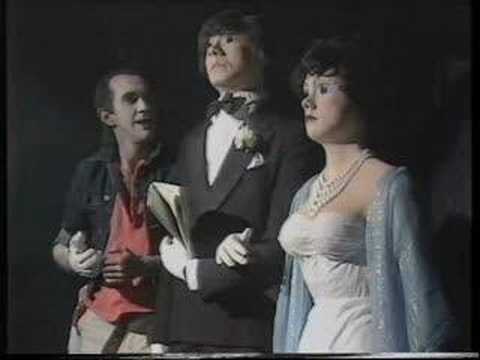
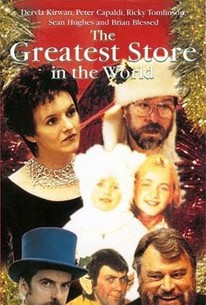
Holiday Spirit: The Greatest Store In The World (dir by Jane Prowse)


Here to help you get in the holiday spirit, we’ve got a British film from 1999!

The Greatest Store In The World tells the story of a single mother and her two daughters.  When the film begins, they’re living in a van but, after the van catches on fire, they upgrade things by moving into a luxurious London department store.  Along with coming together as a family and celebrating the holidays, they also thwart an attempt to rob the store.  It’s a good-natured little movie, one that reminds the viewer of how fun the world could be before the rise of COVID-fueled authoritarianism.  It was filmed in Harrods, though the name itself is not actually uttered in the film.  Fans of Doctor Who will want to keep an eye out for Peter Capaldi while fans of larger-than-life actors will be happy to see the great Brian Blessed.

(I should admit that, when I was little and my family was constantly moving from one state to another and I was always having to say goodbye to whatever new friends I had made, I used to fantasize about living in a big mall.  Perhaps that’s one reason why this sweet-natured film brought a tear to my mismatched eyes.)

Enjoy!

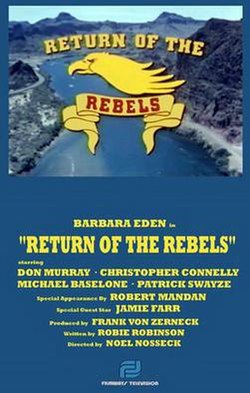
Retro Television Reviews: Return of the Rebels (dir by Noel Nosseck)


Welcome to Retro Television Reviews, a feature where we review some of our favorite and least favorite shows of the past!  On Sundays, I will be reviewing the made-for-television movies that used to be a primetime mainstay.  Today’s film is 1981’s Return of the Rebels!  It  can be viewed on YouTube!

Mary Beth Allen (Barbara Eden) used to be the wife of the leader of Rebels, Arizona’s toughest motorcycle gang.  She’s now a widow and she operates a Colorado River campground.  Her teenager daughter, Amy (Deanna Robbins), has got a crush on a local boy named K.C. Barnes (Patrick Swayze) and that’s a problem because K.C. is kind of a jerk.

Every weekend, K.C. and his gang descend on the campground and proceed to have a good time, redneck-style.  They set up a few kegs of beer.  They water ski.  They play loud music.  They get into fights.  They drive their vans all over the property.  They are so disruptive that Mary Beth is losing customers.  For reasons that are not quite clear, the police refuse to help her.  For some reason, K.C. seems to be determined to drive Mary Beth out of business.  And when I say “for some reason,” what I mean is that there’s absolutely no reason for K.C. to be as obnoxious as he is.  It’s not like he owns a rival campground or anything.  He’s not going to gain a thing by running Mary Beth out of business.  K.C.’s only motivation seems to be that he’s a jerk.  Unfortunately, he’s played by a young Patrick Swayze, who was a bit too likable to be believable as someone who would be a jerk just for the Hell of it. Swayze smirks and sneers and laughs whenever Mary Beth yells at him but, up until the last few moments of the film, he still comes across more as being an overgrown teenager who is too dumb to realize how annoying he’s being than a true villain.  When K.C. does suddenly reveal himself to be a true villain, it’s a bit jarring.  It’s like seeing the neighborhood bully suddenly pick up a gun and rob a bank.  Swayze’s character was definitely bad but he didn’t seem that bad,

Regardless of K.C.’s level of villainy, his antics are threatening to put Mary Beth out of business.  She goes into the city and pays a visit on Sonny (Don Murray).  Sonny used to be a member of the Rebels.  Now, he’s a fairly successful auto mechanic.  He’s also always been in love with Mary Beth.  When he finds out that Mary Beth needs help, he decides that it’s time to get the old Rebels back together so that they can put some young punks in their place. 

The problem, of course, is that some of the old Rebels are really, really old.  Al Williams (Robert Mandan) was once the most fearsome dude on a motorcycle but now he sells used cars and collapses after he’s challenged to run down to the end of the street.  Mickey Fine (Jamie Farr) is now more concerned with taking care of his family than riding motorcycles.  Jay Arnold Wayne (Christopher Connelly) is a wealthy businessman who …. well, he doesn’t get much of a personality beyond that.  “Wild” Bill Karp (Michael Baseleon) is still wild but he’s also middle-aged and out-of-shape.  

Can Sonny get the gang back together before K.C. takes over the campground?  And even if he can, will he able to gather enough former Rebels to take on K.C.’s surprisingly large gang?  Seriously, when K.C. and his gang show up at the campground, K.C. appears to be leading a convoy.  It’s almost as if the entire population of Arizona is following K.C. around for the weekend.

As you may have already guessed, Return of the Rebels struggles to find a consistent tone.  On the one hand, the battle between the old bikers and the young rednecks is a dangerous one and the film tries to generate some suspense over whether everyone will survive.  On the other hand, the film’s cast is full of sitcom veterans who often deliver their lines as if they’re waiting for a laugh track to punctuate their point.  On the one hand, Patrick Swayze’s gang is supposed to be dangerous.  On the other hand, they’re Patrick Swayze’s gang.  For a bunch of delinquents, it seems like all they really want to do is spend the weekend water skiing and drinking beer.  Obviously, beer and motorboats don’t always go well together but Swayze and his friends still never come across as being quite as dangerous as they’re supposed to be.

Return of the Rebels is a film about getting old.  The members of the Rebels have all found success but all of them are nostalgic for their days of being “outlaw” bikers and they get one final chance to show everyone what they can do.  It’s not a bad theme but again, the film can never quite make up its mind how seriously it wants us to take either the Rebels or Swayze’s gang.  It’s a bit of a mess.  That said, the scenery was gorgeous and I’m enough of a country girl that I definitely got a little thrill out of watching scenes of various pickup trucks and vans driving through the river.  I have a weakness for rebels and reformed bikers.  It’s an amiable film, even if it doesn’t make much sense in the end.

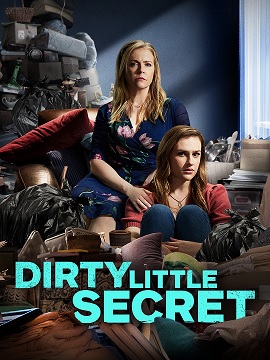
Cleaning out the DVR: Dirty Little Secret (dir by Linda-Lisa Hayter)


On the outside, Joanna (Melissa John Hart) and her 17 year-old daughter, Lucy (Lizzie Boys), seem like they have a good life.

Joanna is a nurse who is beloved by both her patients and her co-workers.  She works hard and she often worries about money but she is also responsible for saving lives.  One of her former patients, Drew (Edward Foy), has even fallen in love with her and is pursuing a relationship with her.  Drew is nice, considerate, and a financially stable.  He seems like he would be anyone’s dream but Joanna is hesitant about getting close to him or anyone else.

Lucy is a smart student and a talented artist and her guidance counselor thinks that she should apply to F.I.T. in New York City.  When Lucy says that she’s not sure that she could afford it, she is assured that she could probably get a scholarship or a grant.  Lucy has a close friend named Kaylie (Pavia Sidhu) and a potential boyfriend named Josh (Wern Lee) and she should be looking forward to a great future.  Instead, she’s spending all of her time making up excuses to keep people from coming by her house.

Joanna and Lucy share a secret.  Joanna is a compulsive hoarder.  Her house is so cluttered that she can’t find a thing.  While Joanna watches home improvement shows and talks about all of her plans for the future, Lucy struggles to find room to sleep.  Lucy is forced to take showers at school because Joanna couldn’t find the water bill.  When Lucy tries to secretly throw away some bubble wrap, Joanna catches her and yells, “What about if I want to send gifts!?”  The clutter is so terrible that Joanna is constantly struggling with her asthma.

It easy to cast Joanna as the villain here but, as the film makes clear, both she and Lucy have been abandoned by the rest of their family.  Joanna’s husband walked out years ago.  Lucy’s older sister, Sara (Samantha Hodhod), refuses to come by the house or even talk to Joanna but, at the same time, she expects Lucy to put all of her plans on hold so that she can take care of their mother.  Everyone has given up on Joanna but Lucy is convinced that she can somehow fix things.  It ultimately leads to tragedy and leaves the audience wondering if anyone in the family ever really had a chance.

This is one dark Lifetime movie.

I have to admit that, though I’m compulsively clean and organized, I always have a bit of sympathy for hoarders.  When you grow up in an unstable household, it’s easy to put a lot of importance in the things that you own because those are the thing that aren’t going to abandon you.  Even the simplest or most mundane items can come to represent either a good memory or hope for a better future.  I’ve seen a few episodes of Hoarders and I always despise the family members who yell at the hoarder for not throwing stuff out.  What the people yelling don’t understand is that those possessions are often the only source of comfort and stability that a hoarder has.  Throwing stuff away means throwing away memories and hope.  (The other reason why I don’t like it when people yell on Hoarders is because they’re usually only yelling to show off for the cameras.  People will ignore a problem for years and then try to play the hero as soon as a television crew shows up.)   Myself, I have a sentimental attachment to just about everything I own.  Fortunately, I also have a storage unit.  

Melissa Joan Hart does a good job playing Joanna, who alternates between pretending that everything is normal and flying into a rage whenever she can’t find something in the house.  Lizzie Boys is also effective as Lucy, who has been unfairly burdened with not only protecting the family’s secrets but also with taking care of her mother.  At the end of the movie, it’s obvious that both characters deserved to be treated better than they were.  Both characters sacrifice their chances for happiness in order to keep the family secrets.  It makes for an effective and sad Lifetime film, one that will hopefully inspire a little compassion for not only the hoarders but also the people who try to take care of them.

What Lisa Marie Watched Last Night #224: Ice Road Killer (dir by Max McGuire)


Last night, I watched Ice Road Killer on the Lifetime Movie Network!

Why Was I Watching It?

It had been a while since I had last watched a Lifetime movie and, with this year soon to come to a close, I figured that last night would be a good time to start catching up.

What Was It About?

While on her way to pick up her daughter from college, Helen (Sarah Allen) nearly runs over a young woman named Carly (Zoe Belkin).  Carly claims that she’s stranded.  Because the roads are icy and a heavy snow is falling, Helen agrees to give Carly a ride to wherever Carly is going.  Needless to say, Helen’s daughter, Lauren (Erica Anderson), is not amused.

Of course, what Helen doesn’t realize is that Carly and her boyfriend, Boyd (Connor McMahon), are planning on robbing her.  But what Carly and Boyd don’t realize is that they are being followed by a psycho trucker (Michael Swatton), who is looking for revenge.  

What Worked?

For a Lifetime film, Ice Road Killer had some effectively scary moments and some creepy locations.  (The motel where Helen, Lauren, and Carly initially attempted to spend the night was memorably run-down and it brought back some memories of my own childhood road trips.)  The ice, the snow, and the howling wind all added up to create an otherworldly atmosphere and Christopher Guglick’s original score was appropriately ominous.  

Michael Swatton was wonderfully creepy as the psycho trucker.

What Did Not Work?

A huge issue that I had was that Carly and Boyd’s robbery scheme never made sense to me.  Instead of just robbing Helen when she first stopped to pick up Carly, Boyd instead followed behind Helen and Carly while they drove down the icy road.  If you’re going to rob a random driver, it seems like it would make more sense to just do it and make a run for it instead of dragging it all out.

Another issue that I had was with the idea that anyone, in the year 2022, would actually pick up a hitchhiker, especially someone like Helen who had reason to not trust people in general.  I get that the weather was bad but still, it seems like a stretch that Helen would give Carly a ride, arrange for Carly to spend the night in a motel with Helen and her daughter, and then leave Carly — a total stranger — alone with the $500 that Helen could not afford to lose. 

You always have to be willing to suspend your disbelief when it comes to Lifetime films, that’s usually a part of the fun.  This film just asked you to suspend it even more than usual.

“Oh my God!  Just like me!” Moments

I am a fairly compassionate person and I do believe in helping those in need but there’s no way in Hell that I would ever pick up a hitchhiker, regardless of how bad the weather conditions are.  If I see a person stranded on the side of the road, I might feel bad for them but I’m still not going to let them get in my car.  I might encourage someone driving behind me to pick them up but I’ve seen too many horror films to make that mistake myself.  So, I couldn’t relate to that part of the film.

However, I also don’t drive well in cold weather.  When Helen ran her car off the icy road and nearly ran over Carly, I could totally relate to that.

Lessons Learned

Don’t pick up hitchhikers and by nice to truck drivers!

Heatseeker (1995, directed by Albert Pyun)


Directed and co-written by Albery Pyun, Heatseeker takes place in the near future, in the year 2019!  The world is a corrupt and dangerous place where the poor are getting poorer and the rich are getting richer.  Corporations are as powerful as governments.  (Albert Pyun, prophet.)  Each corporation is represented by an MMA fighter because it’s not enough that a corporation provide a needed good or service.  Their fighters also have to be able to win tournament after tournament.

Chance O’Brien (Keith Cooke) is a world champion fighter who is unique because he fights without corporate sponsorship and he is also not a cyborg.  While every other fighter has been “enhanced,” O’Brien remains all-natural.  Evil CEO Tsui Tung (Norbert Weisser) wants to show off his newest fighter, Xao (Gary Daniels).  Tung arranges for Chance’s girlfriend and trainer to be kidnapped as a way to force O’Brien to travel to New Manila and take part in the ultimate fighting tournament.  Tung’s plan is for Xao to defeat Chance while the entire world is watching.  Chance just wants to rescue his girlfriend, even if she is now being forced to train Xao.

Heatseeker, I watched in memory of director Albert Pyun.  Pyun was the master when it came to movies about cyborgs entering MMA tournaments and Heatseeker is typical of his films.  The plot is incoherent but no one is watching for the plot.  The fights are the attraction and Pyun doesn’t waste too much time before getting into them.  Gary Daniels and Keith Cooke may not have been the best actors but they were pros when it came to fight scenes and they both give it their all as the work their way to their inevitable final confrontation.  Since all of the fighters, except for Chance, are also cyborgs, that means that each match ends with sparks and exposed stainless steel.

Pyun fans will get exactly what they want out of Heatseeker.  Along with the tournament, Heatseeker also features performance from Pyun regulars like Tim Thomerson and Thom Matthews.  One thing it does not do is feature anyone seeking heart but you can’t have everything.


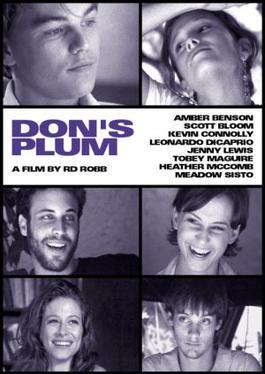
Film Review: Don’s Plum (dir by R.D. Robb)


Filmed in 1996 and given a very limited European release in 2001, Don’s Plum is a micro-budget indie film.  It’s about a group of young friends who meet up at a diner called Don’s Plum and spend the entire night talking to each other.  It’s filmed in grainy black-and-white and the majority of the dialogue is improvised.  The main characters continually let us know that they’re friends by referring to each other as “bro.”  There’s a lot of conversations but none of it adds up to much.  In many ways, it feels typical of the type of indie films that were inspired by the early work of Richard Linklater and Kevin Smith.  Unfortunately, it’s not a particularly good or interesting film.

That said, Don’s Plum has achieved a certainly level of infamy due to the fact that two of the talkative friends are played by Leonardo DiCaprio and Tobey Maguire.  DiCaprio plays Derek, an arrogant, abrasive, and manipulative womanizer.  Tobey Magurie plays Ian, a weirdo with a spacey smile.  DiCaprio and Maguire were both up-and-coming stars when they filmed Don’s Plum.  DiCaprio, who had already received his first Oscar nomination and who had just finished shooting William Shakespeare’s Romeo and Juliet, was a year away from Titanic.  Maguire was also a year away from his breakthrough role in The Ice Storm.  DiCaprio and Maguire not only starred in Don’s Plum but they’re also responsible for the film having never been commercially released in North America.

There’s a lot of conflicting stories about why DiCaprio and Maguire have both attempted to keep the film from being released.  DiCaprio’s story is that neither he nor Maguire were aware that they were shooting a feature film.  Instead, they thought they were making a short film and the only reason that they even showed up during the two nights of filming was because they were friends with the director, R.D. Robb.  The film’s producers, on the other hand, claimed that DiCaprio and Maguire always knew that they were making a feature film and that the reason they objected to the film’s release was because they were embarrassed by how much personal information they revealed while improving.  The truth is probably somewhere in between.

Of course, it’s also possible that DiCaprio and Maguire didn’t want the film to be seen because the film kind of sucks.  The dialogue is tedious, the film’s pace is painfully slow, the grainy black-and-white cinematography is dull, and the film’s soundtrack is so muddy that it’s difficult to understand what the characters are actually talking about.  Playing a total douchebag, DiCaprio does get to show off his natural charisma but Tobey Maguire appears to be dazed and confused in the role of Ian.  To be honest, both DiCaprio and Magurie are outacted by Kevin Connolly, who plays one of their friends and who would later go on to play the only vaguely likable character on Entourage.  (Connolly also directed the Brechtian gangster movie, Gotti.)  Connolly may not be as showy as DiCaprio or Maguire but his steady presence provides a nice contrast to Maguire’s fidgety mannerisms and DiCaprio’s need to always be the center of attention.

DiCaprio, Maguire, and Connolly are joined by Scott Bloom, playing the boring friend who will sleep with anyone.  Jenny Lewis gives a good performance in the role of DiCaprio’s quasi-girlfriend.  Amber Benson plays a hitchhiker who is abruptly chased out of the diner (and the movie) by an incredibly obnoxious DiCaprio.  At one point, Ethan Suplee wanders through the diner, playing a character who is identified in the credits as being “Big Bum.”  Everyone gets their chance to improv a monologue, often while staring at the bathroom mirror.  Eventually, DiCaprio’s character reveals a tragic secret from his past and it would have been an effective scene if not for the fact that it comes out of nowhere.

Oh, improv.  Improv has led so many directors and performers down the wrong path.  It’s an attractive idea, I suppose.  Get a camera.  Get some of your best friends to visit for the weekend.  Shoot a movie!  Who needs a script when you can just make it up as you go along.  Unfortunately, what’s often forgotten is that improv only works if you have a solid story idea or theme that you can continually return to if and when the improv itself starts to lose focus.  Curb Your Enthusiasm is a famous for being improved but all of the improvisations are based on a plot that’s discussed and set in stone ahead of time.  Don’s Plum feels more like one of those weird shows that George Clooney and Steven Soderbergh came up with for HBO in the mid-aughts.  (Remember that one with the acting class?  Frank Langella played a pompous acting teacher named Goddard Fulton and one of his students got a role on One Tree Hill.)  Don’s Plum meanders without any real direction, with none of the actors really trying to challenge each other.  An improved film like this needs a force of chaos, like Rip Torn provided for Norman Mailer’s Maidstone.  Instead, this film can only offer DiCaprio caricaturing his pre-Aviator persona as a hard-partying and often abrasive movie star.  (If nothing else, this film shows just how much DiCaprio has benefitted, as both an actor and a public personality, from collaborating with Scorsese.)

Don’s Plum is one of those films that is only well-known because of how difficult it is to see it.  But now you can see it on YouTube!  You can watch it and then you can ask yourself what all the controversy was about.  At this point, I think both DiCaprio and Maguire have proven themselves as actors and allowing for Don’s Plum to get, at the very least, a proper video release wouldn’t hurt the reputation of either one of them.  If anything, the best way to get people to forget about Don’s Plum would be to give them to the chance to try to sit through it.  There’s nothing about this film that sticks with the viewer, beyond the fact that neither Leo nor Tobey want anyone to watch it.

Retro Television Reviews: Sarah T — Portrait of a Teenage Alcoholic (dir by Richard Donner)


Welcome to Retro Television Reviews, a feature where we review some of our favorite and least favorite shows of the past!  On Sundays, I will be reviewing the made-for-television movies that used to be a primetime mainstay.  Today’s film is 1975’s Sarah T — Portrait of a Teenage Alcoholic.  It  can be viewed on YouTube!

In 1975, two years after shocking audiences in and receiving an Oscar nomination for The Exorcist, Linda Blair played Sarah Travis.  Sarah is fourteen years old.  She has a high IQ.  She lives in a nice suburban home.  She has an older sister named Nancy (Laurette Sprang) and she makes a good deal of money working as a babysitter.  Sarah lives with her mother, Jean (Verna Bloom) and her stepfather, Matt (William Daniels).  She misses her father, a chronically unemployed artist named Jerry (Larry Hagman).  Jerry is the type who will complain about how no one is willing to give him a chance while he’s day drinking early in the morning.  Jerry’s an alcoholic.  That’s one of the many things that led to Jean divorcing him.  (Matt is fairly regular drinker as well but it soon becomes apparent that he can handle his liquor in a way that Jerry cannot.  Matt has a glass of Scotch after work.  Jerry has his daughter by a slushy so he can pour his beer in the cup.)  Jean is always quick to keep Sarah from drinking.  When someone offers her a drink at a party, Jean replies that Sarah only drinks ginger ale.

Of course, the name of this movie is Sarah T. — Portrait of a Teenage Alcoholic so we already know that Jean is incorrect about that.  When we first meet Sarah, she is fourteen and she’s been regularly drinking for two years.  She’s even worked out a system where she gets liquor delivered to the house and then tells the deliveryman that her mother is in the shower but she left the money for the booze on the dining room table.  Like many alcoholics, Sarah has become very good at tricking people and hiding her addiction.  Of course, Sarah doesn’t think that she’s an alcoholic but …. well, again, just check out the title of the film.

When Sarah goes to a party with Ken (Mark Hamill, two years before Star Wars), the handsome captain of the school’s swim team, she ends up having too much to drink.  Nice guy Ken not only takes her home but also takes the blame, telling Jean and Matt that he was the one who gave Sarah the alcohol.  Jean, convinced that this is the first time that Sarah has ever gotten drunk, forbids her from spending any more time with Ken.  In the morning, Jean comments that Sarah will probably have a terrible hangover and maybe that’s punishment enough.  The joke, of course, is on Jean.  Sarah doesn’t even get hangovers anymore.

Soon, Sarah’s grades start to slip and she starts to skip class so that she can drink.  Still blaming Ken for all of Sarah’s problems, Jean finally takes Sarah to a psychologist, Dr. Kitteridge (Michael Lerner).  Dr. Kitteridge announces that Sarah is an alcoholic and recommends that she start attending A.A. meetings.  Sarah does go to one meeting, in which she meets a surprisingly cheerful 12 year-old alcoholic.  However, Sarah still has a way to go and so does the movie.  I mean, we haven’t even gotten to the scene where Sarah begs a group of older boys to give her the bottle of wine that they’re clumsily tossing in the air.  By the end of the film, she’s even managed to hurt poor, loyal Ken.

Myself, I hardly ever drink.  Some of that is because, like Sarah, I’m the daughter of an alcoholic and a child of divorce and I’ve seen firsthand how difficult it can be to live with an addiction.  (My Dad has been sober for five years and I am so proud of him!)  Of course, another reason why I hardly ever drink is because my tolerance for alcohol is amazingly low.  I get drunk off one sip of beer.  Long ago, I realized my life would be a lot easier and simpler if I just didn’t drink and so I don’t.  Watching the film, I wondered if I was watching what my life would have been like if I had gone the opposite route.  Would I have ended up like Sarah T?

Probably not.  Sarah T is one of those films that was obviously made with the best of intentions but it just feels inauthentic.  A lot of that is due to the performance of Linda Blair, who often seems to be overacting and trying too hard to give an “Emmy-worthy” performance.  There’s not much depth to Blair’s performance and, as a result, the viewer never really buys into the story.  At her worse, Blair brings to mind Jessie Spano shouting, “I’m so excited!” during that episode of Saved By The Bell.  (Blair was far better served by B-movies like Savage Streets, in which she got to kick ass as a vigilante, than by films like this.)  As well, the film’s portrayal of A.A. is so cheerful, upbeat, and positive that it almost felt like a Disney version of InterventionWho are all of these happy addicts? I wondered as I watched the scene play out.

Because I’ve been a bit critical of his acting abilities in the past, I do feel the need to point out that Mark Hamill gives the best performance in this film.  He plays Ken as being a genuinely decent human being and it’s hard not to sympathize with him as he gets in over his head trying to deal with Sarah.  If Blair plays every emotion on the surface, Hamill suggests that there’s a lot going on with Ken.  Deep down, he knows that he can’t help Sarah but he still feels like he has to try.  Though Blair may be the star of the film, it’s Hamill who makes the biggest impression.

As a final note, this film was directed by Richard Donner, who is best-known for directing The Omen, Superman and Lethal Weapon.  This was Donner’s final made-for-TV film before he moved into features.  There’s nothing particularly special about Donner’s direction of Sarah T.  If anything, the film’s pacing feels a bit off.  Fortunately, just as Linda Blair would get to prove herself as one of the queens of exploitation cinema and Mark Hamill would go on to achieve immortality as Luke Skywalker, Donner would get plenty of opportunities to show himself to be one of Hollywood’s premier, big budget maestros.

As for Sarah T., I would recommend watching it on a double bill with Go Ask Alice.
Comedians (1979, directed by Richard Eyre)


“Laugh, you buggers, laugh!”

Set in Manchester, Comedians is about a group of working class men who are enrolled in an evening class for aspiring comedians.  Sammy Samuels (Linal Haft) and Mick Connor (David Burke) both tell jokes about being a member of a minority in England.  (Sammy is Jewish while Mick is Irish.)  George McBrain (Derrick O’Connor) works on a loading dock and tells stereotypically racist and sexist jokes.  Phil and Ged Murray (James Warrior and Edward Peel) are brothers and a tense comedy team.  Phil is desperate to become a star and escape Manchester while Ged is more laid back.  Finally, Gethin Price (Jonathan Pryce) is an aggressive comedian who is willing to take risks on stage.  Teaching the class is Eddie Water (Bill Fraser), a veteran comic who was a star during World War II but who has since faded into obscurity.  Gethin says that he’s lost his edge.

Bert Challenor (Ralph Nossek), a retired stand-up and an old colleague of Eddie’s, is in town.  Challenor is now the President of the Comedy Federation and he is scouting new talent.  Eddie’s class will be performing, between games, at a bingo hall.  Before the performance, Eddie admonishes all of them to stay true to themselves and to not pander to the audience with cheap, racist, or sexist jokes.  However, when Challenor drops by the class, he gives the comedians the opposite advice.  He tells them that getting laughs is the most important thing and the only way to do that is to make the audience like you.  Stick to the acceptable targets, move quickly from one joke to the next, and don’t make any of your humor too personal.

The bingo hall performance is the highpoint of Comedians.  Each student performs and each one has to make their own decision whether to follow Challenor’s advice or to stay true to what Eddie told them.  Some sell out and some don’t.  One act implodes on stage.  The bravest performance of the night is greeted by stony silence from the audience.  Each performance allows a look into the mind of the man telling the jokes, even the ones who are trying to hide behind Challenor’s advice.  After the performance, the students return to the classroom and consider what they’ve done and they’ve become.  Challenor comes to the class to offer some of the comedians a contract while dismissing the others as not being ready or worthy of his time.

Comedians started life as a play by Trevor Griffiths.  It opened in London in 1975, where it was directed by Richard Eyre.  Just as he would in the eventual film, Jonathan Pryce played the role of Gethin Price.  When the play moved to Broadway in 1976, Mike Nichols took over as director and Pryce was the only actor to make the transition from New York to London.  Pryce would go on to win his first Tony for his performance in Comedians.  In 1979, when Comedians was filmed for the BBC’s Play For Today, Richard Eyre returned to direct and Pryce, again, played the role of Gethin Price.

As a debate about what makes comedy “good,” Comedians feels especially relevant today.  The debate about how comedians should view their audience and the role that comedy should play in an unstable world is still going on today.  As opposed to the current argument that comedy should always “punch up,” Challenor encourages all of the students to punch down and to get laughs by appealing to the prejudices of the audience.  As Challenor suggests when giving his notes to the students, it’s more important to get laughs than to actually be funny.  As unsympathetic a character as Challenor is, Comedians does acknowledge that the students who got those easy laughs are also the same ones who going to escape the drudgery of working dead end jobs in Manchester.  Comedians like Gethin Price may stay true to themselves but they’ll also probably never become a star.

Very much a filmed version of a theatrical production, Comedians is undeniably stagey.  But the dialogue and the themes remains sharp and Pryce’s performance is still electrifying.  Unfortunately, several of the BBC’s Play For Today productions have been lost or destroyed but Comedians survived and can be viewed on YouTube.

The Eric Roberts Collection: Top Gunner (dir by Daniel Lusko)


In this 2020 film from The Asylum, Eric Roberts stars as Col. Herring.

Herring is in charge of an Air Force training base that sits off the coast of Baja California.  He’s tough and he’s no-nonsense but he also truly loves the pilots that are training under his guidance.  Sparrow (Carol Anne Watts), Cowboy (Ignacyo Matynia), and Spielman (Julian Cavett) might just be recent graduates from the Academy who have never actually served in combat but Herring is convinced that they can be amongst the best of the best.  As he puts it, they can be …. Top Gunner!

They get a chance to prove themselves when an advanced airplane carrying a U.S. black ops group makes an emergency landing at the base.  As Lassen (Reavis Dorsey) explains it, he and his people have just stolen a chemical weapon from the Russians and now, the Russians are desperate to get it back.  The weapon is continually referred to as being the CRISPR.  The word “CRISPR” is used about a hundred times over the course of this movie.  “We have to get the CRISPR!” various characters say.  The problem is that CRISPR sounds more like a name for a hamburger grill than a dangerous chemical weapon.  Seriously, who wouldn’t want to use the CRISPR to prepare dinner?  The CRISPR grills up the best burgers!

With the Russians heading towards the base, it falls on the untested pilots to take to the air and fight them off.  At first, no one has much confidence in the pilots.  Even the pilots themselves aren’t sure that they can defeat the Russians.  But you know who never loses faith?  Colonel Herring.  The Colonel may be a stern taskmaster but he believes in his pilots!

As you’ve probably already guessed, Top Gunner was meant to be a mockbuster of Top Gun: Maverick.  However, because the release of Top Gun: Maverick was continually delayed by the COVID lockdowns, Top Gunner was actually released on video a full two years before Maverick made it into theaters.  That makes it all the more interesting that Top Gunner is all about preventing an enemy nation from using a chemical weapon that, we’re told, could cause a pandemic if released upon humanity.  In a world where COVID didn’t (allegedly) escape from that lab and cause the world to come to a halt, Top Gunner‘s story would probably be described as being implausible.  However, in our current pandemic culture, it’s tempting to look at the pilots in a film like Top Gunner and say, “Where were you when we needed you?”

As you’ve probably already guessed, the budget of Top Gunner was nowhere close to the budget for Top Gun or Top Gun: Maverick.  As opposed to those two films, one never gets the feeling that the pilots in Top Gunner are actually flying their planes or risking their lives to get the shot.  The film’s plot also never makes a whole lot of sense.  But the action moves quickly and, as always, Eric Roberts is fun to watch.  His hair is perhaps a bit too long for an Air Force colonel and there are a few times when he seems to be struggling to hide his amusement at some of his dialogue.  But, for the most part, Roberts delivers his lines with the proper amount of authority.  At last count, Eric Roberts has over 700 credits to his name.  Top Gunner is certainly not the best film that Roberts has ever appeared in but it’s not the worst either.  Mostly, it’s a film just makes you happy that, no matter what else happens, Eric Roberts endures.

Previous Eric Roberts Films That We Have Reviewed:

  1. Star 80 (1983)
  2. Blood Red (1989)
  3. The Ambulance (1990)
  4. The Lost Capone (1990)
  5. Love, Cheat, & Steal (1993)
  6. Love Is A Gun (1994)
  7. Sensation (1994)
  8. Doctor Who (1996)
  9. Most Wanted (1997)
  10. Mr. Brightside (2004)
  11. Six: The Mark Unleased (2004)
  12. Hey You (2006)
  13. In The Blink of an Eye (2009)
  14. The Expendables (2010) 
  15. Sharktopus (2010)
  16. Miss Atomic Bomb (2012)
  17. Lovelace (2013)
  18. Self-Storage (2013)
  19. Inherent Vice (2014)
  20. Rumors of War (2014)
  21. A Fatal Obsession (2015)
  22. Stalked By My Doctor (2015)
  23. Stalked By My Doctor: The Return (2016)
  24. The Wrong Roommate (2016)
  25. Stalked By My Doctor: Patient’s Revenge (2018)
  26. Monster Island (2019)
  27. Seven Deadly Sins (2019)
  28. Stalked By My Doctor: A Sleepwalker’s Nightmare (2019)
  29. The Wrong Mommy (2019)
  30. Her Deadly Groom (2020)
  31. Just What The Doctor Ordered (2021)
  32. Killer Advice (2021)
  33. The Poltergeist Diaries (2021)
  34. My Dinner With Eric (2022)

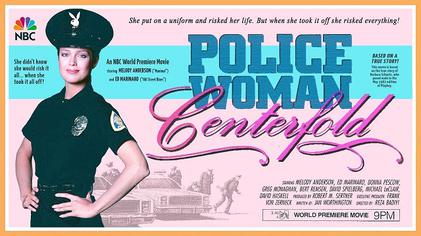
Retro Television Reviews: Policewoman Centerfold (dir by Reza Badiyi)


Welcome to Retro Television Reviews, a feature where we review some of our favorite and least favorite shows of the past!  On Sundays, I will be reviewing the made-for-television movies that used to be a primetime mainstay.  Today’s film is 1983’s Policewoman Centerfold.  It  can be viewed on Tubi!

Jennifer Oaks (Melody Anderson) is a former wild teen turned cop.  While her friends from high school walk the streets, Jennifer rides in a squad car.  It’s not always easy.  She is one of the only women on the force and the men refuse to take care her seriously, no matter how times she proves herself as a police officer.  Recently divorced, she live in a trailer park with her son, Tommy (Jerry Supiran).  At the start of the film, her partner informs her that he’s going to be requesting a new partner because apparently, his wife has issues with him working with another woman.

Jennifer’s new partner is Nick Velano (Ed Mariano).  “Are you Italian?” she asks him at one point, because I suppose the fact that his name was Nick Velano wasn’t enough of a clue.  (For the record, Nick is Italian.)  Though Jennifer says that she doesn’t date the people with whom she works, she makes an except for Nick.  It turns out that Nick, along with being Italian, is an amateur photographer.  After Jennifer says that she’s never felt attractive, Nick snaps a few pictures of her to prove her wrong.  Jennifer is so impressed with the pictures that she mails them off to Centerfold Magazine.  Nick, of course, is a huge fan of Centerfold, though he insists that he just reads the articles.  That said, Nick is not happy when he discovers that Jennifer is going to appear in a pictorial.  For that matter, neither is the police department.  Neither are Jennifer’s parents.  Neither is Tommy, especially after a bunch of older kids beat him up for having an attractive mom.  (I’m not really sure what the logic was there.)  However, Jennifer finds the experience to be liberating and she refuses to apologize for her decision.  When the chief of police attempts to kick her off the force, Jennifer goes to court.

Centerfold Magazine is obviously meant to be a stand-in for Playboy.  Of course, when I say that, I mean that it’s a stand-in for the way that Playboy liked to present itself as opposed to the reality.  In Police Woman Centerfold, Centerfold is a progressive magazine that only employs the most professional and polite of photographers.  In real life, Playboy was a tacky left-over from the late 60s and Hugh Hefner was a creepy old weirdo who lived in a dilapidated mansion and who was notorious for abandoning his models once they had fulfilled their purpose.  In Police Woman Centerfold, Centerfold Magazine is so idealized that its portrayal verges on parody.  It’s like one of those dreary communist propaganda films, where everyone in the collective can’t stop smiling and singing about how happy they are because there’s someone off camera pointing a gun at their head.

Fortunately, Melody Anderson gave a good performance in the main role, playing Jennifer as someone who had been beaten down by life but who still refused to give up hope for a better future.  The film itself may not have always taken Jennifer’s story seriously but Anderson herself did and, as a result, this film a bit better than it has any right to be,