Holiday Film Review: Christmas Evil (dir by Lewis Jackson)


Poor Harry Stradling!

As played by Brandon Maggart in the 1980’s Christmas Evil, Harry is a poor guy who lives alone and spends his days thinking about Christmas.  When Harry was a child, he and his brother, Philip, had an argument about whether or not the Santa they saw in their living room was the real Santa or just their father dressed up as Santa.  Philip claimed that there was no Santa.  Harry insisted that there was.  Later, Harry snuck downstairs and caught his mother doing a lot more than just kissing Santa Claus.  It was enough of a trauma that, 33 years later, Harry is still obsessed with bringing Santa Claus to life.  While Philip (Jeffrey DeMunn) has started a family, Harry is an emotional stunted manchild.

Harry does a lot of creepy things in Christmas Evil, even before the film reaches it’s bizarre denouement.  He starts his day spying on the local children and making a list as to who has been nice and who has been sneaking an adult magazine into his bedroom.  There’s also the scene where he masturbates while secretly watching Philip and his wife.  That’s a bit …. yeah.  Eeek!  And yet, as creepy as Harry can be, it’s hard not to feel bad for him.  His love of Christmas and Santa is just so sincere and earnest.  He’s so obsessed with Christmas that he even has a managerial job at a local toy factory.  The toys are shoddy, his bosses are hypocrites, and his co-workers take advantage of him.  Harry has so many reasons to be miserable but he’s not.  His love for Christmas is the thing that keeps his life going and which gives him hope.

Eventually, Harry decides that maybe he could be the new Santa!  He puts on the beard.  He makes the costume.  He decorates his van with a picture of sleigh and, while he drives it, he gives orders to his imaginary reindeer.  He steals a bunch of toys and tosses them into a bag and, while its snows outside, he joyfully hands out the presents at a children’s hospital.  Later, when he gets dragged into a Christmas Party, he gives out even more toys.  He tells the kids to be good because if they’re bad …. ho ho ho!

Yay for Harry, right?  Well, the problem is that some people aren’t as happy to see Santa as the children are.  Some people make the mistake of mocking Harry, which leads to Harry using his toys to murder them.  Soon, the police are dragging in random Santas and forcing them take part in a lineup.  Meanwhile, Harry drives around town and continues his quest to become the new Santa!

And maybe …. just maybe, he does.  It all depends on how you interpret the ending.  The film’s director, Lewis Jackson, has officially said that most people are not correctly interpreting the ending but I don’t care.  Harry may be a murderer and a weirdo but, dammit, he’s just so earnest!  He deserves a happy ending!

Christmas Evil is often described as being a slasher film but it’s actually more of a character study.  Imagine Taxi Driver if Travis Bickle dressed up Santa.  Harry may be insane and dangerous but he still tries to do some good in the world and, in the end, he wins the hearts and support of the children.  Christmas Evil is an odd mix of mental squalor. gritty grindouse imagery, and holiday earnestness.  Christmas Evil was certainly not the only early 80s “slasher” film to focus more on the killer than his victims but, as opposed to Maniac and Don’t Go Into The House, it’s one of the few to generate some sympathy for its main character.  Everyone deserves a happy Christmas, even (or maybe that should be especially) Harry Stradling.

Holiday Spirit: Santa Claus Conquers The Martians (dir by Nicholas Webster)


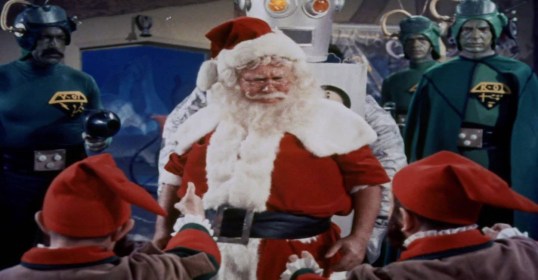
Watching the 1964 holiday sci-fi epic, Santa Claus Conquers The Martians, is a Christmas Eve tradition here at the Shattered Lens!  So, sit back, turn on Kid TV, and get ready to sing!

S

A

N

T

A

C

L

A

U

S

HOORAY FOR SANTY CLAUS!

Holiday Spirit: Santa Claus (dir by Rene Cardona)


Today’s holiday movie is …. well, it’s a little bit odd.

Santa Claus is many things but, for the purposes of this post, Santa Claus is a 1959 Mexican film that reminds us that before he became an advertising icon, Nicholas Claus was a Catholic saint.  According to this film, St. Nick also apparently lives in outer space with a bunch of singing children.  His best friend is Merlin and he apparently gets along with Vulcan, the Roman God of fire, as well.

Perhaps angered by the way that Santa is beloved by children of all races and figures of all mythologies, Lucifer orders a little demon named Pitch to go to Earth and turn the children against Santa.

So yeah, Santa Claus is really weird.  However, if you’ve ever wanted to see a movie where Santa is revealed to be a God-like action hero who holds the fate of the world in his hands, this is the film for you!

Holiday Spirit: An American Christmas Carol (dir by Eric Till)


On Christmas Eve, a miserly businessman is visited by a series of ghosts who help him understand the true meaning of Christmas, along with showing him a frightening vision of a possible future.

And that businessman was named …. Benedict Slade!

Yeah, the name’s have been changed and the action has been updated to Depression-era New England but this is basically the story of Scrooge.  Henry Winkler stars as the Scrooge character in the 1979 made-for-TV movie.  His old age make-up was done by none other than Rick Baker!

Holiday Spirit: Beyond Tomorrow (dir by A. Edward Sutherland)


After three eccentric businessman arrange for a young couple to get together right before the holidays, a plane crash kills the three men.  However, their ghosts remain on Earth to watch over the couple and to take care of some unexpected holiday business.  The film is a holiday film and a comedy and a romance and a musical and a ghost story and a melodrama and finally an oddly sincere meditation on life and death.

From 1940, here’s Beyond Tomorrow!

Holiday Spirit: Santa And The Ice Cream Bunny (dir by Richard Winer)


The year is 1972 and Santa Claus’s magic sleigh is somehow stuck on a beach in Florida!  Can the children help Santa free his sleigh?  If not, he’s going to force them to listen to another fairy tale!  Fortunately, the Ice Cream Bunny is always willing to help …. eventually.

Patrick says this is the worst holiday movie ever made.  Watch it and see if you agree!

Retro Television Reviews: A Very Brady Christmas (dir by Peter Baldwin)


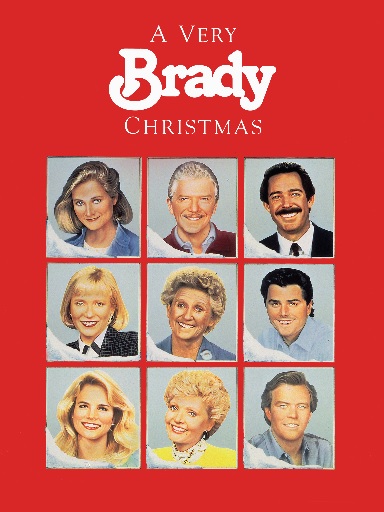
Welcome to Retro Television Reviews, a feature where we review some of our favorite and least favorite shows of the past!  On Sundays, I will be reviewing the made-for-television movies that used to be a primetime mainstay.  Today’s film is 1988’s A Very Brady Christmas!

In A Very Brady Christmas, America’s creepiest family reunites for the holidays.

Mike and Carol Brady (played by Robert Reed and Florence Henderson, of course) have finally got their house to themselves!  The children have all moved out.  A few have even gotten married and started families of their own.  Mike is still an architect, though he now has a mustache that, along with his gray hair, makes him look more like a retired porn actor.

With Christmas approaching, Mike and Carol have each been secretly saving up their money to give the other a trip.  Carol knows that Mike loves Greece.  Mike suspects that Carol would love to go to Japan.  In the end, though, they realize that they would much rather have the entire family come together for Christmas!  They buy tickets for everyone.  Of course, what they don’t know is that each of the Brady kids has an issue of their own.

For instance, consider the youngest of the Brady kids.  Cindy isn’t even herself anymore, mostly because Susan Olsen declined to return for the reunion and Jennifer Runyon was cast in her place.  Cindy is away at college and she’s upset that she has to cancel her plans to go skiing just so she can spend the holidays with her family.  Meanwhile, Bobby (Mike Lookinland) has dropped out of college so that he can race cars on the NASCAR circuit but he hasn’t told his parents yet!  Of course, if Bobby never tells them, he can just keep pocketing that sweet, sweet tuition money.

Meanwhile, Peter Brady (Christopher Knight) is upset because his girlfriend is his boss and she makes considerably more money than he does.  Jan (Eve Plumb) is secretly separated from her husband but, because it’s the holidays, they agree to pretend to still be together so that Mike and Carol don’t get upset.  Greg (Barry Williams) has grown up to be a smarmy doctor but he is upset that his wife will not be joining him for Christmas with his parents.  And Marcia (Maureen McCormick) is trying to keep everyone from discovering that her loser husband has lost his job.

And let’s not forget Alice (Anne B. Davis)!  Alice finally married Sam The Butcher but their marriage is on the rocks….

Could the Bradys be more cursed?

Luckily, Mike and Carol are pretty good at uncovering problems and fixing things.  (Except, of course, for that time that Mike never figured out that Marcia was acting strange because she wanted to surprise him with his father of the year prize….)  Unfortunately, Mike is a bit distracted because his latest building was constructed with cheap material.  When an earthquake causes the building collapse, Mike takes it upon himself to rescue two trapped workers.  (Most of this takes place off-screen, of course.)  When an aftershock hits, it seems like Mike might never emerge from the tomb that he helped to design.

Much like the show that inspired it, A Very Brady Christmas is painfully earnest and …. well, it’s a little dumb.  Of course, the main appeal of The Brady Bunch was always the unapologetic mix of earnestness and stupidity but it’s a bit different when all the Brady kids are grown up and they’re still acting just as dumb as they did when they were younger.  Robert Reed looks annoyed.  Florence Henderson is trouper and gives it her all.  With the notable exception of Maureen McCormick, none of the kids grew up to be particularly good actors.  (In all fairness, Barry Williams is likable when he makes fun of himself but, in this film, he’s somewhat stiff as the most successful of the Brady kids.)  That said, the family singing a Christmas carol while waiting to discover whether or not Mike is dead is one of those moments that is somehow both silly and effective at the same time.  It’s pure Brady Bunch.  To quote Tony Montana, it’s the yayo of nostalgia.

A Very Brady Christmas aired in 1988 and was enough of a rating success that it actually led to the Brady Bunch being (briefly) revived.  Today, it’s impossible to watch the movie without imagining Gary Cole and Shelley Long as Mike and Carol Brady.  Even the collapse of the building is no longer an effective dramatic moment due to it being referenced in The Brady Bunch Movie.  When Mike does emerge from that collapsed building, you half expect him to say, “Wherever you go, there you are.”

In the end, the Bradys have a merry Christmas.  I hope you have one too!

Film Review: Fang (dir by Richard Burgin)


Poor Billy.

Billy (Dylan LaRay) lives in Chicago and, at first glance, he’s typical of the many anonymous young men who we see everyday, working in dead-end jobs and just trying to make it day-to-day without having to deal with too much trouble.  Billy works at a meatpacking plant, for a condescending boss who brags about being able to pay his daughter’s Princeton tuition while, at the same time, telling Billy that he needs to work harder sweeping up the place.  “Do you think my daughter got into Princeton by taking sick days?” the boss asks, not seeming to realize that Billy will never be going to Princeton regardless of how many hours he spends pushing his broom around the warehouse.  Indeed, Billy dropped out of school a few years ago.  His mother, Gina (Lynn Lowry of I Drink Your Blood and Crazies fame), is suffering from Parkinson’s-related dementia and Billy is constantly rushing home to check on her.  Billy never knows if he’s going to be embraced or attacked when he steps through his front door.  Billy takes a daily regimen of pills to keep his mind stable.  He obsessively washes and sanitizes his hands.  He needs everything to be in its proper place but he lives in an increasingly chaotic and unpredictable world.

The one thing that Billy has going for him is that he’s an artist.  He’s created an entire fictional world through his drawings, one in which a group of people escape from a dying Earth but then continue to make the exact same mistakes in their new home.  His mother’s maid, Myra (Jess Paul), even suggests that Billy should try to get his work published but Billy is resistant.  His art is his escape and, though it’s never specifically stated, one gets the feeling that it’s an escape that he wants to keep only for himself.  If Billy ever gets out of this world, he’s not planning on taking anyone along with him.

Billy is haunted by the things that he sees as he walks to and from work.  Death, whether represented by a dead rodent under a car or by the run-down neighborhood in which he lives, seems to be all-around.  After a rat invades his room and bites him, Billy is rushed to the hospital and, despite his frantic protests, he’s injected with the rabies vaccine.  (The film’s use of rabies and it’s close-up of a hypodermic needle piercing Billy’s skin will remind some viewers of another Lynn Lowry film, I Drink Your Blood.)  Whenever Billy is alone, he sees a hole growing on his arm, one that is full of coarse hair, almost as if there is something living within Billy’s skin.  Fang mixes Cronenbergian body horror with visions of Romero-style urban decline.  Billy’s Chicago is almost as run-down and bleak as Romero’s Philadelphia was in Martin.  The stark imagery leaves little doubt that Billy, at the young age of 23, has basically advanced as far as he’s going to advance in the world.  He’s hit a dead end and Billy’s sudden visions of open wounds, vacuous comedians, and rats would seem to suggest that, if there is another world out there, it’s not much of an improvement on the one in which Billy is leaving.  Much like the characters in his artwork, Billy is trapped in a never-ending cycle of mistakes and decay.  

Fang is a well-directed, well-acted, and well-visualized portrayal of life on the fringes of society, one that captures both the timeless theme of loneliness and the uniquely paranoid atmosphere of today.  Though the COVID fears of the past two years are never explicitly mentioned, it’s hard not to think of them as Billy obsessively washes and sanitizes his hands and as he panics over getting the rabies shot.  Billy, like so many people today, feels lost and powerless and even his fantasy of escape is tempered by the knowledge that a fantasy can still go wrong.  Dylan LaRay does a good job of capturing Billy’s fear and his anger and Jess Paul is sympathetic as one of the few people to actually cares about what Billy and his mother are going through.  Lynn Lowry steals the film, playing Billy’s mother as someone who is both frightening and heart-breakingly sad.  Much like Billy, she’s no longer is control of her fears and her actions.  Fang is a film that captures the horrors of everyday life.


Avatar: The Way of Water (dir. by James Cameron)


James Cameron is still out there, trying to push the envelope.

My showing of Avatar: The Way of Water was not only 3D, but in HFR (High Frame Rate), which threw me for a loop. The only other movie I’ve ever watched on a large screen in HFR was The Desolation of Smaug and what was by mistake. The underwater scenes in the film are a sight to behold, but your eyes and mind need to adjust to it. HFR is that thing Christopher McQuarrie and Tom Cruise warned us all about earlier this year, the feature on most modern tv’s that enable a ‘smoothing’ effect. Films that normally look grainy are suddenly “live” under the HFR. It works really well for nature shows and sports events, and with a land as lush as Pandora, it’s good if you know what it is. I’m just not sure how well that will translate for audiences at home or for individuals who are new to it all. I can’t even begin to know what the underwater shooting was like for this film. James Cameron is known to be hard on his cast & crew. Ed Harris supposedly decked him once on the set of The Abyss and Mary Elizabeth Mastratonio once walked off set after they had a film issue on one point. I want to say that whatever they went through for The Way of Water seems to have paid off, but the state of movie theatres overall may have something else to say about that.

There were maybe only 3 people in my 3pm showing, and they seemed to stay for it. I know Cameron wants to save it all, but I feel the theatre experience is still dying. That’s a discussion all it’s own, but not here and now.

The Way of Water finds us having moved on some years after the events of the first film. Jake (Sam Worthington, Man on a Ledge) and Neytiri (Zoë Zaldaña, Guardians of the Galaxy) have a family of five now, living amongst the Omaticaya clan of Na’vi in the lands they moved to since losing Hometree in the first film. The boys, Neteyam (Jamie Flatters, Black Dog) and Lo’ak (Britian Dalton, Ready Player One) are like teenage Marines in training, dutifully following their dad’s orders up until the point where curiousity gets the best of them. The daughters, Kiri (Sigourney Weaver, Aliens) and little Tuk (Trinity Jo-Li Bliss), take a bit after their mom in some ways. There’s also Spider (Jack Champion, The Night Sitter), a young human who is close to Kiri. When humans return to Pandora, the Sullys find themselves once again under attack and on the run, colonization being the big bad it always was. Jake’s just trying to protect his family as best he can, something any parent can relate to. This takes them to a separate water based Na’vi tribe that takes them in and shows them their way of life. That, I really enjoyed. Though I’m mostly a loner at heart, seeing families and communities gel and work together plucks all the right heartstrings for me. There’s nothing that good teamwork can’t resolve and the story keeps circling that with Cameron’s “Family as a Fortress” theme.

If the Saw Movies taught us anything, it’s that you can always expand on a single story with fillers. They took one film, and weaved tons of side points without damaging the main thread. The Fast & Furious films did the same, making sure to keep the continuity, while adding additional content in between. Cameron had four other writers on board along with himself – Shane Salerno (Aliens vs. Predator: Requiem), Amanda Silver (War of the Planet of the Apes), Rick Jaffa (Dawn of the Planet of the Apes), and Josh Friedman (Terminator: The Sarah Connor Chronicles). With The Way of Water, I felt they were pretty successful at doing the same. The film even plants a few seeds here and there for future installments, should Cameron get the green light to go forward with his other 3 films.

If the plot suffers from any problems, it’s that they also took a page out of the Top Gun: Maverick flight manual in following the first film’s flow a little too closely. While The Way of Water has a plethora of new content – vehicles, machines, animals, locales – the story still moves along the path of the first film, making it just a little predictable. I was able to call out two scenes before they occurred. Other than those moments, I spent most of the film either really worrying about the Sully family – they’re outgunned, after all – and marveling at the views.

The editing is also a little weird. I understand this is a big undertaking, but some of the cuts between scenes seemed really abrupt to me, as if someone said…”This scene is out to explain this..you got it?! Good! Moving on to the next…” ..while the audience is still frantically taking notes on what just happened. At 3 hours and 12 minutes (just 11 minutes longer than Avengers: Endgame), there’s a lot to see, but I felt the pacing was okay. If there’s any part of the movie that could be used for a bathroom break, there is an extended sequence with a whale-like creature that could be your best opening. The movie might require more than one viewing to take it all in, but perhaps this is Cameron’s plan all along. One never truly knows.

The sound in The Way of Water was good. Explosions are sharp, animal sounds are cute and the hissing/wailing of Na’vi are clear (though strangely annoying after a while – we get it, you’re in pain or angry, ). The one element I was concerned with was the music. With James Horner’s passing in 2015, those shoes would be a little hard to fill. I originally hoped that Marc Streitenfeld would get the nod, based of his work on Prometheus. Composer Simon Franglen picks up where Horner left off, having worked together on the original Avatar score. Franglen knocks it out of the park, with a score that pays homage to Horner’s work while still making it his own sound.

The Way of Water introduces some new characters and cast. In addition to those previously mentioned, we also have Kate Winslet (Titanic) and Cliff Curtis (Sunshine) as the leaders of the Water Na’vi. Bailey Bass (Claudia in AMC’s Interview With the Vampire) plays their daughter, who helps to train the Sully children. Edie Falco (Nurse Jackie) is on board as a General charged with operations on Pandora. Jermaine Clement (What We Do In The Shadows) is also on hand as a marine scientist. Although everyone’s performances are good, the movie really belongs to the Sully children, with Weaver’s Kiri being the standout. Kiri’s a great character, reminding me a lot of Jinora from The Legend of Korra, and her story arc might be the best one of the lot.

Overall, Avatar The Way of Water is some serious eye candy. You might feel a little sad coming back to Earth after all the wonder Pandora has to offer. Disney could go wild on the merchandizing on this if they wanted (and they probably will). It manages to drop a number of surprises and information on the audience, though the overall trip may be a little too similar to the first film. I’m hoping Cameron gets the 3rd film set.

Retro Television Reviews: Born Innocent (dir by Donald Wyre)


Welcome to Retro Television Reviews, a feature where we review some of our favorite and least favorite shows of the past!  On Sundays, I will be reviewing the made-for-television movies that used to be a primetime mainstay.  Today’s film is 1974’s Born Innocent!  It  can be viewed on Tubi!

Fresh off of her Oscar-nominated role in 1973’s The Exorcist, 15 year-old Linda Blair starred as Christine “Chris” Parker in Born Innocent.

Chris is a 14 year-old who has frequently been caught running away from home.  When you consider her home life, it’s easy to understand why she keeps running away.  Her father (Richard Jaeckel) is quick to lose his temper and obviously has no clue how to relate to a teenage daughter.  When he gets angry at Chris, he beats her.  Chris’s mother (Kim Hunter) spends all of her time smoking cigarettes, watching TV, and refusing to acknowledge what Chris is going through.  Chris’s older brother (Mitch Vogel) has escaped from their abusive home but he’s now got a family of his own and there’s no room for Chris.  With no other options available to her, Chris resorts to frequently running away from home.  In the eyes of the system, this makes her both a delinquent and a repeat offender.  However, as quickly becomes apparent, Chris is very naïve and hardly a criminal.  Instead, she’s just someone trying to escape a terrible situation.

After getting caught once again, Chris is sent to a juvenile detention center.  Unfortunately, because of overcrowding, Chris is sent to one of the toughest centers, one where she is surrounded by people who have done a lot more than just run away from home.  Everyone knows that Chris doesn’t belong at the center but there’s no where else to send her.  With the exception of one teacher (played by Joanna Miles), the staff is too overwhelmed to look after Chris.  Meanwhile, the other inmates see Chris as being an easy victim and they start to bully her.  Eventually, Chris loses her innocence and becomes just as ruthless and angry as her former victimizers.

Born Innocent is often described as being an exploitation film and, indeed, one can just look at the artwork at the top of this review and see how the film was advertised when it was eventually released on video.  That said, the film itself may be undeniably melodramatic but there’s also a sincerity and a sensitivity to it that sets it apart from other women in prison films.  Born Innocent is all about how the System creates criminals.  From the start of the film, it’s obvious that being locked up is the last thing that Chris needs.  Instead, Chris just needs someone to be willing to listen to her but the System would rather just toss her in juvenile hall and then forget about her.  Only Chris’s teacher cares about her but, by the time they actually meet, it’s already too late for Chris.  She’s already been tossed into a situation where the only thing that matters is survival.  Born Innocent is controversial for a scene in which Chris is attacked by several other inmates and sexually assaulted with with a plunger.  It’s a shocking scene and I can only imagine have television audiences in 1974 reacted to it.  In this scene and the scenes that immediately follow, Linda Blair gives a harrowing performance that captures the emotional trauma of what Chris has been put through.  It’s not easy to watch and that’s the point.

Unfortunately, Blair is a bit less convincing during the second half of the film, in which Chris becomes progressively more and more cold-hearted.  The idea is that Chris, in order to protect herself, becomes just as intimidating as the girls who attacked her.  Unfortunately, the vulnerability that made Linda Blair ideal for The Exorcist and the first half of this film also make it difficult to take her seriously as cold-hearted sociopath.  During the second half of the film, Blair tries so hard to come across as being tough that she never convinces us.  Later, in films like Savage Streets, Blair would become one of the toughest badasses around but, in this film, she still come across as being essentially born innocent.