Horror Film Review: The Astral Factor (dir by John Florea)


Filmed in 1978 but not released until 1984, The Astral Factor tells the story of Roger Sands (Frank Ashmore).

Known as the Celebrity Killer, Roger is a serial killer who murdered women who reminded him of his famous mother.  It may seem like Roger is destined to spend the rest of his life in prison but what the legal system didn’t consider is that Roger has the ability to not only move things with his mind but to also turn himself invisible.  How did Roger get those powers?  Who knows?  At one point, Roger’s psychiatrist mentions that Roger was a student of the paranormal.  Later, it’s revealed that he had several books about the supernatural in his bedroom.  Apparently, Roger figured out how to do it himself.

Anyway, Roger is now invisible and soon, he has escaped from prison.  He is determined to kill the five women who testified against him at his trial, both because they remind him of his mother and also because he blames them for sending him to prison.  Roger strangles his victims, which in this case means that the actresses playing them have to pretend like they’re struggling with someone who can’t be seen.  In fact, Roger spends almost the entire film in a state of invisibility.

How do you catch a killer who can’t be seen?  It’s a fair question but police Lt. Charles Barnett (Robert Foxworth) might have the answer.  Barnett’s solution involves grabbing a gun and keep firing it until you hit something.  That’s a straight-forward solution but The Astral Factor is a pretty straight forward film.  The film begins with Roger turning invisible and, to its credit, it doesn’t spend too much time trying to justify or explain Roger’s magical powers.  The film understands that all the audience really needs to know is that Roger can’t be seen and that it’s up to Lt. Burnett to find a way to stop his killing spree.

The Astral Factor is a low-budget film, one that is full of formerly prominent performers who obviously showed up to get a quick paycheck.  Sue Lyon, Marianne Hill, Leslie Parrish, and Elke Sommer all play potential victims and all of them look like they would rather be doing anything other than appearing in The Astral Factor.  Robert Foxworth, to his credit, does his best to give a convincing performance as a level-headed cop who is forced to accept the reality of the paranormal.  Not only is he having to investigate a series of murders but he’s having to do it on his birthday.  Stefanie Powers plays his girlfriend, Candy.  Candy often refers to herself in the third person whenever she’s having a conversation with her boyfriend.  I tend to do the same thing so at least there was a character in this movie to whom I could relate.  Knowing the rules of the genre, I spent the entire movie expecting Candy to be put in danger and I was actually impressed when my expectations were subverted and that didn’t happen.

With the exception of a few atmospheric scenes and an entertainingly garish and tacky dance number, the film itself has the rather flat look of a made-for-TV movie, though the occasional hint of nudity indicates that it was meant to be a theatrical release.  As I mentioned at the start of this review, The Astral Factor was originally filmed in 1978 but it sat on the shelf until 1984.  That’s when a slightly shortened version was released under the title The Invisible Strangler.  Today, the film is available in countless Mill Creek Box Sets, under its original title and with its original run time restored.
Horror on the Lens: The Boogie Man Will Get You (dir by Lew Landers)


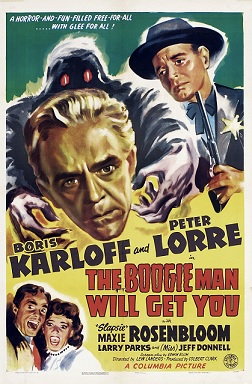
Today’s horror on the lens is a short horror comedy from 1942.  In The Boogie Man Will Get You, Winnie Slade (Miss Jeff Donnell) buys an old house from Prof. Billings (Boris Karloff) with plans to covert it into a hotel.  However, one of the conditions of the sale is that Prof. Billings and his servants be allowed to live on the property.  What Winnie doesn’t know is that Prof. Billings had been conducting experiments on traveling salesman.  He hopes to turn them into supermen who, much like Captain America, can then be sent overseas to fight the Nazis.  However, his experiments have yet to be successful and have mostly just resulted into a lot of salesman being buried out in the rose garden.

However, things start to look up for Prof. Billings when he meets Dr. Lorencz (Peter Lorre), who is not only a doctor but also a mayor, sheriff, and dog catcher.  Seriously, Dr. Lorencz can do it all!

The Boogie Man Will Get You is a fun little time capsule of the time in which it was made.  For horror fans, it is mostly interesting because it features both Boris Karloff and Peter Lorre.  Both Karloff and Lorre appear to be having a lot of fun parodying their usual screen images.

Enjoy!

October Positivity: Glorious (dir by Juan Daniel Zavelta)


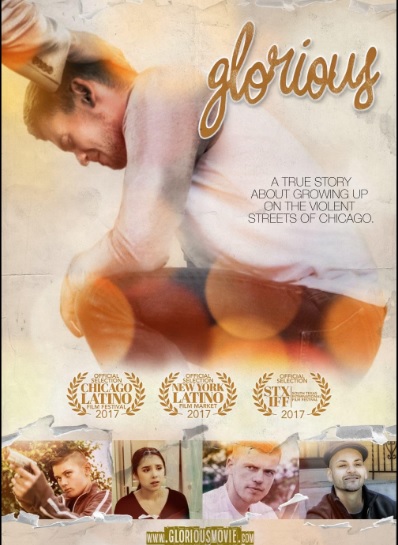
2016’s Glorious tells the apparently true story of Vince, a kid from Chicago.

Vince (played, as a child, by Gabriel Aaron Zavelta) starts life with a lot to overcome.  For one thing, his family is poor.  He’s never met his father and his mother (Olga Cunningham) is often busy at work, leaving Vince alone with his stepfather (Paul D. Morgan).  Vince’s stepfather is quickly established as being a cruel and abusive man, one who looks for any excuse that he can find to beat Vince.  When, after taking a shower, Vince drips water on the “clean rug,” his stepfather sees that as an excuse to take Vince into the basement and whip him with a belt.  At school, Vince never fits in and is introverted and shy.

It’s not until a local gang leader take an interest in Vince that Vince starts to feel more confident about his life.  After Vince withstands a violent initiation, he is praised for being tough and resilient and the sad thing is that this is probably the first time that Vince has ever been praised in his life.  Soon, Vince is leading a double life.  At school and at home, he’s still the shy kid who struggles to express himself.  On the streets, he carries a gun and has no hesitation about opening fire on a car being driven by a rival gang member.  In one of the film’s more shocking moments, he even opens fire on another student, shooting him outside of the school.  Vince may pretend to be hard but the guilt gnaws away at him.  When the cafeteria lunch lady gives him an accusatory “I saw what you did,” greeting, Vince looks like he’s about to cry.

Vince eventually ends up doing several stints in juvenile hall.  Finally, the teenage Vince (now played by Darcy Grey) is accepted into a program that is designed to rehabilitate youthful offenders.  He has to work maintenance for a school while attending chapel on a daily basis.  Initially skeptical, Vince sticks with the program and starts to turn his life around.  However, every time that he is released from juvi, his past is waiting to catch up with him.  No sooner has Vince met and fallen in love with Cynthia (Tanya Nungaray) than his former friends are trying to gun him down.  Can Vince escape his past or is he destined to be brought down by it?

Glorious is a low-budget but earnest look at one man’s search for redemption and it’s actually not that bad at all.  The actors are all convincing in their admittedly thinly written roles and director Juan Daniel Zavaleta keeps the action moving at a good pace.  One reason why the film works is because Vince doesn’t automatically become a saint.  The film makes clear that, even as he commits to no longer being a criminal, Vince still has a long way to go.  Unlike so many other faith-based film, Glorious does shy away from the difficulties that the main character is going to continue to face.  At the same time, the film does highlight the importance of trying rehabilitate — rather than just blindly punish — the incarcerated.  That’s something about which I feel very deeply and it’s obvious that this film does as well.

The budget’s low and occasionally, the film relies a bit too much on the shaky camera gimmick to create tension but, otherwise, Glorious is an effective look at one man’s path to redemption.

The TSL Horror Grindhouse: Chopper Chicks in Zombietown (dir by Dan Hoskins)


An all-women motorcycle gang called the Cycle Sluts roars through the desert. Why are they called the Cycle Sluts? As their leader puts it, they know what people are going to call them so they’re reclaiming the term for themselves. Nobody tells the Cycle Sluts what to do and nobody but the Cycle Sluts decides or defines who the Cycle Sluts are. They’re rebels and they’re singers, making music and fighting the patriarchy as they make their way through the dusty corners of America.  Go, Cycle Sluts, go!

When the Cycle Sluts drive into the small desert town of Zariah, the residents are not happy to see them. Zariah is a peaceful and boring town and the citizens would like to keep it that way.  The citizens are happy having a town where there’s only a few buildings, next to no businesses, and only a few residents.  It’s a town where not much happens and everyone can live in peace, far away from all the evil temptations of the big city and corrupt civilization.  However, the town becomes a lot less peaceful when the local mortician starts to bring the dead back to life. Soon, zombies are wandering through the desert on their way back to their former home and only the Cycle Sluts and a bus full of stranded blind kids can save the town!

That slight plot description probably tells you all you really need to know to get a feel for what type of film 1989’s Chopper Chicks in Zombietown is. It was released by Troma, which means that the humor is crude, the zombie attacks are bloody, and the film’s aesthetic is undeniably cheap. That said, the film itself is enjoyable when taken on its own dumb terms. The action moves quickly, the members of the cast perform their silly roles with an admirable amount of dedication, and the whole thing ends with a message of peace and equality. The townspeople learn how to be tolerant and the Cycle Sluts learn how to trust other people. It’s about as dumb as a movie about about bikers fighting zombies can be but it’s a surprisingly fun movie.  It’s hard not to cheer a little when the Cycle Sluts and the towns people and the blind kids finally set aside their differences and do what has to be done.  They even manage to save the life of a baby and anyone who has seen any other Troma films knows how rare that can be.  In its way, Chopper Chicks in Zombietown serves as a reminded that not every Troma film is as bleak as Combat Shock or Beware!  Children at Play. The Cycle Sluts do a good job and so does the film.

Speaking of doing a good job, keep an eye out for Billy Bob Thornton, making an early appearance as the unfortunate boyfriend of one of the residents of Zariah. Billy Bob seems to be having fun with this early job and his appearance here serves as a reminder that everyone started somewhere.

October True Crime: Drifter: Henry Lee Lucas (dir by Michael Feifer)


In 1983, a one-eyed, illiterate drifter named Henry Lee Lucas was arrested by the Texas Rangers.  Lucas was arrested for unlawful possession of a firearm but, once in custody, he confessed to murdering 82 year-old Kate Rich and his 15 year-old girlfriend, Becky Powell.  Upon being transferred to the Williamson County Jail, Henry Lee Lucas confessed to one murder and then another and then another and then …. well, soon, ol’ Henry Lee Lucas had confessed to over 300 murders.  According to Lucas, he had spent the past decade traveling the country with his friend and lover, Ottis Toole, and killing just about everyone they met.  (Ottis, who was already in prison in Florida, was Becky’s uncle.)  He claimed that he was a member of a nationwide Satanic Cult.  At one point, he even confessed to killing Jimmy Hoffa.

Soon, cops from across the county were traveling down to Texas and asking Lucas if he had killed anyone in their state.  Lucas’s confessed to almost every murder that he was asked about and often times, he provided details that were considered to be close enough to what happened that his confessions were considered to be credible.  The police were happy because they got to take a lot of unsolved murders off the books.  Lucas was happy because he was getting to travel the country, he was getting a lot of media attention, and he was being kept out of the general prison population.  Indeed, many of the Texas Rangers who escorted Lucas from crime scene to crime scene would testify that, the murders aside, Henry Lee Lucas was usually polite, soft-spoken, and genial company.  They would buy him a milkshake.  He would confess to a murder.

It was only after Lucas had confessed to so many murderers that he had gained a reputation for being the most prolific serial killer in history that people started to take a good look at all of Lucas’s confessions.  What quickly became apparent was that it would have been next to impossible for Lucas to have been everywhere that he claimed to be when he claimed to be there.  Many of Lucas’s confessions fell apart under closer investigation.  Lucas may have dropped out of the sixth grade but he was very good at picking up on details and manipulating people.  He told the police what they wanted to hear.  Even worse, it soon turned out that some of the cops were letting him look at their case files before getting his formal confession, allowing Lucas to learn details that only the killer would know.  When confronted with this, Lucas recanted all of his confessions.

How many people did Lucas kill?  It’s know that he killed his abusive mother when he was a teenager.  And, even after he recanted, most legal observers agreed that he killed Kate Rich and Becky Powell.  While some continue to insist that Lucas killed hundreds, it’s actually more probable that Lucas, as sick as he was, only killed three people.  That didn’t stop Henry Lee Lucas and his confessions from serving as the basis of John McNaughton’s terrifying classic, Henry: Portrait of a Serial Killer.

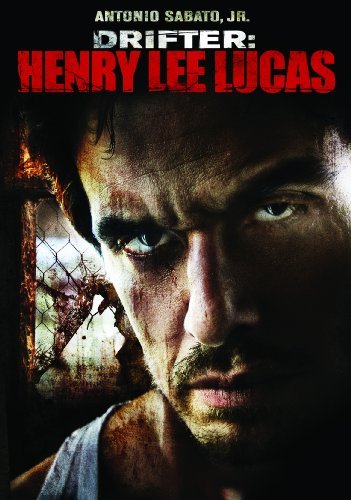
2009 saw the release of another film loosely based on the confessions of Henry Lee Lucas.  Drifter: Henry Lee Lucas opens with Lucas (played by Antonio Sabato, Jr.) being interrogated as to why he confessed to so many murders that he didn’t commit.  The movie then flashes back to Lucas killing Becky Powell (Kelly Curran) before then flashing forward to Lucas confessing to a murder and asking for a milkshake in return and then, once again, it flashes back to Lucas’s Hellish childhood in West Virginia.  That’s a lot of time jumps for just the start of the movie and it’s an early indication of just how jumbled the narrative of Drifter turns out to be.  To a certain extent, the jumbled narrative is appropriate.  It captures the feeling that, in many ways, Lucas is simply making up his life story as he goes along.

Physically, Henry Lee Lucas and Ottis Toole were two incredibly ugly people.  Drifter casts Antonio Sabato as Henry and Kostas Sommer as Ottis, both of whom are notably better-looking than the two men that they’re playing.  Sommer, in particular, is a hundred-time more handsome that Ottis Toole.  (The real Toole looked like one of the toothless hillbillies from Deliverance.)  Even if one overlooks their looks, both Sabato and Sommer are a bit too articulate to be believable as two backwoods murderers.  Sabato does a good job of capturing Lucas’s one-eyed squint but never once do you buy that he’s someone who grew up in the backwoods of West Virginia.  Meanwhile, as Becky, Kelly Curran is shrill and a bit annoying.  A lot of that is due to how Becky is written but still, it doesn’t make any easier to deal with her character.

Narratively, the film avoids taking a firm position on whether or not Lucas was lying.  We do see Lucas commit a few murders but they’re all told as a part of his narration, leaving open the possibility that Lucas could be lying.  Unfortunately, Henry’s stories aren’t that interesting.  What was interesting was that so many people chose to believe his stories, despite the fact that the majority of them fell apart under even the slightest amount of scrutiny.

In the end, Drifter reminded me that Henry Lee Lucas is far less interesting than how people reacted to Henry Lee Lucas and his willingness to confess to every crime that he was asked about.  There’s a great film to be made about the people who enabled Henry Lee Lucas’s lies.  Henry, himself, was far less interesting.

Horror Film Review: Mark of the Witch (dir by Tom Moore)


If I had to guess, I’d say that there is probably nothing more dangerous than being the descendant of a witch hunter.  Even though your ancestors may have found some success hunting witches back in 1622, the witch’s spirit always seems to stick around and wait for its chance to possess someone close to you and get revenge.  Apparently, it’s impossible to get rid of the spirit of a witch once it’s sworn a curse upon you and your family.  In fact, it would probably be better to save everyone the trouble and just leave the witches alone.  At least, that’s what I’ve gathered from watching movies with the word “witch” in title.

Take for example 1970’s Mark of the Witch.  The film opens with a bunch of witch hunter’s sacrificing The Witch (Marie Santell).  The Witch announces that she will have her vengeance, right before she’s hanged.  Jump forward a few centuries and The Witch possesses Jill (Anitra Walsh), a college student who made the mistake of accepting her professor’s invitation to a séance.

Now that Jill’s possessed, it’s time to go after the descendants of the main witch hunter.  To help her out with this, she blackmails the professor (Robert Elston) and demands that he explain to her how modern life works.  There are a few scenes that feel like they could have been lifted from one of those sci-fi shows where the robot or the alien requests to know why humans laugh when they’re happy.  I mean, I don’t know what this witch has been doing in the spirit world but apparently, she hasn’t been keeping up with the times on planet Earth.  Jill’s boyfriend (Darryl Wells) suspects that there’s something wrong with Jill.  Can he save her from the Witch?

Mark of the Witch was an early indie film.  It was shot in Dallas in the 60s and sat on the shelf for a while.  The cast was made up of local actors and to call the acting inconsistent would be an understatement.  That said, Marie Santell gives an enjoyably over the top performance as the Witch and Anitra Walsh is likeable as Jill.  Both of them are required to give lengthy monologues about spells and revenge and magic and all the rest and they both do their best to bring some conviction to the occasionally florid dialogue.  The film itself is a bit too talky to be scary but, visually, there are a few artfully composed shots.  The opening scene, in which the Witch is executed, plays out with a certain dream-like intensity.  It’s not a great film but it has its moments.

For the most part, Mark of the Witch is primarily interesting as an early example of outsider cinema.  The budget was low and the cast and crew may have been amateurs but they still managed to get their movie made and it’s hard not to admire their dedication.  When first released, the film apparently played in a handful of Dallas drive-in but now it can be seen by anybody who is willing to search for it on YouTube.  Mark of the Witch lives on.

Horror On The Lens: The Devil Bat (dir by Jean Yarborough)


In the 1940 film, The Devil Bat, the owners of a company in the small town of Heathville are super-excited because they’re going to be given their head chemist, Dr. Paul Carruthers (Bela Lugosi), a bonus check of $5,000.  However, since Carruthers’s inventions have made millions for the company, he is offended by the small check and decides that the best way to handle this would be to sue in court and demand fair compensation …. just kidding!  Instead, Dr. Carruthers sends his army of giant bats to kill the families of his employers.

The Devil Bat was produced by Production Releasing Corporation, a poverty row studio that specialized in shooting quickly and cheaply.  Going from Universal to PRC was technically a step down for Lugosi but The Devil Bat is actually an excellent showcase for Lugosi and he gives one of his better non-Dracula performances as the embittered Dr. Carruthers.  Indeed, one can imagine that Lugosi, who played such a big role in putting Universal on the map, could relate to Carruthers and his bitterness over not being fairly rewarded for the work he did to make others wealthy.

Enjoy The Devil Bat, starring the great Bela Lugosi!

October Positivity: Day of Defense (dir by Adam Lawson)


In the 2003 film, Day of Defense, two Mormon missionaries show up in a small town.  Elder Burke (John Foss) is an experienced missionary who always tries to be positive.  Elder Davis (Allan Groves) is a younger, less experienced missionary who always seems to be in a bad mood and who spends a lot of time whining.  Burke and Davis do not have a particularly good working relationship.  One gets the feeling that Burke would rather work alone and that Davis would rather work in a big city.

However, it turns out that it really doesn’t matter whether or not David and Burke can get along because they’ve entered a town that is run by the Christian Town Council.  Made up of five other members of the clergy, the CTC runs the town and has passed a law that states that you have to get a license if you’re going to preach.  And they refuse to give issue a license to anyone who they consider to be non-Christian and that includes the Mormons.  Elder Burke and Elder Davis are tossed in jail.

Now, at this point, the path forward seems clear enough.  What the CTC is doing is clearly a violation of the first amendment of the U.S. Constitution.  So, really, the Mormons should just take the CTC to court because there’s no way the law is going to survive a legal challenge.

Instead, Judge Nielson (Joan Peterson) decides that Burke and Davis should get a chance to make their case that Mormons are Christians before a jury of the town’s anti-Mormon citizenry.  She assigns the town’s one public defender, Thomas (Andrew Lenz), to argue in favor of the Mormons.  The town’s district attorney, James (Brooks Utley), and the head of the CTC, Rev. Williams (James Westwood), is assigned to make the case that Mormons are not Christian.  The jury will decide whether Burke and Davis can stay in the town.

Uhmm….yeah.  Basically, what we have here is the Mormon version of something like God’s Not Dead 2.  In that film, instead of just arguing that the law states that a teacher (Melissa Joan Hart) is not allowed to promote religion in a classroom, the evil prosecutor (Ray Wise) decides that the entire case needed to be about proving that God was dead.  In Day of Defense, instead of arguing that the CTC’s actions are a violation of the Constitution, the attorneys decide to prove once and for all whether or not Mormons are Christians.

The entire town shows up for the trial, heckling the Mormons.  As well, a group of rednecks get it into their heads that the Mormon missionaries are going to try to steal their girlfriends.  Thomas’s family demands to know why he’s defending the Mormons, despite being a Catholic.  I imagine it has something to do with the fact that he appears to be the only defense attorney in the town.  Rev. Williams and the other members of the CTC are all portrayed a mustache-twirling villains.  There’s nothing subtle about this film.

In the end, the main thing that sticks out about this film is just how unlikable every single character in the film turns out to be.  I mean, even the two Elders comes across as being jerks.  Where I live, we have a sizable Mormon community and it’s not uncommon to see Elders riding their bicycles around.  They’re always very polite and friendly and I always appreciate the fact that none of them smell like cigarette smoke.  They’re all quite a bit nicer than the two Elders at the center of this film.  Day of Defense was made to appeal to a Mormon audience but I think most Mormons would object to being portrayed as being so smug and angry.

There is a bit of tragedy towards the end of the film.  It feels a bit contrived as does the film’s ending.  In the end, this film wasn’t a victory for free speech as much as it was a defeat for good filmmaking.

October Hacks: Savage Vows (dir by Bob Dennis)


Savage Vows is a shot-on-video slasher film from 1995.

It tells the story of what happens when Mark (Armand Sposto) loses his wife in a car accident and six of his friends decide to spend the weekend with him.  Some of his friends sincerely want to help him.  Some of his friends just want to hang out for the weekend and a funeral is as good an excuse as any to do so.  Some of his friends are wondering how much money Mark is going to get from the insurance company and whether or not he might be willing to give them some of that money.  To be honest, they’re not the most likable group of friends.

For his part, Mark just wants to sit on the couch and spend the entire weekend watching movies.  In one of the few scenes in the film that doesn’t take place in Mark’s house, everyone heads down to the local, indie video store.  Mark rents the Lion King.  His friends insist on renting a bunch of horror films in order to keep Mark from being corrupted by a Disney cartoon.  I mean, Mark may be in mourning and he may have just lost his wife and he might be very generously allowing everyone to stay in his rather small house but that doesn’t mean that he just gets to rent whatever movie he wants to rent!  He’s got friends to think about!

Anyway, Mark is so depressed and he spends so much time either watching movies or running blindly through his neighborhood that he doesn’t even notice that there’s a black-gloved killer murdering his friends.  Who could the killer be?  The natural suspect would seem to be the redneck neighbor who keeps talking about how he’s a sign of the apocalypse but then that neighbor gets killed down at the cemetery so I guess it wasn’t him.  The identity of the killer is eventually revealed but don’t ask me to explain what exactly was motivating this particular person to kill.  I assume that an explanation was given but, for me to have heard it, this film would have had to have done a much better job of holding my attention.  I’ve only got a three-minute attention span.

I was going to be even snarkier than I’m currently being when it came to describing this film but, to be honest, it feels a bit churlish to be too critical of a film that was obviously made over a weekend by a group of friends who had access to a video camera.  This was a direct-to-video film that was shot in someone’s house with a semi-amateur cast and an obvious eye towards selling it in the type of video store that shows up in the movie.  That doesn’t make Savage Vows any sort of secret masterpiece or anything like that.  To be honest, it’s a pretty inept film and it barely even qualifies as a work of outsider art.  But, in the end, you have to admire the fact that the film not only got made but, nearly 30 years later, it can still be viewed on sites like Tubi.  Good for the people who made this film!

That said, Savage Vows still sucks.

The TSL Horror Grindhouse: Snuff (dir by Michael Findlay, Horacio Frederiksson, and Simon Nuchtern)


For a film that has a reputation for being one of the most controversial ever to be released, Snuff is incredibly boring.

Filmed in Argentina in 1971 as Slaughter, the majority of this film deals with a cult leader whose name is Satan (Enrique Larratelli).  Satan pronounces his name with the emphasis on the second syllable, so that it sounds less like the name of the Lord of the Darkness and more like, “Sah-TAN.”  I guess even he understood that the importance of not being too obvious when it comes to naming yourself.  That said, everything about Satan indicates that he worships the Devil so I’m not really sure why he felt the need to get all fancy with the pronunciation of his name.  Interestingly enough, Satan does not have a last name.  I imagine that if he did have a last name, he would be one of those pretentious people who would try to spruce up his last name with a “von” or “de,” like Satan von Smith or Satan de Jones.

Anyway, Satan has a group of followers.  They’re all young women who ride motorcycles and who look like hippies but they’re actually knife-wielding murder groupies.  Over the course of the film, they seduce several men and then kill them.  One of them carries a knife in the waistband of her panties, which is not something that I would ever have the courage to do because, seriously, if you sit down at the wrong angle or trip and fall, you’re probably going to have blood everywhere.

An actress named Terry London (Mirta Massa) comes to Argentina with her boyfriend and producer, Max Marsh (Aldo Mayo).  They’re going to be making a movie but mostly, Terry just wants to sleep and hang out around their mansion.  Some of Terry’s decadent Hollywood friends show up for the carnival.  Someone dies and I assume he was a friend of Terry’s.  Satan and his followers start plotting to attack and kill all of the Hollywood phonies and their rich friends.  Satan is especially offended that one of them is the son of an arms dealer.  Satan is about world peace, don’t you know.

Anyway, if you’re dumb enough to actually get caught up in the story of Satan and his followers, prepare to be disappointed because that story ends abruptly and without resolution.  Instead, some woman that we’ve never seen before suddenly declares that the movie is turning her on and an actor who is supposed to be the director of the movie proceeds to dismember her while the cameras roll.  The idea is that the crew of the movie actually murdered a woman, filmed it, and then decided to release the move into theaters because it’s not like people get prosecuted for murder or anything….

Of course, the murder footage was faked.  It’s painfully obvious that it was faked, just as its obvious that the footage was shot long after filming was completed on Slaughter.  It’s not even the same film stock.  But, in 1976, when Slaughter was released under the name Snuff, there were actual protestors who showed up at the theaters and claimed that the footage was real.  Some of those protestors were hired by the film’s distributor but reportedly, some of them were actual grass roots activists who believed what they had heard.  As a result, this extremely dull film became a box office success.  In New York City, it was the number one film in theaters for three weeks.

Controversy sells and Snuff will always have a place in the history of grindhouse films.  That said, the film itself is pretty much unwatchable.  If you’re going to watch it, hire someone to come march outside of your house with a sign to keep things interesting.  Otherwise, prepare for boredom.