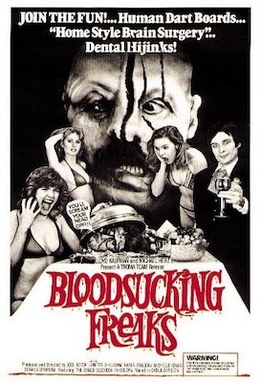
The TSL Horror Grindhouse: Blood Sucking Freaks (dir by Joel M. Reed)


Well, with a title like Blood Sucking Freaks, it has to be good!

Right?

First released in 1976, Blood Sucking Freaks is one of those not particularly good films that every horror fan has to sit through at least once.  Historically, it’s important as an example of a film that generated a thoroughly unnecessary moral panic, largely amongst people who had never actually seen the stupid thing.  It tells the story of Master Sardu (Seamus O’Brien), who runs a Grand Guignol-style theater in SoHo.  Wealthy New Yorkers flock to the theater on a nightly basis, to watch as Sardu and his dwarf assistant, Ralphus (Luis de Jesus), torture women on stage.  The crowd thinks that it’s all fake but what they don’t know is that Sardu and Ralphus are abducting real women and forced them to live in a cage underneath the theater, where they are occasionally brought out to be abused by high-paying patrons.  All of the torture and death that takes place on stage is real.

Most members of the audience enjoy the show and consider Sardu to be a master of transgressive art.  However, critic Creasy Silo (Alan Dellay) doesn’t think much of Sardu or his show and he writes a review in which he refers to whole thing as being pretentious.  Sardu apparently considers “pretentious” to be the worst insult that can be uttered against his production of pain and murder so he orders his followers to abduct Silo.  Held prisoner in the theater, Silo is told the truth about the show and then brainwashed to become a part of the show himself.

Meanwhile, Sardu’s followers have also kidnapped a ballerina named Natasha (Viju Krem).  Sardu feels that, if Natasha can be brainwashed to perform in the show, it’ll lead to greater things.  The show might move to Broadway and then someone might make a movie about Master Sardu!  Natasha’s lunkhead boyfriend, Tom (Niles McMaster), is not happy about Natasha being kidnapped.  He teams up with a sleazy cop (Dan Fauci) and they head down to the theater.

Much as with Snuff, Blood-Sucking Freaks generated a lot of controversy when it was first released, with some speculating that the murders in Blood-Sucking Freaks may have actually been real murders.  It was originally released in grindhouse theaters with an R-rating.  That R-rating might take some people by surprise when you consider how graphic the film supposedly was but it must be understood that the R-rating was self-imposed.  The filmmakers refused to submit the film to the MPAA and just rated it themselves.  When Troma acquired the film and submitted an edited version of the film to the MPAA, the organization refused to even watch the film.  That’s how controversial Blood-Sucking Freaks is!  The MPAA won’t even watch it long enough to tell other not to!

Also, much like Snuff, Blood-Sucking Freaks is actually a pretty boring movie.  Blood-Sucking Friends does deserve some credit for satirizing the pretentions of the underground arts scene but, for the most part, it’s a slow-moving and terribly acted film and the gore, while plentiful, is not particularly convincing.  Seamus O’Brien, who was murdered in an unrelated incident shortly after the film’s release, gives an absolutely lousy performance as Sardu.  Controversy aside, it’s a dumb movie and the only thing that really redeems it is that it knows it’s a dumb movie and doesn’t pretend otherwise.

The main lesson of Blood-Sucking Freaks is that it’s the type of movie that probably would have vanished into obscurity if not for the controversy that it has generated over the years.  Outrage sells.

A Horror Blast From The Past: The Wave (dir by Alexander Grasshoff)


First broadcast in 1981, The Wave stars Bruce Davison as Ben Ross, a high school social studies teacher who conducts a social experiment.

Frustrated by the fact that he can’t answer his students questions of how the German people could have allowed the Holocaust to occur, Ben decides to teach his students a lesson.  He starts by introducing a bunch of seemingly arbitrary rules to his classroom, concerning the proper way for students to sit at their desks and to address the teacher.  Ben is somewhat surprised to see how quickly his students adapt to the new rules, even taking pleasure in showing how quickly and efficiently they can follow orders.  The next day, Ben tells his students that they are now members of The Wave, a national youth organization with membership cards and a secret salute.

And that is when all Hell breaks loose.  Ben only meant to show his students what it’s like to be a member of a mass movement but the students take The Wave far more seriously than Ben was expecting.  Soon, other students are joining The Wave.  When the popular football players announce that they are a part of The Wave, others are quick to flock to the organization.  The formerly likable David turns into a fanatic about bringing people into the organization.  Robert, a formerly unpopular student, revels in his new job of reporting anyone who deviates from the rules of The Wave.  When a student reporter writes an article that is critical of the organization, she and the school paper are targeted.  Has Ben’s social experiment spiraled out of control?

42 years after it was originally produced, The Wave remains a powerful and sobering look at how people can be manipulated into doing things as a mob that they would never do as an individual.  If anything, the film feels more relevant today than it probably did in 1981.  The character of Robert, in particular, is a familiar one.  He’s someone with no self-esteem who latches onto a movement and finds his identity by taking down others and accusing them of failing to follow the rules.  One can find people like Robert all over social media, searching through old posts for any example of wrongthink that they can broadcast all through their social world.  It’s tempting to smirk at how quickly the members of The Wave sacrificed their freedom and their ability to think for themselves but it’s no different from what we see happening in the real world every day.  (Indeed, if the film had been made just two or three years ago, The Wave would probably be the people policing whether or not the rest of us were observing quarantine and wearing our facemasks correctly.)  People like to feel that they belong to something, even if that means sacrificing their humanity in the process.

Featuring a good performance from Bruce Davison as the well-meaning teacher who is both fascinated and terrified by the experiment that he’s set in motion, The Wave can be viewed below:

Bunni (2013, directed by Daniel Benedict)


On Halloween night, two couples leave a Halloween party and, while walking down the street, discover a deserted building.  One of them recognizes the building as being a former sex shop and he insists that he and his friends break in.  Unfortunately, for them, the sex shop is not actually deserted.  Bunni (Cat Geary), a woman who was raped 18 years previously and got a gruesome revenge on her attacker, is also in the building and she’s looking for more victims.

Bunni is full of gore, much of it shown in closeup.  Things that other films would cut away from, Bunni zooms in on.  If you want to see a man get his dick chopped off and then have the severed member stuffed down his throat in close-up, this is your movie.  If you want to see guts literally pour out of a body, this is your movie.  If the main reason you’re watching this movie is for the gore and the sense of transgression, more power to you.  You will like this film.  But me, I would have traded the gore for a compelling plot or at least one interesting character or maybe just one scene that, visually, reached above the level of a youtube video.  Some people will find what they’re looking for with this movie.  I did not.

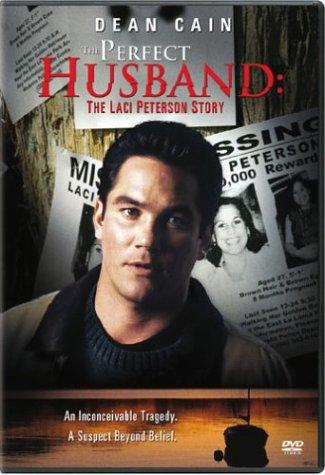
October True Crime: The Perfect Husband: The Laci Peterson Story (dir by Roger Young)


In December of 2002, most likely on Christmas Eve, Laci Peterson was murdered in Modesto, California.  At the time, she was eight months pregnant and, by all account, looking forward to the birth of her first child, Connor.  Suspicion immediately fell on her husband Scott Peterson, who seemed reluctant to contact police when Laci first disappeared and who was later revealed to be cheating on his wife, both before and after his disappearance.  Though Scott and Laci’s friends and family may have thought of Scott Peterson as being the perfect husband, the truth was far different.

After the bodies of both Laci and unborn Connor were discovered, Scott was arrested and charged with murder.  Scott insisted that his wife had been kidnapped and murdered by a gang of meth-dealing Satanists.  The jury disagreed and Scott was found guilty.  Originally sentenced to death, Scott is now serving a life sentence.

The disappearance and subsequent murder of Laci Peterson was national news and Scott Peterson, with his cold demeanor and his history of infidelity, was a perfect villain.  (The case would serve as one of the inspiration for the novel and film, Gone Girl.)  Today, unfortunately, the case has received renewed attention due to a docuseries called The Murder of Laci Peterson.  Though the documentary may have Laci’s name in the title, she’s treated largely as an afterthought.  Instead, the documentary focuses on making excuses for all of Scott’s incriminating behavior and, in the final episode, it goes as far as to include cheesy reenactments of Satanists stalking the streets of Modesto.  This heavy-handed work of propaganda, which was produced by a friend of Scott Peterson’s family, can be found on Hulu and is regularly re-aired on stations like A&E.  Whenever it airs, one can be sure that the dumbest people on twitter will start tweeting stuff like, “I lowkey think Scott Peterson might be innocent!”  The documentary ends with Scott’s creepy sister-in-law delivering an unconvincing monologue about how she often goes to the beach where Laci was found and thinks about her and Connor.  It’s one of the few times that anyone in the documentary mentions anything about Laci.

The 2004 made-for-TV movie, The Perfect Husband: The Laci Peterson Story, also keeps Laci off-screen but it still feels like a more honest look at the Peterson case than the documentary.  Because the movie was put into production before Scott’s trial had actually begun, the film does maintain a sense of ambiguity as to whether or not Scott is actually guilty but, unlike the docuseries, it also doesn’t deny just how suspicious Scott’s behavior was in the days following Laci’s disappearance.  While his friends and his family frantically look for Laci, Scott calls his mistress and flirts over the phone.  (As shown in the film, Scott’s girlfriend did not know that Scott was married and was shocked to see Scott on television, talking about his missing wife.)  When his friends and family beg Scott to help get the word out about his missing wife, Scott retreats into his own shell.  And when Laci’s body is discovered, Scott puts on a fake beard, dyes his hair, and heads to San Diego with a bag full of money.  In the docuseries, Scott’s condescending father claimed that Scott was just trying to get away from the media.  The film leaves little doubt that he was trying to get away from his crimes.

Dean Cain does a good job in the role of Scott Peterson.  Because Scott’s trial had yet to begin, Cain couldn’t play him as being an outright murderer so, instead, he focused on playing Scott as being petulant, insecure, and self-centered, the type of guy who seems to be annoyed that Laci’s disappearance is inconveniencing him.  Dee Wallace and G.W. Bailey have a few good scenes as, respectively, Laci’s mother and the detective investigating the case.  David Denman (who is probably best-known for playing Roy, Pam’s lunkhead fiancé on The Office) gives the film’s strongest performance as a friend of Scott’s who desperately wants to believe that he’s innocent even though the evidence keeps piling up against him.

The Perfect Husband probably gets closer to the truth of the case than any of the documentaries that have followed.  Scott’s a killer.  RIP, Laci and Connor.

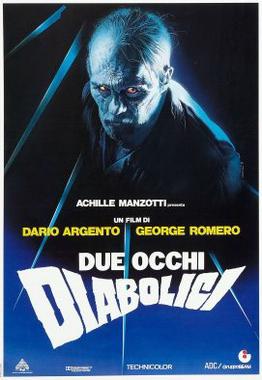
The Film of Dario Argento: Two Evil Eyes


In 1990, long-time friends George Romero and Dario Argento collaborated on Two Evil Eyes, anthology film that was based on the writings of Edgar Allan Poe.  An Italian-American co-production, Two Evil Eyes featured two stories.  The first was directed by George Romero, while the second was directed by Argento.

The Facts In The Case of Mr. Valdemar

(Dir by George Romero)

The first story is Romero’s, a modernized version of The Facts In The Case of M. Valdemar.

Jessica Valdemar (Adrienne Barbeau) is the 40 year-old wife of 65 year-old, Ernest Valdemar (Bingo O’Malley).  Jessica only married Ernest for her money and, now that he’s on his death bed, she and her lover, Dr. Robert Hoffman (Ramy Zada), have hypnotized to him to do and say whatever they tell him to say and do.  Even though Ernest is essentially comatose, the hypnosis allows them to force Ernest to sign his name to legal documents and to tell his suspicious attorney (E.G. Marshall) that he indeed wants to leave all of his money to Jessica.

When Ernest dies while under the influence of hypnosis, Jessica and Robert attempt hide his body in the basement.  But is Ernest really dead?  Jessica is convinced that she hears groaning from the basement and she wonders if the hypnosis has somehow left Ernest in limbo, between life and death.  Robert thinks that Jessica is being foolish but it turns out that she’s not.  After much paranoia and betrayal, one conspirator is dead and the other is a part of the living dead.

Usually, I like Romero’s work but this one didn’t work for me.  From the flat cinematography to the shallow performances, this film felt more like an episode of a television show than anything else.  Perhaps if it had been a stand-alone film, Romero could have found a way to make the material a bit more cinematic.  (The story’s final shot, of blood dripping on a hundred dollar bill, is the film’s strongest moment and the part that feels the most Romeroesque.)  But as a shortened chapter of an anthology film, it fell flat.

The Black Cat

(Dir by Dario Argento)

The Dario Argento segment is based on several different Poe stories.  While the majority of the story is taken from The Black Cat, it also contains elements of Annabel Lee, Telltale Heat, The Pit and the Pendulum, and Buried Alive.  Though this segment doesn’t really work, it’s obvious that Argento is a fan of Poe’s work and, for other Poe fans, there’s a lot of fun to be found in all of the Poe references that Argento sneaks into his story.

Harvey Keitel stars as Rod Usher, a crime scene photographer who loves his work a bit too much.  He’s excited about the fact that his book of photography is about to be published.  He’s less happy about the fact that his girlfriend, Annabel (Madeleine Potter), has adopted a black cat that is constantly glaring at Rod.  Rod is eventually driven mad by both the cat’s apparent hatred of him and the fact that the cat itself keeps showing up no matter how far he goes to get rid of it.  (This film features violence against a cat, which I hated.  But it also featured a cat getting revenge and I appreciated that.)  Eventually, Rod’s paranoia leads to violence and murder.

Look, this is a film about a guy who has an obsessive hatred of a cat.  Obviously, this is not a film that I’m going to enjoy because I love cats.  That said, I can still judge the film on its merits, even if it’s not for me on a personal level.  While Argento is able to build up a good deal of tension and suspense in this film, the overall film doesn’t work because Harvey Keitel, supremely talented actor that he is, was totally the wrong choice for Rod Usher.  Keitel, who reportedly did not get along with Argento during filming, gave a self-indulgent performance that featured a lot of bellowing.  It’s as if Keitel is trying to compete with the constantly moving camera.  The problem is that a star of a film like this has to be the director and Keitel’s histrionics take the viewer right out of the story.

Considering all of the talent involved, Two Evil Eyes is a disappointment.

The (Reviewed) Films of Dario Argento:

  1. The Bird With The Crystal Plumage
  2. Cat O’Nine Tales
  3. Four Flies on Grey Velvet
  4. Deep Red
  5. Suspiria
  6. Inferno
  7. Tenebrae
  8. Phenomena
  9. Opera

Horror Film Review: The Return of Swamp Thing (dir by Jim Wynorski)


What fresh Hell is this?

The 1989 film Return of Swamp Thing is one of the many bayou-set films that I’ve watched recently.  On most streaming sites, it is listed as being a “horror film” and there’s a few horror elements to be found in the film.  There’s mutants and hybrids and evil moonshiners.  There’s a lot jokes that are so corny that you might get scared just from hearing them.  I can accept the idea that this film is technically a part of the horror genre but the film is more of a comedy than anything else.  That’s not a complaint on my part, by the way.  I knew what I was getting into as soon as I saw that it was directed by Jim Wynorski.  Jim Wynorski has been poking fun at himself and his films for longer than I’ve been alive.

Return of Swamp Thing is a sequel to Wes Craven’s 1982 Swamp Thing, a film that I haven’t seen but which I’ve been assured was considerably more serious than the sequel.  (That’s the difference between Craven and Wynorski.)  The film features Louis Jourdan as Dr. Arcane, a mad scientist who lives in a mansion in Louisiana.  Dr. Arcane is obsessed with finding the secret to immortality, which he thinks lies in splicing together different strands of DNA.  As a result of Arcane’s experiments, the swamp is now crawling with bizarre human/animal hybrids.  The bayou is no longer a safe place but, fortunately, the bayou has a protector!  Swamp Thing (Dick Durock) is a human-plant hybrid who wanders around the swamp and beats up evil doers.  Swamp Thing is described as being a humanoid vegetable but he really just looks like a stuntman wearing a green costume.

Abby Arcane (Heather Locklear) is Dr. Arcane’s stepdaughter.  She thinks that Arcane had something to do with her mother’s death and, of course, he did.  Abby heads down to the swamp to confront Arcane but, unfortunately, it turns out that she’s in over her head when it comes to surviving in the bayou.  When she’s not being chased by the weird mutant creatures, she’s having to deal with toothless moonshiners.  Do you know what the worst bayou is?  Bayouself!  (Did I already tell that joke this month?)  Fortunately, Abby is not alone for long because Swamp Thing emerges from the water and protects her.  Abby quickly falls in love with Swamp Thing.

“I’m a plant,” Swamp Thing tells her.

“I’m a vegetarian,” she replies, which I guess means she’s going to cannibalize Swamp Thing after he’s no longer any use to her.  Yikes!  Look out, Swamp Thing!

Dr. Arcane wants to use Abby’s DNA for his experiments.  Swamp Thing decides to protect Abby and the two dumbass kids who keep following him around.  It’s time for a battle in the bayou!

Obviously, Wynorski does not approach this material seriously or with a hint of subtlety and that’s definitely the right approach to take.  The sight of Louis Jourdan in the Louisiana bayous is so ludicrous that you have no choice but to laugh at it.  That said, the film is never quite as funny as one might hope.  It’s easy to imagine it working as a 30-minute pilot for a Swamp Thing sitcom but, as an 90-minute film, it quickly runs out of gas.  Louis Jourdan looks bored but Dick Durock is amusingly earnest as Swamp Thing.  Heather Locklear shows a flair for comedy but the box office failure of The Return of Swamp Thing pretty much ended her film career before it began.

After this, I think I’m going to avoid the swamp for a while.

Horror Film Review: The Tingler (dir by William Castle)


The 1959 film, The Tingler, opens with a middle-aged man standing on a stage and speaking directly to the audience.

“I am William Castle, the director of the motion picture you are about to see. I feel obligated to warn you that some of the sensations—some of the physical reactions which the actors on the screen will feel—will also be experienced, for the first time in motion picture history, by certain members of this audience. I say ‘certain members’ because some people are more sensitive to these mysterious electronic impulses than others. These unfortunate, sensitive people will at times feel a strange, tingling sensation; other people will feel it less strongly. But don’t be alarmed—you can protect yourself. At any time you are conscious of a tingling sensation, you may obtain immediate relief by screaming. Don’t be embarrassed about opening your mouth and letting rip with all you’ve got, because the person in the seat right next to you will probably be screaming too. And remember this—a scream at the right time may save your life.”

When this film was first released in 1959, William Castle wasn’t lying in this warning.  Certain audience members would feel the tingling sensation of fear because some theaters agreed to wire certain seats with buzzers that, when activated, would give the viewer a tingling sensation.  Castle also arranged for certain theaters to fake an attack by the film’s monster, complete with the houselights coming up, a woman screaming and pretending to faint, and the voice of Vincent Price encouraging everyone in the audience to scream because “the Tingler is loose in the theater!”

Uhmm …. that sounds like fun.  When it comes to William Castle’s gimmicks, there’s a lot of documentation concerning what Castle arranged but there’s not as much documentation about how people reacted to being buzzed while watching a movie.  Hopefully, everyone screamed, played along, and had fun.  Personally, I probably would have left the theater during the chaos and snuck into a showing of Anatomy of a Murder.

As for the film, it stars the great Vincent Price as Warren Chapin, a pathologist who is investigating the source of fear.  As he explains to his colleague, Dave Morris (Dwayne Hickman), he believes that the tingling that people feel at the base of their spine is actually a living creature that is formed by fear.  The only way to kill the creature is to scream.  If you don’t scream, the creature will eventually snap your spine.  Well, I guess you better scream then.

Anyway, Dr. Chapin confronts his wife Isabel (Patricia Cutts) over the fact that she’s cheating on him.  He pulls a gun on her and, as she begs for his life, he fires.  She collapses but fear not!  The gun was loaded with blanks and Dr. Chapin just wanted to scare her so that he could x-ray her back and see if the Tingler was forming on her spine.  Dr. Chapin is overjoyed when the Tingler shows up on x-rays but now, he needs to bring a Tingler into the real world….

(I’m not sure why you would want a Tingler but whatever….)

One of Chapin’s friends is Ollie Higgins (Philip Coolidge) who owns a movie theater with his wife, Martha (Judith Evelyn).  Martha is deaf and mute and therefore cannot scream.  When Ollie deliberately frightens her, the Tingler appears on her spine and snaps it.  At the subsequent autopsy, Chapin is able to remove the Tingler from Martha’s spine.  The Tingler, which is a giant centipede that likes to crawl up people’s legs, gets loose and needless to say, all tingling heck breaks out.

Wow, this is a silly film!  There’s is absolutely nothing frightening about a plastic centipede being pulled across the screen by wires.  But, at the same time, it’s a Vincent Price film and Vincent knew exactly how to play his mad-but-not-evil scientist, delivering his lines with the perfect combination of snark and melodrama.  This film came out the same year as another Castle/Price collaboration, The House on Haunted Hill.  It’s nowhere near as good as The House on Haunted Hill but The Tingler is still a lot of fun in its silly way.  It won’t make you scream from fright but you might laugh really loudly.

Horror On The Lens: Tales From The Crypt (dir by Freddie Francis)


For today’s Horror on the Lens, we have 1972’s Tales From The Crypt, a British anthology film which features The Crypt Keeper (Ralph Richardson) informing five strangers of how they will die.  This classic, all-star film was based on stories that originally appeared in the Tales From The Crypt comic book.

In general, I’m not a huge fan of anthology films but Tales From The Crypt is an exception to that role.  It’s an entertaining collection of macabre stories and the cast is to die for …. maybe literally!

This Amicus-produced movie is probably best remembered for the segment in which Joan Collins is menaced by an evil Santa but the whole thing is good.

October Positivity: A Distant Thunder (dir by Donald W. Thompson)


The 1978 film, A Distant Thunder, opens with a group of people confined in what appears to be a high school gym.  They have cots to sleep on and not much else.  They have been informed that they have a choice to make.  They can either agree to take “the mark” and declare their allegiance to the United Nations and Brother Christopher or they can be executed.  They have a day to decide.

Many of the people are willing to go to their death rather than get the mark.  But Patty Myers (Patty Dunning) isn’t so sure.  Her friends and fellow prisoners encourage her to refuse the mark but Patty says that she doesn’t know if she can stay loyal to a God who would allow so many bad things to happen.  One of her friends asks Patty to tell the story of how she came to be a prisoner of UNITE, the UN’s secret police force….

A Distant Thunder is a sequel to 1972’s A Thief In the Night and the first twenty minutes of A Distant Thunder is made up of flashbacks to the previous film.  Once again, we see how Patty had a dream about waking up to discover that her husband and all the other Christians in the world had mysteriously vanished and now, the UN was in charge of everything.  We even get the phenomenom of flashbacks within flashbacks as Patty remembers the times that she remembered her former life.  A Thief In the Night ended with Patty being tossed over a bridge by her friends, Jerry (Thom Rachford) and Diane (Maryann Rachford), just for Patty to then wake up and discover that her husband really was missing and her dream was coming true!

Once A Distant Thunder finishes up its recap of the first film, it follows Patty as she hides out on a farm with her friends, Wenda (Sally Johnson) and Wenda’s little sister, Sandy (Sandy Christian).  While they hide out, the world around grows more and more hostile.  There are wars.  There is a plague.  Brother Christopher announces that everyone will be required to have a special form of identification if they want to buy products, receive government food, or even get healthcare for their children.  Eventually, Brother Christopher announces that the identification is no longer optional.  People can either get the mark or they can face execution.  Wenda, who goes from being a nonbeliever to being a Christian, is determined to not get the mark.  Patty is more conflicted.

At a church-turned-death house in Des Moines, Patty, Wenda, and Sandy wait for their time with the guillotine and also their chance to make their final decision….

A Distant Thunder was made by the same people who did the first film and the majority of the first film’s cast returns for the sequel, which provides a nice sense of continuity between A Thief In the Night and A Distant Thunder.  Unfortunately, A Distant Thunder never quite reaches the fever dream intensity of A Thief In The Night.  A Thief In the Night worked because its imagery often captured the stark horror of an intense nightmare.  A Distant Thunder is a much more talky film and, as such, it exposes the defecencies of the largely amateur cast.

That said, there are a few moments where A Distant Thunder matches the first film’s atmosphere of paranoia.  As with the first film, A Distant Thunder benefits from having been filmed in Ames, Iowa.  Seeing the forces of UNITE invading the actual heartland was surreal in a way that the film never would have been if it had been set in a large and familiar city.  The scene where Patty and Wenda first see the guillotine is also effectively done.  It’s a frightening sight, all the more so because it’s standing in front of a fairly innocuous-looking church.  Seriously, people make fun of guillotines now but, as devices of punishment, they pretty much radiated the promise of a bloody death.

That said, the film is done in by its slow pace and its less than convincing performances.  Still, A Distant Thunder was enough of a success that it led to a sequel that I’ll look at tomorrow.

October Hacks: Sleepaway Camp (dir by Robert Hiltzik)


So much attention has been devoted to dissecting and discussing the ending of 1983’s Sleepaway Camp, that I think people tend to overlook the bigger issue.  This film is the biggest argument against summer camp over filmed.

Seriously, don’t send your kids to camp!  Don’t get a job working at a camp!  Don’t live anywhere near a camp!  If someone tries to open a camp near your home, gather together a posse and run them out of town!  If you discover an abandoned camp within one hundred miles of your home, set the place on fire!  Camps are bad news.  They attract bullies and tragedy and murder.  If there’s anything that I’ve learned from watching the horror movies of the early 80s, it’s that summer camps mean trouble.

Consider the camp in Sleepaway Camp.  Even before the murders start, the place comes across as being a prison camp.  Seriously, I’ve seen a lot of summer camps in a lot of slasher films and it’s hard to think of any of them that look as shabby and dirty as the camp in Sleepaway Camp.  None of the campers appear to be happy to be there.  No one is allowed to leave.  The campers are divided into two groups, the bullies who rule the place like mini-tyrants and the poor kids who spend the entire summer being beaten up and taunted.  Not even the counselors are worth much.  Counselor Meg (Katherine Kamhi) is best friends with the camp’s main mean girl, Judy (Karen Fields).  Meg is the type who tosses a camper in the lake, just because Judy tells her to.  Meanwhile, the owner of the camp is named Mel (Mike Kellin) and he’s just an old perv who doesn’t want to bothered with anyone’s problems.  What type of horrific world is this?

And then, let’s consider some of the murders at the camp.  The skeevy camp cook get scalded with boiling water.  (It’s debatable whether the cook actually dies or not.)  Kenny, one of the camp’s bullies, get drowned while playing a canoe-related prank.  Another bully is stung to death by bees.  That’s just three of the many deaths here and yet, the camp never closes.  It never occurs to the camp’s owner to send anyone home.  It never occurs to anyone that maybe they should send the campers to another camp.  None of the deaths lead to an increased police presence nor does it lead to any changes with the camp’s schedule.  None of the campers appear to be particularly upset by all the deaths.  It’s a disturbing world.

Everyone who dies at the camp earlier picked on Angela (Felissa Rose), an introvert who ends up getting targeted by Judy.  Angela’s cousin, Ricky (Jonathan Tiersten), is very protective of Angela and, as a result, he becomes the number one suspect.  As the film’s ending reveals, the truth is something much different.  The film ends with a justifiably famous shot and it does stick with you as the end credits role.  It’s tempting to read a lot of meaning into the film’s ending but I imagine that’s giving the filmmakers a bit too much credit.  The film was made for 1983 audiences who were looking for a shock, not 2023 cultural critics.

Even before that ending, though, Sleepaway Camp is a bit more creepy than the average 80s slasher film.  The killer is relentless and ruthless and it’s disturbing that the victimized campers are played by performers who are close to the age of their victims as opposed to the usual 30 year-old who played teenagers in these type of films.  The scene with the curling iron is something that I can only watching through the fingers that I’m holding in front of my eyes.  It’s not a great film by any stretch of the imagination but it does definitely capture the feel of being at the worst summer camp imaginable (seriously, one can hear the flies buzzing and even smell the stale order of stopped-up plumbing) and it does stick with you after you watch it.  It’s nothing to lose your head over, it’s just too bad no one told that to the campers.