The Unnominated: The Long Riders (Dir by Walter Hill)


Though the Academy of Motion Picture Arts and Sciences claim that the Oscars honor the best of the year, we all know that there are always worthy films and performances that end up getting overlooked.  Sometimes, it’s because the competition too fierce.  Sometimes, it’s because the film itself was too controversial.  Often, it’s just a case of a film’s quality not being fully recognized until years after its initial released.  This series of reviews takes a look at the films and performances that should have been nominated but were, for whatever reason, overlooked.  These are the Unnominated.

First released in 1980, The Long Riders is one of the many films to tell the story of the James/Younger Gang.

A group of former Confederate guerillas who became some of the most notorious bank robbers to roam post-Civil War America and who were based in Missouri, the brothers who made up the James/Younger Gang were hunted by the Pinkertons and beloved by the citizens who viewed them as being 19th Century Robin Hoods.  Following a disastrous attempt to rob a bank in Northfield, Minnesota, the Younger brothers were captured by the government while Jesse and Frank James made it back to Missouri.  Jesse was shot in the back by Bob Ford while Frank subsequently surrendered to authorities and made a good living on the lecture circuit.

The Long Riders tells the story of the gang, from their first encounter with the heavy-handed Pinkertons to the Northfield raid to Frank’s eventual surrender.  Director Walter Hill both celebrates the legend of the James/Younger Gang while also emphasizing that all the members of the gang were also individual humans who had their strengths and their flaws.  Hill emphasizes the idea of the gang being a group of post-war rebels, still fighting a war against a government that is more interested in protecting banks than looking after people.  The Long Riders deconstructs the legend while also celebrating it.

The main thing that sets The Long Riders apart from other films about the James/Younger Gang is the fact that the brothers are played by actual brothers.  David, Keith, and Robert Carradine plays the Youngers.  Randy Quaid plays Clell Miller while Dennis Quaid assumes the role of the cowardly Ed Miller.  Nicholas and Christopher Guest make a memorably creepy impression as Charley and Bob Ford.  And finally, Jesse and Frank James are played by James and Stacy Keach.  (The Keaches also worked on the film’s script).  And while Stacy is definitely the more charismatic of the Keach brothers, the film makes good use of James’s rather stoic screen presence.  While the rest of the gang enjoys the outlaw life, James Keach’s Jesse is rigid, serious, and ultimately too stubborn and obsessive for his own good.

Now, the casting might sound like a gimmick but it works wonderfully.  When Clell chooses the gang over Ed, it carries an emotional weight because we’re watching real brothers reject each other.  The comradery between the Carradines carries over to the comradery between the Youngers and it also informs their occasional rivalry with the better known James brothers.  While it is Stacy Keach and David Carradine who ultimately dominate the film, every brother in the cast makes a strong impression.  Also giving a memorable performance is Pamela Reed as a defiantly independent Belle Starr, who loves David Carradine’s Cole Younger but marries Sam Starr (James Remar).  The knife fight between Carradine and Remar is one of the film’s highlights, as is the violent and disastrous attempt to rob the bank in Northfield.

The Long Riders is an exciting and ultimately poignant western but sadly, it received not a single Oscar nomination, not even for the stunning cinematography or Ry Cooder’s elegiac score.  Fortunately, just like the legend of the James/Younger Gang, The Long Riders lives on.

Previous entries in The Unnominated:

  1. Auto Focus 
  2. Star 80
  3. Monty Python and The Holy Grail
  4. Johnny Got His Gun
  5. Saint Jack
  6. Office Space
  7. Play Misty For Me

Lisa Reviews An Oscar Winner: CODA (dir by Sian Heder)


Remember CODA?

I ask that because this 2021 film often seems to be forgotten about when people discuss the films that have won the Oscar for Best Picture. Indeed, when the Oscar nominations were first announced for that year, many commentators treated the film’s nomination as an afterthought.  It was pointed out that CODA only had a total of three nominations, for Picture, Adapted Screenplay, and Best Supporting Actor.  It was expected that Troy Kostur would win Best Supporting Actor but it was also felt that Best Picture would be won by one of the big nominees, like The Power of the Dog, Belfast, or West Side Story.

But, interestingly enough, the momentum began to shift shortly after the nominations were announced.  The nomination brought the film to an entirely new audience, all of whom could stream the movie on Apple TV+.  The members of the Academy who hadn’t seen the film before the nominations were announced watched the film and many reportedly fell in love with the simple but touching story of a teenage girl who must decide whether to go to music school or to stay at home with her deaf parents and older brother.  By the time the Academy Awards were held, CODA had become the new front runner.

How did this happen?  A lot of it had to do with the fact that CODA was an unabashedly emotional story, one that was specifically made to bring tears to the eyes of the audience.  CODA was more humanistic than the remote and cold Power of the Dog.  Whereas both West Side Story and Belfast were obviously made with Oscar glory in mind, the low-budget CODA felt as if it simply wanted to tell a good story.  Unlike Dune, CODA was not made to launch a franchise and, unlike King Richard, it was about more than just one performance.  Its straight-forward approach provided quite a contrast to the stylized flourishes of Nightmare Alley and Licorice Pizza.  (Incidentally, Nightmare Alley and Licorice Pizza were my two favorite films of the year.)  It should also be remembered that CODA, like the previous year’s Nomadland, was watched while many people were still hiding their faces behind masks, terrified of catching COVID.  It was a time when many people were yearning for something that would just make them feel good.

And whatever else one might say about CODA, it’s definitely a feel good movie.  From the wonderful moments when Ruby (Emilia Jones) discovers her love for singing to the slyly humorous and emotionally honest performances of Troy Kostur, Marlee Matlin, and Daniel Durant as Ruby’s parents and brother, CODA is a film that will make you smile and think about the people who you consider to be your family.  It’s a sweet movie, one that reminds us that it’s okay to get emotional and that it’s okay to tell people that you love them and that, as an artform, film can be used for something other than just comic book adaptations.

That’s not say it’s a perfect film, of course.  Those who complained that CODA had the flat look of a made-for-TV movie were not incorrect and the fact that most people ended up watching the movie on TV (or, in my case, on a laptop) did not help with the issue.  As Ruby’s music teacher, Eugenio Derbez gives a rather broad performance that often fells at odd with the more realistic work of the rest of the cast.  The film had its flaws but it also made me smile and the end brought real tears to my mismatched eyes and there’s something to be said for that.  During a year when many people were still afraid to get close to anyone else, CODA was a film that celebrated love, family, and community.

Did CODA deserve to win Best Picture?  Like I said, I would have given the Oscar to either Nightmare Alley or Licorice Pizza but I liked CODA and, looking back, I certainly prefer its positive vibes to the well-made emptiness of Power of the Dog.  The low-key CODA is probably destined to join The Artist and Argo as one of the best picture winners that people tend to forget but no matter.  It’s a film that holds up well and, in 2021, it was exactly the film that a lot of people needed.

February Positivity: Always A Winner (dir by Dave Christiano)


In this 2023 film, teenage golf champion Emily (Evangeline Griffin) transfers from one private Christian academy to another.  At her new school, the golf coach, Coach Kelly (Jenn Cooke), tells her two best players, Madison (Amelia Still) and Hannah (Ashley Brant), to befriend Emily and gauge whether or not she plans on continuing to play golf in high school.

When they approach Emily in the school’s cafeteria, they are shocked when Emily says that she’s a pretty good golf player and she plans to be state champion again.  They are scandalized when Emily mentions that she broke all of Coach Kelly’s old records at her previous school.  They are stunned when Emily suggests that she’s a better golfer than Coach Kelly ever was.

“Are you a Christian?” Madison asks.

Yes, this is another one of those films.  This is another Dave Christiano-directed film in which high school athletics (in this case, golf) are used as a metaphor for faith.  Emily may say she’s a Christian but first she’s going to have to learn that being a Christian means always doing what your coach tells you to do (even if that means hitting with a seven when you’d rather use your nine) and, of course, being a humble winner and a gracious loser.  As Coach Kelly explains it, Emily could be the best player in the world but God might have plans for her that don’t include winning the state championship.  To me, that’s an odd way to look at things.  I mean, if God is the one who is deciding who is going to win the tournament, why waste all that time with practicing your swing and learning how to putt?  It takes Emily a while to listen to Coach Kelly so we end up with a lot of scenes of Madison and Hannah sucking up to the coach while Emily rolls her eyes in the background.  One wonders if Christiano realized that Madison and Hannah are both the type of people who everyone hated in school, the snitches who followed the rules and called out anyone who didn’t.  Emily may be arrogant but at least she seems like she gets some sort of enjoyment out of winning.  At least she acts like a human being as opposed to a Sim, waiting to be told what to do.

Meanwhile, Madison is freaking out over whether or not she’ll be able to afford to attend Zion College.  She has applied for all of the scholarships and she’s been working part-time and saving her money and her father is willing to contribute a little as well but Madison is still short $5,000.  Madison suggests that she could take out a student loan but her mother says, “No, your father doesn’t want you borrowing any money.”

On the one hand, that’s good advice.

On the other hand, Madison’s the one who is paying for most of her tuition so shouldn’t she be the one to decide whether or not to apply for a student loan?  I mean, Madison is going to be a legal adult by the time she starts college.  And it’s not like Dad is helping out all that much so who cares what he thinks?  Still, Madison’s mother tells her that it might just be God’s plan for Madison to go to a community college.  And again, with all due respect, you have to wonder if we’re supposed to take comfort in the idea of a God who micromanages ever aspect of our lives.

Finally, Hannah learns that a friend is pregnant and thinking about getting an abortion.  Hannah tells her friend that she can’t get an abortion because the Bible says, “Do unto others.”  As Hannah explains it, how would her friend feel if she had been aborted?  Her friend takes Hannah’s words to heart and tells her father that she’s pregnant.  This leads to a montage of her father yelling at her but we don’t hear what he’s saying because a very mid Christian rock is playing over the soundtrack.  Everything works out in the end, of course.  Speaking as someone who has never been comfortable with the extremes of either side of the abortion debate , this whole scene really irked me, as it was very heavy-handed and poorly written.  It’s easy to win an argument when the other side isn’t allowed to present its case.  Just because pro-abortion writers tend to caricature pro-life arguments, that still doesn’t make it any less strident when pro-life writers do the same thing to the other side.

In the end, everything works out.  Emily learns to be humble.  Madison goes to college.  Hannah is hopefully prepared to babysit.  The film ends with one golfer getting disqualified for making a technical mistake, just for Emily to beg that the rules be suspended so that the other golfer can get the trophy she’s earned.  Amazingly, the rules are suspended which really isn’t the way rules are supposed to work.  Apparently, the message is that God’s rules cannot be broken but UIL’s rules are fair game.

14 Days of Paranoia #10: The Brotherhood of the Bell (dir by Paul Wendkos)


First aired on television in 1970, The Brotherhood of the Bell tells the story of Andrew Patterson (Glenn Ford).

Andrew Patterson is a widely respected economics professor.  He is an influential academic, one who has a nice house, a beautiful wife (Rosemary Forsyth), and a father-in-law (Maurice Evans) who owns a very successful business.  Patterson is also a member the Brotherhood of the Bell, a secret society made up of successful men who all graduated from the prestigious College of St. George in San Francisco.  Patterson has been a member of the society for 22 years and he’s never really taken it that seriously.  He thinks of it as just being a collection of influential men who enjoy getting together and discussing their vision for the world.

That all changes when the man who brought Andrew to the Society, Chad Harmon (Dean Jagger), gives Andrew an assignment.  The Society wants him to deliver an envelope to his friend, Dr. Konstantin Horvathy (Eduard Franz).  Horvathy is up for a deanship that another member of the Society desires for himself.  Inside the envelope is damaging information that the Society has gathered about the people who helped Horvathy defect to the United States, information that will be made public unless Horvathy withdraws as a candidate.  Reluctantly, Andrew shows Horvathy the envelope.  Horvathy responds by committing suicide.

Stricken with guilt, Andrew decides to expose the existence of the Society but he discovers that won’t be easy.  Almost overnight, Andrew’s perfect life starts to collapse.  He loses his job.  The IRS launches an investigation of his father (Will Geer).  As Chad explains it, the Society is responsible for everything that Andrew has and, therefore, the Society can take everything away.  When Andrew goes public, he’s dismissed as just being paranoid and soon, Andrew truly is paranoid.  With his marriage in ruins, Andrew goes on a talk show and can only watch helplessly as his claims are dismissed by the host (William Conrad) and as the audience argues about whether or not the Society is a white plot, a communist plot, a Jewish plot, a Catholic plot, or a government plot.  Even the people who believe Andrew are too busy fighting amongst themselves to provide any help for him or to stand up to the unified power of the Brotherhood.  The host repeatedly rings a bell during the show, the better to mock everyone’s fears.  The film makes a good point.  Crazed theorists are often a conspiracy’s best friend.

An intelligently written and well-acted film, The Brotherhood of the Bell‘s main strength is the direction of Paul Wendkos.  The lighting gets darker and the camera angles become increasingly more skewed as Andrew’s paranoia grows.  In fact, Wendkos does such a good job of visualizing Andrew’s deteriorating mental state that it’s easy to wonder if maybe everyone is right and all of this really is just happening in Andrew’s head.  Though the film ends on a slightly triumphant note, it’s hard not to feel that it’s a temporary victory at best.  The Brotherhood of the Bell (which I imagine was based on Yales’s Skull and Crossbones) will always be there.

14 Days of Paranoia:

  1. Fast Money (1996)
  2. Deep Throat II (1974)
  3. The Passover Plot (1976)
  4. The Believers (1987)
  5. Payback (1999)
  6. Lockdown 2025 (2021)
  7. No Way Out (1987)
  8. Reality (2023)
  9. Chappaquiddick (2017)

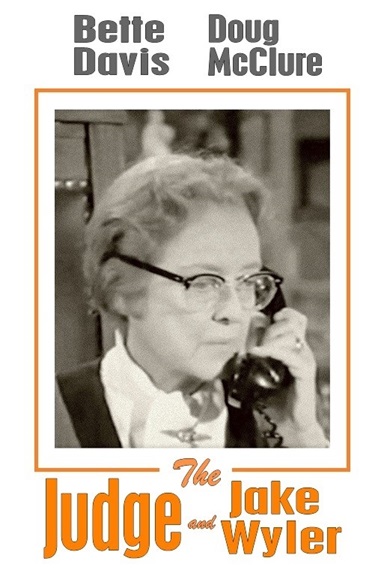
Retro Television Review: The Judge and Jake Wyler (dir by David Lowell Rich)


Welcome to Retro Television Reviews, a feature where we review some of our favorite and least favorite shows of the past!  On Sundays, I will be reviewing the made-for-television movies that used to be a primetime mainstay.  Today’s film is 1972’s The Judge and Jake Wyler!  It  can be viewed on YouTube.

Judge Meredith (Bette Davis) is a retired criminal court judge who has developed a severe case of hypochondria.  She lives in a mansion that she never leaves.  Anyone who comes to see her must be personally vacuumed by her butler before they can be allowed to stand in her presence.  She hates people who take too long to get to the point and she also has little use for people who are rude on the phone.  She especially dislikes cigarettes and refuses to have even an unlit one in her presence.

Jake Wyler (Doug McClure) is an ex-con who is currently on supervised probation.  Despite his criminal past, he’s a likable and amiable guy and, every morning, he wakes up with a new woman in his bed.  Jake enjoys tweaking authority and he always has a pack of cigarettes on him somewhere.

Together, they solve crimes!

They actually do!  The judge is dealing with retirement by running her own detective agency, one that is exclusively staffed by people that she previously sentenced to prison.  Jake does most of the leg work as far as the agency is concerned.  The Judge calls him every morning and demands to know why he’s not working harder.  Jake would rather just sleep-in but working for the judge is a part of his parole.  She could easily send him and everyone else working for her back to prison.  This sounds like a pretty unfair situation to me and the Judge is so demanding that I think it could be argued that she’s an abusive boss.  But, because this is a pilot for a TV show and the Judge is played by Bette Davis, everyone is very loyal to her.

At the start of the film, Jake reveals to Robert Dodd (Kent Smith) that his wife, Caroline (Lisabeth Hush), has been cheating on him with Frank Morrison (Gary Conway).  When Robert is later found dead in a hospital room, the official verdict is that he committed suicide.  However, his daughter, Alicia (Joan Van Ark), claims that her father was murdered.  At first, both Jake and the Judge suspect that Alicia just wants to collect a bigger life insurance settlement but it turns out that Dodd’s beneficiary wasn’t even Alicia.  The money is going to his second wife, the one who was cheating on him.  While the Judge yells at people on the phone, Jake investigates the death of Robert Dodd.

The Judge and Jake Wyler is a mix of comedy and mystery.  Jake has a way with a quip and the majority of the suspects, including John Randolph and Eric Braeden, all have their own eccentricities.  Director David Lowell Rich does a good job of keeping the action moving and the mystery itself is actually pretty interesting.  Surprisingly, the show’s only real flaw is Bette Davis, who seems to be rather bored in the role of Judge Meredith.  Even though the character seems to have been specifically written for her trademark caustic line delivery, Davis delivers her lines with little enthusiasm.  One gets the feeling that she wasn’t particularly happy about the idea of having to do a television pilot.

Davis need not have worried.  The Judge and Jake Wyler did not turn into a series.  That said, the movie is an entertaining and diverting murder mystery.

14 Days of Paranoia #9: Chappaquiddick (dir by John Curran)


On July 18th, 1969, while American astronauts were preparing to land on and then take their first steps on the Moon, a 28 year-old woman named Mary Jo Kopechne attended a party on Chappaquiddick Island in Massachusetts.

A former aide to Robert Kennedy who was reportedly devastated by his assassination, Mary Jo was one of several former campaign workers who gathered at an isolated cabin that night.  According to the others at the party, Mary Jo (who was described as being a devout Catholic who rarely drank) was one of the first people to leave the party.  She left with another guest.  The next morning, that guest’s car was found overturned in Poucha Pond.  Dead in the backseat was Mary Jo Kopechne, who had suffocated as the car slowly filled up with water.  It was later determined that she had been alive and trapped in the car for hours before dying.  The owner of the car was back at his hotel.  He had returned there after crashing his car and, while he had taken a shower and combed his hair and called his father, he had not bothered to call the police.

Normally, a driver in this situation would be in serious legal jeopardy.  Along with having left the scene of the accident, he also left Mary Jo to die.  It was generally agreed that if he had called the police within an hour of the accident occurring, Mary Jo could have been saved.  However, because he was Ted Kennedy and the last remaining of the fabled Kennedy brothers and a man who many expected would someday be president, he was given a slap on the wrist and the death of Mary Jo would be forever described as being a “Kennedy tragedy” as opposed to a Kopechne tragedy.

Not surprisingly, there has been a lot of speculation about what had happened in the moments leading up to the crash.  Like his brothers, Ted Kennedy was a notorious and reckless womanizer.  Unlike his brothers, Ted also had a reputation for being a heavy drinker.  Some went as far as to accuse Ted of deliberately murdering Mary Jo, as if the actions that Ted later admitted to were not, in themselves, already bad enough.  While people may disagree on the circumstances that led to the accident, it is generally agreed that, if Ted had been anyone other than a Kennedy, he would have served time in prison.  The incident ended Ted’s presidential dreams but it didn’t keep him from being described as being the “lion of the Senate” when he died in 2010.  Indeed, when Ted died, many people on twitter expressed their shock as they read or heard about Mary Jo Kopechne for the first time in their lives.

(In 2010, Mary Jo would have been seventy years old.)

Obviously, no one was going to make a movie about Mary Jo Kopechne’s death while Ted was still living.  Indeed, even after Ted died, it still took seven more years for the story to be turned into a film and producer Byron Allen struggled to even book the film in theaters.  2017’s Chappaquiddick stars Jason Clarke as Ted and, briefly, Kate Mara as Mary Jo.  The film speculates as to what happened that night and it probably gets fairly close to the truth.  The accident is an accident, a result of Ted freaking out when a cop stops him for speeding and sees him with a woman who isn’t his wife.  Ted, who is portrayed as being an immature manchild, turns to his handlers and then his family for help.  His fails to call the authorities because, to Ted, there is no greater authority than his abusive father (Bruce Dern).

For the most part, Ted passively sits by as associates of his late brothers — including Ted Sorenson (Taylor Nichols, giving the film’s strongest performance), Joe Gargan (Ed Helms), and Paul Markham (Jim Gaffigan) — take over his defense and carefully craft his every response.  Ted’s attempts to provide input are shot down and it’s made clear that his job is to shut up and concentrate on returning the Kennedys to the White House.  The film’s best scenes feature Sorenson growing frustrated at all of Ted’s mistakes.  Very little concern is shown for the fact that Mary Jo Kopechne, a Kennedy true believer, is dead due to Ted’s recklessness.  When she was alive, Mary Jo was held up as a symbol of the Kennedy youth.  When she died, she was just viewed as being an obstacle to keeping the Kennedys from reaching the power to which they felt entitled.

As you can probably guess, Ted Kennedy does not come off particularly well in this film.  At his best, he’s a wimp who is struggling with a legacy of which he knows he’s not worthy.  At his worst, he is pathologically self-absorbed and incapable of feeling empathy for the woman he left to drown in the backseat of his car.  Both he and Mary Jo and ultimately the voters who are expected to reelect him even after he leaves Mary Jo to die are ultimately portrayed as just being pawns of the shadowy men who lurk behind the scenes of every political operation.

It’s not a happy film and it certainly has its flaws but it provides an important service, reminding viewers that death of Mary Jo Kopchene was more than just as a “Kennedy tragedy.”

14 Days of Paranoia:

  1. Fast Money (1996)
  2. Deep Throat II (1974)
  3. The Passover Plot (1976)
  4. The Believers (1987)
  5. Payback (1999)
  6. Lockdown 2025 (2021)
  7. No Way Out (1987)
  8. Reality (2023)

14 Days of Paranoia #8: Reality (dir by Tina Satter)


One day in 2017, Reality Winner (Sidney Sweeney), a yoga instructor who also works as a government translator, returns home from grocery shopping to discover that the FBI is outside of her house.  Agents Garrick (Josh Hamilton) and Taylor (Marchant Davis) have a search warrant and they explain that they also have some questions to ask her.

At first, both Garrick and Taylor are very friendly.  In fact, they’re almost too friendly.  Whenever Reality asks for more details about what is going on, they ask her about her pets or about whether or not she enjoys her job.  They ask her about her background and about the last trip she went on.  The conversation is cheerful but it’s hard not to notice that, while Garrick is smiling, burly FBI agents are ransacking Reality’s house.  As Reality comes to realize, she actually is in a lot of trouble.  Because she sent classified material to the Intercept, she is about to be arrested and prosecuted under the espionage act.  It’s going to be a while before she sees her house again.

Reality was released last year and aired on HBO.  It’s a film about which I had mixed feelings.  On the one hand, it showed how the government goes about prosecuting its citizens.  From the minute that Reality started talking to the FBI agents, I started yelling at her to shut up and get a lawyer.  No matter how many times they ask about your dog or how interested they seem to be in your recent trip to South America, agents of the FBI are not your friends!  Since the film’s script was largely a transcript of the actual interrogation, Reality presented a lesson in just how exactly law enforcement agencies like the FBI lure people into a false sense of security before dropping the trap on them.

On the other hand, this film also left me wondering just how much of a dumbass one has to be to throw away their career and their freedom for a trash organization like The Intercept.  Reality says that she was 1) upset over the election of Donald Trump (understandable) and 2) she resented being forced to watch Fox News at work when she would have rather watched Al Jazeera.  One needn’t be a fan of Fox to realize how ludicrous it is to suggest that Al Jazeera would somehow be less propagandistic.

There’s a moment, at the start of the film, where Reality — while standing outside of her house — stares at a toy truck on the other side of the street.  The toy has a big Confederate flag decal on it and the symbolism is so heavy-handed that it almost made me laugh out loud.  It leaves the viewer with no doubt that the film is very much on Reality Winner’s side and the film does her a great favor by casting the instantly likable Sydney Sweeney in the title role.  (Oddly, we occasionally see pictures of the actual Reality Winner over the course of the film, all of which invertedly serve to remind us that the real person is not as appealing as the actress playing her.)  Josh Hamilton and Marchant Davis are both appropriately menacing as the passive aggressive FBI agent and the scene where Hamilton goes from being friendly to being serious is truly jolting.

Since the film’s script is based on the actual transcripts of the interrogation, director Tina Satter inserts a film glitch whenever the characters mention anything that has been redacted.  The film’s best moment comes when a particularly big redaction causes the FBI agents to vanish all together and, for a few moments, Reality can actually catch her breath and is free from their questions.  The film did not make me any more sympathetic to Reality Winner (and, for all of its claims to historic veracity, it leaves out the moment she told her father that she wouldn’t be prosecuted because she was pretty and blonde) but it did make me feel empathy for anyone who has ever been targeted by the government.  When the film’s epilogue suggests that Reality Winner was prosecuted and imprisoned for a relatively minor offense solely to scare off other whistleblowers, it’s hard not to disagree.

14 Days of Paranoia:

  1. Fast Money (1996)
  2. Deep Throat II (1974)
  3. The Passover Plot (1976)
  4. The Believers (1987)
  5. Payback (1999)
  6. Lockdown 2025 (2021)
  7. No Way Out (1987)

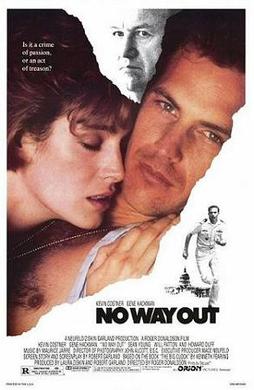
14 Days of Paranoia #7: No Way Out (dir by Roger Donaldson)


Trust no one in Washington would seem to be the message of this 1987 thriller.

Kevin Costner plays Lt. Commander Tom Farrell, a Naval Intelligence officer who is hailed as a hero after saving a shipmate who falls overboard.  In Washington, Tom is recruited by a friend from college, Scott Pritchard (Will Patton), to work for Secretary of Defense Brice (Gene Hackman).  Brice doesn’t trust the head of the CIA (played by future senator, Fred Dalton Thompson) and he wants Tom to serve as his mole within the service.  What Brice doesn’t know is that Tom is sleeping with Brice’s mistress, Susan Atwell (Sean Young).

Still, Brice does suspect that the woman with whom he is cheating is also cheating on him.  When he confronts her about it, their argument leads to him accidentally pushing Susan over an upstairs railing.  Pritchard, who is implied to be in love with Brice, takes charge of the cover-up and decides to push the story that Susan was killed by a possibly mythical Russian agent who is known only by the name “Yuri.”

Tom assists with the investigation of her death, both because he wants to know who killed Susan and also because he knows that there’s evidence in Susan’s apartment that could be manipulated to make him look guilty of the crime.  For instance, Susan took a picture of Tom shortly before her death.  The picture failed to develop but, through the use of what was undoubtedly cutting edge technology in 1987, Naval Intelligence is slowly unscrambling the picture.  For Tom, it’s a race against time to find the actual killer before the picture develops and he’s accused of both killing Susan and being Yuri.

Everyone has an agenda in No Way Out, from the ambitious Brice to the fanatical Scott Pritchard to the head of the CIA, who wants Brice to approve funding for a costly submarine.  Even the film’s nominal hero has an agenda, which has less to do with finding justice for Susan and everything to do with protecting himself and his future.  In fact, as is revealed in the film’s enjoyable if slightly implausible twist ending, some people in Washington have multiple agendas.  The film portrays Washington as being a place where, behind the stately facade, everyone is a liar and everyone is ultimately a pawn in someone else’s game.  If you have the right connections, you can even get away with murder.  Loyalty is rewarded until you’re no longer needed.

It’s an enjoyably twisty thriller, one that makes good use of the contrast between Kevin Costner’s All-American good looks and his somewhat shady screen presence.  The film introduces Costner as being a character who, at first glance, seems almost too good to be true and then spend the majority of its running time suggesting that is indeed the case.  Gene Hackman is well-cast as the weaselly cabinet secretary, as is Sean Young as the woman who links them all together.  In the end, though, the film is stolen by Will Patton, who plays Scott Pritchard as being someone who has unknowingly given his loyalty to a man who is incapable of returning it.  As played by Patton, Scott is an outsider who desperately wants to be an insider and who is willing to do just about anything to accomplish that goal.  He’s a version of Iago who never turned against Othello but instead devoted all of his devious tricks to trying to cover up the murder of Desdemona.

Even with an over-the-top final twist, No Way Out holds up well as a portrait of how the lust for power both drives and corrupts our political system.

14 Days of Paranoia:

  1. Fast Money (1996)
  2. Deep Throat II (1974)
  3. The Passover Plot (1976)
  4. The Believers (1987)
  5. Payback (1999)
  6. Lockdown 2025 (2021)

14 Days of Paranoia #6: Lockdown 2025 (dir by Mike Hall)


2021’s Lockdown 2025 tells the story of a neighborhood on the edge.

Clarence McGee (Glenn Plummer) has a got a nice house in the suburbs.  He has a nice view of the city in the distance and, even though we don’t learn much about what he does for a living, he appears to be very well off.  He has a wife named Carmen (Marie-Francoise Theodore) and three children, conspiracy theorist Junior (Marcus T. Paulk), daughter Crystal Marie (Parker McKenna Posey), and youngest Evan (Cristian Fagins).

To the outsider, it might look like Clarence has the perfect life but the reality is far different.  As a father, Clarence has been neglectful and, as his own wife points out, Evan is the only one of the kids with whom he  seems to have a strong connection.  Meanwhile, Crystal is pregnant and, while she’s told her boyfriend Marcos (Stewart Flores), neither one of them is quite sure how they’re going to tell Clarence.  And what is one to make of the burly police detective (James Black) who is sitting in his car and watching Clarence’s home?

Clarence is excited because he’s convinced that he’s finally going to win the lottery and become a billionaire.  However, just as the lottery numbers are about to be announced, the broadcast is interrupted by the National Alert System.  “This is not a test,” a voice says, before going on to explain that the president has declared a national emergency.  The country is under martial law.  There will be a 24-hour curfew.  No one is to leave their houses.

Suddenly, the skies are glowing and lightning bolts are streaking from the sky to the ground.  Explosions are heard in the distance.  The streets are full of “police soldiers” and anyone caught outside is subject to execution.  When Clarence’s neighbor tries to flee his house, he is executed on the spot.  Both Marcos and Junior suggest that maybe it’s all because of an online terrorist group known for being “pill-popping, weed-smoking, new age religious fanatics!”  Clarence says you can’t believe anything you see on YouTube.  For one thing, they let Junior on YouTube!

Meanwhile, a countdown clock appears on the television and starts to slowly tick down, from 80:00 to zero.  What happens the clock hits zero?  That’s what everyone is wondering.

As you can probably guess, things don’t go well for the McGees.  Being stuck in the house together not only makes them paranoid but it also leads to them revealing all of their deep, dark family secrets.  Soon, Clarence is loading a rifle.  When the detective finally enters the house and reveals his own secret, it leads to a violent confrontation.  Have you ever wondered how many people can accidentally get shot by two men firing guns at each other in a small enclosed space?  This film will tell you!

The plot description probably makes all of this sound more intriguing than it is.  Sadly, It’s not a very good movie, one that is marked by bad acting and bad special effects.  Not even the talented Glenn Plummer can do much with his role.  The initial apocalypse scenes are actually effective but soon, the Birdemic-style visuals kick in.  Worst of all, the film’s ending is the type of cheat that makes you feel stupid for getting in any way invested in the story.  An ending like this might have worked for a 15-minute short film but not for a film that drags on for 90 minutes.

This film was apparently produced by the Jehovah’s Witnesses and one of the final images is of a chastised, former doubter letting two Jehovah’s Witnesses into his home.  (Seriously, on the rare occasion that any of them are in my neighborhood, I hide in my room and don’t make a sound.)  I doubt this inspired anyone to pick up a copy of The Watch Tower.

14 Days of Paranoia:

  1. Fast Money (1996)
  2. Deep Throat II (1974)
  3. The Passover Plot (1976)
  4. The Believers (1987)
  5. Payback (1999)

Smokey And The Good Time Outlaws (1978, directed by Alexander Grasshoff)


After meeting a talent agent while spending a night in jail, aspiring singer J.D. (Jesse Turner) and his best friend, The Salt Flat Kid (Dennis Fimple), decide to leave Texas for Nashville.  J.D. wants to be a star and the Salt Flat Kid is a ventriloquist who doesn’t go anywhere without his dummy.

On the way to the Grand Old Opry, they pick up two women (Dianne Sherrill and Marcia Barkin), one of whom was engaged to marry the idiot nephew (Gailard Sartain) of Nashville’s Sheriff Leddy (Slim Pickens).  The sheriff sets out after the two men, planning on sending them back to Texas.

Despite the title and the subplot about the sheriff searching for his nephew’s former future wife, Smokey and the Good Time Outlaws doesn’t have much in common with Smokey and the Bandit.  J.D. has a Burt Reynolds-style mustache but he’s not a bandit.  He is just someone who wants to be a star and most of the movie is about him and the Salt Flat Kid tying to make their way onto the stage of the Grand Old Opry.  Helping them out is an eccentric woman named Marcie (who is played by Hope Summers, who older viewers will immediately recognize as having been Clara Edwards on The Andy Griffith Show).  When J.D. can’t get an audition, it occurs to him to just rush out on stage and start performing.

This film was a dream project for Jesse Turner, who was a real-life country musician.  He co-wrote and produced the film, as well as starred in it.  Jesse Turner wasn’t much of an actor but he’s surrounded by a good supporting cast.  Slim Pickens steals the show as a more menacing version of Buford T. Justice but he’s not in the film nearly enough.  Dennis Fimple is likable but appears to be too old to be known as “the Kid.”  You can tell this is a movie because no one is creeped out by the Kid’s ventriloquist dummy.

Smokey and the Good Time Outlaws was made for the Southern drive-in circuit and it is good-natured, even if the story is never that interesting.  Country music fans of a certain age will appreciate it.