A group of friends gather and spend a night hanging out. Old resentments simmer to the surface. A murder is committed. A killer with a bag over his head emerges from the night. The friends try to figure out who amongst them could be a killer or if there’s something else going on. I know some people will automatically suspect the guy wearing the Slipknot t-shirt because the members of the band all wear masks and the killer wears a mask but that’s the same logic that led to the Satanic Panic of the 1980s. If he was wearing a Nickelback t-shirt, I would be with you.
This is a short horror film that feels like a bunch of real-life friends got together to play the fictional friends. The opening half is too talky and slow but the second half picks up and features a few clever touches. There aren’t many kills and they’re largely bloodless but I think director Jacob Osborn was going for something more than just another slasher. The movie is more about how the friends relate to each other than anything else. This is a low-budget, regional film that starts out way too slowly but I’m going to cut it some slack because the second half of the movie makes up for the weak first half. At a time when the term indie film gets applied to even big-budget productions with major stars, Murder In The Dark is a true independent film.
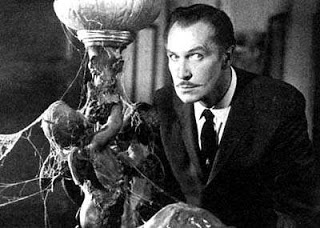
The original The House on Haunted Hill is a classic and one that we make it a point to share every Halloween. And since October is now halfway over, now seems like the perfect time to do so!
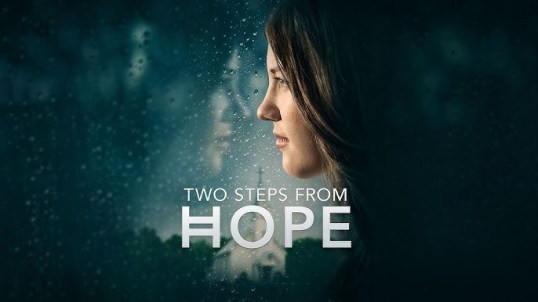
In 2017’s Two Steps From Hope, a family gets hit by tragedy upon tragedy. First, the eldest son is killed in a car accident, which leaves his sister struggling with guilt and his parents on the verge of divorce. In the split second necessary for that accident to occur, lives were changed forever. (If I seem to be harping on this, that’s because I’m still struggling to deal with the fact that my father was okay until he went to the store in May and was involved in the car accident that aggravated his Parkinson’s and ultimately cost him his life. If he hadn’t gone to the store on the day or even at that particular moment, he would probably still be alive today. I will admit that I spend a lot of time obsessing on this and I think it’s definitely changed the way that I react to just about everything.) Then, his sister starts to suffer from sudden nosebleeds, including having one while spending the weekend away at camp. When she returns from camp, she overhears her parents are arguing and, upset, she runs away. After she returns home, her health continues to deteriorate and it’s discovered that she is suffering from Leukemia.
As far as faith-based films are concerned, this one isn’t bad. It’s refreshingly non-preachy and it makes a sincere attempt to deal with grief in a realistic way and without offering up any quick solutions. The characters in this film are going to be struggling for a long time but at least they can draw strength from their faith and their bond as a family, albeit one that is currently in turmoil. That’s not a bad message and the actors play their roles with enough authenticity that the emotions ring true. The movie manages to handle potentially treacly scenes without allowing itself to fall into the trap of being overly sentimental. It’s a well-done film.
That said, the most interesting thing about the film is how it was made. The story was written by a group of teenage interns at Gaffer Media and those same interns made up the majority of the crew, giving them a chance to learn not only about filmmaking but also to make a film about teenagers that didn’t sound like it was written by an adult desperately trying to sound young. (Most faith-based films combine the worst dad jokes with absolutely the worst dialogue imaginable. Whenever I watch them, I always imagine the screenwriter scouring social media in an attempt to learn how people under the age of 18 talk. The end result is an overreliance on slang and a lot of scenes involving parents wondering why their children are so into their phones. “This new phone is totally on fleek!” the teenager will say while the parents exchange bemused glances.) The teenage crew (and I should note that this film was released seven years ago so none of them teenagers anymore) all did a good job. That is definitely something to be positive about.
Twenty-five years ago, six employees were murdered at Phantom Fun-World, an amusement park owned by August Ambrose (played Ari Lehman, best known for having played the young Jason Voorhees in the first Friday the 13th). Now, the park is reopening and there’s already people competing to be the new Phantom Fun-World mascot. Unfortunately, none of them get the job because they’re all killed by a hulking figure wearing a mask. For whatever reason, this killer seems to have a real issue with mascots.
Yes, there is a killer stalking Phantom Fun-World and that’s not good news for Andi (Celeste Blandon), who has taken a job working nights at the park. Andi needs the money to take care of her teenage brother, Cole (Jace Carson) and the job will give her a chance to hang out with her best friend, Collins (Spooky Madison). (It will also give her a chance to spend time away from her toxic mother.) Unfortunately, the killer has plans of his own and soon, Andi’s co-workers are dying and Andi is fighting to both protect Cole and to survive the night.
Despite the brevity of this review, I actually enjoyed Phantom Fun-World quite a bit. There’s nothing particularly unique about the plot. It’s a standard slasher film and the fact that it points out more than once that it’s a standard slasher film doesn’t change that fact. (Indeed, the slasher genre has been so influenced by Scream that it’s now more surprising when a film doesn’t deliberately draw attention to or comment on its use of all of the genre’s cliches.) But the film makes good use of the theme park location and the killer is a frightening one, both because of his mask and the fact that he seems to truly relish his work. Someone like Jason Voorhees kills because it’s the only thing that he knows how to do. He doesn’t seem to take any pleasure out of it. The killer in Phantom Fun-World is having the time of his life and that’s make him all the more frightening. The murders are well-directed and surprisingly brutal. Again, this is one intimidating killer.
It helps that the cast is likable. There’s really no one in this movie who does a bad job. The viewer likes everyone and, as such, there’s some actual emotional stakes to all of the mayhem. Celeste Blandon does an especially good job as Andi, making her a worthy protagonist without making her so perfect that she becomes a less-than-credible character. One of the reasons that the movie works is because Andi truly does make the same mistakes that anyone in her situation would make and, as a result, it’s easy to empathize with her and her desire to protect Cole.
Don’t get me wrong. Phantom Fun-World is a low-budget slasher film and there’s not a whole lot going on here that you haven’t seen in other slasher films. That said, it’s a well-done film and an appropriate way to spend 90 minutes during the Halloween season.
In 1984’s Blind Date, Joseph Bottoms stars as Jonathon Ratcliff, an American who works in Greece.
Jonathon would appear to have it all. He has a good job in an exotic land. He has a nice home. He has a beautiful girlfriend named Claire (Kirstie Alley). He has co-workers who love him so much that they insist on throwing him a birthday party and giving him his cake while he’s making love to Claire. Jonathon enjoys jogging and listening to music and spying on his neighbor, which the film treats as a harmless little thing that all men do. I mean, I guess we should be happy that Jonathon isn’t disguising himself as a taxi driver and murdering the women that he picks up with a scalpel. No, someone else is doing that.
Jonathon suddenly loses his eyesight. Fortunately, Dr. Steiger (James Daughton) has a solution. He’s created a computer program that turns sound into very primitive, grid-like images. As long as Jonathon is wearing his headphones, he can see … kind of. At first, it’s all good fun. Jonathon beats up the extremely flamboyant muggers who have been harassing him at the subway station. And he continues to spy on his neighbor whenever she’s getting undressed which is not cool considering that Claire has stayed with him through his entire ordeal.
Meanwhile, the scalpel murders are continuing….
Now, to be honest, I assumed that Jonathon was going to form some sort of mental connection with the killer and start seeing the murder through the killer’s eyes. Instead, Jonathon just hears the killer walking with one of his victims and he ends up investigating on his own, despite not really being able to see well. Basically, the whole idea of Jonathon being blind doesn’t have much to do with the thriller aspect of the plot. I could maybe accept that if the film hadn’t spent a huge amount of time explaining in pain-staking detail how exactly Jonathon’s “eyes” work. The action literally stopped for a huge chunk of the film’s running time so that the film could make its most ludicrous plot point seem even more ludicrous.
Greek director Nico Mastokaris is obviously trying to do an Argento-style giallo with Blind Date and, indeed, Argento himself has a noted habit of including intriguing but ultimately pointless red herrings in his films. Just as Asia Argento having the Stendhal Syndrome proved to be a bit inconsequential to The Stendhal Syndrome, Joseph Bottoms being blind is inconsequential to Blind Date. That said, Argento can get away with that sort of thing because, even in his weaker films, he’s clever stylist and he usually maintain a solid narrative pace. Blind Date, on the other hand, is rather draggy and Joseph Bottoms is not a particularly likeable hero.
On the positive side, James Daughton (he was the head of the evil frat in Animal House) gives a genuinely interesting performance and Kirstie Alley is likable as the neurotic Claire. For the most part, though, one can see why the sequel promised in the closing credits never came to be.
“You have no idea the sacrifice I have made for this land!” Uncle Ollie (Greg Nutcher) yells when his family complain about life on the farm. They’re about to find out, though.
The audience will figure it out before Neil (Troy Escoda) and his clairovoyant son, Jake (Ian Hernandez-Oropeza). As soon as they arrive at the farm, Jake starts having visions of sacrifices and women having their tongues cut out. It’s easy to figure out what the farmers in the town due to ensure that they’ll have a good crop but no one in the movie is as smart as those of us watching at home.
The movie probably would have been scarier if I could have actually heard or understood half the dialogue. The film’s sound quality is terrible. I even checked my hearing aid to make sure that it wasn’t a problem on my end. Some of the dialogue has been obviously dubbed. Some scenes are too loud. Some scenes you can’t hear anything at all.
There’s not much of a story here so everything gets dragged out. “Have you wondered why there are no children her!?” Uncle Ollie yells while swinging around an axe. Nah, Ollie, we figure it out a while ago.
The 1978 film, Killer’s Delight, opens with the usual beautiful shots of San Francisco in the 70s. It’s a lovely city, full of attractive people with their entire lives ahead of them. The camera lingers on the Golden Gate Bridge. If your movie doesn’t feature the Golden Gate Bridge, is it really set in San Francisco?
A van drives through the city and into the countryside. My first instinct was to think, “Oh, that’s definitely a rape van,” and yes, it is. (Seriously, don’t ever accept a ride from someone with a van. Actually, you shouldn’t be hitchhiking to begin with! Shame on you!) The owner of the van, Danny (John Karlen), pulls over to the side of the road and tosses a naked woman’s body over the side of a cliff.
AGCK!
Now, I have to admit that Killer’s Delight (which is known by about a dozen other titles, including The Dark Ride) is a film that I’ve tried to watch several times but I’ve always struggled to make it all the way through. That’s not because of the subject matter, though as a woman who once thought of herself as being invincible, I could certainly relate to many of the women who appeared in this film and made the fatal mistake of getting in that van. No, the reason why I’ve always struggled with Killer’s Delight is because it’s a slow movie. It’s not necessarily a bad film but it’s not one to watch if your eyelids are already starting to feel heavy.
This is an early serial killer film, made before it was decided that every killer should be portrayed as being an erudite and witty anti-hero. Instead, the film’s killer is a loser named Danny (John Karlen) who has never gotten over his childhood and who, when he’s not killing, is busy sobbing. It’s certainly a more realistic portrayal of a serial killer than anything that one might find in any of the films or books about Hannibal Lecter. Danny has two skills. He’s good at disguising himself and he’s fairly good at getting rid of bodies whenever there’s no one else around to see him. Otherwise, he’s a total loser. This realistic portrayal actually makes Danny into a very scary character. You’re never going to meet Hannibal Lecter in real life. That’s one reason why it’s so easy for some people to accept his crimes. However, there are hundreds of people just like Danny out there. There’s probably at least a few in your city right now.
The majority of the film is taken up with Sgt. Vince De Carlo (James Luisi) and his attempts to prove that Danny is the killer. Vince is married and very protective of his daughters. He’s also having an affair with a psychiatrist (Susan Sullivan) who runs the potential of becoming one of Danny’s victims. Vince becomes obsessed with Danny but, much like Charles Bronson in Ten To Midnight, he knows that the justice system does not know what to do with a monster like Danny.
As I said, it’s a slow film but it is well-acted and, if you stick with it, it does cast an ever-growing atmosphere of doom. It’s the type of film that will make you double-check the locks before you go to bed.
As for why this is a true crime film, it’s loosely based on the crimes of Edmund Kemper and Ted Bundy. At the time the film was made, Bundy was still at large. Killer’s Delight was the first film to be based on Bundy’s crimes, though Danny ultimately has more in common with Kemper than with Bundy.
At the start of 1994’s Godzilla vs. Spacegodzilla, our favorite big green radioactive monster isn’t asking for much. Mostly, he just wants to live on his island and be left alone. He’s busy raising Baby Godzilla and he’s minding his own business. That’s one thing that people tend to forget when it comes to Godzilla. With the exception of the very early films, Godzilla is usually just minding his own business until he’s forced to go on a rampage by either aliens or humans. In this film, Godzilla has to deal with both.
There’s a SpaceGodzilla heading towards the Earth. Apparently, Godzilla cells were released into space during the epic battles that were featured in both Godzilla vs. Biollante and Godzilla vs Mothra. Those cells were exposed to the radiation of a black hole and the end result was SpaceGodzilla. SpaceGodzilla is coming to Earth to not only dethrone Godzilla as King of the Monsters but also to transform Earth’s core into a power source that it can use to do whatever it is that SpaceGodzillas do in their spare time.
After being warned by those two annoying little faeries that follow Mothra around everywhere, psychic Miki Saegusa (Megumi Okada) and some members of G-Force head to the island that Godzilla calls home. Unfortunately, the Yakuza follows them because the want to capture Miki so that they can use her psychic powers to control Godzilla and use him to …. well, I don’t know. I mean, yes, Godzilla is an awesome weapon but he’s really big and there’s always a lot of collateral damage whenever he gets into a fight and it seems like using him to commit any sort of Yakuza-style crimes would be a bit counter-productive. I mean, you can’t really extort businesses if they all get destroyed by Godzilla, can you? Plus, I just don’t see Godzilla agreeing to chop off the tip of his finger or get all of those Yakuza tattoos.
But listen, I’m thinking too hard about the plot here. Yes, there’s some stuff that goes on with the humans but that’s all forgotten as soon as SpaceGodzilla lands and abducts Baby Godzilla. Grown-up Godzilla is out for vengeance and it leads to some very dramatic fights. This film gives us a chance to see Godzilla fight, more or less, himself and it’s an entertaining sight. This is a bit of a campy film, even by Godzilla standards. It even ends with a warning that SpaceGodzilla might return if human don’t stop polluting space. (Uhmm …. talk to Mothra, she’s the one who sent all those cells up there.) But the important thing is that the battles are fun to watch and Baby Godzilla is adorable.
Who needs the Son of Godzilla when you’ve got this?
Opening with a montage of scenes from Night of the Living Dead mixed in with actual footage of civil unrest from the 60s, Festival of the Living Dead imagines a world where a zombie outbreak actually did occur in 1968.
Humanity survived. All of the zombies were apparently put down by human hunters and the plague of the living dead was ended. In order to commemorate the night of the living dead, a Festival of the Living Dead is held every year at the sight of the zombie outbreak. Over the past 55 years, the Festival has become a high-priced event that can only be attended by people who are willing to spend a lot of money for the honor to stay in tents, listen to live music, and set fire to a giant wicker woman. Essentially, the Festival of the Living Dead is Burning Man but instead of basing the festival of new age nonsense, the Festival is based on a zombie outbreak.
Unfortunately, those who attend the Festival have lost sight of what the party is supposed to be about. Now, instead of celebrating the survival of humanity and paying honor to those who lost their lives (sometimes more than once in one night!), the people attending the Festival are just influencers who are hoping to go viral. Early on in the film, Iris (Carmen Bicondova) point out how weird and tacky it is to have a festival celebrating an event where so many people died.
This year, the folks at the Festival of the Living Dead are going to be reminded about what the entire festival is supposed to be about! When one vlogger films himself snorting what he claims to be a crushed meteorite, everyone assumes that he’s just another person looking for online fame. But soon, he’s foaming at the mouth, throwing up, and then savagely attacking the festival staff. Of course, those who have seen the original Night of the Living Dead will remember the much-ridiculed scene in which a news reporter is heard to speculate that the dead are coming back to life due to space dust that was brought back to Earth by NASA. It turns out that reporter knew what he was talking about. It’s not just a case of Hell no longer having room for the dead. It’s the meteorites!
Ash (Ashley Moore) and her friends try to survive the Festival of the Living Dead, which turns out to not be an easy task. Not only are zombies famous for being relentless in their pursuit of the living but the living are famous for reacting to living dead outbreaks in the dumbest ways possible. Ash has one cool friend, that would be Iris. Unfortunately, the rest of her friends are nowhere near as smart. Fortunately, Ash has zombie hunting in her blood. Though the film doesn’t specifically state it, it’s suggested that her grandfather was Ben, the hero of Night of the Living Dead.
Festival of the Living Dead is a loving homage to Night of the Living Dead and its sequels. It’s undeniably derivative but it’s also made with so much love for the genre that it doesn’t matter that you’ll be able to guess who is going to live and who is going to die from the minute they first appear onscreen. Ashley Moore, Carmen Bicondova, and Christian Rose (as the film’s bravest character) all give strong performances and the film’s central joke — which is that everyone at the Festival is either too stoned or too stupid to initially notice the zombie outbreak — is one that works because it’s rooted in fact. Do you seriously think anyone at Burning Man would notice the living dead?
I have to admit that I’ve never been a huge fan of anthology films. Anthology films are almost always a bit uneven. Some filmmakers are better suited to making short films than others and, as anyone who has ever sat through one can tell you, sitting through a boring short film is actually worse than having to watch a boring long film. Too often, anthology films are just a collection of boring short films. If you get lucky, there might be a good segment hidden amongst all of the bad segments. But even so, that often means sitting through 30 minutes of bad filmmaking for 15 minutes of something that’s moderately entertaining.
1962’s Tales of Terror is an anthology horror film. Directed by Roger Corman, the film is a part of his Poe cycle and features adaptations of three Poe short stories, Morella, The Black Cat, and The Facts In The Case of M. Valedemar. While it definitely suffers from the flaws that afflict many anthology films, Tales of Terror is saved a bit by the presence of Vincent Price. Price not only appears in all three of the films but he also provides the narration that links each film. As I mentioned when I reviewed The Premature Burial, one cannot underestimate the importance of Vincent Price and his unique style of acting when it comes to discussing Corman’s Poe adaptations. With his dramatic flourishes and his theatrical style of speaking, Price was the perfect star for these films. As an actor, he perfectly complimented Corman’s flamboyant and colorful direction. It also helps that Price himself seems to be truly enjoying himself in all of these films. His eccentricity brings the film’s to life.
As for the separate stories that make up Tales of Terror, things get off to a rather macabre start with Morella. Leonora (Maggie Pierce) returns home to visit her father (Vincent Price), who is now a drunken wreck who continues to blame Leonora for the death of her mother, Morella (Leona Gage). Morella died while giving birth to Leonora. Leonora is shocked to discover that her father is keeping her mother’s decomposing body in the mansion. Leonora, who is suffering from a terminal illness, tries to take care of her father. However, Morella’s spirit remains in the house, leading this story to a rather depressing and unsettling ending. This story was effectively done, playing out like a particularly morbid companion to The Fall Of The House of Usher.
The Black Cat is presented as a comedy, starring Peter Lorre as a man who becomes convinced that his wife is cheating on him with a snobby wine taster who is, of course, played by Vincent Price. This overlong segment did not work for me and I have to admit that a lot of that is because I love cats, black cats in particular. Beyond that, the humor is a bit too broad. Corman could do comedy, as he showed with Little Shop of Horrors, but he seems to be trying a bit too hard here.
Finally, the third segment is The Facts In The Case of M. Valdemar, in which Vincent Price plays the title character. The dying Valdemar employs a hypnotist (Basi Rathbone) to put him in a trance to help relieve his suffering. However, the hypnotist hopes to marry Valdemar’s wife (Debra Paget) and, after putting Valdemar into a trance, he leaves the dying man there. Valdemar, whose body starts to decay, cannot die. But, once he becomes angry enough, he can still rise from his bed to seek revenge even as his body putrefies. This segment was the best of the three, featuring Price’s best work in the film and also a wonderfully villainous turn from Basil Rathbone. The makeup effects that were used to capture Valdemar’s decay remain effectively frightening today.
Tales of Terror is two good stories and one mediocre one, which is better than the usual anthology film. Still, not surprisingly, the main reason watch is for the wonderful Vincent Price.


 Through the Shattered Lens