Patreon Preview Week : “A Superhero Comic Book” By Ina Parsons


To wrap things up on my Patreon preview week here, I present a recent review of a VERY unique project —

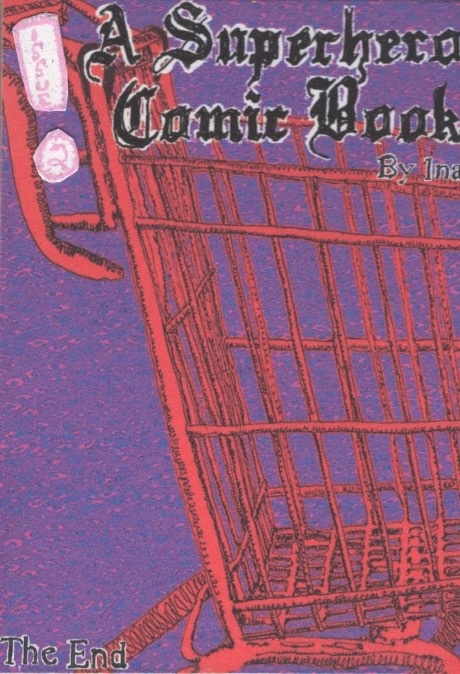
One of the things I’ve always appreciated about Domino — and I’m sure this is true for all the readers of this site who also buy books from them either “on the regular” or occasionally — is that once in awhile proprietor Austin English somehow gets ahold of something that utterly defies not only categorization, but even description. And while on the surface, at least, Ina Parsons’ A SUPERHERO COMIC BOOK would seem to do neither, given that its title clearly states both what it is AND what sort of genre category it fits into, let’s face it : appearances can be deceiving.

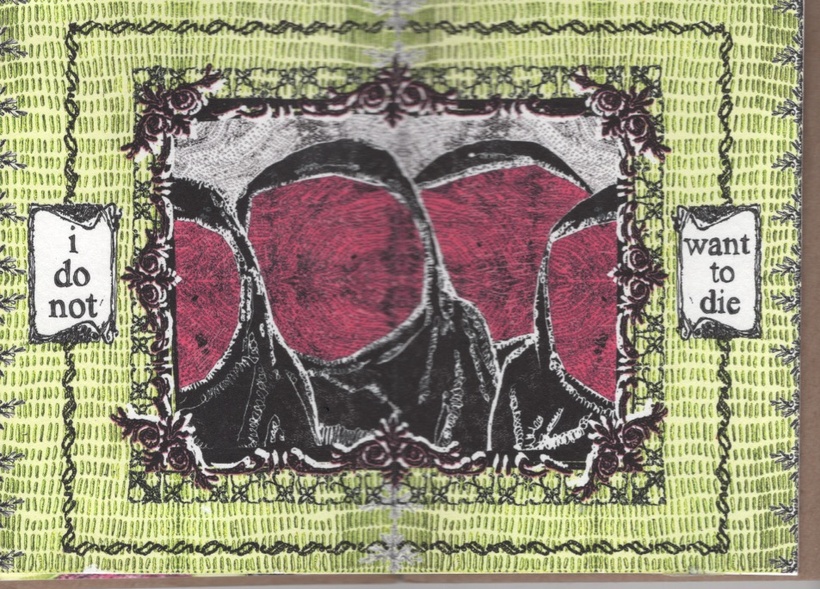
Ironically, however, it’s the APPEARANCE of the three (to date) purported “comic books” in this series that’s the first thing to clue you in to the fact that there’s something very different going on here : roughly the size of maybe a kid’s hand, each “issue” consists of four heavy cardstock “pages” glued (I think, at any rate) inside even HEAVIER cardboard “covers” — we’re clearly talking, then, about genuinely HAND-MADE items here, with each “cover” and “back cover” consisting of reverse-image collage art and each interior image being a double-“page” spread that juxtaposes a provocative sentence fragment with, again, frankly mysterious collages, each of which uniformly evokes the look and feel of photographic negatives, albeit negatives shot through with intentionally garish color schemes.

 Hey, I TOLD YOU this shit was hard to describe — I really am doing my best, promise.

As for what’s “happening” in the “story,” it would appear that some human test subject or other is strapped down to a table and being “gifted” with super-powers of some sort by a shadowy group of doctors, and that said subject is both excited and terrified at the prospect, as one probably would be under the circumstances — whatever those circumstances, ya know, are. That’s all we know so far, and even THAT is up for debate. What ISN’T, however, is that this project has already redefined the parameters and possibilities of both genre fiction AND “chapbook”-formatted art.

In fairness, though, it had damn well BETTER break some new ground given the price tag attached to it : after all, each “issue” costs ten bucks. And while there’s no doubt the minute you look at one of these “comic books” that MORE than ten dollars’ worth of labor went into putting the whole thing together, that’s still a lot of money to spend on what is, at the end of the day, a small art object moreso than it is a “book” per se. All that being said, though, the real question here is : leaving aside what went into it, can you possibly get your money’s worth OUT of it?

That all depends, I suppose, on something we’ll call, for lack of a more readily-available term, the “appreciation factor.” If you derive personal satisfaction from immersing yourself within a highly personal and distinctive artistic vision the likes of which you’ll quite literally find NOWHERE else, then the answer is a very enthusiastic “yes.” But if you don’t have the time, inclination, or desire to grapple with this work on anything more than a liminal “surface” level (and absolutely no judgments here if this describes you — we all have our own individual tastes), then I can’t in good conscience recommend you buy these “comics.” They demand that you meet them on their own terms, and the very first of those terms is decoding precisely what the REST of the terms are. Certainties are few and far between here, it’s true, but while A SUPERHERO COMIC BOOK doesn’t fit any preconceived notions of WHAT superhero comic books are, there’s still no real question that it is EXACTLY what it bills itself as being.

I also think it’s reasonable to assume, even at this apparently-early stage, that this work roughly fits into the category of “superhero deconstruction” — something that’s been so done to death that I can easily understand why even reading those words would put somebody off. But it’s not deconstructing the superhero via narrative means alone. Visually, formally, even conceptually, Parsons is splitting the idea apart like Oppenheimer did with the atom. There’s no telling what will emerge from it — perhaps, at least in part, because there’s no telling where we are within the overall framework of the project right now — but it’s sure to be fascinating, regardless of whether or not it’s entirely decipherable.

If your interest in piqued, check out more by going over to http://dominobooks.org/superhero1.html

And if your interest is piqued by the preview content I’ve been presenting this week, please check out more by going over to https://www.patreon.com/fourcolorapocalypse

Patreon Preview Week : “Marshal Law : The Deluxe Edition” By Pat Mills And Kevin O’Neill


Next up on our Patreon preview week is a representative example of an occasional series I have going on there called “Retro Comics Corner” where I take a break from reviewing contemporary comics to cast a critical eye on older stuff. If you fid it to your liking, please consider signing up for said Patreon, a link to which will follow this review.

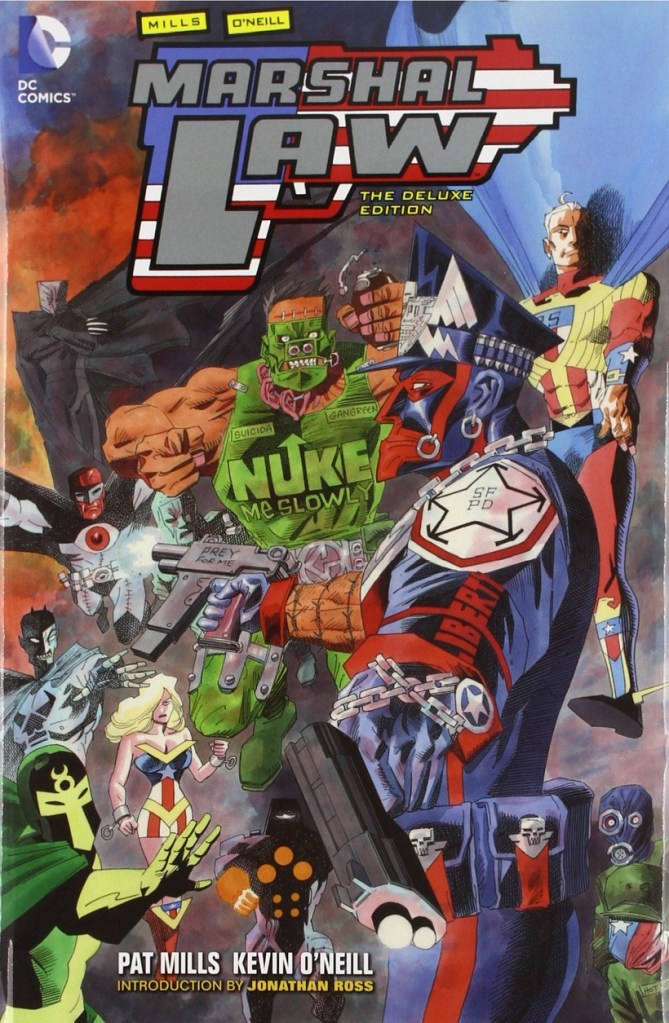
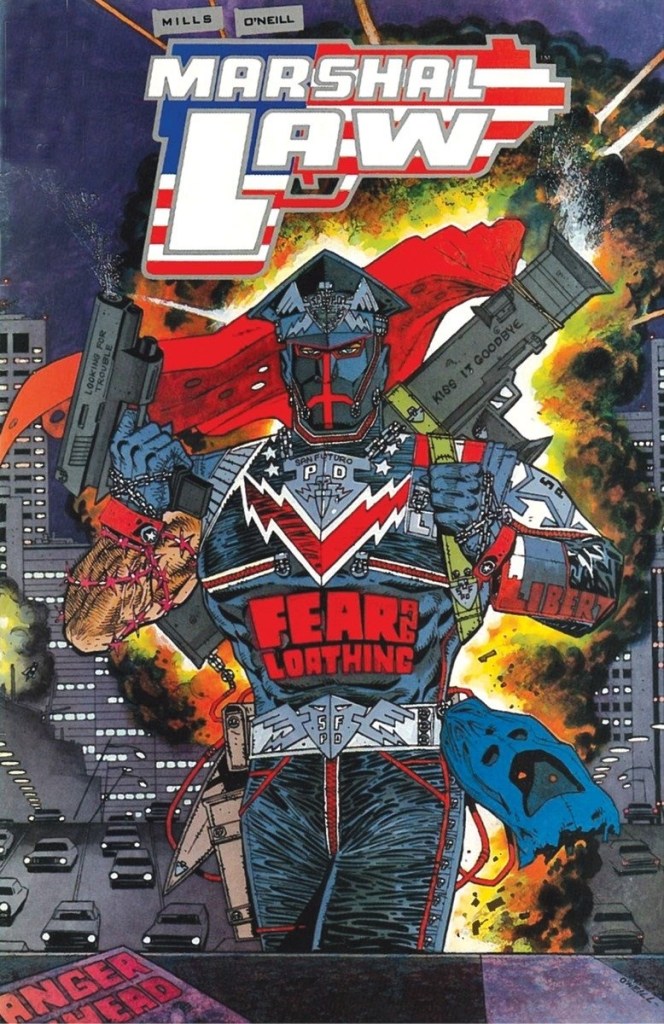
What a long, strange trip it’s been for Pat Mills and Kevin O’Neill’s MARSHAL LAW. Originally “green-lit” by Archie Goodwin, then-head honcho of Marvel’s creator-owned Epic Comics line, back in 1987 as a kind of “last word” on super-hero deconstruction, the creators followed Goodwin out the door when he left for DC, but opted not to join him there, instead throwing in their lot with short-lived British comics publishing venture Apocalypse (where Mills was put in charge of the equally-shot-lived TOXIC! anthology title) before returning the project back to these shores via Dark Horse. The eventual end of the comic (and the character) as a going concern didn’t mean Mills and O’Neill were done with their vagabond ways, though —

In 2010, Top Shelf announced that they had entered into an agreement with the pair to publish an omnibus collection of all of Marshal’s appearances, even his late-period crossovers with Erik Larsen’s SAVAGE DRAGON, Clive Barker’s PINHEAD, and Doug Mahnke’s THE MASK, but somehow that fell by the wayside, and when we finally DID get a “definitive” MARSHAL LAW book, it came in the form of DC’s 2013 MARSHAL LAW : THE DELUXE EDITION,  a snazzy hardcover that was notably WITHOUT the “team-up” comics which had originally been slated for inclusion. Methinks copyright issues are the primary reason that this supposedly “complete” collection isn’t, in fact, complete, but still — at nearly 500 pages, it’s at the very least a COMPREHENSIVE volume by anyone’s definition of the word.

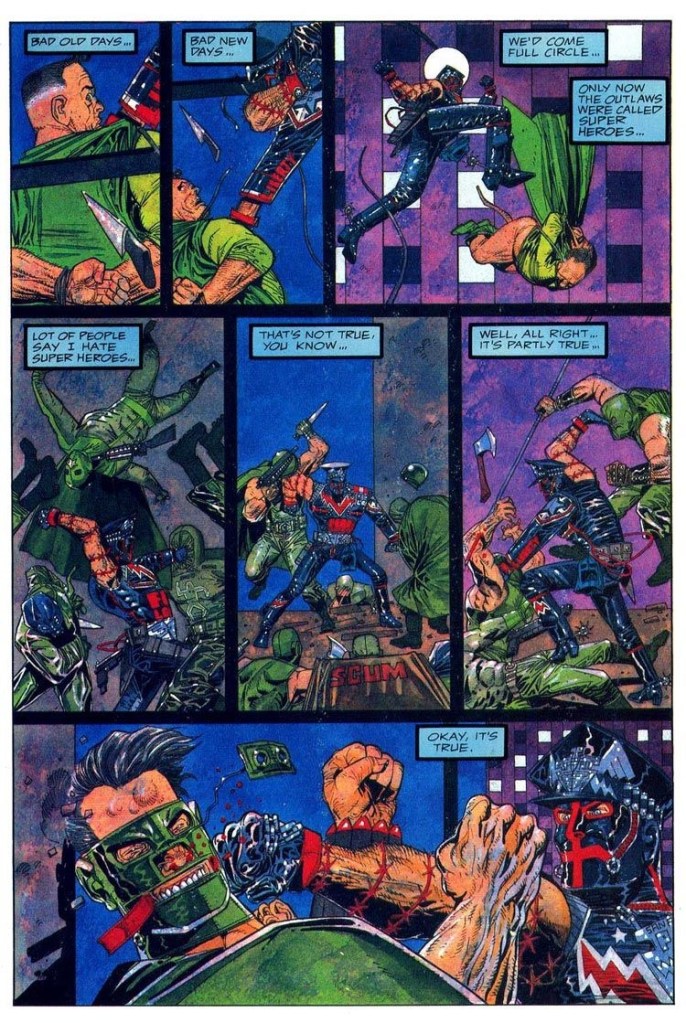
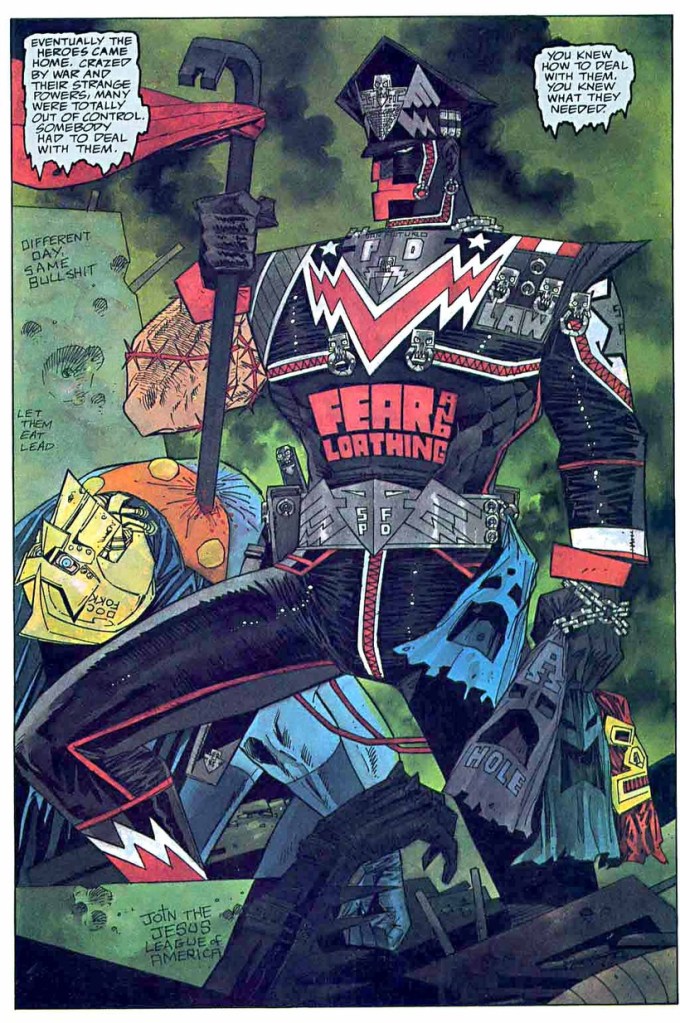
It’s also a DAMNED uneven one, truth be told. but the responsibility for that should be laid squarely on the shoulders of Mills and O’Neill themselves, who kept this concept going well beyond it’s “sell-by” date, with each outing delivering diminishing returns until all that was left was hollow self-parody. Make no mistake, though : the first MARSHAL LAW series, latterly sub-titled “Fear And Loathing,” is great fun and succeeds wildly in chiseling an epitaph on the entire concept of the super-hero in general. Sure, there’s a somewhat predictable mystery story shoehorned into the proceedings that revolves around one of the more painfully obvious “MacGuffins” you’re ever likely to come across, but that’s not REALLY what the comic was about, per se : rather, it was about Mills and O’Neill venting their spleen on super-heroes on a conceptual level, and on the hyper-violent “realistic” iterations of them that were polluting the comics landscape at the time in particular. Sure, it was self-indulgent to the point of being borderline-masturbatory, but that was the whole POINT. These two hated super-heroes, and even more than that hated what had BECOME of super-heroes, and they wanted to hammer that hatred home in a manner that mocked and ridiculed the genre’s excesses by dialing them up to 11. This is a narrow creative remit, to be sure, but they hit it out of the park.

Lost in all the hubbub, though, is the obvious debt the whole premise owed to JUDGE DREDD, with Marshal himself essentially being a stand-in for his more famous predecessor and the ruined post-apocalyptic hellscape of San Futuro functioning as Mills and O’Neill’s very own Mega-City One. Both protagonist and city were exceptionally well thought-out, however, it must be said, and very few exercises in “borrowed” world-building have anywhere near the effort put into them that this one did. No points for originality, then, but points APLENTY for execution.

Cracks in the firmament began to show pretty quickly after “Fear And Loathing,” though : when next we encountered Marshal, it was in a series of oversized one-offs that would pop up sporadically, with dead giveaways about the plots of each being baked right into the titles : “Marshal Law Takes Manhattan,” “Kingdom Of The Blind,” “The Hateful Dead,” and “Super Babylon” won’t leave anyone wondering what the hell is happening in the books themselves,  and it’s no exaggeration to say that each is  more concerned with upping the ante in terms of overall OTT-ness than they are about anything else. Kudos to O’Neill for clearly having a blast delineating all the carnage Mills could throw his way, but by the time of Marshal’s final solo adventure, the two-part “Secret Tribunal,” the comic was little more than a “greatest hits” pastiche forever seeking to re-capture some frisson of its faded glory. There was still a fair amount of stupid fun to be had for readers, sure, but even then most of that stupid fun came tinged with hollow reminders of just how fucking COOL this comic USED to be.

By the time this book ends, then, it’s honestly no stretch to say that you’ll be rather glad it’s over, but there are a smattering of extras on hand to make you feel good about the purchase, including a highly-detailed full color map of San Futuro, some “virgin” cover art, and a couple of early-version character sketches. None of this is earth-shaking stuff by any stretch, and my understanding is that much of it is “ported over” from an earlier Graphitti Designs collection of “Fear And Loathing” and “Marshal Law Takes Manhattan” that boasts much more in terms of backmatter (good luck finding that!), but again : this is all more than exhaustive enough for anyone other than the hardest of hard-core fans. Unless you happen to number yourself among that lot, then, the MAIN value to be had from this collection is twofold : it reminds you of just how apropos for its time the first MARSHAL LAW series was — and of how quickly the times passed poor old Marshal by. “Fear And Loathing” is certainly good enough to DESERVE to stand as a capstone on the entire concept of ultra-violent, “mature” super-hero revisionism, but the fact that it DOESN’T is at least partially down to Mills and O’Neill’s decision to keep the concept going beyond that point.

Want more? Then please give my Patreon a look by heading over to https://www.patreon.com/fourcolorapocalypse

Patreon Preview Week : “Beatnik Buenos Aires” By Diego Arandojo And Facundo Percio


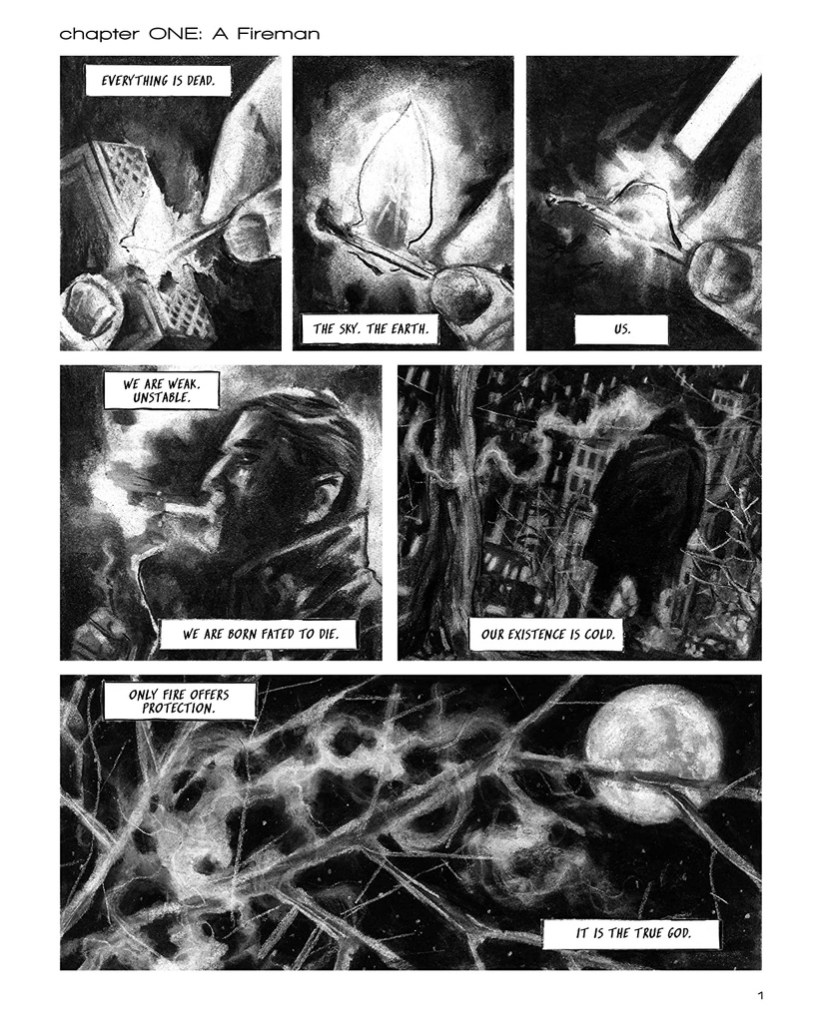
Continuing with our “preview week” of content originally posted on my Patreon, here’s a recent-ish review I wrote of Diego Arandojo and Facundo Percio’s BEATNIK BUENOS AIRES, published in English in 2021 by Fantagraphics —

There are three kinds of historical narratives — those that relate the nuts and bolts of the particular epoch they’re analyzing, those that capture and evoke the MOOD and ATMOSPHERE of the time, and those that manage to do both. 

The comics medium is uniquely suited to the second option, of course, being a visual means of communication, but that doesn’t preclude the first and third options from being on the table, as it were, as well — when you’ve only got 96 pages to work with, though, you’d better figure out precisely what it is you’re looking to do if you want to do it WELL. There’s not much room for false steps when you’re operating within the strictures of a concise page count, after all, and there’s even LESS time to recover from them.

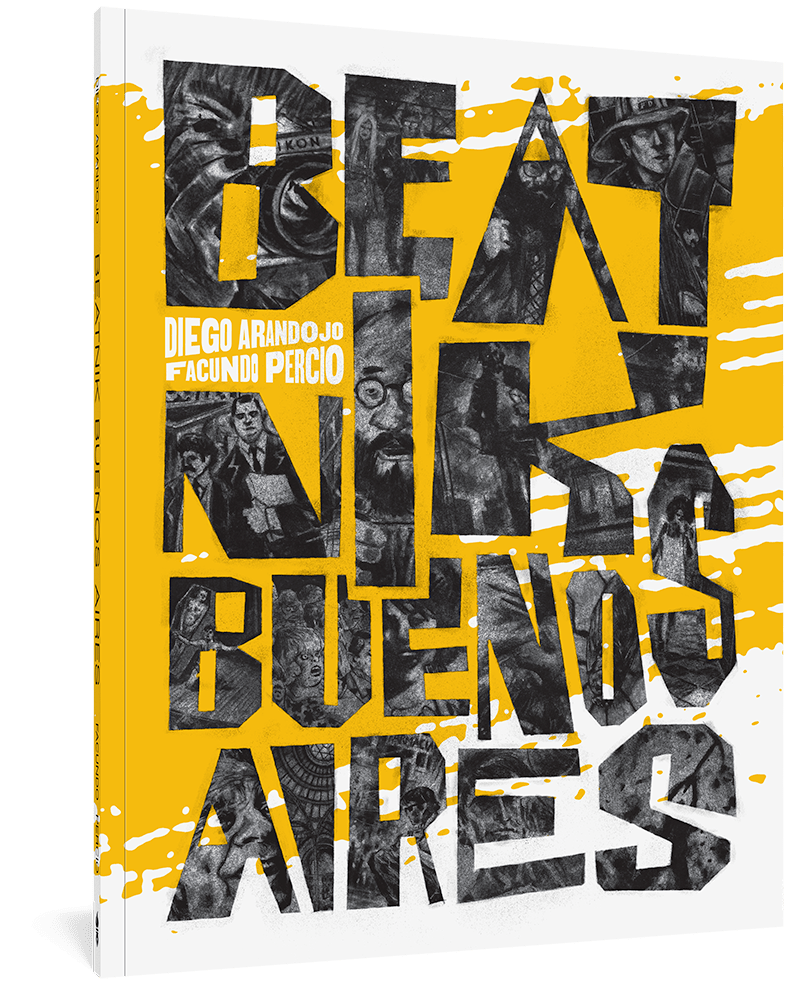
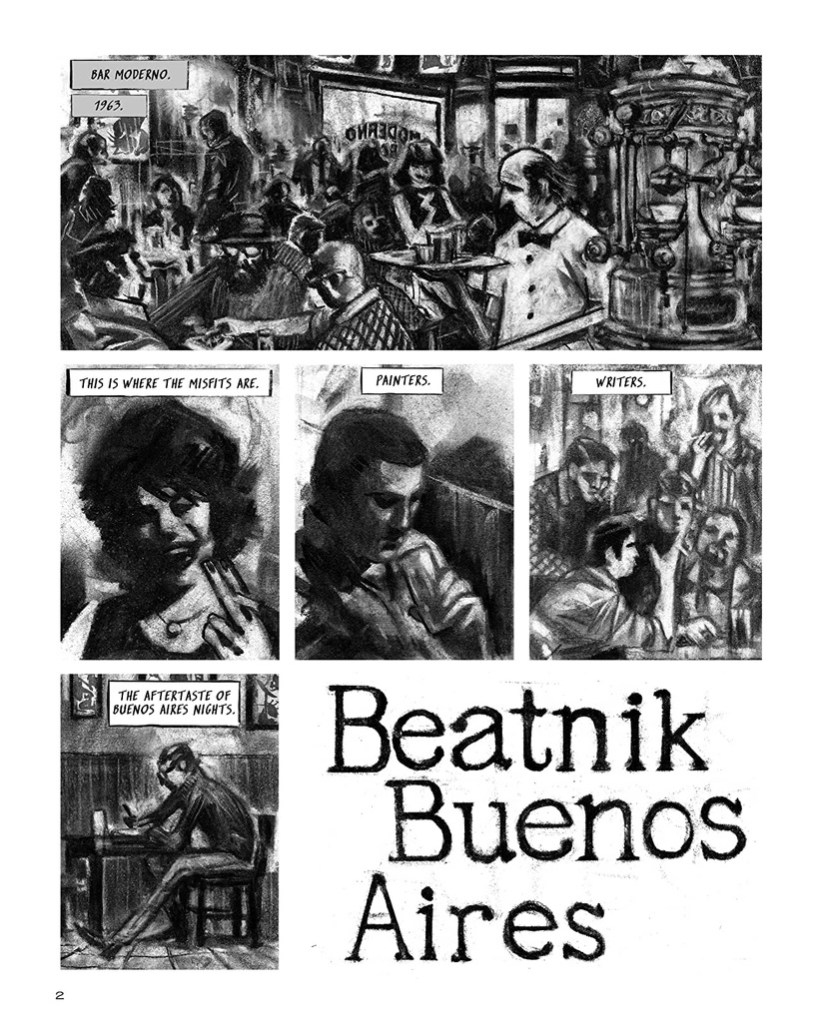
To that end, the Argentinian creative team of writer Diego Arandojo and artist Facudo Percio get right to work on delivering the goods in BEATNIK BUENOS AIRES (originally published on their native soil in 2019 and released in an English-language edition earlier this year by Fantagraphics, with translation by Andrea Rosenberg), a sweeping overview of the dimly-lit cafes and eccentric creative personages that made up the largely-forgotten 1960s (to be specific, 1963) Bohemian scene in their country’s capitol city. To their credit, the narrative doesn’t FEEL rushed in any way — and Percio’s exquisitely moody charcoal illustrations certainly LOOK anything but — yet there’s an urgency to the pacing here that belies its breezy tone. All of which is to say, there’s a LOT going on, but we are only given crucial glimpses of a LITTLE of it.

This, however, is not a criticism — in fact, the ingenious structure herein really works, the book’s 13 short chapters, each focused on a different artist, coalescing into an eminently readable (and again, because it bears repeating, visually GORGEOUS) tapestry that avails itself of the second of three storytelling options I mentioned at the outset, with mood and atmosphere taking precedence over the grim and gritty details.

Which isn’t to say that you’re not afforded one tantalizing peek after another into the places, people, and events that made this largely sub rosa cultural renaissance so special, only that these collaborators are far more concerned with imparting the essential CHARACTER of the period than they are its minutiae. You’ll be left wanting more, absolutely, but that’s as much a testament to the POWER of the craft on display here than it is to any of its shortcomings — and there are endnotes at the back for those looking to branch off into some independent researches of their own.

Still, this scattershot approach is not without its shortcomings — without some sort of fuller meat and bones context, the actions of an art forger and a photographer who damn near kills his girlfriend come off as too matter-of-fact in their presentation/recounting for their own good, and while we get a taste of the unfortunate sexism that was rife in this counter-cultural milieu, Arandojo never takes it upon himself to take the dudes perpetrating it to task for it in any way. In fact, sometimes his overall tone can be a bit too hagiographic to be considered either honest OR effective.

These are no mere minor quibbles, I’ll grant you, but in the overall scheme of things they certainly don’t rise to the level of being “deal-breakers,” either. This is an IMPRESSIONTIC overview first and foremost, remember, and erring on the side of the overly-comprehensive would likely get in the way of the primary task at hand, that being to capture the essence of the overall local zeitgeist. With another hundred pages (at least), Arandojo and Percio would certainly have been able to pull off something more exhaustive, but then some of that urgency I spoke so highly of would necessarily have been, if not lost, at the very least hopelessly bogged down.

Whether or not you view this comic as a modest little masterwork or an intriguing but ultimately pointless exercise in self-indulgence, then, rests largely on whether or not you’re willing to meet it on its own terms — it achieves almost all of what it sets out to do, some notable exceptions aside, but if that’s ENOUGH for you or not is something only you can decide for yourself. All I know for certain is that Arandojo and Percio made me smell the cigarette smoke, hear the jazz, and feel the heat of the creative energy that were all hanging so heavily in that rarefied 1963 Buenos Aires air.

Interested in more? Then please take a look at my Patreon, the blatant promotion of which is, after all, what this week is all about. Here’s the link : https://www.patreon.com/fourcolorapocalypse

Patreon Preview Week : “Scoop Scuttle And His Pals : The Crackpot Comics Of Basil Wolverton,” Edited By Greg Sadowski


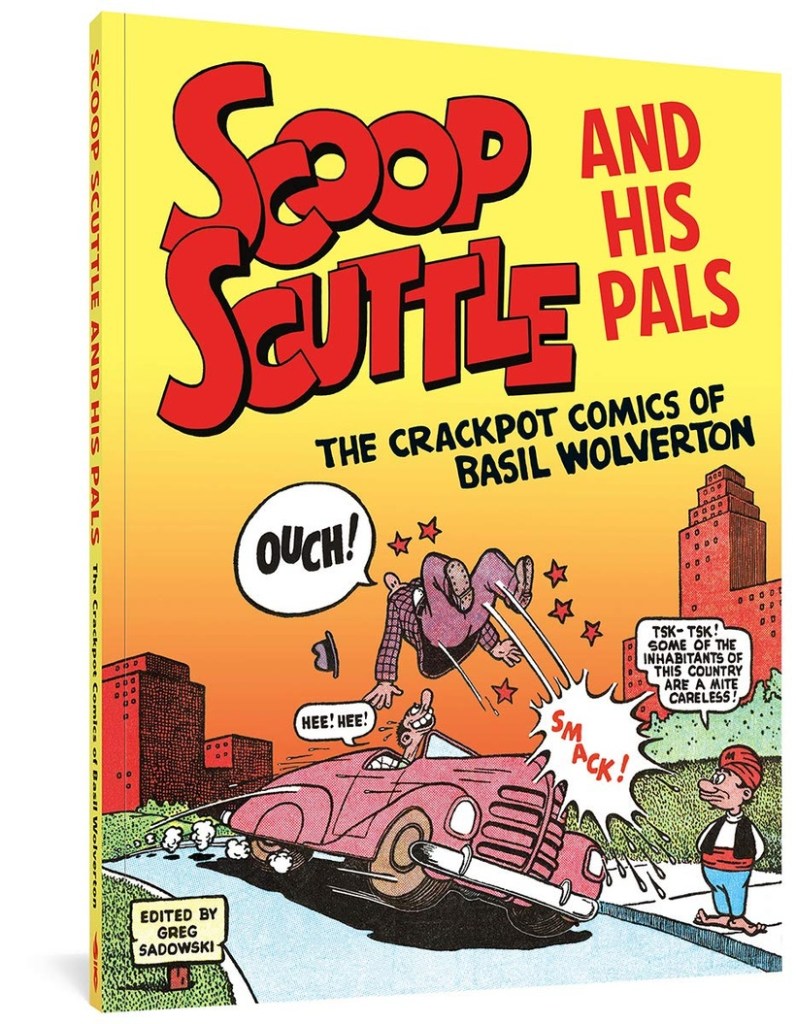
I do this once a year, and figured the first week of the year might be a better time for it than some random week in July or August or whatever — essentially the point here being, and I’m not too proud to admit it, to gin up a little interest in my Patreon site by offering everyone a sampling of the wares they’ll find if they decide to join up. I update it three times weekly, and seriously, it does help make all this writing (somewhat) financially viable. Plus, we’ve got a great group of folks on there, the conversation in the comments section is usually pretty lively, and everyone whose a member is, at the risk of sounding corny, more than just a member, they’re a friend. And couldn’t we all do with more of those in life? Anyway, first up is a review I did a couple months back of editor Greg Sadowski’s 2021 Fantagraphics collection SCOOP SCUTTLE AND HIS PALS : THE CRACKPOT COMICS OF BASIL WOVERTON, with a link to my Patreon at the end if you’re interested in reading more stuff of this nature..

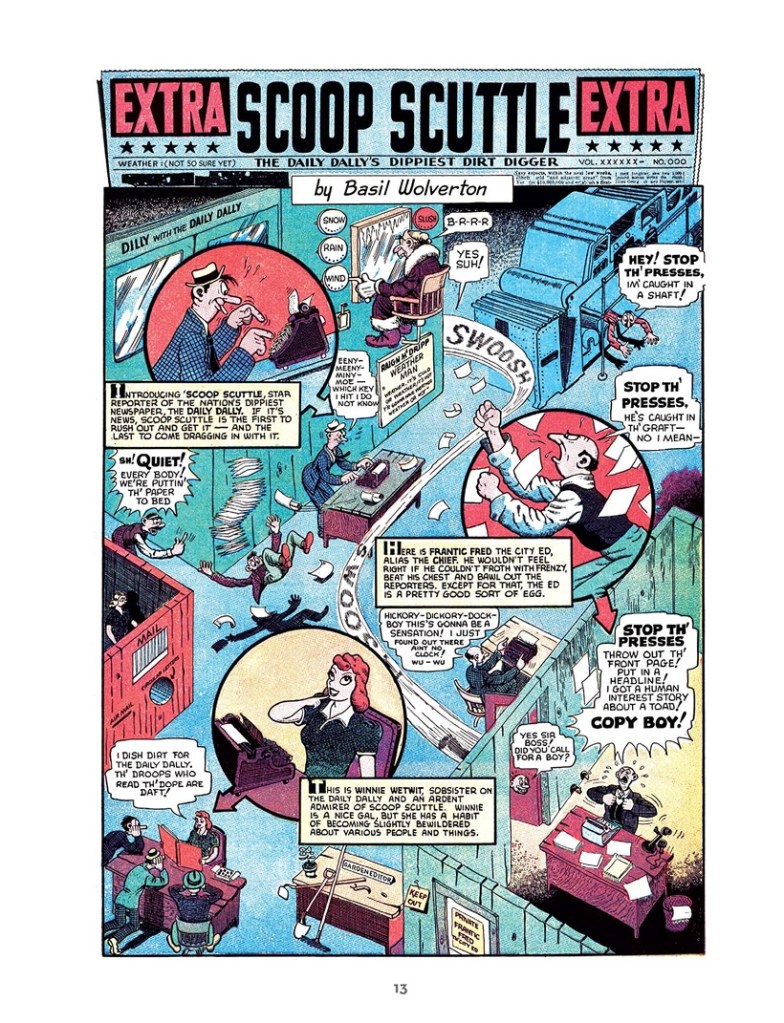
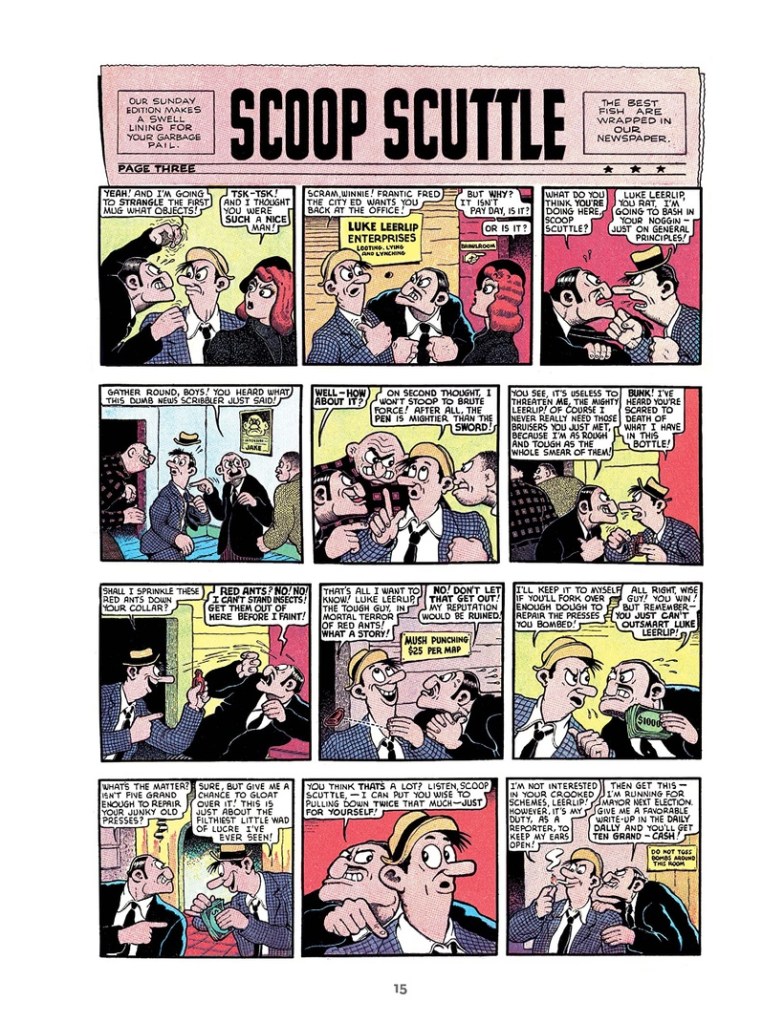
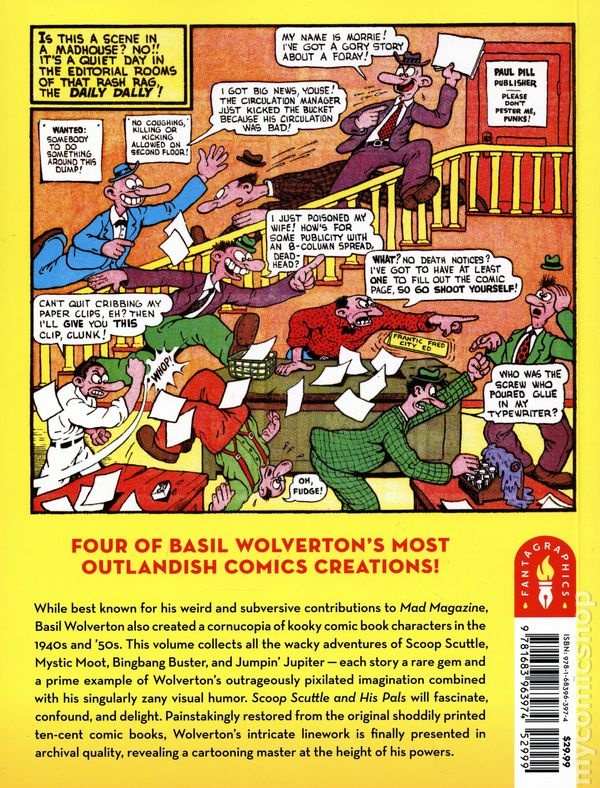
Most people are well aware that visionary cartoonist Basil Wolverton’s legendary contributions to MAD were hardly his first go-’round with humor strips, but leave it to Wolverton scholar par excellence Greg Sadowski to curate a long-overdue collection of some of his most obscure and overlooked comedic creations of the 1940s and 1950s : goofball reporter Scoop Scuttle, magic-nosed swami Mystic Moot, idiot savant cowboy Bingbang Buster and his horse Hedy, and slapstick spacefarer Jumpin’ Jupiter. To say that none of these characters made much by way of a lasting impression on the readership of the time is undoubtedly true, sure — but each in their own way presaged much of the madcap shenanigans to come from Wolverton’s mind and pen, and their misadventures are sure to delight even the most jaded of modern readers.

Which, admittedly, is a camp that I all-too-frequently find myself numbered amongst, given my frankly robust reading schedule, yet even for those of us who’ve literally seen it all before, there’s something about seeing how it was done earlier that feels like, if you’ll forgive the cliche, a breath of fresh air. And talking of cliches —

OF COURSE they’re a dime a dozen in these pages, but Wolverton’s ability to poke good-natured fun at them remains an unbridled joy, even if the occasional ethnic stereotype rightly gives today’s readers some pause. That being said, such offensive caricatures are in far shorter supply in Wolverton’s work than they are in that of many of his contemporaries, and the persons, places, and things he draws are so uniformly outlandish that they don’t especially stand out from what’s more or less ALWAYS a crowded field of visual eccentricities. Simply stated, then, it’s safe to say that these stories (and it should be stated for the record that Sadowski presents the printed exploits of all four characters in their entirety) were all constructed as FUN strips fist and foremost, and that they remain precisely that to this day.

Admittedly, there’s no escaping the fact that these are “toned down” a notch compared to Wolverton’s MAD work, but it’s intriguing to see him feeling his way forward, so to speak, and it’s also important to remember that he was working under undoubtedly tighter editorial standards. Even for all that, though, there’s a tremendous amount of innovation on display in many of these strips, and not just in terms of the far-out sound effects that Sadowski draws particular attention to in his thoroughly absorbing introductory essay — indeed, the page layouts, intuitive flow of the action, outrageous character designs, and even some of the plot twists are all several levels above and beyond the standard humor comics fare of the era.

None of which means this isn’t ultimately formulaic stuff, mind you — but a big part of Wolverton’s genius always rested in his ability to thoroughly subvert expectation WITHIN a given formula; to give readers a combination of MORE than what they bargained for and EXACTLY what they bargained for simultaneously. In that respect, then, this necessarily “hemmed in” work could potentially be said to represent a MORE INGENIOUS distillation of the “Wolverton ethos,” if you will, than later material where he was more free to let it all hang out.

Sure, ultimately I don’t think there’s any argument that SCOOP SCUTTLE AND HIS PALS will primarily be of interest to hard-core Wolverton aficionados above all (certainly the admirable amount of care that went into the flat-out amazing restoration process makes this an essential purchase even for collectors who might own a fair number of time-yellowed originals), but it’s also this critic’s considered opinion that Sadowski has managed to put together a collection that damn near ANYONE can take a tremendous amount of enjoyment from, be they crusty veteran or member of comics laity. Given what we’ve all been through over the past year and change, some extra laughter in our lives is likely to be welcomed by anyone and everyone, and if the source of that laughter is 70-80 years old, then hell, that’s reason to be IMPRESSED as well as amused.

Okay, I hope you’ve enjoyed this first little sample offering. If you’re interested in more, my Patreon costs as little as a dollar a month to join and can be found by heading over to https://www.patreon.com/fourcolorapocalypse

Great Moments In Comic Book History #13: Captain America Punches Hitler


Above, we see Captain America punching out Hitler on the cover of the first issue of his new comic book.

It’s an image that we’ve all seen before.  It’s often held up as a perfect piece of wartime propaganda, as well as an answer to question of what should be done to anyone who wants to follow in Hitler’s footsteps.  However, the most important thing about this cover is often overlooked.

It was published in December of 1940.

In 1940, America was officially neutral.  Europe was at war and, while the U.S. was on the side of the Allies, the country still hadn’t entered the conflict.  Due to the trauma of World War I, many American voters and politicians were still “isolationists,” saying that it was not America’s place to get involved in a conflict taking place on the other side of the world.

Joe Simon and Jack Kirby, however, disagreed.  Kirby and Simon were both first-generation Americans and they understood what was happening in Europe.  As Jews, they understood the evil that Hitler represented and, Simon later said, they both felt helpless whenever they heard reports about what was happening from the members of their family who were still in Europe.  In one of his final interviews, Joe Simon said that he and Kirby created Captain America to serve as the antithesis of Hitler.  And, with this cover, Simon and Kirby left no doubt where they and Captain America stood on the issue of neutrality.  What is often forgotten today is how much courage it took to take that stand in 1940.  At a time when comic books were viewed as being for kids and avoided taking a stand on anything beyond being anti-crime and also when there were any who still defended Hitler and shared his anti-Semitic views, Simon and Kirby took a stand and, to his credit, publisher Martin Goodman took that stand with them.

When this issue first came out, it sold a million copies.  At the time, that was an unheard of amount.  Though it would be another year before the U.S. officially entered the war after the attack on Pearl Harbor, Simon and Kirby took an early stand and created a great moment in comic book history.

Previous Great Moments In Comic Book History:

  1. Winchester Before Winchester: Swamp Thing Vol. 2 #45 “Ghost Dance” 
  2. The Avengers Appear on David Letterman
  3. Crisis on Campus
  4. “Even in Death”
  5. The Debut of Man-Wolf in Amazing Spider-Man
  6. Spider-Man Meets The Monster Maker
  7. Conan The Barbarian Visits Times Square
  8. Dracula Joins The Marvel Universe
  9. The Death of Dr. Druid
  10. To All A Good Night
  11. Zombie!
  12. The First Appearance of Ghost Rider
  13. The First Appearance of Werewolf By Night

Four Color Apocalypse 2021 Year In Review : Top Ten Original Graphic Novels


At last we reach the finish line with the sixth and final of our “Best of 2021” lists. This time up the category is TOP TEN ORIGINAL GRAPHIC NOVELS, which I hope is fairly self-explanatory : new and original works in the so-called “graphic novel” format that have not been previously serialized, at least in anything like their entirety, either physically or digitally. There were many excellent books to choose from this year, and narrowing it down to my ten favorites was a pretty tough task. Here’s what I came up with :

10. Penny By Karl Stevens (Chronicle Books) – While not a “graphic memoirist” per se, Stevens always finds inspiration for his lavishly illustrated stories pretty close to home : this time out it’s his cat’s turn to have adventures ranging from the cosmic to the banal and everything in between. Seriously, if this book doesn’t move you, then check your pulse — you may not have one.

9. Generous Bosom Part 4 By Conor Stechschulte (Breakdown Press) – The twists and turns finally all converge in this final installment of Stechschulte’s opus of mindfuckery. A perfect ending it’s not, but that doesn’t preclude it from being an eminently satisfying one. Oh, and hey — soon to be a major motion picture! But that’s another story for another time, and one that’s already more convoluted than the books it’s (partially, at any rate) based on.

8. Mycelium Wassonii By Brian Blomerth (Anthology Editions) – Comics’ modern master of psychedelia follows up his book on the early days of acid research with a book on — the early day’s of ‘shroom research? Hey, give Blomerth credit : he knows both what he likes and what he does really well. An educational, informative, and gorgeously-drawn “trip” well worth taking.

7. Lure By Lane Milburn (Fantagraphics) – An ambitious science fiction epic that never loses sight of its humanity, Milburn’s exploration of life on Earth and its fictitious “twin” planet may be set in the future but is still as timely as they come, offering as it does cogent commentary on such things as the so-called “gig economy,” the exploitation of the natural world, Amazonian hyper-capitalism, colonialism, and the billionaire space race. One of those rare comics that not only lives up to, but exceeds, all the “buzz” surrounding it.

6. Super! Magic Forest By Ansis Purins (Revival House) – A “kids’ comic” for the kid in all of us, Purins’ vividly imaginative world leaps off the page and into your heart with the kind of unforced charm that simply can’t be faked. All that wonder and mystery and significance you left behind when you grew up? It’s all right here, waiting to welcome you back.

5. Death Plays A Mean Harmonica By Steve Lafler (Cat Head Comics) – American ex-pats decamp to Oaxaca to live the good life, only to find themselves surrounded by vampires, intelligent fungi, and yes, even Death him/itself — but hey, maybe it’s still the good life after all! Blending the personal with the outrageous with the outrageously funny as only he can, Lafler has created one of the finest works of his storied career.

4. Nod Away Vol. 2 By Joshua W. Cotter (Fantagraphics) – The second “chapter” in Cotter’s science fiction masterpiece-in-progress abruptly shifts focus yet still manages to build on all that’s come before. Written and drawn with more passionate intensity per page than perhaps anything else out there, this is the embodiment of a true magnum opus — and while I can’t claim to have the first guess as to where it’s all headed, I do know that I wouldn’t miss it for the world. Neither should you.

3. Chartwell Manor By Glenn Head (Fantagraphics) – Powerful, poignant, and painful, Head’s memoir of abuse at the hands of a schoolmaster is just as much about the parental denial that allowed it to continue and the lasting psychological scars that never really heal as it is about the perpetrator, and as a result this stands as one of the most thorough-going examinations of survival in the history of the medium. When they talk about “comics that will be discussed and debated for years to come,” this is what they mean.

2. From Granada To Cordoba By Pier Dola (Fantagraphics Underground) – The full-length debut of a masterful new voice, Dola’s existential downward spiral balances humanism with nihilism (don’t even ask me how that works), visual literacy with the aesthetics and approach of a true “outsider.” In a sane and just world, this would be the year’s most influential comic. Here’s to hoping — just don’t expect to find much hope in the pages of the book itself, okay?

1. The Domesticated Afterlife By Scott Finch (Antenna) – A decade in the making, Finch’s breathtakingly unique book is a seamless marriage of the literary and the visual in service of telling a multi-faceted but absolutely singular story with an equally singular worldview. Not exactly an anarchist anti-domestication text per se, although such sentiments surely inform it, I would argue that it’s more an emotive exploration of what is lost when the conscious and unconscious are bifurcated and dreaming itself is colonized by pedestrian rationality. Featuring a complex and enthralling set of contrasting symbols and mythologies, this is no mere exercise in “world-building,” but rather an act of reality creation that stands as a testament to the transformational power of imagination.

And that, my friends, is a wrap — not only on these lists, but on Four Color Apocalypse for the year 2021. I’ll be back in early January (that’s next week, so it’s not like I’m taking some long “break” or anything) with the first reviews of the new year, but until then, if you want more, there’s always my Patreon, which I update three times per week and can be found by going over to https://www.patreon.com/fourcolorapocalypse

Four Color Apocalypse 2021 Year In Review : Top Ten Contemporary Collections


We’re getting near the finish line here, I promise. Two lists to go, including this one, TOP TEN CONTEMPORARY COLLECTIONS. This is another fairly broad category, with ALL comics published from the year 2000 to the present day eligible, as long as they are not original, stand-alone graphic novels. So basically we’re talking about any trade paperbacks that are a collection of single issues; any translated works such as Eurocomics, manga, etc.; any anthologies; any print collections of webcomics; or any collections of strips or assorted odds and ends, etc., as long as fit my admittedly absurd 21-year definition of “contemporary.” And with that out of the way, we’ll jump right in :

10. Go Fck Myself : The Fckpendium By Mike Freiheit (Kilgore Books) – Sprawling, ambitious, heartbreaking, and hilarious, Freiheit’s cartoon “thesis statement” on human history — and humanity’s future — is as personal as it is universal. The kind of book that makes you feel glad to be alive — except when it doesn’t — and a legit tour-de-force work.

9. My Begging Chart By Keiler Roberts (Drawn+Quarterly) – A year just doesn’t feel complete without a glimpse into the lives of Roberts and her family, and this is one of her very best books to date. One day we’re going to look back at these and recognize them as perhaps the pre-eminent example of long-form memoir in the medium’s history.

8. Tono Monogatari By Shigeru Mizuki, Translated By Zack Davisson (Drawn+Quarterly) – A poignant and lavishly illustrated adaptation of Japan’s most timeless collection of “fairly tales,” done by a master working at the height of his powers. Many of the pages in this will quite literally take your breath away, as will the scope and grandeur of the project itself.

7. Fungirl By Elizabeth Pich (Silver Sprocket) – The funniest “hot mess” in comics finally gets her due in a comprehensive collection of hijinks and mayhem sure to make you laugh hard and then feel appropriately guilty for having done so. Pich has her finger on the pulse of something truly unique here that straddles a fine line between blissful ignorance and willful amorality. Consequences — unintended or otherwise — have never been this much fun.

6.Post York By James Romberger (Dark Horse/Berger Books) – A refreshingly human-scale take on post-apocalyptic survival stories, Romberger’s work is greatly fleshed out and expanded upon in this new definitive edition that finally gives the material the presentation it’s always deserved. A strong contender for the best-drawn comic you’ll lay eyes on all year, this is a truly timeless tale that both honors and transcends its genre-specific origins.

5.Night Bus By Zuo Ma, Translated By Orion Martin (Drawn+Quarterly) – A wide-screen, epic modern-day fable by one of the brightest lights of the Chinese cartooning underground, don’t let the vaguely “YA” trappings of this one fool you for an instant : this is visionary, hallucinatory, reality-bending stuff. As immersive as visual storytelling gets, yet somehow speaking in a language all its own, this is a book that demands you meet it on its own terms and rewards you for doing so with a journey unlike anything you’ve ever seen or read.

4. Are Comic Books Real? By Alex Nall (Kilgore Books) – Nobody in comics better understands — or more respects — children than arts educator Nall, who communicates both the simple truth and impenetrable mystery of their worldview with grace, humor, and heart. This collection marks the end of the road for his Teaching Comics strips, and trust me when I say you’ll miss them well before you’ve even finished reading them.

3. Aerosol Plus By C.F. (Mania) – This slim collection of comics by the former Fort Thunder mainstay showcases the work of an artist who is forever pushing the boundaries of his own creativity forward and refusing to let what comics have been determine what they will be. Visually, conceptually, tonally, and formally transformational work by someone for whom the term auteur is almost too confining and restrictive.

2. Heart Shaped Tears By Abby Jame (Silver Sprocket) – With this collection, Jame makes a strong case for being the cartooning voice of her generation, communicating as she does the inner lives of fundamentally-unimpressed young women and teens with all the nonchalance and cynicism of a true “insider.” Today’s youth have been there and done that before they’ve even been anywhere or done anything, it seems — but could it be that they come off as smarter than us old-timers because they actually are? Forget crap like Euphoria — this is the real deal. And besides, TV is such old news.

1. Dog Biscuits By Alex Graham (Self-Published Via Lulu) – The quintessential webcomic of 2020 is the quintessential print comic of 2021, as Graham’s “pandemic epic” actually reads even stronger in collected form than it did in daily single-page doses. The lockdown may be over — for now, at any rate — but this story nevertheless captures both where and who we are better than any other work in any medium. Probably a shoe-in to be on just about every critic’s “best comics of the decade” list come 2030 — assuming our species makes it that long.

We’ll wrap things up tomorrow with the TOP TEN ORIGINAL GRAPHIC NOVELS list, but until then I’m non-contractually obligated to remind you that all of these columns/round-ups are “brought to you” by my Patreon site, where I serve up exclusive thrice-weekly rants and ramblings on the worlds of comics, films, television, literature, and politics for as little as a dollar a month. Subscribing is the best way to support my continuing work, so I’d be very appreciative if you’d take a moment to give it a look by directing your kind attention to https://www.patreon.com/fourcolorapocalypse

Four Color Apocalypse Year In Review : Top Ten Vintage Collections


Moving right along with our 2021 round-up, we arrive at the TOP TEN VINTAGE COLLECTIONS list. The rules for this category are as simple as they are arbitrary on my part : basically, any book which collects and/or presents comics material originally published prior to the year 2000 fits my definition of “vintage.” One of these years I should probably bump that up by a decade or so, but this is not that year. This category also includes translated works such as manga, Eurocomics, and the like, provided they’re chronologically appropriate. And with that out of the way, here’s what we’ve got :

10. Scoop Scuttle And His Pals : The Crackpot Comics Of Basil Wolverton, Edited By Greg Sadowski (Fantagraphics) – A legitimately uproarious collection or little-seen early Wolverton humor strips meticulously restored and overseen by the comics historian who knows his work best, these are admittedly not as outrageously OTT as what would come later, but stand well enough on their own to mark this book as more than simply a compendium of early-days curiosities. If there’s not enough fun stuff in your current reading pile, picking this up will surely rectify that situation immediately.

9. Alberto Breccia’s Dracula, Translated By Jamie Richards (Fantagraphics) – Lavish wordless strips from the Argentinian master that place history’s most infamous vampire in conflict with the dual soul-crushing forces of military dictatorship and US commercial imperialism, this was both gutsy stuff for its time and, as it turns out, a prescient warning about the future. Even Breccia’s funniest work packs a conceptual wallop.

8. Red Flowers By Yoshiharu Tsuge, Translated By Ryan Holmberg (Drawn+Quarterly) – After dabbling in genre for his earliest stores, Tsuge left its safe confines to create these emotionally immersive tales informed by his own travels, and the results are still several levels above the merely “impressive” to this day. I’d say something about witnessing the flowering of an artist’s talents, but surely that would be too painfully obvious for its own good, wouldn’t it? Except I sort of just did. Whoops.

7. My Life & Times : Spain Vol. 3 By Spain Rodriguez, Edited By Patrick Rosenkranz (Fantagraphics)  The most recent volume of Rosenkranz’ exhaustive Spain retrospective is also the best, focusing as it does primarily on the underground master’s autobiographical comics. Gorgeously restored and thoughtfully presented, this is the “deluxe treatment” this work has long been deserving of.

6. The Biologic Show By Al Columbia (Hollow Press) – Apparently the cartoonist himself is none too pleased with this collection for reasons I’m not privy to, but damn if I wasn’t impressed. One of the most disquieting series ever produced as well as one of the finest auteur works of the 1990s, having this material back in print is something for which all of us not named Al Columbia should be incredibly thankful.

5. BugHouse Book One By Steve Lafler (Cat Head Comics) – Bridging the 1990s/early 2000s divide but with very much a 1950s Beatnik “vibe” to it, Lafler’s under-appreciated gem of a series is richly deserving of finding a broader audience. Jazz, drugs, femmes fatales — there’s no telling which is more dangerous in this unassumingly, and unquestionably, visionary comic.

4. It’s Life As I See It : Black Cartoonists In Chicago 1940-1980, Edited By Dan Nadel (New York Review Comics) – Released in conjunction with a retrospective exhibition of the same name, Nadel’s superb collection features everything from political cartooning to newspaper strips to undergrounds to downright mainstream-leaning fare and presents a comprehensive and engrossing view of the rich cartooning history that’s been an integral part of the Black experience in Chicago. There are names both familiar and less so on offer in these pages, as well as plenty of work that’s seldom been made available outside the city itself, making this the definition of an “essential” read.

3. Jimbo : Adventures In Paradise By Gary Panter (New York Review Comics) – Unquestionably the most influential book on this list, there’s no underestimating the impact of Panter’s masterwork on generations of cartoonists who followed in its (and his) wake. Some unfortunate production errors on the part of the publisher (including cropped-off artwork) prevent this from being ranked higher than it deserves to be, but its nevertheless a fairly decent presentation of one of the best comics every made by anyone.

2. Enigma : The Definitive Edition By Peter Milligan And Duncan Fegredo (Dark Horse/Berger Books) – The finest mainstream comic of the 1990s finally gets its due with an impressive presentation that may leave a bit to be desired in terms of color reproduction and page size, but still represents a more comprehensive package than fans of this cult classic (myself included) probably had any right to hope for. More than the “British Invasion” mind-fuck to end all “British Invasion” mind-fucks (although it sure is that), Milligan and Fegredo’s magnum opus is a labyrinthine, clever, and hilarious meditation on identity, reality creation, and the nature of meaning itself in a postmodern world.
1. Trots And Bonnie By Shary Flenniken, Edited By Norman Hathaway (New York Review Comics) – If “long overdue” is a running theme here, no collection fits that description better than this deluxe oversized presentation of Flenniken’s groundbreaking National Lampoon classic. “Irreverent” is the most polite way to put it when it comes to these strips — “beyond good and evil” might be more like it. Obliterating all boundaries of taste (good and otherwise), Flenniken created a comic whose power to shock and disturb is only exceeded by its ability to make you laugh your ass off and empathize with its characters. Like nothing else, before or since.

We’ve got two lists left to go, for TOP TEN CONTEMPORAY COLLECTIONS and TOP TEN ORIGINAL GRAPHIC NOVELS, and my plan is to get them both done in the next day or two. Until then, it’s my duty to remind you that ALL of these are “brought to you” by my Patreon site, where I serve up exclusive thrice-weekly rants and ramblings on the worlds of comics, films, television, literature, and politics for as little as a dollar a month. Subscribing is the best way to support my continuing work, so I’d be very appreciative if you’d take a moment to give it a look by directing your kind attention to https://www.patreon.com/fourcolorapocalypseAdvertisement

Four Color Apocalypse 2021 Year In Review : Top Ten Special Mentions


Next in our year-end lists we come to TOP TEN SPECIAL MENTIONS, a “grab-bag” category I came up with a few years back to encompass everything adjacent to comics that isn’t comics “proper” per se — so in short we’re talking about art books; ‘zines, books, and scholarly works about comics and/or cartoonists; non-comics projects by people who usually do comics; and, perhaps most nebulously, sequentially-illustrated narrative works that don’t quite fit the standard operating definition of comics in that they don’t contain word balloons, thought bubbles, or in-panel caption boxes. Read on and all will, hopefully, become clear :

10. Bubbles, Edited By Brian Baynes (Bubbles Publications) – Baynes’ “independent fanzine about comics and manga” had another strong year, and if there’s one thing I’ve come to appreciate about this publication above all else it’s the unabashedly fannish tone the editor and writers bring to the table. There’s not an ounce of cynicism to be found in these pages — everyone who contributes to this ‘zine literally loves the medium, and it shows.

9. Please, God – Help Me Be Normal! By John Trubee (Mucus House) – A long-overdue comprehensive collection of Trubee’s “Ugly Men” drawings, plus other miscellany, that not only doesn’t disappoint but might even exceed expectations. A gallery of grotesqueries for the ages that is a required item on the coffee tables of all who read this blog.

8. Queen City By Karl Christian Krumpholz (Tinto Press) – A unique narrative and visual history of Denver by the cartoonist who knows it best, as well as a heartfelt lament for the its pre-gentrification glory days. this feels very much like the work Krumpholz has been building toward his entire career. Gorgeously illustrated, evocatively written, and altogether engrossing.

7. Strangers, Edited By Eddie Raymond (Strangers Fanzine) – The old-school print ‘zine that specializes in old-school content branched out a bit in conceptual terms this year, covering more new stuff and featuring tons of original comics by a “murderer’s row” of talented cartoonists. Every time a new issue comes in the mail I devour it from cover to cover, and it always leaves a big, shit-eating grin on my face.

6. Discipline By Dash Shaw (New York Review Comics) – Sure to be a fixture on many a “best comics of 2021” list, Shaw’s meditation on the Civil War, the limits of pacifism, and the human toll of conflicts inner and outer fits the SPECIAL MENTIONS category here in that it is a series of illustrations derived and adapted from letters written at the time. Innovative, exquisitely drawn, and instantly memorable, this is a powerful and poignant work from a contemporary master fully in command of all his storytelling gifts.

5. Francis Bacon By E. A. Bethea (Domino Books) – You can expect to find this on any number of “best-of” list as well — this one included, obviously — but again, due to the absolutely unique nature of Bethea’s work, I’m more comfortable categorizing it as “narrative sequential art.” Deeply personal, evocative, and as always using its subject as springboard to a long-form reverie that unfolds like a vividly-remembered dream, this is, in my humble estimation, Bethea’s most fully-realized and emotionally resonant ‘zine to date.
4. According To Jack Kirby By Michael Hill (Self-Published Via Lulu) – The necessary historical corrective we’ve all been waiting decades for is here, as Hill meticulously combs through thousands of “on-the-record” quotations and statements to present a persuasive and comprehensive case for Kirby as the pre-eminent creative genius in mainstream comics history as well as the sole creator of most of the so-called “Marvel Universe.” An exhaustive forensic examination of the facts written in an engaging, page-turning style that might even make the most hardened of Stan Lee partisans think twice about all the bullshit their guy spewed to line his own pockets and enrich his corporate paymasters at the expense of an undisputed — and still under-appreciated — true artistic visionary.

3. Mysterious Travelers : Steve Ditko And The Search For A New Liberal Identity By Zack Kruse (University Press Of Mississippi) – Without question the finest work of Ditko scholarship ever committed to print, Kruse re-contextualizes the iconoclastic creator’s singular body of work within a more expansive framework that gives new insights into the motivations behind, and philosophy of, one of comics’ most uncompromising auteurs. More than a historical re-analysis, this is a meticulously-researched and eye-opening critical appraisal of some of the most important work in the history of the medium that has only been partially understood by far too many who have laid unearned claims of expertise on it in the past.

2. A Cockeyed Menagerie : The Drawings Of T.S. Sullivant, Edited By Conrad Groth (Fantagraphics) – Years in the making, and clocking in at well over 400 pages, this utterly sublime monograph covers every phase of Sullivant’s groundbreaking career from the 1880s up to the 1920s, and to say no stone has gone unturned and no expense has been spared in its preparation and presentation is an understatement of criminal proportions. This is the prestige release of the year, perhaps of the last several years, and balances historical essays, critical appreciations, and painstakingly-restored artwork to give a full and complete picture of a true artistic trailblazer. Lose yourself in this one and you may find you never want to come out of it.

1. I Never Promised You A Rose Garden By Mannie Murphy (Fantagraphics) – A lyrical melding of the personal, political, social, and historical into one gorgeously expressive and darkly harrowing journey through both the streets of Portland and Murphy’s own life, this is bold and revelatory work that stands with the best art created in any medium this year. A love letter to an idealized vision of a city that never was, a requiem for a dream that nobody even tried to realize, a righteous call to action for a future that is hopefully still worth fighting for — this is a modern masterpiece in every respect that elicited a reaction I wasn’t even sure I was capable of anymore after so many years in the critical trenches : awe.

And with that, I’m taking a short holiday break. The end-of-year recaps will resume next week with my picks for TOP TEN VINTAGE COLLECTIONS, TOP TEN CONTEMPORARY COLLECTIONS, and TOP TEN ORIGINAL GRAPHIC NOVELS. Hope to see you then — in the meantime, should you want more of my content for whatever reason, including a couple of posts on my thought processes as I was cobbling these lists together, I humbly remind you that I have a Patreon that I update three times per week and that you can join for as little as a buck a month. Here’s the link : https://www.patreon.com/fourcolorapocalypse

Four Color Apocalypse 2021 Year In Review : Top Ten Comics Series


As we trudge on with our year-end review, we come next to a category that’s fairly easy to explain : TOP TEN COMICS SERIES refers to any ongoing or limited comic book series that saw more than one issue released in the past calendar year. As you’re about to see, anthologies — both solo and multi-creator — ruled the roost in 2021, a trend I’d be most happy to see continue. But we’ll worry about that in the future, for now here are my personal picks for best comics series in the present :

10. Bubblegum Maelstrom By Ryan Alves (Awe Comics) – Alves just plain tore it up in 2021, producing two issues of this now-concluded solo anthology title, the last of which was an 80-plus-page monster. Fitting, I suppose, given that monstrosity itself was a core concern of so many of the strips in this series. Bu turns grotesque and exquisite, sometimes both, Alves really went for the conceptual jugular with this comic, and I’m more than anxious to see what he does next.

9. Flop Sweat By Lance Ward (Birdcage Bottom) – Don’t you dare say memoir is dead until you’re read this. Ward’s autobio series is harrowing, heartfelt, sometimes even humorous — but never less than painfully honest. When the abyss that gazes back is your own life, and you can still make compelling art from that? You’ve got guts to match your skills. Never doubt Ward’s abundance of both.

8. Love And Rockets By Gilbert And Jaime Hernandez (Fantagraphics) – If you find a best-of list that this title isn’t on, you’ve found yourself one lazy-ass critic. Or a stupid one. Down a few spots from where I normally place it simple because, sorry to say, Beto’s current stuff isn’t registering with me to the degree it usually does, but hey — Jaime is continuing to produce some of the best comics of his career.

7. Vacuum Decay, Edited By Harry Nordlinger (Self-Published) – The most uncompromising underground horror anthology in decades continued to push the envelope with issue three — and with issue four, it just plain wiped its ass with it. To quote my own tweet back at me (speaking of lazy critics) : this is a comic that goes there. Whether you want to go with it or not, well — that’s your call. I know I’m down for the ride.

6.Rust Belt Review, Edited By Sean Knickerbocker (Self-Published) – Knickerbocker’s own strips about the tribulations and travails of life in “flyover country” set the tone for this diverse, oversized anthology centered on the big dreams and big problems of people with so-called “small” lives. Quintessential reading for everyone who understands that neither neoliberalism nor Trumpian neofascism (nor, for that matter, ‘tech bro” libertariansim) offers any solutions to those ground under by the wheels of what some still laughably term “progress.” Real stories about real people are the order of the day here.
5. Goiter Comics By Josh Pettinger (Tinto Press/Kilgore Books) – Two issues in one year from two publishers? Pettinger was one busy cartoonist in 2021, and the increased workload seems to be agreeing with him — from his strongest character studies to the opening salvo of an OMAC-esque dystopian fable by way of the Amazon warehouse, this was the year this title well and truly came into its own and left any Clowes and Ware comparisons firmly in its rear view.

4. Acid Nun By Corinne Halbert (Self-Published) – Psychedelic cosmic interdimensional Satanic nunspolitation with a generous helping of BDSM fetishism not just on the side, but front and center? Sign me the fuck up for that any day, and when you factor in Halbert’s astonishing compositions and use of color what you’ve got is one of the most visually literate comics of the year as well as probably the most deliciously pervy. Plenty to turn your crank whether you’re gay, straight, somewhere in between, or completely undecided, but there’s something more going on here than erotic stimulation for its own sake (not that there’s anything wrong with that) — if you appreciate a cartoonist who’s clearly playing a “long game” of stimulating you libidinally as foreplay to stimulating you intellectually, you’ve come to the right place.

Future By Tommi Musturi (Self-Published) – A web that draws you in by continuing to expand outward, Musturi’s various (and variously-styled) narratives never cease to impress, even as they bob and weave between confounding and illuminating. Everything is building toward something here — a conceptual singularity, at least, and perhaps even a narrative one —but I’m enjoying the individual journeys far too much to be ready for a destination yet. It doesn’t get much more unique than this, folks — a series you already miss before it’s even over.

2. Reptile House, Edited By (I’m Assuming Here) Nick Bunch (Reptile House Comix) – Created and published by a de facto artistic collective out of Philly, this is exhibit B for my contention that locally-focused anthologies are the future of comics. A heady mix of long-form continuing narratives and hilariously visceral one-offs, 99% of the cartoonists appearing in these pages are folks that I’ve never heard of before, but their work — like this series itself — just gets stronger and stronger as it goes on. And they wrapped up an already amazingly strong year with a killer 3-D issue. This is grassroots comics-making the way you remember it — and the way you’ve never seen it before.

1. Tinfoil ComixEdited By Floyd Tangeman With Co-Edits On #4 By Austin English (Dead Crow/Domino Books) – As for exhibit A for my contention about locally-based anthologies, this is it right here. Tangeman’s Bay Area anthology will, mark my words, go down as the most important signifier of not just where comics are, but where they’re going, since Kramers Ergot 4. This series burned as quickly and brightly as one can imagine, and the mark it left is going to be felt for years to come. We’ll see if the new bi-coastal “successor” series Tangeman and English are cooking up can keep the creative momentum going, but if the job they did together on #4 is any indication, we’ve got plenty to be excited about.

Next up we’ll do the “grab-bag” category that is TOP TEN SPECIAL MENTIONS, but in the meantime please consider helping me crank out more of this kind of theoretically enjoyable content by subscribing to my Patreon, where I serve up exclusive thrice-weekly rants and ramblings on the worlds of comics, films, television, literature, and politics for as little as a dollar a month. Here’s a link : https://www.patreon.com/fourcolorapocalypse