Great Moments In Comic Book History #17: Spider-Man and The Dallas Cowboys Battle The Circus of Crime


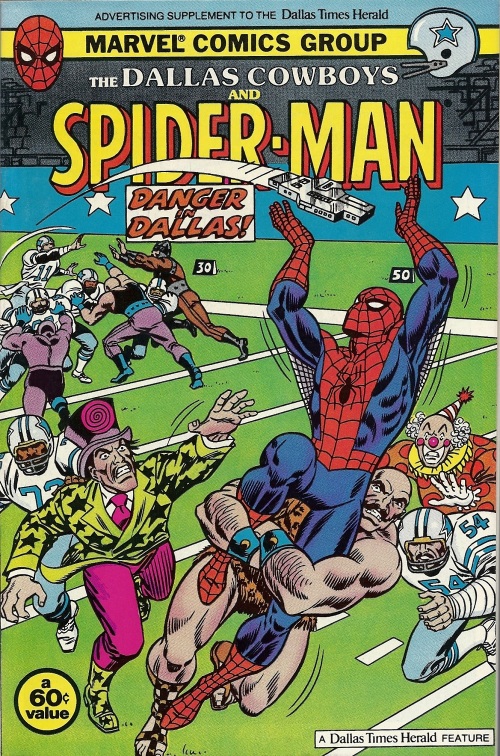
Spider-Man meets the Dallas Cowboys!

In 1983, Marvel comics teamed up with local newspapers to produce inserts that would feature heroes like the X-Men and Spider-Man visiting towns outside of New York, meeting with local celebrities, and, of course, providing ad space for local businesses.  One of the newspapers that they teamed up with the now-defunct Dallas Times Herald, which was also the original home of Texas’s own drive-in movie reviewer, Joe Bob Briggs.

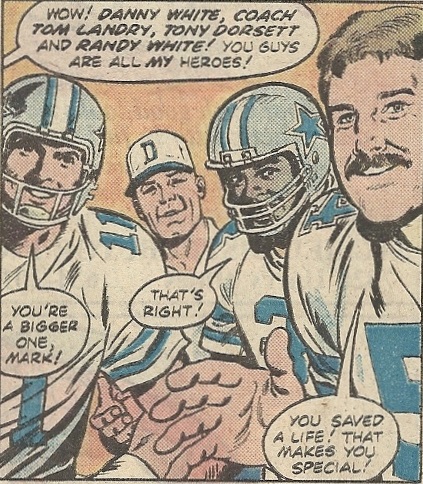
Marvel ended up doing three inserts for the Dallas Times Herald, one with the X-Men at the State Fair and then two featuring Spider-Man.  In “Danger in Dallas,” Peter Parker accompanied J. Jonah Jameson and Dr. Mudge to Dallas so that Dr. Mudge’s wheelchair-bound son could meet his heroes, the Dallas Cowboys.

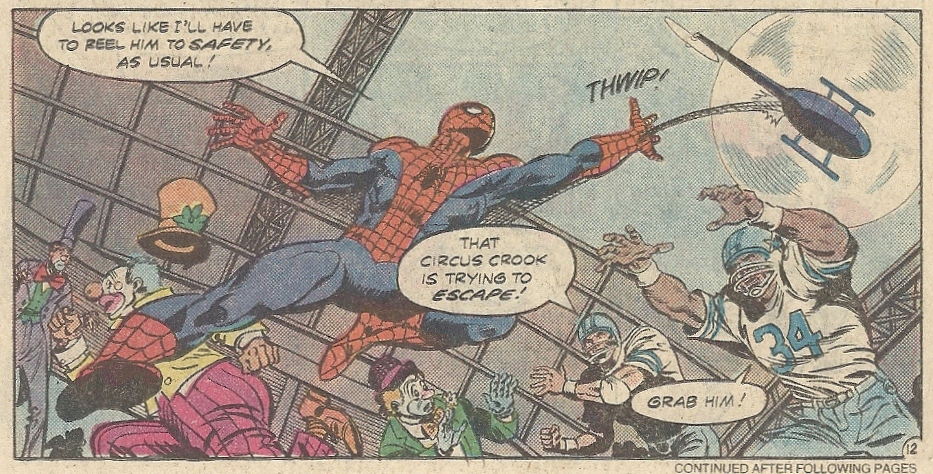
Dr. Mudge had also developed an anti-gravity device and the Circus of Crime was determined to steal it for themselves.  Spider-Man had to stop them but to fight an entire circus, he would need some help.  Good thing that Cowboys didn’t have anything to do that day!

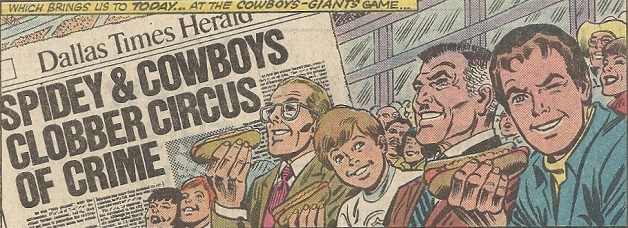
Once the Cowboys had tackled the Circus of Crime, Peter and even Jonah were able to enjoy opening day.  Peter even proved his courage by eating a Texas Stadium hot dog!

Spider-Man wished the Cowboys a good game, letting us know that even super heroes from New York were rooting for America’s Team in the 80s.

Out of curiosity, I decided to see how the Cowboys did during the 1983 season.  They went 12-4 and were second in the NFC East.  They earned a wildcard spot but lost to the Rams, 17-24.  Despite Spider-Man’s blessings, it was not the Cowboys who went to the Super Bowl but instead the team currently known as Football Team.  (Full disclosure: By default, that was my family’s team until Baltimore finally got the Ravens.)  Fortunately, Washington lost to the Raiders, 9-38.

According to the cover, this was a 60 cent value in 1983.  Currently, it sells for $18.00 online.

The Dallas Cowboys and Spider-Man #1 “Danger in Dallas” (1983)

Writer Marie Severin and David Kraft
Pencilers Marie Severin and Kerry Gammill
Inker Mike Esposito
Colorist Stan Goldberg
Letterer R. G. O’Shaw

Previous Great Moments In Comic Book History:

  1. Winchester Before Winchester: Swamp Thing Vol. 2 #45 “Ghost Dance” 
  2. The Avengers Appear on David Letterman
  3. Crisis on Campus
  4. “Even in Death”
  5. The Debut of Man-Wolf in Amazing Spider-Man
  6. Spider-Man Meets The Monster Maker
  7. Conan The Barbarian Visits Times Square
  8. Dracula Joins The Marvel Universe
  9. The Death of Dr. Druid
  10. To All A Good Night
  11. Zombie!
  12. The First Appearance of Ghost Rider
  13. The First Appearance of Werewolf By Night
  14. Captain America Punches Hitler
  15. Spider-Man No More!
  16. Alex Ross Captures Galactus

Don’t F*ck With Cats : Isaac Moylan’s “The Maspeth Witch”


There’s an old rule in storytelling : write (or, in the case of a comic, write and draw) what you know — and then tinker around with it at the margins just a bit. After all, you want what you’re writing (or, again, writing and drawing) to be at least marginally more interesting than “real” life, right?

That’s the theory, at any rate, and it’s served many a novelist (or, in this case, a cartoonist — I know, I know, I need to stop with this shit already) well over the years, the latest being Isaac Moylan, who parlays his intimate knowledge of the arts “scene” and the city of New York into an unassumingly absorbing tale and throws in a dash of the supernatural for good measure in his new self-published graphic novel, The Maspeth Witch. Just authentic enough to ring true, just fantastical enough to keep you turning the pages, for a full-length debut (Moylan’s apparently dabbled here and there in short-form comics but makes his living in freelance commercial illustration) it’s a surprisingly assured work that knows both how to maintain a reader’s attention and how to make sure what flaws it does have don’t in any way appreciably detract from the (sorry to be crass, but) finished product.

By way of brief (and deliberately truncated so as to avoid “spoilers”) synopsis, our protagonist here, grounded-but-nominally-ambitious young(-ish) artist Miriam is preparing for her “big break” gallery show when an act of casual cruelty toward a cat engenders a chain reaction of events that quickly turns the lives of her and her husband, Moshe, into — well, a “living hell” might be putting it strongly, but then again, by the time all is said and done, maybe it’s not. Suffice to say, both the title of this review and the title of the book itself make complete sense — I’m just being an asshole and not giving you full context for them in the here and now. Mama didn’t raise no snitches and all that, but you’re a smart person — you can probably figure it out. I mean, everybody knows what any self-respecting witch’s “familiar” animal of choice is, right?

The big “plus” here, as one would expect given his background, is Moylan’s richly detailed art. His people look like real people, both when it comes to their faces and their bodies, and the attention he pays to the so-called “little things” really pays off : he draws buildings, backgrounds, and environments really well. Normally I’m not a huge fan of photo-referencing, but I’ll give him a pass for leaning on it here because he utilizes it as an enhancement in his work, rather than making it the backbone of it, and that’s a crucial distinction because it means good, old-fashioned, freehand illustration is still what he most relies on for his visual storytelling — as any real artist damn well should, at least in this admittedly cantankerous old-timer’s opinion.

Where Moylan could stand to hone his craft a bit more, though, is in the area of narrative fluidity. While most of his dialogue is reasonably crisp and authentic, and his main characters are genuinely likable (and still relatable even when they’re not), he has a tendency to use exposition as a crutch, both when he’s setting the stage initially and when he wants to move things along, and sometimes that can break up his story’s natural rhythm. To his credit, he always gets his footing back in fairly short order, but there is an art to hitting precise story “beats” in organic (or at least seemingly organic) fashion that Moylan is still learning. No harm or shame in that, of course, but prospective readers should be prepared to make allowances for a bit of “clunkiness” to rear its head from time to time within what is, all told, an otherwise enjoyable and well-crafted comic.

If I had to pinpoint Moylan’s greatest strength, in a word I’d say it’s his composition. He’s got an eye for truly cinematic “camera angles” and his sense of perspective is incredibly firm and even a bit on the playful side — which tells me that he knows what he’s inherently good at and isn’t afraid to get creative with it. As time moves on and he becomes more comfortable with the fundamental differences between drawing and cartooning, I have a feeling we may find he’s got a truly great comic or graphic novel in him. Until then, this book serves to announce the arrival of an intriguing new talent who’s the “chops” to go far, and it’s a fun, compelling, and interesting yarn, to boot. I’ll be keeping an eye out for what Moylan does next, and in the meantime I would be surprised at all to find myself re-reading this a time or two.

******************************************************************

The Maspeth Witch is available for $15 from Isaac Moylan’s website at https://isaacmoylan.net/maspethwitch

Also, this review is “brought to you” by my Patreon site, where I serve up exclusive thrice-weekly rants and ramblings on the world of comics, films, television, literature, and politics for as little as a dollar a month. Subscribing is the best way to support my continuing work, so I’d be very pleased if you’d take a moment to give it a look by directing your kind attention to https://www.patreon.com/fourcolorapocalypse

A Velvet Glove Cast In Iron : B. Mure’s “Methods Of Dyeing”


Some stories don’t “unfold” so much as they’re peeled back, each layer revealing another underneath, until the reader finally arrives at the core. Such is the case with the fourth installment in British cartoonist B. Mure’s “Ismyre” series of graphic novels, Methods Of Dyeing (Avery Hill, 2021), and while one could make a strong case that the title itself is both too clever and too obvious by half, given the narrative centers around an investigation of a murdered botanist/professor whose particular area of expertise is plant-based dyes, it’s just as accurate to say that most everything else on offer here is shrouded in a definite air of mystery.

It’s a mystery of a very — and, for the record, appealingly — singular nature, though : one that takes its time, isn’t afraid to savor its own richness, and gently takes the reader along for the ride. Certainly there’s enough by way of revelations going on for this to have been a fast-paced, suspenseful work, if that was the direction Mure had chosen to go, but the fact that it concerns itself instead with establishing its own tempo and temperament speaks to the confidence this cartoonist has in both their methodology and their fictitious de facto “universe.” It’s a comic that’s entirely comfortable in its own skin, immune to the pressures of trying to be what audiences could, at first glance, be forgiven for assuming it either should or must be.

Speaking of audiences, while it’s fair to say that some working knowledge of the world of Ismyre certainly doesn’t hurt going into this, it’s in no way necessary, and I daresay any newcomers are likely to be impressed enough by what they discover here to find themselves sufficiently motivated to track down previous volumes — but the laconic pacing and efficiently minimalist dialogue may require some getting used to on the part of so-called “newbies.” That’s certainly not a criticism by any means — a comic that demands you meet it on its own level is, after all, usually the best kind of comic there is (hell, some might say comics of that nature are the only type worth reading, and I’m not prepared to refute that opinion) — but it does mean that it’s incumbent upon Mure to roll out the red carpet and welcome folks in, metaphorically speaking. No need to fear on that score, though — this story may not propel itself forward in any traditional sense, but it does exert an inexorable pull, a siren call that one can’t help but feel compelled to follow, wherever it may lead.

It also doesn’t hurt that it’s so damn gorgeous to look at. Mure’s cartooning is soft, wistful, warm, welcoming, offering a compelling contrast to the violence at the center of the proceedings and the dread as our gender-norms-bending anthropomorphic animal investigator — who would seem to be hiding a few secrets of her own — works toward solving the case. The fluid strokes of Mure’s brush line and the lithe application of watercolors are enough to fool you into thinking Ismyre is a peaceful idyll of a village, but underneath those surfaces beats what is, at the very least, a semi-dark heart. This might be a perfectly fine comic to show kids, sure, but tonally and thematically, a “kids’ comic” it is not.

And yet, there’s a tangible sense of wonder that informs everything here that’s well and truly childlike in terms of its sheer infectiousness. Mure is clearly having a blast hooking us on the line and reeling us in, and even appears to take a certain amount of glee in yanking us subtly in the wrong direction on occasion. These are all familiar enough tropes that are being exploited, it’s true — but that’s what makes their nod-and-wink subversion so effective. This isn’t a comic out to re-write any rulebook, but to play against expectation precisely because you know the rules — and Mure knows that you know them. I promise that last sentence makes sense — or at least, it will once you’ve read this book.

Which, not to put too fine a point on it, should be your next move. Methods Of Dyeing is a quiet little marvel that fully immerses you in a world you won’t won’t to leave — even as it becomes clear that world is fraught with more peril than appearances would initially suggest. Granted, appearances can always be deceiving — but the spell that this comic casts on you is as real as it gets.

*****************************************************************************

Methods Of Dyeing is available from Avery Hill Publishing at https://averyhillpublishing.bigcartel.com/product/pre-order-methods-of-dyeing-by-b-mure

Also, this review is “brought to you” by my Patreon site, where I serve up exclusive thrice-weekly rants and ramblings on the world of comics, films, television, literature, and politics for as little as a dollar a month. Subscribing is the best way to support my continuing work, so I’d be very appreciative if you’d take a moment to give it a look by directing your kind attention to https://www.patreon.com/fourcolorapocalypse

Share this:

A Whole New World : Hurk’s “Jinx Freeze”


It can be a fickle bastard of a thing, this critiquing business. In theory, at any rate, you’re judging a work on its own merits and nothing else — how well it succeeds at establishing the terms of what it is, first off, and then subsequently delivering upon them. But who are we kidding? Outside influences, both subtle and less so, almost always figure into the equation on some level, the so-called “soft tyranny” of expectations being foremost among them. “Was this book all that I wanted or hoped for it to be?” is a question most critics ask themselves — fair or not; whether they even realize it or not.

It’s just as well, then, that every so often something comes along that blows that whole framework out of the water : a comic that, by its very nature, is steadfastly resistant to the “expectations game” on the one hand, and to comparison of any sort on the other. Something that makes its own rules, does things its own way, operates according to the dictates of its creator and to nothing or no one else. That “something” being, in this case, UK cartoonist Hurk’s 2021 Avery Hill-published graphic novel Jinx Freeze.

The comics medium itself is no longer a young one, it’s true, and so works that are completely original are tough to come by — maybe even flat-out impossible — but a book like this serves to, at the very least, remind one that, of all forms of art, comics remains the one with the most untapped potential. And hey, even if I’m only saying so myself and asking you to take me at my word, that right there is a big reason why I felt myself drawn toward analyzing and reviewing them in the first place. Sure, you might very well be able to place Hurk’s work somewhere along a stylistic continuum that includes names such as Mark Beyer, Kaz, Max Huffman, or Marc Bell (among others), but the spot it carves out for itself is, in point of fact, utterly its own, and as Jinx Freeze unfolds, even the least astute reader out there will get a very real sense of an artist claiming his thematic and stylistic territory while he goes about weaving an apparently-haphazard-yet-actually-quite-intricate series of vignettes into a tapestry that’s hitherto unseen because, frankly, it’s hitherto unimagined. Even the parts that don’t make “sense” in the conventional — errrmmm — sense of the term do so within the hermetic de facto confines of what I’ll call, at least here in a pinch, the “Hurk-verse.” And I guess now’s the point at which I hope the cartoonist himself, should he ever actually read this, can forgive me for coining that unfortunate term on the fly. But I effing digress —

So what do we have here, in purely narrative and aesthetic terms? Well, in one respect it’s a classic caper. In another, it’s a surreal spin on police procedurals. In still another, a sprawling-ensemble slapstick yarn. And in yet one more, a futuristic sci-fi comedy thriller. Upping the ante still further, each of these respective genre sandboxes the narrative is playing around in is shot through with elements of pastiche, and so it’s fair to say Hurk is both marginally beholden to them and sending them up (or, as they’d say on his side of the pond, “taking the piss out of them”) simultaneously. Now throw in the added elements of each component riffing off the others and being in conversation with them, all while being recognizably part of the same world and story thanks to Hurk’s vivid, energetic, stylized, colorful, geometrically-informed cartooning, and the end result is something that should, by all rights, probably be a cacophony of literary and visual noise, but instead builds up in truly symphonic fashion.

Which isn’t to say, of course, that the occasional note of discord doesn’t linger in the background or, on occasion, force itself to the fore. There are punchlines that fall flat, story “beats” that miss the mark — but the overall trajectory of the piece is never derailed in any appreciable, lasting manner, and the only thing that quells the urge to keep turning the pages is the desire to spend more time “oohing” and “aahing” over the ingenious little flourishes of the one you’re already on. Don’t be afraid to take your time with this comic, then, even if the pace is rapid and frenetic, verging on the breakneck.

And so we return to our analysis of the phenomenon of critical analysis itself. Jinx Freeze is, perhaps, easier to praise than it is to describe, at least for someone of my meager capabilities — and it’s arguably greater on the whole than the sum of its parts would, upon first reading at any rate, suggest. Although, the more I pore over it, the more I come to see the “little things” that come together to form the “big picture” are all there, either in plain sight or hiding in it. Here’s what I do know : I didn’t want it to end, and when it did, I wanted to start reading it all over again. And whaddya know? That’s exactly what I did.

************************************************************************

Jinx Freeze is available from Avery Hill Publishing at https://averyhillpublishing.bigcartel.com/product/pre-order-jinx-freeze-by-hurk

Also, this review is “brought to you” by my Patreon site, where I serve up exclusive thrice-weekly rants and ramblings on the worlds of comics, films, television, literature, and politics for as little as a dollar a month. Subscribing is the best way to support my continuing work, so I’d be very appreciative if you’d take a moment to give it a look by directing your kind attention to https://www.patreon.com/fourcolorapocalypse

Great Moments In Comic Book History #16: Alex Ross Captures Galactus In All His Glory


Galactus has always been one of my favorite Marvel characters and it’s a shame that his only film appearance was botched in 2007’s Fantastic Four: Rise of the Silver Surfer.  Now that the Fantastic Four are once again free to be a part of the MCU, my sincere hope is that we’ll get a worthy Galactus film.  If Marvel Studios could bring Thanos to life, why not the Planet-Eater?

Below is Galactus (and the Silver Surfer) as imagined by Alex Ross.  All four of these images are from Marvels #3 (March 1994) and they really capture Galactus in all of his glory.

Hopefully, the next time Galactus appeared in a film, he’ll be as impressive as he was here.

Previous Great Moments In Comic Book History:

  1. Winchester Before Winchester: Swamp Thing Vol. 2 #45 “Ghost Dance” 
  2. The Avengers Appear on David Letterman
  3. Crisis on Campus
  4. “Even in Death”
  5. The Debut of Man-Wolf in Amazing Spider-Man
  6. Spider-Man Meets The Monster Maker
  7. Conan The Barbarian Visits Times Square
  8. Dracula Joins The Marvel Universe
  9. The Death of Dr. Druid
  10. To All A Good Night
  11. Zombie!
  12. The First Appearance of Ghost Rider
  13. The First Appearance of Werewolf By Night
  14. Captain America Punches Hitler
  15. Spider-Man No More!

The Old College Try : Clio Isadora’s “Sour Pickles”


I wonder, if Dan Clowes knew that he’d be starting a decades-long “cottage industry” in comics with his “Art School Confidential” strip, if he’d take it all back?

Not that it was a bad strip, mind you — quite the opposite. It still makes me laugh to this day. But the art school memoir has grown and metastasized from that point into a beast that literally will not die, even if the critical and box office failure of Clowes and Terry Zwigoff’s film adaptation of the aforementioned story probably should have, by all rights, put it to rest. Okay, sure, it hasn’t been all bad : Matthew Thurber’s Artcomic, Joseph Remnant’s Cartoon Clouds, and Walter Scott’s Wendy series stand out as high-water marks, but on the shallow end we’ve got, well — everything else.

Welcome to everything else — or, at the least (and the most), a fairly standard representative example of everything else. Clio Isadora’s Sour Pickles (Avery Hill, 2021) is certainly okay enough for what it is, sure, but the problem I have with it is that it’s not appreciably different or distinctive as far as art school memoirs go apart from the fact that her authorial stand-in protagonist, Pickles (hence the title) and her friend/fellow classmate, Radish (noticing a pattern here?) temporarily become speed freaks in order to power their way through finals. Which is one of the older tricks in the book for students cramming their way to the finish line, admittedly, but hasn’t been explored, to my knowledge, on the comics page before — and, to be honest, Isadora’s frenetic art style, which might best be described as a kind of “Peow Studio aesthetic on crank plus an intentionally garish color scheme,” works well for the instances when Pickles and Radish are wired as fuck, and really brings a reader inside their racing minds. Unfortunately, however, that’s only part of the book.

It honestly doesn’t take long for Isadora’s admittedly interesting art to begin to grate, especially when her adherence to it negates the emotional impact of certain scenes like a “friend of a friend” funeral and a decidedly anticlimactic graduation, but I do have to admit I admire her determination to present everything in a uniform visual language, as well as the confidence it takes to stick to those guns, even if I’m not convinced doing so was necessarily the greatest idea. Art is all about bold choices — or should be — but Isadora’s cartooning style for this book is one of those double-edged swords in that works really well in terms of communicating certain things, but falls flat when it comes to communicating others. I could see warming up to it more upon a second reading as being a distinct possibility, but my next task here, as fate would have it, is to let you know precisely why said hypothetical second reading probably isn’t in the offing.

Stop me if you’ve heard this one before : Pickles is the only hard-working student in an arts program overflowing with spoiled trust-fund kids. Her instructors are hopelessly out of touch with their students. Her parents can’t relate to her, nor she to them. Life after graduation looks to be fraught with uncertainty. Her love life’s DOA. Why, it’s like she’s always stuck in second gear. It just hasn’t been her day, her week, her month, or even her year. And while I’m not saying this book is anywhere near as vapid as any given episode of Friends, that’s partly down to the simple fact that, let’s face it, nothing can be. I don’t think Isadora’s a cartoonist without ambition, or without the ability to see that ambition through to a reasonably compelling finished product (I haven’t seen her Is It Vague In Other Dimensions? ‘zine, but it comes highly recommended by people whose opinions I generally trust), but thematically she’s playing it really safe here : “write and draw what you know” is solid advice and all, but should come with the caveat “if you have something new to add to the conversation.” Isadora herself may, but unfortunately this comic does not.

On the plus side of the ledger, Isadora’s dialogue is sharp, clear, and natural, even if no one’s really saying anything we haven’t read before, and her sense of comic timing is spot-on : this story is frequently quite funny. But one can’t help but feel she’s going for a crowd-pleaser with this project rather than pushing her talents to their utmost. There’s enough here to ensure that I’ll be keeping an eye out for her next book in the hopes that she’ll do just that, but not quite enough that I can recommend this one.

*****************************************************************************************

Sour Pickles is available from Avery Hill Publishing at https://averyhillpublishing.bigcartel.com/product/pre-order-sour-pickles-by-clio-isadora

Also, this review is “brought to you” by my Patreon site, where I serve up exclusive thrice-weekly rants and ramblings on the worlds of comics, films, television, literature, and politics for as little as a dollar a month. Subscribing is the best way to support my continuing work, so I’d be very appreciative if you’d take a moment to give it a look by directing your kind attention to https://www.patreon.com/fourcolorapocalypse

Share this:

Titans S3 Ep6, “Lady Vic”, Review by Case Wright


The holidays are over and I know A LOT about Electricity, Magnetism, and Titans. The episode opens with a brutal scene of a woman killing two cops. I almost had to look away. It is NOT for the faint of heart. What got to me was the cold psychopathy of it. The reason for this little Kill-spree is poorly developed. It quickly cuts to Wayne Manor and Blackfire is now a quasi-Titan and she still prevents me from totally concentrating. She and Superboy have REAL chemistry. So… pretty sure that’s happening very soon. Kyptonians get all the luck!

Lady Vic really more of a B-Storyline. We see how Barbara Gordon and Dick became an item. Boy knows girl, boy and girl both dress flamboyantly, and boy and girl knock over a museum for an old trinket, which of course leads to Knocking Boots. There’s a lid for every pot, but museum heist leading to intercourse doesn’t seem like a direct route to me, but what do I know- I study hours of Math …. for fun. Through flashbacks, we learn that Babs and Dick went on heists for fun, but ended up killing Lady Vic’s husband, brother… or something.

I guess that I have to note that there is a plotline of when will Blackfire and Superboy hook up? However, this plot-line is just so predictable that it’s not great. The show needs Hawk back. He added a terrific wisecracking element and Gar and Superboy just don’t quite make up for his loss.

Jason Todd is still Red Hooding with Dr Crane. Lady Vic works for him too, but just as a side-hustle.

This episode was more disjointed than a knee replacement, but I guess you have to watch it to prepare for the next episodes.

The Unbearable Lightness Of Being : Karen Shangguan’s “Quiet Thoughts”


You know, it’s funny — I was just remarking to a couple of friends/fellow critics on Twitter earlier today that “understated and contemplative” just aren’t where my reading interests are at these days. It’s not only that they’ve been done done to death in contemporary “alternative” comics (although that surely plays a large part), either : it’s also that they’re a pretty cheap and easy pose for people without a whole hell of a lot to say if they want to try and come off as more profound than they actually are. Disappointed about where you are in life? Confused about the future? Feeling isolated, alone, and disconnected from humanity? Hey, that’s too bad and all, but how about you tell us something about yourself that actually sets you apart from the overwhelming majority of people in late-stage capitalist society?

Speaking of which, a lot of books that indulge in the kind of navel-gazing I’m bored to death with reek of privilege — after all, folks who are clocking 60 hours a week (or more) at back-breaking, dehumanizing menial jobs, or struggling to figure out how they’re going to feed their kids, simply don’t have the luxury of feeling sorry for themselves even though they surely have every right to do so. After all, reflecting on the admitted bummers of unrealized dreams, unfulfilled potential, and unrequited love is only something you can do if you’ve got the free time to do it with.

The simple fact that Vancouver-based artist Karen Shangguan’s Quiet Thoughts (Avery Hill, 2021) was able to impress me, then, given my current negative disposition toward all things blatantly introspective, is something of an achievement in and of itself. I mean, the title gives away what sort of work this is from word go, and it doesn’t lie : collected in this slender volume are visually lyrical musings, ruminations, and illustrations that, fair enough, present one person’s interpretation of various aspects of the human condition from the inside out, but Shangguan goes about her business with a deft enough touch that nothing on offer here will remind you of your annoyingly “angsty” friends — assuming you’re foolhardy enough to still keep any around.

Crucially, while her art and sparse prose are uniformly delicate — sometimes to the point of being downright ethereal — they’re imbued with enough earnestness to give them a conceptual weight that both accentuates, and creates a kind of aesthetic tension by default with, their formal presentation. Shangguan’s use of space and intuitive understanding of sequential rhythm are keys in this regard, communicating at all times the fleeting and transitory nature of, well, pretty much everything, but doing so in a way that manages to be instantly memorable while grasping for ideas and feelings that come and go like a summer cloud. Change is the only constant, as the old cliche goes, but hidden within that is something both inherently more haunting and more wondrous that Shaungguan’s work captures with disarming alacrity : impermanence is the only thing a person can actually count on.

Okay, yeah, there’s still something a bit plastic-bag-in-the-wind about all this, but unlike that infamously vapid scene from an infamously vapid film (American Beauty, in case you’d mercifully forgotten), Shangguan doesn’t hold your hand through the process of interpreting and understanding how she feels about what she’s poetically expounding upon. She establishes a flow from the outset and trusts in your ability as a reader to go with it. This takes more confidence than the tone of many of these pieces would at least imply this artist to be in possession of, but have it she does, and the end result is something of a gently bumpy glide through the semi-turbulent air of life itself — by turns almost too painful to contemplate and too beautiful to ever want to let go of.

And I guess that’s my cue to hop off before I get more pretentious than I’m comfortable with here, but kudos to Shangguan for making me look at things in a way that would normally work my nerves and not only get me to see the value in doing so, but even to enjoy it. There are some raw wounds to be found in this book, no doubt, but even they’re presented as exactly what they are : part of the rich overall tapestry of an existence that will be over with all too soon however one measures it. And I’ve got a sneaky feeling that when it’s all said and done, those contemplative moments of introspection that I claim to be so over and done with will turn out to be what life’s really been about all along — so hey, as Dave Gahan said, “enjoy the silence.”

*****************************************************************************

Quiet Thoughts can be ordered directly from Avery Hill Publishing at https://averyhillpublishing.bigcartel.com/product/quiet-thoughts-by-karen-shangguan

Also, this review is “brought to you” by my Patreon site, where I serve up exclusive thrice-weekly rants and ramblings on the worlds of comics, films, television, literature, and politics for as little as a dollar a month. Subscribing is the best way to support my continuing work, so I’d be very appreciative if you’d take a moment to give it a look by directing your kind attention to https://www.patreon.com/fourcolorapocalypse

Share this:

Better Late Than Never? “The Christmas Before/Santer”


The holidays may be mercifully over, but considering that I got my review copy of Ryan Alves and Ron Beek III’s new “split release” comic (co-published under the auspices of Alves’ AWE Comics and Beek’s Wtfawta), The Christmas Before/Santer, after the purportedly most wonderful time of the year had run its course, I was left with two options : review it now to keep the unseasonability of doing so to a minimum, or sit on it until next Christmas. I chose the former since the comic was still fresh in my mind and since it’s still available for purchase, which may not be the case in 11 months.

Before we delve too deeply into the particulars of the book itself, I should state that it seems the image of Santa Claus has fallen on rather hard times, which I suppose is to be expected in this cynical age, but we’re four decades on from films like Christmas Evil and Silent Night, Deadly Night, and the simple fact remains that there isn’t much of a “middle ground” for the character between jolly bringer of gifts and joy and psychotic serial killer apart from Bad Santa, which has become something of a latter-day holiday classic. You’d think somebody else would mine the fertile territory that is a debased but not altogether evil iteration of St. Nick, but for whatever reason, no one’s picked that ball up and run with it to any appreciable degree.

Not that I’m paying particularly close attention, mind you : Christmas and popular culture have merged into one inseparable commercialized entity at this point, and it’s one that I couldn’t frankly care less about — but that certainly didn’t preclude me from quite enjoying this comic, which is a testament in and of itself to the talents of the cartoonists who made it. I mean, if you can hold my interest with a Christmas-themed comic in the first place you’re doing something right, and if you can manage to do so in the days immediately following the end of a holiday season that I’m nothing but happy to see firmly in the rear view mirror, you’re doing something doubly right.

Not that I would expect anything less from these guys, both of whom have impressed me with their solo and collaborative efforts in the past, but I think turning their creative juices loose on a single connecting theme really draws attention to the different sensibilities each brings to the table, as well as the tonal similarities that make this pairing such a natural one. They’ve both, for instance, chosen to place their versions of St. Nick somewhere beneath Bad Santa but above the various “Santa slashers” on our makeshift “creepy Santa” scale, and both are masters at utilization of blacks, whites, and gray tones in their art (Alves’ cartooning leaning more toward abstraction and Beek’s more toward formal realism), but whereas Alves sets his wordless interpretive yarn in the dim reaches of prehistory, Beek’s story is very much contemporary, urban, and depressingly believable. Contrasts and convergences are the name of the game here, two sides of the same coin, so it’s entirely fitting that this is formatted as a true “flip book,” with each story given its own cover and both, quite literally, meeting in the middle.

The natural enough question following along from all this would be, of course, “so which story did you like better?,” but as much as this will no doubt sound like a cop-out, I found both to be successful for entirely different reasons. Alves’ The Christmas Before leaves one with more to think about, certainly, given its more mystical nature, but Beek’s Santer is open enough to interpretation as well and perhaps packs a bit more of a wallop in purely visceral terms, so — yeah, don’t force me to choose one or the other since I technically don’t have to anyway.

Besides, of utmost import here is the fact that they work really well together, something not every co-operative creative venture can claim — themed anthologies, in particular, having a rather spotty track record when it comes to maintaining an overall flow to them given that “all these comics are about a similar subject” is often an easy way to avoid the more challenging task of selecting material that either possesses an overall artistic cohesion or establishes a frisson of conceptual and aesthetic tension throughout, both of which of course offer their own rewards. Alves and Beek give us the best of both worlds here, presenting two discrete but linked comics stories that manage to play off each other and stand in stark contrast to one another. Don’t ask me how that works, just be glad that it does.

*****************************************************************************************

The Christmas Before/Santer is available for $5.00 from the AWE Comics Storenvy site at https://www.storenvy.com/products/34444423-the-christmas-before-santer

Also, this review is “brought to you” by my Patreon site, where I serve up exclusive thrice-weekly rants and ramblings on the worlds of comics, films, television, literature, and politics for as little as a dollar a month. Subscribing is the best way to support my continuing work, so I’d be very appreciative if you’d take a moment to give it a look by directing your kind attention to https://www.patreon.com/fourcolorapocalypse

Great Moments In Comic Book History #14: Spider-Man No More!


One of the things that made Spider-man unique amongst the heroes of the Silver Age was that he often didn’t want to be a hero.  When he first got his powers, he wanted to make money.  It was the death of Uncle Ben that left him feeling obligated to fight crime.  But even then, he would have much rather have been Peter Parker.  Often times, when Spider-Man swinging across New York and fighting folks like Electro and the Sandman, he would have much rather have been at home, taking care of Aunt May or studying for a midterm or out on a date with Gwen Stacy or Mary Jane Watson.   Unlike the similarly angsty Hulk and The Thing, Spider-Man actually could had the option of abandoning his secret identity and trying to live a normal life if he wanted.  That Peter Parker not only felt obligated but often resentful made him a hero to which readers could relate.

He finally did try to walk away in 1967’s Amazing Spider-Man #50 and it led to a classic cover from John Romita.  This cover, with both Peter and Spider-Man turning their backs on each other, perfectly captures the inner conflict that Peter dealt with every issue.  When he was Peter, he didn’t want to be Spider-Man and when he was Spider-Man, he didn’t always want to be Peter Parker.  In Amazing Spider-Man #50, exhausted from being continually condemned by J. Jonah Jameson and worried about Aunt May’s health (as always), Peter tried to walk away.

It didn’t last, of course.  At first, Peter enjoyed not being Spider-Man but, as crime increased, Peter realized that he still owed it to the people of New York City and the spirit of Uncle Ben to fulfil his “great responsiblity.”  At the end of the issue, Peter retrieved his costume and once again took to the streets.  It wasn’t a minute too soon because this issue featured not only a classic cover.  It also featured the first appearance of the crime lord known as the Kingpin.  New York needed Spider-Man more than ever.

Previous Great Moments In Comic Book History:

  1. Winchester Before Winchester: Swamp Thing Vol. 2 #45 “Ghost Dance” 
  2. The Avengers Appear on David Letterman
  3. Crisis on Campus
  4. “Even in Death”
  5. The Debut of Man-Wolf in Amazing Spider-Man
  6. Spider-Man Meets The Monster Maker
  7. Conan The Barbarian Visits Times Square
  8. Dracula Joins The Marvel Universe
  9. The Death of Dr. Druid
  10. To All A Good Night
  11. Zombie!
  12. The First Appearance of Ghost Rider
  13. The First Appearance of Werewolf By Night
  14. Captain America Punches Hitler