Halloween Havoc! Book Extra: DARK DETECTIVES (Edited by Stephen Jones; Titan Books paperback 2015)


gary loggins's avatarcracked rear viewer


Back in September, I was browsing at the local Barnes & Noble (as I frequently do, given the lack of independent bookstores around here) looking for something to review this Halloween season. I’d just finished with Stephen King’s REVIVAL (Pocket Books paperback, 2017), and while it’s good, everybody does King this time of year, and I wanted something different. I wandered through the fantasy section, and waaaay up on the top shelf I spotted a title that caught my interest. DARK DETECTIVES: An Anthology of Supernatural Mysteries, combining two of my favorite genres, horror and detective fiction! Curiosity piqued, I grabbed the book and bought it (along with the great James Lee Burke’s latest novel, ROBICHEAUX).

DARK DETECTIVES, first published as a limited edition in 1999, features ten short stories, some old, some written especially for the anthology, by authors I’m familiar with (and I assume you are too, if…

View original post 412 more words

Book Review: Eaten Alive, edited by Jay Slater


If you were to ask me to recommend one book to someone who is looking for an introduction to the world of Italian horror, Eaten Alive is the book that I would recommend.

That’s largely because this book was my introduction.  Way back in 2006, I came across a copy at Recycled Books in Denton, Texas and I bought it.  I bought it because, at the time, I was already into horror movies.  However, after reading the reviews and the essays in this book, I discovered that I wanted to learn much more about Italian horror.  Outside of Suspiria and a few giallos like Blade in The Dark, the first Italian horror movies that I specifically tracked down and watched were the movies that I read about in this book.  If not for Eaten Alive, I would never have seen the wonderfully macabre and disturbing Beyond the Darkness.  This was book was also my first real exposure to Lucio Fulci.  If not for this book, I never would have seen Zombi 2.  I never would have discovered the Beyond trilogy.

In fact, considering that Arleigh and I first bonded over Italian horror, it’s doubtful that I would be writing for this site if I had not made that decision to buy Eaten Alive.

As for the book itself, it’s a comprehensive overview of Italian cannibal and zombie cinema.  Along with containing information about every Italian cannibal and zombie film released in the 20th Century, it also features interviews with stars like Ian McCullough, Catriona MacColl, and GIovanni Lombardo Radice.  (Radice even reviews one of the films himself.)  The majority of the films are reviewed by Jay Slater but there are also contributions from writers like Ramsey Campbell and Lloyd Kaufman.  (In fact, Kaufman writes a rather stirring defense of one of the more controversial films to be found in Eaten Alive, Cannibal Holocaust.  Campbell, meanwhile, thoroughly destroys Nights of Terror.)

Seriously, if you’re interested in learning more about Italian horror or if you’re already a fan, this book is a must!

Book Review: The Beast Within by Edward Levy


Way back at the end of August, in anticipation of the TSL’s Horrorthon, I went down to my local Half-Price Books and I explored their collection of old horror paperbacks.  Among the books that I pulled off the shelf was the 1981 horror novel, The Beast Within by Edward Levy.

The book opens, in the 1920s, on the Arkansas farm of Henry Scruggs.  Henry is a cruel religious fanatic, one who views fornication as being such a sin that he refuses to even have sex with much younger wife, Sarah.  (Sarah, for her part, was practically sold to Henry by her father.)  One day, an Englishman named Connors shows up at the farm.  He’s a traveling bible salesman who specializes in seducing farm girls.  When he attempts to do just that to Sarah, they both end up getting caught by Henry.  Henry sets his wife on fire and then chains up Connors in the basement.  That’s where Connors spends the next 20 years, while Henry prays for his soul.

By the time Henry dies and Connors manages to escape, Connors is no longer human.  He’s been turned into a savage beast, who lives in the woods and eats anything that he comes across.  The beast eventually attempts to catch a snake and ends up getting a poisonous bite as a result.  However, before it dies, the Beast rapes Carolyn McCleary.

When Carolyn subsequently gives birth to a son named Michael, both she and her husband, Eli, convince themselves that Michael is Eli’s child, even though there’s no physical resemblance.  As a child, Michael has a terrible temper and is sometimes violent.  He has terrible dreams and sometimes wakes up covered in the blood of other animals.  After Eli and Carolyn are forced to resort to extreme measures to control Michael’s impulses, it seems as if Michael has recovered.  He grows up to be a relatively normal boy.

But then puberty hits….

The Beast Within is a grim, dark, and occasionally depressing little book.  It’s also compulsively readable.  Though many of the scenes between Henry, Sarah, and Conners verge a bit too much towards the cartoonish side, the book picks up once Henry’s out of the way and the focus shifts to the McClearys.  You find yourself hoping the best for Eli, Carolyn, and Michael, even though you know it’s doubtful that this story is going to have a happy ending.  The Best Within is short, sordid, pulpy as can be, and undeniably effective.

Night Surf, Review By Case Wright


NS

Where do stories come from? Not important or interesting.  Why are some stories shot out like a cannonball from an artist’s brain in a matter of days like Kerouac’s “On The Road” and even written on a scroll; whereas, some stories take a decade or more of developing until they are born like Stephen King’s The Stand?  Very Important and Very Interesting!  I will not be discussing King’s opus The Stand, but rather how it evolved from Night Surf.

Night Surf was written for the University of Maine literary magazine in 1969 when King was twenty-two.   Night Surf introduces us to the plague that kills off mankind and how people can be pulled to darkness when no one is looking. The disease is even called “A6” just as it was called in The Stand, but The Stand didn’t get published until 1978.  Why did it take so long for The Stand to incubate and his other stories seem to shoot from him like they are on a sluice?

I see this dichotomy in my own writing.  For some stories, I’ll get pieces of dialogue and scenes in my head that kick around for years, but I don’t know how they fit together like a jigsaw puzzle with too many smooth edges.  I can’t speak for Stephen King, but for me the longer developing stories occur when I’m picking at something personal like an emotional wound that’s been puffed out by pus, but not yet ready to drain.  I guess I just want to hold onto the pain; maybe, King does too?

Night Surf takes place on the New England coastline when summer’s ending, but it’s not just the leaves dying on the trees; humanity is blowing out from a massive viral extinction event.  The disease is called A6- a superflu.  In The Stand, he refers to the virus also as Tube Neck and Captain Trips.  The world is not quite dead yet, but it’s getting there.  The story is narrated by Bernie who is spending humanity’s last days at a beach town.  At first, the group believes that they are immune from the disease and demonstrate their superior immunity with the most primitive act of all: Human Sacrifice.  A man who’s dying from the flu comes to their town and, instead of caring for him and helping him die, they burn him to death in a bonfire.

Why burn him?  They describe it almost like a sacrifice to the beach itself.  The act seemed to me to be more like a line in the stand between the dying world and themselves.  The mere mortals are simply cord wood and can be used for fuel.  Their perception as the kings of humanity is vindicated by their health because they are immune and the rest of humanity perished.  It harkens to the idea of the Puritans where the Select were touched by God and were guaranteed success in life and VIP treatment on the ethereal plane.  Of course, the Puritans would balk at using lesser people as a duraflame.

Soon after burning the flu victim alive, Bernie realizes that one of his comrades has A6 symptoms and will soon die, indicating all of them might expire soon.  The story forces us to look at what allows us to be moral.  Are we only good because society will punish us if we are bad?  It could be argued that they looked at the immolation as a last hurrah, but I think that is wrong because at the time in the story, they believed they were immune.  If their friend had developed symptoms before the unlucky traveler arrived, would they see him as their brother or would they have burned them both to adamantly declare their superiority?

The theme of people being seduced to darkness is throughout The Stand, but in this story, they don’t get the devil made me do it excuse; the group murdered because they could and felt like doing it.  After the immolation, we return to Bernie’s backstory, humanizing him even more.  It seems King is saying that this horrendous act was just another act in a number of countless acts that Bernie did from birth to his upcoming demise.  Maybe doing evil is just as common as getting the paper? I hope not, but as the great philosopher Bobby Dylan said, It’s not dark yet, but it’s getting there.

This story is more relevant to me today than when I first read it years ago.  What makes it more difficult for me is that the people in the story are just so normal.  I hope none of my readers will ever have to do this, but I’ve looked right into the face of evil once and the man looked like he could have been a cousin.  When I remember the encounter, it still chills me to the bone.  I met a Bernie once; maybe, you have too, but you didn’t know it.

The Lawnmower Man, Review by Case Wright


LMW

The “Lawnmower Man” by Stephen King really makes me understand the power of peyote.  Stephen King has is very open about his drug and alcohol addiction and in the 1970s even regular folks were dabbling in the Yayo.  In fact, he has said that he doesn’t remember writing The Shining.  In those days, he would use cotton balls up his nose from the constant nose bleeds from his cocaine use.  The Lawnmower Man  has to be seen in this context.

Harold Parkette is a typical suburban man.  He’s lawn obsessed and needs to make it purdy.

Sidenote: This story takes me back to me youth.  In my football and track days, I would mow lawns and split wood to make extra cash.  I would never wear a shirt because I would get hot.  I never understood until later why only the wives would call me to do the yard work, would make really odd excuses to give me extra lemonade, and cash. A lot of times they’d just sit on their porch, watch, and occasionally wave. 

The Lawnmower Man is not that kind of story.  Harold gets an odd landscaper who starts working and then Harold takes a nap.  When Harold wakes, he sees that the lawnmower is moving on its own and the lawnmower man is eating the clippings.  The image that stuck with me the most is that grass was growing on the lawnmower man’s teeth- yuck. The Lawnmower Man reveals himself to be the Greek God Pan and proceeds to eat Harold.

This story is just plain weird.  Pan was into wine and sex, not landscaping.  Also, I get the economy can be tough, but if you’re a god wouldn’t you do better than a solo landscaping biz? All around, I’m very confused.

Book Review: Crystal Lake Memories: The Complete History of Friday the 13th by Peter M. Bracke


A few years ago, when I reviewed the entire Friday the 13th film franchise for this site, one of the main resources that I used in my research was the 2006 book, Crystal Lake Memories: The Complete History of Friday the 13th.

As you can probably guess from the title, the book is a nearly complete history of the Friday the 13th franchise.  (I say nearly complete because the book was published to coincide with the release of Freddy vs. Jason so there’s no information about the later reboot.  That’s okay, though, because the reboot sucks and deserves to be forgotten.)  What sets this book apart is that it’s an oral history so you’re learning about the history of the Friday the 13th films from the people who were actually involved.

It makes for compelling and interesting reading, providing a portrait not just of the franchise but also of what it was like to be involved in the world of low-budget, genre film making.  Friday the 13th may have started out as an independent American giallo just to then become a studio slasher franchise but the one thing that remained consistent was that, no matter how much money the films made, they weren’t ever given much respect.  One of the recurring themes in the book is that the actors who were cast in the films were often happy for the work but it was rare that getting killed in a Friday the 13th film ever led to stardom.  (Kevin Bacon, of course, is the exception to that rule.  Though Bacon isn’t interviewed in the book, everyone who worked on the first film seems to agree that he was fun to work with.)  Some of the actors interviewed are just happy to have been a part of an iconic franchise.  Some of them display a commendable sense of humor while other seem rather annoyed to know that they’ll be forever associated with Friday the 13th.  Some, like New Beginning‘s Jerry Pavlon, worry about the franchise’s subtext while actress Barbara Howard jokes that she calls her annual Final Chapter residual check her “blood money.”

Another recurring theme in Crystal Lake Memories is that of the bitter screenwriter.  For the most part, the people assigned to write the scripts for these films come across as being a uniformly bitter lot.  It’s actually understandable, as the majority of them attempted to add a new twist to the franchise just to be told that the studio just wanted more scenes of Jason killing camp counselors.  That gets at a larger frustration shared by almost everyone interviewed.  How do you add your own personal touch to a set of films that are specifically designed to be as impersonal as possible?  That’s the question that everyone involved with the franchise had to answer for themselves and it makes for an interesting and relatable read.

Perhaps the most interesting part of the book deals with the lengthy development of the Freddy vs. Jason film.  We’re told that one of the executives involved with the film believed that, if she added an environmental subtext to the story, Freddy vs. Jason would be the first slasher film to win an Academy Award.  As for the films themselves, it sounds like Friday The 13th: A New Beginning had the most out-of-control set while Friday the 13th Part 2 was the fun set.  The set I would have wanted to avoid would have been Friday the 13th 3D, where everyone was apparently too stressed out over the special effects to actually have any fun.

This book is a must not just for Friday the 13th fans but for movie lovers in general.

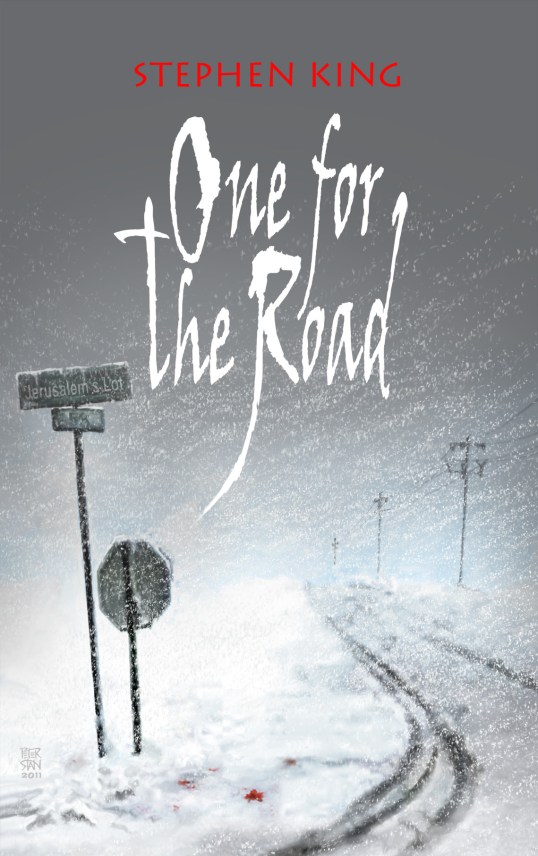
Horror Review: “One for the Road” (by Stephen King)


Stephen King’s writing style in “One for the Road” exemplifies his mastery of atmosphere, character voice, and narrative restraint. While much of his later work often invests heavily in world-building over long stretches, this short story demonstrates his ability to deliver a rich, immersive experience in a concise format. His choices here, both stylistic and structural, serve the story’s central purpose: to convey unspoken dread and the inevitability of evil.

The story serves as a chilling epilogue to ’Salem’s Lot, set during a brutal New England winter many years after a fire destroyed the infamous town. Told by Booth, an elderly local from nearby Falmouth, it begins in the warm familiarity of Herb Tookey’s bar, where Booth and Herb are longstanding fixtures. Their evening is interrupted when Gerald Lumley, cold and near collapse, stumbles in. Lumley explains that his car broke down in the snow miles away, and that he left his wife and daughter in the vehicle while seeking help. Tension deepens when he reveals the breakdown happened near Jerusalem’s Lot—a place everyone in the area fears but rarely discusses. Despite knowing the dangers, Booth and Herb reluctantly agree to help him return.

Their journey into the storm is both physically taxing and emotionally tense, as the two locals understand all too well what they might find. As they approach the outskirts of The Lot, King uses sparse detail and implication to build dread. By the time they reach Lumley’s car, the supernatural horror makes itself known, hammering home the message that evil never truly dies—it lingers, waiting for an opportunity to strike.

King’s decision to frame “One for the Road” within a harsh New England winter is critical to its success. The cold itself becomes an antagonist—slowing movement, reducing visibility, and draining the characters’ strength—adding a physical urgency to the supernatural threat. Snowstorms are a recurring motif in his work (The ShiningStorm of the Century) because they isolate the characters, making escape impossible and forcing confrontation with whatever is lurking nearby. The blizzard in this story intensifies feelings of claustrophobia, despite the vastness of the open, rural landscape.

King also makes the setting deeply familiar for his readers. Falmouth feels like a lived-in place, with its bar, locals who know one another’s routines, and whispered legends about The Lot. The story doesn’t waste time describing Jerusalem’s Lot in detail; instead, its horrors exist in the margins, in what the locals refuse to say.

The choice of Booth as the first-person narrator adds authenticity and intimacy. Booth speaks with the cadence of an elder New Englander—practical, reserved, and hardened by experience. Readers never doubt that this is the account of someone who understands the local history and its dangers. The conversational delivery, sprinkled with regional colloquialisms, draws the reader into the moment rather than presenting a polished, detached recounting.

Rather than sensationalizing The Lot’s horrors, Booth lets them linger unsaid. King understands that withholding explicit details can fuel imagination more effectively than extravagant description. This restraint makes the story’s climax more impactful because the dread has been steadily fed through implication.

The story’s pacing is deliberate but tight. King introduces the danger early—Lumley’s car is stranded near Jerusalem’s Lot—then uses the journey back to extend suspense. The structure mirrors a descent into darkness: starting in the relative safety of Herb Tookey’s bar, venturing into the blizzard, and finally confronting the true horror at the edge of The Lot. King avoids unnecessary subplots, instead focusing on a single mission: rescuing Lumley’s family. This gives the narrative relentless forward motion while allowing tension to rise in small increments.

One of King’s most notable thematic choices is the portrayal of evil as a constant, indestructible force. In ’Salem’s Lot, that evil once emanated from the Marsten House, a decaying mansion that served as both the symbolic and literal heart of darkness. By the time of “One for the Road,” however, the Marsten House has been burned down and stripped of its power. Yet, rather than eradicating the evil, its essence has expanded outward—the town itself has inherited its malign influence. The Lot has effectively become the new Marsten House, and its ruined streets and frozen remains now radiate the same dark gravity that once resided solely within those walls. King transforms the geography of evil: what was once contained in a single haunted house has transposed itself over the entire landscape, infecting the air, the snow, and the silence with something sentient and waiting.

King also plays with the tension between duty and self-preservation. Booth and Herb could have ignored Lumley’s plea. Their choice to help—despite knowing what might await them—aligns with King’s recurring motif that true courage lies in facing evil with no guarantee of victory.

Even when weaving atmosphere, King exercises a tight control over detail. The bar scene is economical: we know just enough about Herb, Booth, and their friendship to trust their dynamic. The blizzard is described vividly but without purple prose. This brevity forces the reader to focus on what matters—the growing realization that Lumley’s family is in mortal danger. The vampires themselves receive minimal “screen time,” a deliberate choice that allows the prior suspense to make their eventual appearance all the more devastating.

As a companion piece, “One for the Road” functions as both a continuation and a tonal reinforcement of ’Salem’s Lot. Rather than tying up loose ends, King emphasizes that nothing was truly resolved. Evil is only temporarily held back, and the destruction of the town did not remove its blight. By telling the story through outsiders who skirt the edge of The Lot without entering deeply into it, King preserves the town’s mystique, forcing readers to imagine the horrors that remain—an imaginative space where dread thrives long after the last page.

Nightmares and Dreamscapes: From the stories of Stephen King, Battleground, Review by Case Wright


bg4.jpg

Happy Horrorthon!!! I decided to do a bit of a hybrid review of one of my favorite stories:  “Battleground” by Stephen King.  This book is part of a short story anthology in Night Shift.  Battleground was written in 1972 by King.  This was back in the days when he wasn’t just hungry, he was starving.  He was working in laundries, substitute teaching, maybe even a paper route.  This particular work was published in Cavalier, which was a low-rent Playboy.  In those days, he would sell stories to Swank – a low-rent Penthouse as well.  Many of these stories were real gems or at least gems in the rough.  For example, Night Surf (Cavalier and Night Shift) evolved into his opus The Stand about a decade later.  Battleground was made into a 52 minute long episode of the above short-lived series (watch them on youtube before they are taken down!!!).

This episode starred William Hurt and like the short-story there is ZERO dialogue, giving the episode a silent movie feel that is very compelling.  Throughout the episode, you only hear ambient noise or grunts or yells, but no spoken dialogue.  In fact, even when a newscaster is announcing that a murder has taken place, it’s done with subtitles.  This is as close to genius television as it gets.  I was truly saddened that it was not renewed.

The episode depicts William Hurt as a nameless hitman who is taskered to kill a toymaker.  He does.  When Hurt goes back home to his San Francisco condo, he receives a package.  Inside the package is compilation of army men and “additional surprises”.  These aren’t your grandpa’s plastic army men; however, they are alive and they have cruel intentions for Mr. Hurt!

Within moments of opening the package, the army men attack William Hurt in very Army like fashion. They take a covered position under Hurt’s couch and open fire, forcing William to flee to the bathroom.  This solace is short-lived because they have mini-howitzers.  Yes, I was primed to like this one.  There are even mini-helicopters that attack Hurt and they send nasty notes to one another demanding and refusing surrender.

The battle to avenge the toy maker’s death continues even out to the ledge of the building, which is likely an Easter Egg to another King story “The Ledge”.  Hurt prevails against the army men, but there are two more “Additional Surprises” 1) a commando who very resourceful and 2) a mini thermonuclear device.  The mini thermonuclear device is the only dumb part of the story because there is no such thing as a tiny Thermonuclear reaction – these are atoms we’re fusing or splitting afterall.  If detonated (regardless of its “mini” nature) , it would’ve destroyed all of San Francisco, but let’s give King- a liberal arts major- a break on that one because it’s still a fun story.

I will review a few more of these stories that were in Night Shift or episodes from this show.

Happy Halloween!!!!

Book Review: ‘Salem’s Lot by Stephen King


The town of Jerusalem’s Lot, Maine has two new arrivals.

One is Ben Mears, a successful writer who, we’re told, even has his own FBI file.  (Apparently, it only consists of a report that he once attended an anti-war rally.)  Ben spent part of his childhood is Jerusalem’s Lot and, upon returning, he discovers a small but friendly town.  Sure, there’s some drama going on behind closed doors.  There’s the sleazy real estate agent, for instance.  And then there’s the Catholic priest who, naturally, has lost his faith.  And then there’s the unhappy teenage mother and, of course, there’s the usual collection of alcoholics, adulterers, and cranky bus drivers.  Maybe Jerusalem’s Lot isn’t that friendly after all….

The other new arrival is Kurt Barlow.  Barlow’s from Austria and he’s moved into the old Marsten House.  (The Marsten House, like most old houses that you come across in Stephen King novels, used to belong to a notorious gangster.)  Barlow’s going to be opening up an antique store.  Interestingly enough, hardly anyone ever seems to see Barlow.  His business partner, Richard Straker, claims that Barlow is often away on buying trips.

Anyway, the townspeople have a lot more to worry about than what’s going on with Kurt Barlow.  For instance, a lot of people are disappearing.  And even those who aren’t vanishing are growing ill and having a bad reaction to sunlight.  Hmmm …. what could possibly be going on?

First published in 1975, ‘Salem’s Lot was Stephen King’s second published novel and it actually holds up better than most of his recent work.  It’s interesting to read ‘Salem’s Lot after Carrie, just to see how much King grew as a writer in between the two books.  Whereas King often seemed uncomfortable with the plot of his first novel and tended to hold Carrie White at a distance, he dives right into ‘Salem’s Lot.  It’s not just that King is obviously more comfortable writing about a male writer than a teenage girl.  It’s also that King creates a town that seems so real that we feel as if we could find it on a map.  King tells his story with such enthusiasm and confidence that it doesn’t matter that ‘Salem’s Lot is a fairly predictable and traditional vampire story.

Clocking in at a briskly paced 440 pages, ‘Salem’s Lot is quite a bit longer and more detailed than Carrie without, at the same time, getting bogged down in the type of stylistic self-indulgence that has come to typify a lot of King’s recent work.  (One gets the feeling that if King wrote ‘Salem’s Lot today, it would be a 1,200 page novel and that Barlow wouldn’t show up until page 900.)  King does a good job of offering up little snippets of life in Jerusalem’s Lot, just enough to make sure we have enough knowledge to mourn the eventual death of the town.  ‘Salem’s Lot takes Dracula, drops him in the middle of a small town melodrama, and the results are still entertaining to this very day.

Book Review: Baal by Robert R. McCammon


Baal begins with an act of violence.

In the late 60s, a woman is raped in an alley by a stranger whose touch burns her skin.  Nine months later, Jeffrey Harper Raines is born.  The woman’s husband fears the baby and tries to drown him, just to be stopped and murdered by Jeffrey’s mother.

Jeffrey is sent to a Catholic orphanage, where he proves himself to be an intelligent and troubled child, the type who can not only mentally control all of the other children but also inspire them to go on a rebellious and destructive rampage.

Years later, a mysterious cult leader named Baal has emerged, first in California and then eventually in Kuwait.  His followers come from all walks of life and they include some of the wealthiest men on the planet.  A researcher tries to gain access to Baal’s cult and promptly disappears.  The researcher’s mentor, an elderly theologian named Dr. Virga, goes to Kuwait in search of his protegé.

What he discovers is that Baal is not only extremely dangerous but that his followers are willing to do anything that he orders them to do.  Fortunately, Virga does find one ally out in the desert — a mysterious man named Michael….

(I guess it was Gabriel’s week off.)

Baal was first published way back in 1978 and reading it, it’s obvious that the novel was heavily influenced by films like The Omen and Rosemary’s Baby.  In fact, it’s so derivative of those films that it’s impossible not to get kinda annoyed at not only how predictable the story is but also at the fact that it takes the people in the book so much longer to figure out what the reader realizes immediately.  You really do have to wonder if a cult leader couldn’t have perhaps come up with a name other than Baal.  I mean, that’s kind of like naming yourself Lou C. Ifer or something like that.  You’re just giving the game away.

Today, Baal is best known for being the debut novel of Robert R. McCammon.  McCammon was only 25 years old when he wrote and published Baal and most of the book’s problems — the lack of focus, the occasionally clumsy plot twists– are problems that many debut novels seem to have in common.  For quite some time, McCammon refused to allow Baal to be republished, saying that he felt it was inferior to his later historical and crime novels.  For the record, McCammon’s correct about that but Baal still has enough trashy and sordid moments to be occasionally entertaining.  I guess my point here is that Baal isn’t great and, at times, it’s barely good but it’s still better than Bob Honey Who Just Do Stuff.