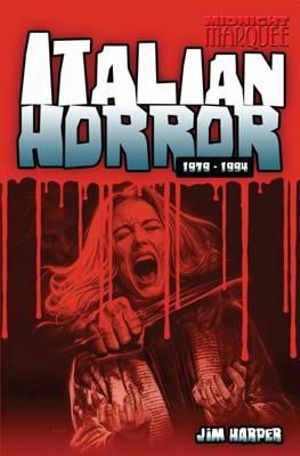
Book Review: Italian Horror By Jim Harper


As our long time readers know, I absolutely love Italian horror.  I was very lucky to discover the greatness of Italian horror when I was a teenager (it was a double feature of Suspiria and Blade In the Dark that did it for me) and I’ve been lucky enough to be able to spend the last few years studying everything that made the Italian horror films of the 80s and early 90s so memorable.

However, I do realize that not everyone has spent the past few years watching the films of Dario Argento, Lucio Fulci, Lamberto Bava, Michele Soavi, and Joe D’Amato.  For those who are just starting to learn about the history of Italian horror cinema, I highly suggest Italian Horror by Jim Harper, a short but highly readable overview of the genre.  Covering the years of 1979 through 1994, Italian Horror contains insightful reviews of films both famous (The Beyond, Dellamorte Dellamore) and infamous (Zombi 3 and so many others).  Even better, there are reviews of several of the more obscure Italian horror films, the ones that actually take some effort to track down.  For instance, I never would have seen Ratman if I hadn’t come across it in Harper’s book.  And I know that you’re probably saying, “Would it be that a bad thing if you had never see Ratman?”  Listen, Italian horror fans understand.

If you’re trying to start your studies of Italian horror off on the right foot, this is definitely a good book to start with.  Read it and prepare to have a hundred new movies to watch afterwards.

Paperback Review: The Vampire Curse by Daoma Winston


Yesterday, Erin shared the cover.  Today, I’m reviewing the book!  That’s what teamwork is all about!

This 1971 novel is all about an 18 year-old named Teena Halliday.  Needless to say, anyone with a name like Teena Halliday is going to be young, beautiful, and innocent.  Teena was perfectly happy living in a Mediterranean villa with her mom but then her mom had to go off and get remarried.  With her mom heading off to South America on a whirlwind honeymoon, Teena is being sent to Massachusetts, where she’ll stay with the Rentlows, some distant relatives that she has yet to actually meet.  Teena is hoping that, once she’s in Boston, she’ll get the chance to spend some time with her father.  However, when Teena arrives, her father is nowhere to be seen.

Instead, Teena is met by the mysterious but handsome Rory, who takes her to Rentlow Retreat.  Teena meets the Rentlows and discovers that they’re a bit more eccentric than she was expecting.  Neither Uncle Charlie nor Aunt June seem to be happy to see her and Teena’s cousin Estrella obviously views Teena as being competition for Rory’s attention.  In fact, the only person who seems to be the least bit welcoming is Jeremy Rentlow.

Jeremy is a world-renowned sculptor, despite the fact that everyone and everything that poses for him seems to end up dead.  The family seems to always be nervous around Jeremy.  Could it have something to do with those rumors that Jeremy might be a vampire?  Teena isn’t quite sure what to make of Jeremy, especially when he starts to tell her that she’s the most beautiful woman that he’s ever seen and that she simply must pose for him.  Teena is hesitant but what else is she going to do?  I mean, she has to do something to pass the time, especially considering that her dog Scuffy dies of a mysterious “wasting” disease shortly after Teena arrives at Rentlow Retreat.

Of course, soon, Teena is not only starting to feel a bit anemic herself but Jeremy suddenly announces that they’re going to be married and Teena is not to leave the estate!  Is Jeremy a vampire or is he a human with serious and dangerous control issues?  Is Teena being drained of blood or is she feeling weak because of the stress of the situation in which she’s found herself?  You can probably guess the answer to both of those questions.

Just like Air Force One Is Haunted, The Vampire Curse is one of the books that I found while searching through my aunt’s old paperback collection.  It was a fun and (at 196 pages) quick read.  It’s very much a gothic romance first and a vampire story second but there’s an undeniable charm to the efficiency with which author Daoma Winston told the story.  Everything you could want from a gothic romance is here: breathless, first person storytelling, an old house, an eccentric family, a dark secret, passionate kisses and, of course, a hedge maze.  There’s always a hedge maze.

The Vampire Curse was an enjoyable read.  I’m a bit stunned that Lifetime has never adapted the book into a film.  If they can turn everything credited to V.C. Andrews into a “film event,” surely they can find some time for The Vampire Curse.


Horror Book Review: Encyclopedia Of Vampire Mythology by Theresa Bane


Now, here’s the interesting thing about vampires:

They’ve been around forever.

Seriously, long before Bram Stoker first put pen to paper, there were legends about vampires.  Of course, they weren’t always called vampires.  In the Middle East, there was talk of the Afrit, which was the soul of a murdered person who would return to the spot of its death and drink the blood of anyone unlucky enough to cross it.  In Macedonia, it was said that certain people who had lived wicked lives and never eaten pork would return to life as a blood-drinking wild boar.  In Iceland, it was the Alfemoe who sucked blood while the ancient Greeks could tell you all about Empusa, who drank blood to maintain a youthful appearance.

Of course, we all know that vampires don’t exist, or at least they don’t exist as supernatural creatures.  Still, it is somewhat amazing that all of these different societies and cultures developed essentially the same myth at roughly the same time, despite not having much contact with each other.  There is just something universal about both the threat and the allure of the vampire.

With all of the different legends out there, it can be difficult to keep your mythological vampires straight.  Fortunately, the Encyclopedia of Vampire Mythology is here to help!  Written by a vampirologist (albeit one who goes out of her way to make sure that we understand that she personally doesn’t believe in them), this encyclopedia has entries for all of the various mythological vampires and their legends.  With the exception of Dracula, this encyclopedia doesn’t include any of the “fictional” vampires from television or film.  If you’re looking for an entry on Angel or Edward Cullen, this is not the place to look.  But what the book does have is entries on the legendary beings who came before the celebrity vampires of today.  It makes for interesting reading and it also serves as a reminder that there’s more to the vampire legend than what we’ve seen in the movies or read in novels.

For both authors and readers of vampire fiction, the Encyclopedia of Vampire Mythology is a valuable resource.


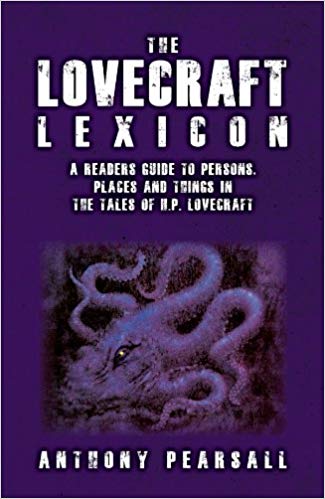
Horror Book Review: The Lovecraft Lexicon by Anthony Pearsall


Are you planning on searching for Cthulhu this October?

If you are, you might want to think again.  Seriously, Cthulhu does not like being woken up.  The majority of people who have gotten on Cthulhu’s bad side are dead and the one who survived have gone insane.  Add to that, it’s not always easy to track down Cthulhu.  I mean, sometimes it can be difficult to tell one lost city from another.  I guess you could try to track down your local Cthulhu cult or maybe you could summon Nyarlathotep and ask him for directions.  If I remember correct, I think that’s what Randolph Carter used to do.

If, despite all the warnings, you’re really determined to track down Cthulhu this summer, you need to order yourself a copy of Anthony Pearsall’s The Lovecraft Lexicon.  First published in 2005, The Lovecraft Lexicon contains all the information that you could possibly want about all of the persons, places, and things in the tales of H.P. Lovecraft.

It’s set up like an encyclopedia, with entries on …. well, everything.  You want to know about Charles Dexter Ward?  He’s in here.  Curious about Azathoth?  This book has all the information that you need to find.  Pearsall details the adventures of Randolph Carter and also sorts through the many legends about the Necronomicon.  This book is the next best thing to taking a course at Miskontic University.

However, the Lovecraft Lexicon is more than just an encyclopedia.  It’s also a reader’s guide, one that examines just what may have been going through Lovecraft’s mind when he wrote about some of his most infamous creations.  The book not only takes a look at Lovecraft’s work but also at the man himself and, to its credit, it’s honest about both Lovecraft’s flaws as a person and his strengths as a writer.  In the end, the book celebrates Lovecraft’s imagination and his influence on future writers.  Whether you’re a reader who is just now starting in on the works of H.P. Lovecraft or a writer looking to continue to tales of Cthulhu, The Lovecraft Lexicon is an invaluable resource.

Joker, Book Review, By Case Wright


IMG_1908

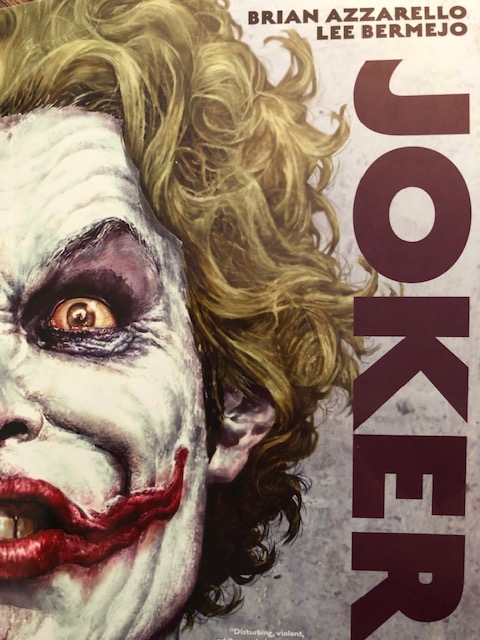
Happy Horrorthon! 2008 – Barack Obama was becoming a household name, I still had some hair, and Heath Ledger’s Joker brought the absolute evil of clowns to the silver screen.  I understand that some of you might think that the comic Joker is not a horror comic, but guys it’s got a clown right there on the cover; they are ALL trying to kill you. IT COUNTS!

Brian Azzarello and Lee Bermejo sought to bring Ledger’s Joker into a comic form and dig a little deeper into the psychology of Joker and why someone would follow him.  The story is narrated by Jonny Frost – a small time gangster- who wanted to be big.  Jonny figures that he himself is not larger than life, but by being near bright evil, he too could shine like the moon does with the earth.  He picks the Joker.

Christopher Nolan described the Joker as an absolute. He is an id of Corruption and destruction.  In this story, the Joker has gotten out of Arkham….again.  SIDE NOTE: what’s with Gotham?! They must have the single party liberal governing that we have in Seattle because you’d think they’d have a Three Strikes Rule or the Death Penalty by now.  I mean, why let the Joker continue to keep breathing? I get how Batman has this weird code- he wears rubber, cape, lives in a cave, and is all kinds of weirdo, but why do the rest of Gotham’s citizens have it? Do they not vote? Do they have only one ballot choice? So, the Joker meets Jonny Frost the second that he leaves Arkham and Jonny works as a toady and hanger on for the majority of the book.

Jonny narrates the Joker’s return to power as he reaps through the underworld, but he burns most of his possessions down and kills all of his own henchmen and even shoots Jonny at the end.  Really, the story depicted the Joker as a force of Anti-Creation.  While it was a deeper dive into this Super Villain, it left me wanting because it was told through the lens of this mediocrity Jonny Frost.  It says Joker right there on the cover so you’d think it would be all about the Clown Prince of Crime, but instead it was this tangential view of him.  I would’ve been more captivated by a story just about the Joker without a go-between.

The story was strong and depicting LOTS AND LOTS of gore.  In fact, the Joker kills more people than the Spanish Flu.  He’s Lucifer and Death combined to cause havoc.  In the end, we get the obvious conclusion that he’s just this disease of evil and that Batman is really just a treatment, but not a cure.  It seems that Gotham’s real disease is a soft on crime public policy.

N. By Stephen King; Review By Case Wright


kingsnhere

What if you’re not crazy?  What if you’re finally seeing the truth that everyone else is too afraid to see?  Is the revelation too much for your mind?  Could your mind be both the doorway to hell and the gate keeping the evil old ones at bay?  Most importantly, can a person’s mental illness infect another person?  Stephen King’s “N” is a hybrid of Lovecraft and Modern Psychology where we are forced to learn the answers to these questions.

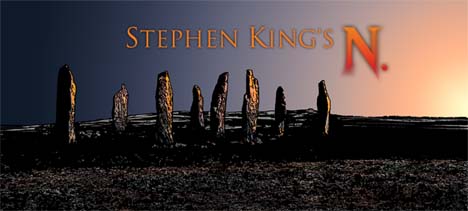
The story was both a novella and adapted as a comic book/olde-timey radio-show.  Confused?  Let me explain.  N was first published as a novella, but instead of getting made into a comic book or as is typical of King’s work- a movie or miniseries, it became something else.  Marc Guggenheim adapted the work as an all dialogue webseries similar to the serials of the 1930s and 40s and presented the story as a series of hyper-detailed comic illustrations.  You can see it in its entirety below.

I have also read the novella several times.  Honestly, sometimes I’m not sure why I like a particular Stephen King story more than another, but it seems to be when the characters are so real that they could be you or your neighbor.  Yes, the monsters are spooky, but it’s the people, their story, their lives, who just happen to have to also deal with a monster or four.

The story begins with Sheila Bonsaint who is in mourning from her brother’s suicide.  She is calling her friend who is reminiscent of Anderson Cooper to look into why her brother John killed himself.  She believes it’s because of his contact with a patient named N.  The story shifts to John’s perspective describing a patient N who suffers from extreme OCD.  N believes his OCD rituals keep the portals between our world and the hell world closed.

N describes how he encountered a field with rocks similar to Stonehenge in Maine and that by viewing the structure, he caused the structure to activate and potentially release an ancient evil that will consume mankind.  He begins to do OCD rituals to keep the portal closed, but realizes that he must sacrifice his life in order to shut the gate forever.  Unfortunately, John becomes infected by N’s mental disorder and becomes overcome with the need to investigate the structure, which activates it again and causes him to spiral into the same OCD as N.

This story struck a very strong chord with me.  Last year, I began to take a long road into facing my own PTSD experiences in the Army.  When I would tell the medical professionals in the VA about what happened, one cried.  My stories had infected them and left them different afterwards.  The world was less clean, less safe, and much darker.  Now, like N, if I have to tell a person the stories, I begin by saying that I am sorry because what I will tell you, will change you.  I suppose that is what humanity does; we share our burdens and our curses.  Maybe that’s how we keep the gate to hell closed?

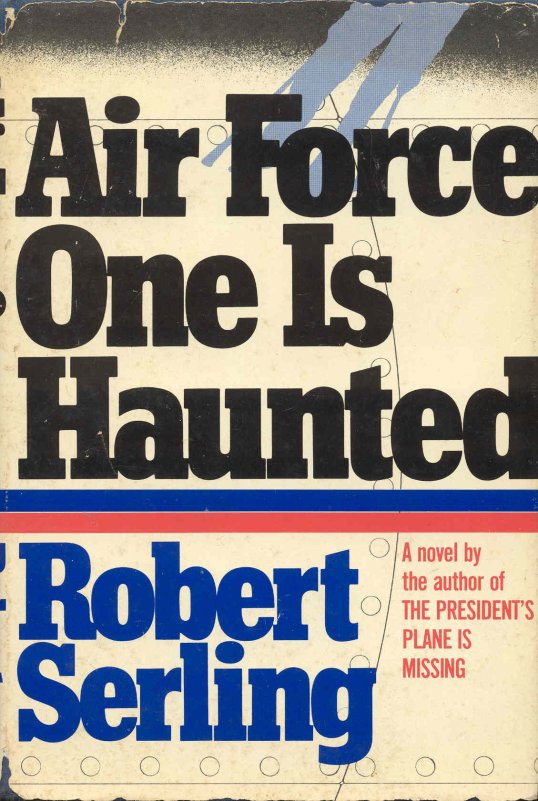
Book Review: Air Force One Is Haunted By Robert J. Serling


OH MY GOD, AIR FORCE ONE IS HAUNTED!

A few weeks ago, I was going through my aunt’s collection of old paperback novels, searching for anything that I could possibly review during October.  While I found a good deal of promising books, I have to admit that I almost squealed for joy when I came across Air Force One Is Haunted.

Now, don’t get me wrong.  I had never heard of the book before and I knew absolutely nothing about the plot.  But I saw that title and I knew I just had to read it.  I mean, seriously — Air Force One Is Haunted!  That’s like the greatest title ever!  I looked at that title and I asked myself, “What’s haunting Air Force One?  Angry druids?  Zombies?  Succubi?  Woodrow Wilson?”  Either way, it sounded like it had the potential to be terrifying!

Then I got home and I read the book and I discovered that …. well, let’s just say that my imagination got ahead of me.

Air Force Is Haunted was originally published in 1985 and the author was not only a world-renowned aviation expert but he was also the brother of Twilight Zone-creator Rod Serling.  So, it’s perhaps not surprising that Air Force One Is Haunted feels like an extended episode of The Twilight Zone.  It’s one of those things where a good but conflicted person has the chance to do something that seems like it might be good for him but it will also be bad for the world at large.  Fortunately, a ghost shows up and gives him a lot of advice.

The conflicted person, in this case, is President Jeremy Haines.  Haines is in his second term and it seems like the entire world is falling apart around him.  America’s in the middle of a great depression.  Russia and China are teaming up to possibly try to take over the world.  President Haines could always launch a first strike, which would wipe out Russia as a world power but which would also kill a lot of innocent civilians.  He can’t make up his mind what to do and, as a result, people across the world are starting to view him as being weak.  The President has even started to see a psychiatrist but they’re soon too busy having tasteful, mass market paperback-style sex to actually do anything about the President’s issues.

If only there was a mediocre ex-president that Haines could talk to and get some advice from!  However, it appears that even Jimmy Carter is refusing to take his calls.

That’s when FDR shows up.

That’s right.  It turns out that FDR is haunting Air Force One and, whenever President Haines boards the plane, he ends up getting advice from him.  FDR has a lot of stories to tell about governing during an economic depression.  He also says “Bully,” a lot, even though that was Teddy’s phrase.

Anyway, I think the book would have been a bit more interesting if FDR had turned out of be some sort of malevolent demon who intentionally gave President Haines bad advice that eventually led to World War III.  And, to be honest, I kept expecting that too happen.  I kept expecting FDR’s eyes to suddenly burn like hellfire as he said, “Burn it!  BURN IT TO THE GROUND!”  But that never happened.  Instead, this is one of those books where FDR is the greatest dead president ever and, in the end, middle-of-the-road liberalism keeps the world safe for democracy.

As you’re probably guessing, this is kind of a corny book but it is written with a lot of sincerity.  One gets the feeling that Serling really did feel that, if only America’s leaders just looked to the ghost of FDR, every problem in the world would be solved.  The book is also overwritten in the way that well-meaning, melodramatic novels of the past often were.  One character is identified as having a “gnawing ulcer of doubt” deep in the “bowels of his conscience.”  (Ewwwwwww!)  That’s the type of book that this is.  It’s definitely a product of its time but, if you’re a history nerd like me, that’s not necessarily a bad thing.

If anyone is haunting Air Force One, I personally hope that it’s Rutherford B. Hayes.  He was the best!
Horror Review: Glyceride by Junji Ito


Junji Ito Glyceride

While Junji Ito’s work has been done both in long-series format and novella-style stand-alone, most of his work has been through short story collections which has been collected in tanboko collections. It’s with some of his short stories that themes really shine through despite their short length. He’s able to disturb unnerve, disgust and horrify a reader with a quick read than most horror writers and filmmakers have tried using much longer formats.

One such short tale is “Glyceride.”

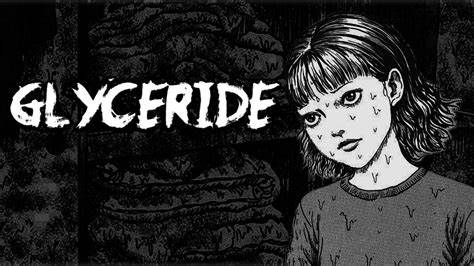
“Glyceride” is chapter 5 of his collection of one-shot stories in the collection Yami no Koe (Voices in the Dark). It tells the tale of a girl named Yui whose family owns a barbecue restaurant (city or town never mentioned other than it has a clear view of Mt. Fuji) in town. The place is always dark, dirty and there’s a heavy atmosphere of grease permeating everything in the place.

It’s this sense of grease both literal and figuratively which creates that sense of otherworldly horror and uneasiness. Ito’s artwork makes one feel the very grease the tale’s protagonist speaks about to such a level that, at least for me, one would need to take a thorough shower once done.

While the story is quite brief it leaves a definite imprint on the reader. Below is the anime adaptation of the short story.

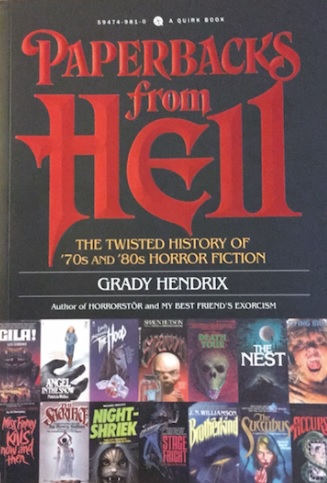
Horror Book Review: Paperbacks From Hell by Grady Hendrix


So, it’s October 1st and you know what that means!

It’s time to put together a Halloween reading list!

(Actually, to be honest, you’re running behind.  You should have started selecting the books for your October reading list way back in July.  Really, what have you been doing all this time?  Well, anyway….)

When it comes to putting together a Halloween reading list, there’s no better place to start than with Grady Hendrix’s Paperbacks From Hell!

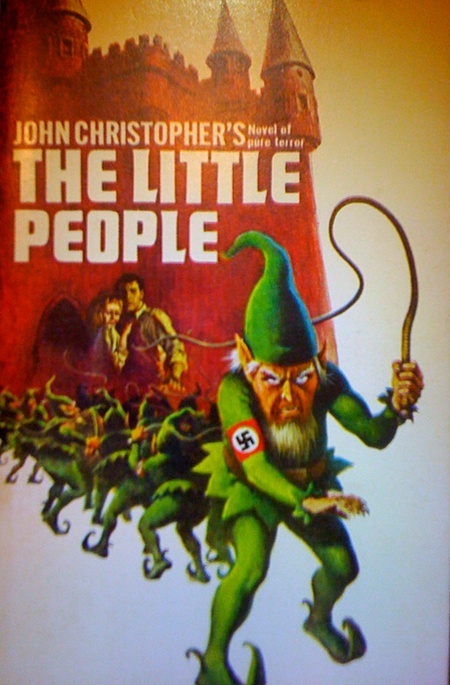
First published in 2017, Paperbacks From Hell is a compulsively readable and fun overview of the horror-themed paperbacks that scared readers in the 70s and the 80s.  Every genre of paperback horror is covered, from the demonic possession novels that came out after the success of The Exorcist and The Omen to the “based on a true haunting” ghost novels to the extremely gory and rather unpleasant serial killer stories of the late 80s.  Along with discussing the best sellers of that era, Paperbacks From Hell also includes hundreds of wonderfully sordid and often rather bizarre paperback covers.  Have you ever wandered what a bunch a Nazi dwarves would look like?  Well, just check out the cover of The Little People:

I mean, seriously — AGCK!

Paperbacks From Hell isn’t just a book about scary paperbacks, however.  It’s also a social history.  So many of these books were designed to appeal to whatever was scaring suburbanites at the moment and, as a result, the history of horror paperbacks is also a history of moral panics.  From Satanic cults to dirty music to environmental catastrophe and evil children, there’s a paperback for every one of them and, in all probability, the cover of that papeprback can be found in Paperbacks From Hell.

Paperbacks From Hell is a definite must-have for anyone who loves history and horror.  After I read it, I decided that I would read every single paperback that was mentioned in Paperbacks From Hell.  That turned out to be a bit more difficult than I thought it would be because, sadly, a lot of those classic old paperbacks are out-of-print and being sold for hundreds of dollars on Amazon.  I mean, I would love to read Satan Sublets by Jack Younger but I don’t know if I want to spend four hundred dollars to do so.  That said, even if some of the books that scared our parents and grandparents are no longer readily available, at least we have Paperbacks From Hell.

If you don’t already have a copy of Paperbacks From Hell, order it.  It’s addictive reading at its best.


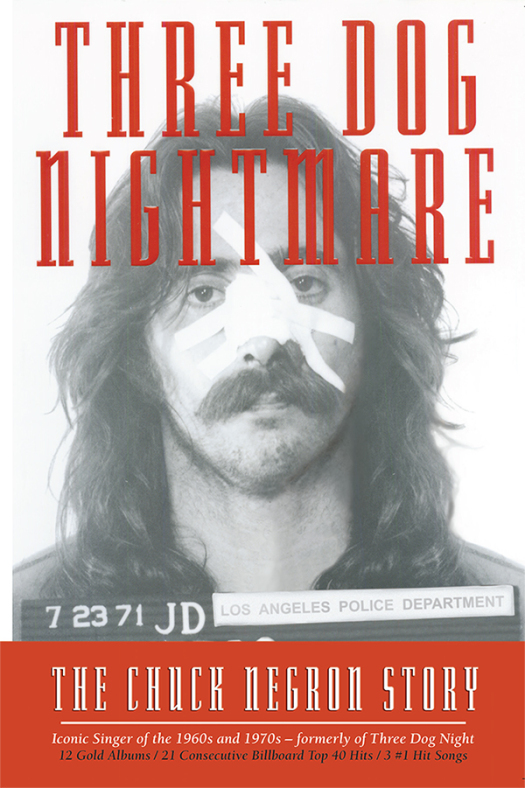
Book Review: THREE DOG NIGHTMARE: The Chuck Negron Story (4th edition; independently published 2017)


gary loggins's avatarcracked rear viewer

From 1969 to 1974, Three Dog Night was one of the biggest rock bands in the world, known for smash hits like “One”, “Eli’s Coming”, “Mama Told Me Not to Come”, “Shambala”, “Black & White”, and of course “Joy to the World”. Their squeaky-clean, family friendly image made them popular with both teens and adults, but behind that image lurked a deep, dark secret – co-lead singer Chuck Negron, the long-haired, mustachioed one, was an unrepentant heroin addict.

THREE DOG NIGHTMARE, first published in 1999 and revised in 2017, tells the harrowing tale of the horrors of drug addiction by the man who lived that nightmare for over twenty years. And ‘nightmare’ it truly was, as Chuck tells his tale of going from the pinnacle of the rock’n’roll universe to a Skid Row junkie, lying, cheating, and stealing his way through life leaving nothing but sorrow and devastation in his…

View original post 318 more words