This song has been a favorite Johnny Cash track of mine. God’s Gonna Cut You Down really brings the Old Testament gospel side of Johnny Cash to light. This song will probably get more mentions and airplay with it’s usage by Ubisoft in the release trailer for their latest Sam Fisher game, Splinter Cell: Conviction. While it’s probably not the way I would want young people to get introduced to Johnny Cash by way of video game at least they will get to hear and learn one of the greatest musical icons in American music history.
The Man in Black takes what really is a very upbeat and hopeful gospel folk song and turns it onto it’s head. Using a rhythmic stomp-clap to accompany his acoustic guitar playing, Cash imbues God’s Gonna Cut You Down with a grimness that shows God in vengeful, Old Testament flame and sword vengeance mode. It is difficult not to get into this song even if one is not religious. The way Cash song-speaks the lyrics just pulls one into the song until it’s completely hooked it’s talons onto one’s mind and won’t let go. I know I get into humming the song almost by instinct whenever I catch a bit of it on the radio and now on tv.
God’s Gonna Cut You Down
You can run on for a long time
Run on for a long time
Run on for a long time
Sooner or later God’ll cut you down
Sooner or later God’ll cut you down
Go tell that long tongue liar
Go and tell that midnight rider
Tell the rambler, the gambler, the back biter
Tell ’em that God’s gonna cut ’em down
Tell ’em that God’s gonna cut ’em down
Well my goodness gracious let me tell you the news
My head’s been wet with the midnight dew
I’ve been down on bended knee talkin’ to the man from Galilee
He spoke to me in the voice so sweet
I thought I heard the shuffle of the angel’s feet
He called my name and my heart stood still
When he said, “John go do My will!”
Go tell that long tongue liar
Go and tell that midnight rider
Tell the rambler, the gambler, the back biter
Tell ’em that God’s gonna cut ’em down
Tell ’em that God’s gonna cut ’em down
You can run on for a long time
Run on for a long time
Run on for a long time
Sooner or later God’ll cut you down
Sooner or later God’ll cut you down
Well you may throw your rock and hide your hand
Workin’ in the dark against your fellow man
But as sure as God made black and white
What’s done in the dark will be brought to the light
You can run on for a long time
Run on for a long time
Run on for a long time
Sooner or later God’ll cut you down
Sooner or later God’ll cut you down
Go tell that long tongue liar
Go and tell that midnight rider
Tell the rambler, the gambler, the back biter
Tell ’em that God’s gonna cut you down
Tell ’em that God’s gonna cut you down
Tell ’em that God’s gonna cut you down
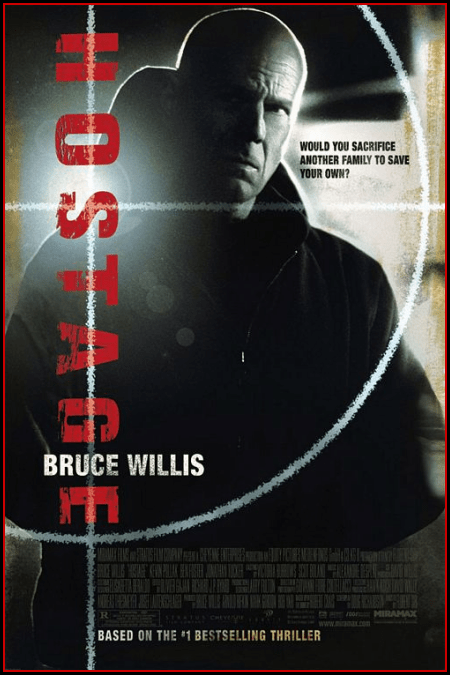
The five years or so has seen the rise of several new directors from France who’ve made quite a splash with their Hollywood debuts. There’s Alejandro Aja with Haute Tension (or Switchblade Romance/High Tension) who brought back the late 70’s early 80’s sensibilities of what constitutes a good slasher, exploitation film. Then there’s Jean-Francois Richet whose 2005 remake of John Carpenter’s early classic, Assault on Precinct 13 surprised quite a bit in the industry. Neither film made too much in terms of box-office, but they did show that a new wave of genre directors may not be coming out of the US but from France of all places. Another name to add to this list is Florent Siri and his first major Hollywood project Hostage shows that he has the style and skills to make it in Hollywood.
Hostage is another Bruce Willis vehicle that was adapted by Doug Richardson (wrote the screenplay for Die Hard 2) from Robert Crais’ novel. Hostage is a very good thriller with a unique twist to the hostage-theme. Willis’ character is a burn-out ex-L.A. SWAT prime hostage negotiator whose last major case quickly ended up in the death of suspect and hostages. We next see him as chief of police of a small, Northern California community where low-crime is the norm. We soon find out that his peace of mind and guilt from his last case may have eased since taking this new job, but his family life has suffered as a consequence. All of the peace and tranquility is quickly shattered as a trio of local teen hoodlums break into the opulent home of one Walter Smith (played by Kevin Pollak). What is originally an attempt to steal one of the Smith’s expensive rides turn into a hostage situation as mistakes after mistakes are made by the teens.
From this moment on Hostage would’ve turned into a by-the-numbers hostage thriller, but Richardson’s screenplay ratchets things up by forcing Willis’ character back into the negotiator’s role as shadowy character who remain hooded and faceless throughout the film kidnap his wife and daughter. It would seem that these individuals want something from the Smith’s home and would kill Willis’ character’s family to achieve their goals. The situation does get a bit convoluted at times and the final reel of the film ends just too nicely after what everyone goes through the first two-third’s of the film.
The character development in the film were done well enough to give each individual a specific motivation and enough backstory to explain why they ended up in the situation they’ve gotten themselves into. Willis’ performance in Hostage was actually one of better ones in the last couple years. The weariness he gives off during the film was more due to his character’s state of mind rather than Willis phoning in his performance. I would dare say that his role as Chief of Police Jeff Talley was his best in the last five years or so. The other performance that stands out has to be Ben Foster as the teen sociopath Mars. Foster’s performance straddles the line between being comedic and over-the-top and could’ve landed on either side. What we get instead is one creepy individual who almost becomes the boogeyman of the film. In fact, the last twenty minutes of Hostage makes Mars into a slasher-film type character who can’t seem to die.
The real star of the film has to be Florent Siri’s direction and sense of style. From the very first frame all the way to the last, Siri gives Hostage the classic 70’s and 80’s Italian giallo look and feel. Siri’s use of bright primary colors in conjuction with the earthy, desaturated look of the film reminds me of some of the best work of Argento, Bava and Fulci. In particular, Siri’s film owes alot of its look to films such as Tenebrae, The Bird with the Crystal Plumage, and The Psychic. Certain scenes, especially the penultimate climax in the Smith home, take on an almost dreamlike quality. Siri’s homage to the classic gialli even gives Hostage some sequences that would comfortably fit in a 70’s slasher film.
Florent Siri’s Hostage is not a perfect film and at times its increasing tension without any form of release can be unbearable to some people, but it succeeds well enough as a thriller. It also shows that Siri knows his craft well and instead of mimicking and cloning scenes from the gialli he’s fond of, he emulates and adds his own brushstrokes. The film is not for everyone and some people may find the story convoluted if not dull at times, but for me the film works well overall. Siri is one director that people should keep an eye on.
Our latest hottie of the day is the lovely Ms. Bella Valentine.
Ms. Valentine is a glamour model born in Florence, Italy and who spent time growing up between Italy and Poland. She’s quite the cosmopolitan lass who is fluent in Italian and Polish in addition English and Spanish. Bella Valentine began her modeling career in 1999 as a runway model in Italy and stayed in the business for a couple years before moving to the US in a student exchange program in 2001. Still a teenager, she stayed in Northern California before moving onto Kansas City after high school to attend the Kansas City Art Institute. She soon dropped trying to study for a career as an artist and went into business school. After getting her degree in Business Management she tried her hand at the corporate game, but soon tired of it.
in 2008 she went back to modeling full-time and hasn’t looked back since. She’s been quite busy since her decision to return to modeling. Her work ranges from print and magazine ad modeling shoots to tv commercials in the Southwest region of the US. Miss Valentine has also done the promotion circuit as a model from 2008 to now. She has also worked with man of the top glamour modeling photographers in and out of the country. Her background in business has also given her the skill to start her own website business and looks forward to expanding her brand.
I wasn’t born yet when George A. Romero’s Night of the Living Dead was first released in theaters, but I’ve wished many a night that I was old enough to have seen this classic horror film on the big screen. Night of the Living Dead simply changed the film industry forever and showed that horror was taking an uncharted road toward realism, brutality, and true terror. Before Romero’s film, horror often echoed the classic 1940s Universal style or the technicolor Hammer Films. Night of the Living Dead became the torchbearer of what would soon evolve into the splatter and exploitation films of the following decades. The influence this film has had on horror filmmakers is still ongoing.
Zombie films existed long before Night of the Living Dead, but they mostly depicted the traditional Haitian voodoo variety—with zombies as heavily drugged victims forced into slave labor for merciless masters. Romero changed all that in 1968. Made on a shoestring budget even by the standards of the time, Romero and his friends decided to make their own horror movie. The premise was simple: radiation from a returning Venus probe (though later films in the series abandoned that explanation for something more vague) somehow reanimated the recently deceased—though these zombies only had the most basic motor skills. That alone was terrifying enough. But Romero took it further by giving the zombies a new motivation: an unending hunger for the flesh of the living. With this, Night of the Living Dead marked the birth of horror at its most extreme.
The story was heavily influenced by Richard Matheson’s apocalyptic vampire novel I Am Legend, and Herschel Gordon Lewis’ Blood Freaks and Two Thousand Maniacs. Matheson’s novel contributed the idea of an encroaching horror besieging the survivors, while Lewis’ films provided an unflinching portrayal of exploitative violence and gore. Lewis didn’t shy away from gore, but Romero was the first to put a solid story behind the carnage.
The film opens simply enough, with a brother and sister heading to a rural cemetery to visit their dead mother. Right away, it takes on a disturbing tone, as both siblings come under attack from what seems to be a transient. Barbara, played by Judith O’Dea, flees for her life, with her brother Johnny already down. The tension of the opening sequence still makes my pulse pound every time I watch it. Soon, the story introduces the strongest character: Ben, played by Duane Jones in what became his signature performance. But even as strong-willed and level-headed as Ben is, he shares flaws that lead to critical mistakes later. The rest of the cast follows: Harry Cooper (Karl Hardman), his wife Helen (Marilyn Eastman), their injured daughter Karen (Kyra Schon), and the local couple Tom (Keith Wayne) and Judy (Judith Ridley). As the farmhouse becomes surrounded by a growing horde of undead, attracted by their noise, you’d expect the group to band together to survive the night until help arrives. But instead, misunderstandings and bitterness divide them, escalating into open conflict and self-preservation without concern for others.
The infighting and inability to cooperate is Night of the Living Dead’s strongest message—a bleak reflection of human nature in times of upheaval. The characters are fully realized, complex, and rare for horror films of that era. Their realistic portrayal makes their conflicts hit harder. After watching them fall apart, it’s easy to judge them as foolish, but realistically, many others faced with the same pressure might behave just as destructively. Romero’s harsh commentary on humanity’s failure to unite has led to conflict throughout history, and the film points this out in the bluntest, most brutal way possible.
The horror of Romero’s film is intensified by an economic choice. Color film was available in the 1960s but still expensive; only major studios or wealthy independents could afford it. Romero instead used black and white, helped by his background in documentary filmmaking, which made film stock easier to procure. This gave Night of the Living Dead its signature cinéma vérité look—grainy, raw, and immediate, like 8mm home movies of the era. Combined with Romero’s economical editing and minimalist, bass-heavy soundtrack, the film gains a life of its own. Its creeping dread was so tangible, I’m surprised more viewers didn’t walk out when it first played. The horror lingered long after watching.
There really isn’t much to complain about this film. Horror fans were given a movie that went well beyond exploitation. It also opened the door for a new generation of filmmakers who saw that movies could be more than entertainment—they could express social, political, and economic truths of their era. Night of the Living Dead had it all. It told audiences young and old that the era of silly, fantastical horror was over, and a new wave of realistic horror was about to descend. It didn’t shy away from violence. Flesh was ripped from limbs; intestines and organs were shown being handled and devoured. This “Vietnamization” of film violence launched a new era in what filmmakers could depict. But in 1968, this was the kind of violence usually reserved for drive-in exploitation fare—and initial audiences were unprepared. Not just adults, but 11- and 12-year-olds saw this as part of Saturday morning double features. One moment they were watching Flash Gordon or Buck Rogers, the next they faced flesh-eating ghouls and damning social themes bombarding their minds.
1968 is now seen as a turning point in filmmaking history. Night of the Living Dead influenced not just horror directors but filmmakers in all genres. It’s no surprise the film lives in the Smithsonian National Film Registry as a work that reshaped filmmaking art. Decades later, it still shocks first-time viewers and delights devoted fans. Night of the Living Dead didn’t just usher in a new era of horror and cinema; it announced the arrival of a genuine guerrilla auteur, a master of his craft.
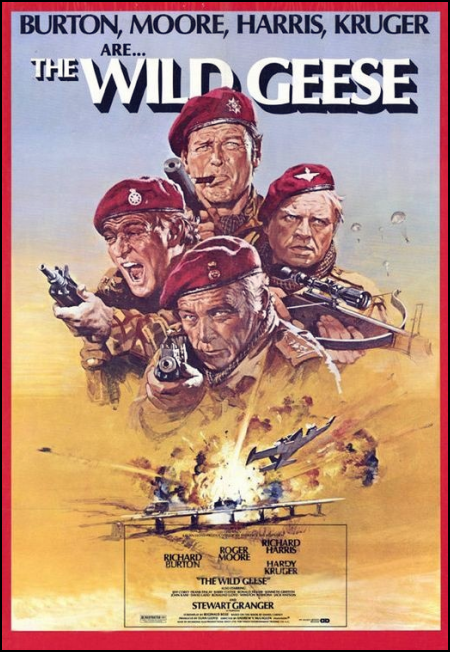
1978’s action war film The Wild Geese is an adaptation of Daniel Carney’s unpublished novel about a group of mercenaries on a mission during the turbulent revolutionary times that beset Central Africa during the 1960s and early 70s. The film features an all-star cast of British actors, a true who’s who of the era. Under the direction of Andrew V. McLaglen, The Wild Geese manages to be an action-packed and well-told film with memorable performances.
The character Colonel Allen Faulkner, played by Sir Richard Burton, is loosely based on the real-life mercenary legend Michael “Mad Mike” Hoare. Hoare not only inspired this central character but also served as the film’s military and technical advisor. Adding to the film’s authenticity, one of the actors portraying a mercenary, Ian Yule, had served with Hoare in his mercenary company. This infusion of real-life experience gives the film a vivid sense of art imitating life and lends credibility to its portrayal of mercenary warfare.
The story begins with a meeting between Faulkner and British banker Sir Edward Matheson about a rescue mission in the fictional Central African nation of Zembala. The first third follows Faulkner’s recruitment of a 50-man mercenary team, including his reluctant old friend Rafer Janders (Sir Richard Harris). The film portrays the mercenary company training and preparing for the mission before being inserted behind enemy lines. The second half details the rescue of their target: a deposed African leader about to be executed by the man who overthrew him.
During the second third of the film, the action intensifies. Though tame by today’s standards, the sequences were energetic and well-shot for their time. The mercenaries are shown not as idealized heroes but as pragmatic soldiers who use ruthless tactics—such as cyanide gas and poisoned crossbow bolts—that may shock modern audiences. This realism reflects Hoare’s influence and presents mercenaries as professionals doing a dangerous job for pay, blurring the moral lines of warfare. Betrayal during the mission tests their survival in enemy territory.
Burton and Harris deliver excellent performances as hardened war veterans, while a younger Sir Roger Moore adds roguish charm as the Irish pilot Shaun Fynn. Strong supporting roles include Hardy Kruger as Pieter Coetzee, an initially racist Afrikaner who gains new perspective on the continent’s upheaval, and Stewart Granger as the principled banker Matheson.
Though relatively small budgeted compared to other war epics of the era, The Wild Geese carries an epic feel and should have appealed more to American audiences. Unfortunately, financial difficulties with the production company affected its U.S. release. Over time, video and DVD releases built it a cult following among war and mercenary film fans, a subgenre often dominated by lesser films. McLaglen’s straightforward direction keeps the film’s pacing steady, and the story balances action with political and philosophical themes in its final act.
The Wild Geese stands as a rare gem in war cinema that delves into a little-known subgenre. With strong performances by knighted British actors, a former Hitler Youth, and real-life mercenaries as extras, the film distinguishes itself from the many flawed war movies flooding late-70s and early-80s cinema. Its roots in actual mercenary experiences, highlighted by Hoare’s real-life involvement and character inspiration, make it a compelling and underappreciated classic for aficionados of the genre.
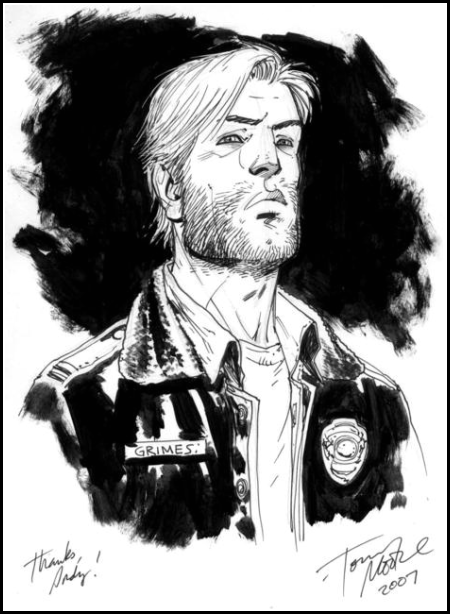
The good folks over at The Hollywood Reporter have reported that Frank Darabont’s tv series adaptation of Robert Kirkman’s award-winning comic book, The Walking Dead, have finally found the actor to play the series’ lead protagonist, Rick Grimes. The actor chosen came out of left field as his name was never even one people were clued in on. Fan favorites like Peter Krause and Mark Pellegrino were not even seen or heard having tried out for the lead role. Other names like Jamie Bamber (Battlestar Galactica’s Lee “Apollo” Adama) and Johnny Lee Miller (Eli Stone and Hackers) were also mentioned as having tried out for the role with the latter seen as the front-runner.
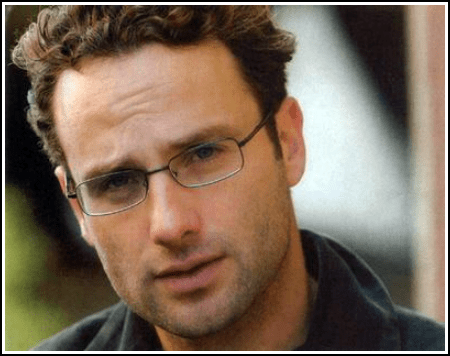
So, it’s seen as a surprise by many following the production of The Walking Dead to see the name Andrew Lincoln come up as the actor chosen to play Rick Grimes. The UK actor has worked in mostly shows and films in his native UK w/ Love Actually being the more recognizable of those he’s worked on. I think the choice was, and is, a good one. This is literally an unknown actor to US audiences so it will be easier for suspension of disbelief to be achieved for those watching.
While the reaction to this news is mostly one of guarded optimism there’s a very tiny but vocal group that seem to cry foul at this choice just for the fact that Andrew Lincoln will be a British-actor playing an American from the South. I think fans at times just think that dream choices for roles in their favorite stories should be the only ones chosen to play those roles whether they actually want to take on the role or not, or if they’re even good for the role.
For the detractors I say give the man a chance to get into the role before you put the man down. Oh yeah, one other thing…just be glad the show is actually being down and with strong creative people behind it. Put the fanboy/girl hat into storage.
For our newest hottie of the day we travel from the Land of the Rising Sun over to the United Kingdom to meet the lovely Ms. Rosie Jones.
Ms. Jones was born in July of 1990 in her hometown of Middlesex, UK. Rosie Jones is the latest in a long line of British Page 3 models who have gained quite the large fan following. Ms. Jones is still very young and still new to the game of glamour modeling over in the UK, but she has already been compared to past popular and successful British glamour models such as Keeley Hazell, Rhian Sugden and Lucy Pinder. Rosie has been busy modeling not just for the Sun as a Page 3 girl, but also for UK men’s magazines such as Loaded, Nuts and Front.
While her claim to fame is still her modeling work (most of which are topless) she’s got room to grow and her fast rising star in the glamour modeling world has many seeing her becoming one of the most sought after. It is more than likely that we will see her heavenly figure and natural beauty become more prevalent not just in the UK but in the US and the rest of the world.
I am pleased to announce the arrival of a new contributor to the site. The lovely and smart LisaMarieBowman. Her love for foreign films and especially grindhouse films of the 70’s and 80’s match my own thus she’s automatically one of the coolest people on this planet. She’ll be posting her thoughts on foreign films and other things entertainment which catches her fancy.
So, for the regular visitors to the site plesse make her feel welcome and wish her good luck.
2009 Fantastic Fest had one specific film which had a visceral effect on that film festival’s attendees. The fact that it won that festival’s Best Picture in the horror category gave it a boost in the buzz department. I am talking about the film directed by Tom Six titled simply, The Human Centipede: First Sequence.
Just watching the trailer and the sample clip below would be enough to sell the film for someone or just outright make them run straight to the bathroom. Either way it looks like this is one film which will not have a middle-ground when it comes to people’s reactions. If this film was released 25-30 years ago it definitely would be an example of what makes a grindhouse flick.
Finally, we get the first full trailer for his summer’s upcoming film adaptation of the popular 80’s action tv series, The A-Team.
The first trailer was a teaser version which didn’t seem to elicit much excitement from people when it was first shown. It was short on any sort of details and didn’t really introduce the characters to people who may not have seen the series. That teaser trailer was also lacking in any action sequences to tease the public into wanting to see more. Well, that is until the very final sequence with the palleted tank free-falling from tens of thousands of feet and Bradley Cooper’s character “Face” popping out of the commander’s hatch, prime the Ma Deuce and firing it while doing said tank free-fall.
It’s been a couple months since that teaser’s release and there hasn’t been much from the film’s studio to help increase buzz on the film. But it looks like this official full trailer might have fixed the problem the teaser caused. This full trailer actually makes The A-Team look like it could be a fun, action flick. There’s some of the humor from the series and the full trailer gives a quick intro of the team’s four members (I liked Murdock’s best). There’s even a subtle reference in the trailer about how give the team an hour and they’re practically invincible. This is in reference to the tv show where the team literally MacGyver’s their way through no-win situations save the day. I hope that becomes part of whatever last reel climactic action sequence the film may have.
The A-Team is set for a June 11, 2010 release. It’s directed by Joe Carnahan (Narc, Smokin’ Aces) and starring Liam Neeson (Hannibal), Bradley Cooper (Face), Quinton Jackson (BA Baracus) and Sharlto Copley (howlin’ Mad Murdock). I know I’ll be there on Day One of it’s release to watch and knowing some of my older uncles and my dad, they’ll be there as well.













 Through the Shattered Lens