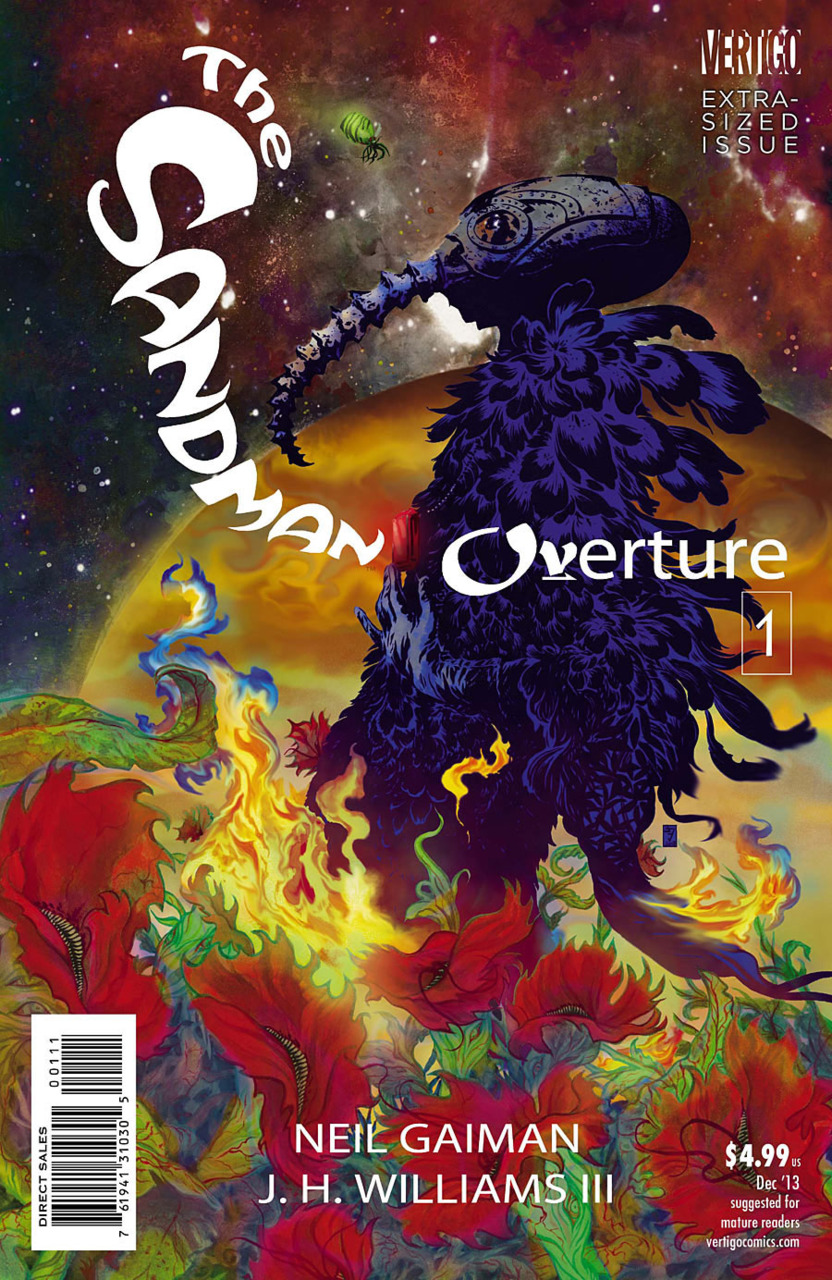
Halloween Horrors 2013 : “The Sandman : Overture” #1


3410429-01a

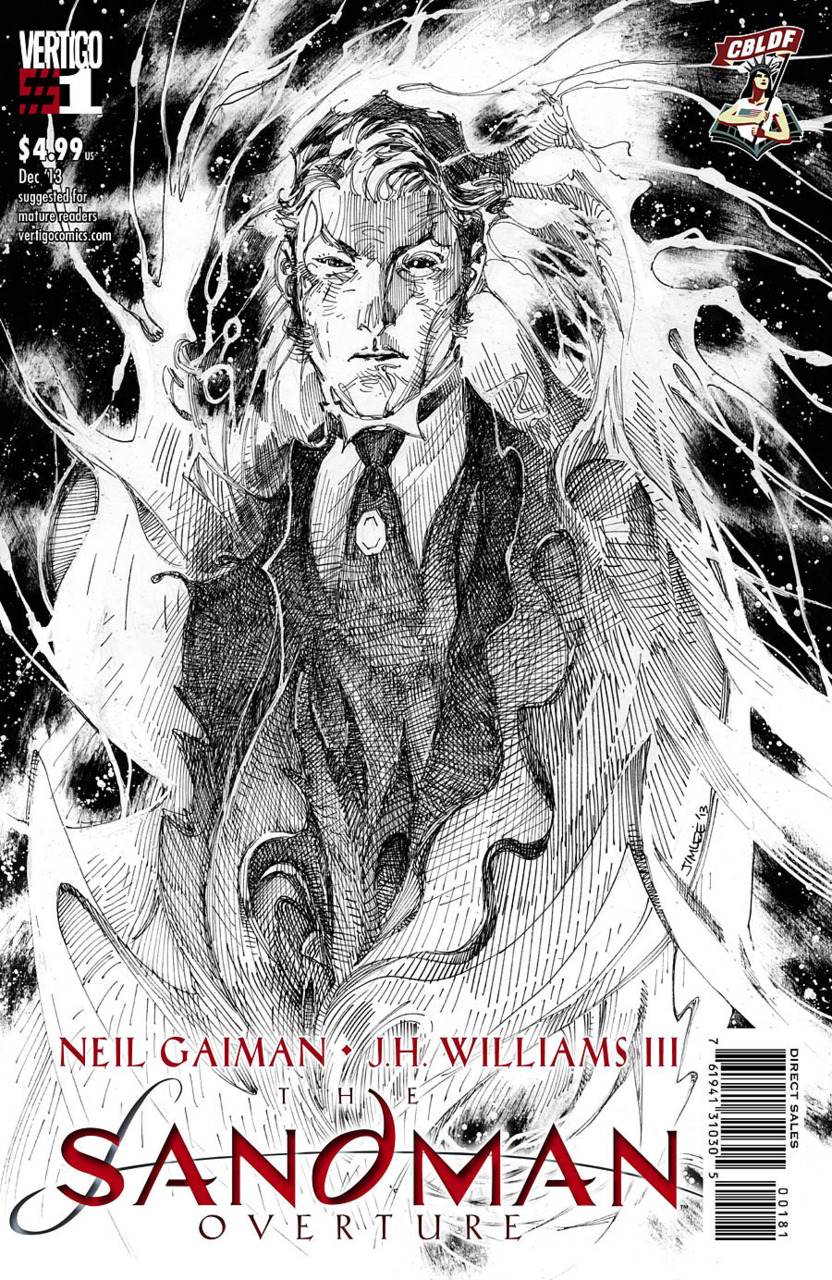
So — you probably weren’t expecting me to finish up my contributions to TTSL’s Halloween horror round-up with a review of a horror comic, as opposed to a horror movie — or, hell, maybe you were — but let’s be honest : the debut of Neil Gaiman and J.H. Williams III’s The Sandman : Overture (which, I suppose, might be more accurately categorized as “myth” or even “fairy tale” than actual “horror,” per se, but what the heck — The Sandman started out life being billed and marketed as a “horror” series, and it’s certainly always maintained a strong following among horror fans, so — that’s good enough for me) is an honest-to-goodness event in its own right, and something tells me that a lot of folks who haven’t set foot in a comic shop in a very long time will be back to pick this one up ( guess we’ll see how well those  former black-clad goth kids have aged), and, Sandman fans being by and large a pretty hard-core lot, I don’t think we’ll have a repeat of the type of precipitous sales declines between the first and second issues that we saw with, say, Before Watchmen, which was the last big “bring the old readers back” push that DC/Vertigo undertook.  It also helps that The Sandman : Overture is probably going to be a good  comic, of course, as well — at least if the first issue is any indication.
3412271-01b

Notice, however, that I didn’t quite go so far as to say that it’s going to be a great comic. Frankly, it’s just too early to tell. I’m certainly hoping it will be, and have no real reason to doubt Gaiman or Williams, but — for the time being, I think it might be smart to leave myself just a little bit of wiggle room by not pronouncing its greatness too early. There’s no doubt that I absolutely enjoyed each and every word and panel in this book, and that it made me smile from ear to ear and cover to cover all three times (so far) that I’ve read it, but it’s also not without its (small, I grant you, but still — ) flaws.
3412269-01c

I’ll tell ya what, though — the art’s not one of them. This is probably the first Sandman comic where the illustrations have outshone the script. Which is no knock on the script, by any means — it’s just to say that Williams, who employs literally dozens of different styles here, really knocks it out of the park. Whether he’s doing lush dreamscapes, black-and-white etchings, watercolor historical pastiches, or magnificent cosmic two-,three-, and even four-page spreads, he’s entirely and majestically at the top of his game. Honestly, his work on this first issue puts even his best efforts on Promethea to shame. This is  a consummate and visionary professional at the height of his creative powers. Feel free to “ooh” and “aah” profusely — I sure did.
3412268-01d

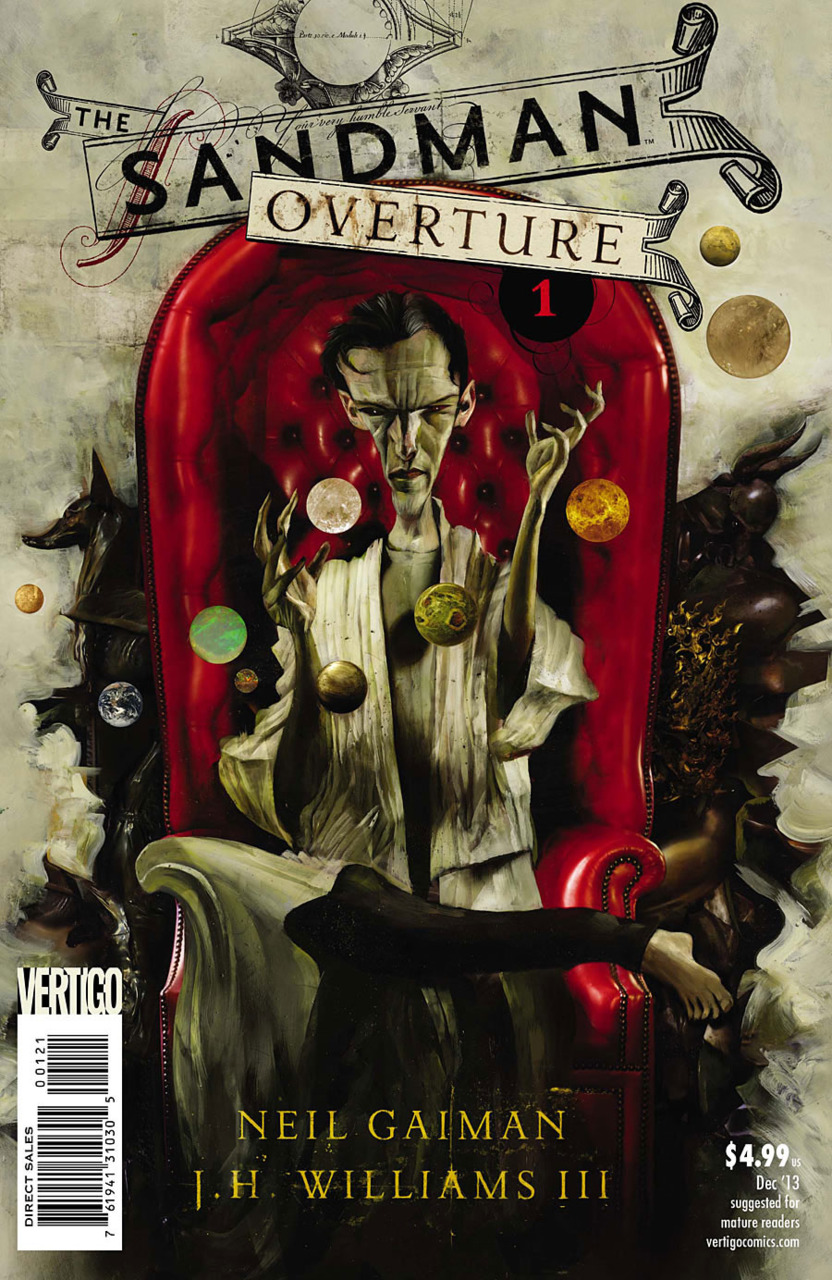
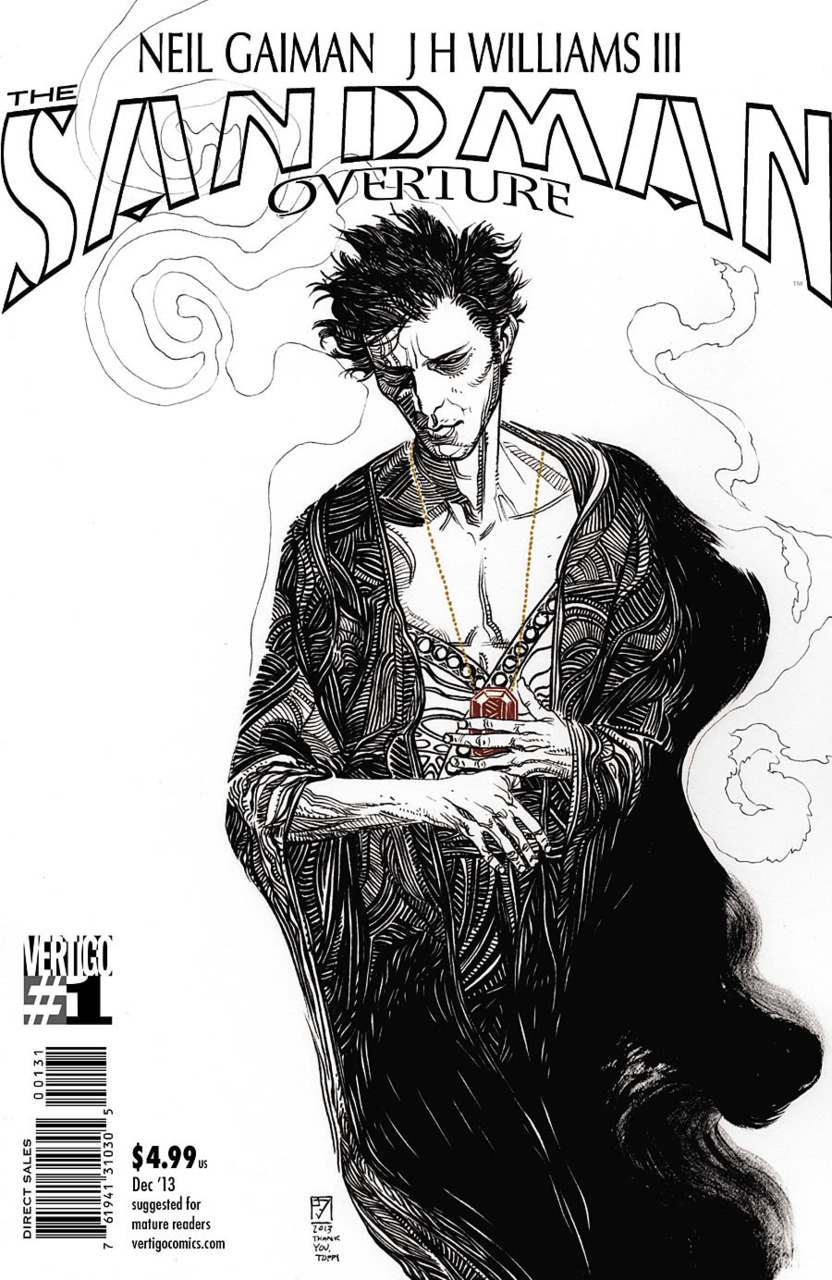
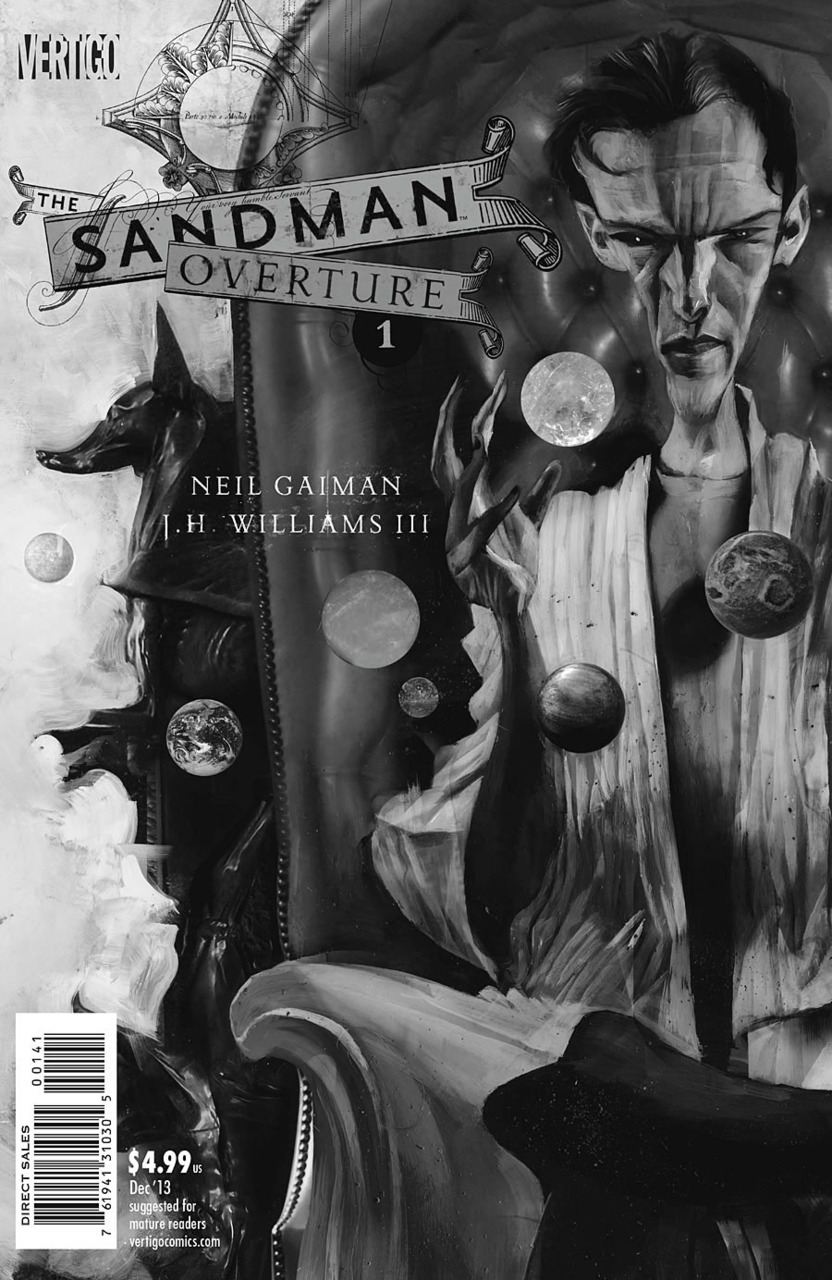
The variant covers (by, as pictured, Williams, original Sandman cover artist Dave McKean, Williams again, McKean again, and DC head honcho Jim Lee — yes, even his looks cool) are all quite a sight to behold, as well, even if McKean’s “two” amount to different iterations of the same painting. There’s no doubt that these lavish works do much more than just celebrate the 25th anniversary of this series (shit, I suddenly feel really old), or herald the arrival of a major new story, or even reintroduce a fan favorite with the proverbial “bang” — they all complement the issue itself about as perfectly as one could hope — dare I say dream — for. Each says “welcome back, old friend — you’re in good hands, this was crafted with love and we’re pleased that you’ve joined us.”

Not to be too overly- effusive with my praise, mind you — just calling it like it is.
3410426-01-cbldf

So what’s holding me back from saying that this is the best thing to come down the mainstream comics pipeline in a decade or more, at least? Well, to be honest, the book does have a few minor problems. Gaiman seems to have hung the framework for this introductory chapter over a couple of really neat ideas that, for whatever reason, he never really delved into much in The Sandman‘s original 76-issue run — namely, what dreams are like for alien life forms and what a gigantic conclave of all the various iterations of Morpheus/Dream’s anthropomorphic “selves” would play out like. Between all that we have brief but welcome appearances of beloved characters like Destiny, Death, Lucien, Merv Punkinhead, and The Corinthian, but so far all we really know is that this six-issue “prequel” is going to end where The Sandman #1 began and finally tell us exactly how the Lord of Dreams was able to be captured by mere human dabblers in necromancy in the first place.

It promises to be an intriguing and dare I say wild ride, to be sure, but — we also knew that’s what this book was going to be about going into it. I mean, the Overture part of the title pretty much gives things away, doesn’t it?

In all fairness, there’s nothing here in the first issue that will dissuade anyone from sticking with the series to its conclusion (although Gaiman’s intuitive knack for sequential pacing appears to have slipped a bit in the first few pages, he quickly regains his old form and is firing on all cylinders by about the fifth or sixth page)  — quite the reverse — but it’s also neither particularly accessible to new readers nor of much value, story-wise, as a “stand-alone” piece. There’s nothing wrong with that, of course, but it strikes me that the very best issues of the original Sandman series were either stand-alone works like the magnificent “A Midsummer Night’s Dream” or “August,” or  individual segments of sweeping, multi-part epics like “The Dolls’ House” and “A Game Of You” that also could be read and enjoyed (although, admittedly, not enjoyed, or even understood, as completely) when read on their own. The Sandman : Overture #1 really only works when considered within its context : as the opening salvo of a story that readers have been waiting a quarter-century to be told.

In all honesty, though, it’s probably well-nigh impossible for me to separate this book out from my own personal context as a reader either. I picked up The Sandman #1 back when it first came out and stayed with it right up to the end. The years of its publication coincided with my heaviest period of comics collecting, and though my tastes changed radically over the course of its run — I was subsisting on a steady diet of then-current Marvel and DC pablum when the series started and had all but given up on the mainstream in favor of titles like HateEightballYummy Fur, and Palookaville by the time it was done — my love for Gaiman’s characters, concepts, imagination, and sheer storytelling prowess never dimmed in all that time. Reading The Sandman : Overture #1 is like catching up with a long-lost friend or family member that, if pressed, you’d have to confess you probably thought you’d never see again. I can’t even accurately describe how fucking good it felt to see a new Sandman comic on the shelves at the shop today, nor how great it felt to immerse myself in its pages after buying it.

The book itself may not be perfect, but life sure felt perfect while I was reading it. That.  my friends, is as good a  textbook definition of “magic” as you’re likely to find  right there. Pinch me, please, because I must be dreaming.

Halloween Horrors 2013 : “Self Storage”


self-storage-movie

Sometimes even a movie with very little to recommend for it still has — well, something to recommend for it. Such is the case with this year’s direct-to-video, shot-on-HD indie horror effort Self Storage,  a largely pathetic, unmemorable, boringly amoral (more on that before we’re through) piece of — uhhmm, work —- written and directed by, and starring, the supremely untalented Tom DeNucci.

Shot in Rhode Island, this is one of those flicks that’s pretty hard to see having much of an audience beyond the friends and immediate family of anyone involved in its production, being that every single character in it’s a complete douchebag, the blood n’ guts are both fairly tame and poorly realized, and its somewhat inventive premise is buried under layer upon layer of incompetent execution.

First, the particulars of the plot : go-nowhere pothead Jake (the aforementioned DeNucci) works as a security guard at a mini-storage facility. His friends, a half-assed assemblage of walking caricatures (the slut, the hot chick, the good girl, the horn-dog guy who gets a lot of pussy, the two other horn dog guys who get no pussy and are hopeless porn addicts) want to party at his workplace one night and figure it should be no sweat because Jake actually lives on the premises, as well. He says no at first, then says yes when he learns that his asshole boss (Eric Roberts) and flunky right-hand man (Micheal Berryman, whose name might not ring a bell to anyone but die-hard horror fans, but who even most casual viewers will recognize instantly thanks to The Hills Have EyesThe Devil’s Rejects, and too many other flicks to mention — in short, he’s the tall, bald, weird-lookin’ dude) have cut some kind of shady deal with a local black marketeer (Jonathan Silverman — -speaking of supremely untalented), and intend to shut the place down the next day when they’re good and rich and fire their deadbeat part-timer’s ass in a heartbeat.

So — the party’s on, but everyone but Jake and his sweetheart get killed because the “big deal” that’s going down is a massive sale of kidnapped coeds for the purportedly thriving underground body parts and organs trade. Jake accidentally melts the folks who have already been kidnapped in an acid shower — long story — and finds that he and his dickhead friends have been tapped as replacements.

Self-Storage-2013-Movie-Tom-DeNucci-1

Yeah, I know — it sounds kinda creepy/interesting yet hopelessly stupid at the same time. Rest assured, dear reader, that the “hopelessly stupid” part of the equation wins the day in a hurry and you’ll be hoping against hope for everyone — even (and maybe especially) our purported “hero ” —  to get killed both gruesomely and quickly. Unfortunately, things take a long time to get going, and aren’t very interesting once they do. DeNucci’s film is that rarest of things, then — a story about people you’re aching to see get murdered that bores you so fucking much that you don’t even end up caring how, when, or even if they die — you want ’em too, sure, but actively giving a damn is just too much effort.

So what about that whole “dully amoral” thing, then? Well, Jake ends up pocketing the take for his dead pals’ organs in the end, and rides off into the sunset with his ladyfriend, and I guess the two live happily ever after on the gruesome loot they’ve procured on the deceased bodies of their friends. Could be shocking, I suppose, if handled correctly, but it’s such a garbled mess that you honestly wonder if DeNucci even considered the ethical implications of his tasteless finale or if he just wrapped things up quickly because he didn’t know what the hell else to do at that point. The end result? It all falls pretty flat — just like the preceding 90-or-so minutes.

Self-Storage-2013-Movie-Tom-DeNucci-4

Still, as I mentioned at the outset, Self Storage has at least one thing going for it — Eric Roberts, who’s clearly in the “anything for a buck” phase of his career at this point. I don’t know about you, but if my script called for a psychotic cheeseball Viet Nam vet who owns a mini-storage business and trades in impromptu homemade (and fatal) surgery on the side, he’d be the first guy I’d call. And he certainly doesn’t disappoint here, hamming it up with the kind of overstated, fourth-wall-busting relish that makes his turn as the villainous Master in 1996’s Doctor Who TV movie look subtle by comparison. He’s a lot of fun to watch, and is clearly pushing the envelope of what he can get away with simply because he knows his chickenshit kid director doesn’t have the balls to step in and tell him to at least try to play it straight. I have a weird kind of respect for anyone willing to piss in his boss’s face so brazenly, and so I tip my hat to Mr. Roberts for  clearly communicating with his outrageous performance exactly what he thinks of this steaming pile of dogshit he’s working on. Thanks for the money, ya snot-nosed little punk, now shut up, get the fuck out of my way, and let me do what I do best.

1077595_404045043049202_1907699543_o

Beyond that, though, this is a movie with less than nothing going for it. Don’t waste your time and/or money picking it up on Blu-Ray or DVD, to be sure — and if you absolutely must watch it in spite of my dire warnings, then catch it on Netflix’s instant streaming queue, like I did. But honestly — you’re just better off leaving the whole thing alone and just trusting me when I say that Roberts is a blast to watch, but Self Storage is in no way worth sitting through just to see him ooze sleaze and disrespect for his (temporary) employers unless you’re really bored, stoned, or both.

Halloween Horrors 2013 : “Carrie” (2013)


Carrie-movie-poster


Let me preface this review by saying one thing : Lou Reed died today, so not much else matters.

Seriously — in a world dominated by poseurs and phonies, Lou was the read deal. Avant garde before there was avant garde, glam before there was glam, punk before there was punk, new wave before there was new wave — Lou stayed six steps ahead of all trends by simply not giving a flying fuck about any of them and staying true to himself. Plus, he was quintessential New York in a way that just can’t be faked. In many ways, he was a mirror to the Big Apple’s other favorite creative son, Woody Allen — Woody’s world is one of stuffy academia, anally rententive dinner parties, emotionally distant family patriarchs and matriarchs, and lifeless and pretentious gallery openings, while Lou’s world wasn’t just the streets but the gutters : strung-out drag queens who will give head to strangers to earn enough for their next heroin fix; two-bit hustlers looking for a gullible mark from out of town; desperate AIDS patients freezing in the cold because they lost their homes, families, and jobs; kids fresh from the Port Authority bus terminal looking to hit it big but willing to do anything to get by in the meantime while secretly knowing from the outset that their dreams are never gonna come true.

In short, the kind of people Woody Allen tells stories about are outnumbered by the kind of people Lou Reed told stories about by a factor of about 1,000 to 1, but the rarified elites from planet Woody love to glamorize and pine for the kind of lives that folks on Planet Lou lived — unless, of course, they had to spend one night on the streets, outside the safe confines of their luxury condos, at which point their romanticized notions of life among the “unwashed” would dissipate in a hurry. They know that, of course, so they just “take a walk on the wild side” comfortably by purchasing framed photographs and paintings by down-and-out artists who may or may not become “the next big thing” but are, they know, quite likely living hand-to-mouth existences right now and probably always will.

Burroughs. Warhol. Basquiat. Reed. Our connection to that New York as it was is fading rapidly, isn’t it? Disney has cleaned up 42nd Street. The grindhouses are gone. Harlem has been Clintonized. And another link to the past was severed today, irrevocably. New York’s got class now, but it ain’t got soul. Characters like Alan Alda’s blowhard from Woody’s Crimes And Misdemeanors have won. Poverty and desperation are more widespread than ever, but they’re inside, keeping their mouths shut. And one of the last honest voices that chronicled the lives of the poor and desperate with no pretense, no bullshit, and no flinching is silent  forevermore. Iggy Pop’s doing car commercials now, for Christ’s sake, and Debbie harry’s touring the casino circuit — all is lost.

And on that note, let’s talk about this new Carrie remake, shall we?

chloe-grace-moretz-as-carrie-white-in-carrie-718x400


Competence shouldn’t be a dirty word, all things considered, but when it’s all a movie has going for it, is that really saying very much? Director Kimberly Peirce doesn’t really do anything new with Stephen King’s horror classic apart from giving the unfortunate title character a more lurid backstory, but it’s not like she’s done anything actively bad here, either. The story proceeds more or less along the lines of the original (and along the lines of the made-for-cable remake starring Angela Bettis), so hey — it’s a decent little horror tale, we all know that. Likewise, Chloe Grace Moretz turns in a respectable enough performance in the lead role, Julianne Moore takes a completely different tack with the elder White than did Piper Laurie but it really works, and among the supporting cast Gabriella Wilde deserves special mention for her nice turn as the well-enough-meaning-but-hopelessly-misguided  Sue Snell.

Still — where’s the soul? Like the new, cleaned-up Manhattan, Carrie circa 2013 is an exercise in mere presentation, with no substance beneath it whatsoever. DePalma’s dramatics are nowhere to be found here, nor his shocks. This is a movie that knows we already know the story and proceeds accordingly. “Just don’t fuck things up” seems to be all the more that Peirce and company were aiming for here, and as a result that’s all we get — a movie that gets in, does the job, and gets out.

Chloe-Grace-Moretz-and-Julianne-Moore-in-Carrie-2013-Movie-Image-3


Little touches like having Carrie make her prom dress herself make sense, but serve no real purpose in terms of broadening our understanding of the character or her situation, much less get us to go so far as to re-evaluate either — and adding camera phones to the infamous shower scene at the beginning don’t so much as “modernize” the proceedings as they draw attention to the fact that elements are being tacked on her for the sake of — well, nothing, I suppose.

So — we come back to competence again. Lou Reed wasn’t a “good singer” in any conventional sense of the term, but man, he was in there. He lived and breathed the kind of life he wrote songs about. He brought the same kind of immediacy to his work that Brian DePalma brought to Carrie in 1976. And that’s what’s missing here in Perice’s cold, clinical, by-the-numbers remake. That doesn’t make this new version a bad one, I guess, as I said — but it does make it a pointless one. This has all been done before, and been done a whole lot better, so — why bother?

Carrie-the-movie-every-bully-should-see


But again — none of this matters all that much. Lou Reed died today. I’m wasting your time — and mine — by talking about anything other than that.

Halloween Horrors 2013 : “Carrie” (1976)


Carrie-Poster


Over at my “main” site — http://trashfilmguru.wordpress.com , for those who don’t know, don’t care, either, or both — I’ve been doing what every other goddamn movie blog in the universe does in the month of October: namely, review a bunch of random horror flicks. But come on — you didn’t think I was just gonna sit back and let Lisa Marie, Arleigh, Leonard Wilson, and everybody else have all the fun here on TTSL, did you?

Nah. I just had to muscle in and opine on a few macabre movie delights on these digital “pages” before the month was out, as well. And I might as well start with the one everybody’s talking about right now, Carrie, the 1976 classic directed, in his inimitable style, by Brain DePalma, based on the runaway best-seller by Stephen King, and starring Sissy Spacek as quite likely the most hapless horror heroine in history.

This film is significant for a number of reasons, not the least of which being that it was the first King “property” to be adapted for the big screen, thus announcing the arrival of a major new player on the scene who would go on, of course, to have a veritable industry of celluloid “translations” of his work sprout up over the ensuing decades, some of which were clearly — oh, wait, people these days are talking about a different Carrie altogether? One that just came out last week?

Well, I saw that one, too, but fuck it — I feel like reviewing this one first.

carrie_mother


Let’s backtrack to that “horror’s most hapless heroine” claim for a minute, shall we? It might sound like a bold claim, but I swear it’s true — think about it for a minute : poor Carrie White starts the movie by having her first period in the shower at school, she thinks she’s dying because her religious whack-job of a mom is too chickenshit to tell her about menstruation, she gets teased mercilessly by all the girls who witness her uncomfortable (to say the least) entry into womanhood, she has no friends to speak of, she’s stuck with a bunch of telekinetic powers that she doesn’t understand or know how to effectively control, she’s the butt of every cruel joke her classmates play, she has to listen to her idiot mother blather nonsense 24/7,  she gets invited to the prom as by the most popular kid in school strictly as an act of misguided charity, and then, just when she’s granted one moment of respite from the nonstop parade of tragedy that comprises her existence when she’s crowned world’s most unlikely  prom queen, she gets a bucket full of pig blood dumped all over her, freaks out and kills everybody with her “mind powers,” and goes home from the best/worst night of her life to find that mommie dearest has decided to kill her in Jesus’ name.

Talk about a gal who just can’t catch a break.

carrie1976-0372


Sure, it all seems a bit over the top — okay, it all is a bit over the top — but DePalma pulls out all the stops to draw you into this sordid little world of revival tent-reject parents (Piper Laurie), evil high school bitches (Nancy Allen), pussy-whipped wannabe-tough guys (John Travolta), well-meaning but ultimately ineffectual teachers (Betty Buckley), semi-guilt-ridden classmates (Amy Irving), jocks with out of control white-guy ‘fros (William Katt), and grounds the whole heady mixture in a turn-for-the-ages performance by Spacek that really makes you feel for the poor kid even — maybe especially — when she finally snaps. His always-stylish-and-inventive use of sound, split screen, and slow-burn tension keep you pretty well fixated on the proceedings throughout, and all in all you’ve just gotta say this still holds up as a pretty impressive cinematic achievement.

Of course, King hit on a fairly inventive little gimmick from the outset here — plenty of horror stories, fairy tales, fables, and probably even  nursery rhymes are little more than thinly-disguised metaphors for the onset of puberty and the scary transition from childhood into the ‘adult” world, but here he just dispensed with the pretense and doubled-down by ripping the mask off and piling the real, actual, non-metaphorical point on top of the , as we say in modern parlance, “genre trappings,” and as a result ended up penning a scary story for the ages.

Sissy_Spacek_as_Carrie_White,_1976


Classic visuals — you know, like the one reproduced directly above — hammer the point home in memorable fashion, to be sure, and what Carrie lacks in subtlety it definitely makes up for in sheer, shock-ya-senseless power. Audiences went wild for this flick back in ’76, and while that might not be saying much because they also went apeshit for every cheesy “patriotic” bicentennial gimmick, knick-knack, gee-gaw, and useless item of “home decor” that came out that year, in this case they were absolutely right — this is a nifty little barnburner of a movie that has aged as well as any wine you care to mention.

Carrie is aviailable on DVD and Blu-Ray from MGM, and it’s also currently playing on Netflix’s instant streaming queue, where it can be found under no less than three category headers — “horror,” “Halloween favorites,” and “cult movies.” So go check it out already — or check it out again already, as the case may be — and we’ll talk about that other  movie with the same title next time around.

Trash TV Guru : “Breaking Bad” Series Finale


breaking-bad-season-5-episode-16-b

The promotional blurbs on A&E’s cover packaging for the various box set and stand-alone DVD releases of Patrick McGoohan’s classic series The Prisoner refer to it as “television’s first masterpiece,” but let’s be brutally honest here — for a good long time there it probably stood as television’s only “masterpiece.”

Which isn’t to say that there haven’t been some good shows over the years, but start-to-finish, wire-to-wire masterpieces have been pretty tough to come by. I won’t speculate here as to why that’s been with any kind of probing analysis, apart from making the obvious observation that American TV, in particular, has been geared to appeal to the so-called “lowest common denominator” for so long now that frankly most people don’t even expect for there to be anything good on the tube when they turn it on, even with 200-300 channels to choose from. We all just sorta watch it anyway.

I’ll be the first to admit that my two favorite shows of all time — Doctor Who and Twin Peaks — hardly fit the definition of “masterpiece” even though I love ’em dearly. Hell, one of the best things about Who — and I’m referring to old-school Who  here, not the current abomination running around cloaked in its title, which hasn’t held much of any appeal to me since the end of its first return season with Christopher Eccleston in the lead role — is that it’s so damn imaginative and clever and stupid in a fun way and addictively, insanely watchable and re-watchable in spite of its glaring production value weaknesses, often hammy acting, and atrocious dialogue that those so-called “deficiencies” actually become part of its charm. And I’m willing to be that “charm” is one of the things that has engendered such a strong following for various other “fan-driven” series, such as  Joss Whedon’s  Buffy The Vampire Slayer and Angel, both of which have rabid cult followings, to be sure, but neither of which, I think,  even the most zealous Whedon fan (and there’s plenty of competition for that title) would admit, at least in their more honest moments, was anything like a “masterpiece.”

Charm is not something that Breaking Bad ever had much of, though, is it? From the outset, we knew we were being asked to become involved in the life story of a guy who was dying, and furthermore was broke and dying. It’s been a pretty “heavy” show from day one, hasn’t it?

Which isn’t to say that it didn’t have lighter moments interspersed here and there throughout, because of course it did, and in early days it even looked like Dean Norris’ Hank character was never going to amount to much more than bog-standard, albeit well-written, comic relief. But as things progressed, even he became a more multi-dimensional character, and as Bryan Cranston’s Walter White sold out more and more of his soul to purportedly “provide for” his family, a show that started out heavy only became heavier.

And yet — lack of charm and a general “bummer” tone don’t preclude a show from being great, do they? And I would contend that Breaking Bad will be remembered as being more than just great, it will be remembered as — here’s that term again — a masterpiece (the third by my count anyway, in TV history — anyone care to guess what I think the second was? The only hint I’ll give is that it was a relatively recent show).

It was difficult, at times, to be sure. Watching the lives of all these people go to hell in a handbasket even became something of a chore during this final season, particularly the season’s second half following its over-12-month hiatus. Walt was a real bastard, wasn’t he? And that could be downright excruciating to witness. But here’s the thing:

You just never knew what the hell was going to happen next. Series creator Vince Gilligan and his coterie of writers always had another rabbit in their hat, another brightly- colored handkerchief tied to that long string of them coming out of their sleeve. The show never once lost its power to surprise.

Until tonight’s series finale, “Felina,” written and directed by Gilligan himself, which pretty much saw all loose ends tied up more or less exactly as you thought they would be.

I’m sure there might be some hand-wringing among fans that long-suffering characters like Anna Gunn’s Skyler and Aaron Paul’s Jesse weren’t given necessarily “that much to do” in this wrap-up episode — hell, RJ Mitte’s hapless Walter Jr./Flynn didn’t even have a single line of dialogue! Meanwhile, a couple characters we hadn’t seen much of since the second season, Gretchen and Elliot Schwartz, played a pivotal part in Gilligan’s last script.

And yet — everything ended on just the right note for all these people, whether they were given too much to do, too little, or just enough. Events played out more or less in exactly the fashion we expected them, maybe even needed them, to.

And that, finally, may prove to be Breaking Bad’s greatest trick of all : a series that thrived on the element of surprise gave us an entirely predictable conclusion that nonetheless felt exactly right.

Walter White is dead and gone now, and Heisenberg with him. His hat’s off. And so is mine. This series hit it out of the park from the word “go” to the word “stop.” As a slow-burn tale of human tragedy — hell ,of loss of humanity altogether — it stands unequaled. A “happy ending” or “loose, interpretive ending” would have been a huge cop-out. There’s only one way things could have gone here — only one way they were ever going to go.

That’s how they went. And that’s just perfect.

“Oh, The Villainy!” TTSL Style, Take Three : “Harley Quinn” #1


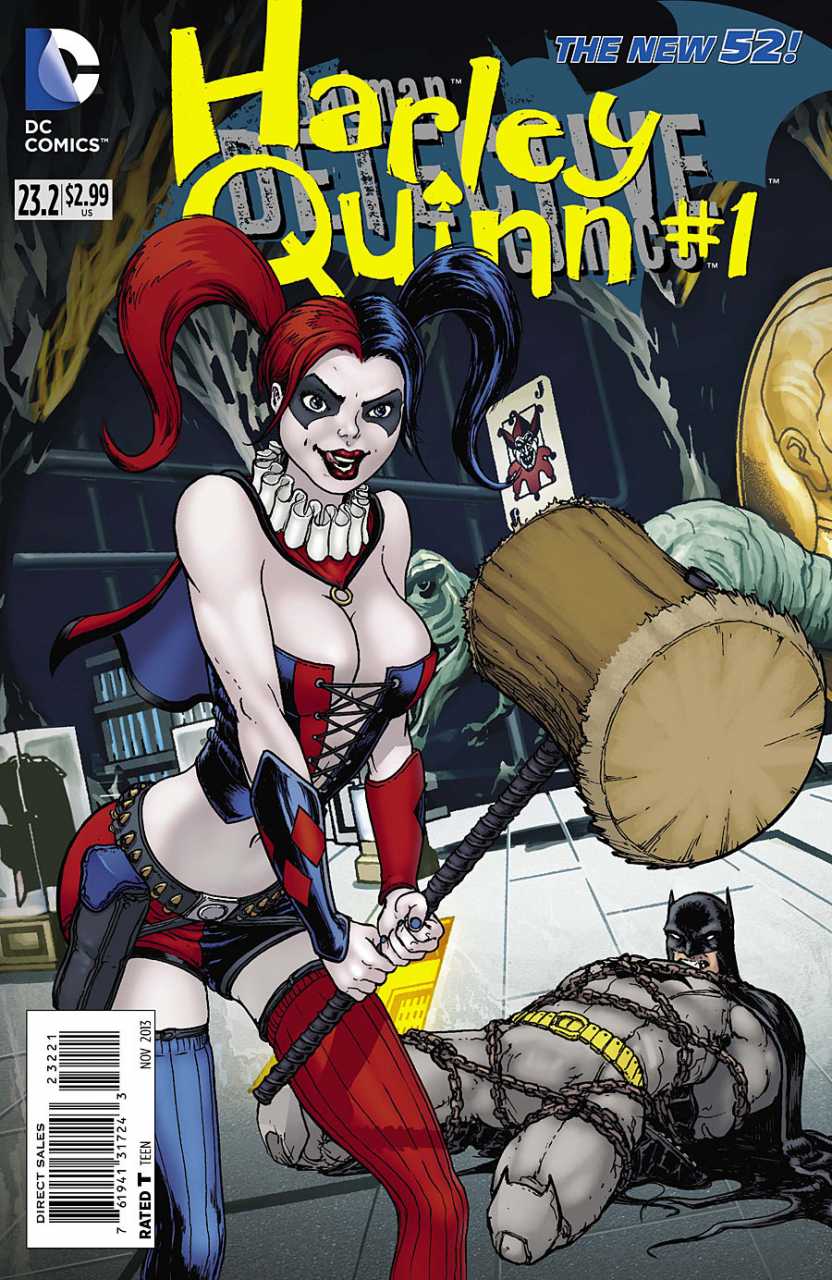
3300992-detective

So, I’ve saved the worst for last.

Oh, sure, there are plenty more DC “Villains Month” books that we could talk about, but I counted up earlier today and between this site and Geeky Universe I’ve reviewed an even 10 of these things, and that’s enough for me. After this, I’m out.

Anyhoo, in recent weeks, in case you haven’t been following the comics industry scuttlebutt, DC has come under fire for having an open submission contest for new artists. What’s so wrong with that, you ask? Why, nothing — it’s great to find new “talent” to replace the already poorly-compensated average comic book penciller, I suppose. You don’t like drawing Justice League for 80 bucks a page, no health insurance or pension, and little to no royalties per copy sold? Fine. We’ll find some new kid to take your job who’ll work for 60 bucks a page and won’t complain. It’s the American way, right?

So what’s this got to do with Harley Quinn #1, or Detective Comics #23.2, as the official record-keepers would have it? Well, the “sample page” DC wanted their next generation of potential suck — err, freelance non-contract employees to submit was a scene depicting super-villain Harley Quinn, best known as the Joker’s on-again/off-again girlfriend, sitting naked in a bathtub and slicing her wrists open. Sex n’ suicide — again, the American way, right?

As insanely offensive at worst, tone deaf at best as the theme for this “new talent contest” was, however, it ain’t squat compared to what Harley does in this book. This whole “villains month” fiasco has already given us a mass shooting in a hospital in the pages of Desaad #1 and a workplace mass-murder/ suicide in the pages of Solomon Grundy #1, both of which would lead one to suspect that none of the suits at DC have been following the news for the past, I dunno, decade or so, but here, writer Matt Kindt (who was also responsible for the aforementioned Solomon Grundy, and who’s capable of soooooo much better,  as his work on Dark Horse’s Mind Mgmt. series shows) has the psychotic villainess, in between flashback sequences to her pre-evil nutcase days as a psychiatrist at Gotham City’s infamous Arkham Asylum, engineer a senseless mass slaughter of innocent poor children by giving away booby-tapped video game systems at a local orphanage.  When she flicks a switch, the Nintendos or Segas or X-Boxes or whatever all go “boom!” and the kids all get killed.

And after that, she’s recruited by Deadshot to rejoin the Suicide Squad, a team of hard-luck “anti-heroes” who work for the government. You know, the very same government that should be locking her ass away in prison for life for just having killied hundreds of children for no reason whatsoever.

Artist Neil Googe does a decent enough job illustrating this senseless and thoroughly tasteless tale of depravity, but that’s just trying to stitch a silk purse out of a sow’s ear when your subject matter is this out-and-out vile. I don’t blame him for the overall tone of the book, but shit, I honestly wouldn’t care how badly I needed to eat, I’d have refused this assignment if I were in his shoes.

But hey, who knows, right? DC’s playing pretty fast and loose with continuity these days, maybe we’ll find out this whole sorry spectacle was just a delirious fever-dream that naked Harley was having while she killed herself in her tub.

“Oh, The Villainy!” TTSL Style, Take Two : “Two Face” #1


anigif_enhanced-buzz-29602-1370114330-2


Not sure what to really say about Two Face #1, or as it’s known to the more officious Batman And Robin #23.1 (even though, say it with me, “Robin’s dead again these days”), apart from the fact that it probably has the neatest of the 3-D holographic covers that have adorned any of DC’s “Villains Month” books. And since that’s the only selling point this comic  seems to have going for it, maybe I should just leave it at that and call it a day, right?

Nah. The folks behind this travesty don’t deserve to get off that easy.

And by “folks,” I should say that I mean specifically writer Peter J. Tomasi. The art by Guillem March on this one is actually pretty good — even really good for the first few pages, before settling into a “competent enough to get the job done” kind of groove. The story, though, is a complete and utter waste of time.

Figuring everybody already knows the origin  of former Gotham City D.A. turned criminal boss/mastermind Two Face, Tomasi opts to skip the detailed backstory and just waste time for twenty pages. We see Two Face flip his infamous scarred coin a lot, threaten fellow baddie Scarecrow, settle a few old scores from his days on the right side of the law, and reminisce about some past events, and that’s it. At the end he flicks his coin once again to see whether or not he’ll raise hell now that Batman’s supposedly out of the picture (“dead,” it would seem, along with the rest of the Justice League, in the limp and predictable-to-a-fault Forever Evil mega-crossover mini-series) or chill out and watch his fellow crazies do the job for him. We don’t get to see the result of the toss, and it doesn’t really matter because, well — the rest of the book didn’t, either. Tomasi has taken a page from Seinfeld, it would seem, and given us a comic where more or less nothing actually happens.

I dunno, I’ve felt generally ripped off, snookered, and otherwise suckered by more or less every one of these “Villains Month” issues, but this one might take the cake in terms of being the most overtly pointless of the entire rancid bunch. Which is kind of shame when you stop and think about it because Two Face, as a character, is (or at least was, prior to this whole “New 52” thing) at least a somewhat interesting and compelling figure, and he probably still could be. But he’s not here. Shit, Tomasi doesn’t even put in enough effort to make him actively dull in this book, he’s just sorta — there.

But your four bucks won’t be if you’re foolish enough (as I was) to buy this rag.

“Oh, The Villainy!” TTSL Style, Take One : “Joker” #1


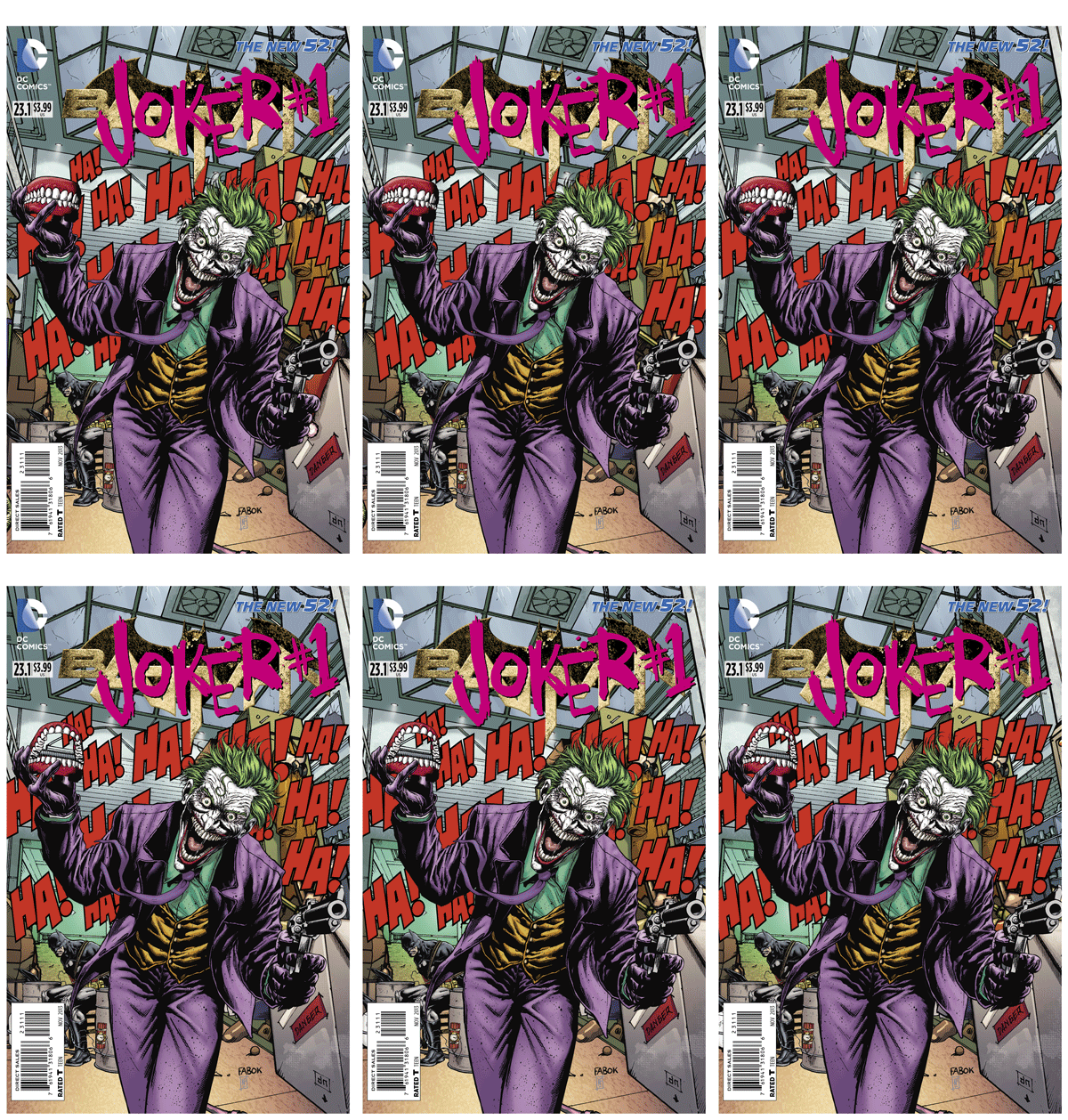
034.DCC_.JokerFC.1.0

Okay, first things first — for those of you (assuming there are any) who have been wondering wondering just where the hell I’ve been hiding the last couple of months, rest assured, I’ve been writing as much as ever — maybe even moreso. Just not about movies. And just not here. Which may come as a relief, I’ll bet, to some. But for those among you who just have  to have an explanation —

I’m currently in the midst of two comics-related series over at http://www.geekyuniverse.com, which I’ve been — ahem! — “re-presenting” over on my own “main” site — http://trashfilmguru.wordpress.com — as well. One, entitled “Just Pay Ditko!” is an exploration of the questionable (at best) ethics of the current comic reprint craze that’s seeing the works of some of the industry’s greatest talents packaged in high-quality, expensive hardcovers — with no compensation being directed toward the artists and writers whose work is contained in these hefty tomes. As you might gather from the title,  I’m paying special attention to this unfolding dilemma as it relates to Spider-Man and Doctor Strange’s real creator, visionary artist Steve Ditko, but the scope of the articles has expanded somewhat to include other creators, as well as other creator’s-rights-related issues. I can’t imagine the average Through The Shattered Lens reader would find all this terribly interesting, but for those of you who want a glimpse into comics’ sorry ethical and legal practices, you may want to hop on over to GU and take a look — right now I’m up to part 12 in the series and will probably be looking to wrap it up somewhere around part 15  or 16 in the next few weeks.

The other ongoing “concern” I’m immersed in, however, might be of at least slightly more concern to you good folks here, though, and that is my continuing evisceration of DC’s uniformly sorry and uninspired/uninspiring “Villains Month” books. For those (blissfully, I might add) not in the know about this, throughout the month of September the House That Superman (or, more accurately, Siegel and Shuster) Built is turning all their regular monthly titles over to the bad guys, and throwing flashy 3-D holographic covers on each of the issues (at an extra buck a pop) , to boot. Quite clearly this is nothing but a cheap publicity stunt to gin up sales in the short term, but then so is everything that DC and Marvel does these days. As you’d expect, this being the current “New 52” take on these characters, the results are pretty dire. But given that I’ve droned on about these books for a few weeks already over at GU and that’s I’m an equal-opportunity kind of guy who wishes to spread the miser— err, wealth — around a bit, I thought I’d save my last few entries in this series for the readers here at TTSL and give you all a little taste of what you’ve been missing if you’ve wisely chosen to ignore these comics.

And so, without any further ado, let’s take a look at Joker #1 — or, as it’s officially numbered, Batman #23.1 — shall we?

In short, despite having better art, courtesy of Andy Clarke, than most of those other “Villains Month” quick-cash-grabs, this book still pretty well sucks, and that’s entirely down to the lame script by Andy Kubert, who’s turning out to be nowhere near the writer-artist his legendary father, Joe, was.

Kubert starts off with some possible flashbacks to the Joker’s origins — never a good idea for anyone to tackle unless their name is Alan Moore — then segues into, I guess, the present day, wherein the Clown Prince Of Crime decides to expand his inner circle by liberating a gorilla from the Gotham City Zoo, naming the hapless creature Jackanapes, and raising it as his own, well, child, I guess.

Oh, sure, it’ll all end in tears, but the limp nods Kubert makes toward Grant Morrison-era Doom Patrol-style surrealism are so ham-fisted and ill-considered that it makes for a downright excruciating read even if Clarke’s pencils and inks are generally pretty pleasing to the eye. For a “special” issue, the whole thing has the feel of a good, old-fashioned “inventory” story that’s been sitting on the shelf, unpublished (for good reason) for a couple of years. It’s all over as quickly as it is predictably, which is probably its’  one saving grace (at least only five minutes of your life will be wasted on it), but at the end of the day all you really are for your $3.99 investment is, well, a little bit more broke.  You already knew the Joker was crazy, you already knew that he has a habit of making irrational decisions, and you already knew he was capable of acting utterly without conscience. Giving him a pet ape doesn’t change any of that, nor does it do much to “shed new light” on his character, motivations, you name it.

I think it’s safe to assume that you get the picture here, but just in case you don’t, I’ll make it real easy — avoid at all costs.

Trash Film Guru Vs. The Summer Blockbusters : “Pacific Rim”


245941id1b_PacRim_1sided_120x180_2p_400.indd

Let’s start with a life lesson here that’s completely contradictory right on its face and therefore of absolutely no value whatsoever — sometimes the simplest ideas are great, and sometimes they’re really, really dumb.It all depends on the inherent intelligence level of the person who has them.

First case in point : a retrograde, racist, trigger-happy, self-appointed “neighborhood watch captain” decides it would be a good idea to follow around a kid in his gated suburban subdivision who’s minding his own business and eating Skittles. The cops tell him to back the fuck off and stay in his car, but our low-grade Charles Bronson-wannabe thinks he knows better : he pursues the young man on foot, removes his gun from its holster, loads  some rounds in the chamber, unlatches the safety, and proceeds to generally and obviously tail him for three or four blocks. When the target of his harassment finally decides enough is enough and jumps him, a fight ensues. We’ll never definitely know who threw the first punch, but when “Mr. Tough Guy” was on the ground getting his nose bloodied by the kid’s fist, he decided he’d had enough and shot his “assailant” in the heart.

Dumb idea. I don’t care if a jury gave him a free pass for murdering the victim of his stalking or not, it’s still just not smart. Bargain-basement Bronson was reckless with his firearm, needlessly killed a kid who was, let’s face it, provoked into a confrontation, and now he has this bright, promising youngster’s blood on his conscience (assuming he has one, which is debatable) and has to sleep with one eye open for the rest of his life. Clearly, nothing good came from this guy’s very simple, and very stupid, idea.

Case in point number two : Wouldn’t it be seriously fucking cool if the Transformers fought Godzilla?

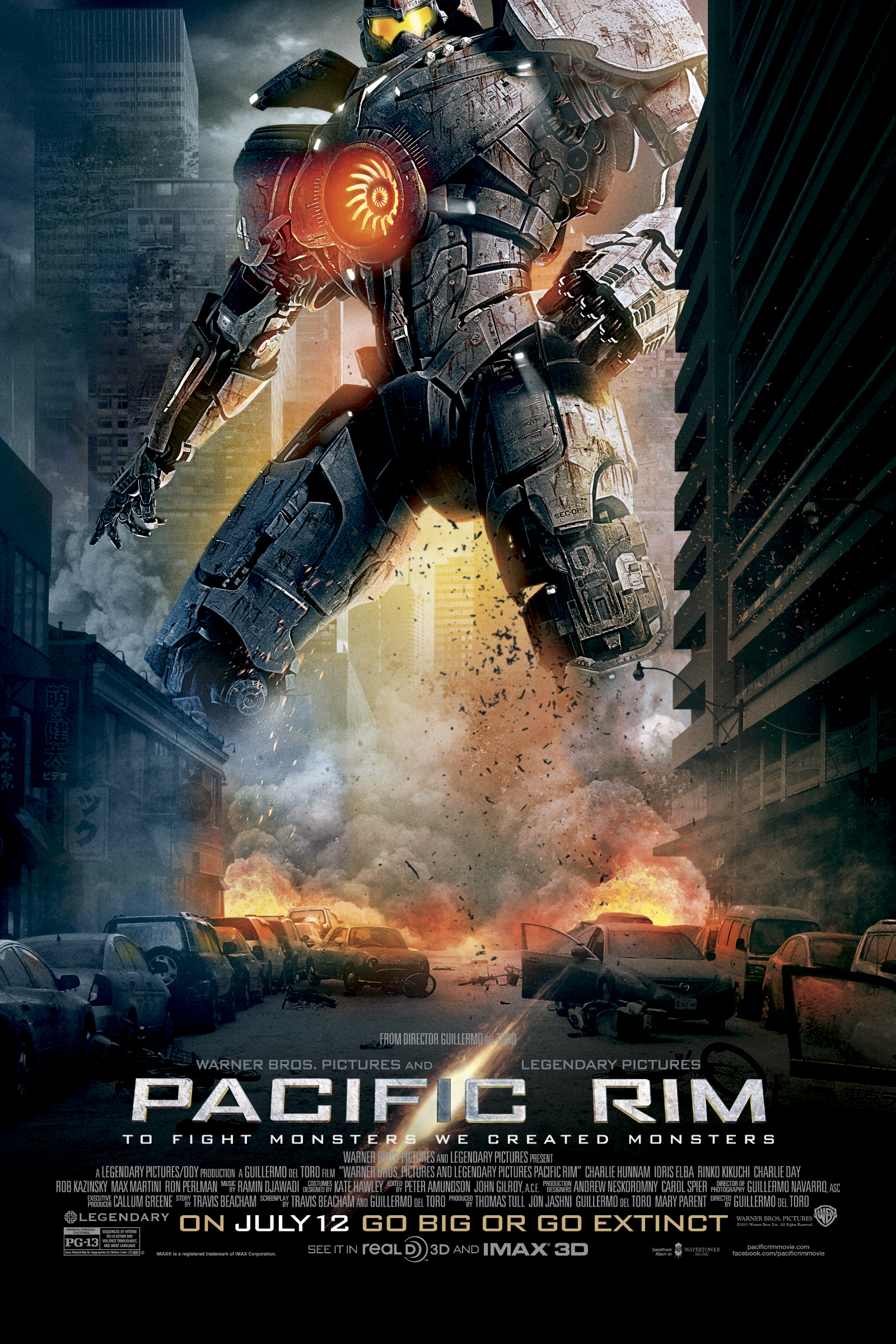
The answer to this question is as resounding as it is obvious : hell yes (as long as Michael Bay doesn’t direct it)! Thankfully, Guillermo del Toro is the guy who had this idea, and the result is Pacific Rim, easily the funnest thing to hit the silver screen this summer (even if I did just say the same thing about The Lone Ranger — this tops it, and by a wide margin).

Now, you can take exception to my admittedly over-simplified root description of this film all you want — hey, man, this is about a lot more than that : it’s about giant mentally-linked-to-human-host robots called Jaegers who battle inter-dimensional monsters from beneath the ocean floor known as Kaiju, there’s a nice little low-key love story that develops between out hero, Raleigh Beckett (Charlie Hunnam) and his co-pilot, Mako Mori (Rinko Kikuchi), it’s got Idris Elba as a stoic-but-compassionate military commander, and hey, Ron Perlman’s on board playing a mad scientist/black marketeer with the kind of relish that only he can bring to a role.

All these things are true, of course, but at the end of the day this is still a 12-year-old sci-fi geek’s wet dream realized on an enormous Hollywood budget. And that’s the best thing about it (besides maybe the awesome post-credits dedication to Ray Harryahusen and Ishiro Honda). This is del Toro letting loose his inner child for all of us to see, and that’s a pretty insipiring thing indeed, my friends.

Are there plot holes aplenty here? Sure, bigger than the monsters themselves (most notable among them being that if they know one of these nuclear Jaegers can seal up the dimenstional breach for good by blowing it to kingdom come, why did’t they try it years ago?), but never you mind that. Just sit back and allow yourself to be as thoroughly and completely wowed as is humanly possible by a movie. And when you feel a smile forming at the corners of your lips as the week goes on, don’t fight it — you really did have that much fun at the movies. It’s totally okay to feel like a giddy little kid again for awhile.

Trash Film Guru Vs. The Summer Blockbusters : “The Lone Ranger”


poster1


It all seemed like such a no-brainer, didn’t it?

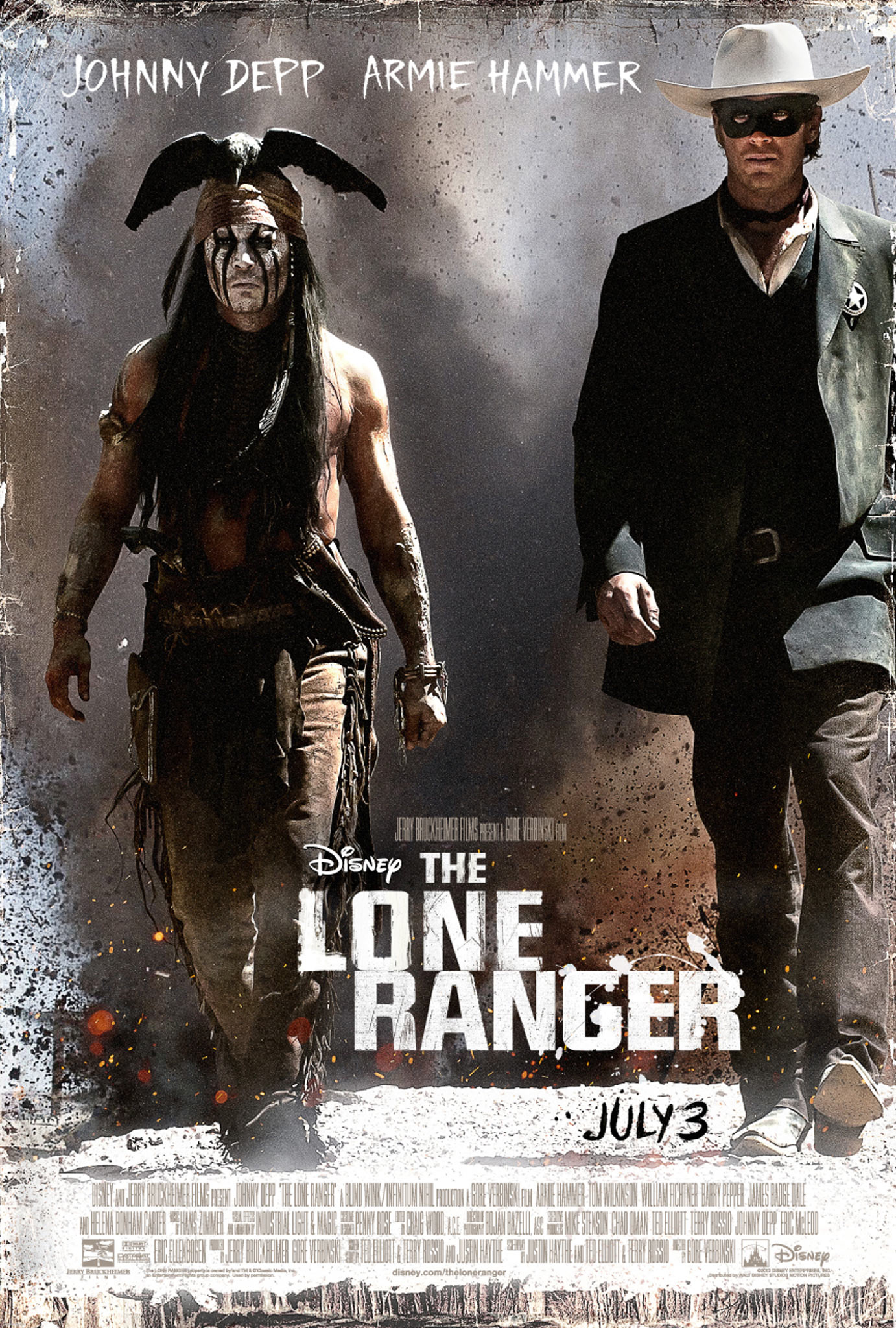
Disney snaps up the cinematic rights to the most famous Western hero of them all — one that hasn’t been “rebooted” since 1981’s disastrous Legend Of The Lone Ranger — and turns it over, naturally enough, to Jerry Bruckheimer, who “gets the band back together,” so to speak, by hiring Gore Verbinski to direct and Johnny Depp to star as Tonto. Pirates Of The Caribbean Goes West, anyone?

It goes without saying that budget wouldn’t be a concern here — special effects, production values, sets and costumes — all would be state-of-the-state-of-the-art. Turn it loose on the public over the extended July 4th holiday weekend, sit back, and collect all that cold, hard cash. What could possibly go wrong? This was fool-proof.

Except for the fact that, well, it hasn’t been. The Lone Ranger has landed at the box office with a thud — not as big a thud as it did back in ’81, but a thud nonetheless. The critics seem to despise it, and while audiences have been considerably kinder in their appraisal of the film, they haven’t been large enough for Disney to come anywhere close to recouping their considerable investment in this rapidly-unfurling boondoggle.

All of which is kind of a shame because, as with last year’s panned (but considerably more successful at the box office) Men In Black 3, I honestly can’t figure out where all the hate is coming from. Simply put, The Lone Ranger is a damn fun movie, full of exactly the kind of kick-ass, jaw-dropping CGI, solid “out for justice” storytelling, tight, pacy plotting, and charismatic acting that makes for a sure-fire crowd-pleaser. Even if the crowds aren’t proving to be all that big.

Not exactly a “revisionist” take on the legend of John Reid (confidently played by Armie Hammer), a Texas Ranger who, when his life is turned tragically upside-down, dons a mask and adopts a new persona. this flick nevertheless provides a different spin on things by telling the tale from the point of view of an older, wiser, and maybe even somewhat broken-down Tonto (Johnny Depp in, quite honestly, one of the finest performances of his career), who earlier in life threw his lot in with Reid to bring to justice the source of all our hero’s troubles, renegade quasi-militia leader Butch Cavendish (William Fichtner, who makes for a terrific bad guy) and ,more generally, to put a stop to all the various shenanigans this good-for-nothing had a hand in.

If this sounds like your idea of a simple-minded, non-stop thrill ride full of all the excitement, adventure, humor, and yes, even human drama that you want in summertime popcorn fare, rest assured — it is. Good supporting turns from the likes of Helena Bonham Carter, Tom Wilkinson, and Ruth Wilson don’t hurt matters any, either.

Yeah, there are some gaping plot holes large enough for an entire herd of cattle to stampede through, but has that stopped folks from liking, say, World War Z or Man Of Steel, both of which are at least as guilty of counting on you to put your suspension of disbelief completely on hold for a couple of hours? If you can do it for them, surely you can do it for this, right?

Look, I won’t kid you — some small, petty, vengeful little corner of my dark and twisted soul is always happy to see a mega-budget Disney project end up costing the studio untold millions in losses. They’re bastards and they deserve it. But truth be told, if you join the legions of people who have already evidently decided to take a pass on The Lone Ranger, you’re not hurting the evil empire much — they’ve already got Monsters University to more than compensate for any bite this takes from their corporate balance sheet. The only thing you’re really doing by skipping it, then,  is robbing yourself of a good time.

It’s summer! Get out there and have some fun — by sitting on your ass in a cool, air-conditioned mega-plex and catching what’s most likely the best action-adventure film of the year so far.