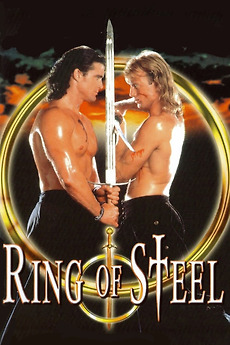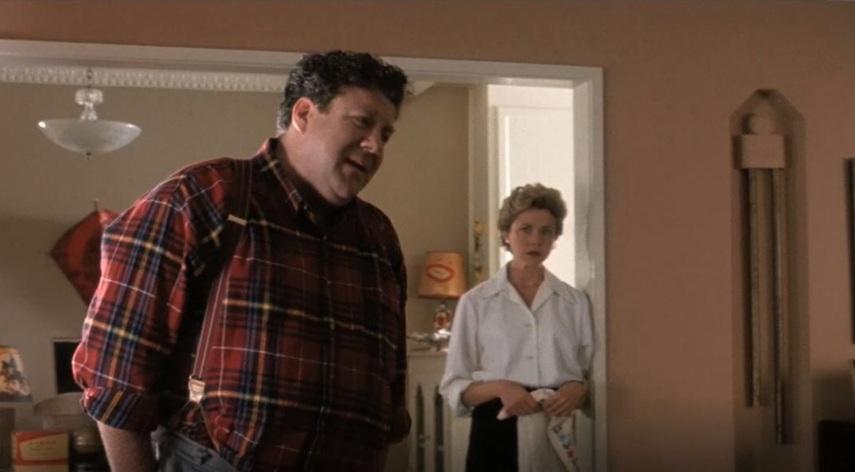
Ring of Steel (1994, directed by David Frost)


After Olympics-bound fencer Alex Freyer (Robert Chapin) accidentally kills his opponent, he is blacklisted from the sport.  His career seems like it’s over until he’s saved from a mugging by the mysterious Man In Black (Joe Don Baker).  The Man In Black says that he’s been watching Alex and he knows that Alex could be “the best.”  The Man In Black isn’t talking about the Olympics, though.  He’s talking about taking part in a series of underground sword fights, know as the Ring of Steel.  Alex is all for it, until he learns how high the stakes actually are.  The Man In Black is determined to keep Alex fighting so he abducts Alex’s girlfriend (Darlene Vogel).

This is one of the many “underground fighting films” that were made in the 90s.  The plot is nothing special but the use of swords instead of fists does add an unexpected spark to the fight scenes.  Robert Chapin, who also came up with the film’s story (and who wrote an original draft of the screenplay that was considerably darker than the film that was eventually made), was a stuntman and an accomplished swordfighter so the fights in Ring of Steel feel authentic and are exciting even if the story is predictable.  Joe Don Baker plays the villain, a character who actually is credited as being “The Man In Black,” and he does a good job tempting Alex to the dark side and then mocking his attempts to escape.  Though I prefer Baker as a hero, he always really threw himself into his villainous roles.

Ring of Steel used to show up on cable when I was a kid.  I always made a point to watch it.  It’s on YouTube now and it’s still an entertaining fight film.

Felony (1994, directed by David A. Prior)


In New Orleans, a drug raid gone wrong leads to eleven cops being gunned down and then blown up.  The disastrous raid was being filmed for a Cops-like reality show  The show’s producer, Bill Knight (Jeffrey Combs) finds himself being pursued through New Orleans by a collection of rogue intelligence agents, cops, and gangsters, all of whom want the tape of the massacre.

It’s a simple direct-to-video premise and the film’s plot hits every chase film cliche, while keeping the action moving at a decent pace.  Bill Knight is not supposed to be a typical action hero.  He’s just a television producer who was in the wrong place at the wrong time.  Yet Knight proves himself to be as indestructible as any Arnold Schwarzenegger hero.  He gets shot, twice.  He falls from a great height.  He crashes through a window.  He repeatedly gets hit over the head.  And yet, his injuries never seem to really slow him down or even hurt that much.  He does hook up with a nurse (Ashley Laurence) but still, it’s hard to believe anyone could take that much punishment and keep running.  Jeffrey Combs, the brilliant star of films like Re-Animator, is miscast as Knight but he’s still always entertaining to watch.

In fact, the cast is the main thing that Felony has going for it.  David Prior was able to assemble a true group of B-movie all-stars.  Lance Henriksen and David Warner are the evil intelligence agents who are determined to kill Knight.  (Warner finally gets to handle a grenade launcher and we’re all the better for it.)  Leo Rossi and Charles Napier are the two New Orleans cops who are investigating the drug raid.  Joe Don Baker is the rogue intelligence agent who dresses like a cowboy and who is trying to clean up everyone else’s mess.  The cast keeps the action moving and there are enough eccentric personalities in this film that it’s always watchable.  I think this might be the only film to feature Joe Don Baker and Lance Henriksen performing opposite each other.  If nothing else, it deserves to be watched for that!

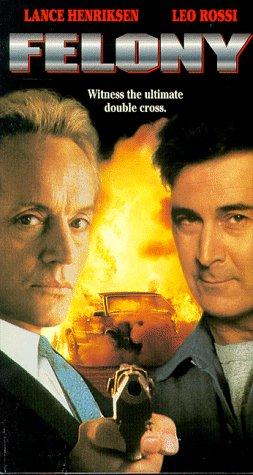
(The cover for Felony features Lance Henriksen and Leo Rossi but not Jeffrey Combs, even though Combs is the lead in the film and Rossi’s role is actually pretty small.  Henriksen also doesn’t have blonde hair in the movie.  There are plenty of double crosses in the movie but I can’t think of any that really qualify as the “ultimate double cross.”)

Even with its miscast lead and its cliche-heavy plot, Felony is what direct-to-video action movies should be all about, fact-paced action and a cast unlike any other,


RIP, George Wendt: Guilty By Suspicion (1991, directed by Irwin Winkler)


George Wendt passed away in his sleep earlier today.  He was 76 years old.

If you’re old enough to have watched Cheers when it originally aired or to have caught it in reruns, George Wendt will always be Norm Peterson, the beer-drinking accountant who spent all of his time at the show’s titular bar.  One of the show’s trademarks was that, whenever he entered the bar, everyone greeted him by shouting, “Norm!”  “How’s the world treating you?” a bartender would ask.  “It’s a dog eat world and I’m wearing milkbone underwear,” Norm once replied.

(One of my favorite joke from the series was when Norm went into a steakhouse and everyone inside was heard to yell, “Norm!” as the door closed behind him.)

If we’re going to be really honest, Norm was probably a high-functioning alcoholic and terrible husband.  (Wife Vera was often-mentioned but never seen.)  Wendt was so likable in the role and was so good at delivering those one-liners that it didn’t matter.  Watching the show, you never wondered why Norm was in the bar.  You were just glad he was.
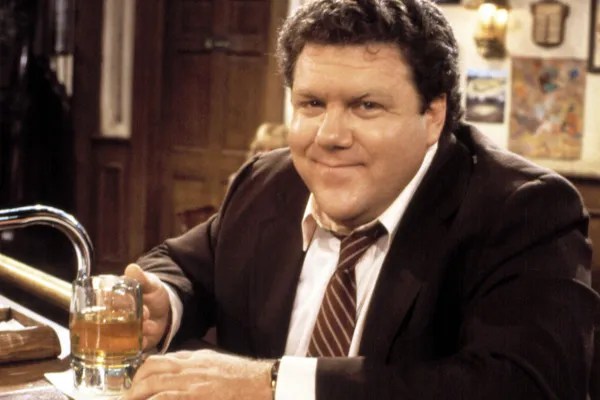
George Wendt was also an accomplished stage actor.  (I saw him on stage when he was co-starring with Richard Thomas in 12 Angry Men.)  He appeared in several movies, usually playing the comedic sidekick or the hero’s best friend.  His film roles often didn’t ask him to do much other than be likable but one exception was his performance in 1991’s Guilty By Suspicion.

Guilty By Suspicion is a film about the McCarthy era, starring Robert De Niro as film director David Merrill, who is threatened with being blacklisted unless he names four of his colleagues as being communists.  George Wendt plays screenwriter Bunny Baxter, a childhood friend of David’s who attended a few communist rallies when he was younger, failed to mention it to the FBI, and who is now being investigated as a subversive.  The studio argues that David should name Baxter because his name is already out there.  When David refuses, he finds himself blacklisted and unable to make a living.  Bunny Baxter, meanwhile, is offered a similar deal.  Baxter can save his own career but only if he names David as a communist.  Unlike David, Baxter considers betraying his friend because it’s the only way that he can ever hope to work again.  “Your dead anyway,” Baxter says to David.

Guilty By Suspicion suffers from Irwin Winkler’s plodding direction but De Niro gives a good performance, as does Martin Scorsese who is cast as a director based on Joseph Losey.  The film is full of actors who would later become better-known, like Chris Cooper, Tom Sizemore, and Annette Bening.  Wendt, however, gives the film’s best performance as the screenwriter who is torn between protecting his career and maintaining his integrity.  The scene where he asks permission to name Merrill as a communist is powerful and it shows how good an actor George Wendt could be.  Bunny Baxter is asking his best friend to allow himself to be stabbed in the back.  Baxter is that desperate.  That he’s played by George Wendt, an actor who was everyone’s favorite likable barfly in the 80s, makes the scene all the more powerful.

George Wendt, RIP.  Thanks for the memories.
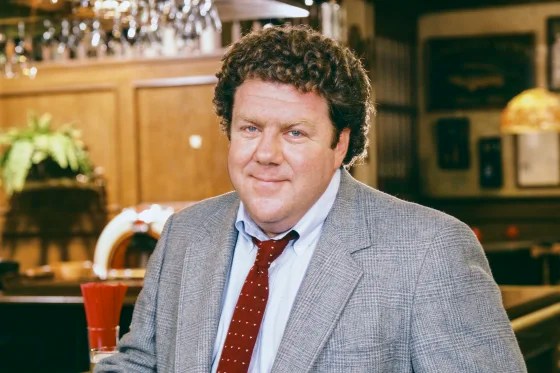
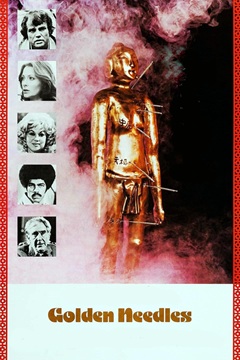
Golden Needles (1974, directed by Robert Clouse)


An ancient Chinese statue contains several acupuncture needles that, when placed correctly, can grant a man unstoppable vim and vigor.  It can also grant amazing sexual prowess, which is why every elderly crime boss in the world wants it.  In Hong Kong, a group of flamethrower-toting thugs steal the statue so that their boss, Lin Tao (Roy Chiao), can sell the statue to a Los Angeles mobster named Winters (Burgess Meredith!).  Winters’s agent in Hong Kong, Felicity (Elizabeth Ashley), decides to hire Vietnam vet Dan Mason (Joe Don Baker) to steal the statue from her so that she can not only take Winters’s money but also sell the statue herself.  Mason agrees, in return for money and sex.

Eventually, the action does move from Hong Kong to Los Angeles.  That allows Jim Kelly to make an appearance as Jeff, a buddy of Mason’s who helps him look for the statue and who takes part in one lousy fight scene.  It’s really a glorified cameo.  Robert Clouse previous directed Enter The Dragon, in which Kelly played the member of the heroic trio who didn’t survive.  There are actually a handful of Enter the Dragon cast members scattered throughout Golden Needles but, unfortunately, Bruce Lee was dead and John Saxon was apparently unavailable.

There are a few good action sequences in this film, though if you’re hoping to see Joe Don Baker lay down some sweet kung fu moves, you’re going to be disappointed.  Baker’s character throws people through windows but there’s not much finesse in his fighting style.  I still appreciated Baker’s performance in Golden Needles.  Clouse makes good use of Baker’s lumbering form, showing how out of place he is in Hong Kong.  Baker and Elizabeth Ashley make a good team and Burgess Meredith gives a performance that’s only slightly less subtle than his turn as the Penguin on Batman.  The film’s PG-rating keeps the violence from getting too extreme but it also probably made Golden Needles perfect for a Saturday matinee.

Golden Needles is an enjoyable oddity.  See it if you’re a Joe Don Baker fan.

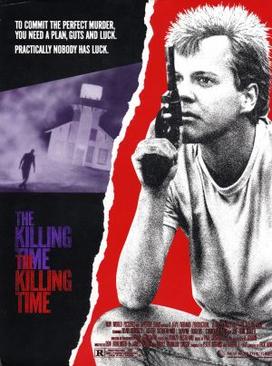
The Killing Time (1987, directed by Rick King)


After she is raped and beaten by her husband, Jake (Wayne Rogers), Laura Winslow (Camelia Kath) and her lover, Deputy Sam Wayburn (Beau Bridges), plot to murder him.  Sam and Laura come up with a plan to shoot Jake and frame another deputy, the recently hired Brian Mars (Kiefer Sutherland), for the crime.  What Sam doesn’t know is that Brian isn’t Brian.  Instead, “Brian” killed the real deputy and stole his identity.  Fake Brian has his own reasons for wanting to kill Jake but he also doesn’t appreciate Sam and Laura trying to set him up.

This is a typical 80s neo-noir, with an interesting premise that is sabotaged by subpar execution.  A big problem is with the casting.  Beau Bridges, whose stock-in-trade has always been a natural human decency, is miscast as a deputy who would conspire to not only murder someone but also frame an innocent man.  Camelia Kath doesn’t have the style necessary to be a compelling femme fatale.  Sutherland is good when he’s playing a psychopath but he’s less convincing when he has to pretend to be Brian.  It’s hard to believe that Sutherland’s obviously unstable killer would be able to fool anyone.

Instead, the film is stolen by Joe Don Baker and Wayne Rogers.  Joe Don Baker plays the sheriff who gives up his retirement plans so that he can solve the biggest crime that’s ever been committed in his jurisdiction,  Baker’s role isn’t huge but he still gives one of the better performances in the film.  If anyone was born to play a small-town sheriff, it was Joe Don Baker.  Meanwhile, Rogers is very much cast against type as the evil Jake but the film uses Rogers’s good guy persona to its advantage.

The other big problem is that, other than Baker’s sheriff, there’s no one likeable to be found in this movie.  The movie tries to generate sympathy for Sam but once you decide to frame an “innocent” man for murder, it’s impossible to then go back to being a sympathetic character.  Brian may be a killer but Sam didn’t know that when he and Laura decided to frame him for killing Jake.

Movies like this used to be a HBO mainstay.  Even though the movies themselves often weren’t that good, I still miss those days.


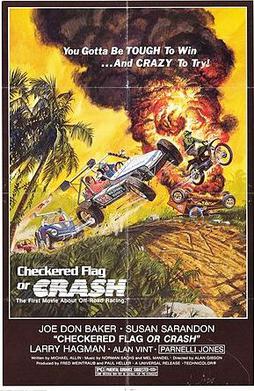
Checkered Flag or Crash (1977, directed by Alan Gibson)


Joe Don Baker stars at “Walkaway” Madden, a race car driver who got that name because he has always managed to walk away from every crash.  When Madden agrees to compete in an off-road race through the Philippines, he is not happy to discover that his sponsor has arranged for a female journalist named C.C. Wainwright (Susan Sarandon) to accompany him and record his adventures.  Walkaway’s a good ol’ boy and C.C.’s an independent woman but wouldn’t you know it, they’re in love by the end of the race.

This has one of the most simple plots that I’ve ever seen.  Madden and C.C. race through the jungle and there’s never really any doubt about how the race is going to end because all of the other drivers are terrible, except for Madden’s former partner, Doc Pyle (Alan Vint).  A manic Larry Hagman plays Bo Cochran, the promoter who put the race together, and gets the majority of the film’s laughs.  When I watched this movie, I thought it had been made to capitalize on the success of Smokey and the Bandit but then I saw that Checkered Flag actually came out a few months before Burt Reynolds and Jackie Gleason hit the drive-in circuit.  The young Susan Sarandon is a lively presence and she has a surprising amount of chemistry with Joe Don Baker, ideally cast here as a good ol’ boy who likes to drive fast.  The movie doesn’t hold many surprises but the game cast keeps it watchable.

Director Alan Gibson was a Canadian filmmaker who had previously worked for Hammer films, directing the last of their Dracula films before he eventually found himself in the Philippines, working with Larry Hagman, Susan Sarandon, and Joe Don Baker.

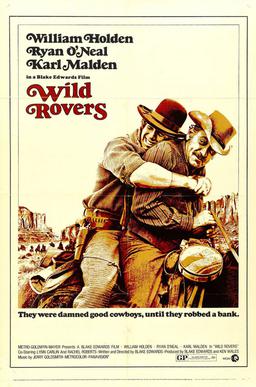
Wild Rovers (1971, directed by Blake Edwards)


In Montana, Walter Buckman (Karl Malden) runs his ranch with an iron hand, warning his neighbor, Hansen (Sam Gilman) not to even think of allowing his sheep to graze on his land.  Walter has two sons, hot-headed John (Tom Skerritt) and the laid back and good-natured Paul (Joe Don Baker).  When Walter learns that two of his ranch hands — aging Ross Bodine (William Holden) and young Frank Post (Ryan O’Neal) — have robbed a bank and are heading down to Mexico, he sends John and Paul to bring them back.  Walter is a big believer in the law and he’s not going to allow any of his people to get away with breaking it.

Ross is a veteran cowboy, who only robbed the bank after Walter withheld his pay to cover the damage of a saloon fight between Ross and Hansen’s men.  Frank is the wilder of the two.  He looks up to Ross and Ross is protective of Frank, even if he has a hard time admitting it.  Ross and Frank are heading down to Mexico so Ross can retire in peace.  Instead of going straight to Mexico, though, they make the mistake of stopping by a small town so Frank can play a little poker and visit the town’s brothel.

Wild Rovers was Blake Edwards’s attempt to make an epic, revisionist western and he includes plenty of shots of the sun setting over the mountains as well as several violent shoot-outs that are shot in Peckinpah-style slow motion.  Unfortunately, the story itself isn’t really strong enough to support Edwards’s ambitions and all of the shots of the countryside, while nice to look at, don’t really add up too much.  Wild Rovers was also a troubled production, with MGM slashing Edwards’s original three-hour film down to 106 minutes and advertising it with a poster featuring O’Neal hugging Edwards from behind, making the film look like a buddy comedy in the style of Butch Cassidy and the Sundance Kid (or an early version of Brokeback Mountain) as opposed to a violent and elegiac western.  (In 1986, a director’s cut was released, which ran for 136 minutes.)  If you only know Blake Edwards from his Pink Panther movies, the grim and tragedy-filled Wild Rovers will come as a surprise.

One thing that Wild Rovers does have going for it is a good cast.  William Holden and an energetic Ryan O’Neal are a solid team and Karl Malden, Tom Skerritt, Rachel Roberts, James Olson, and Moses Gunn all give good performances too.  This movie also provides Joe Don Baker with a sympathetic role and he’s very likable as the laid back Paul Buckman.  It’s not the type of role that Baker often got to play and it’s obvious that a lot of scenes between John and Paul were cut from the film but, in the truncated version, Joe Don Baker’s Paul Buckman becomes the moral center of the film’s story.

Wild Rovers was a disappointment at the box office, one of many that Edwards suffered in the 70s before he and Peter Sellers brought back Inspector Clouseau.

Duel In The Sun (1946, directed by King Vidor)


After her father is executed for killing her mother and her mother’s lover, “half-breed” Pearl Chavez (Jennifer Jones) is sent to live with her father’s second cousin, Laura Beth McCanles (Lillian Gish).  Laura is the wife of rancher, politician, and all-around racist Senator Jackson McCanles (Lionel Barrymore).  Worried that Pearl’s beauty and uninhibited manner will get her into trouble, Laura arranges for Pearl to meet with a minister known as The Sinkller (Walter Huston) who instructs Pearl on how to be a “good” girl.

Wanting to make Pearl bad and his, Lewton “Lewt” McCanles (Gregory Peck) becomes obsessed with Pearl and is soon forcing himself on her on a regular basis.  When the good McCanles brother, Jesse (Joseph Cotten), leaves the ranch despite being in love with Pearl, Pearl tries to find a good husband in the form of Sam Pierce (Charles Bickford).  Lewt responds by gunning Sam down and then goes on the run.  It all leads to an overwrought duel in the sun as the two doomed lovers take aim at each other.

Duel In The Sun is credited to veteran director King Vidor and there are a few shots of the western landscape that do feel typical of Vidor’s work.  However, Duel In The Sun’s true auteur was its producer, David O. Selznick.  Still looking to recapture his earlier success with Gone With The Wind and eager to make his future wife, Jennifer Jones, into an even bigger star than she was, Selznick obsessed over every detail of Duel In The Sun, pushing Vidor and a host of other directors (including Josef von Sternberg, William Dieterle, William Cameron Menzies, Otto Brower, and Sidney Franklin)  to make the film more steamy, more melodramatic, more violent, and more visually epic.  Reportedly, while Video was trying to shoot the film’s titular duel, he had to call cut several times when Selznick ran into the scene with a water bottle to spray more “sweat” onto Jones and Peck.  Today, the stiff Peck seems miscast as the black sheep of the family, the reserved Jones is even more miscast as a mestiza, and the plot is clearly too simplistic to carry the film’s epic ambitions.  A few impressive shots aside, Duel In The Sun is just boring,  In the 40s, though, the film’s relative openness about sex generated enough controversy to make Duel In The Sun into a box office hit.  It was one of the two top-grossing westerns of the 40s, beating out Red River, My Darling Clementine, Fort Apache, The Ox-Bow Incident, and several other films that were actually good.

Unlike Jones, Peck, and even usually reliable stalwart like Lionel Barrymore and Walter Huston, Joseph Cotten at least emerges from this film with his dignity intact.  Playing the good brother, Cotten gets to underplay while everyone else is overplaying and it turns out to be the right approach for him.  Surviving Duel In The Sun was no easy feat but Cotten pulled it off.

Scenes That I Love: Joseph Cotten In The Third Man


Imagine being Holly Martins.  You’re in Vienna, investigating the death of your best friend, getting chased by an angry mob and threatened by British intelligence, and suddenly you’re reminded that you, an author of dime-store novels, agreed to give a lecture on post-war literature.

That’s what happens in this scene that I love (featuring Joseph Cotten as Holly Martins) from The Third Man.

4 Shots From 4 Films: Special Joseph Cotten Edition


The Third Man (1949, directed by Carol Reed)

4 Shots From 4 Films is just what it says it is, 4 shots from 4 of our favorite films. As opposed to the reviews and recaps that we usually post, 4 Shots From 4 Films lets the visuals do the talking!

As you can probably guess from my pen name and my profile pic, Joseph Cotten is one of my favorite actors.  Cotten may be best known for his association with Orson Welles but he worked with several great directors over the years.  Along with playing Jedediah Leland in Welles’s Citizen Kane, he starred in Hitchcock’s Shadow of a Doubt and Carol Reed’s The Third Man.  Even while his film career was flourishing, Cotten continued to appear on the Broadway stage and, during the early days of television, he frequently appeared on anthology series, the majority of which were broadcast live.

In honor of Cotten’s birthday, here are four shots from four of his best films.

4 Shots From 4 Films

The Magnificent Ambersons (1942, directed by Orson Welles)

Shadow of a Doubt (1943, directed by Alfred Hitchcock)

Portrait of Jennie (1948, directed by William Dieterle)

The Third Man (1949, directed by Carol Reed)