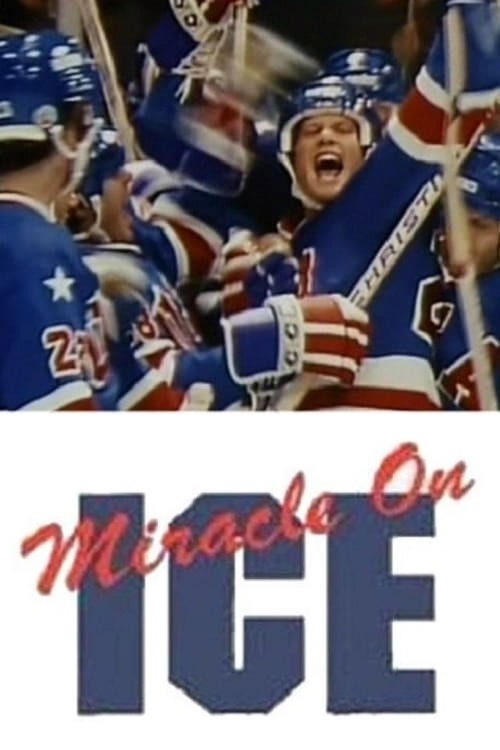
Miracle On Ice (1981, directed by Steven Hilliard Stern)


On February 22nd, 1980, the U.S. Olympic Hockey team pulled off one of the greatest upsets in sports history when they defeated the Soviet team during the Winter Olympics.  At a time when America was struggling under Jimmy Carter and the Soviet Union appeared to be winning the propaganda war, a group of unheralded college students brought the U.S. together in celebration as they defeated the Soviets and then went on to defeat Finland for the gold medal.

Everyone knows that the Miracle On Ice, as it was called, served as the basis of the Disney film Miracle, with Kurt Russell playing coach Herb Brooks.  What is now forgotten is that the story was first recreated in 1981, with a made-for-tv movie called Miracle On Ice.  Who played Herb Brooks in that movie?

Karl Malden.

Keep in mind, Herb Brooks was 42 years-old when the U.S. team defeated the Soviets and he was a former player himself.  Malden was 69 when he starred in Miracle On Ice and didn’t look like he had ever worn skates in his life.  Malden is convincingly grumpy and hard-nosed as Brooks but he’s still very miscast and the movie misses the point that one of the reasons why Brooks could coach the young American team was because he was still relatively young himself.  The actors playing the members of the team are better cast, with Andrew Stevens playing team leader Mike Eruzione and Steve Guttenberg cast as goalie Jim Craig.  A lot of time is devoted to Craig’s financial difficulties and his fear that remaining an amateur for the Olympics, instead of going pro, will continue to make life difficult for his family.  On the one hand, it is messed up that the U.S., at the time, did not allow its Olympians to turn professional.  On the other hand, the fact all of the players were considered to be “amateurs’ made their victory over the Soviets all the more special.

It takes a while for Miracle on Ice to get to the main event.  There’s a lot of scenes of Brooks dealing with everyone’s skepticism and Eurozione trying to keep the players from giving up in the face of the Soviet Union’s previous domination of the game.  Once the movie does finally reach the Winter Olympics, it relies on actual footage from the game, which is actually pretty cool.  Watching the real footage, you can still feel the growing excitement in both the stadium and the broadcast booth as people started to realize that the American team was going to pull it off and defeat the Soviets.  It’s impossible not to be inspired by the Soviet Union getting humiliated by a bunch of American college players.  The Soviets may have had the performance enhancing drugs but the Americans had the spirit!

Of the two films about America’s victory, Miracle is definitely the one to see but Miracle On Ice still pays tribute to a great moment.

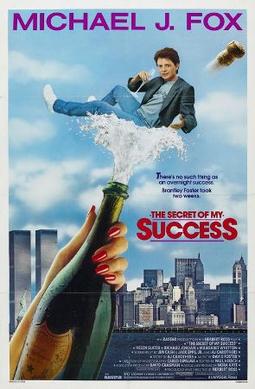
The Secret of My Success (1987, directed by Herbert Ross)


ȋ‚˜é

Brantley Foster (Michael J. Fox) heads to New York City with his business degree from the University of Kansas and the promise of an entry-level job as a financier.  He arrives to discover that the company that hired him no longer exists and that Brantley is out of a job.  New York is a harsh town for someone who is down on his luck and all of out of money.  Brantley eventually gets a job working in the mail room of a company owned by his wealthy uncle (Richard Jordan).  His uncle doesn’t even know who he is but soon, Brantley becomes just as rich and successful as he always dreamed.

What’s the secret of Brantley’s success?

Screwing his Aunt Vera (played by Margaret Whitton).

What’s the other other secret of his success?

Pretending to be named Carlton Whitfield and claiming that he’s a new executive at the corporation.

I remember when Kramer did the same thing on Seinfeld.  It didn’t work out for Kramer.  He got fired after turning in his first report.

“This is gibberish,” his boss said, “It’s almost as if you have no business training at all.  I’m afraid we have to let you go.”

“I don’t actually work here,” Kramer replied.

“That’s what makes this so hard.”

Seinfeld, never topped.

Back to The Secret of My Success, this is the most 80s film ever made, complete with montages of Brantley exploring New York and a saxophone playing on the soundtrack.  Brantley’s all about TCB, taking care of business.  He screws his aunt but falls in love with Christy Wills (Helen Slater).  Brantley doesn’t learn anything but he gets the best office and becomes a success without actually doing any real work.  It’s the ultimate fantasy and, like many fantasies, The Secret of My Success is superficially appealing.  Michael J. Fox is likable as Brantley.  Margaret Whitton is outrageously sexy as Vera.  Helen Slater is pretty and boring, traits that made her the ideal “good” girlfriend for Brantley’s story.

The Secret of My Success is your ticket to the 80s.

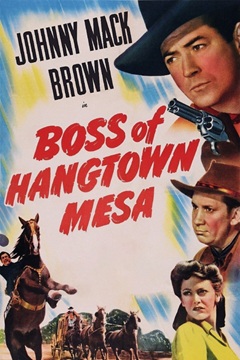
Boss of Hangtown Mesa (1942, directed by Joseph H. Lewis)


The telegraph company has come to the frontier town of Hangtown Mesa and soon, the citizens will be connected to the rest of the world.  The wealthy men who run the town don’t want that to happen because then people might discover how corrupt they are.  They hire a gunman known as the Utah Kid (Hugh Prosser, not looking much like a kid) to come to town and kill the owner of the telegraph line, John Wilkins (Henry Hall).  The Utah Kid steals the clothes of engineer Steve Collins (Johnny Mack Brown) and frames him for Wilkins’s murder.  With the help Betty Wilkins (Helen Deverell) and traveling medicine man Dr. J. Willington Dingle (Fuzzy Knight), Steve sets out to clear his name.

This is a pretty good Johnny Mack Brown western.  The plot isn’t half-bad as far as Poverty Row westerns are concerned and director Joseph H. Lewis keeps things lively.  Lewis not only gets good performances from his cast but he also makes Hangtown Mesa seem like an actual, growing frontier town.  Lewis even manages to create some suspense as The Utah Kid and Steve Collins switch identities.  Comparing Lewis’s westerns to the ones directed by Sam Newfield shows how much difference a good director can make, even within the confines of a poverty row production.  Even Fuzzy Knight is used well!

Boss of Hangtown Mesa is one of the better Johnny Mack Brown westerns, featuring a good story and an interesting idea behind it as it shows how far the bad guys will go to keep their own private fiefdom from connecting with the rest of the world.  Brown is convincing, whether he’s riding a horse or holding a gun.  He’s playing an educated man here, an engineer, but Brown is still a cowboy through-and-through.

Zardoz (1974, directed by John Boorman)


Welcome to the year 2293.  Savages known as the Brutals live in a wasteland and worship a giant stone head named Zardoz, who comes out of the sky, tells them to shoot guns and not have sex, and then dumps hundreds of firearms on them.  One Brutal, Zed (Sean Connery, wearing what appears to be a big red diaper) jumps into Zardoz’s mouth and discovers that Zardoz is actually a spaceship that is piloted by Arthur Frayn (Niall Buggy).  Zed shoots Arthur and then flies with Zardoz to the Vortex, where a bunch of overdressed and overaffected Immortals are having a perpetual garden party.

The Immortals, who can live forever because they’ve mentally learned how to slow the aging process, take an immediate interest in Zed.  They want to know where Arthur is.  Zed wants to explore the Vortex and learn what’s going on.  The Immortals assign Zed to do menial tasks.  Consuela (Charlotte Rampling) falls in love with Zed but keeps trying to kill him.  If you could live forever, the film asks, wouldn’t you eventually want to die?  I would not.

John Boorman, you nut!  Boorman is one of the greatest directors ever, responsible for Point Blank, Deliverance, and ExcaliburZardoz shows what happens when a great filmmaker falls so in love with his vision that no one can tell him that it’s not working.  Zardoz is pure Boorman, obsessed with nature, curious about paganism, and cynical about religion.  Boorman had something that he wanted to say about nature and humanity and he deserves a lot of credit for that.  He had just directed Deliverance and could have had his pick of projects in 1974.  He could have directed an action spectacular or he could have just gone home to Europe and counted his money.  Instead, Boorman decided to go with a dream project that he had been trying to put together for years.

Did it work?  No, it did not.  A few stunning images (that stone head!) aside, the movie itself is slow and talky and Sean Connery, with his deep brogue, is miscast as Zed.  (As Lisa said last night, “I’m glad to see Scotland survived the apocalypse.”)  With his pony tail and his handle-bar mustache, Connery seemed like he was doing a dry run for his Highlander character.  Charlotte Rampling is beautiful as Consuela and some viewers — mostly men — will appreciate her costumes, but the society of the Immortals is never as interesting as Boorman seems to think it is.

Zardoz is bad but still compelling because Boorman was so dedicated to whatever it was he thought the message of the movie was.  Watch it with a bud and try to figure it out,

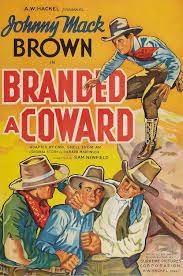
Branded A Coward (1935, directed by Sam Newfield)


When Johnny Hume was just a young boy, he witnessed his entire family being killed by a group of bandits led by the mysterious Cat.  Johnny grows up to be a trick-shot artist but, despite his skill with a gun, he can’t stand to point it at anyone or to be near any sort of gunfights.  When a fight breaks out in a saloon, he hides behind a bar and is labeled a coward.

Still, Johnny and his sidekick (Syd Saylor) somehow find the strength to run off a bunch of stagecoach robbers and save passenger Ethel Carson (Billie Seward).  Johnny is offered a chance to become the new town marshal.  Johnny, despite his fear of gunfights, accepts after he hears that the Cat is back in business.  Johnny wants revenge but the Cat turns out to be not who he was expecting.

Branded A Coward may be a zero-budget Poverty Row western but it’s actually has an interesting story and a good (if not entirely unexpected) twist towards the end.  Johnny Mack Brown was one of the better actors amongst the cowboys who starred in the westerns put out by PRC and directed by Sam Newfield.  Brown does a good job portraying Johnny’s fear and also his determination to get justice for his family.  Johnny proves he’s no coward but at what cost?

The plot here is a little darker than most of the westerns that were coming out at this time.  Every Poverty Row western featured a comic relief sidekick but this might be the only to feature the sidekick getting killed.  In the role of Oscar, Syd Saylor leaned very heavily on his fake stuttering shtick, to the extent that it actually got offensive.  I wasn’t sorry to see his character go.  Johnny Mack Brown didn’t need any help to get justice.

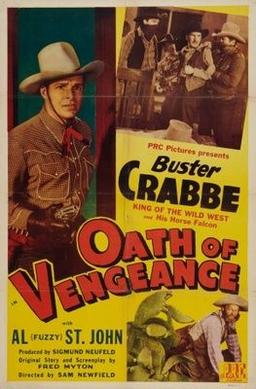
Oath of Vengeance (1944, directed by Sam Newfield)


In a small frontier town, the ranchers and the farmers are nearly at war with each other.  Cattle are being rustled.  The head of the farmers (Karl Hackett) is accused of killing a ranch hand.  Store owner Fuzzy Q. Jones (Al St. John) suspects that it’s all a set-up and he’s not going to stand for it.  If the farmers kill all the ranchers and the ranchers kill all the farmers, there won’t be anyone left to shop at his store.  Fuzzy calls in his friend, Billy Carson (Buster Crabbe).

Buster Crabbe may have gotten his start in the westerns by playing Billy the Kid but the producers of his films eventually realized that there was only so long that Buster could play a character known as “the Kid” and Billy the Kid’s reputation as an outlaw was actually not helpful at the box office because parents didn’t want to send their kids to a matinee that might teach them the wrong lessons.  After a handful of “Billy the Kid” films, Buster’s western hero suddenly had a new name.  Billy Carson was a standard western do-gooder, called in whenever a town needed to be cleaned up or his old sidekick Fuzzy needed some help around the store.  Crabbe was a convincing hero no matter what but the Billy Carson films lacked the thing that made the Billy the Kid films interesting.  Usually, no one was trying to arrest Billy Carson.

Oath of Vengeance isn’t bad, at least not by the standards of Poverty Row westerns.  There’s plenty of fights and Crabbe, being a former Olympian, looks convincing with he throws a punch.  The plot is a pretty standard B-western plot but Crabbe’s natural likability carries the day.  Fans of the genre will be happy to see Charles King and Kermit Maynard, playing bad guys.  Frank Ellis plays the ranch hand whose murder sets off the story.  It’s always good to see the old gang back together again.

Music Video of the Day: Good Vibrations by Marky Mark and the Funky Bunch (1991, directed by Scott Kalvert)


Mark Wahlberg, the man once known as Marky Mark, is 54 years old today.  That’s the type of news that really makes you realize how quickly time passes.

Good Vibrations was Mark “Marky Mark” Wahlberg’s first MTV-promoted music video.  The woman in the video is model Traci Bingham, who later went on to appear on Baywatch.  Boxer Mickey Ward was brought in to show the 18 year-old Marky Mark how to convincingly throw a punch in the ring.  Years later, Wahlberg would play Mickey Ward in The Fighter.

I would love to be able to go back to 1991 and tell everyone that Marky Mark was destined to be an Oscar nominee.  They would be so shocked that they probably wouldn’t even flinch when I told them that, when Marky Mark turned 54, Donald Trump was serving his second nonconsecutive term as President.

Enjoy!

Billy The Kid Trapped (1942, directed by Sam Newfield)


Billy “The Kid” Bonney (Buster Crabbe) and his two buddies Fuzzy (Al St. John) and Jeff (Bud McTaggart) are just trying to mind their own business and make a living in the old west but they keep getting accused of every crime that happens.  This time, they’re sentenced to hang for a crime they didn’t commit.  Luckily, a group of strangers break Billy and his friends out of jail and send them on their way to the next town.  However, the men who broke them out of jail are soon committing crimes while disguised as Billy, Fuzzy, and Jeff!  Billy teams up with Sherriff Masters (Ted Adams) to stop the imposters, who are working for Boss Jim Stanton (Glenn Strange).

One of the joys of Poverty Row westers like this one is that they always featured the same stock company.  Al St. John was everyone’s sidekick.  Ted Adams was often a sheriff.  Glenn Strange was always the criminal mastermind pulling the strings.  Milton Kibbee was always a corrupt judge or ranch owner.  George Cheseboro, Horace B. Carpenter, Jack Curtis, and Budd Buster are amongst the very familiar faces in Billy The Kid Trapped.  It gives each film a homey feel that will be appreciated by fans of the genre.  The hero of the films often changed but the stock company always remained the same.

I like the idea behind Billy The Kid Trapped but the film still feels repetitive, even though it’s less than an hour long.  After Billy captures the men who are imitating him and his friends, a crooked judge sets the men free and the immediately go back to imitating Billy.  Billy has to capture them all over again.  No wonder Billy aged so quickly!  (Buster Crabbe was in his mid-thirties when he was playing The Kid.)  The movie does have all the usual gunfights and horse chases that people watch these movies for.  It’s comforting that, no matter what, the villain is always going to turn out to be Glenn Strange.

Music Video of the Day: Communication by The Power Station (1985, directed by Julian Caidan)


The Power Station was one of the best supergroups of the 80s.  Made up of Robert Palmer, Chic’s Tony Thomas, and Duran Duran’s John and Andy Taylor, this group may have started as a whim (with Thomas and the Taylors specifically wanting to to do a cover of T. Rex’s Get It On) but it’s first record was such a hit that it led to the band going on tour and also singer Robert Palmer leaving the band to pursue his solo career.

Originally, the band wanted to have a rotating list of lead singers.  Palmer was recruited just to sing Communication but when Palmer also said he wanted to sing Get It On, it led to Thomas and the Taylors hiring him to sing on all the songs on the album.  After Palmer left, he was replaced by Michael Des Barres.

Communication was one of three music videos that The Power Station released for their debut album.  It was directed by Julian Caidan, who is better-known for his work as an editor.  Caidan went on to direct several music videos for Robert Palmer’s solo career and he also did the video for Iron Maiden’s Stranger in a Strange Land, which is about as far away from Robert Palmer as you can get.

Enjoy!

Billy The Kid’s Smoking Guns (1942, directed by Sam Newfield)


It’s a tale as old as time.  During the days when the west was wild, the U.S. Army is planning on setting up a new outpost near a town so the bad guys want to run all the ranchers off of their land so that they can be the ones to sell it.  Sheriff Carson (Ted Adams) is corrupt and working for the bad guys so the ranchers have to turn to Billy the Kid (Buster Crabbe) and his sidekicks, Jeff (Dave O’Brien) and Fuzzy (Al St. John) for help.  When Jeff is wounded in a fight, Fuzzy takes him to Doc Hagen (Milton Kibbee), little suspecting the doctor is actually the leader of the bad guys and using his medical practice to kill anyone who won’t give up their land!

Coming to us straight from Poverty Row, this B-western is interesting in that it seems to take a very cynical view of law enforcement.  Sheriff Carson is corrupt and Billy and his friends are running from the law themselves.  Buster Crabbe’s Billy the Kid films always kept it unclear why Billy was in trouble with the authorities.  Crabbe’s Billy the Kid always seemed to be the nicest guy in the west.  (Of course, Crabbe was also 33 and no longer seemed like he should have been known as “the Kid.”)  Eventually, the series was retconned and Buster Crabbe was no longer playing Billy the Kid but instead he was playing an upstanding citizen named Billy Carson.

Crabbe may not be a convincing outlaw but he is a convincing hero, which is all these films really required.  Billy the Kid’s Smoking Guns is a little bit interesting because of the character of Doc Hagen, whose occupation makes him a little more memorable than typical B-western bad guy.  The film is also interesting in that, for once, there’s no love interest.  Instead, it’s just men in hats shooting at each other.  That probably made the film’s youthful target audience happy.

The real-life Billy The Kid was killed when he was only 21 and after he had been an outlaw for only three years.  Buster Crabbe would g0 on to play Billy (or o some variation of Billy) until he was closing in on 40.