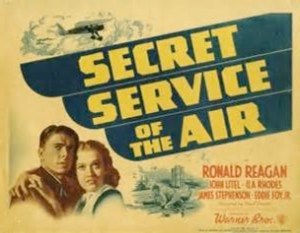
A Movie A Day #222: Secret Service of the Air (1939, directed by Noel M. Smith)


When a secret service agent’s investigation into a supposed counterfeiting ring instead leads to him discovering a plot to smuggle illegal aliens into the United States via airplanes, the agent ends up plummeting several hundred miles to his death.  Realizing that they need someone who can go undercover and infiltrate the smuggling ring, the Secret Service recruits Lt. Brass Bancroft (Ronald Reagan).  Bancroft is a war hero who is now a commercial airline pilot.  He is also good with his fists, has an innate sense of right and wrong, and a sidekick named Gabby (Eddie Foy Jr., giving a very broad performance as the movie’s comic relief).  But before Brass can win the trust of the smugglers, he will have to establish a firm cover story and that means allowing himself to be arrested on fake charges.  In order to save the day, Brass will have to first survive prison.

If Secret Service of the Air is remembered today, it is because it featured future President Ronald Reagan in an early starring role.  In the role of Brass Bancroft, Reagan gives a performance that can be best described as being amiable.  He may not be anyone’s idea of a good actor but he is likable, a trait that served him well when, 26 years later, he ran for governor of California.  As for the rest of the movie, it was obviously cheaply made but it is also only an hour long, which means that there is rarely time for a dull moment.  It plays out like as serial, with a new cliffhanger ever few minutes.  Though Reagan was dismissive in the film in his autobiography, Secret Service of the Air was enough of an unexpected success that he would play Brass Bancroft is two sequels.
A Movie A Day #221: Scorned (1994, directed by Andrew Stevens)


“In an hour, I promise, you’ll be able to beg in two languages.” — Patricia (Shannon Tweed) in Scorned
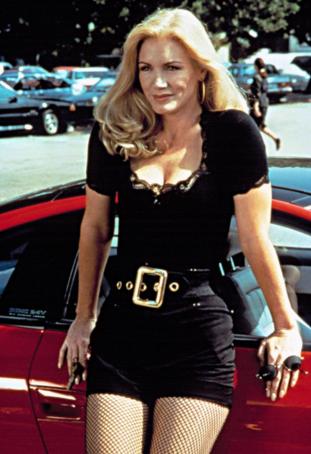
If anyone could pull that line off, it would be Shannon Tweed at the height of her Skinemax stardom!

In Scorned, Shannon plays Patricia, the beautiful wife of executive Truman Langley (Daniel McVicar).  Truman is desperate to land the Wainwright account, thinking it could be the key to getting a huge promotion.  To help him out, Patricia sleeps with Mason Wainwright (Stephen Young).  Truman gets the account but Alex Weston (Andrew Stevens, who also directed) gets the promotion.  After Truman kills himself, Patricia shows up at the Weston house, disguised as a tutor for their son, Robey (Michael D. Arenz).  Like clockwork, Patricia seduces not just Alex and Robey but Marina Weston (Kim Morgan Greene) as well.

Of the many direct-to-video films that Andrew Stevens and Shannon Tweed made together in the 90s, Scorned is one of the best.  Of course, Shannon Tweed looks good.  Of all the regular 90s direct-to-video vixens, Shannon was the sexiest.  What is often forgotten is that Shannon could also actually act and she shows that here with her ferocious performance.  Andrew Stevens does a good job too, giving an above average performance and, as a director, staying out of Shannon’s way.  He knows that everyone watching the movie is watching to see Shannon and this film does not disappoint.

It does stretch credibility that no one in the household realizes that Shannon is trying to destroy them but, then again, what parents would actually hire their hormonal, teenage son a live-in tutor who looks like this?

It is all about maintaining a healthy suspension of disbelief.


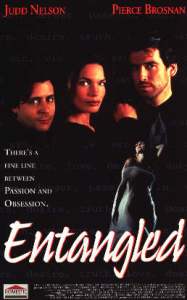
A Movie A Day #220: Entangled (1993, directed by Max Fischer)


There has been a car crash in Paris and now, David (Judd Nelson) is in the hospital, slowly recovering.  In flashbacks, it is revealed that David is an American writer who came to France after his first novel flopped.  He came to see his best friend, a womanizing photographer (Roy Dupuis), and ended up meeting and falling in love with the beautiful model, Annabelle (Laurence Treil).  Even as he worked on his second novel, he was consumed with jealousy over Annabelle.  Why was she sneaking off to a château owned by a mysterious and decadent businessman named Garavan (Piece Brosnan)?  Any why, while he is in the hospital, is his second novel published and credited to someone else?

Entangled is yet another 90s neo-noir starring Judd Nelson.  Laurence Treil was beautiful and often naked, which made it perfect for showings on Skinemax but the movie fails because, like so many others, it requires the audience to believe that Judd Nelson could not only write a book but get a model girlfriend as well.  That takes much more work than is portrayed in Entangled.  Early on in Entangled, Judd Nelson gropes a cardboard cut-out of George H.W. Bush and it is pretty much all downhill from there.  Not even Brosnan doing a good job as a sinister character can do much to save Entangled.

What could have saved Entangled?  Like so many of Judd Nelson’s direct-to-video movies, Entangled needed the calming hand of Judd’s co-star from Shattered If Your Kid’s On Drugs, Burt Reynolds!

Am I saying that Entangled would have been a better movie if Burt Reynolds had been given a role?

It couldn’t have hurt.

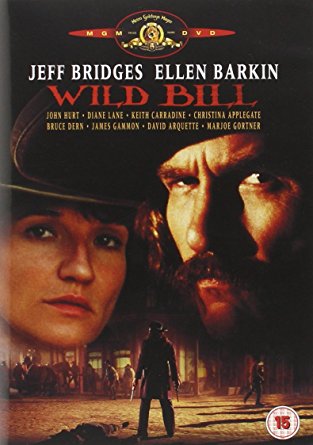
A Movie A Day #219: Wild Bill (1995, directed by Walter Hill)


The year is 1876 and the legendary Wild Bill Hickok (Jeff Bridges) sits in a saloon in Deadwood and thinks about his life (most of which is seen in high-resolution, black-and-white flashbacks).  Hickok was a renowned lawman and a sure shot, a man whose exploits made him famous across the west.  Thanks to his friend, Buffalo Bill Cody (Keith Carradine), he even appeared on the New York stage and reenacted some of his greatest gun battles.  Now, Hickok is aging.  He is 39 years old, an old man by the standards of his profession.  Though men like Charlie Prince (John Hurt) and California Joe (James Gammon) continue to spread his legend, Hickok is going blind and spends most of his time in a haze of opium and regret.
Hickok only has one true friend in Deadwood, Calamity Jane (Ellen Barkin).  He also has one true enemy, an aspiring gunslinger named Jack McCall (David Arquette).  McCall approaches Hickok and announces that he is going to kill him because of the way that Hickok treated his mother (played, in flashback, by Diane Lane).  Hickok does not do much to dissuade him.

Based on both a book and a play, Wild Bill is a talky and idiosyncratic Western from Walter Hill.  Hill is less interested in Hickok as a gunfighter than Hickok as an early celebrity.  There are gunfights but they only happen because, much like John Wayne in The Shootist, Hickok has become so famous that he cannot go anywhere without someone taking a shot at him.  Almost the entire final half of Wild Bill is set in that saloon, with Hickok and a gallery of character actors talking about the past and wondering about the future.

At times, Wild Bill gets bogged down with all the dialogue and philosophizing.  (To quote The Good, The Bad, and the Ugly: “When you have to shoot, shoot.  Don’t talk.”)  Luckily, the film is saved by an intriguing cast, led by Jeff Bridges.  In many ways, his performance was Wild Bill feels like an audition for his later performance in True Grit.  David Arquette is intensely weird as the jumpy Jack McCall and Ellen Barkin brings the film’s only underwritten role, Calamity Jane, to life.  Smaller roles are played by everyone from Bruce Dern to James Remar to Marjoe Gortner.

United Artist made the mistake of trying to sell Wild Bill as being a straight western, which led to confused audiences and a resounding flop at the box office.  Ironically, years after the release of Wild Bill, Walter Hill won an Emmy for directing the first episode of HBO’s Deadwood, an episode the featured Wild Bill cast member Keith Carradine in the role of Hickok.

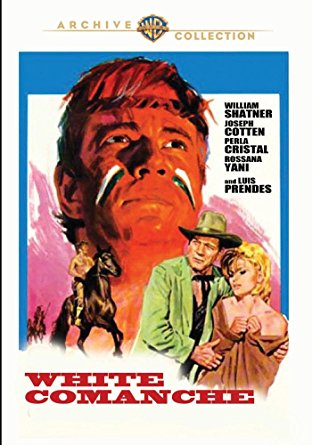
A Movie A Day #218: White Comanche (1967, directed by Jose Briz)


Johnny Moon (William Shatner) is a half-breed.  His father was white and his mother was a Comanche.  Johnny was raised Comanche but he now lives as a white man.  He is a good and law-abiding citizen but he has a problem.  Johnny has a twin brother named Notah (played, of course, by William Shatner) and, hooked on peyote, Notah keeps holding up stagecoaches, killing white men, and raping white women.  Sick and tired of people constantly trying to lynch him, Johnny contacts Notah and demands a final showdown.  At the same time, Johnny refuses to tell anyone about Notah’s existence so everyone still wants to kill Johnny.  The only person who realizes that Johnny and Notah are not the same is one of Notah’s victims, a showgirl named Kelly (Rosanna Yanni).  She sees that good Johnny has blue eyes while bad Notah has black eyes.
William Shatner has described White Comanche as being his worst film, which is saying something when you consider some of the movies that Shatner made between the cancellation of Star Trek and the release of Star Trek: The Motion Picture.  Still: William Shatner as twins, one of whom spends the entire movie tripping on peyote.  That sounds like it should be fun and it would be except that, for the first and only time in his career, Shatner actually gives a low-key performance.  When Shatner is playing Notah, he is the Shatner that we all know and love.  But when Shatner plays Johnny Moon, he tries to give a subtle and restrained performance and, unfortunately, the movie is about 75% Johnny.  That’s not what we pay money to see when we watch a William Shatner movie!

This one is for Shatner completists only.


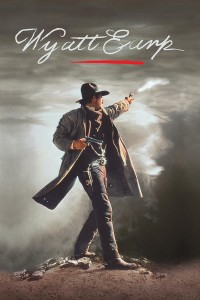
A Movie A Day #217: Wyatt Earp (1994, directed by Lawrence Kasdan)


Once upon a time, there were two movies about the legendary Western lawman (or outlaw, depending on who is telling the story) Wyatt Earp.  One came out in 1993 and the other came out in 1994.
The 1993 movie was called Tombstone.  That is the one that starred Kurt Russell was Wyatt, with Sam Elliott and Bill Paxton in the roles of his brothers and Val Kilmer playing Doc Holliday.  Tombstone deals with the circumstances that led to the Gunfight at the O.K. Corral.  “I’m your huckleberry,” Doc Holliday says right before his gunfight with Michael Biehn’s Johnny Ringo.  Tombstone is the movie that everyone remembers.

The 1994 movies was called Wyatt Earp.  This was a big budget extravaganza that was directed by Lawrence Kasdan and starred Kevin Costner as Wyatt.  Dennis Quaid played Doc Holliday and supporting roles were played by almost everyone who was an active SAG member in 1994.  If they were not in Tombstone, they were probably in Wyatt Earp.  Gene Hackman, Michael Madsen, Tom Sizemore, Jeff Fahey, Mark Harmon, Annabeth Gish, Gene Hackman, Bill Pullman, Isabella Rossellini, JoBeth Williams, Mare Winningham, and many others all appeared as supporting characters in the (very) long story of Wyatt Earp’s life.

Of course, Wyatt Earp features the famous Gunfight at the O.K. Corral but it also deals with every other chapter of Earp’s life, including his multiple marriages, his career as a buffalo hunter, and his time as a gold prospector.  With a three-hour running time, there is little about Wyatt Earp’s life that is not included.  Unfortunately, with the exception of his time in Tomstone, Wyatt Earp’s life was not that interesting.  Neither was Kevin Costner’s performance.  Costner tried to channel Gary Cooper in his performance but Cooper would have known better than to have starred in a slowly paced, three-hour movie.  The film is so centered around Costner and his all-American persona that, with the exception of Dennis Quaid, the impressive cast is wasted in glorified cameos.  Wyatt Earp the movie tries to be an elegy for the old west but neither Wyatt Earp as a character nor Kevin Costner’s performance was strong enough to carry such heavy symbolism.  A good western should never be boring and that is a rule that Wyatt Earp breaks from the minute that Costner delivers his first line.

Costner was originally cast in Tombstone, just to leave the project so he could produce his own Wyatt Earp film.  As a big, Oscar-winnng star, Costner went as far as to try to have production of Tombstone canceled.  Ironically, Tombstone turned out to be the film that everyone remember while Wyatt Earp is the film that most people want to forget.

A Movie A Day #216: America Undercover: Skinheads USA: Soldiers of the Race War (1993, directed by Shari Cookson)


In a shack in rural Alabama, a fat, middle-aged man named Bill Riccio watches a faded VHS tape with several teenage boys.  All of them have shaved heads.  Several of them have elaborate tattoos of swastikas and other racist symbols.  When asked, the majority of them say that they come from broken homes with alcoholic fathers and little hope for the future.  One of them says that he feels that Bill Riccio is his father.  All of them agree, with Riccio, that almost all of the country’s problems can be linked to an international conspiracy that they call ZOG (that stands for Zionist Occupational Government).  They have named their home “the War House.”
The movie that they are watching is Leni Riefenstahl’s The Triumph Of The Will.  They all agree that they are impressed with an extremely intense drummer boy.  They agree that he has his shit together.  When Adolf Hitler appears and starts to speak, one of the boys says that Bill Riccio reminds him of Hitler.  “Don’t compare me to that man,” Riccio says.  “I am not worthy.”

Skinheads USA was a part of HBO’s America Undercover documentary film series.  Camera crews followed Riccio and his Neo-Nazi followers around for months, following them as they drink beer, shout “white power!,” and forge an alliance with the local KKK.  When they go out on the streets to pass out racist flyers, people argue with them and call them ignorant.  The skinheads don’t give a shit.  Instead, they savor being despised.  It feeds into their persecution complex.

Skinheads USA is a portrait of pure evil.  Bill Riccio is a predator who peddles hate while his followers are young men who, poorly educated and with no real prospects for the future, fell through the cracks of society and were easily gathered up by the forces of hate.  Riccio provided them with both a home and scapegoats for all of their problems.  (Years later, one of Riccio’s followers, from a jail cell where he was serving time for murder, said that Riccio provided drugs and alcohol while also abusing the younger boys sexually, a charge that will not surprise anyone who has seen Skinheads USA.)   Towards the end of the documentary, when Riccio is arrested on weapons violations and sent to jail, his brainwashed followers are left directionless but no less dangerous.  The documentary ends with one of Riccio’s lieutenants trying to fire up the remaining skinheads and chanting, “Heil Bill Riccio!”

In the 90s, when Skinheads USA used to regularly play on HBO and A&E, it was easy to laugh off Riccio and his followers.  Today, we know better.  If you are wondering how the Richard B. Spencers and the David Dukes of the world continue to find followers, Skinheads USA is a good place to start.

A Movie A Day #215: Crossplot (1969, directed by Alvin Rakoff)


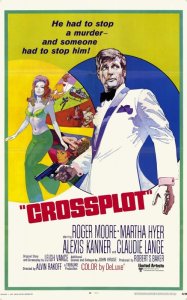
In swinging London, Roger Moore is ordered by Bernard Lee to track down a model  who is connected to an international conspiracy.
If you think that sounds like a James Bond movie, you’re close.  In Crossplot, which was released four years before Roger Moore took over the role of 007 in Live and Let Die, Moore plays Gary Fenn and Bernard Lee is Mr. Chilmore.  Gary is a playboy and an advertising executive while Mr. Chilmore is his latest client.  Mr. Chilmore has ordered Gary to find a model who can serve as the new “Miss Swing,” but actually, the bad guys are using Gary to try track down a beautiful Hungarian named Marla Kugash (Claudie Lange).  Kugash, the ex-girlfriend of a radical political activist, has knowledge about a conspiracy to assassinate a visiting African president.  It leads to car chases, shoot outs, and a wedding that is ruined when Gary and Marla take refuge in a church.

Crossplot was an obvious attempt to cash in on the popularity of the James Bond films.  At the time that Crossplot came out, Moore was best known for playing The Saint on television.  Crossplot was the first film that Moore made after signing a three-movie contract with United Artists and, had the film been a success, Moore would have returned in the role of Gary Fenn and it is totally possible that he would not have been available to step into Sean Connery’s shoes when Connery announced that he was finished with the role of James Bond.

However, Crossplot was not a success and it is easy to see why.  The plot was overly convoluted and it’s emphasis on “swinging” London (complete with wacky hippies) probably made Crossplot seem dated before it was even released.  It is interesting today mostly as Moore’s “audition” for the role of Bond.  Moore gives a very Bondish performance, complete with arched eyebrows and one liners.  Moore is the best thing about the movie but it is also interesting to see Bernard Lee playing a character far less savory than M.  This was also one of the many 60s Bond rip-offs to feature the beautiful Claudie Lange.  Lange, who would have made a great Bond girl if she’d been given the opportunity, retired from acting in 1973, the same year that Moore appeared in Live and Let Die.

A Movie A Day #214: Urban Justice (2007, directed by Don E. FauntLeRoy)


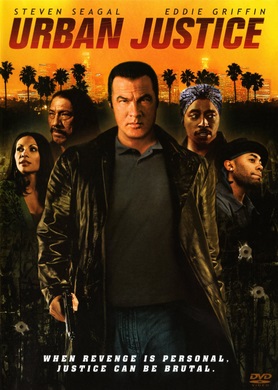
Steven Seagal returns and this time, he’s out for justice!  Urban justice!
After his son, a beloved Los Angeles cop, is assassinated, Simon Ballister (Seagal, of course) comes out of retirement to get revenge.  Retirement from what?  Like most of Seagal’s characters, Simon has a deadly and legendary past.  Nearly everyone who meets him says something like, “So, you’re Simon.”  Everyone wants Simon Ballister to do something for them.  El Chivo (Danny Trejo!) wants Simon to help defeat his rival, Armand Tucker (Eddie Griffin).  Armand Tucker wants to be Scarface.  Simon just wants revenge.

Much like Elvis, Steven Seagal’s career can be divided into a thin and a fat period.  Thin Steven Seagal was all over movie screens in the 90s, making up for the fact that he could not act by convincingly beating people up.  Fat Steven Seagal appears almost exclusively in direct-to-video productions.  He does everything that Thin Seagal did but he sweats a lot more while doing it.  Unfortunately, Fat Seagal is an even worse actor than Thin Seagal.  Since Fat Seagal produces almost all of his own films, there is no one around to say, “Let’s cut away from Steve during this speech, he looks stupid.”

Urban Justice is peak Fat Seagal.  It actually features more fights than the typical Fat Seagal movie but they are all edited in such a way that it is obvious that most of the blows were delivered by a stuntman while Seagal undoubtedly stood in a corner, trying to catch his breath. Since Urban Justice features Seagal in what is supposed to be the ghetto, he calls everyone that he meets, “motherfucker.”  Fat Seagal has the same Clint Eastwood-style rasp that he had when he was Thin Seagal but he still sound stupid whenever he says, “I want the motherfucker who killed my son.”

Eddie Griffin is pretty good as Armand Tucker.  I don’t know if Eddie improvised all of his dialogue but it certainly seems like he did.  All of the movie’s best lines belong to Eddie Griffin.  Just one example: “Man, fuck Santa Claus!  He never gave me shit!  That’s why I sell dope!”  As for Danny Trejo, he doesn’t do much but he’s Danny Trejo.

Personally, looking over the career of Steven Seagal, I think he made a mistake by trying to be an action hero.  It is hard to think of any other actor with as unlikable a screen presence as Steven Seagal.  If Steve had made his career playing villains, he would probably still have a good career going.  People would gladly play money to see Steven Seagal get blown up at the end of a Jason Bourne sequel.  Instead, he insisted on playing the hero and his career is now made up of appearing in direct-to-video movies and threatening to run for governor of Arizona.

To quote Clint Eastwood, “a man’s got to know his limitations.”

A Movie A Day #213: Illegally Yours (1988, directed by Peter Bogdanovich)


This is really bad.

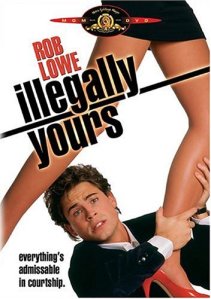
Richard Dice (Rob Lowe, wearing glasses and running around like a speed freak) is a loser who lives at home with his mother (Jessica James), his younger brother (Ira Heiden), and his mother’s boyfriend (Harry Carey, Jr.).  When he gets called for jury duty, Richard thinks that he will be able to easily get out of it but then he discovers that the defendant is someone from his part, even if she does not remember a thing about him.  Ever since the first grade, Richard has been in love with Molly (Colleen Camp) and now she is on trial for murder.  Richard lies about knowing who she is and gets selected for the jury.  When it starts to look like Molly might be convicted, Richard starts to investigate the murder himself.  His investigation leads him to two teenage blackmail victims (played by Kim Myers and Bodganovich’s future wife, Louise Stratten) and a tape of the murder being committed.  Illegally Yours attempts to be a screwball comedy but it just comes across as being frantic, with Lowe especially going overboard.  The actors all speak quickly but that can not disguise how lame most of the dialogue is.  The movie also comes with a clunky narration, a sure sign of post production desperation.

Made at a time when Peter Bogdanovich was mired in an expensive lawsuit over changes made to his previous film, Mask, Bogdanovich has said that he solely did Illegally Yours because he needed the money.  Bogdanovich has accurately described Illegally Yours as being the worst film that he ever directed.  Coming from the director of At Long Last Love, Nickelodeon, and Texasville, that is saying something.