Goodbye, Don Rickles, and Thank You For The Laughter


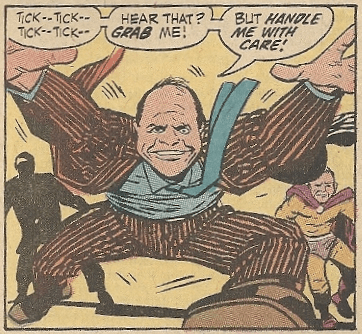
Don Rickles, as drawn by Jack Kirby

Oh man, Don Rickles.

Remember when they used to show old episodes of Saturday Night Live on Comedy Central?  I once watched an episode from 1984.  The host was Don Rickles.  His opening monologue was pure Don Rickles, which is to say that he insulted everyone in the audience.  It didn’t matter who the person was, Rickles was going to insult them.  He insulted John Madden.  He insulted Brandon Tartikoff, the president of the NBC.  He insulted the people who had just come in from off the street.  I don’t remember much about the specific insults.  The main thing that I remember is that the audience absolutely loved it.  Even before Rickles thanked them all for being good sports, the audience was eating out of his hand.

Don Rickles was the King of Insult Comedy.  His nickname was Mr. Warmth.  The nickname was not as ironic as you might think.  Off-stage, Rickles was reportedly a kind and generous man.  And, on-stage, Rickles may have insulted the audience but he did it with a twinkle in his eye and he always thanked him at the end.  His humor may have been built on insults but it was also built on self-depreciation.  The only person he made fun of more than the guy sitting in front row of the audience was himself.  Going to one of his shows might lead to you being called a “hockey puck,” but Rickles’s ultimate message was always that we’re all in this together.

As funny as Rickles was, he was also lucky enough to start his career in the 1950s.  (Reportedly, he got his big break when he saw Frank Sinatra in the audience, said, “Make yourself at home, Frank.  Hit somebody!” and insulted his work in his last movie.  Sinatra loved it.)  If Don Rickles had started his career this century, his politically incorrect humor would have gotten him banned from most clubs and Amy Schumer and Lena Dunham would have led a twitter campaign to have him incarcerated.  Don Rickles was lucky enough to by funny at a time when comedians were actually rewarded for making us laugh.

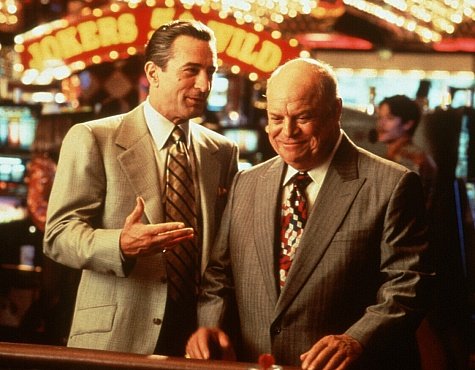
What was your favorite Don Rickles role?  He always said that his grandkids only liked him because he voiced Mr. Potato Head in the Toy Story films.  Rickles also had a rare dramatic role in Martin Scorsese’s Casino, more than holding his own against heavyweight actors like Robert De Niro and Joe Pesci.

Don Rickles died today at the age of 90.  I would say rest in peace but I don’t think Don Rickles would have appreciated the “in peace” part.  I will just say goodbye, Mr. Rickles and thank you for the laughter.


TV Review: Twin Peaks 1.5 “The One-Armed Man” (directed by Tim Hunter)


It’s all about team work.

Aren’t Lisa and Leonard doing a great job with their Twin Peaks reviews?  Yesterday, I was reading Leonard’s review of Rest In Pain and I immediately thought to myself, “I’m going to have to up my game if I want to keep up.”  That’s what team work does.  It challenges you to work harder and hopefully, it makes you better at whatever it is that you do.

For instance, Twin Peaks is usually thought of as being the “David Lynch show” but actually, there were several different creative voices involved and all of them left their mark on the series.  The show was co-created by veteran TV writer, Mark Frost (whose father, Warren Frost, played Doc Hayward).  Many of the show’s scripts are credited to Harley Peyton, who also wrote the film version of Less Than Zero.  Even Jerry Stahl, of Permanent Midnight fame, is credited with writing an episode.  While Twin Peaks had an easily identifiable style, only six of its 30 episodes were actually directed by David Lynch.  The other episodes were directed by directors like Uli Edel, Todd Holland, and Caleb Deschanel.  Even Diane Keaton directed an episode during season 2.  All of them brought their own talents and perspectives to this show and upped their game.

Episode 5, “The One-Armed Man,” was written by Robert Engels and directed by Tim Hunter.  Hunter, who directed two more episodes during the show’s second season, is best known for two sensitive films that he made about teenagers, Tex and River’s Edge.  Of the two, the surreal River’s Edge (which features Dennis Hopper playing a one-legged drug dealer who lives with a sex doll) feels the closest to Twin Peaks.
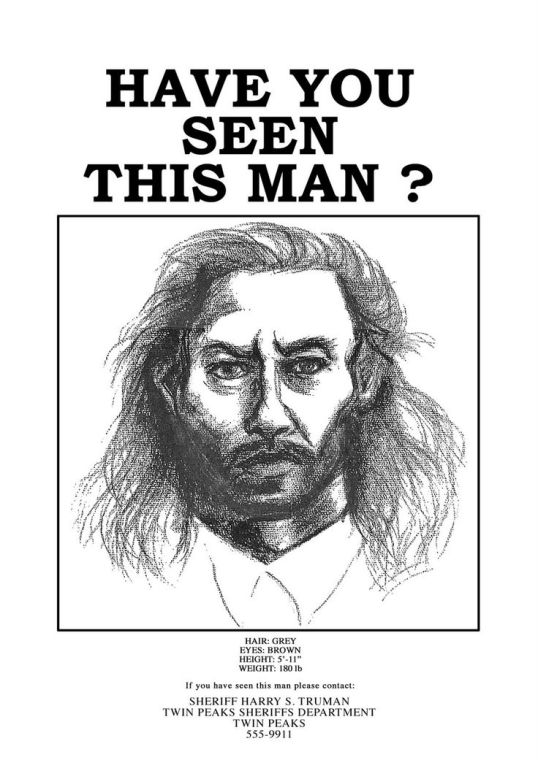
Episode Five opens with Sarah Palmer (Grace Zabriskie) giving a description of Killer BOB (Frank Silva) to Harry (Michael Ontkean) and Andy (Harry Goaz) while Doc Hayward and Donna (Lara Flynn Boyle) listen.  When Leland (Ray Wise) wanders into the room and taunts Sarah about having had two visions, Sarah talks about seeing someone digging up Laura’s necklace, making Donna uncomfortable since she’s the one who buried it in the first place.

(Whenever I see Grace Zabriskie and Warren Frost play a scene together, I am reminded of their later work on Seinfeld, where they played the bitter parents of Susan Ross and Mr. Ross was revealed to have been a former lover of John Cheever.)

Back at the police station, there’s a happening.  Lucy (Kimmy Robertson) is caught up in the latest episode of Invitation to Love, where the storyline seems to parallel the efforts of Ben Horne (Richard Beymer) and Catherine Martell (Piper Laurie) to run Josie (Joan Chen) out of business.  FBI Director Gordon Cole (voiced by David Lynch, himself) calls in to let them know that Albert has discovered that Laura Palmer was bound by household twine and that the marks on her shoulder came from a bird.  When Harry and Andy show Dale Cooper (Kyle MacLachlan) the sketch of BOB, Cooper identifies him as one of the men from his dream.
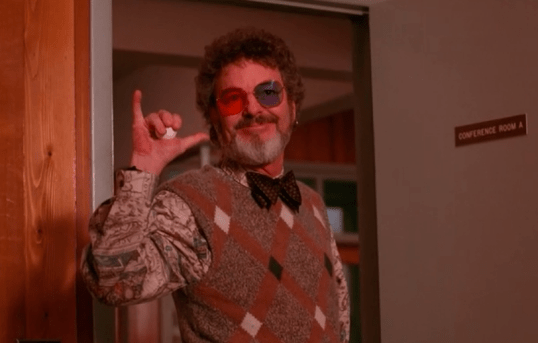
Dale also finally interviews everyone’s favorite psychiatrist, Dr. Jacoby (Russ Tamblyn).  Jacoby tries to beat Cooper at his own game, speaking in riddles and comparing the people of Tibet with the native Hawaiians.  Jacoby says that, when it comes to Laura, he can not violate doctor-patient confidentiality but he does share that “Laura was a woman” surrounded by boys and that, on the night Laura was murdered, he was following one of the men that Laura had told him about.  When Jacoby says that the man drove a red corvette, both Harry and Dale realize that he is talking about Leo Johnson (Eric Da Re).

Lucy interrupts to let Dale and Harry know that Deputy Hawk (Michael Horse) has just called.  He has tracked down MIKE, the one-armed man!
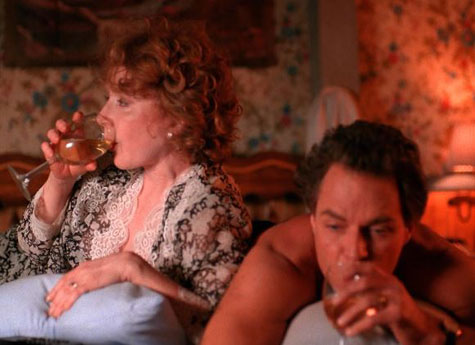
At the Timber Falls Motel, Ben and Catherine are having another tryst and discussing their plans for setting the mill on fire and forcing Josie into bankruptcy.  What they do not know is that Josie is sitting outside in her car, taking pictures.

The Timber Falls Motel is also the current home of the one-armed man and, as Harry, Andy, and Dale pull up, they are met by Hawk who tells them that the man is in room 101 and that his full name is Philip Michael Gerard.  (The One-Armed Man shares his name with Richard Kimble’s relentless pursuer on The Fugitive, a show that itself centered around the search for a one-armed man.  This episode aired years before the film version and Tommy Lee Jones reintroduced the world to the character.)

Andy has a Barney Fife moment when, standing outside of Room 101, he accidentally drops his gun and it goes off.  (“Gunplay,” Catherine says in her cabin, “Sounds serious.”)  When not even the sound of gunfire can get Gerard to open the door, Harry and Dale kick it in and discover their one-armed man stepping out of the shower.

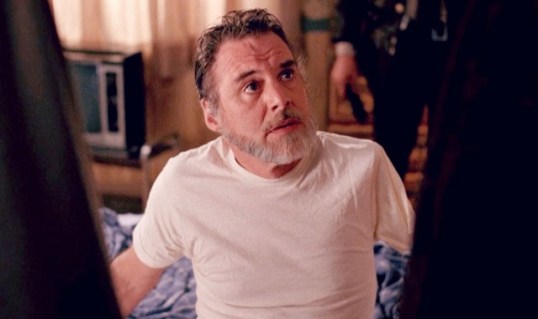
Looking at a the drawing of BOB, Gerard says that he has never seen him before but that he does “look like someone.”  When Cooper asks if he has a friend named Bob, the one-armed man replies, “Bob Lydecker is just about my best friend in the world.”  He says that he’s been at the hospital because Bob, who is apparently the “best veterinarian in the county,” is in a coma.  Gerard is a traveling salesman, selling shoes.  He says that he lost his arm in a car accident.  He admits that he did have a tattoo on the arm that he lost.  In tears, he says that the tattoo said, “Mom.”

Al Strobel was a real-life amputee whose cameo in the pilot, riding in an elevator with Cooper and Harry, was originally meant to be his only appearance, a one-time homage to The Fugitive.  Lynch was so impressed with Strobel that he filmed some additional scenes with him that were used in the version of the pilot that was released theatrically in Europe.  (Those scenes were later incorporated into Cooper’s dream.)  In this episode, Strobel gives a memorable performance that justifies Lynch’s decision to expand his role.
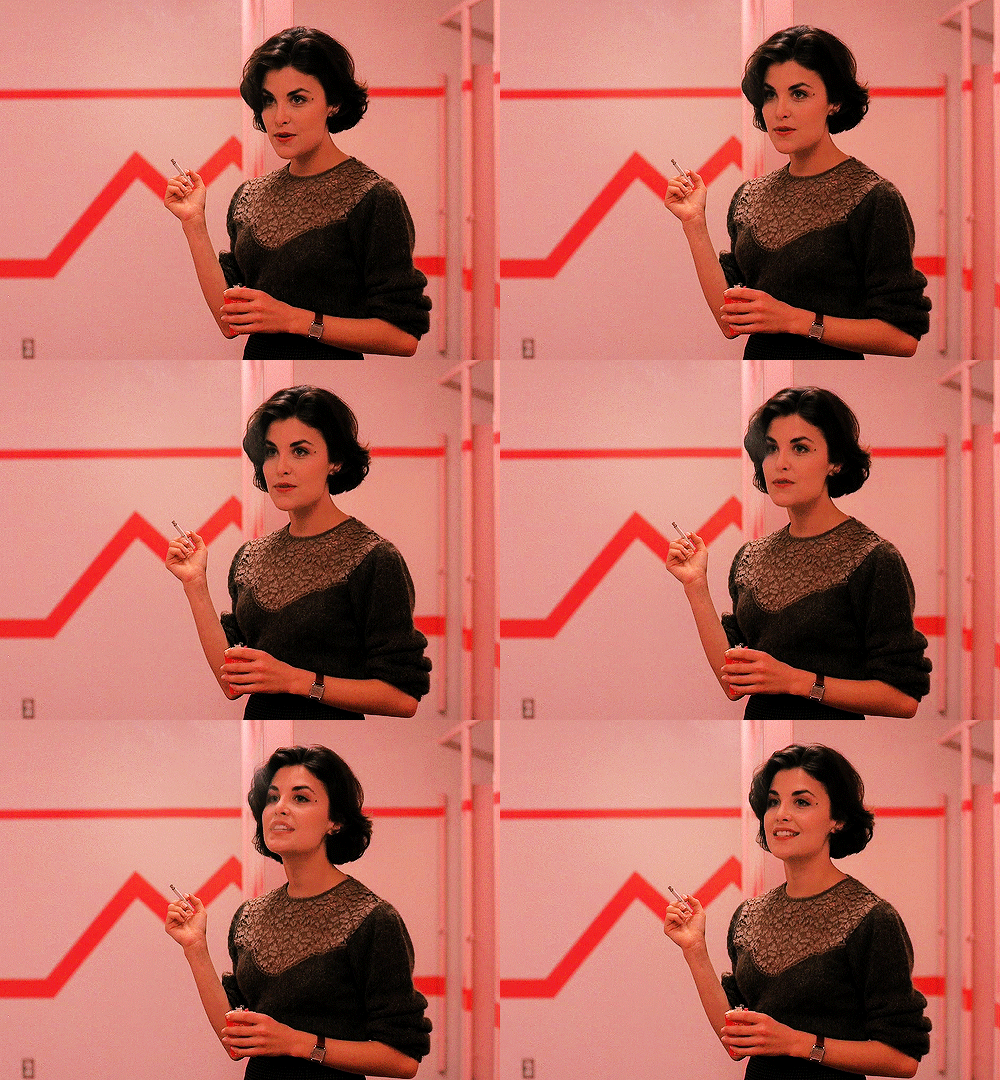
At the high school, Audrey (Sherilyn Fenn) is smoking in the girl’s room and begging Donna to help her investigate Laura’s murder.  Audrey says that if she can solve the murder then maybe Dale will take her away with him.  When Audrey mentions One-Eyed Jacks, Donna proves herself to be just as crushworthy as Audrey by replying, “Isn’t that a western with Marlon Brando?”  Considering that One-Eyed Jacks was a box office flop that was released years before she was born, Donna’s knowledge of Marlon Brando’s filmography is truly impressive.

At the prison, Norma (Peggy Lipton) promises the parole board that, if Hank (Chris Mulkey) is released, she will give him a job at the diner and they will live together as “husband and wife.”  That will be interesting considering that Norma is now having an affair with Hank’s former best friend, Ed Hurley (Everett McGill.)

Meanwhile, Dale, Harry, Andy, and Hawk have pulled up in front of Dr. Bob Lydecker’s vet clinic.  Hawk immediately high-fives a biker.  Harry pets a little girl’s rabbit.  Cooper notices that a convenience store is right next to the clinic and sends Andy, who is still shaken up from nearly shooting himself, to discover whether the store sells the type of twine that was used on Laura.

Inside the clinic, Dr. Lydecker’s receptionist says that the sketch of Killer BOB looks nothing like the good doctor.  As a woman leads a llama through the waiting room, Dale asks whether Lydecker had any bird patients.  As Cooper explains to Harry, “The bird that attacked Laura Palmer is a client of this office!”

Meanwhile, back at the Johnson House, Shelly Johnson (Madchen Amick) is fooling around with Bobby Briggs (Dana Ashbrook).  Shelly says that Bobby’s outburst at the funeral really turned her on.  Bobby says that he’s going to “fix” James Hurley.  “Fix me first,” Shelley replies.  Bobby asks when Leo’s coming back and Shelly says that Leo will be gone for hours.  Whenever Shelly says that Leo won’t be back for a while, that is usually Leo’s cue to kick open the door and start yelling.

However, that does not happen this time.  For once, Leo does not show up.  According to Shelly, he is with “creepy Jacques, that Canuck who works at the Roadhouse.”  Realizing that Jacques must be the one supplying Leo with cocaine, Bobby does his innocent act.  He says that he knows that Leo has been selling drugs at the high school, maybe even to Laura.  Now, if only he can find evidence linking Leo to Laura, maybe they can get Leo out of their lives forever.  Shelly helps out by showing Bobby the bloody shirt that she found in Leo’s truck.  She also shows Bobby the gun that she just bought and she asks Bobby to show her how it works.  Hopefully, Bobby’s better with a gun than Andy.

Fan Service, Twin Peaks Style

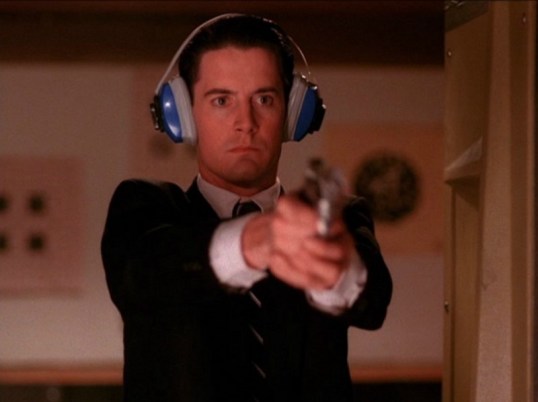
Speaking of which, Andy is still feeling upset over nearly shooting himself so, back at the police station, Andy, Cooper, Harry, and Hawk gather at the shooting range for some gunfire and male bonding.  They all agree that women cannot be understood and they all marvel over Dale’s marksmanship.  Not only does Dale do dream interpretation but he can shoot a man in the nostrils.
At the diner, Norma thanks a man named Toad for his tip.  When Shelly comes in, they bond over their shared experience of being married to loser drug dealers.  Shelly says that she’s ready to get rid of Leo but, after seeing him at the parole hearing, Norma is now less sure about her plan to divorce Hank and marry Big Ed.  She is even more unsure after she gets a phone call telling her that Hank got his parole.  He is coming home.

Meanwhile, Ed’s nephew, James (James Marshall), is using the diner’s payphone (remember those?) to call Donna.  However, James is distracted when Maddy (Sheryl Lee), Laura’s look-alike cousin, walks into the diner.  After James approaches her, Maddy explains that she and Laura used to be close but had recently drifted apart.  Maddy says that she lives in Missoula, Montana. Missoula just happens to be the birthplace of David Lynch.

Meanwhile, at the Great Northern, Audrey deftly manipulates her father into giving her a job working at the perfume counter at Horne’s Department Store.  Audrey says that it is because she wants to learn the family business but actually, it’s because both Laura and Ronette Pulaski also worked at the perfume counter.  Ben agrees and then leaves so that he can hire Leo Johnson to burn down the Packard Mill.  Who suggested Leo to Ben?  Hank Jennings!

At the police station, Cooper, Harry, and Andy pour over the files on all of the birds treated by Dr. Lydecker.  Albert faxes over a reconstruction of a poker chip from One-Eyed Jacks that was found in Laura’s stomach, along with the information that the bird bites on Laura’s shoulder came from a mynah bird.  At the exact moment, Andy redeems himself by announcing that Jacques Renault owns a mynah bird named Waldo.

When the police show up at Jacques’s apartment, Jacques is not there.  However, Bobby Briggs is.  Bobby runs as soon as the police arrive and manages to escape out a back window.  (Assuming that Bobby is Briggs, Hawk gives chase but loses him in the woods.)  Cooper finds what Bobby was planting the apartment, Leo’s bloody shirt.

In the woods, Donna and James go to the location where Donna buried the necklace and discover that Sarah Palmer’s vision was correct.  Someone followed them and dug up the necklace.  Donna and James agree they have to solve the murder and share a kiss while an owl watches above.

At the mill, Pete (Jack Nance) asks Josie if she would consider entering a fishing competition with him.  Josie and Pete?  That would be an interesting match.  But Josie soon has more to worry about, after she receives a drawing of a domino in the mail.  No sooner has she looked at the drawing then she gets a phone call from a man asking her if she got his message.

Who is on the other line?

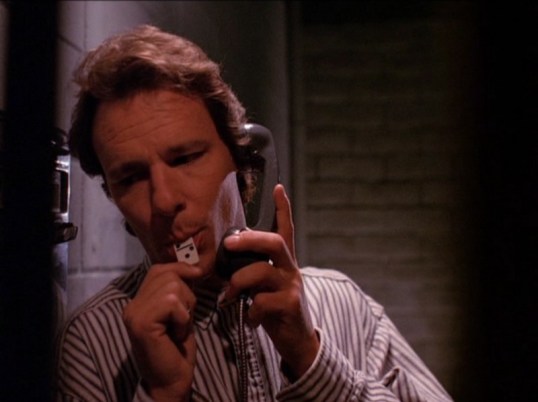
The suddenly very important Hank Jennings!
“The One-Armed Man” is a good episode, one that moves the story forward, introduces some new mysteries, and justifies that faith that David Lynch put into collaborators like Tim Hunter and Al Strobel.  As I said at the start of this review, it’s all about team work.

Previous Entries in The TSL’s Look At Twin Peaks:

  1. Twin Peaks: In the Beginning by Jedadiah Leland
  2. TV Review: Twin Peaks 1.1 — The Pilot (dir by David Lynch) by Lisa Marie Bowman
  3. TV Review: Twin Peaks 1.2 — Traces To Nowhere (directed by Duwayne Dunham) by Jedadiah Leland
  4. TV Review: Twin Peaks 1.3 — Zen, or the Skill To Catch A Killer (dir by David Lynch) by Lisa Marie Bowman
  5. TV Review: Twin Peaks 1.4 “Rest in Pain” (dir by Tina Rathbone) by Leonard Wilson
A Movie A Day #88: Where The Day Takes You (1992, directed by Marc Rocco)


This month, since the site is currently reviewing every episode of Twin Peaks, each entry in Move A Day is going to have a Twin Peaks connection.  Where The Day Takes You is a movie that has not just one but two connections to Twin Peaks.

Where The Day Takes You is an episodic film about young runaways living on the streets of Los Angeles.  Led by 22 year-old King (Dermot Mulroney), who ran away from home when he was 16, the runaways form a surrogate family.  While being constantly harassed by both the police and well-meaning social workers, some of the runaways get addicted to drugs while others turn to prostitution in order to survive.  Some find love.  Some find death.  They all go where the day takes you.  (Not sure if that was the movie’s tag line but it should have been.)

Where The Day Takes You is a gritty and often tough film, though it’s effectiveness is undercut by a predictable ending and the presence of too many familiar faces in the cast.  The runaways are made up of a who’s who of prominent young actors from the 1990s.  Balthazar Getty plays King’s second-in-command.  Sean Astin plays an obviously doomed drug addict.  Alyssa Milano and David Arquette play prostitutes.  Ricki Lake and James Le Gros play comedic relief.  Will Smith, in his film debut, plays a wheelchair-bound runaway.  Christian Slater and Laura San Giacomo show up as social workers while the police are represented by Rachel Ticotin and Adam Baldwin.  Everyone gives a good performance but the film would have worked better with unknown actors or even real runaways.  No matter how good a performance Sean Astin gives as a heroin addict, he is always going to be Sean Astin and it is always going to be difficult to look at him without saying, “I might not be able to carry the ring but I can carry you!”

The movie’s first Twin Peaks connection is that Lara Flynn Boyle, who played innocent Donna Hayward on Twin Peaks, plays innocent runaway Heather in Where The Day Takes You.  The role is cliché but Boyle shows the same charm that she showed while playing Donna.

The movie’s second Twin Peaks connection is more unexpected.  Kyle MacLachlan is effectively cast against type as Ted, the drug dealer who keeps most of the runaways hooked on heroin and who is perfectly willing to leave an overdosed junkie in a garbage bin.  Ted is about as far from Dale Cooper as you can get.

A Movie A Day #87: Free Grass (1969, directed by Bill Brame)


As everyone surely knows, before they appeared as Dr. Lawrence Jacoby and Benjamin Horne on Twin Peaks, Russ Tamblyn and Richard Beymer co-starred in West Side Story.  Tamblyn played Riff, the leader of the Jets.  Beymer played his best friend, Tony, who fell in love with Natalie Wood.  West Side Story is a classic that won several Oscars.  What is not as well known is that, in between West Side Story and Twin Peaks, Beymer and Tamblyn co-starred in one other movie, a hunk of psychedelic cheese called Free Grass.
By the late 60s, both Beymer and Tamblyn had tired of their clean-cut images and, like their characters in Free Grass, had become card-carrying members of the Hollywood counter-culture.  Beymer plays Dean, a motorcycle-riding drop-out from conventional society.  Dean meets and falls in love with buxom, mini-skirted Karen (played by Lana Wood, younger sister of Natalie).  When a riot breaks out on the sunset strip, Dean punches a cop.  With the Man now looking for him, Dean needs some quick cash so that he and Karen can escape to Dayton, Ohio.

(Dayton, Ohio?)

That’s where Russ Tamblyn comes in.  Tamblyn plays Dean’s friend, Link.  Link works for a drug kingpin named Phil (played not very convincingly by Casey Kasem, of all people).  Phil is willing to pay Dean $10,000 if he smuggles several pounds worth of grass across the Mexican border.  Dean agrees but soon finds himself being pursued by two narcotics agents, played by Jody McCrea and Lindsay Crosby (sons of Joel McCrea and Bing Crosby, respectively).  Because Dean is not willing to commit murder, Link plots to kill him.  But first, Link doses Dean with LSD, which leads to the de rigueur psychedelic 60s light show.

Slow-moving and ineptly directed, Free Grass is for fans of the 1960s counterculture only.  Russ Tamblyn provides the movie with what little energy it has but Richard Beymer apppears to be just as uncomfortable here as he was in West Side Story and Casey Kasem shows why he was better known as a DJ than an actor.  Lana Wood does look good in a miniskirt, though.  Otherwise, Free Grass shows why both Tamblyn and Beymer grew so frustrated with Hollywood that they were both in semi-retirement when David Lynch revitalized their careers by casting them on Twin Peaks.

A Movie A Day #86: Don’t Tell Her It’s Me (1990, directed by Malcolm Mowbray)


This month, since the site is currently reviewing each episode of Twin Peaks, every entry in Move A Day is going to have a Twin Peaks connection.  I am going to start things with Don’t Tell Her It’s Me, a movie that I normally would never think of as having anything to do with Twin Peaks or anything else that David Lynch has ever been associated with.
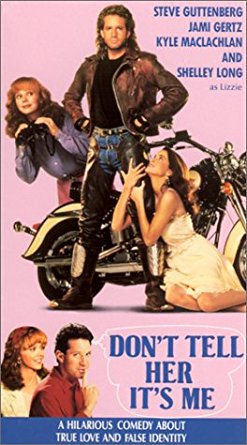
In this very minor romantic comedy, Gus (Steven Guttenberg) is a cartoonist who has just recently beaten cancer.  The treatment has left him bald, overweight, and lonely.  His sister, a popular romance novelist named Lizzie (Shelley Long), sets hm up with her friend, a journalist named Emily (Jami Gertz).  When Emily does not return Gus’s affection, Lizzie decides to transform Gus into every woman’s dream, which in this movie is a rebel named Lobo who comes from New Zealand and rides a motorcycle.  Gus spends a month working out, growing his hair long, and learning how to speak with a New Zealand accent.  Emily falls in love with Lobo, never realizing that he is actually Gus but what will happen when Gus has to finally tell her the truth?  Despite good performances (especially from Shelley Long), Don’t Tell Her It’s Me it too formulaic and predictable to be memorable.  Even if he does have a mullet and is speaking with a different accent, Steve Guttenberg is always going to be Steve Guttenberg and it’s hard to believe that Emily would not be able to see through his act.

Don’t Tell Her It’s Me actually has two Twin Peaks connections.  Kyle MacLachlan, the one and only Dale Cooper himself, plays Trout, who is both Emily’s editor and her cad of a boyfriend.  It’s a nothing role but fans of Twin Peaks will be interested to know that, when Trout is inevitably revealed to be cheating on Emily, the woman that he’s cheating with is played by MacLachlan’s Twin Peaks co-star, Madchen Amick.

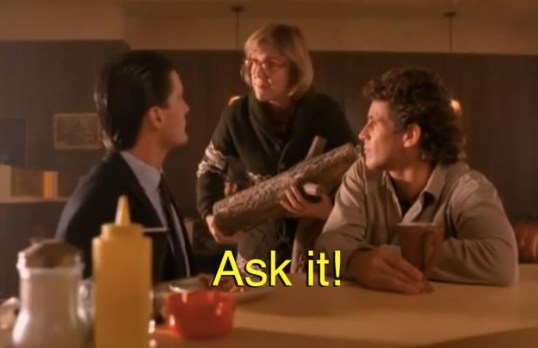
If only the Log Lady had been around, Don’t Tell Her It’s Me could have been a much different picture.

TV Review: Twin Peaks 1.2 “Traces to Nowhere” (directed by Duwayne Dunham)


Traces to Nowhere is an episode defined by two accidents.

The first is Pete Martell serving Agent Cooper (Kyle MacLachlan) and Sheriff Truman (Michael Ontkean) fish-tainted coffee while Cooper and Truman are asking Josie (Joan Chen) about Laura Palmer (Sheryl Lee) tutoring her in English.  Pete runs into the room, saying, “Fellas, don’t drink that coffee!  A fish fell into the percolator!”  Hours later, sitting at the Double R Diner, Cooper says that he still has “the taste of that fish-flavored coffee in my mouth.”

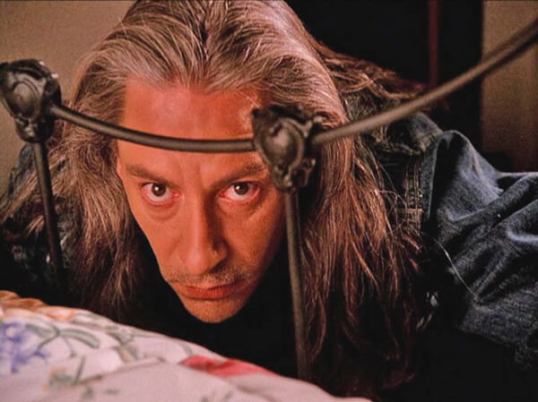
The other accident was Killer Bob, who makes his first appearance when Mrs. Palmer (Grace Zabriskie) has a vision of him in the corner of a room.  Bob and his sudden appearances would become one of the best known things about Twin Peaks but, ironically, he wasn’t even a part of the show’s original conception.  Bob was played by Frank Silva, a prop master and set decorator who was working on the pilot episode of Twin Peaks when David Lynch accidentally caught his reflection on camera.  Lynch was so taken by the accidental image that he created the role of Killer Bob specifically for Silva.  Silva made a strong and undeniable impression as the growling Bob but, unfortunately, it would be his only role as an actor.  Silva died of AIDS in 1996, four years after appearing in Twin Peaks: Fire Walk With Me.

Frank Silva as Killer Bob

Traces to Nowhere was the first regular episode of the series, following the pilot.  Probably in order to reassure nervous television executive and viewers who were on the fence about whether or not Twin Peaks was for them, this episode is more quirky than actively strange.  A lot of time is devoted to the show’s more soapy plot threads, like the affairs between Ben Horne (Richard Beymer) and Catherine Martell (Piper Laurie) and Donna Hayward (Lara Flynn Boyle) and James Hurley (James Marshall) and the abusive marriage of Leo (Eric Da Re) and Shelley (Madchen Amick).

There are a lot of first in Traces to Nowhere.  This is the episode where Audrey first talks to Cooper, Cooper first says that the Great Northern serves a “damn fine cup of coffee,” where Cooper first has a slice of cheery pie, and where Cooper first talks about Albert Rosenfield.  This episodes also features the first mention of the Bookhouse Boys and, most importantly for fans of the series, the first appearance of Catherine Coulson as everyone’s favorite Log Lady.  When the Log Lady first shows up and tells Cooper to ask her log who killed Laura Palmer, the character seems like just a throw away joke.  But fans of the show know how important the Log Lady will become.

Catherine Coulson, was passed away in 2015, was the ex-wife of Jack Nance, who played Pete Martell.  Coulson and Nance both worked with David Lynch on his first film, Eraserhead.  It is said that during the shooting of Eraserhead, Lynch looked over at Coulson and said that he had just suddenly had a vision of her holding a log.  (Nance and Coulson were not the only Eraserhead alumni to later appear on Twin Peaks.  Charlotte Stewart, who played the weak mother of Bobby Briggs on Twin Peaks, earlier played Mary X, Nance’s strange girlfriend in Erasherhead.)

Up next: Zen, or the Skill To Catch a Killer!

Previous Entries in The TSL’s Look At Twin Peaks:

  1. Twin Peaks: In the Beginning by Jedadiah Leland
  2. TV Review: Twin Peaks 1.1 — The Pilot (dir by David Lynch) by Lisa Marie Bowman

A Movie A Day #85: Blue Skies Again (1983, directed by Richard Michaels)


As Lisa said in her review of Night Game, Erin asked for baseball reviews today and there is no way you can turn down Erin.  So, I watched Blue Skies Again on YouTube.

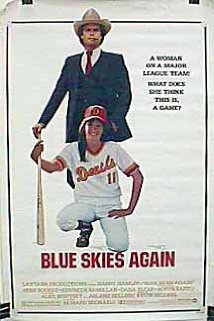
The Denver Devils is a minor league baseball team that is coming off of its worst season ever.  The new owner (Harry Hamlin) is only concerned with making money and does not know anything about baseball.  The veteran coach (Kenneth McMillan) does not have the respect of his players.  Teammates like Ken (Andy Garcia), Calvin (Joseph Gian), and Wall Street (Cylk Cozart) are worried that they could lose their place on the team at any moment.  The only good news is that two sports agents (Mimi Rogers and Dana Elcar) have found the perfect prospect for the Devils.  This player can play second base.  This player can catch a grounder and turn it into a double play.  This player can hit the ball out of the park.  The only problem?  The player’s name is Paula (Robyn Barto) and she’s a girl!

Robyn Barto was asked to audition after a casting director saw her playing softball for her community college.  Blue Skies Again was her first film role.  In the role of a professional baseball player, Barto was a very convincing softball player.  But Barto was likable and had an engaging screen presence so it’s too bad that this movie was not only her first but also her last.  In the publicity leading up to the release of Blue Skies Again, Barto got to throw out the opening pitch at a Dodger game but that was it for her time in the spotlight.  According to one article that I found that was written ten years after the release of Blue Skies Again, Barto never regretted not having a film career and ended up coaching the softball team at her old high school.

Blue Skies Again was not only the debut of Robyn Barto but also the first feature film for both Mimi Rogers and Andy Garcia.  Garcia does not get to do much but Mimi Rogers shows off the sexy and fun screen presence that always makes me wonder why she never really became a big star.

Blue Skies Again is an okay movie but it does not add up to much.  No one wants to play with a girl but then she gets a hit so everyone changes their mind.  It’s the type of movie that, today, would be made for Hallmark or the Family Channel.  It’s a nice baseball movie but it can’t compare to the real thing.


A Movie A Day #84: Made In U.S.A. (1987, directed by Ken Friedman)


Dar (Adrian Pasdar) and Tuck (Chris Penn) are two losers.  Dar is angry.  Tuck is a moron.  They live in a dying Pennsylvania industrial town, where they have no future.  Dar is worried that the air has been poisoned by the nearby coal mine.  He and Tuck decide to go to California so that they can look for a woman whose picture they’ve seen in a magazine.  Since Dar and Tucker have no money and no one is willing to pick up two hitchhikers who look like they are on sabbatical from the Manson Family, they end up having to steal cars and hold up convenience stores.  They also pick up a mentally unstable woman named Annie (Lori Singer).  Annie may be dying because of all the pollution in the world.  Dar and Tuck take the time to transport a Native American runaway back to her reservation, where they both get scalped.  Mostly, Dar and Tuck just drive through some of the ugliest parts of America and talk about how, because of pollution, everything is all messed up.
In the 1990s, Made In U.S.A. used to show up frequently on HBO.  It’s a lousy movie, featuring one of the worst performances of Chris Penn’s career.  (Adrian Pasdar is also pretty bad but more is expected from Chris Penn than from Adrian Pasdar.)  Made in U.S.A. does provide a contrast to the relentlessly pro-American films that dominated the box office in the 1980s but it’s really only noteworthy for the soundtrack, which features songs by Sonic Youth and Timbuk3.

Whatever you do, do not mistake this Made In U.S.A. for Jean-Luc Godard’s.

Twin Peaks: In The Beginning


Twin Peaks started with Marilyn Monroe.  It sounds like a bad April Fools joke but it’s true.

In 1986, after the success of Blue Velvet, David Lynch was hired to direct a biopic of Marilyn Monroe.  Lynch would later say that the Monroe film never happened because, while he liked the idea of doing a story about “a woman in trouble,” he was not comfortable with telling a true story.  Even though the film was never made, it did lead to David Lynch meeting and befriending a screenwriter named Mark Frost.  Frost, who had written for ground-breaking TV shows like Hill Street Blues, was one of the many screenwriter who would take a stab at the screenplay for the Monroe project.

Even after it became obvious that the Monroe biopic was never going to be produced, Lynch and Frost continued to look for projects that they could work on together.  After several film proposals that failed to generate much interest, they followed the advice of Lynch’s agent and worked on a project that, like Blue Velvet, would look at the underbelly of life in small town America.

Lynch and Frost started with an image, a body washed up on the shores of the lake.  The body was Laura Palmer who, like Marilyn Monroe, was a woman in trouble.  Originally called North Dakota (because that was where it was originally meant to take place), this is the project that eventually became Twin Peaks.

Twin Peaks premiered on ABC on April 9th, 1990 and, for its first season, it was a phenomena.  Though critics were often baffled, audiences were intrigued by the combination of Lynch’s surrealistic vision and Frost’s serialized storytelling.  Twin Peaks was nominated for 14 Emmys at the end of its first season.  The second season, however, saw rating sharply decline as audiences, critics, and executives all decided that the show was just too strange.  After just 30 episodes, Twin Peaks was canceled.

Even after it ended, Twin Peaks lived on.  There was a feature film.  There were frequent reruns on stations like Bravo.  Twin Peaks‘s quirky style changed the face of television.  Shows like Picket Fences and Northern Exposure were basically Twin Peaks-lite, quirky without ever being truly surreal.

Despite the unceremoniously way that it ended, Twin Peaks never went away and new audiences discover it every day.  In May, 26 years after it went off the air for the first time, Twin Peaks will be returning. with new episodes, to Showtime.  Before it starts again, we are going to take a look back at the original Twin Peaks on this site.  Look for Lisa’s review of the pilot tomorrow.

To quote Dale Cooper, “I have no idea where this will lead us, but I have a definite feeling it will be a place both wonderful and strange.”

A Movie A Day #83: Shattered: If Your Kid’s On Drugs (1986, directed by Burr Smidt)


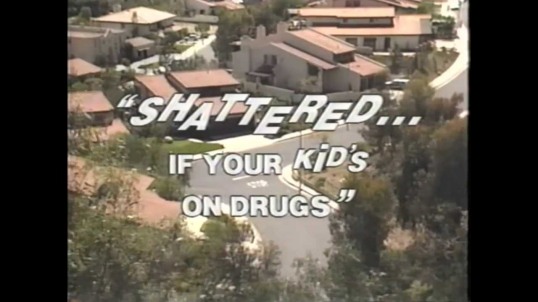
Shattered: If Your Kid’s On Drugs is a typical anti-drug video from the 1980s.  The story is familiar after school special material.  Kim (Megan Follows) and Rick (Rick Segall) are upper middle class kids who live in the suburbs.  Rick is a track star.  Kim is at the top of her class.  That all changes when they start hanging out with the local drug dealer (Dermot Mulroney), who gets Rick hooked on marijuana and Kim hooked on cocaine.  Kim gets an F on her report card.  Rick can no longer jump the hurdles.  Eventually, their parents stop drinking and taking valium long enough to force them into rehab.  The message is that tough love is the only solution.

The only thing that makes Shattered: If Your Kid’s On Drugs noteworthy is the strange and unexpected presence of Burt Reynolds and Judd Nelson, playing themselves and commenting on the action.  The first scene in the video is Burt and Judd driving their pickup truck through the suburbs, talking about how nice it is.  “Lot of nice restaurants,” Burt says.  “Are you going to buy me lunch?” Judd asks.  “Lot of nice restaurants,” Burt replies.  “This town is the American Dream,” Judd says.  “Or the American nightmare,” Burt adds.  When Kim and Rick are getting high in Dermot Mulroney’s chartreuse microbus, Burt and Judd sit on a picket fence and shoot the crap.  Burt can’t understand why teens would use drugs and Judd reminds him that it has been a while since he was a teenager. Rumor has it that both Burt and Judd appeared in this video to fulfill court-ordered community service.

Everything works out in the end.  If you have any doubt, just look at Burt giving us a thumbs up before the final credits roll.