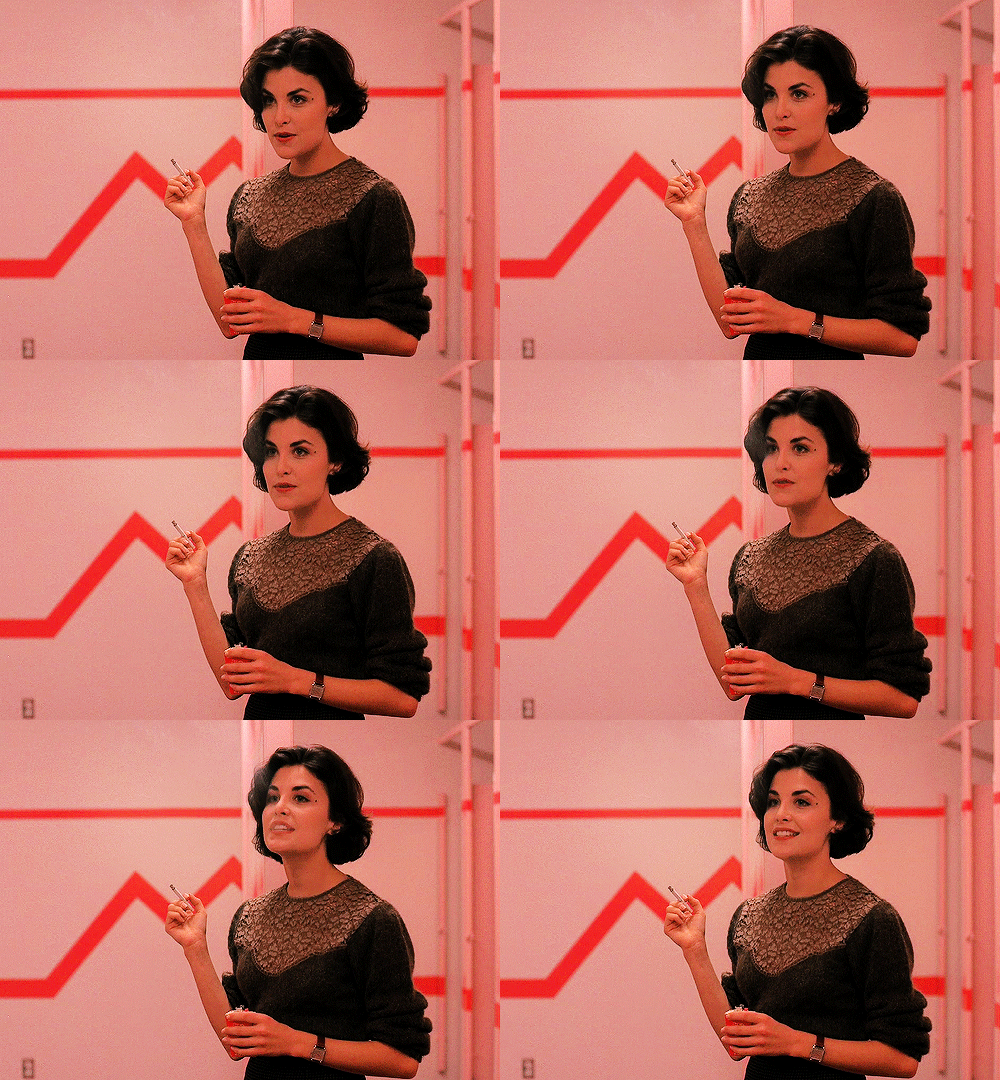
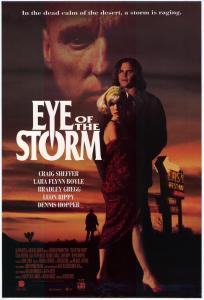
A Movie A Day #94: Eye of the Storm (1991, directed by Yuri Zeltser)


A motel sits off of a highway in the Nevada desert.  One night, two criminals (Ally Walker and German boxer Wilhelm von Homburg) brutally murder the husband and wife who own the motel.  Their youngest son, Steven, flees the criminals by jumping through a window and is left for dead.

Ten years later, the motel is still sitting off the highway, operated by the blind Steven (Bradley Gregg) and his older brother, Ray (Craig Sheffer).  Ray is very protective of his brother and, when a car pulls up to the motel, he does not even want to turn on the vacancy sign.

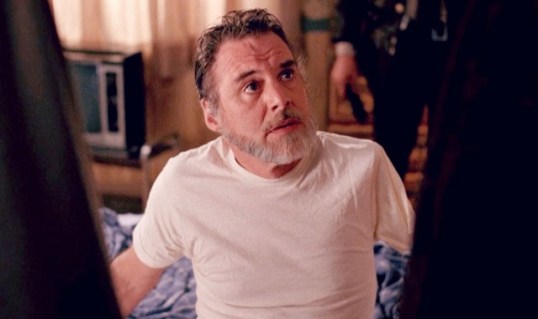
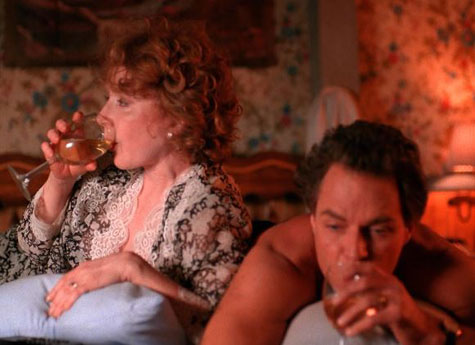
The motel’s newest guests are a very unlikely couple.  Marvin Gladstone (Dennis Hopper) is an alcoholic gambler who regularly berates at his much younger trophy wife, Sandra (Lara Flynn Boyle).  Marvin and Sandra were heading to Las Vegas to renew their vows but the drunk Marvin accidentally drove their car off the road.  Now, Marvin and Sandra are stranded at the motel while a dust storm approaches and one of the brothers turns out to be psychotic.

Eye of the Storm is another low-budget and predictable thriller from the 1990s but, taken on its own terms, it’s not bad.  Along with some striking shots of the desert, Eye of the Storm features a quartet of strong performances.  For fans of David Lynch, the main interest here will be seeing Blue Velvet‘s Dennis Hopper and Twin Peaks‘s Lara Flynn Boyle as a couple in trouble.  Hopper especially seems to be enjoying himself and when his character leaves the movie, Eye of the Storm becomes much less interesting.  Lara Flynn Boyle is sexy throughout, enough to make you reconsider everything you thought you knew about Donna Hayward.

See this one on a double bill with Red Rock West.

TV Review: Twin Peaks 2.2 “Coma” (directed by David Lynch)


Among fans of the series, the second season of Twin Peaks is a sore point.  Almost everyone agrees that it was a let down and that it never matched the brilliance of the first season.  The only question is why.

Was it because the first season started as a mid-season replacement and only had to come up with eight episodes worth of story?  If the first season had been a full, 22-episode season would it have eventually become as uneven as the second season?

Was it because, as some ABC executives have suggested, David Lynch and Mark Frost were making up their complex story as they went along and, when the second season did not immediately reveal who killed Laura Palmer, they ended up alienating the audience through their self-indulgence?

Was it because, as supporters of Lynch and Frost often argue, ABC demanded more control over the series during the second season?  One reason that it was such a shock to hear that Lynch would be bringing Twin Peaks back was because he swore, after the show’s first cancellation and the failure of the Mulholland Drive pilot, that he would never deal with television executives ever again.

It may be that all of the above is true but one thing is for sure.  If the first season of Twin Peaks showed how far the medium of television could be pushed, the second season showed just how hard television can push back.
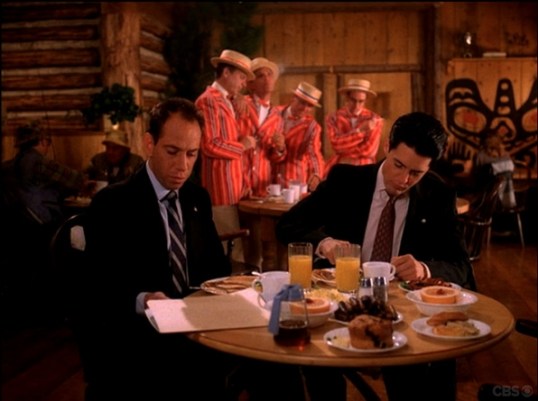
The second episode of the second season, Coma, was directed by Lynch himself.  It opens with Cooper (Kyle MacLachlan) and Albert (Miguel Ferrer) eating breakfast at the Great Northern.  For some reason,  members of a Barbershop quarter, all wearing red striped jackets, are standing behind them.  Cooper talks about the Happy Generations of Tibet.  Albert is not happy about anything, not even Ronette Pulaski waking up.  Albert also warns Cooper that his former partner, Windom Earle, has escaped from a mental asylum.

(Windom will be, after BOB, this season’s Big Bad.)

Donna (Lara Flynn Boyle) is doing Laura’s Meals on Wheels route.  When she brought a meal to Mrs. Tremond, a coughing woman who is confined to her bed, it took me a few minutes to realize why Mrs. Tremond looked so familiar.  Mrs. Tremond was played by Frances Bay, who appeared on a classic episode of Seinfeld as a woman who is mugged for her marble rye.  (Bay also appeared in Blue Velvet.)

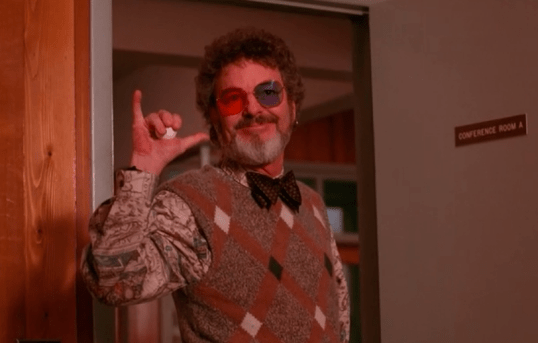
Mrs. Tremond has a grandson (Austin Jack Lynch, the real-life son of David Lynch and Mary Fisk).  He wears a tuxdeo, sits in a corner, and says, “Sometimes things can happen just like this,” before snapping his fingers.  When Mrs. Tremond sees creamed corn on her meals on wheel plate, says that she asked for no creamed corn and suddenly, the creamed corn appears in her grandson’s hands.

“My grandson is studying magic,” Mrs. Tremond says.

“That’s nice,” Donna says, while the grandson stares at her without the slightest hint of a smile.

Mrs. Tremond tells Donna that she did not know Laura but she recommends that Donna ask “Mr. Smith” next door.  “He was Laura’s friend.”

J’ai une ame soilitaire,” Mrs. Tremond’s grandson adds.
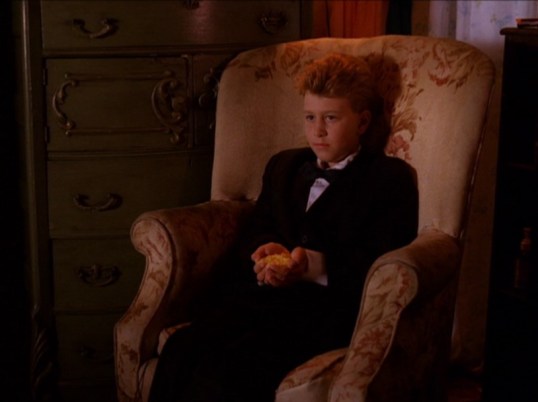
(Deliberately surreal scenes like this might be why ABC executives felt that they needed to step in and assert some control over the show.  Fans of David Lynch love this stuff and the scene may not seem that unusual now that we are living in a world where almost every show owes some sort of debt to Twin Peaks but, in 1990, viewers, many of whom were unfamiliar with Lynch’s films, were probably saying, “This is too weird for me,” and changing the channel.)

Donna goes next door and, when Mr. Smith fails to respond to her knocking, she slips a note under his door.

At the hospital, Cooper and Harry (Michael Ontkean) drop in on Ronette (Phoebe Augustine).  After some lengthy business about Cooper and Harry trying to figure out how set up a stool so that they can sit next to Ronette’s bed, Cooper shows Ronette sketches of both BOB and Leo.  Though Ronette cannot speak, she still shakes her head no when Cooper asks her if Leo is the man who hurt her.  However, the sketch of BOB causes Ronette to freak out.  “Trrr…trrr…” Ronette says, which Cooper interprets as meaning, “Train.”

At the Great Northern, Ben (Richard Beymer) and Jerry (David Patrick Kelly) sit on the floor and stare at two ledgers.  The real ledger shows the Packard Mill slowly sinking into bankruptcy.  The fake ledger shows the mill turning a profit.  Ben and Jerry are trying to decide which ledger to burn.  Since they can’t make up their mind, they decide to roast marshmallows instead.

(Meanwhile, in 1990, a housewife in Michigan says, “This is too weird,” and changes the channel over to Beverly Hills 90210 on Fox.)
At the Double R Diner, Andy (Harry Goaz) has been taping up pictures of BOB and now his hands are covered in tape.  The Log Lady (Catherine Coulson) enters and sits down next to Major Briggs (Don S. Davis).  Her log has something to tell Maj. Briggs.

“Can you hear it?” The Log Lady asks.

“No, ma’m, I cannot,” Maj. Briggs says.

“I will translate…deliver the message…do you understand?”

“Yes, ma’m, I do.”
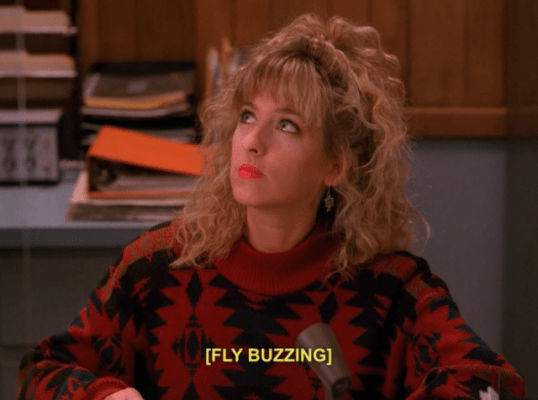
At the police station, Lucy (Kimmy Robertson) kills a buzzing fly.  Andy, who still has a piece of tape attached to his forehead, comes in and tells Lucy that, when he last donated to the sperm bank, he was told that he was sterile.  So, if Lucy’s pregnant, it is not with his child.  Lucy pulls the tape off his forehead and refuses to speak to him.

Hank (Chris Mulkey) comes by and signs in with Harry.  Cooper watches as Harry and Hank have another tense conversation and, after Hank leaves, he asks Harry how long the two of them were friends.  Harry says that Hank used to be a Bookhouse Boy.  “Back then, he was one of the best of us,” Harry says.

Before Harry can continue, Ben Horne calls.  He tells Harry that Audrey has been missing for two days.  Then Jerry comes into Ben’s office and reveals that Catherine never signed the life insurance policy.  “Win a few, lose a few,” Ben says.

Suddenly, the newly energized and white-haired Leland (Ray Wise) comes walking into the office.  He says that Ben should call Thor Einer in Iceland, just to discover that Ben is already calling Thor Einer.  Einer reveals that Leland already called him to tell him about the fire at the mill.  Ben assures Einer that the fire is nothing to worry about, all the while glaring at Leland.

Leland sees a sketch of BOB in the corner of Ben’s office.  Leland picks it up and says, “I know him.”  Leland says that BOB used to live next door to his grandfather’s vacation home.  Leland runs out of the office.

“Jerry,” Ben says, “please kill Leland.”

“Is this real, Ben,” Jerry says, “or just some strange and twisted dream?”

(Meanwhile, in 1990, a farmer in Iowa shakes his head, switches over to CBS, and watches Doctor, Doctor, a sitcom starring Matt Frewer.)
At the hospital, Doc Hayward (Warren Frost) updates Shelley (Madchen Amick) on Leo’s (Eric Da Re) condition.  The bullet lodged in Leo’s spine.  He lost a lot of blood and suffered brain damage.  Shelly asks if Leo’s going to be a vegetable.  Shelly cries but does not seem to be that upset.

At the police station, someone calls for Sheriff Truman but refuses to reveal their name.  Lucy hangs up on them.

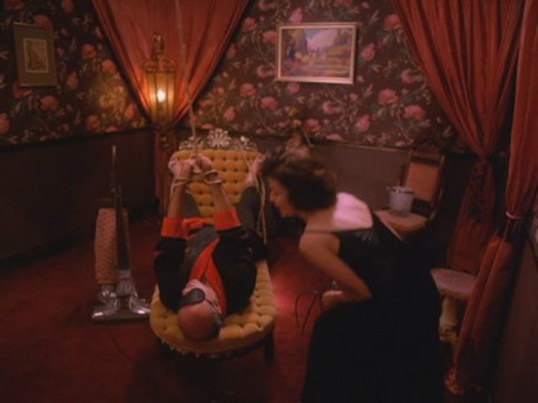
At One-Eyed Jack’s, Audrey (Sherilyn Fenn) brings a bucket of ice to a room where her boss at Horne’s Department Store, Emory Battis (Don Amendolia), is tied up, blindfolded, and listening to a vacuum cleaner.  Emory gets upset with the vacuum cleaner is turned off but is even more upset when Audrey wraps a cord around his throat, rips off his blindfold, and demands to know everything that he knows.

“I work for the owner of One-Eyed Jacks!” Emory says.

“WHO IS!?” Audrey demands, tightening the cord.

“Your father!  He owns everything!”  Emory goes on to say that Ben know Laura worked at One-Eyed Jack’s and then says, “Laura always got her way!  Just like you!”
At night, Bobby (Dana Ashbrook) and Shelly sit in his car and listen to the generic rock station.  They talk about ways to torture comatose Leo.  Bobby has a plan.  Shelly can bring Leo home and then collect his disability checks.

At the Great Northern, Dale records a message to Diane, telling her that Windom Earle has vanished.  Unfortunately, as someone who has sat through all of season 2, I already know how long the show is going to draw out the Window Earle storyline.  Before I can spend too much time dwelling on that, Maj. Briggs shows up at Dale’s hotel room.  Is he delivering the log’s message?

Yes, he is!  Maj. Briggs says that he can not reveal the nature of his work or the identity of the message sender but Briggs does reveal that, as a part of his work for the federal government, Maj. Briggs keeps an eye on transmission’s received by deep-space monitors, “aimed at galaxies beyond our own.”  Most of the time, the transmissions are just gibberish but, on Thursday night/Friday morning, the following transmission came in:

“The owls are not what they seem.”

This was followed, hours later, by another transmission: “Cooper.  Cooper.  Cooper.”

(Meanwhile, in 1990, a man in Florida says, “I can’t follow this,” and changes the channel to CBS so he can watch the last few minutes of the first attempt to bring The Flash to network television.)
We now reach one of the most derided scenes in the history of Twin Peaks.  At the Hayward House, James (James Marshall) plays guitar while Maddy (Sheryl Lee) and Donna sing a song into a microphone.  Supposedly, the inspiration for this scene came after David Lynch walked by James Marshall’s dressing room and heard Marshall playing a blues riff.
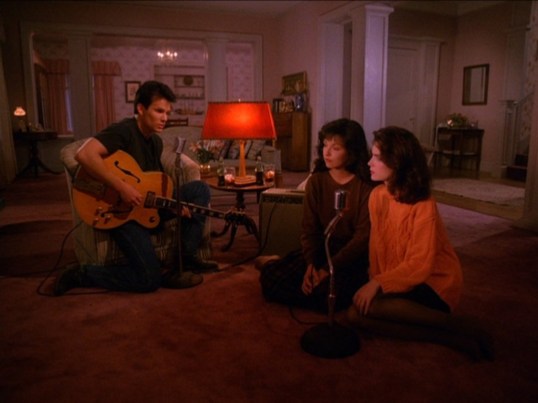
Musical interludes are actually one of Lynch’s trademarks.  Remember Dean Stockwell and Isabella Rossellini in Blue Velvet?  Or Bill Pullman at the jazz club in Lost Highway?  Or the Llorando scene in Mulholland Drive?  Even the pilot for Twin Peaks had Julie Cruise singing at the Road House.  The problem with the scene in Coma is that the song is boring and that the performance seems to drag on forever.  Whatever genius that Lynch thought he heard coming from Marshall’s dressing room is not present in the Hayward House.

(In 1990, a Montana rancher gives up once the song reaches the second verse.  He switches over to NBC, just in time to catch the final punchline in that night’s episode of a new sitcom called Wings.)
Finally, Donna gets jealous of the way that James is looking at Maddy and runs over to a corner of the house.  When James walks up to her, she kisses him.

Way to Go, James!

“Donna,” James asks, “what’s going on?”

Dude, don’t ask questions!  Just go with it!

“I’m trembling, James,” Donna says, “You made me.”

Wait, what?

The phone rings.  Donna ignores it but Doc Hayward answers and yells downstairs, “Donna, there’s a telephone call for you from a Harold Smith.”

Donna takes the call and asks Harold if they can meet.
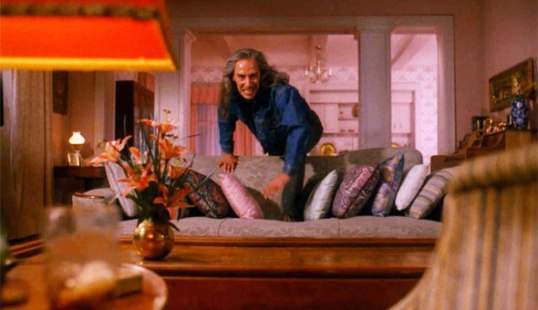
Meanwhile, Maddy sits in front of the microphone with a “What did I do?” look on her face.  Suddenly, she sees BOB (Frank Silva) walking through the living room.  She screams as he climbs over the couch.  James and eventually Donna run over to her.  Bob has vanished.

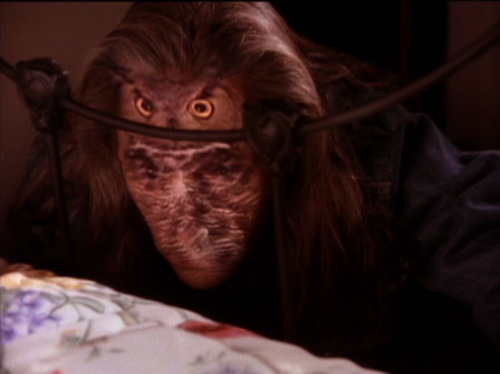
At the Great Northern, Cooper has a dream.  He sees the Giant.  He hears Maj. Briggs saying, “The owls are not what they seem.”  BOB appears.  His face morphs into the face of an owl and then back again.

Cooper is woken up by the sound of his telephone ringing.  It’s Audrey.  She’s crying.  “Why aren’t you here?” she says.  Cooper tells her that she needs to come home.

Suddenly, the call is cut off.  Audrey has been discovered by Blackie (Victoria Catlin) and Emory.  “Trouble, Ms. Horne?” Blackie says.  “You don’t know what trouble is.”

End credits.
But do not worry.  Cooper, Audrey, Lucy, and all your favorites will return in the next episode, The Man Behind the Glass, which I’ll be reviewing tomorrow.

Previous Entries in The TSL’s Look At Twin Peaks:

  1. Twin Peaks: In the Beginning by Jedadiah Leland
  2. TV Review: Twin Peaks 1.1 — The Pilot (dir by David Lynch) by Lisa Marie Bowman
  3. TV Review: Twin Peaks 1.2 — Traces To Nowhere (directed by Duwayne Dunham) by Jedadiah Leland
  4. TV Review: Twin Peaks 1.3 — Zen, or the Skill To Catch A Killer (dir by David Lynch) by Lisa Marie Bowman
  5. TV Review: Twin Peaks 1.4 “Rest in Pain” (dir by Tina Rathbone) by Leonard Wilson
  6. TV Review: Twin Peaks 1.5 “The One-Armed Man” (directed by Tim Hunter) by Jedadiah Leland
  7. TV Review: Twin Peaks 1.6 “Cooper’s Dreams” (directed by Lesli Linka Glatter) by Lisa Marie Bowman
  8. TV Review: Twin Peaks 1.7 “Realization Time” (directed by Caleb Deschanel) by Lisa Marie Bowman
  9. TV Review: Twin Peaks 1.8 “The Last Evening” (directed by Mark Frost) by Leonard Wilson
  10. TV Review: Twin Peaks 2.1 “May the Giant Be With You” (dir by David Lynch) by Leonard Wilson
 

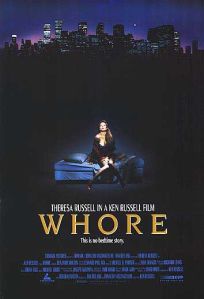
A Movie A Day #93: Whore (1991, directed by Ken Russell)


Liz (Theresa Russell) is a prostitute trying to survive on the mean streets of Los Angeles.  With the help of a homeless performance named Rasta (Antonio Fargas), Liz tries to escape from her abusive pimp, Blake (Benjamin Mouton).
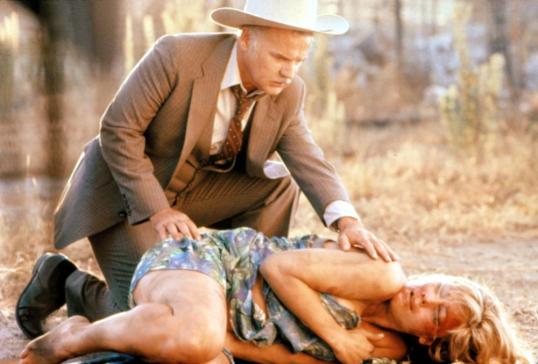
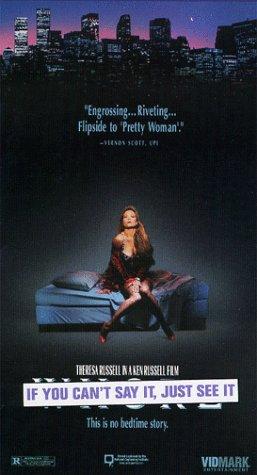
To its credit, Whore was made as a response to the glamorous and irresponsible way that prostitution was portrayed in Pretty Woman but Whore had too much going against it to succeed.  It was based on a theatrical monologue, which was almost always a bad sign.  The majority of the movie was Liz talking straight to the camera, which was another red flag.  Most ominously, it was a Theresa Russell movie that was not directed by Nicolas Roeg and those never seemed to turn out well.  The director of Whore was Ken Russell but it featured none of the excess that Russell was known for.  Stuck with a low-budget and a reportedly unenthusiastic studio, Russell’s direction was uncharacteristically restrained.  (That’s a polite way of saying boring.)

The one good thing about Whore, and the reason why I’m writing about it during this site’s look back at Twin Peaks, was the presence of Jack Nance, playing one of the few men who actually tries to help Liz.  Nance, of course, not only played fishing-obsessed Pete Martell in Twin Peaks but also starred in Eraserhead and appeared in all of Lynch’s films (with the exception of The Elephant Man) up until Nance’s mysterious death in 1996.  Literally credited as playing “Helpful passerby.” Nance only had a few minutes of screen time but made a definite impression as one of the few kind people to be found in Liz’s dark world.

As a reflection of how much times have changed, Whore‘s title was so controversial that, in 1991, it was released in some areas under an alternative title: If You Can’t Say It, Just See It.


A Movie A Day #92: Love, Cheat, & Steal (1993, directed by William Curran)


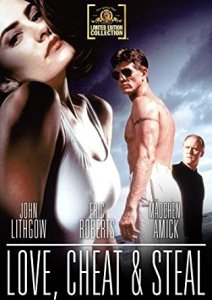
Paul Harrington (John Lithgow) is a wealthy banking consultant who has just married a sexy, younger woman, Lauren (Madchen Amick).  Paul thinks that Lauren is perfect but then her brother, Donald (Eric Roberts), shows up.  What Paul does not know is that Donald is not actually Lauren’s brother.  Instead, Donald is Reno, Lauren’s first husband who she never actually divorced. Reno has just escaped from prison where he was serving time for a crime for which he believes Lauren framed him.  While Paul tries to save his father’s failing bank, Reno starts to plan a bank robbery and Lauren tries to balance her old life with Reno with her new life with Paul.
Mild neo noirs like Love, Cheat, & Steal were a dime a dozen in the 1990s.  Love, Cheat, & Steal was made for Showtime and, throughout the 1990s, it used to tempt kids like me with its promise of “Brief Nudity” and “Adult Situations.”  The only thing that makes it memorable is the presence of Madchen Amick, who was always the most beautiful of all of the Twin Peaks starlets, even if she often was overshadowed by Sherilyn Fenn and Lara Flynn Boyle.  Madchen Amick has the right combination of girl next door innocence and enigmatic sultriness to make her perfect for movies like Love, Cheat, & Steal.  Other than the presence of Madchen Amick, Love, Cheat, & Steal is best remembered for being your only chance to see Eric Roberts do a Jack Nicholson imitation.

One final note: Irish actor Dan O’Herlihy has a small role.  Though he is best known for playing Conal Cochran in Halloween 3, he also co-starred with Amick during the second season of Twin Peaks.

A Movie A Day #91: Ruby (1992, directed by John Mackenzie)


Of all the stars to come out of Twin Peaks, Sherilyn Fenn’s star briefly shined the brightest and sadly, she was the most misused by Hollywood.  While it is true that Fenn has worked regularly since Twin Peaks went off the air, she has rarely gotten the great roles that someone with her talent deserves.  Instead, her performances have far too often been the best thing about an otherwise mediocre film.
For example, Ruby.

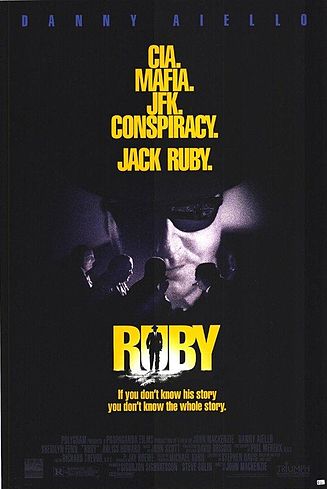
In this very speculative biopic about the strip club owner who killed Lee Harvey Oswald and whose organized crime background has put him at the center of a thousand conspiracy theories, Danny Aiello plays Jack Ruby and Sherilyn Fenn plays his only friend, Sheryl Ann Dujean (or, when she’s stripping in the Carousel Club, Candy Cane).  The film portrays Jack Ruby as being a low-level mobster who is never as valuable or as important to his superiors as he thinks he is.  In this movie, Ruby is always on the outside looking in on the conspiracy and, when he kills Oswald, it is because he wants to prove that he is more than just a small time hood.  Candy, who was a composite of several Carousel Club dancers, maintains a strong platonic friendship with Jack and is always there for him to talk to, except for when she goes to Vegas to perform for and sleep with the President.

Ruby came out as the same time as JFK and it often seems like a fanfic based on Stone’s film.  Low budget and overwritten, Ruby never works as a movie but Danny Aiello is perfectly cast as the bombastic but insecure Jack Ruby.  Unfortunately, Ruby‘s screenplay often does not seem to know what it wants to say about its main character.  As Candy, Fenn is not given nearly enough to do but she still manages to show the same natural spark that made her a star on Twin Peaks.

Sherilyn Fenn is not the only Twin Peaks cast member to have a role in Ruby.  Keep an eye out for a post-Twin Peaks, pre-X-Files David Duchovny, playing the role of J.D. Tippit.

A Movie A Day #90: Red Rock West (1992, directed by John Dahl)


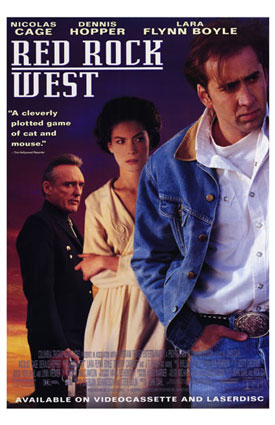
The place is Red Rock, a little town located in the middle of nowhere Wyoming.  When a man from Texas (played by Nicolas Cage) wanders into his bar, the owner, Wayne (J.T. Walsh), assumes that the man is Lyle From Dallas, the semi-legendary hit man who Wayne has hired to kill his wife, Suzanne (Lara Flynn Boyle).  Wayne gives the man half of his payment in advance and promises the other half after Suzanne is dead.  What Wayne doesn’t realize is that Lyle From Dallas is not actually Lyle From Dallas.  Instead, he is a drifter named Michael who has just recently lost his job.  Michael takes Wayne’s money but, when he sees Suzanne, he tells her that Wayne wants her dead.  Suzanne responds by offering to pay Michael to kill Wayne.  Michael mostly just wants to leave town but his every effort is thwarted, with him continually only managing to get a mile or two out of town just to then find circumstances forcing him to once again pass the Red Rock welcome sign.  Meanwhile, the real Lyle From Dallas (Dennis Hopper) has shown up and he is pissed.
Red Rock West is a clever and energetic neo noir that plays out like the child of a marriage between the Coen Brothers and David Lynch.  Like the Coens’ Blood SimpleRed Rock West is a violent movie that is full of twist and turns and features characters who are often confused and rarely understand what is actually going on.  From David Lynch, it borrows both Twin Peaks‘s Lara Flynn Boyle and Blue Velvet‘s Dennis Hopper.  Red Rock West was made when Nicolas Cage still gave a damn and it also shows why, during his short career, J.T. Walsh was everyone’s favorite duplicitous character actor.  Hopper is his usual crazy self and Boyle is a sultry and sexy fatale.  Red Rock West is one of the best neo noirs of the 1990s.

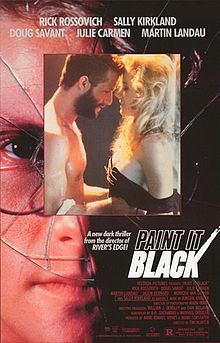
A Movie A Day #89: Paint It Black (1989, directed by Tim Hunter)


This month, since the site is currently reviewing every episode of Twin Peaks, each entry in Move A Day is going to have a Twin Peaks connection.  Paint In Black was directed by Tim Hunter, who directed three episodes of Twin Peaks, including the one that I reviewed earlier today.
Jonathan Dunbar (Rick Rossovich) should have it all.  He is an acclaimed sculptor but he’s being cheated financially by his dealer and sometimes girlfriend, Marion Easton (Sally Kirkland).  Things start to look up for Jonathan after he has a minor traffic accident with Gina (Julie Carmen).  Not only are he and Gina immediately attracted to each other but it turns out that Gina is the daughter of Daniel Lambert (Martin Landau), who owns the most prestigious art gallery in Santa Barbara.  It appears that Jonathan is finally going to get the big show that he has always dreamed of, but only if he can escape from Marion’s management.

One night, Jonathan helps out a man who was apparently mugged outside of an art gallery.  The man, Eric (Doug Savant), says that he’s an art collector and that he is a big fan of Jonathan’s work.  When Jonathan opens up about his problems with Marion, Eric decides to return Jonathan’s favor by killing Marion and anyone else who he feels is standing in the way of Jonathan’s success.  Because of the way that Eric artistically stages the murders, the police suspect that Jonathan is the murderer.

Depending on the source, Paint It Black’s original director was either fired or walked off the project and Tim Hunter was brought in to hastily take his place.  According to Hunter, he spent the production “shooting all day and rewriting all night.”  Paint it Black is a standard late 80s, direct to video thriller but it is interesting as a tribute to Alfred Hitchcock.  Hunter taught a class on Hitchcock at the University of California at Santa Cruz and Paint it Black is full of shout outs to the master of suspense.  Marion’s murder is staged similarly to a murder in Frenzy.  There are frequent close-ups of scissors, a reference to Dial M For Murder.  Probably the most obvious homage is the character of Eric, who appears to be based on Robert Walker, Jr’s character from Strangers on a Train.

Rick Rossovich was best known for playing cops, firemen, and soldiers in movies like Top Gun, Navy SEALS, and Roxanne.  He’s not bad in Paint it Black but he is still not the most convincing artistic genius.  Doug Savant and Sally Kirkland were better cast and more enjoyable to watch.  In fact, Kirkland is killed off too early.  The movie loses a lot of its spark once she is gone.

Paint It Black may not live up to being named after one of the best songs that the Rolling Stones ever recorded but Tim Hunter took unpromising material and shaped it into something that is far more watchable than anyone might expect.


Goodbye, Don Rickles, and Thank You For The Laughter


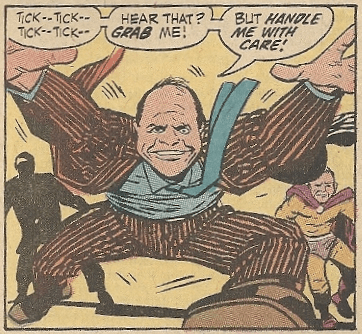
Don Rickles, as drawn by Jack Kirby

Oh man, Don Rickles.

Remember when they used to show old episodes of Saturday Night Live on Comedy Central?  I once watched an episode from 1984.  The host was Don Rickles.  His opening monologue was pure Don Rickles, which is to say that he insulted everyone in the audience.  It didn’t matter who the person was, Rickles was going to insult them.  He insulted John Madden.  He insulted Brandon Tartikoff, the president of the NBC.  He insulted the people who had just come in from off the street.  I don’t remember much about the specific insults.  The main thing that I remember is that the audience absolutely loved it.  Even before Rickles thanked them all for being good sports, the audience was eating out of his hand.

Don Rickles was the King of Insult Comedy.  His nickname was Mr. Warmth.  The nickname was not as ironic as you might think.  Off-stage, Rickles was reportedly a kind and generous man.  And, on-stage, Rickles may have insulted the audience but he did it with a twinkle in his eye and he always thanked him at the end.  His humor may have been built on insults but it was also built on self-depreciation.  The only person he made fun of more than the guy sitting in front row of the audience was himself.  Going to one of his shows might lead to you being called a “hockey puck,” but Rickles’s ultimate message was always that we’re all in this together.

As funny as Rickles was, he was also lucky enough to start his career in the 1950s.  (Reportedly, he got his big break when he saw Frank Sinatra in the audience, said, “Make yourself at home, Frank.  Hit somebody!” and insulted his work in his last movie.  Sinatra loved it.)  If Don Rickles had started his career this century, his politically incorrect humor would have gotten him banned from most clubs and Amy Schumer and Lena Dunham would have led a twitter campaign to have him incarcerated.  Don Rickles was lucky enough to by funny at a time when comedians were actually rewarded for making us laugh.

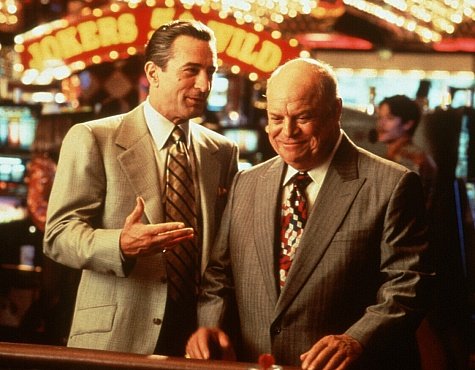
What was your favorite Don Rickles role?  He always said that his grandkids only liked him because he voiced Mr. Potato Head in the Toy Story films.  Rickles also had a rare dramatic role in Martin Scorsese’s Casino, more than holding his own against heavyweight actors like Robert De Niro and Joe Pesci.

Don Rickles died today at the age of 90.  I would say rest in peace but I don’t think Don Rickles would have appreciated the “in peace” part.  I will just say goodbye, Mr. Rickles and thank you for the laughter.


TV Review: Twin Peaks 1.5 “The One-Armed Man” (directed by Tim Hunter)


It’s all about team work.

Aren’t Lisa and Leonard doing a great job with their Twin Peaks reviews?  Yesterday, I was reading Leonard’s review of Rest In Pain and I immediately thought to myself, “I’m going to have to up my game if I want to keep up.”  That’s what team work does.  It challenges you to work harder and hopefully, it makes you better at whatever it is that you do.

For instance, Twin Peaks is usually thought of as being the “David Lynch show” but actually, there were several different creative voices involved and all of them left their mark on the series.  The show was co-created by veteran TV writer, Mark Frost (whose father, Warren Frost, played Doc Hayward).  Many of the show’s scripts are credited to Harley Peyton, who also wrote the film version of Less Than Zero.  Even Jerry Stahl, of Permanent Midnight fame, is credited with writing an episode.  While Twin Peaks had an easily identifiable style, only six of its 30 episodes were actually directed by David Lynch.  The other episodes were directed by directors like Uli Edel, Todd Holland, and Caleb Deschanel.  Even Diane Keaton directed an episode during season 2.  All of them brought their own talents and perspectives to this show and upped their game.

Episode 5, “The One-Armed Man,” was written by Robert Engels and directed by Tim Hunter.  Hunter, who directed two more episodes during the show’s second season, is best known for two sensitive films that he made about teenagers, Tex and River’s Edge.  Of the two, the surreal River’s Edge (which features Dennis Hopper playing a one-legged drug dealer who lives with a sex doll) feels the closest to Twin Peaks.

Episode Five opens with Sarah Palmer (Grace Zabriskie) giving a description of Killer BOB (Frank Silva) to Harry (Michael Ontkean) and Andy (Harry Goaz) while Doc Hayward and Donna (Lara Flynn Boyle) listen.  When Leland (Ray Wise) wanders into the room and taunts Sarah about having had two visions, Sarah talks about seeing someone digging up Laura’s necklace, making Donna uncomfortable since she’s the one who buried it in the first place.

(Whenever I see Grace Zabriskie and Warren Frost play a scene together, I am reminded of their later work on Seinfeld, where they played the bitter parents of Susan Ross and Mr. Ross was revealed to have been a former lover of John Cheever.)

Back at the police station, there’s a happening.  Lucy (Kimmy Robertson) is caught up in the latest episode of Invitation to Love, where the storyline seems to parallel the efforts of Ben Horne (Richard Beymer) and Catherine Martell (Piper Laurie) to run Josie (Joan Chen) out of business.  FBI Director Gordon Cole (voiced by David Lynch, himself) calls in to let them know that Albert has discovered that Laura Palmer was bound by household twine and that the marks on her shoulder came from a bird.  When Harry and Andy show Dale Cooper (Kyle MacLachlan) the sketch of BOB, Cooper identifies him as one of the men from his dream.

Dale also finally interviews everyone’s favorite psychiatrist, Dr. Jacoby (Russ Tamblyn).  Jacoby tries to beat Cooper at his own game, speaking in riddles and comparing the people of Tibet with the native Hawaiians.  Jacoby says that, when it comes to Laura, he can not violate doctor-patient confidentiality but he does share that “Laura was a woman” surrounded by boys and that, on the night Laura was murdered, he was following one of the men that Laura had told him about.  When Jacoby says that the man drove a red corvette, both Harry and Dale realize that he is talking about Leo Johnson (Eric Da Re).

Lucy interrupts to let Dale and Harry know that Deputy Hawk (Michael Horse) has just called.  He has tracked down MIKE, the one-armed man!

At the Timber Falls Motel, Ben and Catherine are having another tryst and discussing their plans for setting the mill on fire and forcing Josie into bankruptcy.  What they do not know is that Josie is sitting outside in her car, taking pictures.

The Timber Falls Motel is also the current home of the one-armed man and, as Harry, Andy, and Dale pull up, they are met by Hawk who tells them that the man is in room 101 and that his full name is Philip Michael Gerard.  (The One-Armed Man shares his name with Richard Kimble’s relentless pursuer on The Fugitive, a show that itself centered around the search for a one-armed man.  This episode aired years before the film version and Tommy Lee Jones reintroduced the world to the character.)

Andy has a Barney Fife moment when, standing outside of Room 101, he accidentally drops his gun and it goes off.  (“Gunplay,” Catherine says in her cabin, “Sounds serious.”)  When not even the sound of gunfire can get Gerard to open the door, Harry and Dale kick it in and discover their one-armed man stepping out of the shower.

Looking at a the drawing of BOB, Gerard says that he has never seen him before but that he does “look like someone.”  When Cooper asks if he has a friend named Bob, the one-armed man replies, “Bob Lydecker is just about my best friend in the world.”  He says that he’s been at the hospital because Bob, who is apparently the “best veterinarian in the county,” is in a coma.  Gerard is a traveling salesman, selling shoes.  He says that he lost his arm in a car accident.  He admits that he did have a tattoo on the arm that he lost.  In tears, he says that the tattoo said, “Mom.”

Al Strobel was a real-life amputee whose cameo in the pilot, riding in an elevator with Cooper and Harry, was originally meant to be his only appearance, a one-time homage to The Fugitive.  Lynch was so impressed with Strobel that he filmed some additional scenes with him that were used in the version of the pilot that was released theatrically in Europe.  (Those scenes were later incorporated into Cooper’s dream.)  In this episode, Strobel gives a memorable performance that justifies Lynch’s decision to expand his role.

At the high school, Audrey (Sherilyn Fenn) is smoking in the girl’s room and begging Donna to help her investigate Laura’s murder.  Audrey says that if she can solve the murder then maybe Dale will take her away with him.  When Audrey mentions One-Eyed Jacks, Donna proves herself to be just as crushworthy as Audrey by replying, “Isn’t that a western with Marlon Brando?”  Considering that One-Eyed Jacks was a box office flop that was released years before she was born, Donna’s knowledge of Marlon Brando’s filmography is truly impressive.

At the prison, Norma (Peggy Lipton) promises the parole board that, if Hank (Chris Mulkey) is released, she will give him a job at the diner and they will live together as “husband and wife.”  That will be interesting considering that Norma is now having an affair with Hank’s former best friend, Ed Hurley (Everett McGill.)

Meanwhile, Dale, Harry, Andy, and Hawk have pulled up in front of Dr. Bob Lydecker’s vet clinic.  Hawk immediately high-fives a biker.  Harry pets a little girl’s rabbit.  Cooper notices that a convenience store is right next to the clinic and sends Andy, who is still shaken up from nearly shooting himself, to discover whether the store sells the type of twine that was used on Laura.

Inside the clinic, Dr. Lydecker’s receptionist says that the sketch of Killer BOB looks nothing like the good doctor.  As a woman leads a llama through the waiting room, Dale asks whether Lydecker had any bird patients.  As Cooper explains to Harry, “The bird that attacked Laura Palmer is a client of this office!”

Meanwhile, back at the Johnson House, Shelly Johnson (Madchen Amick) is fooling around with Bobby Briggs (Dana Ashbrook).  Shelly says that Bobby’s outburst at the funeral really turned her on.  Bobby says that he’s going to “fix” James Hurley.  “Fix me first,” Shelley replies.  Bobby asks when Leo’s coming back and Shelly says that Leo will be gone for hours.  Whenever Shelly says that Leo won’t be back for a while, that is usually Leo’s cue to kick open the door and start yelling.

However, that does not happen this time.  For once, Leo does not show up.  According to Shelly, he is with “creepy Jacques, that Canuck who works at the Roadhouse.”  Realizing that Jacques must be the one supplying Leo with cocaine, Bobby does his innocent act.  He says that he knows that Leo has been selling drugs at the high school, maybe even to Laura.  Now, if only he can find evidence linking Leo to Laura, maybe they can get Leo out of their lives forever.  Shelly helps out by showing Bobby the bloody shirt that she found in Leo’s truck.  She also shows Bobby the gun that she just bought and she asks Bobby to show her how it works.  Hopefully, Bobby’s better with a gun than Andy.

Fan Service, Twin Peaks Style

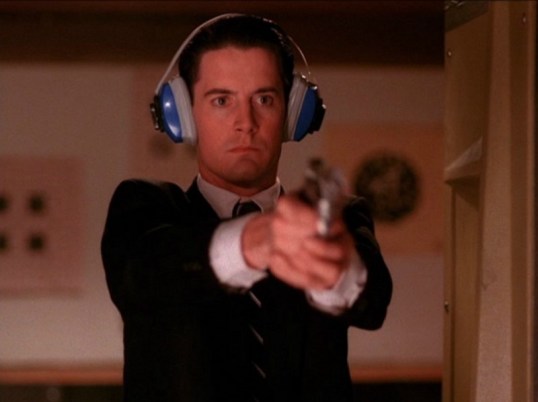
Speaking of which, Andy is still feeling upset over nearly shooting himself so, back at the police station, Andy, Cooper, Harry, and Hawk gather at the shooting range for some gunfire and male bonding.  They all agree that women cannot be understood and they all marvel over Dale’s marksmanship.  Not only does Dale do dream interpretation but he can shoot a man in the nostrils.

At the diner, Norma thanks a man named Toad for his tip.  When Shelly comes in, they bond over their shared experience of being married to loser drug dealers.  Shelly says that she’s ready to get rid of Leo but, after seeing him at the parole hearing, Norma is now less sure about her plan to divorce Hank and marry Big Ed.  She is even more unsure after she gets a phone call telling her that Hank got his parole.  He is coming home.

Meanwhile, Ed’s nephew, James (James Marshall), is using the diner’s payphone (remember those?) to call Donna.  However, James is distracted when Maddy (Sheryl Lee), Laura’s look-alike cousin, walks into the diner.  After James approaches her, Maddy explains that she and Laura used to be close but had recently drifted apart.  Maddy says that she lives in Missoula, Montana. Missoula just happens to be the birthplace of David Lynch.

Meanwhile, at the Great Northern, Audrey deftly manipulates her father into giving her a job working at the perfume counter at Horne’s Department Store.  Audrey says that it is because she wants to learn the family business but actually, it’s because both Laura and Ronette Pulaski also worked at the perfume counter.  Ben agrees and then leaves so that he can hire Leo Johnson to burn down the Packard Mill.  Who suggested Leo to Ben?  Hank Jennings!

At the police station, Cooper, Harry, and Andy pour over the files on all of the birds treated by Dr. Lydecker.  Albert faxes over a reconstruction of a poker chip from One-Eyed Jacks that was found in Laura’s stomach, along with the information that the bird bites on Laura’s shoulder came from a mynah bird.  At the exact moment, Andy redeems himself by announcing that Jacques Renault owns a mynah bird named Waldo.

When the police show up at Jacques’s apartment, Jacques is not there.  However, Bobby Briggs is.  Bobby runs as soon as the police arrive and manages to escape out a back window.  (Assuming that Bobby is Briggs, Hawk gives chase but loses him in the woods.)  Cooper finds what Bobby was planting the apartment, Leo’s bloody shirt.

In the woods, Donna and James go to the location where Donna buried the necklace and discover that Sarah Palmer’s vision was correct.  Someone followed them and dug up the necklace.  Donna and James agree they have to solve the murder and share a kiss while an owl watches above.

At the mill, Pete (Jack Nance) asks Josie if she would consider entering a fishing competition with him.  Josie and Pete?  That would be an interesting match.  But Josie soon has more to worry about, after she receives a drawing of a domino in the mail.  No sooner has she looked at the drawing then she gets a phone call from a man asking her if she got his message.

Who is on the other line?

The suddenly very important Hank Jennings!

“The One-Armed Man” is a good episode, one that moves the story forward, introduces some new mysteries, and justifies that faith that David Lynch put into collaborators like Tim Hunter and Al Strobel.  As I said at the start of this review, it’s all about team work.

Previous Entries in The TSL’s Look At Twin Peaks:

  1. Twin Peaks: In the Beginning by Jedadiah Leland
  2. TV Review: Twin Peaks 1.1 — The Pilot (dir by David Lynch) by Lisa Marie Bowman
  3. TV Review: Twin Peaks 1.2 — Traces To Nowhere (directed by Duwayne Dunham) by Jedadiah Leland
  4. TV Review: Twin Peaks 1.3 — Zen, or the Skill To Catch A Killer (dir by David Lynch) by Lisa Marie Bowman
  5. TV Review: Twin Peaks 1.4 “Rest in Pain” (dir by Tina Rathbone) by Leonard Wilson

A Movie A Day #88: Where The Day Takes You (1992, directed by Marc Rocco)


This month, since the site is currently reviewing every episode of Twin Peaks, each entry in Move A Day is going to have a Twin Peaks connection.  Where The Day Takes You is a movie that has not just one but two connections to Twin Peaks.

Where The Day Takes You is an episodic film about young runaways living on the streets of Los Angeles.  Led by 22 year-old King (Dermot Mulroney), who ran away from home when he was 16, the runaways form a surrogate family.  While being constantly harassed by both the police and well-meaning social workers, some of the runaways get addicted to drugs while others turn to prostitution in order to survive.  Some find love.  Some find death.  They all go where the day takes you.  (Not sure if that was the movie’s tag line but it should have been.)

Where The Day Takes You is a gritty and often tough film, though it’s effectiveness is undercut by a predictable ending and the presence of too many familiar faces in the cast.  The runaways are made up of a who’s who of prominent young actors from the 1990s.  Balthazar Getty plays King’s second-in-command.  Sean Astin plays an obviously doomed drug addict.  Alyssa Milano and David Arquette play prostitutes.  Ricki Lake and James Le Gros play comedic relief.  Will Smith, in his film debut, plays a wheelchair-bound runaway.  Christian Slater and Laura San Giacomo show up as social workers while the police are represented by Rachel Ticotin and Adam Baldwin.  Everyone gives a good performance but the film would have worked better with unknown actors or even real runaways.  No matter how good a performance Sean Astin gives as a heroin addict, he is always going to be Sean Astin and it is always going to be difficult to look at him without saying, “I might not be able to carry the ring but I can carry you!”

The movie’s first Twin Peaks connection is that Lara Flynn Boyle, who played innocent Donna Hayward on Twin Peaks, plays innocent runaway Heather in Where The Day Takes You.  The role is cliché but Boyle shows the same charm that she showed while playing Donna.

The movie’s second Twin Peaks connection is more unexpected.  Kyle MacLachlan is effectively cast against type as Ted, the drug dealer who keeps most of the runaways hooked on heroin and who is perfectly willing to leave an overdosed junkie in a garbage bin.  Ted is about as far from Dale Cooper as you can get.