 It’s Die Hard in a school!
A group of gun-wielding drug runners have broken into Hamilton High so that they can use it as the base of operations for a huge drug deal. With the Vice President scheduled to be traveling through town that weekend, they figure that the school will be deserted and no one will be paying attention to what’s going on. What they failed to consider is that not every student goes home after the final bell rings. One paraplegic student is still in the library, doing research. Two more are in the auditorium, getting high. There’s even a few “bad” kids in detention, including one of whom is pregnant. Even worse, for the drug dealers, is that Sam Decker (Dolph Lundgren!) is in charge of detention. He may teach phys ed and history but before he decided to help broaden young minds, Sam was an army ranger.
Of all of the performers who starred in direct-to-video action movies in the 90s and early aughts, Dolph Lundgren was the best actor. When considering that his competition largely came from Steven Seagal and Jean-Claude Van Damme, that may sound like damning with faint praise but the fact that Lundgren could actually memorize his lines and hit his marks actually did make a difference. It is easy to imagine Detention with Lundgren and the results are not pretty. Steven Seagal would have been too busy whispering his lines and waiting for his stunt double to show up. Jean-Claude Van Damme would have gotten too caught up in doing the splits to waste his time worrying about the kids trapped in the auditorium. Not Lundgren, though. Dolph Lundgren’s too busy getting shit done to worry about any of that.
Though the action sequences are top notch, Detention would work better if the villains were Lundgren’s equal but they’re not. One reason why Die Hard worked was because Alan Rickman and his men always seemed like they were capable of killing Bruce Willis. In Detention, the main villains are three Hungarian punks and a flamboyant American, Chester Lamb (Alex Karzis), and none of them seem like they could even carry Dolph Lundgren’s shoes, much less defeat him in a combat situation. Scenes where Chester pretends to be an innocent bystander seem like they were included to remind us of the first meeting between Alan Rickman and Bruce Willis in Die Hard but Chester Lamb is no Hans Gruber. There is just no way that Dolph Lundgren is going to lose to someone named Chester Lamb.
Even with the underwhelming villains, Detention is a gloriously stupid action movie that is entertaining because Lundgren gives it his all.
 Though it is sometimes hard to remember, there more on late night Cinemax than just Shannon Tweed films like
 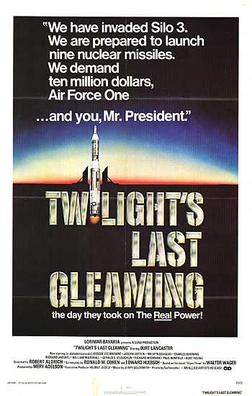 In Montana, four men have infiltrated and taken over a top-secret ICBM complex. Three of the men, Hoxey (William Smith), Garvas (Burt Young), and Powell (Paul Winfield) are considered to be common criminals but their leader is something much different. Until he was court-martialed and sentenced to a military prison, Lawrence Dell (Burt Lancaster) was a respected Air Force general. He even designed the complex that he has now taken over. Dell calls the White House and makes his demands known: he wants ten million dollars and for the President (Charles Durning) to go on television and read the contents of top secret dossier, one that reveals the real reason behind the war in Vietnam. Dell also demands that the President surrender himself so that he can be used as a human shield while Dell and his men make their escape.
 Since yesterday’s entry in movie a day featured Philip Baker Hall playing Richard Nixon in
 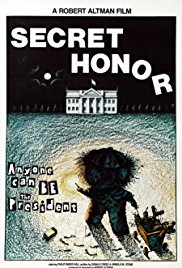 Disgraced former President Richard M. Nixon (Philip Baker Hall) sits alone in his study. He has a bottle of Scotch, a loaded gun, and a tape recorder. He is surrounded by security monitors and paintings. All but one of the paintings are portraits of former presidents, all of whom are destined to be more fondly remembered than Nixon. The only non-presidential painting is a portrait of Henry Kissinger. Over the course of one long night, Nixon drinks and talks. He talks about his Quaker upbringing and his early political campaigns. He rails against all of his perceived enemies: Eishenhower, the Kennedys, the liberals, the conservatives, and everyone in between. As he gets drunker, he starts to talk about the real story behind Watergate and why his resignation actually shielded the country from a greater scandal. As Nixon explains it, his resignation was his greatest act of patriotism, his secret honor.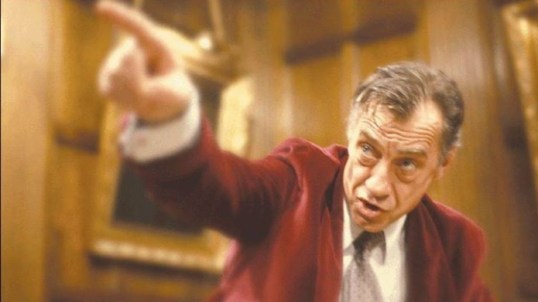
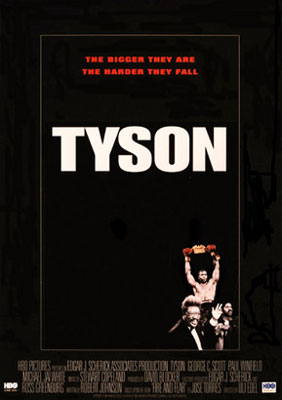 If any heavyweight champion from the post-Ali era of boxing has lived a life that seems like it should be ready-made for the biopic treatment, it is “Iron Mike” Tyson. In 1995, HBO stepped up to provide just such a film.
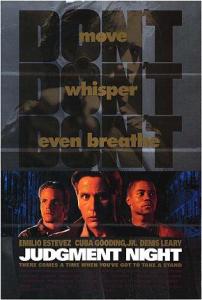 Four suburbanites (Emilio Estevez, Stephen Dorff, Jeremy Piven, and Cuba Gooding, Jr.) are driving to a boxing match in pricey RV when Piven takes a wrong turn and they end up lost in the wrong side of the city. Not only are they lost but they also witness Fallon (Denis Leary) and his gang murdering a young man. Jeremy Piven thinks that he can negotiate with Fallon and get his friends out of the situation by pulling out his wallet and flashing a few bills. Guess how well that works out for them? With Fallon chasing them through the city, these formerly smug and complacent yuppies are forced into a battle for survival.
 Bernard Hopkins. Evander Holyfield. Mike Tyson. Three men who came from similar backgrounds and who eventually became three very different heavyweight champions. Bernard Hopkins was the ex-con who transformed himself through boxing. Mike Tyson was the ferocious and self-destructive fighter whose legendary career eventually became a cautionary tale. Evander Holyfield was the underrated fighter, whose discipline and self-control made him a champ but also ensured that he would never get as much attention as the other boxers of the era.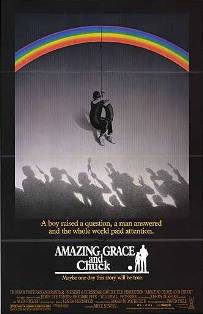
 Johnny Walker (Anthony Michael Hall) may be the best high school quarterback in the country but he has a difficult choice to make. He promised his girlfriend, Georgia (Uma Thurman), that he would go to the local state college with her but every other university in the country wants him. (Even legendary sportscaster Howard Cosell calls Johnny and advises him to go to an Ivy League college.) As Johnny tours universities across the country, he faces every temptation. By the time he makes his decision, will Johnny still be good?
 Through the Shattered Lens