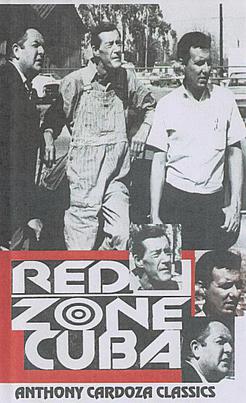
Red Zone Cuba (1966, directed by Coleman Francis)


An escaped convict named Griffin (Coleman Francis) meets up with two other men (Anthony Cardoza and Harold Samuels) and, for some reason, all three of the fly down to Cuba where they join up with the mercenaries who are planning on overthrowing Castro during the Bay of Pigs invasion.  That doesn’t work out so, after escaping from a Cuban POW camp, they decide to fly back to America so that they can rob a mine.  Along the way, they shoot several people and they run into John Carradine who gives them a ride on a train and also sings the film’s theme song, Night Train to Mondo Fine.  “He ran all the way to Hell,” Carradine says about Griffin, even though Griffin spends most of the film either flying or moving at an ambling gait.

Red Zone Cuba is best known for being one of three Coleman Francis films to be showcased on Mystery Science Theater 3000.  Watching this film with Mike and the Bots commenting on the action is a lot of fun.  Trying to watch it without Mike the and the Bots is a different experience all together.  I always assumed that the plot seemed incoherent because I was distracted by Mike, Tom Servo, and Crow talking through the film but it turns out that the plot is incoherent regardless of how you watch the film.  Coleman Francis tried to make a tough and gritty desert noir but the only part he got right was the desert.  There’s a lot of desert in this movie.

Red Zone Cuba is a painfully slow movie but at least John Carradine’s in it for a few minutes.  A reporter shows up to interview him about the three men who rode his train all the way to Hell and Carradine answers his questions with the type of grim determination that briefly fools you into thinking Red Zone Cuba is going to be better than its reputation.  Carradine exits the film quickly, though.  He got his paycheck and then headed off to his next role, leaving Coleman Francis to carry the weight of the film.

Red Zone Cuba is a slow mess of a film that’s not even entertainingly bad but I do have to wonder: was this the first narrative film to use the Bay of Pigs as a plot point?  Hats off to Coleman Francis if it was.
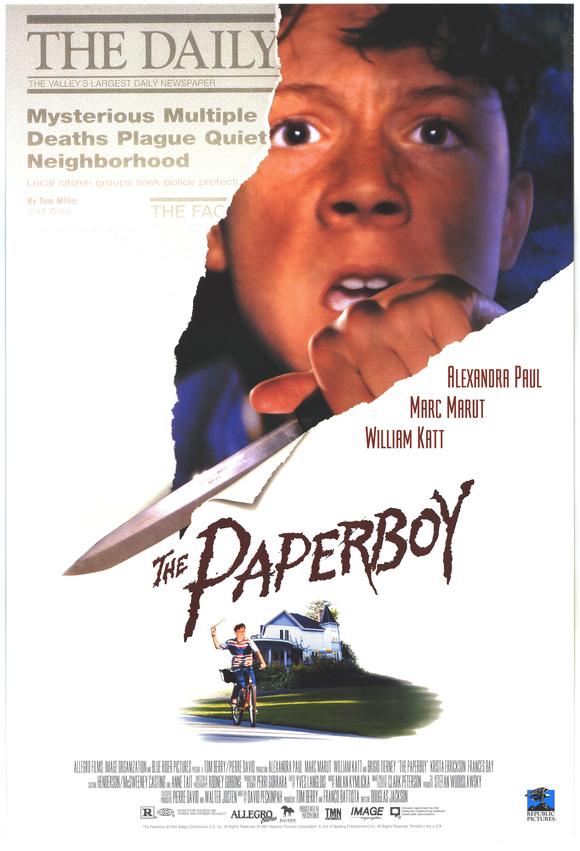
 

Cinemax Friday: The Paper Boy (1994, directed by Douglas Jackson)


12 year-old Johnny McFarley (Marc Marut) is a paperboy who desperately wants to be a part of a stable family.  He wants Melissa Thorpe (Alexandra Paul) to be his mother but Melisssa has moved to a different town.  Johnny solves that problem by suffocating Melissa’s mother with a plastic bag, which causes Melissa to return home.  That’s one way to do it!

As soon as Melissa and her daughter, Cammie (Brigid Tierney), move into Melissa’s mother’s old house, Johnny starts making himself indispensable by doing things like mowing the lawn for free.  He also does things like break into the house in the middle of the night, plant hidden cameras, and demand that Melissa bake him a pie.  He wants Melissa to be his mother and because Melissa feels sorry for him, she indulges Johnny and his mood swings.  Even after everyone else in the neighborhood tells her that Johnny is a little bit off, Melissa continues to allow him into the house.  Not even the crazy religious lady saying that Johnny has “the mark of Cain” can dissuade Melissa.

Johnny will do anything to make Melissa his new mother.  But then Brian (William Katt), Melissa’s boyfriend, shows up and Johnny really goes off the deep end.

The Paperboy is an adequate killer child film.  Marc Marut gives a good performance as the creepy and disturbed Johnny and the movie does make an attempt to provide him with a believable backstory to explain why he’s become the little killer that he is.  The kills are all imaginatively staged and all the more disturbing because they feature a child as the killer and that really is the whole point of the whole psycho kid genre.  The main problem with the movie is that Melissa keeps overlooking Johnny’s clearly unstable behavior.  At the point when just about anyone else would have told Johnny to stay away and perhaps even called the cops on the little bugger, Melissa keeps letting him back into her life.  By the time that Melissa finally realizes that maybe Johnny actually is as dangerous as everyone has been telling her, you’re too frustrated with her to care.

One good thing about The Paperboy is that it features William Katt in a supporting role.  If there’s ever a Late Night Cinemax Hall of Fame, William Katt will be entitled to an entire wing.  Even though he spent the majority of the 90s appearing in low-budgets movies like this one, Katt always gave a good performance, like he does here.


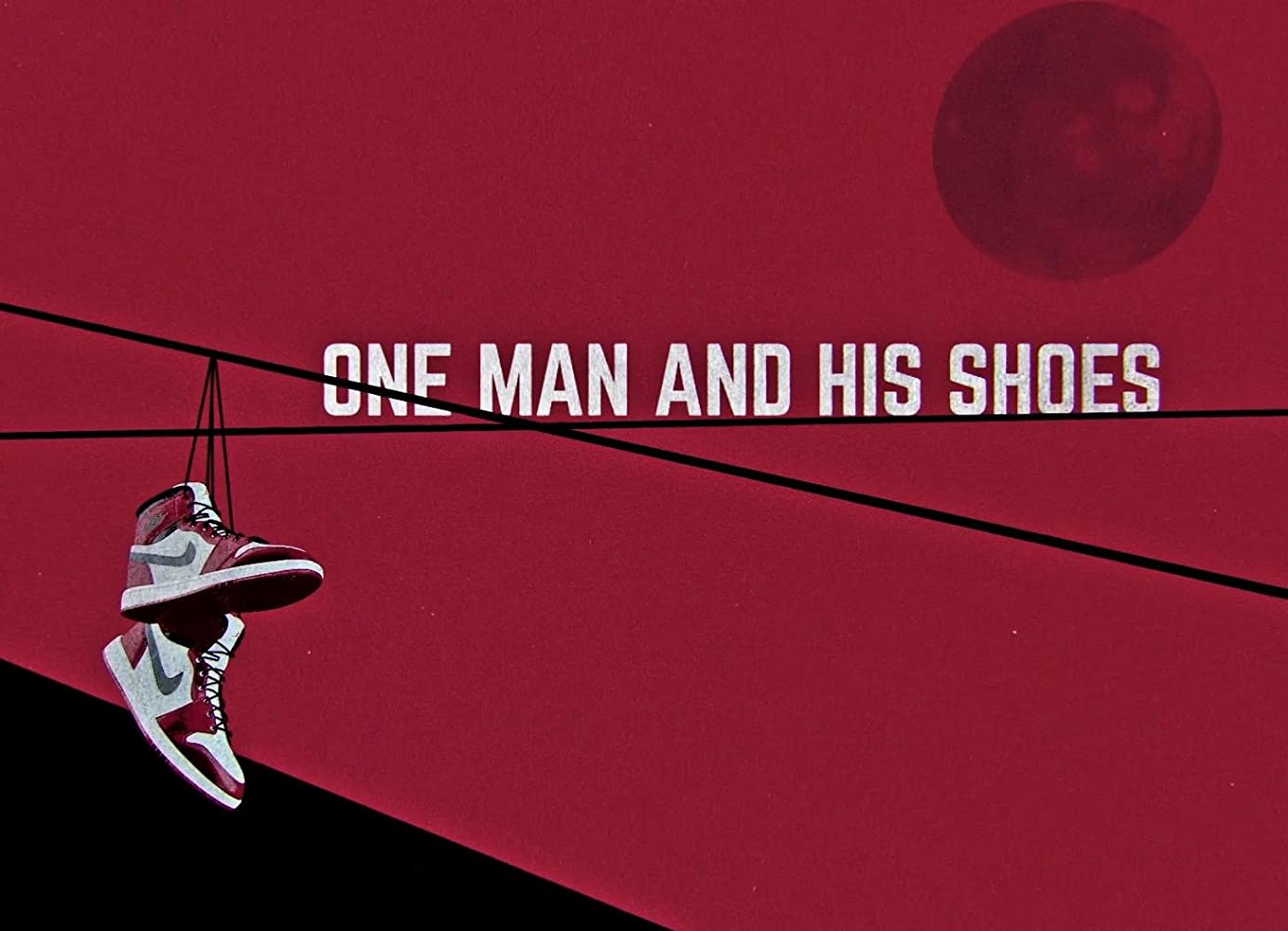
One Man And His Shoes (2020, directed by Yemi Bamiro)


I have never been a shoe person.

As long as they fit, they’re comfortable, and they get me where I’m going, I’ve never cared who made my shoes or what they represented.  That set me apart from most of the people who I grew up with.  They were not only very much concerned with wearing the right shoes but they also judged anyone who was perceived as wearing the wrong shoes.  They all wanted the Air Jordans, even though I can’t think of a single person I knew who was ever able to get a pair.  Everyone knew that the Air Jordans were expensive and that they sold out quickly.  They also knew that owning a pair of Air Jordans could be dangerous.  People got killed for their shoes.  A friend of mine came close to getting a pair but his mother refused to give him the money after she read a news story about someone on the Block getting shot because he wouldn’t hand over his shoes.  That always seemed strange to me.  Why shoot someone over their shoes?  Of course, I was not a shoe person.

The new documentary, One Man and His Shoes, is all about shoes and shoe culture.  Beginning in the 80s, when Michael Jordan was just a promising basketball player in North Carolina and Nike was considered to be an also-ran in the shoe business, the documentary shows how Michael Jordan and the shoes named after him revolutionized American culture.  At a time when shoe companies like Converse were making cringe-worthy commercials that featured Larry Bird and several other players rapping about their shoes, Nike reinvented the game by teaming up with Michael Jordan and bringing in Spike Lee to film their commercials.

If the first half of the documentary celebrates the success of Jordan and Nike, the second half takes a critical look at the violence that has sprung up over the shoes.  Nike is faulted for aggressively advertising the shoes and then only released a limited amount of them at a time.  As a result, the shoes become a status symbol that are difficult to get and which some people are willing to kill to possess.  The documentary goes from celebrating Jordan and Nike to condemning them for refusing to speak out about the violence surrounding their product.  As one interviewee puts it, Jordan telling people to “knock it off” wouldn’t end all of the violence but it wouldn’t hurt.

The documentary ends with the wrenching tale of a man in Houston who was killed for his shoes.  When the murder became national news, Jordan personally sent the grieving family a pair of the new Air Jordans.  The dead man’s sister explains that she didn’t feel safe wearing them in public because, if anyone saw them in her possession, they might kill her as well.

One Man and His Shoes is a sobering documentary.  If you just watched The Last Dance, you owe it to yourself to also watch One Man and His Shoes.

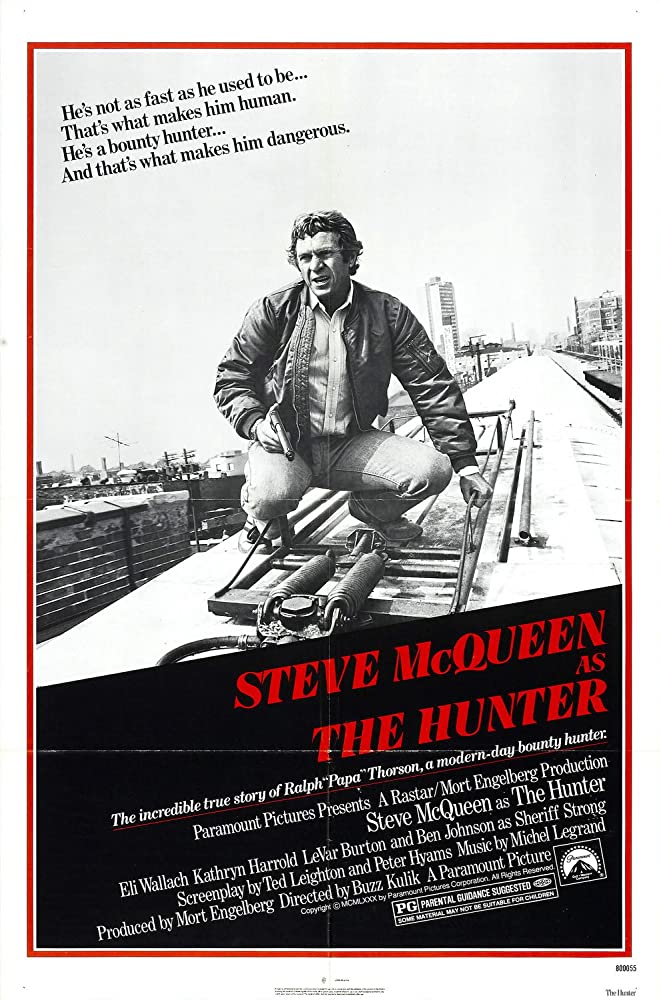
The Hunter (1980, directed by Buzz Kulick)


In The Hunter, legendary car nut, Steven McQueen, plays Papa Thorson, a bounty hunter who is a very bad driver.

That’s it.

That’s the joke.

Papa Thorson was a real-life bounty hunter, the Dog the Bounty Hunter of his day, and The Hunter was based on his own autobiography.  Maybe that explains why the film itself is so extremely episodic.  Thorson goes from one assignment to another, capturing criminals with relative ease and occasionally having to deal with an unappreciative sheriff (Ben Johnson).  Along the way, one of those criminals (Levar Burton) goes to work with Papa and becomes his protege.  Papa’s girlfriend (Kathryn Harrold) is pregnant and a crazed criminal (Tracey Walter) is targeting her because he wants revenge on Papa for putting him away.  It’s all Magnum P.I.-level stuff, without the backdrop of Hawaii to distract you from how predictable it all is.  It’s not terrible because there are a few good action scenes but it still feels more like a pilot for a weekly Papa Thorson television series than a feature film.

The Hunter was also Steve McQueen’s final film.  After The Towering Inferno, McQueen was inactive for most of the 70s.  He still received scripts and turned down good parts (including the roles of both Willard and Kurtz in Apocalypse Now) but the only film in which he appeared in a barely released version of An Enemy of the People.  It wasn’t until 1980 that McQueen finally started appearing in movies again, starring in both Tom Horn and The Hunter.  Tom Horn is an underrated western but The Hunter is largely forgettable.  Sadly, The Hunter would be McQueen’s last film as he died of lung cancer shortly after it was released.

McQueen was obviously ill during the filming of The Hunter, though he still had the laconic coolness that made him a star in the first place and he still looks credible, even at the age of 50, handling a gun and chasing criminals.  He doesn’t give a bad performance as Thorson and he even shows a talent for comedy.  Both Tom Horn and The Hunter show that McQueen wasn’t afraid to play his age.  Neither Tom Horn nor Thorson were young men and, in The Hunter, McQueen gets a lot of mileage out of being a cranky, middle-aged malcontent who has never figured out how to parallel park.  The film might be forgettable but Steve McQueen shows that, to the end, he was an actor who was often better than his material.

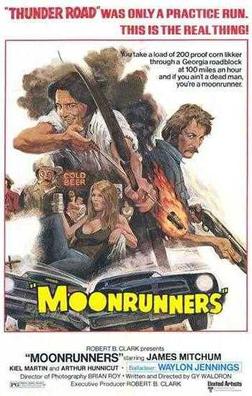
Moonrunners (1975, directed by Gy Waldron)


Does this sound familiar?

Grady and Bobby Lee Hagg (played by Kiel Martin and Jame Mitchum) are just some good ol’ boys, never meaning no harm, but they’ve still been in trouble with the law since they day they were born.  They live in rural Georgia, on a farm owned by their Uncle Jesse (Arthur Hunnicutt).  Uncle Jesse’s an expert on two things: the Bible and how to brew the best whiskey.  Uncle Jesse is moonshiner with integrity.  No one knows his formula and he won’t sell his moonshine to just anyone.  He doesn’t want anything to do with the New York mob and their efforts to move in on the moonshine racket.

Uncle Jesse’s main rival is Jake Rainey (George Ellis), the corpulent county commissioner who used to be Jesse’s business partner but who now is in league with the Mafia.  Jake and the Hagg boys have a rivalry that is sometimes friendly but still dangerous.  Helping Jake control the county is a formerly honest lawman named Rosco P. Coltrane (Bruce Atkins).

The Hagg boys are on probation so they can’t leave the county and they can’t carry guns.  Instead, they hunt with bow and arrow.  They drive a fast car that they’ve named Traveller (after General Lee’s horse).  Grady dreams of going to Nashville with Beth Anne Eubanks (Chris Forbes) and becoming a country music star.  Bobby is a laid back race car driver who is having an affair with Jake Rainey’s wife.

The film follows the Hagg boys as they transport moonshine, outrun the police, and occasionally get into bar fights.  The movie was shot on location on Georgia, features several car chases, and it’s narrated by country singer Waylon Jennings.

Moonrunners was filmed in 1973 but not released until 1975.  It didn’t get much attention when it was released but it did go on to inspire a television series called The Dukes of Hazzard.   Even considering the show’s popular success and current cult status, Moonrunners is still a largely unknown film.  (It’s so obscure that Warner Bros. was reportedly shocked to discover that they were required to pay several million in royalties to the film’s producers before they could move ahead with their own film adaptation of The Dukes of Hazzard.)  However, Moonrunners is superior to The Dukes of Hazzard in every way.

Of course, being better than The Dukes of Hazzard may seem like a low bar to clear but Moonrunners is still one of the better moonshiner films out there.  The car chases are genuinely exciting and well-filmed and the cast feels authentic.  Arthur Hunnicutt and George Ellis both seem like they naturally belong next to a still while James Mitchum and Kiel Martin are well-paired as Grady and Bobby Lee.  Mitchum, in particular, channels the laconic charisma of his father, Robert.  Not surprisingly, Moonracers is far rougher and has more of an edge than The Dukes of Hazzard.  The TV show may have been for kids but the movie is not.

It’s a B-movie, of course.  The soundtrack, which is full of outlaw country, is sometimes obtrusive.  I burst out laughing at the film’s most dramatic moment because Waylon Jennings suddenly started singing a song called “Whiskey Man.”  The DVD release appears to have been copied straight from a VHS tape so the images were often grainy.  It’s not a perfect movie but I still enjoyed Moonrunners for what it was, a celebration of fast cars, pretty girls, and rebellious attitudes.  Your collection of car chase films is incomplete without it!

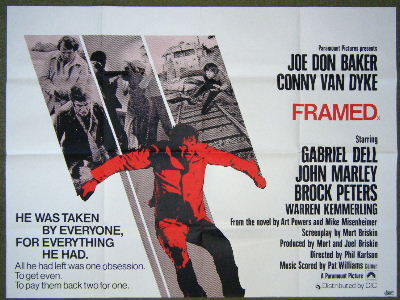
Framed (1975, directed by Phil Karlson)


Revenge can be brutal, especially when you’ve been framed.

Joe Don Baker plays Ron Lewis, a surly nightclub owner and gambler who wins a small fortune, witnesses a crime, and nearly gets shot all in the same night.  When he reaches his house, he’s planning on calling the police but he’s confronted in his own garage by a sheriff’s deputy who tries to kill him!  In a lengthy and brutal scene, Ron beats the deputy to death and gouges out his eyes.  Even though Ron was only acting in self-defense, he’s charged with murder.  Told that there is no way that he’ll be able to win an acquittal, Ron pleads guilty to a lesser charge and is sent to prison for four years.

While he’s in prison, Ron befriends a mob boss (John Marley, who famously woke up with a horse’s head in his bed in The Godfather) and the boss’s number one hitman, Vince (Gabriel Dell).  While Ron is in prison, a group of men assault his girlfriend (country singer Conny Van Dyke) and tell her not to ask any questions about the events that led to Ron being framed.

After serving his sentence and getting into numerous fights with the guards, Ron is finally released.  When Vince shows up and tells Ron that he’s been hired to kill him, the two of them team up with an honest deputy (Brock Peters) and set out to find out why Ron was set up and to get revenge.

Framed is a brutal movie, Ron and his friends hold nothing back in their quest to get revenge.  Whether he’s shooting a man in cold blood or hooking someone up to a car battery in order to get information out of him, there’s little that Ron won’t do and the movie lingers over every act of violence.  Several pounds overweight and snarling out of his lines, Joe Don Baker may not be a conventional action hero but he’s believable in his rage.  He’s the ultimate country boy who has been pushed too far and now he doesn’t care how much blood he has to get on his hands.  However, because Baker does seem more like an ordinary person than a Clint Eastwood or a Charles Bronson-type, he retains the audience’s sympathy even as he splashes blood all over the screen.  As violent as his action may be, they always feel justified.

Baker’s performance and the believable violence are the film’s biggest strengths.  It’s biggest weakness is a plot that revolves around an elaborate conspiracy that doesn’t always make sense and some notably weak supporting performances.  Ron’s revenge may be brutal but it takes a while to get there and the first hour gets bogged down with Ron’s struggle to adjust to life in prison.  John Marley does a good job as Ron’s prison mentor but then he abruptly disappears from the movie.

Before making Framed, Baker and director Phil Karlson previously collaborated on Walking Tall.  Framed is far more violent than that film was but its plot doesn’t hold together as well.  However, if you’re just looking for a violent action film that features Joe Don Baker doing what he does best, Framed delivers.

Nighthawks (1981, directed by Bruce Malmuth)


DaSilva (Sylvester Stallone) and Fox (Billy Dee Williams) are two tough New York cops who just want to be left alone so that they can arrest muggers and purse snatchers.  However, because they both have a background in the military, they are assigned to work with an international anti-terrorism task force that is being headed up by Detective Inspector Peter Hartman (Nigel Davenport).  Rumor has it that the notorious terrorist Wulfgar (Rutger Hauer) is coming to New York and Hartman tells DaSilva and Fox that they must be prepared to do whatever is necessary to take Wulgar down, even if it means taking a shot while he is hiding behind a hostage.  DaSilva says he’s not sure that he could shoot an innocent person, even if it meant stopping Wulfgar from escaping.

Wulfgar has no such moral qualms.  Wulfgar is a terrorist-for-hire who claims to be fighting for the people but whose main interest is remaining employable.  Unfortunately, Wulfgar has become so ruthless and so cavalier about killing civilians (including children) that most terrorist groups have started to refuse to hire him.  He brings too much bad publicity to his employers.  Wulfgar has come to New York to lead a bombing campaign, with the hope of once again making himself employable.  Wulfgar’s partner in all of this is the equally ruthless Shakka Kapoor (Persis Khambatta).

Nighthawks was one of the films that Stallone made after he found stardom as Rocky but before he redefined his career by playing John Rambo.  Stallone actually gives a surprisingly good performance as DaSilva.  DaSilva may be another tough cop who plays by his own rules but the script still gives the character some unexpected shadings and Stallone plays him as being more cerebral than you might expect.  It’s interesting to see Stallone play a character who is worried about using excessive force to do his job and, to the film’s credit, it actually takes DaSilva’s conflicted feelings seriously.  Billy Dee Williams, unfortunately, is not given as much to do as Stallone and his character is far more one-note than Stallone’s.  He’s the loyal partner and, with his natural charisma, Williams deserved a role with more depth.  Also appearing in small roles are Joe Spinell (as Stallone’s boss), Lindsay Wagner (as Stallone’s ex-wife), and the legendary pornographic actor Jamie Gillis (as Wagner’s boss).

Not surprisingly, the film is stolen by Rutger Hauer, who gives a performance that, in many ways, anticipates his more acclaimed work in Blade Runner.  As played by Hauer, Wulfgar is a charismatic sociopath who knows exactly the right thing to say but who, because of his own arrogance, is still vulnerable to allowing his emotions to get the better of him.  He and Stallone both play-off each other well and their face-to-face confrontations are intense.  It probably helped that Hauer and Stallone did not personally get along during the filming.  (Both, however, were very complimentary towards each other in the years that followed Nighthawks, with Hauer especially saying that there was nothing personal about their on-set arguments.)

Nighthawks is hardly an in-depth look at the realities of international terrorism but it has a handful of exciting action scenes and two excellent performances from Stallone and Hauer.  It’s currently on Netflix and worth watching.

Music Video of the Day: Subterranean Homesick Blues (1965, directed by D.A. Pennebaker)


Today we wish a happy birthday to one of the most important figure in American music and American culture in general, Mr. Bob Dylan.

This music video was shot as a promo for the ground-breaking documentary, Don’t Look Back.  It was filmed in an alley near the Savoy Hotel in London.  The cards that Dylan flips throughout the video were written by Donovan, Allen Ginsberg, Bob Neuwirth and Dylan himself and, of course, both Ginsberg and Bob Neuwirth can spotted standing in the background of the video.  (Considering that Don’t Look Back features a famous scene in which Dylan absolutely humiliates Donovan, I always found it interesting that he played a role in the production of this video.  Did Donovan help write out the cards before or after the It’s All Over Now, Baby Blue incident?)  In typical Dylan fashion, the cards feature intentional misspellings and occasionally they don’t actually match up with the lyrics.  For instance, the song may mention needing “eleven dollar bills” but the card reads “twenty.”

Dylan filmed two other versions of this video, neither one of which was officially released but which can both be found in Martin Scorsese’s Dylan documentary, Don’t Look Back.  One was shot at a nearby park while the other was apparently filmed in the Savoy Hotel itself.  All three of the videos follow the same basic theme of Dylan flipping cards while Ginsberg and Neuwirth wander about in the background.

This song, which was inspired by the writings of Beats like Ginsberg and Kerouac (as well as, according to Bob Dylan, by the music of Chuck Berry), was Bob Dylan’s first top ten single in the U.S.

Enjoy!


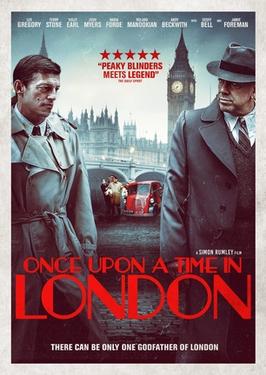
Once Upon A Time In London (2019, directed by Simon Rumley)


It’s not easy to make British gangsters seem boring but Once Upon A Time In London manages to do it.

Once Upon A Time In London deals with the period of time when British organized crime was still in its infancy, before the Krays came to power and made every London criminal with a good wardrobe into a minor celebrity.  The movie starts in the 30s with Jack Comer (Terry Stone) forming a crime syndicate out of a group of anti-fascists who originally came together to battle the members of Oswald Mosley’s pro-Nazi British Union of Fascists.  However, because that story would have possibly been interesting, the film then switches focus to Billy Hill (Leo Gregory), a younger gangster who used to work with Jack but who now wants to displace Jack as the top man in London organized crime.

It’s based on a true story and Jack Comer (or Jack Spot, as he was better known as) and Billy Hill were the type of flamboyant gangsters that could, in theory, be the subject of a really good movie.  Unfortunately, Once Upon A Time In London is not that film.  It’s a strange film, one that is overlong but which also feels as if it’s missing key scenes.  It’s often hard to follow why anyone is doing what they are doing.  The action skips from violent set piece to violent set piece but the film never takes the time to explain who is fighting who or for what reason so all of the violence doesn’t add up to anything.  The constant fights and torture scenes feel like they were lifted from other, better gangster films.  You’re never sure why Jack and Billy were working together in the first place so there’s no emotional stakes to their eventual rivalry.  That neither Terry Stone nor Leo Gregory gives a particularly interesting performance definitely does not help matters.

Once Upon A Time In London does deserve credit for its efforts to recreate the London of the 40s and 50s.  The clubs and the shabby suits all feel authentic and the dialogue is believably pungent, if not particularly interesting.  But, for all the care that went into recreating the era, the movie struggles to get us to care about any of it.

Once Upon A Time In London is disappointment.  There are many great stories to be told about British organized crime but this isn’t one of them.

Music Video of the Day: Bang (Starting Over) by Corey Hart (1990, directed by Meiert Avis)


Corey Hart is best known for defining the 80s with Sunglasses At Night but, as the saying goes, he did have other songs.

Bang (Starting Over) is the title track from Hart’s fifth album, Bang.  Unfortunately, Bang only produced one moderate hit and it wasn’t this song.  I say unfortunately because Bang (Starting Over) is actually a pretty good song and it just had the misfortune to be released at a time when musical tastes were changing.  Both the song and Hart are better appreciated now than they were in 1990.

This video was directed by Meier Avis, who has directed videos for just about everyone.

Enjoy!