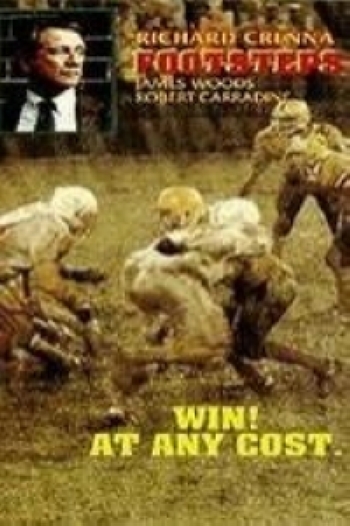
Footsteps (1972, directed by Paul Wendkos)


Paddy O’Connor (Richard Crenna) is a former football player-turned-coach whose record of success has been overshadowed by his own arrogance and heavy drinking.  O’Connor has such a bad personal reputation that he’s found himself unemployable.  Only one man is willing to give him a chance.  Jonas Kane (Clu Gulager) played football with Paddy and he’s now coaches for a small college.  Kane may not like O’Connor but he knows that O’Connor might be the key to turning around his team’s fortunes and, at the same time, saving Kane’s job.  Kane hires O’Connor to serve as a his defensive coordinator.

At first, O’Connor’s cockiness rubs people the wrong way.  It’s not until O’Connor moves offensive player J.J. Blake (Bill Overton) to defense that the team starts to win.  And once the team stars to win, everyone’s problems with O’Connor disappear.  Kane can only watch helplessly as O’Connor moves in on his girlfriend (Joanna Pettet), knowing that he owes his job to O’Connor remaining at the school.

However, when Blake gets a concussion, O’Connor is forced to decide whether or not to let him play.  Boosters like Bradford Emmons (Forrest Tucker) want Blake to play, regardless the risk.  The NFL scouts, who are looking for the next number one pick, want to see Blake on the field.  Blake says he wants to play but O’Connor can tell that he’s lying about the extent of his injury.  With everyone breathing down his neck and a syndicate of gamblers pressuring O’Connor to shave points so that the spread pays off, O’Connor has to decide what to do.

Though this made-for-TV movie may not be as well-known as some other films, it’s one of the best movies ever made about college football.  Though it may be short (only 74 minutes), it still examines all of the issues that have always surrounded college football.  Despite not getting paid for their efforts, the players risk serious and permanent injury during every game, just on the slight hope that they might someday make it to the NFL.  The coaches, who are supposed to be looking after the players, are more interested in padding out their win-loss record and hopefully moving onto bigger and better-paying jobs.  Meanwhile, aging alumni and boosters demand that the team win at all costs, regardless of what happens to the men on the field.  Footsteps intelligently explores all of those issues and suggests that the risks are ultimately not worth the rewards.

Along with an intelligent script, Footsteps is helped by a talented cast.  Crenna and especially Gulager both give excellent performance as the two rival coaches.  Al Lettieri (Sollozzo from The Godfather) plays one of the gamblers.  Beah Richards plays Blake’s mother, who makes the mistake of believing O’Connor when he says that he’s going to always have Blake’s best interests at heart.  Ned Beatty has a small role as another assistant coach who is forced to make an important decision of his own.  Keep an eye out for Robert Carradine and James Woods, both of whom have tiny roles.

As far as I know, Footsteps has never officially been released on DVD.  I saw it late one night on the Fox Movie Channel.
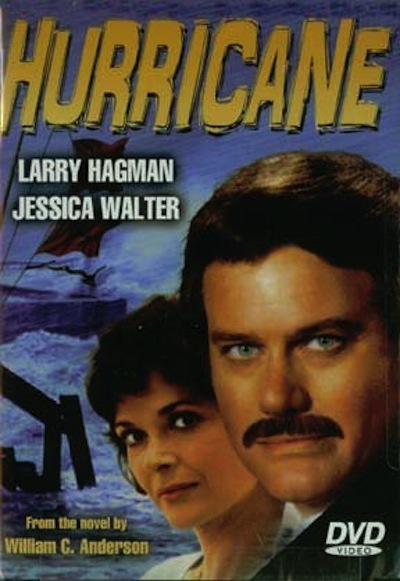
Hurricane (1974, directed by Jerry Jameson)


Hurricane Hilda is crashing down on the Gulf Coast and everyone in its path is about to get all wet.  While Will Geer and Michael Learned try to warn everyone about the approaching hurricane, coast guard pilot Martin Milner observes the storm from the air and tires to rescue everyone in its path.  Some people listen and some people don’t.  Milner’s own father, played by Barry Sullivan, ends up getting stranded in a cabin while Larry Hagman and Jessica Walter play a married couple on a boat who find themselves sailing straight into the storm.  On temporarily dry land, Frank Sutton (a.k.a. Gomer Pyle’s Sgt. Carter) plays a homeowner who refuses to evacuate because he’s convinced that he knows everything there is to know about hurricanes.  He and the neighbors have a drunken party while waiting for the storm.  When Patrick Duffy and his wife announce that they’re heading for safety, Sutton demands that they come in and have a beer with him.  When Hilda finally makes landfall, some survive and some don’t.

Hurricane is a by-the-numbers disaster movie.  It was made after The Poseidon Adventure and during the same year as The Towering Inferno and it hits all the usual disaster movie beats.  Survival is determined by karma, with Hilda going after anyone who was too big of a jerk during the first half of the movie.  It’s predictable stuff but it does feature footage from an actual hurricane so it’s at least not too dragged down by any of the bad special effects that always show up in made-for-TV disaster films.

This is one of those films where the cast was probably described as being all-star, even though most of them were just TV actors who needed a quick paycheck.  Seen today, the film feels like a MeTV reunion special.  Years before they played brothers in Dallas, both Larry Hagman and Patrick Duffy appeared in Hurricane, though neither of them shares any scenes.  Will Geer and Michael Learned were starring on The Waltons when they appeared in this movie and they’re in so few scenes that they probably shot their scenes over a weekend before returning to Walton’s Mountain.  The best performance is from Frank Sutton, who died of a heart attack just a few weeks after this movie aired.  He’s a convincing hothead, even if he doesn’t have Gomer around to yell at.

Hurricane may be bad but it’s still not as terrible as most made-for-TV disaster movies.  People who enjoy watching TV actors pretending to stare at a tidal wave of water about to crash down on them will find this film to be an adequate time waster.

Above Suspicion (1995, directed by Steven Schachter)


Dempsey Cain (Christopher Reeve) is a former test pilot turned homicide detective who ends up getting shot because of the incompetence of another cop, a patrolman named Nick Cain (Edward Kerr).  Nick also happens to be Dempsey’s younger brother.  While Dempsey’s in the hospital, Nick has an affair with Dempsey’s wife, Gail (Kim Cattrall).  When a now-paralyzed Dempsey returns home, he deals with his depression by drinking and contemplating suicide.  He tells Gail and Nick that he no longer wants to live but that his life insurance policy doesn’t cover suicide.  He comes up with a plan for his wife and brother to stage a break-in and murder him.  Because Gail and Nick are secretly lovers and want Dempsey out of the way, they agree.  However, it turns out that Dempsey isn’t as naive as they assumed and he still has a few tricks of his own.  It looks like the perfect murder but Detective Alan Reinhardt (Joe Mantegna) is determined to solve the case.

Produced for HBO, Above Suspicion is a clever and twisty film noir that, unfortunately, never escapes the shadow of Reeve’s real-life tragedy.  Just a week after the film first aired on HBO, Christopher Reeve was suffered the spinal chord injury that left him confined to a wheelchair for the rest of his life.  Knowing that Reeve would spend the final nine years of his life paralyzed from the neck down can make it difficult to watch Above Suspicion, which is unfortunate because this film features what might be Reeve’s best performance.

As an actor, Christopher Reeve was always typecast as Superman and he definitely missed out on some roles as a mistake.  Above Suspicion makes clever use of Reeve’s good guy image but casting him as someone who everyone thinks is a hero but who actually has a very dark side to his personality.  Everyone in the film thinks of Dempsey as being Superman but he instead reveals himself to be Lex Luthor.  It was definitely a chance of pace role for Reeve and he really seems to enjoy playing a scheming villain for once.  Watching the film today, it is obvious that he had enough talent that, if not for his injury, he probably would have eventually made an Alan Alda-style comeback that would have seen him settling into the role of being a much-in-demand character actor.

Interestingly, the clever script was written by William H. Macy, shortly before he found fame as Jerry Lundegaard in Fargo.  The film is a clever homage to films like Double Indemnity and The Postman Always Ring Twice and Christopher Reeve and Joe Mantegna are both fun to watch as they play their cat-and-mouse game.  Despite the real-life tragedy that it unintentionally invokes, Above Suspicion is a clever and twisty thriller featuring a cast of talented actors at their best.


Mistrial (1996, directed by Heywood Gould)


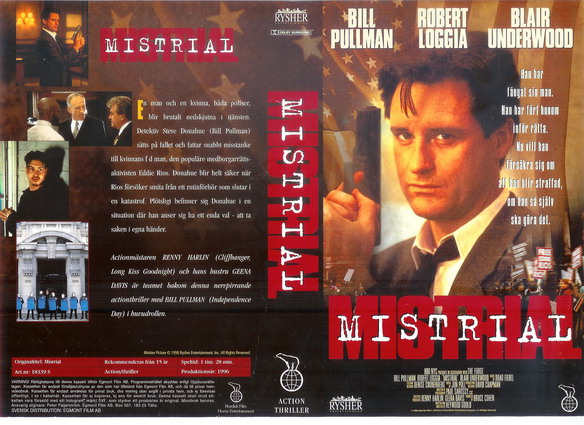
When a NYPD cop and her partner are murdered, overworked and stressed-out Detective Steve Donohue (Bill Pullman) follows a trail of circumstantial evidence that leads him to the door of the cop’s ex-husband, a community activist named Eddie Rios (Jon Seda).  Donohue’s attempt to arrest Rios goes terribly wrong and results in a shootout that leaves Rios’s second wife and bother dead before the handcuffs are eventually slapped on his wrists.

Rios may be the one on trial but Donohue is now the one facing judgment.  With protesters lined up outside the courthouse and the city’s mayor (James Rebhorn) more interested in his own reelection than in the pursuit of justice, Donohue knows that the only way he’ll be vindicated is if Eddie Rios is convicted.  Unfortunately, that’s not what happens.  Rios’s sleazy attorney (played by Josef Sommer) gets most of the evidence tossed out of court on a technicality and it appears that Rios is going to walk free.  That’s when Donohue decides to take the court itself hostage, pulls out a gun, and demands that Rios immediately be put on trial for a second time, with the jury hearing all of the evidence that was originally thrown out of court.

Mistrial is an example of the good-cop-pushed-over-the-edge genre.  Up until a few years ago, this was a very popular genre.  Today, of course, it feels tone deaf and it’s a lot more difficult to sympathize with a cop, even a fictional one, complaining about being restricted by the constitution.  The main problem with Mistrial is that it’s established early on that Eddie Ramos is guilty so there’s no real tension as to whether Donohue is doing the right thing by demanding a second trial.  If there had been some ambiguity about whether or not Ramos was the murderer that Donohue claims he is, it would have made the film much more interesting and less predictable.  The other problem is that Bill Pullman is just too naturally earnest and clean-cut to be convincing as an overworked cop who has been pushed into doing something crazy.  Remembering back to the 90s, I think someone like Gary Sinise or William L. Petersen could have pulled off the role but Pullman’s just not right for it.

Robert Loggia has a few good moments as Pullman’s sympathetic captain.  This was the 2nd time that Pullman and Loggia co-starred together.  The first time was in Independence Day.  The 3rd time would be in Lost Highway, a film that’s as different from Mistrial as day is from night.

The Life and Death of Peter Sellers (2004, directed by Stephen Hopkins)


Peter Sellers was a brilliant actor and comedian while also being a childish and selfish human being who, because he was always performing, never really developed a personality of his own.

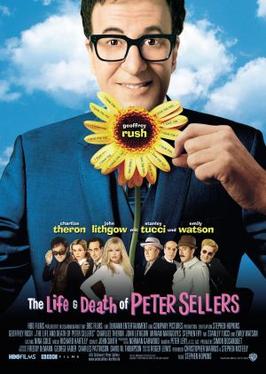
That’s the argument made by The Life and Death of Peter Sellers, which stars Geoffrey Rush as Sellers.  The film follows Sellers from his success with The Goon Show to his subsequent collaborations with Stanley Kubrick (Stanley Tucci) and Blake Edwards (John Lithgow).  Sellers becomes an international star but remains a deeply unhappy person, cheating on his wives, emotionally abusing his son, and being difficult on set.  The film makes the argument that that the only person that Sellers truly loved was his doting mother (played by Miriam Margoyles) and that, having been born into a show business family, performing was the only thing that he was capable of doing.  Even the few times when he’s shown to be a decent father, husband, or friend, it’s suggested that he’s just acting the role.  Rush plays Sellers as being someone who is incapable of understanding how other people think so, whenever he has to interact with them, he simply imitates what he’s seen others do.  Just look at the scene where he attempts to flirt with Sofia Loren by grinning up at her like a character in a romantic comedy.

The problem with a film like this is that, because he’s portrayed as being so selfish and immature, it’s hard to make Peter Sellers into a character that you would want to spend any time with.  The narrative goes from one Sellers tantrum to another.  Stephen Hopkins livens things up by including fantasy sequences where Sellers is taunted by some of his best-known characters, driving home the point that there wasn’t much to Sellers beyond the characters that he played and reminding us of both Sellers’s talent and Geoffrey Rush’s as well.  There are also frequent monologues from Rush, dressed up like the other characters in the movie and discussing their relationship with Peter Sellers.  Sometimes it works and sometimes it doesn’t.  Rush does a good job playing Stanley Tucci playing Stanly Kubrick but when he’s made up to look like Miriam Margoyles, the conceit gets too ridiculous to work.

The main reason to see the film is for the performances, especially Emily Watson as Sellers’s first wife and Stephen Fry as Sellers’s “spiritual advisor.”  Stanley Tucci is an inscrutably brilliant Stanley Kubrick while John Lithgow is a hyperactive and crass Blake Edwards.  Finally, Geoffrey Rush is a marvel as Peter Sellers.  Rush has a difficult job, making an extremely unlikable character compelling but he succeeds despite not always being helped by the film’s script or direction.

Like the man it portrayed, The Life and Death of Peter Sellers is flawed but filled with enough talent to watchable.


The Late Shift (1996, directed by Betty Thomas)


Want to relive the public battle over whether David Letterman or Jay Leno would be Johnny Carson’s successor?

Then The Late Shift is the film for you!

Though it pales when compared to the subsequent battle between Leno and Conan O’Brien, the competition between Letterman and Leno to succeed Johnny Carson as host of The Tonight Show riveted America in the early 90s.  Most media critics (and, reportedly, Carson himself) felt that Letterman had not only earned the right to host The Tonight Show but that he represented the future of late night comedy.  The NBC network execs, however, preferred Leno, who had served for years as Carson’s permanent guest host and who was viewed as being more of a team player than Letterman.  The end result, of course, was that Leno got The Tonight Show, Letterman switched networks, and for years the country was separated into Leno people and Letterman people.  (Letterman got the critical acclaim but Leno got the ratings.)

The Late Shift opens with the unexpected retirement of Johnny Carson (played, as an enigma, by Rich Little) and then follows Letterman (John Michael Higgins) and Leno (Daniel Roebuck) as they maneuver their way to become his successor.  Unfortunately, neither Higgins nor Roebuck are particularly believable in their roles, though Roebuck does get to wear a truly impressive fake chin.  Far more impressive are Kathy Bates as Leno’s manager and Treat Williams as Mike Ovitz.  Bates rips through her scenes, destroying anyone standing in the way of Jay Leno while Williams is cool, calm, and menacing as the agent who was, at the time the film was made, the most powerful man in Hollywood.

The main problem with The Late Shift is that, when it went into production, Letterman was ahead in the ratings and the film is clearly sympathetic to him.  Leno comes across as a weasel while Letterman is portrayed as being neurotic but brilliant.  But, shortly before the film made its debut on HBO, Leno landed the first interview with Hugh Grant after the latter’s arrest with a prostitute.  Leno not only won that night in the ratings but he won every subsequent night and soon, Letterman was the one who was forever stuck in second place.  A title card was added to the end of  The Late Shift, admitting that Leno was now winning the war for the late night.  Since every minute of the film was designed to make Letterman appear to the winner, it’s hard not to be let down by the ending.

Despite the disappointing ending, The Late Shift is an entertaining look at network politics.  (Seinfeld fans will note that, after playing a version of Warren Littlefield during the show’s 4th season, Bob Balaban was cast as the real thing in The Late Shift.)  After watching the movie, be sure to read the Bill Carter book on which it’s based.

Overdrawn At The Memory Bank (1983, directed by Douglas Williams)


Aram Fingal (Raul Julia) is a computer technician in the future who is caught watching Casablanca at work.  The CEO of Novicorp (Donald Moore) is the only person allowed to watch old movies so he decrees that Aram be “droppled,” which is supposed to give Aram a new outlook on life.  Aram’s mind is taken out his body and transferred into the body of a baboon.  At first, Fingal enjoys being a baboon but then he nearly gets killed by an elephant and he decides that it’s time to return to his body.  Unfortunately, his body has been misplaced.

Instead of just leaving Aram’s mind inside of the baboon, Novicorp decides to save his mind in a computer mainframe where Aram discovers how to create his own world, which he patterns after Casablanca.  (Raul Julia even takes on a second role, playing the virtual world’s version of Humphrey Bogart.)  Watching all of this is a computer technician named Apollonia (Linda Griffiths), who has been assigned to keep an eye on Aram until his body is found.  Apollonia falls in a love with Aram but unfortunately, his mind will cease to exist unless it is quickly reunited with his corporeal form.

Originally produced for PBS, Overdrawn At The Memory Bank is best-known for being featured on an episode of Mystery Science Theater 3000.  You can watch it in its original form on YouTube but I don’t recommend it.  When I first saw it MST 3K, I assumed that the film seemed incoherent because Mike and the Bots were talking over most of the action.  When I watched the movie without their commentary, I discovered that it was even more confusing without them talking over the action.  The movie seems to take place in the future and it’s insinuated that Novicorp is in charge of the government but then Novicorp’s share prices start to crash when it’s revealed that Aram’s body has been lost and that seems like that’s something that an all-powerful corporation could have avoided.  Aram is punished by being put in the body of a baboon but I’m not sure why spending a few hours as a baboon would make Aram no longer want to watch Casablanca.  At the same time that Novicorp is trying to find Aram’s body, their agents are invading Aram’s virtual world and trying to destroy his mind which seems counterproductive.  Along with featuring a plot that’s impossible to follow, the other problem with Overdrawn at the Memory Bank is that it’s just so damn disillusioning.  Raul Julia was a great actor but, judging from this film, he just wasn’t very skilled when it came to imitating Humphrey Bogart.  Overdrawn At The Memory Bank is a mix of 1984, The Matrix, and Casablanca and that sounds like it should be cool but somehow, it’s just not.

Only watch this one with Mike and the Bots.

Black Moon Rising (1986, directed by Harley Cokeliss)


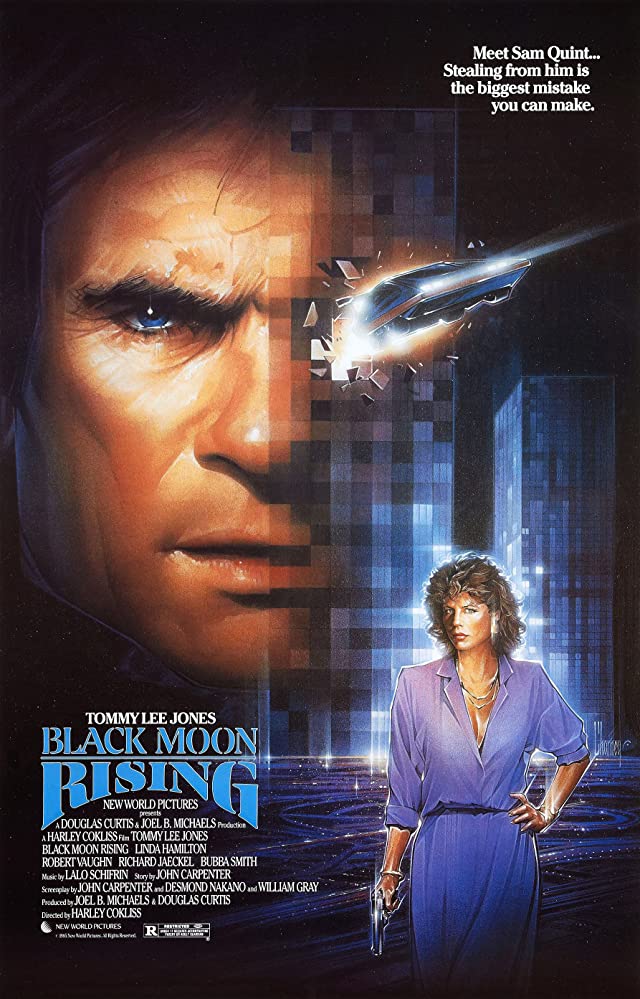
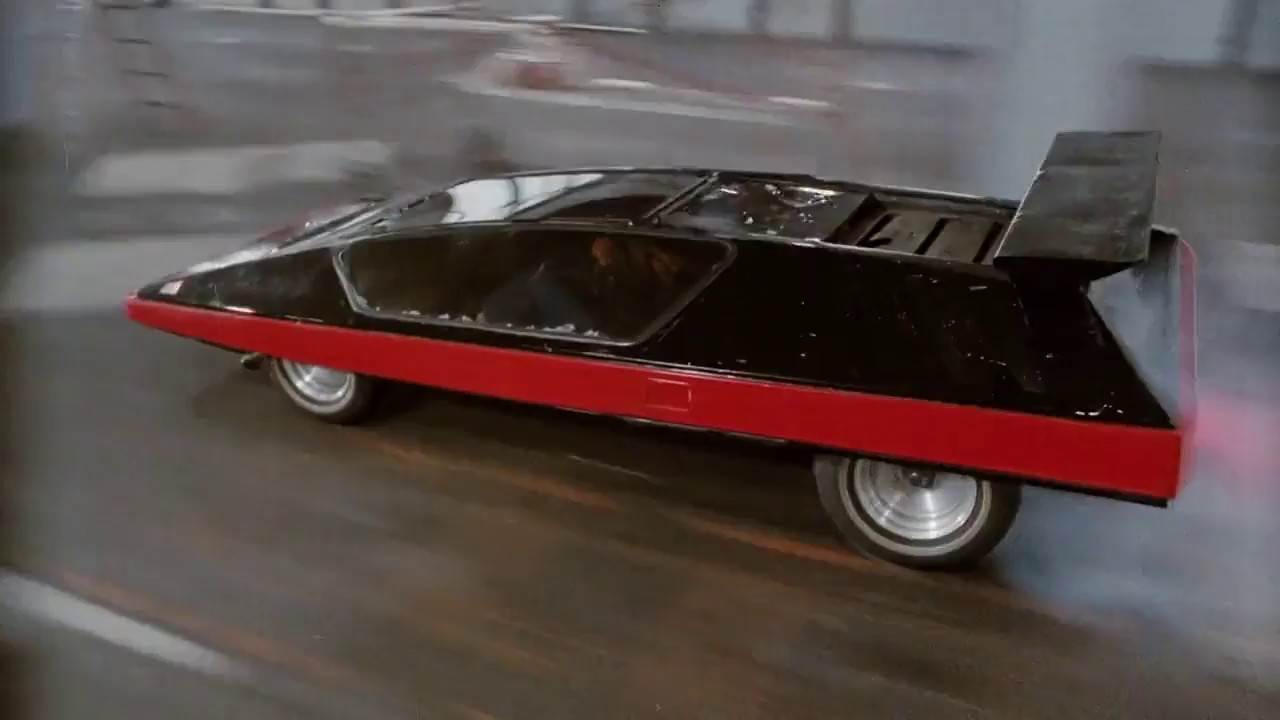
The FBI needs someone to steal a computer disk that can bring down a corrupt Las Vegas corporation so they hire reformed thief Sam Quint (Tommy Lee Jones).  Quint manages to steal the disk but he finds himself being pursued by Ringer (Lee Ving), an old acquaintance who now works for the corporation.  In order to keep the disk from falling into Ringer’s hands, Quint hides it in the back bumper of an experimental racing car called the Black Moon.  The Black Moon, which runs on water and can fly when it reaches its top speed, is being taken to Los Angeles by Earl Windom (Richard Jaeckel) so Quint assumes that he’ll just follow Window to L.A. and then retrieve the disk when no one is watching.

However, as soon as the Black Moon arrives in Los Angeles, it’s stolen by Nina (Linda Hamilton).  Nina works for Ed Ryland (Robert Vaughn), an outwardly respectable businessman who secretly runs a syndicate of car thieves.  Now, Quint and Nina (who conventiently falls in love with Quint) have to steal the car back from Ryland while staying one step ahead of both Ringer and the FBI.

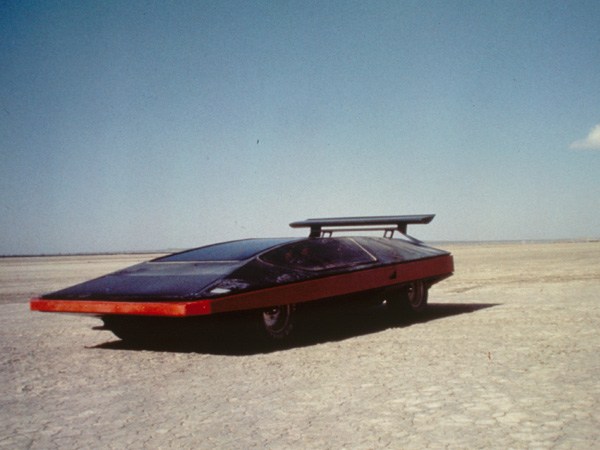
Black Moon Rising is not a movie that you watch for the plot or for the non-existent romantic chemistry between Tommy Lee Jones and Linda Hamilton.  You don’t even watch it for the white collar villainy of Robert Vaughn, who basically just recycles his performance from Superman III.  This is a movie that you watch for the car!  The Black Moon is definitely an impressive vehicle.  Who wouldn’t want to steal one of these?

In a car chase movie like Black Moon Rising, the most important thing is that the car must be cool.  The Black Moon looks like something Mad Max would drive and it can actually fly so, by definition, it’s pretty cool.  Unfortunately, Black Moon Rising doesn’t spend as much time with the car as it should.  The movie gets bogged down with the scenes of Quint and Nina falling in love and Quint having to deal with his FBI handler (played by Bubba Smith).  This is a film that would have benefited from being directed by someone like Hal Needham, who understood that people don’t come to car chase movies for the plot.  They come to car chase movies because they want to see people driving fast and cars crashing in spectacular ways.  Still, even though the car isn’t onscreen as much as it should be, the car is still cool enough to make Black Moon Rising watchable.

One final note: the screenplay is credited to John Carpenter.  Though the imdb claims that this was the first script that Carpenter ever sold and that the film spent ten years in development, Carpenter says that he wrote the script around the same time that he made Escape from New York.  He also says that he’s never actually seen the completed film.


Music Video of the Day: Big City Night by Scorpions (1985, directed by ????)


On the road with Scorpions!

In America, Scorpions are best-known for Rock You Like A HurricaneBig City Nights comes from the same album, Love At First String.  In fact, it was the last single released from that album and the video is made up of footage that was shot while the band was touring in support of Love At First Sting.  Though the song was never as big a hit as Rock You Like A Hurricane, the video was probably responsible for a lot of teenagers deciding to start a band in 1985.  The main message of this video seems to be that if you want to get laid, even when you’re middle-aged and your hair is starting to thin, then you need to start a band.  Of course, that was the message of most music videos of the period.

Enjoy!