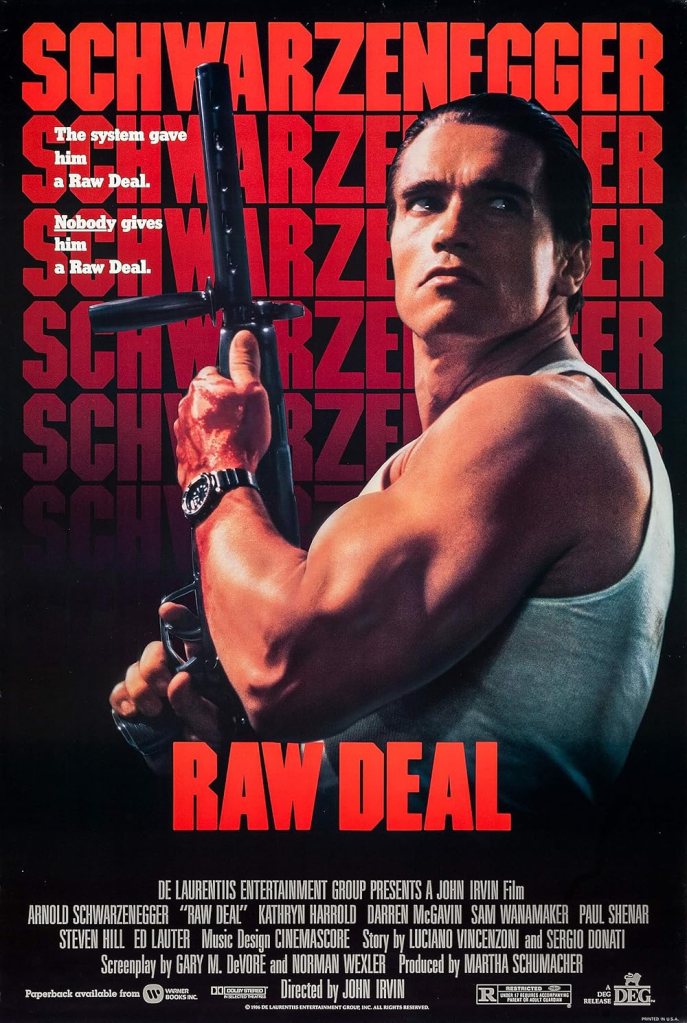
There is a point in every Arnold Schwarzenegger fan’s journey where they eventually circle back to Raw Deal and go, “Wait, how did this one slip through the cracks?” Set between Commando and Predator, this 1986 action vehicle often feels like the red-headed stepchild of Arnold’s golden era: a half-forgotten mob thriller dressed up as a one-man-army shoot-’em-up, with an undercover plot that keeps tripping over itself. Before Arnold was secret agent Harry Tasker in True Lies, he was already workshopping that whole undercover persona as former FBI man Mark Kaminski in Raw Deal. There is something strangely compelling about watching him play at being slick, whether he is posing as “Joseph Brenner” in mob circles or later reinventing himself as a suburban-family-man-turned-super-spy. Yet for all its clumsiness, tonal whiplash, and baffling choices, Raw Deal settles into that sweet, trashy groove where “this is bad” and “this is kind of awesome” blissfully merge. It is, in the purest sense, a guilty pleasure.
The setup is straightforward on paper. Arnold plays Mark Kaminski, a former FBI agent pushed out of the bureau for beating a suspect who assaulted and murdered a child, now stuck as a small-town sheriff in North Carolina with an unhappy, alcoholic wife and a life that feels like exile. His shot at redemption comes when his old FBI buddy Harry Shannon (Darren McGavin) recruits him for an off-the-books vendetta: infiltrate the Chicago mafia responsible for Shannon’s son’s death and tear them apart from the inside, in exchange for a possible path back into the bureau. Kaminski fakes his death, rebrands himself as “Joseph Brenner,” and sets out to worm his way into the organization run by boss Luigi Patrovita (Sam Wanamaker), while juggling mob politics, double-crosses, and a steady escalation of gunfire.
What makes the Kaminski era so weirdly fascinating is how hard the film leans on Arnold as a suave operator when his natural screen charisma is more brute-force than smooth-talking. In Raw Deal, he stalks through nightclubs and mob hangouts as an “undercover” tough guy, and you can almost see the movie trying to stretch him into a more traditional cool-gangster mode even as his sheer physicality keeps breaking the illusion. That tension carries right into True Lies, where the humor finally acknowledges how absurd it is to treat this gigantic Austrian bodybuilder as a low-key spy. The seeds of Harry Tasker’s double life are there in Kaminski: the awkward attempts at suave posturing, the undercover role-play, and the sense that the film is constantly asking the audience to accept him as something more than just the gun-toting tank he so effortlessly embodies. That tonal tug-of-war is kind of a mess, yet it’s also exactly why the movie is weirdly fun to revisit.
As an action piece, Raw Deal is very hit-or-miss, but when it hits, it goes all in on 80s excess. Director John Irvin stages a number of shootouts, but the standout sequence is the gravel pit massacre where Kaminski tears through mob soldiers with Mick Jagger’s “(I Can’t Get No) Satisfaction” blaring on the soundtrack, turning what should be a grim set piece into something closer to a music video about vengeance. The climactic assault on Patrovita’s casino base is another high point, with Kaminski stalking room to room, methodically mowing down henchmen in suits as the film abandons any pretense of undercover subtlety and embraces straight-up carnage. These moments are absurdly over the top, but they’re the reason the film lingers in the memory more than some “better” constructed movies from the same era.
The problem is that the film around those set pieces often feels oddly slack. For a movie with such a simple premise—ex-cop goes undercover in the mob—Raw Deal somehow manages to tangle itself in muddled plotting and underdeveloped subplots. Roger Ebert complained that the story is so basic it should be impossible to screw up, yet the movie still finds ways to make motivations cloudy and relationships confusing, especially when it comes to FBI leaks and why certain hits are happening. There are scenes, like the cemetery assassination setup, that should be loaded with emotional and narrative clarity but instead play as strangely opaque, leaving viewers wondering less “What will happen next?” and more “What exactly is going on?”
Despite the narrative wobbling, the cast gives the film more personality than it probably deserves. Schwarzenegger is still in that phase where his acting is limited but his screen presence is undeniable, and Raw Deal leans into that presence by letting him oscillate between stoic enforcer and deadpan comedian. He is not as effortlessly iconic here as he is in The Terminator or Predator, but he has a grounded gruffness in the early scenes as the weary small-town sheriff, and a playful swagger once he shifts into mob-infiltrator mode. The movie’s tonal confusion sometimes works in his favor: when he drops a ridiculous line in the middle of a supposedly serious undercover situation, it breaks the film’s self-seriousness in a way that oddly makes it more enjoyable.
On the supporting side, Darren McGavin brings a welcome dose of worn-out moral anguish as Harry Shannon, a man consumed by grief and desperate enough to go rogue, while Sam Wanamaker’s Patrovita and Paul Shenar’s lieutenant Max Keller give the mob side just enough theatrical menace to keep things lively. Kathryn Harrold’s Monique—Patrovita’s associate and Kaminski’s sort-of ally—is more underwritten than she should be, but she adds a smoky, world-weary charm to an otherwise thin role, bringing a touch of noir-vibe melancholy to a film that mostly cares about bullets. The dynamic between Kaminski and Monique hints at a more emotionally grounded movie lurking underneath, one that never fully arrives but peeks through in their quieter moments.
Visually and stylistically, Raw Deal fits comfortably into the mid-80s action aesthetic: slightly grimy urban backdrops, neon-lit nightclubs, smoky gambling dens, and anonymous industrial sites where bad guys go to die. John Irvin, better known for dramas and war films, occasionally tries to inject a more grounded tone, but the movie keeps undercutting that with comic-book logic and stylized violence, making it feel as if two different films are wrestling for control. On one level, that is a flaw; on another, that disjointed energy is part of what gives Raw Deal its “so off it becomes its own thing” quality, especially when watched now with decades of ironic distance.
Critically, the film was not well-loved on release, and its reputation has never really recovered in a mainstream sense. It holds a low Rotten Tomatoes score and only middling numbers on Metacritic, with reviewers at the time describing it as muddled, clichéd, and cheap compared to other action fare. Yet audience reactions have always skewed a bit warmer, with CinemaScore polling showing a respectable “B” grade and plenty of fans over the years framing it as an uneven but entertaining entry in Schwarzenegger’s catalog. The distance of time has turned Raw Deal into one of those movies where people admit its flaws freely but still find themselves rewatching it, chuckling at its corniness and vibing with its shootouts.
As a guilty pleasure, Raw Deal works because it is simultaneously too serious and not serious enough. It wants to be a gritty mob infiltration story but keeps indulging in gleefully excessive violence and dumb jokes; it dreams of being a tight cop thriller but never quite musters the narrative discipline. Yet that tension gives it a peculiar charm: it is a film that fails to be the sleek genre picture it might have been, but succeeds as a scrappy time capsule of 80s action sensibilities, carried by Arnold’s charisma and a few standout set pieces.
Viewed today, Raw Deal is hard to defend as “good” in any conventional sense, especially when measured against Commando’s pure cartoon energy or Predator’s lean genre perfection. But as a late-night watch, beer in hand, half-laughing at the dialogue while leaning forward during the gravel pit and casino shootouts, it absolutely delivers the specific pleasure it promises. The system may have given Mark Kaminski a raw deal, but for Arnold fans willing to embrace something messy, loud, and gloriously dated, this film still feels like a trashy little win
Previous Guilty Pleasures
- Half-Baked
- Save The Last Dance
- Every Rose Has Its Thorns
- The Jeremy Kyle Show
- Invasion USA
- The Golden Child
- Final Destination 2
- Paparazzi
- The Principal
- The Substitute
- Terror In The Family
- Pandorum
- Lambada
- Fear
- Cocktail
- Keep Off The Grass
- Girls, Girls, Girls
- Class
- Tart
- King Kong vs. Godzilla
- Hawk the Slayer
- Battle Beyond the Stars
- Meridian
- Walk of Shame
- From Justin To Kelly
- Project Greenlight
- Sex Decoy: Love Stings
- Swimfan
- On the Line
- Wolfen
- Hail Caesar!
- It’s So Cold In The D
- In the Mix
- Healed By Grace
- Valley of the Dolls
- The Legend of Billie Jean
- Death Wish
- Shipping Wars
- Ghost Whisperer
- Parking Wars
- The Dead Are After Me
- Harper’s Island
- The Resurrection of Gavin Stone
- Paranormal State
- Utopia
- Bar Rescue
- The Powers of Matthew Star
- Spiker
- Heavenly Bodies
- Maid in Manhattan
- Rage and Honor
- Saved By The Bell 3. 21 “No Hope With Dope”
- Happy Gilmore
- Solarbabies
- The Dawn of Correction
- Once You Understand
- The Voyeurs
- Robot Jox
- Teen Wolf
- The Running Man
- Double Dragon
- Backtrack
- Julie and Jack
- Karate Warrior
- Invaders From Mars
- Cloverfield
- Aerobicide
- Blood Harvest
- Shocking Dark
- Face The Truth
- Submerged
- The Canyons
- Days of Thunder
- Van Helsing
- The Night Comes for Us
- Code of Silence
- Captain Ron
- Armageddon
- Kate’s Secret
- Point Break
- The Replacements
- The Shadow
- Meteor
- Last Action Hero
- Attack of the Killer Tomatoes
- The Horror at 37,000 Feet
- The ‘Burbs
- Lifeforce
- Highschool of the Dead
- Ice Station Zebra
- No One Lives
- Brewster’s Millions
- Porky’s
- Revenge of the Nerds
- The Delta Force
- The Hidden
- Roller Boogie
 Through the Shattered Lens
Pingback: Guilty Pleasure #100: Ski Patrol (dir by Rich Correll) | Through the Shattered Lens
Pingback: Guilty Pleasure No. 101: The Executioner Series (by Don Pendleton) | Through the Shattered Lens
Pingback: Guilty Pleasure No. 103: Private Lessons (dir. by Alan Myerson) | Through the Shattered Lens
Pingback: Guilty Pleasure No. 104: The Parker Series (by Richard Stark) | Through the Shattered Lens
Pingback: Guilty Pleasure No. 105: Ramba (by Rossano Rossi & Marco Bianchini) | Through the Shattered Lens
Pingback: Guilty Pleasure No. 108: Interspecies Reviewers (Ishuzoku Rebyuāzu) | Through the Shattered Lens