Welcome to Late Night Retro Television Reviews, a feature where we review some of our favorite and least favorite shows of the past! On Wednesdays, I will be reviewing 1st and Ten, which aired in syndication from 1984 to 1991. The entire series is streaming on Tubi.
Victory’s yours …. for that taking….
Ugh, let’s do this.
Episode 2.5 “California Freeze Out”
(Dir by Bruce Seth Green, originally aired on September 22nd, 1986)
Training camp continues!
Oh, Good Lord, does it continue.
And look, I get it. This was a low-budget show that relied on stock footage for the majority of its game footage. There was probably only so much footage available. Not every episode could feature a game. And training camp is an important part of football and I’m sure that, back in 1986, HBO was proud of that set they built for the ugly bar where all the players hang out. It’s not a bad set. You look at it and you can literally smell the rancid combination of sweat and urine that seems to follow most male athletes.
But seriously …. I’M TIRED OF TRAINING CAMP! Its time to move on!
As for this episode …. hey, Waldren is already back from rehab and he’s clean! That was quick. However, shady quarterback Johnny Valentine continues to hang out with drug dealers and Waldren gives into temptation. He ends up at a raucous drug party that’s busted by the cops. Waldren jumps out of a window. His date is accidentally shot. You might think that Johnny Valentine would be in trouble considering how anti-drug the league has become but it turns out that Johnny is a star and busting him would effect ad revenue. So, Johnny gets off scot-free.
Meanwhile, O.J. Simpson — whoops, sorry, I meant to say T.D. Parker, don’t hurt me, Vengeful Spirit of O.J. — recruits a young player named Rick Lambert (Marcus Allen) to be the team’s new running back. Marcus Allen gave such a stiff performance that I immediately realized that he had to have been an actual player and it turns out that I was right. You can always tell the actual players because they’re the ones who can never summon up any emotion when they stumble through their lines. O.J. was the epitome of a player who became a bad actor but he came across as being …. well, not quite Olivier but maybe David Niven, while acting opposite Marcus Allen. Maybe that’s why Allen was added to the cast, to make O.J. look good.
Anyway, here’s hoping that O.J. and the rest of the Bulls slash their way out of training camp soon!
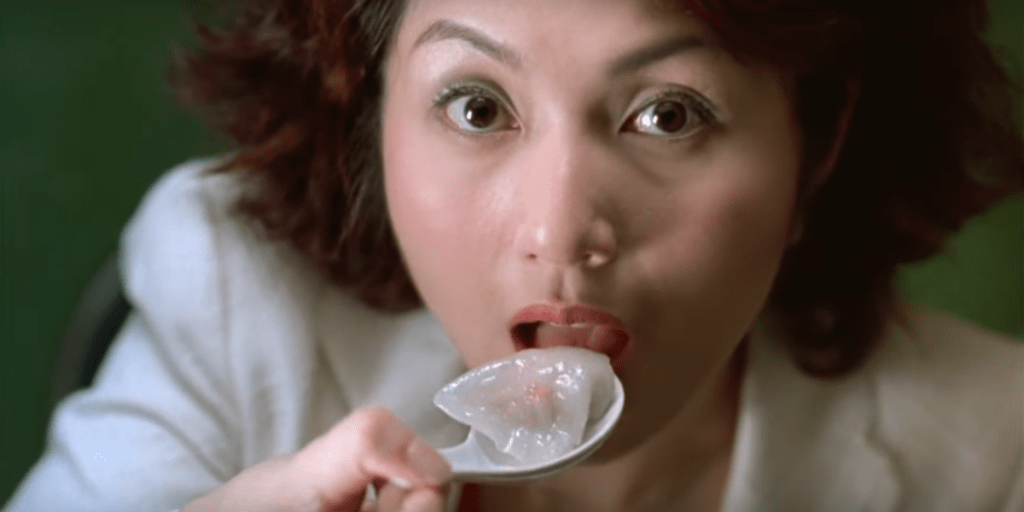
DUMPLINGS (2004) centers on Mrs. Li (Miriam Yeung), a former actress now in her forties, who’s struggling with getting older and no longer being attractive to her husband, Mr. Li (Tony Leung Ka-Fai). It seems he’s more interested in his beautiful young masseuse than he is in her, which leads Mrs. Li to seek out Aunt Mei (Bai Ling), an ex-gynecologist from mainland China who has a reputation in the underground for her expensive “miracle” dumplings that promise a fountain of youth. Initially appalled by Aunt Mei’s not-so-secret ingredients, once she starts looking better, Mrs. Li begins to not only accept the recipe, but she also starts to relish it. Soon she’s making passionate love to her husband and finding herself the envy of her friends again. But what is that fishy smell and why is she so itchy all of a sudden? And does it even matter if she feels young and beautiful again?!! Expanded into a feature length movie from a segment of the 2004 anthology film, THREE…EXTREMES (2004), DUMPLINGS ponders just how far we’re willing to go to defy the aging process.
I recently reviewed the category III Hong Kong film THE UNTOLD STORY, one of the most graphically violent films I could possibly imagine. Today, I’m discussing the category III film DUMPLINGS. While receiving the same rating, these movies couldn’t be more different. While THE UNTOLD STORY presents murderous violence in horrific detail, DUMPLINGS makes us imagine what it’s like to be so vain that unspeakable and immoral acts against others are meaningless as long as we feel good about the way we look. Even though the film gives away the “secret” of the dumplings somewhere in the first twenty minutes, I’m not going to give it away here. Just know that it’s repulsive, and the gleeful manner with which Aunt Mei goes about her work is every bit as sick to me as serial killer Wong in THE UNTOLD STORY. At the end of the day, each of us must ask what we’re willing to do to feel good about ourselves. In DUMPLINGS, it appears that the characters will do anything it takes!
This is the first time I’ve ever watched a film directed by Fruit Chan, whose MADE IN HONG KONG (1997) swept all the major Hong Kong Film awards a number of years before this film came out. Blending culinary horror with human self-obsession, his DUMPLINGS is a patient film, willing to let his gruesome story seep into our bones without relying on a lot of graphic shock value. Chan doesn’t flinch from showing the extreme subject matter a number of times, but he still crafts an almost elegant film that deals with real world human emotions, albeit extremely selfish and morally bankrupt ones. He also gets really strong performances from the cast. Bai Ling’s casually demented and sexualized turn as the eternally young Aunt Mei is the showpiece of the film, with her cleavage practically in a supporting role all to themselves. Her performance was strong enough to earn her the Hong Kong Film Award for Best Supporting Actress for this movie. Miriam Yeung, who was best known at the time for her fluffy romantic comedies like LOVE UNDERCOVER (2002) and THREE OF A KIND (2004), is solid as the lady whose desire for beautiful, tight skin allows her to willingly abandon basic human dignity, transforming into a remorseless monster just below the surface of that skin. And finally, Tony Leung Ka-Fai, as the philandering husband who thinks with his male anatomy more than he does with his heart, is suitably effective in the way he makes us wish Mrs. Li would have just accepted the aging process and left his sorry ass from the very beginning.
Overall, DUMPLINGS is a slow burn that will reward patient and attentive viewers with a tale of madness that touches on real world petty concerns while using extremely sick and twisted subject matter. As viewers, our discomfort with both that subject matter and the unchecked evolution of the characters seem to almost be the point. I don’t know how much you’ll truly enjoy the film, but I can’t imagine it not provoking a reaction.
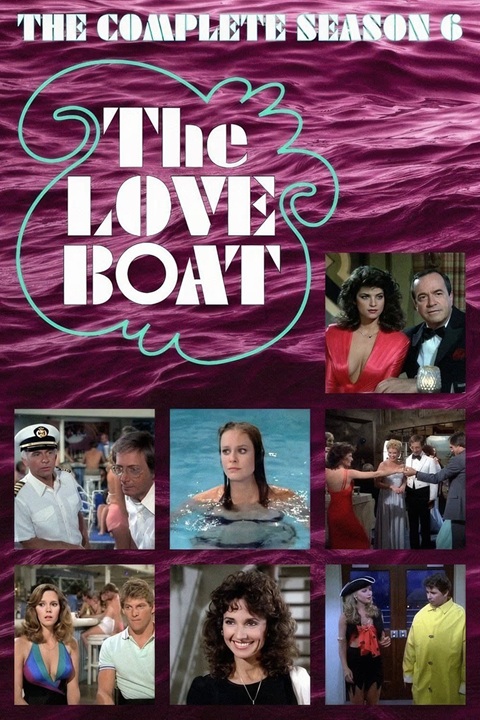
Welcome to Retro Television Reviews, a feature where we review some of our favorite and least favorite shows of the past! On Wednesdays, I will be reviewing the original Love Boat, which aired on ABC from 1977 to 1986! The series can be streamed on Paramount Plus!
The Love Boat promises something for everyone!
Episode 6.26 “The Professor Has Class/When The Magic Disappears/We, The Jury”
(Dir by Richard Kinon, originally aired on April 2nd, 1983)
I sent a message to my friend Jason, letting him know about this week’s episode of The Love Boat.
“This week’s episode featured a Van Patten and a Van Dyke!” I wrote.
He wrote back, “Two Dicks?”
“No, one Dick and a Barry.”
Dick Van Patten plays The Great Stellini. He’s upset that his daughter (Mary-Margaret Humes) wants to marry Joey Gardiner (Barry Van Dyke), a novice magician. The Great Stellini thinks that Joey wants to steal all of his tricks. His daughter teaches Stellini a lesson by actually disappearing during their stage show. Stellini is humiliated but he learns an important lesson about letting go and also supporting younger magicians.
Meanwhile, Anne Meara played Jerry Stiller’s former landlady. Anne was using Jerry for damaging her property. Gopher decided that a jury made up of the crew should decide the case. Huh? Why? That makes no sense. But you know what? Anne Meara and Jerry Stiller were so cute together that it didn’t really matter.
Finally, a 91 year-old professor (Sam Jaffe) was upset to discover that one of his former students (Bettye Ackerman) was going to replace him. Luckily, everyone fell in love. Sam Jaffe was one of the great character actors and it was kind of nice to see him on this show, acting opposite his wife, Bettye Ackerman. This was Jaffe’s final performance and he had a twinkle in his eye. He seemed to be having fun.
“Everyone loves a puzzle until it’s time to solve it.” — Benoit Blanc
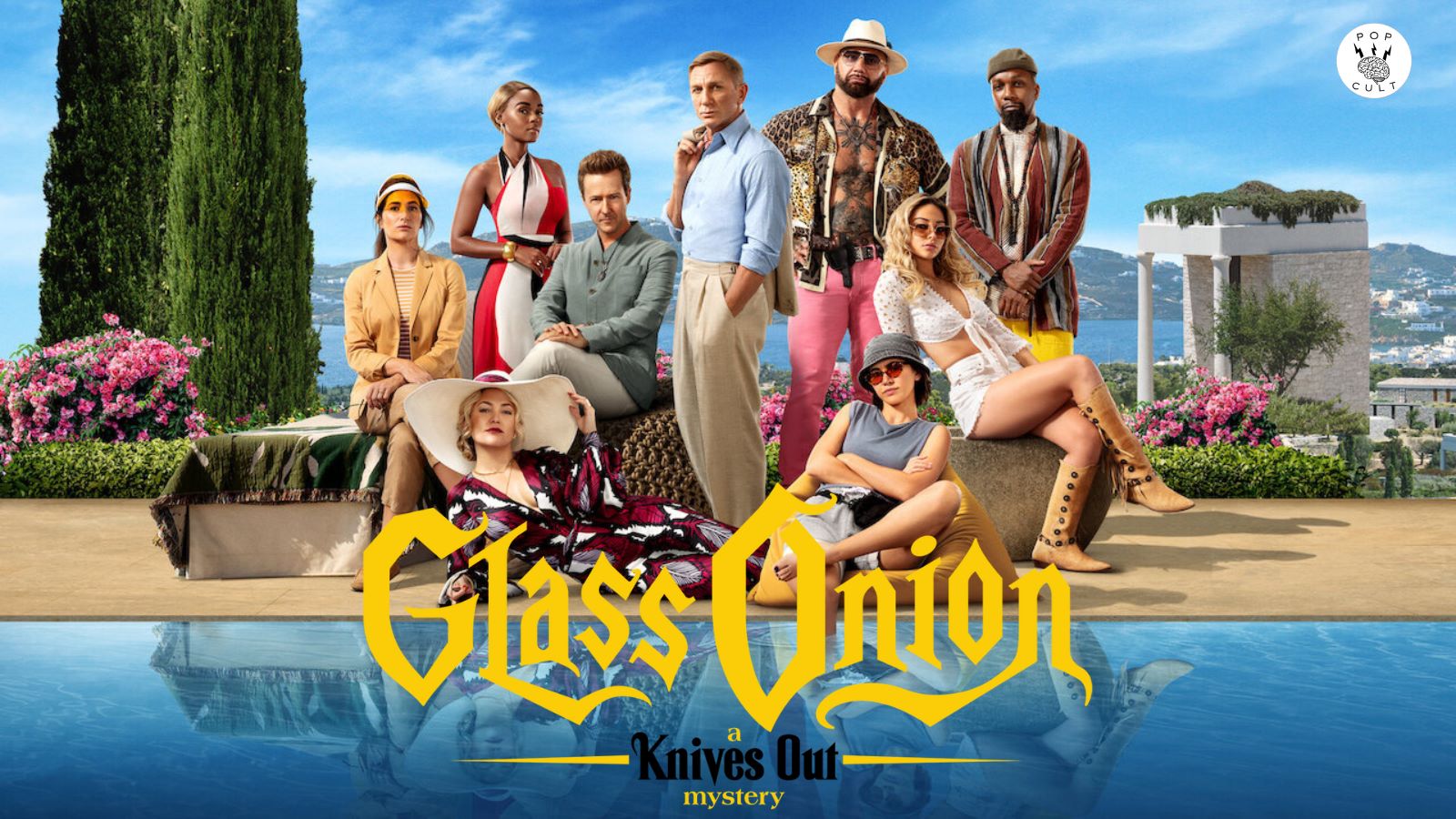
Glass Onion: A Knives Out Mystery is a follow-up to the original Knives Out film, starring Daniel Craig as the ingenious detective Benoit Blanc. It builds on the premise of a murder mystery but wraps it inside a colorful, satirical commentary on wealth, influence, and the human condition. Set on the private island of a tech billionaire named Miles Bron, the story assembles a quirky cast of characters, all entangled in complicated relationships that unravel layer by layer. The casual tone of the movie masks a sharp, incisive look at the absurdities of the ultra-rich and the moral compromises they often make.
From the outset, Glass Onion shines with its clever blending of classic whodunit tropes and contemporary social critique. The gathering on the island is ostensibly for a murder mystery party, but the tension quickly escalates when the lines between game and reality blur. As detective Benoit Blanc begins to peel back the layers, it becomes clear that the story is much more than just a puzzle; it’s a reflection on fame, fortune, intellectual theft, and the lengths people will go to protect their reputations and secrets. The mystery itself is engrossing, delivering plenty of twists and turns that keep viewers guessing without feeling predictable.
The characters are vividly drawn, each embodying a certain archetype of privilege and excess, yet crafted with enough depth to avoid caricature. Miles Bron, in particular, captures the archetypal tech mogul—brash, arrogant, and unapologetically wealthy—but his flaws and vulnerabilities make him an intriguing focal point. His colorful group of friends each contribute their quirks and motives, creating a dynamic interplay that enriches the plot. Through their interactions, the film deftly explores themes of betrayal, sycophantic behavior, and the moral decay that can accompany unchecked power.
Edward Norton’s portrayal of Miles Bron has often been linked to Elon Musk, mostly because Bron’s flamboyant personality and billionaire tech mogul status seem reminiscent of Musk. However, director Rian Johnson and Norton himself have been clear that the character is not based specifically on Musk. Instead, Miles embodies the broader archetype of “tech bros”: exceedingly wealthy, extremely arrogant, and more than a bit sociopathic. Norton’s portrayal blends charm, obliviousness, and bravado, embodying this tech mogul stereotype more than mimicking any particular real-life figure. This approach allows the film to critique the broader billionaire culture, using Miles as a symbol of its excesses and absurdities, rather than targeting one individual.
A distinctive feature of Glass Onion is how it incorporates the reality of its production during the height of the COVID-19 lockdown. Set in May 2020, during global lockdowns, the film naturally weaves in social distancing and mask-wearing as part of its narrative fabric. This not only adds an element of authenticity but also becomes a device to reveal character traits—whether sincere compliance or performative adherence. The pandemic protocols also shaped production logistics, reducing extras and focusing tightly on the main cast, creating an intimate but tense atmosphere. By anchoring the isolation of its characters in a real-world health crisis, the film echoes classic mystery confinements while feeling relevant and immediate.
Emotional stakes in Glass Onion are amplified through Helen, who arrives on a personal mission to uncover the truth behind her sister’s death. Unlike many self-interested guests on the island, Helen represents a disruptive force challenging the privileged elite. Her story adds urgency and depth, highlighting themes of justice, accountability, and silence’s costs. This subplot weaves seamlessly into the larger narrative, enriching the mystery’s resolution with meaningful emotional weight.
Visually, the film dazzles with opulent settings and a vibrant color palette that amplify the sense of excess and detachment characterizing the guests’ lives. The private island itself almost becomes a character—a lush, insular playground where drama explodes amid luxury. Production design and cinematography balance whimsy with darker undertones, while costumes and set details root satire in an authentic world.
Craig returns as Benoit Blanc with a mix of charm, wit, and gravitas, anchoring the film amidst eccentric chaos. Blanc’s character delights as a master detective who enjoys intellectual puzzles but wrestles with moral questions. Meanwhile, the supporting cast gives nuanced performances that capture their characters’ complexities and motivations.
Narratively, Glass Onion triumphs by delivering an engaging mystery while embedding incisive social commentary on inequality and hypocrisy. The film compellingly probes how wealth and influence can obscure truth and the costs endured by those who confront power. The sharp, often humorous writing makes it both entertaining and thought-provoking.
Whether viewed casually or analyzed deeply, Glass Onion offers much to enjoy. Plot twists, sharp dialogues, visual style, and strong performances combine for an engrossing experience. At its core, the story emphasizes how the pursuit of personal gain can harm others, and reckoning with uncomfortable truths demands courage and sacrifice.
Ultimately, Glass Onion is a skillfully crafted, entertaining mystery that surpasses typical genre fare. It balances suspense, humor, and social critique naturally and compellingly. Cementing Rian Johnson’s success in the Knives Out franchise, it reclaims his reputation after the contentious backlash to The Last Jedi. While fan expectations proved insurmountable in that galaxy far, far away, Glass Onion confirms Johnson as a brilliant filmmaker capable of crafting sharp, layered stories. The film invites audiences to not only solve a crime but also reflect on integrity, power, and humanity’s search for justice and meaning. Its impact lingers long after the credits roll.
Carlos Santana’s song “Black Magic Woman” is a timeless tune that hooks you right from the start, but it’s that guitar solo that really makes it unforgettable and that is what make it our latest “Song of the Day.” The solo kicks in around 2 minutes and 24 seconds into the track. What’s great about Santana’s solo is how it feels like a conversation rather than just fast playing. His guitar almost sounds like it’s telling a story, with smooth, soulful notes that seem to sing. It’s not about shredding or showing off; it’s about playing each note with feeling and attitude, making you want to listen over and over.
What really stands out in the solo is how Santana uses bends and vibrato — which means he gently raises the pitch of the notes and adds a slight shake. This gives the solo a warm and emotional feel, almost like a human voice expressing deep feelings. The smooth back-and-forth flow between notes keeps it easy to follow, so even if you’re not a guitarist, you can feel the emotion. Plus, the mix of Latin rhythms shines through, giving the solo a unique flavor that sets Santana apart from other guitarists and adds some groove to the song.
The solo in “Black Magic Woman” is what really grabs listeners and keeps them hooked. It’s not about playing a million notes fast, but about making every sound count and really feeling the music. Santana’s guitar almost talks and sings with a warm, inviting voice that pulls you into the mood of the song. His unique blend of smooth, flowing notes with just the right amount of grit and emotion makes the solo stand out as something special and timeless. Instead of flashy showmanship, it’s the deep connection you feel through the guitar that keeps the solo memorable and moving for generations of listeners. This soulful approach is what turns a simple guitar solo into a truly magical moment in the song.
Black Magic Woman
Got a black magic woman Got a black magic woman
I’ve got a black magic woman Got me so blind I can’t see That she’s a black magic woman She’s tryin’ to make a devil out of me
Don’t turn your back on me, baby Don’t turn your back on me, baby
Yes, don’t turn your back on me baby Stop messin’ around with your tricks Don’t turn your back on me baby You just might pick up my magic sticks
[guitar solo]
Got your spell on me baby Got your spell on me baby
Yes you got your spell on me baby Turning my heart into stone I need you so bad – magic woman I can’t leave you alone


 Through the Shattered Lens