October Positivity: The Moment After 2: The Awakening


2006’s The Moment After 2 picks up where The Moment After ended.

In the days after the Rapture, the Global Alliance has taken over the world.  The government seeks to control everything.  Paper money is becoming a thing of the past and instead, everyone is expected to pay via a chip that’s been implanted in their hand.  Not having a chip means going to prison and probably being executed for being a subversive.  The Global forces, led by the sadistic Commander Fredericks (Monte Rex Perlin), are hunting down dissidents.  People are being reeducated.  It’s the type of world that, in reality, a lot of people want, even if they hide it behind a bunch of class struggle rhetoric.

Former FBI agent Adam Riley (David A.R. White) is on Death Row but he gets a chance for freedom when the prison transport is attacked by a rebel group.  When the other prisoners ask Adam to come with them, Adam takes one look at all the bodies of the people killed during the attack and refuses.  He’s not a follower of Global but he doesn’t want any part of the rebel militia’s demand of “an eye for an eye.”  Instead, Adam wanders through the desert until he finds a community of Christians.  He’s reunited with the Rev. Jacob Krause (Brad Heller), from the first film.  He also meets Carissa (Andrea Logan White), a woman with whom he is in love.  However, she’s married to Richard (Mark Atteberry) and we all know what the Bible says about adultery.  Of course, the world is now a dangerous place and, with Fredericks executing every Christian he finds, maybe Adam will still get his chance.  Adultery may be a sin but moving in on a new widow is not.

Meanwhile, Adam’s former partner and friend, Charles Baker (Kevin Downes), is recruited to track Adam down.  If Charles captures Adam, maybe Charles’s wife Rebecca (Deanne Morre) will be releases from prison.  Or maybe not.  You really can’t trust the Global Alliance.

One thing that I appreciated about this film is that Adam, despite plenty of opportunities to give into temptation, stayed true to the commandment that “Thou Shalt Not Kill.”  A lot of faith-based, apocalypse films tend to use the end times setting as an excuse to turn its characters into quip-ready action heroes, gunning down the forces of the world government and blowing up buildings without a second thought.  This film, though, is smart enough to say, “Hold on, the whole anti-killing thing still applies, regardless of how bad things get.”

As for the rest of the film, it’s well-made and the cast is decent.  That may sound like faint praise but, after you’ve watched enough low-budget faith-based productions, you come to appreciate the ones that at least feature a steady camera, a clean soundtrack, and actors who can at least show a modicum of emotion.  As tempting as it may be to laugh at the heavy-handedness of the Global Alliance, those of us who remember the COVID lockdowns will never forget some of the suggestions that were made for dealing with people who were judged to be noncompliant because they didn’t want to observe curfew or close their businesses.  Much like the first film, The Moment After 2 is a decent thriller, one that works nicely for our paranoid times.
Late Night Retro Television Review: Highway to Heaven 4.18 “We Have Forever: Part Two”


Welcome to Late Night Retro Television Reviews, a feature where we review some of our favorite and least favorite shows of the past!  On Thursdays, I will be reviewing Highway to Heaven, which aired on NBC from 1984 to 1989.  The entire show is currently streaming on Tubi and several other services!

This week’s episode is massively confusing.

Episode 4.18 “We Have Forever: Part Two”

(Dir by Michael Landon, originally aired on February 17th, 1988)

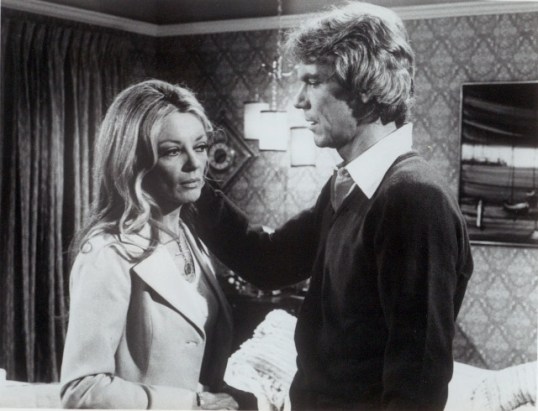
Picking up from last week, an embittered Jonathan is no longer an angel.  Instead, he’s a mortal man who can’t get a job because he doesn’t have any references.  (The idea is that Jonathan can’t explain that he’s spent the last 40 years working for God.  But, over the past four and a half seasons, he’s had numerous jobs where he helped people out.  Couldn’t he have listed some of those people are references?)  However, Jonathan is happy because he’s fallen in love with Jennifer (Leann Hunley), the woman that he saved from drowning last week.

Meanwhile, Mark is actually making an effort to help people by working at the camp for the blind where he and Jonathan worked earlier in the season.  (Actually, why couldn’t Jonathan ask for a job at the camp?  The more I think about it, Jonathan not being able to get a job makes less and less sense.)

Jennifer, however, has a secret of her own.  At the end of the episode, she leaves Jonathan a note, in which she explains that she’s actually Joan, Jonathan’s late wife.  Jonathan was upset because he felt God was keeping him from seeing Joan in Heaven.  Instead, it turns out that Joan — like Jonathan — has been assigned to work on Earth as an angel.  So, the two months that Jonathan spent with Jennifer was actually God giving Jonathan a chance to spend time with Joan but, for some reason, no one told Jonathan that was what was happening so Jonathan got mad and walked out on God.  But then, Jonathan changes his mind after learning that Joan is Jennifer but instead of asking to work with Joan/Jennifer, Jonathan goes back to working with Mark.

Seriously, I’m having a hard time following some of the logic here.

That said, despite all the lapses in logic, this episode still made me cry.  Admittedly, I’ve been feeling under the weather today so maybe that’s why I was so emotionally susceptible to this episode.  Or maybe it’s just the fact that Highway to Heaven is such an overwhelmingly earnest and sincere show that even the episodes that shouldn’t work somehow do.  All I know is that I was sobbing by the end of this episode.

The important thing is that, at the end of the episode, Jonathan and Mark have a new assignment  and drive off.  Wait, I thought Mark had a job.  Way to abandon all those blind children, Mark!

Perhaps it’s best not to think too hard about this episode and just accept it for being the tear jerker that it was.

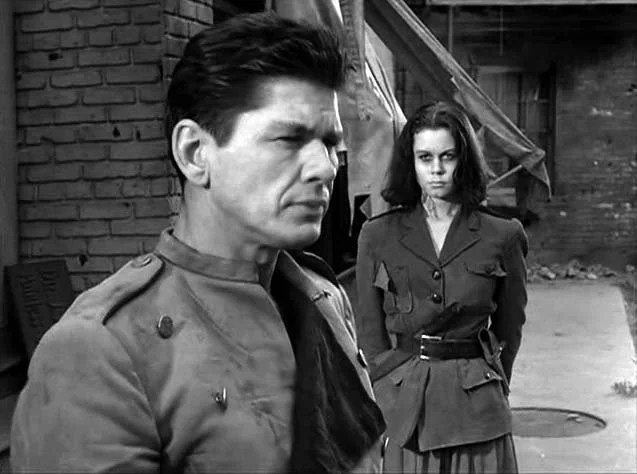
THE TWILIGHT ZONE (TV Series) – S3, E1: “Two,” starring Charles Bronson and Elizabeth Montgomery!


You know producer Buck Houghton had high hopes for the opening episode of Season 3 of THE TWILIGHT ZONE when it aired on September 15, 1961. It stars up and coming actors of the time, Charles Bronson and Elizabeth Montgomery, who were all over TV screens in the 50’s and early 60’s, with Bronson emerging as a strong character actor in movies as well. The two would be major stars within a few years, but they weren’t quite there yet. 

This episode, titled “Two,” opens with “The Woman” (Elizabeth Montgomery), who is wearing a tattered dark military uniform, wandering into a bombed out, deserted city, and spotting the remains of a restaurant. Tired and hungry, she goes in and digs around until she finds an old can of chicken. As she’s opening the can, “The Man” (Charles Bronson), who’s wearing a tattered, light-colored uniform, walks in on her. Immediately attacking him with a combination of meat cleavers, bottles, pots and pans, The Man tries to hold her off until if becomes clear that he’s going to have to subdue her, which he does with one vicious punch that knocks her out cold. At this point it’s clear that these are the last two remaining survivors of a devastating war, on opposing sides no less, that completely destroyed the world. When The Man wakes The Woman up by dumping a pot of cold water on her face, he gives her back her chicken and tells her that there is no reason to fight anymore, as everyone else is dead. She doesn’t understand what he is saying so he walks off in frustration. The Woman doesn’t trust The Man, but she begrudgingly starts to follow him around to keep an eye on him. Will they kill each other? Will they join forces to survive? Could they even fall in love? Writer-Director Montgomery Pittman answers all of these questions over the course of the episode’s brisk 25 minutes. 

The allegorical “Two” was a bold choice to open the popular TV show’s third season with its minimalist production set in a few sections of a single bombed-out town and featuring only two characters who barely even speak, especially Montgomery, who says two words throughout the entire episode. Not that much really happens either, so it’s the type of episode that lives or dies based on the performances of the lead actors, and Bronson and Montgomery both deliver outstanding work. Bronson, a dependable character actor at this point in his career, is especially good as The Man. His square-jawed stoicism unravels enough to reveal a weary vulnerability and desire for a connection with another person, even when they’re supposed to be mortal enemies. It’s ultimately a romantic part and Bronson kills it. For those who mostly know Bronson from his post DEATH WISH action star roles, parts like this are a revelation. Montgomery, still a few years away from beginning her iconic portrayal of Samantha in BEWITCHED, is quite beautiful even when she’s this grimy. Her performance as The Woman is even more challenging as it’s almost completely a physical performance, and she shines as her character transforms over the course of the episode.

Ultimately, “Two” may resolve its setup a little too quickly to be realistic, but I still enjoyed it immensely. The performances are outstanding and its hopeful denouement left me with a smile on my face. 

Horror On TV: The Cloning of Clifford Swimmer (dir by Lela Swift)


Tonight’s televised horror is The Cloning of Clifford Swimmer.  Peter Haskell stars as Clifford Swimmer, an angry jerk who is unhappy with his marriage.  He’s come up with a plan, though.  He’s going to have himself cloned and then, after leaving his clone with his family, he’ll be free to live his life.  However, Swimmer discovers that things never work that simply when it comes to creating a clone.  This is a clever story with a great twist at the end.

It originally aired on November 1st, 1974 as a part of ABC’s The Wide World of Mystery.  Unfortunately, whoever uploaded this film to YouTube has disabled playback so you’ll have to click on the link to watch it!

Way To Go, Dodgers!


Baseball update!  The Dodgers have just defeated the Brewers in Game 3 of the NLCS!  The Dodgers now lead the series 3-0 and are one win away from going to the World Series!  As they are the only team that is not from a state (or country) that is at the very top of the lower 48, I am in the unexpected position of cheering for the Dodgers as the MLB postseason reaches its conclusion.

Now, it’s up to the Mariners to defeat the Blue Jays in Game 4 of the ALCS and we will be that much closer to the World Series that I want.

Go Mariners!  Go Dodgers!


On-Stage On The Lens: Hamlet From The Lunt-Fontaine Theater (dir by Bill Colleran and John Gielgud)


That Richard Burton is today best-remembered for his tumultuous marriages to Elizabeth Taylor and for his performances in several less-than-worthy films is unfortunate as Burton was also one of the most highly regarded staged actors of his generation.  In fact, late in his life, Burton often expressed regret that he had ever left the stage for films to begin with.

In 1964, Burton played Hamlet on Broadway, in a production that was directed by John Gielgud.  (Gielgud also provided the voice of the Ghost.)  This is a video-recording of both that production and Burton’s acclaimed performance.  Burton brings an intense and almost divine madness to the role.  Watching, one can see why Burton would have preferred to have been remembered for this instead of for playing Mark Antony.


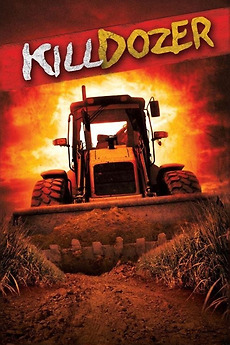
Killdozer (1974, directed by Jerry London)


Six construction workers (played by Clint Walker, Carl Betz, Neville Brand, James Wainwright, James A. Watson, and Robert Urich) are boated to an isolated island off the coast of Africa.  An oil company has assigned them to build an airstrip on the island.  On the first day of work, they come across a meteorite buried in the ground.  When one of the men tries to pick up the meteorite with the bulldozer, a blue light envelops the bulldozer and, at the same time, fatally injures Robert Urich.  Possessed by the meteorite, the bulldozer starts to track the remaining workers down, killing them one-at-a-time.  It’s a killdozer!

Based on a short story by Theodore Surgeon and made-for-television, Killdozer asks the question, “Have you ever seen a big, bulky bulldozer attempt to sneak up on someone?”  Given that Killdozer is not fast and it’s not very agile, it should be easy to escape it but the construction keep doing dumb things, like getting drunk or trying to hide inside a copper tube instead of just running away.  The surviving men wonder how they are going to make it until help eventually arrives.  Maybe if you hear Killdozer coming, you should could just step to the side or maybe you could even run behind Killdozer.  Instead, the construction workers keep trying to fight it head-on.  Every time Killdozer pauses from noisily rolling across the island and sits still because it senses one of the workers might be nearby, I’m reminded that Killdozer is an absolutely ludicrous film but that it’s also wonderfully strange and that it’s also impossible to enjoy it on some level.

The cast is good and, for the most part, so is the straight-forward, waste-no-time direction.  The Killdozer deserved an Emmy and maybe its own series but instead, it just had to settle for cult stardom.

The Magic Voyage of Sinbad (1953/1962, directed by Aleksandr Ptushko)


When is a Sinbad film not a Sinbad film?

When it’s The Magic Voyage of Sinbad!

Sinbad (Sergei Stolyarov) returns to his land after going on a great quest.  He sees that half of the citizens are rich and happy and always dancing.  He sees that the other half are poor and never happy.  Those of us watching see that the film’s version of Persia looks a lot like Russia.  Sinbad announces that he is going to capture the Bird of Happiness and bring it back to his people.  He sets sail and is given help by the daughter of Neptune.  Sinbad visits many lands and spend some time underwater, where Neptune offers him the hand of his daughters and there’s also an octopus hanging around and watching in the background.  Sinbad never finds the Bird of Happiness but it doesn’t matter because he realizes that his people have all the happiness that they need in Persia.

The Magic Voyage 0f Sinbad may seem like a strange Sinbad film and that’s because it was never a Sinbad film in the first place.  It was actually a Russian film called Sadko, about a young Russian man who tries to prove himself by finding the Bird of Happiness.  In America, Sadko was even released under its original name and plot in 1953.  No one paid much attention to it.

Then, in 1962, Roger Corman got his hands on the American distribution rights for the film and he decided to rerelease it.  He changed the title to The Magic Voyage of Sinbad and he hired a young film student to write narration for the film and to also “translate” the film’s dialogue so that it could be dubbed into English.  The very Russian Sadko instead became a film about Sinbad, the legendary Persian sailor.

The Corman version went on to become the better-known version, largely because it was featured on Mystery Science Theater 3000.  Personally, I prefer the Corman version because the badness of the dialogue and the overly solemn narration go a long way toward making up for the fact that this is a 79-minute movie about someone searching for something and failing to find it.  After making so many grand promises, Sinbad returns to his home and tells everyone that he actually lied and they don’t need the Bird of Happiness to be happy.  The film ends abruptly, probably because the people rose up and tossed Sinbad in the ocean at that point.

As for that film student who wrote the script, Francis Ford Coppola later did alright for himself.

Retro Television Review: Decoy 1.8 “Escape Into Danger”


Welcome to Retro Television Reviews, a feature where we review some of our favorite and least favorite shows of the past!  On Thursdays, I will be reviewing Decoy, which aired in Syndication in 1957 and 1958.  The show can be viewed on Tubi!

This week, Casey pursues her neighbor and nearly dies.

Episode 1.8 “Escape Into Danger”

(Dir by Teddy Sills, originally aired on December 2nd, 1957)

Casey Jones (Beverly Garland) returns home from a night shift, hoping to get some rest so that she can get over a bad cold.  (I’ve had enough bad colds that I’m fairly confident that Garland herself was suffering from a cold when she filmed this episode and it was written into the script.)  She discovers that her neighbor, Mary (Madeline Sherwood), has hit her abusive and drunken husband across the back of his head.  Mary is convinced that she’s killed her husband and is terrified that she’ll go to jail.  When Casey informs her that her husband is just knocked out and that everything is going to be okay, Mary doesn’t believe her because Casey is a cop and a cop will say anything to make an arrest.  While Casey is in her apartment calling for an ambulance, Mary flees the scene.

Mary’s husband does die but he dies of acute alcohol poisoning so Mary’s off the hook.  (Apparently, this episode take place in a world where assault isn’t a crime.)  Despite her cold, Casey takes to the streets and searches for Mary.  Knowing that Mary is masseuse, Casey checks out all the massage parlors.  In a move that kind of makes me wonder if Casey is really that good at her job, she decides that she might as well get a massage as well.

The woman who gives Casey the massage is Katy Olin (Virginia Kaye), who is Mary’s sister and a bitter ex-con who hates all cops.  While Katy massages Casey, Mary hides in the changing room.  When Casey says that she’s looking for Mary, Katy has Mary sneak out of the dressing room and choke Casey into unconsciousness.  Mary steals Casey’s gun and then makes her escape.

A few thoughts:

First off, after years of being spoiled by shows like Law & Order, I have to say that I was initially surprised that Casey didn’t know that Mary had a sister or that the sister was an ex-con.  But then I remembered that this episode was filmed in 1957, back before all of that information was available at just the touch of a key.

That said, what type of police officer is going to get a massage while on duty?  Even if Casey had looked up from the massage table and seen Mary trying to escape the room, what was Casey going to do?  Chase her through the streets of New York while wearing a towel?  Also, Casey often seems to just drop her purse anywhere, despite the fact that her purse contains a loaded gun.

Third, Katy mentions to Mary that there’s no way for her to leave the room without walking right past Casey.  So, how did Mary get into the room in the first place and how come Casey didn’t notice her when she first arrived?

Fourth, once Casey wakes up, she takes Katy down to the police station.  Katy’s interrogated and refuses to answer any questions.  She asks if she’s being charged with anything and, because she’s not, she’s allowed to go.  Is she not an accessory for hiding Mary and then just standing by while Mary attempted to murder a police officer?

Katy decides that the best thing for Mary to do would be to hide out in her old apartment, the one that is next door to the police officer who Mary just tried to strangle.  (Neither Katy nor Mary appear to be that smart.)  Casey, of course, discovers that two of them hiding there.  She and the neighborhood priest (John McLiam) talk Mary into putting down the gun.  They assure her that she did not kill her husband.  Mary finally believes that Casey is telling the truth….

….which is all good and well except Mary ASSUALTED A POLICE OFFICER!  Indeed, one could argue that what Mary did to Casey counts as attempted murder.  So, really, it seems like Mary should be going to jail regardless.  Unfortunately, we never learn about what happened to Mary after she stop pointing the gun as Casey.  If I was Casey, I would prefer a neighbor who hasn’t tried to kill me.

This episode didn’t really make sense but I’m glad that Casey got over her cold by the end of it.