Late Night Retro Television Review: Pacific Blue 2.19 “Lost and Found”


Welcome to Late Night Retro Television Reviews, a feature where we review some of our favorite and least favorite shows of the past! On Tuesdays, I will be reviewing Pacific Blue, a cop show that aired from 1996 to 2000 on the USA Network!  It’s currently streaming everywhere, though I’m watching it on Tubi.
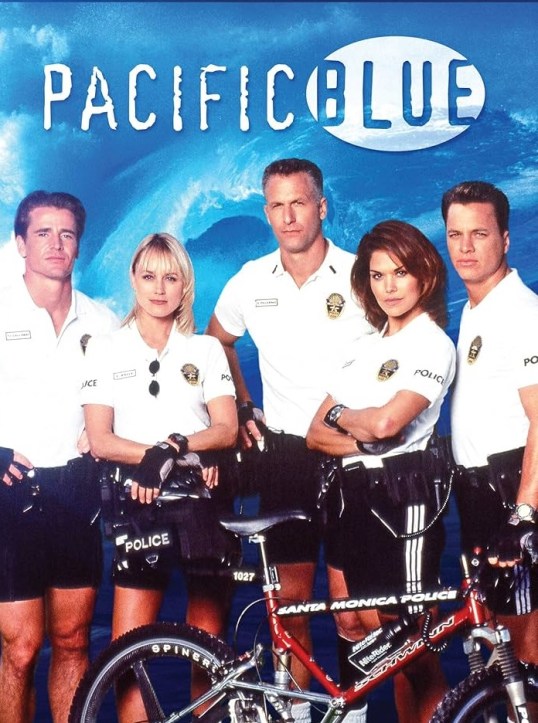
This week, the bike cops screw up another case.

Episode 2.19 “Lost and Found”

(Dir by Michael Levine, originally aired on March 2nd, 1997)

I’ve often felt that the most interesting thing about Pacific Blue is witnessing just how totally incompetent the bicycle cops really are.

This episode centers around a girl who has run away from home.  Chris and Palermo are holding her at the station and they release her to the first guy who shows up claiming to be her father.  They don’t bother to ask the man for any sort of proof that he’s her father.  They don’t even ask to see his ID.  Instead, they just let her go with him.

Guess what?  That guy wasn’t her father!

Her actual father shows up a little while later and, needless to say, he’s pretty pissed off.  Instead of apologizing or in any way accepting accountability for screwing up, Palermo and Chris snap at the guy to calm down and then say that they’ll track down his daughter.  What’s funny is that we’re supposed to be on the side of the bicycle cops because the father is angry and yelling.  Well, the father has every right to be angry and yelling.  THE IDIOTS LET HIS RUNAWAY DAUGHTER LEAVE WITH THE FIRST GUY WHO SHOWED UP!

Now, the show later reveals that the father was abusive and that his daughter ran way because he was beating her.  Yeah, he’s not a good father and he should lost custody of his daughter.  That doesn’t make the bicycle cops any less incompetent, though!  It just amuses that this show continually tries to convince us that we should take these people seriously as cops but every episode seems to feature them making some sort of terrible mistake.  This show really seems to think that, as long as Chris is shooting people the death glare, that means she’s not responsible for any of her screwups.

This episode also featured a subplot in which Cory tried to protect her no-good brother from some hitmen.  She did a better job with her storyline than Chris and Palermo did with the case of the runaway.  Maybe Cory should be in charge.
Brad’s watching THE MAGNIFICENT SEVEN (1960) at the theater tonight!


Y’all have a wonderful night as I watch my 5th Charles Bronson film at the movie theater! In 2022, I watched THE MECHANIC, MR. MAJESTYK, and DEATH WISH 3 at the Mahoning Drive-In in Lehighton, PA. Last year I caught HOUSE OF WAX here in downtown Little Rock at the Ron Robinson Theater. Tonight the Ron Robinson Theater is celebrating the 65th anniversary of the classic western THE MAGNIFICENT SEVEN!

In my excitement, I’ll share Henry Brooks’ song THE MAGNIFICENT SEVEN from his musical “Charles Bronson – More than a Vigilante – The Musical!” Enjoy my friends!

Retro Television Review: Fantasy Island 7.9 “Fantasy Island Girl/Saturday’s Child”


Welcome to Retro Television Reviews, a feature where we review some of our favorite and least favorite shows of the past!  On Tuesdays, I will be reviewing the original Fantasy Island, which ran on ABC from 1977 to 1984.  Unfortunately, the show has been removed from most streaming sites.  Fortunately, I’ve got nearly every episode on my DVR.

This week, we have two fantasies that seem very familiar.

Episode 7.9 “Fantasy Island Girl/Saturday’s Child”

(Dir by Leslie H. Martinson, originally aired on December 10th, 1983)

Actress Marion Sommers (Stella Stevens) comes to the Island.  Lawrence is a huge fan and can’t imagine what fantasy she could possibly have.  Roarke explains that Marion wants to be reunited with her children.  The twist is that her children don’t know that Marion is their mother.  They think that their mother died and that they were adopted by Fran Woods (Diane Baker).

Marion is told that, because of the way she phrased her fantasy, she’ll get to meet her children on the island but she can’t tell them that she’s their mother.  The children have spent the last few years with Ms. Woods as their mother.  Marion agrees but she doesn’t keep her word and, by the end of her fantasy, she’s told both Bill (David Kaufman) and Ellie (Amy Linker) that she is their mother and that she wants them to come with her.  Bill and Ellie reject her, saying that Ms. Woods will always be their mother.  However, they would like it if Marion would be their friend.

Lawrence asks Marion to give him her autograph so he can give it to his niece.  Then, after Marion leaves, Lawrence tells Roarke that he doesn’t have a niece….

This fantasy seemed awfully familiar.  I don’t really have the time to go back and reread every Fantasy Island review that I’ve written but I’m pretty sure that this show has already gone to the “I’m  a famous actress who wants to meet the children that I gave up” well more than a few times.  In this case, it just felt like everyone was going through the motions.

As for the other fantasy, it involved the Fantasy Island Girl Beauty Pageant and, again, I’m pretty sure I’ve seen several versions of this pageant fantasy in the past.  This time, it’s the pageant’s producer, Nick Gleason (Paul Burke), who has a fantasy.  It seems that Nick has a reputation for fixing his pageants so his fantasy is to run a totally “clean” and honest pageant.  It seems like he could have just done that on his own without even having to go to Fantasy Island.  Since when have fantasies become about doing things that most people would just do naturally?

Nick’s daughter, Tina (Audrey Landers), enters the pageant and suddenly, Nick finds himself tempted to fix the pageant for her.  When Roarke explains this to Tina, Tina withdraws from the pageant and Nick doesn’t fix the pageant.  Nick is so happy that he finally put on a honest pageant but the only reason he didn’t fix the pageant was because Tina dropped out.  If she hadn’t dropped out, he totally would have rigged it.  So, I’m not really sure that Nick has anything to brag about.  It’s kind of like bragging about not robbing a bank because it was closed on Sunday.

Lawrence is appointed as one of the judges for the beauty pageant.  You know who really enjoyed beauty pageants?  Tattoo.  This would have been a fun fantasy for Tattoo.  Instead, we just get Lawrence looking all huffy and puffy.

The trip to the Island was no fantasy.

4 Shots From 4 Kevin S. Tenney Films


4 Shots From 4 Films is just what it says it is, 4 shots from 4 of our favorite films. As opposed to the reviews and recaps that we usually post, 4 Shots From 4 Films lets the visuals do the talking!

Any days is a good day to give a little respect to Kevin S. Tenney, director of some of most best loved horror films of the 80s and the 90s!  It’s time for….

4 Shots From 4 Kevin S. Tenney Films

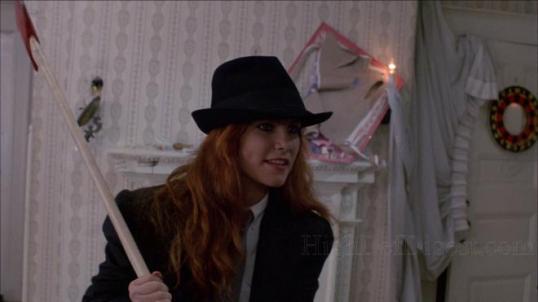
Witchboard (1986, dir by Kevin S. Tenney, DP: Roy Wanger)

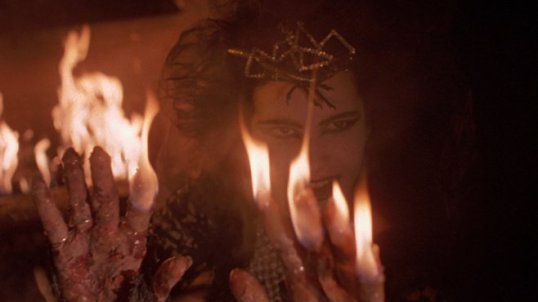
Night of the Demons (1988, dir by Kevin S. Tenney, DP: David Lewis)

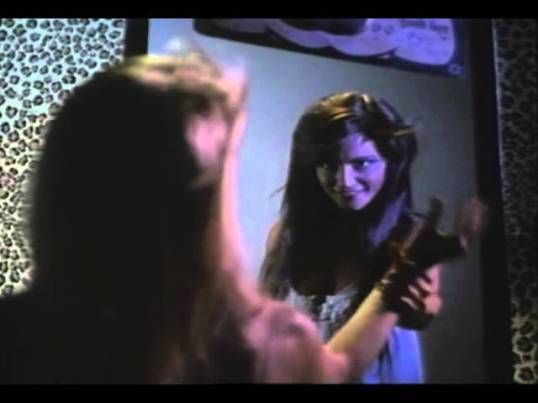
Witchboard 2: The Devil’s Doorway (1993, dir by Kevin S. Tenney, DP: David Lewis)

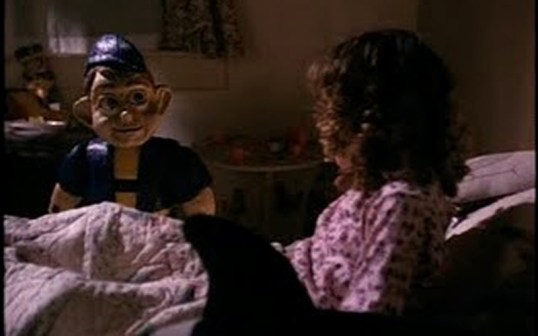
Pinnochio’s Revenge (1996, dir by Kevin S. Tenney, DP: Eric Anderson)

Music Video Of The Day: Animal by Def Leppard (1987, directed by Doug Freel and Jean Pellerin)


Animal is a song that took three years for Def Leppard to complete.  The band started work on the song in 1984 with producer Jim Steinman, who is best known for his collaborations with musicians like Meat Loaf and Bonnie Tyler.  Steinman’s orchestral style proved to be a poor fit with Def Leppard’s more straight forward sound.  After realizing that Steinman wasn’t going to work out, the band brought in Mutt Lange, who was able to get the sound that the band wanted.

Though the band had already found success in the United States, Animal was the first Def Leppard song to became a hit in the UK.  Not only did it reach No. 6 on the UK Single Chart but it also scored the band their first invitation to perform on Top of the Pops.  (For the benefit of our American readers, that was, back in the day, a big effing deal.)

The video finds the band working and performing in a traveling circus.  The video was directed by Doug Freel and Jean Pellerin, both of whom have directed videos for several different artists.  Along with directing several other videos for Def Leppard, Freel and Pellerin have also worked with Metallica.  On his own, Freel has done videos for Roxette and Faith No More.  Pellerin, meanwhile, directed the films, Laserhawk, For Hire, Daybreak, and The Clown At Midnight.

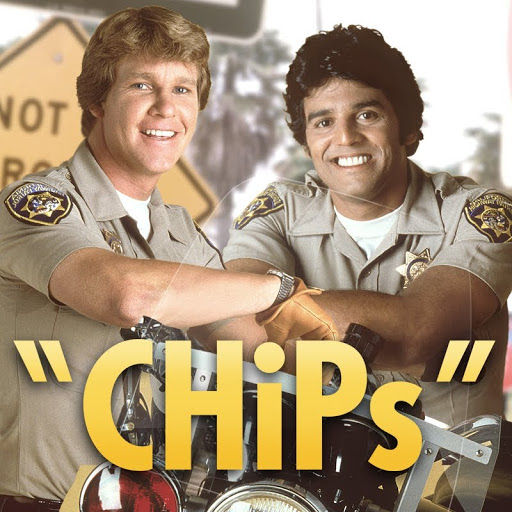
Late Night Retro Television Review: CHiPs 4.12 “Home Fires Burning”


Welcome to Late Night Retro Television Reviews, a feature where we review some of our favorite and least favorite shows of the past!  On Mondays, I will be reviewing CHiPs, which ran on NBC from 1977 to 1983.  The entire show is currently streaming on Prime!

It’s arson and basketball on CHiPs!

Episode 4.12 “Home Fires Burning”

(Dir by Charles Bail, originally aired on February 1st, 1981)

Two arsonists (David Hayward and Michael Cavanugh) are setting RVs on fire as a part of an insurance scam.  One man (Jack Kruschen) who hires the arsonists is horrified when their carelessness leads to a security guard getting seriously injured.  If the guard dies, the man is looking at serious jail time!  (Luckily, the guard doesn’t die and apparently, everyone just forgets about sending his boss to jail.)

Luckily, Baker is there to help track the arsonists down.  Ponch, on the other hand, is busy putting together a Highway Patrol basketball team.  It’s hard not to notice how much time the Highway Patrol spends on stuff like basketball, dirt bike competitions, and drag car racing.  Somehow, Ponch has gone from being the department’s screw-up to now being the guy who is automatically given all of the responsibility.  It’s the Ponch Show and everyone knows it.

This episode was directed by veteran stuntman Charles Bail and it does have some spectacular stunts.  (A car jumping through an exploding RV was my favorite.)  And let’s be honest.  I could sit here and spend hours talking about CHiPs became the Ponch Show during the fourth season and how the rest of the cast was underutilized.  And I would be totally correct.  But the stunts and the car crashes are the main appeal of this show and this episode featured several examples of each.

As such, this was a good episode.

Brad reviews STAR TREK – S1, E10 – “The Corbomite Maneuver!”


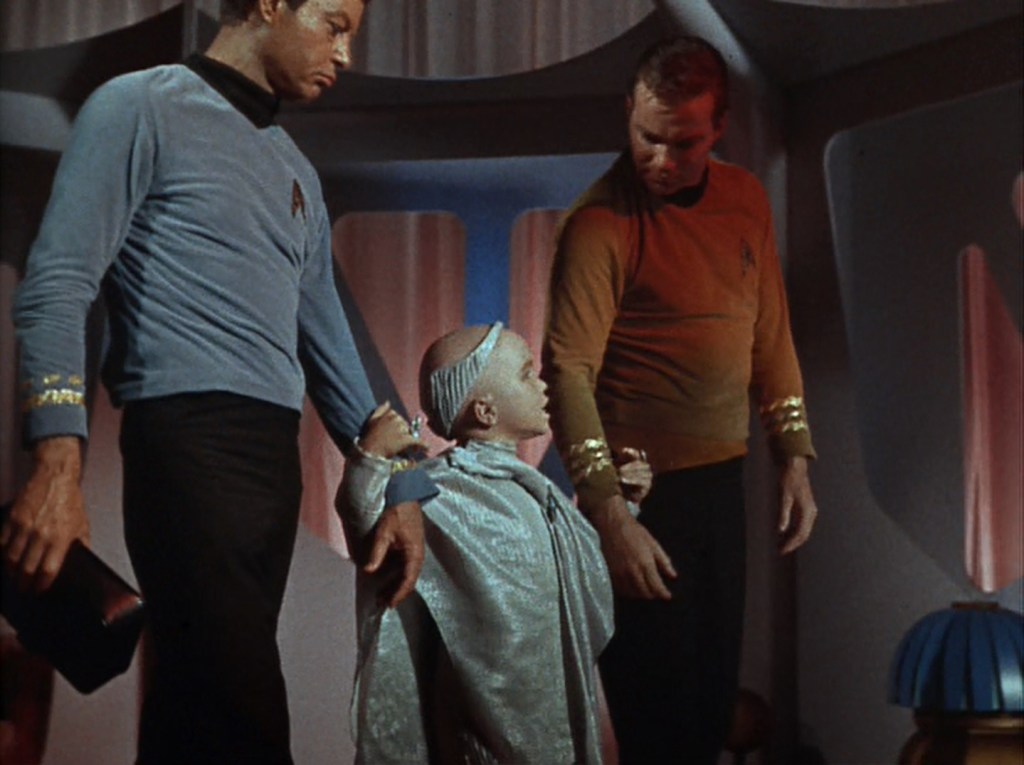
DeForest Kelley, Clint Howard and William Shatner

“The Corbomite Maneuver,” one of the earliest of the original STAR TREK episodes ever filmed, first aired on November 10, 1966. In this episode, the Enterprise, under Captain Kirk’s command, encounters a mysterious cube blocking its path in uncharted space. When attempts to communicate fail, the cube emits radiation, forcing the crew to destroy it. This action provokes a powerful alien vessel, the Fesarius, commanded by Balok, who accuses the Enterprise of trespassing and announces its imminent destruction. Kirk, facing a seemingly unbeatable foe, bluffs by claiming the Enterprise is equipped with a fictional “corbomite” device that would destroy any attacker. As a tense standoff takes place, Kirk’s gamble pays off when Balok blinks first and initiates contact, leading to a somewhat surprising conclusion.

I’ve watched some of the STAR TREK movies and TV shows over the years, but I’m nowhere near what someone would call a “Trekkie.” I do remember watching and liking STAR TREK II: THE WRATH OF KHAN (1982) when I was a kid, and as an adult, I enjoyed the 2009 reboot from J.J. Abrams. I recently read Ron Howard and Clint Howard’s memoir, THE BOYS, and Clint talked about how often fans would bring up his appearance in this specific episode of STAR TREK. Since today, September 8th, is “Star Trek Day,” and the original series is streaming on Paramount Plus, I decided I would see what all the fuss is about. I did think it was pretty cool when I saw that the episode was directed by Joseph Sargent, who would go on to direct a couple of my favorite movies of the early 70’s, WHITE LIGHTNING (1973) and THE TAKING OF PELHAM ONE TWO THREE (1974).

I had a lot of fun watching “The Corbomite Maneuver” for the first time today. From what I’ve read online, many consider this a really strong episode of the original series, and I can see why. The episode builds some pretty strong tension as Balok’s vessel seems so much stronger than the Enterprise, and it seems believable that the crew is really in danger. The special effects seem to be well done for the time period, with the “glowing cube” especially interesting. While there is not a lot of action in the episode, there are solid dramatics and a sense of humor rears its head from time to time. The main cast of William Shatner as Captain Kirk, Leonard Nimoy as Spock, and Deforest Kelly as Bones McCoy provide many of their classic character traits that would lead to them becoming pop culture icons. Shatner’s Kirk exudes extreme confidence amid a seemingly hopeless situation, while Nimoy’s Spock offers his unquestionable logic, and Kelley’s McCoy provides his gruff but loyal empathy. When a seven year old Clint Howard finally shows up as the real Balok in the last five minutes of the episode, I was ready. I got quite the kick out of watching Clint, whose voice is dubbed by a guy named Walker Edmiston, serve the guys a delicious drink named Tranya, a drink he truly relishes. As the episode was ending, my mouth was watering for the tasty looking alien beverage! 

Happy Star Trek Day friends. I truly enjoyed joining in on the celebration for the first time in my life today! 

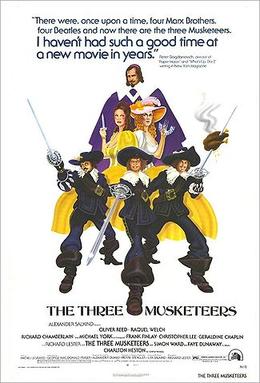
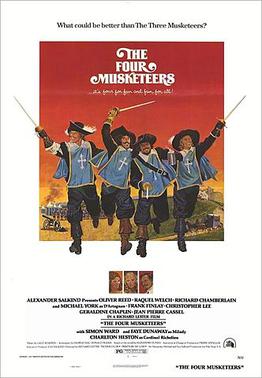
The Three Musketeers (1973, directed by Richard Lester) and The Four Musketeers (1974, directed by Richard Lester)


In 1973, director Richard Lester and producer Ilya Salkind decided to try to get two for the price of one.

Working with a script written by novelist George McDonald Fraser, Lester and Salkind had assembled a once-in-a-lifetime cast to star in an epic film adaptation of Alexandre Dumas’s The Three Musketeers.  Michael York was cast as d’Artagnan, the youthful swordman who goes from being a country bumpkin to becoming a King’s Musketeer.  His fellow musketeers were played by Oliver Reed, Richard Chamberlain, and Frank Finlay.  Faye Dunaway and Christopher Lee were cast as the villains, Milady and Rochefort.  Charlton Heston played the oily Cardinal Richelieu.  Geraldine Chaplin played Queen Anne while Simon Ward played the Duke of Buckingham.  Comedic relief was supplied by Roy Kinnear as d’Artagnan’s manservant and Raquel Welch as Constance, d’Artagnan’s klutzy love interest.  The film was a expensive, lushly designed epic that mixed Lester’s love of physical comedy with the international intrigue and the adventure of Dumas’s source material.

The only problem is that the completed film was too long.  At least, that’s what Salkind and Lester claimed when they announced that they would be splitting their epic into two films.  The cast and the crew, who had only been paid for one film, were outraged and the subsequent lawsuits led to the SAG ruling that all future actors’ contracts would include what was known as the Salkind clause, which stipulates that a a single production cannot be split into two or more films without prior contractual agreement.

But what about the films themselves?  Both The Three Musketeers and The Four Musketeers are currently available on Tubi.  I watched them over the weekend and, of the many films that have been made out of Dumas’s Musketeer stories, Richard Lester’s films are the best.  Lester captures the swashbuckling spirit of the books while also turning them into two films that are easily identifiable as Lester’s work.  There’s a lot physical humor to be found in Lester’s adaptation, especially during the first installment.  d’Artagnan runs through the streets of Paris, convinced that he has been insulted by the haughty Rochefort.  d’Artagnan manages to get challenged to three separate duels, all to take place on the same day.  After his first swordfight as a member of the Musketeers, d’Artagnan tries to tell the men that he wounded about an ointment that will help them with their pain.  Raquel Welch also shows a genuine flair for comedy as Constance, which makes her fate in the second film all the more tragic.

For all the controversy that it caused, splitting the story into two films was actually the right decision.  If The Three Musketeers is an enjoyable adventure film, The Four Musketeers is far more serious.  In The Four Musketeers, Oliver Reed’s melancholic Athos steps into the spotlight and his story of his previous marriage to the villainous Milady casts his character in an entirely new light.  In The Four Musketeers, the combat is much more brutal and the humor considerably darker.  Likable characters die.  The Musketeers themselves commit an act of extrajudicial brutality that, while true to Dumas’s novel, would probably be altered if the film were made today.  From being a naive bumpkin in The Three Musketeers, The Four Musketeers finds d’Artgnan transformed into a battle weary soldier.

The cast is fabulous.  This is a case of the all-star label living up to the hype.  Oliver Reed, Frank Finlay, and Richard Chamberlain all seems as if they’ve been riding and fighting together for decades.  Christopher Lee plays Rochefort as being an almost honorable villain while Faye Dunaway is a cunning and sexy Milady.  What truly makes the film work, though, is the direction of Richard Lester.  Lester stay true to the spirit of Dumas while also using the material to comment on the modern world, with the constant threat of war and civil uprising mirroring the era in which the films were made.  Interestingly enough, Richard Lester first became interested in the material when Ilya Salkind reached out to the Beatles to try to convince them to play the Musketeers.  While the Beatles were ultimately more interested in a never-produced adaptation of The Lord of the Rings, Richard Lester was happy to bring Dumas’s characters to life.

Both The Three Musketeers and The Four Musketeers are currently on Tubi, for anyone looking for a truly great adventure epic.