Today’s scene that I love comes from 1971’s Dirty Harry, in which Clint Eastwood, as “Dirty Harry” Callahan finally confronts the the Scorpio Killer (Andy Robinson) and asks him if he feels lucky. Eastwood himself later said that Callahan’s badge must have been attached to a rubber band because he was somehow able to get it back in time for Magnum Force.
Did you know that Clint Eastwood once had a number one country hit?!! His duet “Bar Room Buddies” with country music icon Merle Haggard hit number one on the Billboard Hot Country Songs chart in July of 1980. Released as part of the soundtrack for BRONCO BILLY, the song spent a total of thirteen weeks on the chart. Clint’s not much of a singer, but it’s still a fun drinking song!
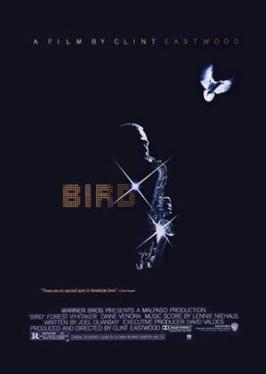
Forest Whitaker stars as the legendary saxophonist Charlie “Bird” Parker. The film, which is structured around flashbacks and time jumps and features some of the most beautifully-done transitions that I’ve ever seen, follows Parker as he plays his saxophone, challenges the jazz purists who his own individual style, and looks for work in both America and France. Along the way, we watch as he befriends and learns from Dizzy Gillespie (Samuel Wright), mentors a young trumpet player named Red Rodney (Michael Zelniker), and has a complex relationship with a white jazz lover named Chan Parker (Diane Venora). Throughout his life, Charlie Parker struggles with his addiction to heroin and alcohol, occasionally getting clean to just then fall back into his habit. To its credit, the film avoids most of the biopic cliches when it comes to portraying Parker’s addiction. Parker accepts that he’s an addict, just as he accepts that he has a talent that is destined to revolutionize American music.
Director Clint Eastwood has always been a fan of jazz and he actually saw Charlie Parker perform when he was a young man. His love of jazz had been present in almost every modern-era film that he has directed, staring with Play Misty For Me’s lengthy trip to the Monterey Jazz Festival. Bird was a passion project for Eastwood, the first film that Eastwood directed without also appearing in. (Eastwood doesn’t star in his second directorial effort, Breezy, but he does have a brief and silent cameo as a man standing on pier.) Eastwood takes a nonlinear approach to telling the story, eschewing the traditional bopic format and instead putting the focus on Parker’s music. Eastwood was able to get several never bef0re-released recordings of Parker performing and, when Whitaker is blowing into his saxophone in the film, we’re actually hearing Parker. Eastwood’s direction captures the smoky atmosphere of the jazz clubs where Parker and Gillespie made their name while the nonlinear style reflects the feeling of just letting a song take you to wherever it’s going. This is a movie about jazz that plays out like a jazz improvisation.
Forest Whitaker gives an amiable and charismatic performance as Charlie Parker, playing him as someone who has found both an escape and peace in his music, even as he physically struggles with the ravages of his drug addiction. Whitaker won the Best Actor at Cannes for his performance in Bird. Eastwood received the Golden Globe for Best Director. Bird feels like it was labor of love for both of them. Bird may not have set the box office on fire when it was originally released but it remains one of the best jazz films.
In TIGHTROPE, a psychiatrist makes the following comment to New Orleans police detective Wes Block (Clint Eastwood) while he’s trying to catch a serial killer who’s targeting sex workers:
“There’s a darkness inside all of us, Wes; you, me, and the man down the street. Some have it under control. Others act it out. The rest of us try to walk a tightrope between the two.”
This statement definitely hits home to Wes, whose personal life has gotten rather dark. His wife has recently left him and their two daughters (Alison Eastwood and Jenny Beck), and the detective seems to be drowning himself in his work, at times in a bottle, and at other times in the arms of some of the local ladies of the night. Whenever he does try to plan something with his girls, his job always seems to get in his way. As he investigates the murders in a variety of the seediest locations in New Orleans, we learn that Wes is very much into the kinds of women who inhabit these places, and he gives into his secret desires on multiple occasions. This becomes personal when the killer, who knows that Wes is the detective in charge of the case, begins targeting and killing some of the very same women who helped ease Wes’ emotional pain, and then taunts him about it. It becomes even more personal when the killer goes after his daughters and his new “legitimate” lady friend Beryl Thibodeaux (Geneviève Bujold), a rape counselor Block has gotten to know as part of the broader investigation. As the bodies continue to pile up, will Wes be able to stop the killer in time to save the most precious people in his life?!!
TIGHTROPE is a special movie to me. I’ve mentioned this before in other reviews, but FOX-16 out of Little Rock played a lot of good movies in the mid to late 80’s when I was a teenager. Some of those movies hold a strong nostalgic value in my life because I first discovered them and my true love of movies during those years. The channel advertised and showed TIGHTROPE, and many other Eastwood films, quite often. Of course, the movie broadcast on FOX-16 was heavily edited, and I didn’t realize the true sexual complexity of detective Wes Block until I was quite a bit older. In the original DIRTY HARRY, there’s a running gag where different people ask Eastwood’s iconic character, “Why do they call you Dirty Harry?” From what we see in TIGHTROPE, if someone asked, “Why do they call you Dirty Wes,” the answer would be more than obvious as he engages in various kinky forms of sexual relations with at least three of the sex workers he hits up for information. The killer knows of his sexual activities with these women, even watching on occasion. The movie leans hard into this connection between Wes’ kinky sex that often involves handcuffs, and the kinship that the killer feels with Wes when he’s perpetrating violence on these same women. It adds an uneasy and unsettling quality to the proceedings when the killer publicly taunts his rival, who understandably doesn’t want his peers to know of his more private nocturnal activities. He can’t fool his new lady friend, the tough as nails Beryl Thibodeaux, who senses his hidden desires and accepts him for who he is, especially after spending some quality time with him and his daughters. I like Genevieve Bujold in the role and the French-Canadian actress is able to even nail the local accent on a couple of occasions. I also wanted to mention the excellent chemistry between Clint Eastwood and his real-life daughter Alison, who play father and daughter in the movie as well. Alison was only 12 years old when TIGHTROPE was released, but she gives a strong performance as the older daughter who’s still trying to come to terms with her parents’ divorce. The killer really messes up when he targets her.
I’ll tell anyone who’s willing to listen that I love the city of New Orleans as a movie location. I personally love to visit the city and partake in its fun atmosphere and wide variety of excellent cuisine. TIGHTROPE hits many of the highlights of New Orleans in 1984… Bourbon Street, Jackson Square, the Super Dome, the Creole Queen, a warehouse full of Mardi Gras floats, the famous cemeteries, Randi Brooks in a hot tub, etc. etc. One thing about New Orleans is that its famous streets like Bourbon Street have not been cleaned up or become “family friendly” in the same way as a place like Times Square in New York City. To this day, it retains that same feeling of sexual decadence that is portrayed here in 1984.
I personally consider TIGHTROPE to be a must-see film for fans of Clint Eastwood, as Wes Block is a wholly unique addition to his cavalcade of tough cop characters, and he makes us justifiably uncomfortable at times. Eastwood’s conflicted performance, the serial killer storyline and the fun New Orleans locations add up to a very good movie that’s aimed squarely at adults.
4 Or More Shots From 4 Or More Films is just what it says it is, 4 shots from 4 of our favorite films. As opposed to the reviews and recaps that we usually post, 4 Shots From 4 Films lets the visuals do the talking!
On this date, 131 years ago, the great cinematic stylist Josef von Sternberg was born in Vienna. Von Sternberg would become one of the great directors of both the silent and the early sound era and is today best remembered for his many collaborations with Marlene Dietrich.
It’s time for….
4 Shots From 4 Josef von Sternberg Films
Underworld (1927, dir by Josef von Sternberg, DP: Bert Glennon)
The Blue Angel (1930, dir by Josef von Sternberg, DP: Gunther Rittau)
Shanghai Express (1932, dir by Josef von Sternberg, DP: Lee Garmes and James Wong Howe)
The Scarlet Empress (1934, dir by Josef von Sternberg, DP: Bert Glennon)
Today’s music video of the day is for Iron Maiden’s The Trooper, which was one the band’s few songs to achieve frequent radio airplay in the United States.
The song was inspired by Tennyson’s poem, The Charge of the Light Brigade and the video features scenes taken from the 1936 film of the same name. The BBC actually banned this video and demanded significant cuts because they felt that the footage from the film was too violent. Obviously, back in 1983, no one at the BBC had any idea what the future would hold as far as violence in music videos was concerned.
The footage of the band performing was filmed in Brixton Academy and directed by Jim Yukich, who did videos for everyone who was anybody.


 Through the Shattered Lens