4 Or More Shots From 4 Or More Films is just what it says it is, 4 shots from 4 of our favorite films. As opposed to the reviews and recaps that we usually post, 4 Shots From 4 Films lets the visuals do the talking!
101 years ago, on this date, Marlon Brando was born in Omaha, Nebraska. One of the greatest of American actors and one of the main reasons why so many young actors became enamored with the Method, Marlon Brando played many roles in our culture. When he was young, he was a Broadway bad boy. When he went out to Hollywood, he became a legitimate movie star. In the 60s, he was a cautionary tale as his career suffered a series of notorious flops. In the 70s, he made a comeback and, in during the final years of his career, he was as known for his eccentricities as for his talent. It’s a shame that those eccentricities overshadowed Brando as an actor. When he wanted to be, he was one of the best to ever appear on stage or in the movies.
In honor of the wonderful, tragic, and talented Marlon Brando, it’s time for….
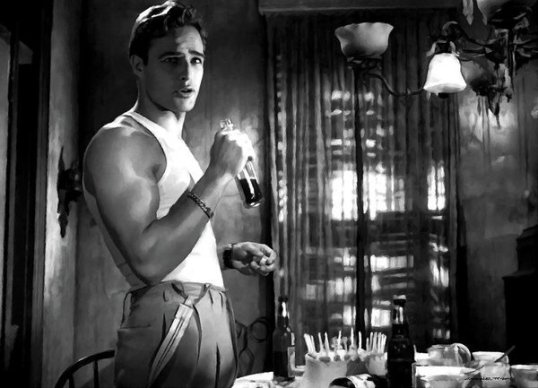
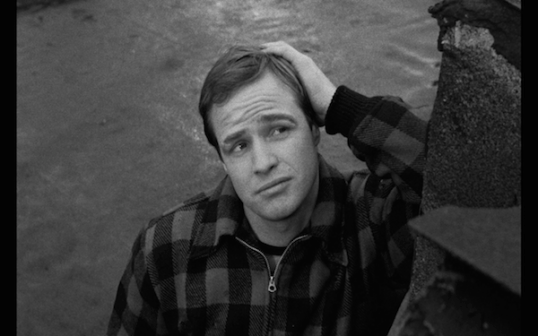
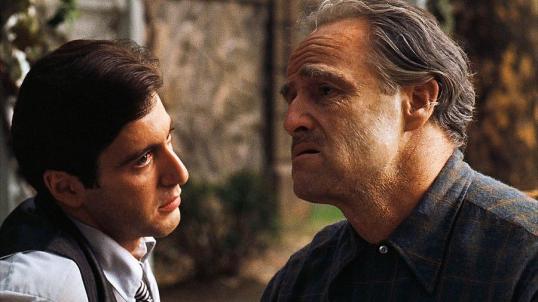
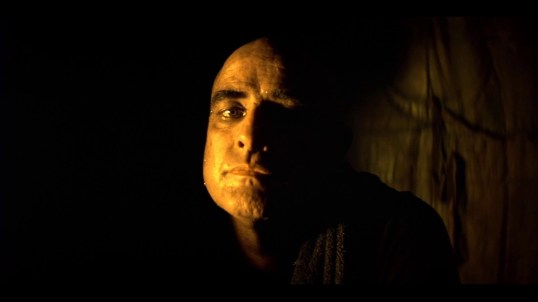
4 Shots From 4 Marlon Brando Films
A Streetcar Named Desire (1951, dir by Elia Kazan, DP: Harry Stradling)
On The Waterfront (1954, dir by Elia Kazan, DP: Boris Kaufman)
The Godfather (1972, dir by Francis Ford Coppola, DP: Gordon Willis)
Apocalypse Now (1979, dir by Francis Ford Coppola, DP: Vittorio Storaro)
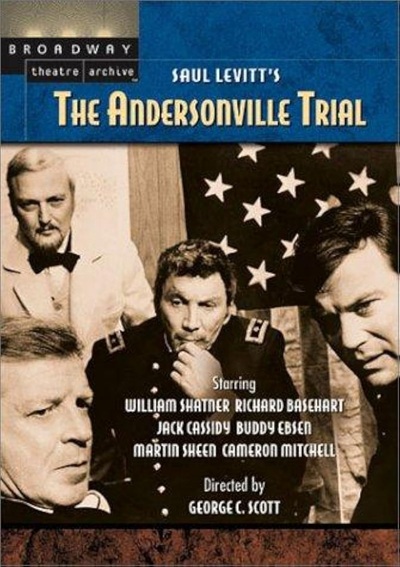
1970’s The Andersonville Trial takes place in one muggy military court room. The year is 1865. The Civil War is over but the wounds of the conflict are still fresh. Many of the leaders of the Confederacy are still fugitives. Abraham Lincoln has been dead for only a month. The people want someone to pay and it appears that person might be Captain Henry Wirz (Richard Basehart).
Originally born in Switzerland and forced to flee Europe after being convicted of embezzlement, Henry Wirz eventually ended up in Kentucky. He served in the Confederate Army and was eventually named the commandant of Camp Sumter, a prison camp located near Andersonville, Georgia. After the war, Captain Wirz is indicted for war crimes connected to his treatment of the Union prisoners at the camp. Wirz and his defense counsel, Otis Baker (Jack Cassidy), argue that the prison soon became overcrowded due to the war and that Wirz treated the prisoners as well as he could considering that he had limited resoruces. Wirz points out that his requests for much-needed supplies were denied by his superiors. Prosecutor Norton Chipman (William Shatner) argues that Wirz purposefully neglected the prisoners and their needs and that Wirz is personally responsible for every death that occurred under his watch. The trial is overseen by Maj. General Lew Wallace (Cameron Mitchell), the same Lew Wallace who would later write Ben-Hurand who reportedly offered a pardon to Billy the Kid shortly before the latter’s death. Wallace attempts to give Wirz a fair trial, even allowing Wirz to spend the trial reclining on a couch due to a case of gangrene. (Agck! The 19th century was a scary time!)
The Andersonville Trial started life as a 1959 Broadway production. On stage, George C. Scott played Chipman, an experience he described as difficult because, even though Chipman was nominally the play’s hero, Wirz was actually a much more sympathetic character. When the play was adapted for television in 1970, Scott returned to direct. Admittedly, the television version is very stagey. Scott doesn’t make much effort to open up the play. Almost all of the action is confined to that courtroom. We learn about the conditions at Fort Sumter in the same way that the judges learned about the conditions. We listen as the witnesses testify. We listen as a doctor played by Buddy Ebsen talks about the deplorable conditions at Fort Sumter. We also listen as a soldier played by Martin Sheen reports that Wirz has previously attempted to suicide and we’re left to wonder if it was due to guilt or fear of the public execution that would follow a guilty verdict. We watch as Chipman and Baker throw themselves into the trial, two attorneys who both believe that they are correct. And we watch as Wirz finally testifies and the play hits its unexpected emotional high point.
As most filmed plays do, The Andersonville Trial demands a bit of patience on the part of the viewer. It’s important to actually focus on not only what people are saying but also how they’re saying it. Fortunately, Scott gets wonderful performances from his ensemble cast. Even William Shatner’s overdramatic tendencies are put to good use. Chipman is outraged but the play asks if Chipman is angry with the right person. With many of the Confederacy’s leaders in Canada and Europe, Wirz finds himself standing in for all of them and facing a nation that wants vengeance for the death of their president. Wirz claims and his defense attorney argues that Wirz was ultimately just a soldier who followed orders, which is what soldiers are continually told to do. The Andersonville Trial considers when military discipline must be set aside to do what is morally right.
Admittedly, when it comes to The Andersonville Trial, it helps to not only like courtroom dramas but to also be a bit of a history nerd as well. Fortunately, both of those are true of me. I found The Andersonville Trial to be a fascinating story and a worthy production.
First released in 2019 and funded by an Indiegogo campaign, The Reliant is the epitome of a late-era Eric Roberts film.
Roberts appears towards the beginning of the film. He gets roughly 45 seconds of screen time. He delivers three lines, all in close-up. His character is named Mr. Johnson but, to know that, you have to sit through the entire film so that you can track down his name in the end credits. We don’t know anything about his character, other than he’s a hardware store owner. We don’t know anything about his fate. When last seen, his store is being overrun by a bunch of Antifa goons. It’s not looking good for Mr. Johnson but luckily, he has a lot of weapons.
Kevin Sorbo is also in the film. His role is slight larger. He only gets maybe 16 minutes worth of screentime. His character is killed off fairly early but he does get to appear in a few flashbacks and a fantasy sequence. He plays a father who has taught his children how to shoot guns and survive in case society breaks down. Society does break down and he dies while defending his family. He probably would have survived if his liberal daughter Sophie (Mollee Gray) hadn’t hid the key to the gun safe. Sophie (boo!) doesn’t believe in the Second Amendment and doesn’t like it when her father goes shooting. Not even the sight of hundreds of angry rioters getting ready to open fire on her house can change Sophie’s mind. Boo, Sophie, boo!
Sophie doesn’t believe in killing, even if self-defense. (I don’t believe in killing either. That said, if someone’s coming at you with a gun, you have every right to defend yourself.) When she finds out that her fiancé, Adam (Josh Murray), has had to kill people while she and her siblings were hiding out in the woods, Sophie throws a fit and says that she doesn’t even want Adam — who can barely walk due to an injury — staying at her family’s camp. Sophie is a …. well, I swore off profanity for Lent.
Sophie and her family are being stalked by Jack (Brian Bosworth), an angry man who has a personal grudge against them. Along with Roberts and Sorbo, Bosworth is the other “name” in this movie and he actually does get substantial screentime. And he actually gives a good performance as well, certainly the best in this film.
The Reliant is a technically well-made film and some of the action sequences are surprisingly effective. Unfortunately, whenever the characters are arguing about faith and whether or not guns cen be a useful tool, the movie becomes painfully draggy. The Reliant is occasionally fun in a “I’m going to show this to the most annoying leftie I know and watch them get offended” sort of way. But, for the most part, it’s just too talky and slow for its own good.
Previous Eric Roberts Films That We Have Reviewed:
 Through the Shattered Lens