January Positivity: Escape (dir by Paul Emami)


2012’s Escape tells the story of two men who meet in Thailand.

Paul Jordan (C. Thomas Howell) is a doctor who came to Thailand with his wife, Kim (Anora Lyn).  Paul and Kim are both working in a clinic, trying to bring healthcare to the poor and the downtrodden.  They specifically left America because of the death of their newborn.  Paul says that they need to make a clean break and start new lives for themselves.  Paul is an atheist, both because of the death of his child and all of the misery that he sees around him.  Kim is secretly religious.  Though she doesn’t discuss it with Paul, she brings a bible with her and she regularly asks the people back home to pray for them.

Malcolm Andrews (John Rhys-Davies) is a former tech boss who has retired and has been exploring the world with his wife (Puttaya Chaimongkolepetc).  Malcolm is extremely wealthy but also very humble, a kind man who always tries to treat people with decency.  Unlike Paul, he is very religious and has no problem with accepting the idea the God can exist even when the world itself is a complete mess.

When Paul and Malcolm first meet, Paul initially distrusts Malcolm but that soon changes due to the circumstances of their meeting.  They’ve both been kidnapped by outlaws and they’re being held in a bamboo cage in the middle of an island jungle.  Paul has been kidnapped because one of the outlaws has been wounded and is dying.  Paul is expected to keep the man alive, with the understanding being that if the man dies, Paul dies as well.  Malcolm has been kidnapped because the outlaws are hoping to get a huge ransom for him.  Despite their differing views of the world, Paul and Malcolm become friends because, when you’re stuck in  a bamboo cage with someone, you really don’t have much of a choice but to become friends.  In a situation like that, there’s only so long someone can go without making eye contact.

While Paul and Malcolm debate theology and wait for an opportunity to make their escape, their wives try to get the authorities to search for their husbands.  Unfortunately, it turns out that the authorities are almost as incompetent as the outlaws.

Lately, there have been a lot of faith-based films that have attempted to duplicate Hollywood gerne films.  Escape has a religious message but it’s also a thriller about two men trapped in the middle of the jungle.  It’s fairly well-done, though the action does occasionally drag.  (There’s only so many ways that you can film two men talking in a cage.)  The film makes good use of C. Thomas Howell’s bland niceness and the jungle scenery is both beautiful and ominous.  That said, John Rhys-Davies is the main attraction here and he gives a strong and compelling performance as Malcolm.  Regardless of whether you agree with his beliefs or not, you really do want to see him make it back to his wife.

Escape ends on a bit of an abrupt note but it’s still an effective thriller.

Late Night Retro Television Review: Check It Out 3.2 “Hey, Take Me Over”


Welcome to Late Night Retro Television Reviews, a feature where we review some of our favorite and least favorite shows of the past!  On Saturdays, I will be reviewing the Canadian sitcom, Check it Out, which ran in syndication from 1985 to 1988.  The entire show is currently streaming on Tubi and Peacock!

This week, Howard continues to dream of a better job.  Good luck with that, Howard.

Episode 3.2 “Hey, Take Me Over”

(Dir by Alan Erlich, originally aired on  October 10th, 1987)

Cobb’s has been sold!  Because the new owner is a huge corporation that owns several luxury resorts, Howard convinces himself that he’s going to be promoted to running a hotel in Tahiti.  (Howard’s background in hotel management has been one of the few consistent things in Check It Out.)  Instead, corporate vice president T.C. Collingwood (Elizabeth Hanna) comes down to the store and tells Howard that he needs to start wearing a smock that says “Howie, Store Manager” on it.

Howard does what any reasonably immature, 50ish man would do.  He quits.  But then Edna explains that Howard will lose his pension if he quits so Howard decides that maybe wearing the smock won’t be so bad.  “You’re throwing away your future,” Edna says at one point, as if Howard isn’t clearly approaching the age when most people retire.

This episode really drove home one of the biggest issues with Check It Out!, which is that Howard was written to be an ambitious man in his 40s but he was played by Don Adams who, when the show began, was already in his 60s.  Now, it should be admitted that Adams looked about ten years younger than his actual age but still, Howard comes across as a bit too old to still be fantasizing about suddenly changing careers.  There’s a principle that everyone rises to their level of incompetence.  They keep getting promoted until they reach a job they can’t do and then, they get stuck there.  Howard’s level of incompetence appears to be working as a general manager of a grocery store.

Howard eventually does put on the smock and agrees to keep working at his job.  What’s odd about this is that Howard was already wearing the smock during the previous episode.  Obviously, the episodes that made up the final season of Check It Out! were not aired in their intended order.

For all of the flaws to be found in this episode, it was still better than the majority of the second season.  It would appear that, with season 3, the show’s producers and writers finally settled on Howard being an incompetent manager and the store being a mess.  That’s definitely the right way to go.  When it comes to workplace sitcoms, incompetence is always funnier than hypercompetence.  (Just consider the U.S. version of The Office, in which the funniest episodes featured the office in chaos and the cringiest episodes were always the ones the centered on how good Jim was at selling paper.)  No one respects Howard and Howard has no idea how to do his job.  That’s a lot funnier than whatever the second season was trying to do.

Finally, I should mention that T and T‘s Sean Roberge has a small role in this one, playing the new bagboy.  If I’ve learned anything from doing these retro television reviews, it’s that, in the late 80s, syndicated Canadian television shows really did seem to share the same small pool of actors.

Lisa Marie’s Week In Television: 12/29/24 — 1/4/25


It’s a new year but there’s still much to watch.  Here’s some thoughts on what I viewed during the first week of 2025!

CHiPs (Prime)

Freevee may be dead but CHiPs continues on Prime.  My reviews of the show will return on Monday.

Cobra Kai (Netflix)

I watched the 2nd part of the final season of Cobra Kai on Friday.  I know the regular complaint about Cobra Kai is that every season is pretty much the same and there’s actually some validity to that comment.  But I don’t care.  It’s a fun show and William Zabka is a joy to watch.  From the start, I know this latest set of episodes would end with yet another huge brawl but, at this point, I’d be disappointed if they didn’t.  The showrunners know exactly why people watch this show.

Dark (Netflix)

Case and I have been watching this atmospheric German show on Netflix.  This week, we finished up the first three episodes.  Case has watched the show before.  He said it would appeal to my “analytical mind” and so far, he’s very much correct about that!  I’m enjoying uncovering the mysteries of this macabre mystery.

Days of Our Lives (Peacock)

On Saturday, I got caught up with Days of Our Lives on Peacock.  One thing that I like about this show is that you can go for six months without watching and still feel like you can jump right back into the storylines when you come back!  I enjoyed watching all of the citizens of Salem celebrate Christmas and New Year’s.  And I’m glad to see that Patch is still with us.

Dick Clark’s New Year’s Rockin’ Eve with Ryan Seacrest (Tuesday Night/Wednesday Morning, ABC)

Jeff and I spent New Year’s Eve at my BFF Evelyn’s annual “Screw The Year That Was” party.  The big annual countdown was playing on the television in one of the rooms at Evelyn’s place and I glanced in on the show occasionally.  I’ve never really gotten into any of the televised New Year’s Eve celebrations.  I don’t really have the attention span for them.  I just find it interesting that it’s still Dick Clark’s New Year’s Rockin’ Eve, even though Mr. Clark passed away quite some time ago.  It’s like Ryan Seacrest is a medium or something, letting us hear from Dick Clark from beyond the grave.

Going Dutch (Thursday Night, Fox)

After getting barraged by commercials for this show on an almost nonstop basis, I felt as if I had to watch the premiere.  Denis Leary plays an army officer sent to enforce discipline on a base in the Netherlands.  The base’s former commander?  His daughter!  I was glad that this show didn’t use the tired mockumentary format that is so popular nowadays but, overall, it still didn’t do too much for me.  The mix of family drama and goofy humor just didn’t work,

Hell’s Kitchen (Thursday Night, Fox)

Hell’s Kitchen returned this week, with both Joe and Anne-Marie being eliminated from the competition.  Like Chef Ramsay, I was surprised that Joe didn’t last long enough to receive a black jacket.  As for Anne-Marie, she probably should have been eliminated weeks ago.  She’s just too scatterbrained to be the head chef.  (For the record, she would still do a better job in the position than I ever would!)

King of the Hill (Hulu)

On Sunday, after the news broke about the death of Jimmy Carter, my sister Megan and I watched the episode of King of the Hill in which Carter attempted to broker peace between Hank and his father.  It turned out to be too big a job for even Jimmy.  This was a classic episode and it featured one of my favorite King of the Hill lines.  Upon meeting Carter, Hank says, “You ran our country …. (voice filled with reverence) America.”

Miami Vice (Prime)

I got back to watching Miami Vice this week.  Watch for my review on Monday!

Saved By The Bell (Prime)

I wasn’t feeling well on Sunday night so Megan and I watched a few episodes from the Ms. Bliss era.  We both agreed that Ms. Bliss was kind of a bitch.

The Twilight Zone (SyFy, Tuesday and Wednesday)

I caught a few episodes of the annual New Year’s marathon.  This is a classic show and I always try to find times to catch my favorites, like The Monsters Are Due On Maple Street, Eye Of The Beholder, Shadowplay, and that one with the nurse saying, “Room for one more, honey!”

Lisa Reviews An Oscar Winner: The Life of Emile Zola (dir by William Dieterle)


The Life of Emile Zola, the winner of the 1936 Oscar for Best Picture of the Year, opens with two French artists living in a drafty apartment.

Emile Zola (Paul Muni) is destined to become one of France’s most popular and important writers.  Paul Cezanne (Vladimir Sokoloff) will eventually become one of the most important artists of the post-impressionist movement.  But for now, they’re just two struggling artists who have sworn that they will never sell out their principles.  They are poor but they’re happy.  That changes for Zola after he meets a prostitute named Nana (Erin O’Brien-Moore) and he uses her life story as the inspiration for a novel.  The book is controversial and its frank content scandalizes France.  The public censor comes close to banning it.  But it also becomes a best seller.  It’s the book everyone secretly owns but claims to have never read.

Zola writes several more books, all about the conditions of the working class in France.  Eventually, he becomes what he claimed he would never be, a wealthy man living in a mansion and having little contact with the poor and oppressed.  Cezanne sees Zola one last time, calling him out for having sold his talent for money.  Cezanne explains that, on general principle, he can no longer be Zola’s friend.

Meanwhile, a quiet and rather meek family man named Captain Alfred Dreyfus (Joseph Schildkraut) has been arrested and accused of being a spy for Germany.  There’s little evidence that Dreyfus is a spy.  Indeed, most of the evidence seems to point to a Major Walsin-Esterhazy (Robert Barrat).  But, because Dreyfus is considered to be an outsider, he is convicted in a show trial and exiled to Devil’s Island.

(In real life, it’s generally agreed that Dreyfus was a victim of anti-Semitism.  As the only Jewish member of the army’s General Staff, Dreyfus was viewed with suspicion by his colleagues even before anyone knew that there was a German spy.  The Life of Emile Zola doesn’t specifically state that Dreyfus was a victim of anti-Semitism, with the exception of a brief moment when one of his accusers looks at his personnel file and says, “He’s not one of us,” while pointing at the word “Jew.”  Otherwise, the fact that Dreyfuss was Jewish is never mentioned in the film.  It’s as if the film is going out of its way to avoid offending the very people that the movie is criticizing.)

After speaking to Dreyfus’s wife (played by Gale Sondergaard, who would later become the victim of a show trial herself when she was blacklisted as a suspected communist), Zola decides to take up Dreyfus’s case.  He publishes an open letter — J’Accuse — in which he states that Dreyfus was not given a fair trial and that Dreyfus is innocent of the charges against him.  Zola finds himself in court, accused of libel.  Zola uses his trial to give Dreyfus the hearing that he never received.  While the army boos his every utterance, the people of France rally to his side.

The Life of Emile Zola is an early example of the type of prestige production that today is often referred to as being an “Oscar picture.”  It tells a true story.  As a film that condemns the treatment of Alfred Dreyfus but avoids stating the obvious reason why Dreyfus was targeted in the first place, it’s political without being radical.  And it features a performance from the most acclaimed actor of the era, Paul Muni.  Muni gives a powerful performance as Zola, holding the viewer’s attention even during the lengthy trial scenes that take up most the second half of the film.  That said, the true star of the film is Joseph Schildkraut, who plays Dreyfus as being a kind and trusting soul who finds himself caught up in a Kafkaesque nightmare.  At one point, Dreyfus is given a gun and told that there’s one way that he can avoid being put on trial for treason.  Schildkraut played the scene so well that I wanted to cheer when he refused to surrender.

The Life of Emile Zola is a big and, at times, self-consciously important production.  It was clearly designed to win a bunch of Oscars and it certainly managed to do that.  Compared to some of the other films nominated that year — The Awful Truth, Dead End, A Star is Born, Lost Horizon, Stage Door, In Old Chicago — The Life of Emile Zola can seem a bit stodgy.  However,  the performances of Muni and Schildkraut continue to make the film worth watching.

Scalplock (1966, directed by James Goldstone)


In this comedic western, gambler Benjamin Calhoun (Dale Robertson) wins big in a poker game.  Not only does he walk away with several thousand dollars but he also now owns his own railroad, the BP;S&D.  Calhoun celebrates the biggest win of his career by tossing ten dollar bills at the townspeople, recruiting a worshipful young assistant (Bob Random), and commandeering a private railcar that belongs to wealthy Burton Standish (John Anderson).  In the car, he finds Marta Grenier (Diana Hyland), a “working woman,” who has been hired to provide company for Standish.

Calhoun and Marta ride off to check out Calhoun’s new railroad.  What he discovers is that the railroad that he won is not only not completed but the workers are striking because they haven’t been paid in two weeks.  The quick-thinking Calhoun offers to make all of the workers part-owners of the railroad.  With construction once again starting, Calhoun tries to figure out how to keep his new business open.  He also meets a strong-headed storekeeper named Joanna Royce (Sandra Smith).

When Standish finally shows up, it turns out that he was originally planning on buying the BP;S&D.  Will Calhoun hold onto the railroad and honor the promise he made to the workers or will he sell out to Standish?

For all the talk about completing the railroad, Scalplock ends with most of the work undone.  That’s because Scalplock was a pilot for The Iron Horse, a television series that lasted for two seasons in the 60s.  Scalplock (and The Iron Horse) is mostly a showcase for Dale Robertson, a low-key but always convincing actor who specialized in westerns.  Usually, Robertson was cast as an upstanding citizen and law enforcement agent.  In Scalplock, he’s playing the type of genial rogue that James Garner played on Maverick and later in The Rockford Files.  Robertson is likable in Scalplock and even convinces us that Calhoun would choose his workers over a quick payday.  Fan of the genre will enjoy Scalplock, as long as they don’t get too invested in witnessing that last track of rail laid into the ground.

Dale Robertson, who started his career in the 40s, continued to act through the 90s, though usually as a guest star instead of a series lead.  Robertson eventually retired to Oklahoma where he owned a ranch that was home to over 200 horses.  He passed away in 2013 at the age of 89.

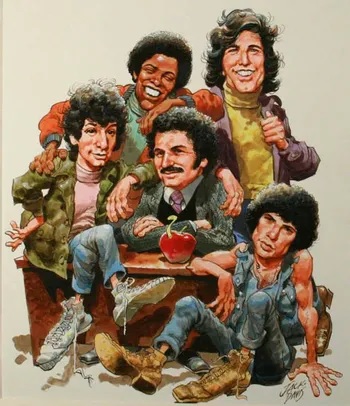
Retro Television Review: Welcome Back Kotter 4.12 “A Little Fright Music”


Welcome to Retro Television Reviews, a feature where we review some of our favorite and least favorite shows of the past!  On Saturdays, I will be reviewing Welcome Back Kotter, which ran on ABC  from 1975 to 1979.  The entire show can be purchased on Prime.

Welcome back to Brooklyn.

Episode 4.12 “A Little Fright Music”

(Dir by Norman Abbott, originally aired on December 2nd, 1978)

Sick and tired of Mr. Woodman insisting on ending the monthly “Parents’ night” meeting by singing the old and outdated school song, Freddie takes it upon himself to rewrite the school song.  He keeps the original melody but updates the lyrics to make it clear that Buchanan High is a “groovy alma mater.”  When recording star J. Bubba-Hampton (Sip Culler) overhears Freddie singing the song, he decides he wants to buy it and release a disco version on his next album,

The only problem is that Woodman wrote the original song and, since Freddie kept the melody, Freddie has to get Woodman to sign off on selling the new version of the song.  At first, Woodman refuses but then he realizes that he could make a lot of money off the deal.  Woodman agrees and puts on a scarf and sunglasses.  He’s a star now, after all.

For some reason, J. Bubba-Hampton agrees to bring the contracts over to the Kotter apartment so that Woodman and Freddie can sign.  However, when Bubba-Hampton mentions that Woodman actually plagiarized the song from a 1930s tune written by Irvine Russell, Woodman is stunned.  It turns out that Woodman had no idea that he did that. Woodman feels that it would be unethical to sell the song.  Freddie agrees.  J. Bubba-Hampton says, “I’ll just have to find another song for my album,” and leaves the apartment.  Julie suggests that maybe the school could have two songs.  Everyone ignores her.  Gabe then says that maybe the school could have two songs and everyone agrees.  The look of absolute hatred that Julie directed towards Gabe was one of the funniest things about this episode.

For a fourth season episode of this show, A Little Fright Music was not that bad.  For one thing, it featured Mr. Kotter from beginning to end and, watching this episode, I realized that, even if he wasn’t exactly the greatest actor in the world, Gabe Kaplan’s presence really was one of the keys to the show’s earlier success.  Kaplan was naturally funny whereas Marcia Strassman, who filled the role that Kaplan normally would have filled for many of the fourth season episodes, was not.  This episode also gave John Sylvester White and Lawrence Hilton-Jacobs a chance to take center stage.  John Sylvester White’s unhinged Woodman has always been one of the best things about this show.

Horshack is not present in this episode and he’s not missed.  Unfortunately, Barbarino is also not present.  Seriously, this would have been a perfect episode for Barbarino.  Julie is also present, which means we get another chance to watch Gabe Kaplan and Marcia Strassman struggle to pretend to like each other.  Julie’s new short haircut always makes it appear as if Kotter has divorced his wife and is now sharing his apartment with a teenage boy.

Gabe gets to tell a joke at the end of this episode.  His Uncle Seymour dug up Schubert to see if he could find the Lost Symphony.  Shubert said, “Go away.  Can’t you see I’m decomposing?”

Song of the Day: Scary Monsters and Nice Sprites by Skrillex


Since today is director Harmony Korine’s birthday, I decided that today’s song of the day should be one that was used quite memorably in Korine’s best film, 2013’s Spring Breakers.  From Skrillex, here is Scary Monsters and Nice Sprites!

Film Review: Voyage of the Damned (dir by Stuart Rosenberg)


In 1939, an ocean liner named the MS St. Louis set sail from Hamburg.  Along with the crew, the ship carried 937 passengers, all of whom were Jewish and leaving Germany to escape Nazi persecution.  The ship was meant to go to Havana, where the passengers had been told that they would be given asylum.  Many were hoping to reunite with family members who had already taken the voyage.

What neither the passengers nor Captain Gustav Schroeder knew was that the entire voyage was merely a propaganda operation.  No sooner had the St. Louis left Hamburg than German agents and Nazi sympathizers started to rile up anti-Semitic feelings in Cuba.  The plan was to prevent the passengers from disembarking in Cuba and to force the St. Louis to then return to Germany.  The Nazis would be able to claim that they had given the Jews a chance to leave but that the rest of the world would not take them in.  Not only would the Jews be cast as pariahs but the Germans would be able to use the world’s actions as a way to defend their own crimes.

Captain Schroeder, however, refused to play along.  After he was refused permission to dock in Cuba, he then attempted to take the ship to both America and Canada.  When both of those countries refused to allow him to dock, Schroeder turned the St. Louis toward England, where he planned to stage a shipwreck so that the passengers could be rescued at sea.  Before that happened, Belgium, France, the Netherlands, and the United Kingdom jointly announced that they would accept the refugees.

Tragically, just a few days after the passengers disembarked, World War II officially began and Belgium, France, and the Netherlands all fell to the Nazi war machine.  It is estimated that, of the 937 passengers on the St. Louis, more than 600 of them subsequently died in the Nazi concentration camps.

The journey of the St. Louis was recreated in the 1976 film, Voyage of the Damned, with Max von Sydow as Captain Schroeder and a collection of familiar faces playing not only the ship’s passengers and crew but also the men and women in Cuba who all played a role in the fate of the ship.  In fact, one could argue that there’s a few too many familiar faces in Voyage of the Damned.  One cannot fault the performances of Max von Sydow, Malcolm McDowell, and Helmut Griem as members of the crew.  And, amongst the passengers, Lee Grant, Jonathan Pryce, Paul Koslo, Sam Wanamaker, and Julie Harris all make a good impression.  Even the glamorous Faye Dunaway doesn’t seem to be too out-of-place on the ship.  But then, in Havana, actors like Orson Welles and James Mason are awkwardly cast as Cubans and the fact that they are very obviously not Cuban serves to take the viewer out of the story.  It reminds the viewer that, as heart-breaking as the story of the St. Louis may be, they’re still just watching a movie.

That said, Voyage of the Damned still tells an important true story, one that deserves to be better-known.  In its best moments, the film captures the helplessness of having nowhere to go.  With Cuba corrupt and the rest of the world more interested in maintaining the illusion of peace than seriously confronting what was happening in Germany, the Jewish passengers of the St. Louis truly find themselves as a people without a home.  They also discover that they cannot depend on leaders the other nations of the world to defend them.

Defending the passengers falls to a few people who are willing to defy the leaders of their own country.  At the start of the film, Nazi Intelligence Chief Wilhelm Canaris (Denholm Elliott) explains that Captain Schroeder was selected specifically because he wasn’t a member of the Nazi Party and could not be accused of having ulterior motives for ultimately returning the passengers to Germany.  Canaris and his fellow Nazis assume that anti-Semitism is so natural that even a non-Nazi will not care what happens to the Jewish passengers.  Instead, Schroeder and his crew take it upon themselves to save the lives of the passengers.  It is not Franklin Roosevelt who tries to save the passengers of St. Louis.  Instead, it’s just a handful of people who, despite unrelenting pressure to do otherwise, step up to do the right thing.  Max von Sydow, who was so often cast in villainous roles, gives a strong performance as the captain who is willing to sacrifice his ship to save his passengers.

Flaws and all, Voyage of the Damned is a powerful film about a moment in history that must never be forgotten.

What Lisa Marie Watched Last Night #228: Dressed to Kill (dir by Lindsay Hartley)


Last night, I turned over to the Lifetime Movie Network and I watched Dressed to Kill!

Why Was I Watching It?

Because it was on Lifetime!  It’s been a while since I’ve really gotten a chance to enjoy a good Lifetime film.  I was planning on getting back into my Lifetime viewing habit last year but 2024 had other plans.  This year, though, I hope to once again get to enjoy my weekly Lifetime fix.

What Was It About?

When Vanessa (Suzanne R. Neff) dies after someone steals her asthma inhaler, she leaves her clothing company not her spoiler daughter Blair (Annie Sullivan) but instead to her loyal and kind-hearted assistant, Amy (Brianna Cohen).  Amy tries to figure out who killed Vanessa.  Was it Blair?  Was it disgruntled seamstress Wanda (Monanik Dugar)?  Or was it Amy’s own boyfriend, Kevin (Moe Sehgal)?

What Worked

First, and most importantly, this film fully embraced the melodrama.  When it comes to Lifetime films, the promise of melodrama is essential and the best films are the ones that shamelessly embrace it.  Director Lindsay Hartley kept the action moving and didn’t waste too much time trying to convince the viewer that they were watching a realistic portrait of life in the fashion industry.

This film actually did keep me guessing as far as who the murderer was.  It’s obvious that the filmmakers understood who most veteran Lifetime viewers would automatically suspect and, wisely, they played around with those expectations.

Monanik Dugar’s performance was Wanda was wonderfully unhinged.  I also liked Annie Sullivan’s performance as the hilariously entitled Blair.  As played by Sullivan, Blair was the influencer from Hell.

What Did Not Work

I probably would have taken the fashion aspect of the movie more seriously if the clothes hadn’t been so …. uhm, well …. ugly.  Of course, it’s all in the eye of the bolder but let’s just say that I would not have worn any of the outfits.

This movie did feature a fashion show but it looked so low-rent that, again, it left me wondering whether it would be better to just let the company go out of business.

“Oh my God!  Just like me!” Moments

I have asthma so, as soon as I saw Vanessa grabbing her inhaler, I knew how she was going to die.  That made me go “Agck!” because, seriously, asthma attacks are always scary.

When I was 18, I had a friend who got a job at a clothing company in Dallas.  At first, I thought that was really exciting but then I visited her at work and discovered that it was a place that designed polyester cabana wear for senior citizens.  Admittedly, that doesn’t have much to do with this movie but I still found myself thinking about it as I watched Dressed To Kill.  At least the company in Dressed to Kill could afford to put on a fashion show.  This place where my friend worked wasn’t even willing to do that,

(For the record, my friend only worked there for two weeks before walking off the job.  Some of that was my fault because I had lunch with her on her final day and, as her lunch hour came to a close, I said, “What if you just didn’t go back?”  Having never had a job before, I was shocked to discover that people still get a final paycheck even if they just leave for lunch and then never come back.  Hmmm, I thought, maybe I’ll get a job someday….)

Lessons Learned

Be careful with those scissors!

Live Tweet Alert: Join #ScarySocial for Twilight Zone: The Movie!


As some of our regular readers undoubtedly know, I am involved in a few weekly live tweets on twitter.  I host #FridayNightFlix every Friday, I co-host #ScarySocial on Saturday, and I am one of the five hosts of #MondayActionMovie!  Every week, we get together.  We watch a movie.  We tweet our way through it.

Tonight, at 9 pm et, Tim Buntley will be hosting #ScarySocial!  The movie?  Twilight Zone: The Movie!

If you want to join us this Friday, just hop onto twitter, start the movie at 9 pm et, and use the #ScarySocial hashtag!  I’ll be there tweeting and I imagine some other members of the TSL Crew will be there as well.  It’s a friendly group and welcoming of newcomers so don’t be shy.

Twilight Zone: The Movie is available on Prime!

See you there