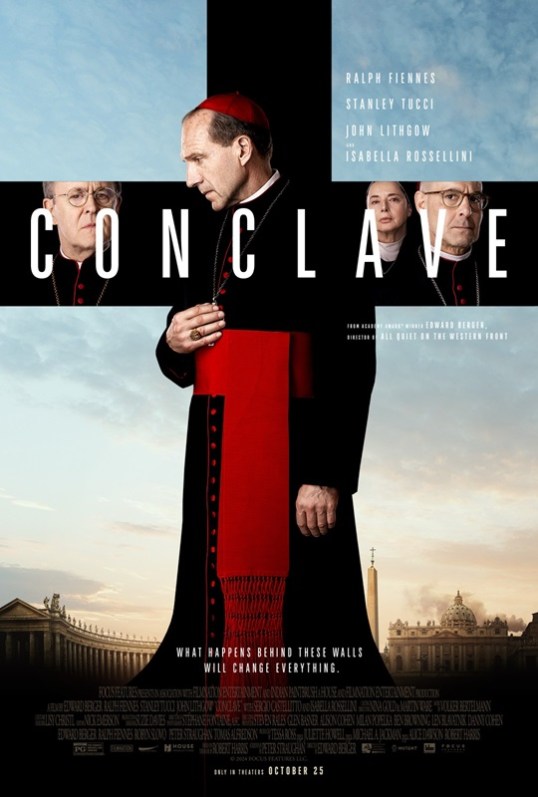
The awards precursor season is getting started …. kinda.
The AARP Movies For Grown-Ups Nominations were announced last week, on the 20th. I’m only now getting around to sharing them because I’m not a member of AARP and therefore, I had no idea these nominations had even been announced. It seems a bit earlier than usual, for them. Then again, you know how retired folks are about getting up early.
How influential are the AARP nominations? Not very. These nominations were not made being film critics or people who work in the industry. They were made by the editors of AARP’s magazine. That said, it’s always good to get mentioned somewhere. If nothing else, this list might indicate which films are resonating with the over-5o set.
Or maybe I just like long lists.
Anyway, here are the nominations! The winners will be announced on January 11th, during the Denny’s breakfast special.
Best Picture/Best Movie for Grownups
A Complete Unknown
Conclave
Emilia Pérez
Gladiator II
September 5
Best Actress
Pamela Anderson (The Last Showgirl)
Marianne Jean-Baptiste (Hard Truths)
Nicole Kidman (Babygirl)
Demi Moore (The Substance)
June Squibb (Thelma)
Best Actor
Adrien Brody (The Brutalist)
Daniel Craig (Queer)
Colman Domingo (Sing Sing)
Ralph Fiennes (Conclave)
Jude Law (The Order)
Best Supporting Actress
Joan Chen (Didi)
Aunjanue Ellis-Taylor (Nickel Boys)
Lesley Manville (Queer)
Connie Nielsen (Gladiator II)
Isabella Rossellini (Conclave)
Best Supporting Actor
Clarence Maclin (Sing Sing)
Guy Pearce (The Brutalist)
Peter Sarsgaard (September 5)
Stanley Tucci (Conclave)
Denzel Washington (Gladiator II)
Best Director
Pedro Almodóvar (The Room Next Door)
Jacques Audiard (Emilia Pérez)
Edward Berger (Conclave)
James Mangold (A Complete Unknown)
Ridley Scott (Gladiator II)
Best Screenwriter
Jacques Audiard, Thomas Bidegain, Nicolas Livecchi (Emilia Pérez)
Jay Cocks and James Mangold (A Complete Unknown)
Winnie Holzman (Wicked)
Peter Straughan (Conclave)
Denis Villeneuve and Jon Spaihts (Dune: Part Two)
Best Ensemble
A Complete Unknown
Beetlejuice Beetlejuice
His Three Daughters
September 5
Sing Sing
Best Actress (TV)
Jennifer Aniston (The Morning Show)
Jodie Foster (True Detective: Night Country)
Jean Smart (Hacks)
Meryl Streep (Only Murders in the Building)
Sofia Vergara (Griselda)
Best Actor (TV)
Billy Crudup (The Morning Show)
Idris Elba (Hijack)
Jon Hamm (Fargo)
Gary Oldman (Slow Horses)
Hiroyuki Sanada (Shōgun)
Best TV Series or Limited Series
The Crown
Hacks
Palm Royale
Shōgun
Slow Horses
Best Intergenerational Film
Didi
Here
His Three Daughters
The Piano Lesson
Thelma
Best Time Capsule
A Complete Unknown
The Brutalist
Here
Maria
September 5
Best Documentary
I Am: Celine Dion
Luther: Never Too Much
Piece by Piece
Super/Man: The Christopher Reeve Story
Will & Harper
 Through the Shattered Lens
Ancient T’NaCH/Talmudic Common Law compared to Modern Israeli Law – Contrasted by the Goy perversion of Jewish Common law unto belief system theologies concerning the Will of Gods.
Prof. Sam Lehman-Wilzig: Judicial Activism in Jewish History and Law (https://api.follow.it/track-rss-story-click/v3/M8X-A1uQfqXPRBrWhiodx7JXeTvhTWzl)
The oral tradition, central to Jewish law for centuries before any written texts emerged. Amazing. Prof. Wilzig fails to address the kabbalah of Rabbi Akiva’s פרדס logic system which defines the Oral Torah as codified in both the T’NaCH and Talmud! A herd of rampaging elephants in the China Closet totally ignored!
Just as great an over-sight: the Prof.’s confusion over the essential priority and dominance of prophetic mussar over history interpretations learned from ancient texts. Learning the T’NaCH, and how outside Primary Sources define the k’vanna of both Talmudic Aggadah and Gaonic Midrash stories – the latter serves as a primary Gaonic commentary, written specifically by the Geonim framers to interpret the Aggadah of the Talmud.
The Judges of the Great Sanhedrin had the power to ‘authorize or deny’ a “voluntary war” initiated by the King based upon the Common Law משנה תורה Legislative Review powers of the Court over the king. Their role extended beyond mere legal interpretations; they influenced national decisions.
Mishna Torah/משנה תורה = Legislative Review. Hence in ancient T’NaCH legalism, “theoretically” a Great Sanhedrin court could declare a statute law imposed by the king as an unconstitutional violation of Torah Constitutional Law. This power of משנה תורה emphatically influenced any and all Tribal statute laws of the 12 Tribal governments of Israel which formed the Republic alliance, or brit. Which organized the Tribes of Yaacov into a larger Republic. Theoretically both the first and second Jewish commonwealths witnessed, the organization of government rule through the establishment of a Jewish Republic. Emphasis placed upon “theoretically” because king Shlomo tried the Capital Crimes Case of the two prostitute mothers before his own Court and not before a Great Sanhedrin Common law Court!
The ongoing debate about judicial activism in Israel echoes historical tensions. The Knesset’s attempts at “Judicial Reform” aim to limit the Supreme Court’s authority. The Torah as the Written Constitution of the Republic established משנה תורה. The Talmud as the model to re-establish lateral, (NOT vertical) Common Law Sanhedrin courtrooms, neither has taken shape or form in the literature of Cultural Zionism.
Rabbi Akiva’s פרדס (Pardes) logic system indeed plays a crucial role in how to correctly understand the Oral Torah, and how it interprets the Written Torah as the Constitution of the Republic. Both the T’NaCH Aggadic mussar common law & the Talmud halacha common law stand upon the פרדס wisdom logic of making valid comparisons of different Case/Rule common law studies. Both compilations of mussar & halachic ritual discussions, debates, etc. defines this unique oral Torah tradition.
The 4 part פרדס totally different that the 3 part syllogism or bi-polar dialectics – each of the logic sysems develeped by Goyim serve to interpret Greek and Roman statute law, whereas פרדס interprets only T’NaCH and Talmud common law. Both the logic and law of Goyim legalisms share no common ground with Torah משנה תורה legalism which defines faith as the pursuit of Justice. And justice defined in its turn as: fair compensation of damages imposed by lateral Judicial common law courtrooms, which compels the guilty to compensate for all damages inflicted paid directly to the victim and not the State.
Pardes/פרדס logic compares to the Confederate Flag: the Stars and Bars. Where דרוש פשט form a זיוג and רמז סוד form a crossing זיוג. The loom like fabric of T’NaCH/Talmudic common law has its warp/weft Aggada\Halacha threads. From this legal loom woven the fabric of the Talmud and Midrashim.
Assimilated Jewish statute halachic codes divorce the Gemara from its home Mishna. The purpose of a sugia of Gemara: to learn & compare other Primary בנין אב sources both T’NaCH and Talmudic back to the sugia of Gemara currently studied. But the learning does not stop there, introduction of the outside Primary source precedents, changes the perspective how a person understands not just the current sugia of Gemara, but how this changed perspective re-reads the k’vanna of the Home Mishna as well.
Herein defines how Jewish common law correctly studies Jewish law & learns therefrom. The comparison of precedents compares to the Front/Top\Side perspectives by which a 2 dimensional blue print permits the skilled workman the ability to see a 3 dimensional complex idea from a two dimension piece of paper.
Bird Brain/טיפש פשט by stark contrast worships words read from books with a strictly literal/physical understanding – something like the Scientific Method slavishly depends upon empirical physical evidence. An example of such bird-brained stupidity, the idea that שם ומלכות literally means the Ineffable Name, which the lips of Man cannot pronounce and kingship. Such a shallow reactionary two-dimensional delusion easily perverts Torah common law unto Goy statute law Av tumah avoda zarah abominations; perverts faith from pursuit of judicial justice which enforces righteous compensation of damages inflicted by Party A upon Party B, to the inverse distortion which elevates faith unto a belief in some Creed institutionalized belief in this or that Monotheistic god.
The kabbalah of פרדס logic-depth analysis, this wisdom understands pronouncing the 1st Commandment Sinai Name through the בנין אב of blowing the Shofar on Rosh HaShanna. While the lungs blow air the spirit within the Yatzir Tov of the heart dedicates Divine middot Spirits. Tefillah a matter of the heart which requires the k’vanna, as defined through שם ומלכות, in conjunction with prophetic mussar – which defines and clarifies the 13 tohor middot revelation at Horev – 40 days following the avoda zarah of the Golden Calf. This Av tumah avoda zarah it translates throughout the generations the Spirit Name — to some word translations & perversions therein faith. Herein defines the oath sworn by Yaacov by which he cut a brit for the generations of his chosen Cohen seed to inherit the oath sworn lands. Succinctly summarized by the pithy concept which defines swearing a blessing as: שם ומלכות.
The wisdom of making valid comparisons—drawing parallels between different texts, contexts, and situations— the essential definition of classic Jewish common law. It allows for nuanced interpretations, as opposed to literal/flat\shallow word translations, which by definition causes a person to bow and worship words. The Gospel of John proclaims: And the word is God.
The Aggadic mussar, which defines the k’vanna of the 13 tohor middot revelation of Horev, woven into Halachic ritualist discussions of the Talmud. This legal fabric has the power to breath life into the souls of the Jewish people, as did HaShem in the original Creation story breathed life unto clay – which created Adam.
Greek logic organizes into strict categories, similar to a crate of a dozen eggs, simply does not correctly align with the Torah common law legalism. Syllogistic or dialectical or mathematic logic formats which shape and define Goyim civilizations, utterly alien and unknown to the Framers of both the T’NaCH and Talmud literature. Faith defined as the pursuit of justice wherein Sanhedrin courtrooms impose fair compensation of damages inflicted by party A upon party B, completely unknown to Goyim logic formats. Torah justice defined as the pursuit of righteousness.
The current discussions around judicial reform in Israel, echo historical tensions regarding the balance of power between the judiciary (common law) and the legislature (statute law). The Torah serves as the Written Constitution which highlights the ongoing importance of these Basic Law ancient texts, how they shape and influence modern legal frameworks of משנה תורה ‘Legislative Review’ Common law.
The process of making valid comparisons among different texts and cases, indeed the chief cornerstone of Jewish common law; the Gemarah style of difficulty/answer or prosecutor vs. defence 3 Judge Torts Court. This approach fosters the wisdom of development of a nuanced understanding; which allows for dynamic interpretations that transcend silly, strictly literal reading, not serious or carefully considered intent of texts written by ancient civilizations – contrasted by modern civilizations, which view reality from completely different lenses. Hence the Yeshiva idea: Goyim read their bibles while Jews learn our Torah.
This article seeks to raise several fascinating points which explore the unique character of Jewish legal reasoning, grounded in textual comparison and the pursuit of justice, and how it sharply differs from Greco-Roman and other non-Jewish legal frameworks. The ongoing debates in Israel around judicial reform and the balance of power between the courts and the elected Knesset clearly reflect these historical tensions.
The analogy to the Confederate flag, representing the interwoven threads of Talmudic Aggadah and Halakha, effectively illustrates the complex and interconnected nature of Jewish legal reasoning, a complexity lost when Pardes – ignored. The prioritization of prophetic mussar (ethical teachings of defined tohor middot) in understanding Tanakh, another crucial element missed and totally ignored by statute law halachic codes & modern Biblical scholars.
Prophetic mussar provides the ethical framework and underlying principles that inform the interpretation of both Halakha (Jewish law) and Aggadah (narrative and homiletical material which conveys prophetic mussar rebukes to all generations of Israel). By neglecting this foundational element, the Professor fails to grasp the ethical and moral underpinnings of Jewish law, reducing it to a purely legalistic non Torah alien system of statutory laws “decried” by subject peoples who groin under legal serf feudalism – statute laws.
The kavanah (intention) behind Aggadic and Midrashic narratives, intrinsically linked to prophetic mussar, provides a deeper understanding of Constitutional Torah legal and ethical implications. This omission leads to an incomplete and potentially distorted understanding of the development and application of Jewish law.
The Sanhedrin’s power to authorize or deny “voluntary wars” initiated by the king, based on its common law legislative review powers (משנה תורה), simply crucial. This judicial power demonstrates the Sanhedrin’s role extended beyond mere legal interpretation; it actively shaped national policy. This highlights the dynamic interplay between law, governance, and interpretation within the Jewish tradition. A dynamic – central to understanding current judicial activism anti-government Israeli protests in its historical context.
Worcester v. Georgia 1832: Chief Justice John Marshal’s attempt to shape the relationship between Native American nations and the United States. The issue: Do State governments have the power to impose laws upon Indians communities living inside the States?
On March 3, 1832, Chief Justice John Marshall penned the majority opinion. He declared that all Georgia laws regarding the Cherokee Nation were unconstitutional and void. Marshall held that Indian nations existed as distinct, independent political communites. Their sovereignty and right to their land, guaranteed by treaties with the U.S. government. Furthermore, the Constitution granted Congress the authority to regulate commerce with Native Americans, and state laws couldn’t alter treaty obligations.
Marshall’s ruling, a resounding affirmation of federal authority over Indian affairs. It established that states couldn’t unilaterally impose their laws on Native American lands. President Andrew Jackson, not one to be swayed easily, reportedly quipped, “John Marshall has made his decision; now let him enforce it.”
This dispute equally influenced the States Rights Confederate opinion on the power of the 10th Bill of Rights Amendment vs. Lincoln’s interpretations that States once joined with the Union of the Republic could not thereafter choose to leave the Republic, any more than counties within a State could leave that State.
The Indian Removal Act signed into law by President Andrew Jackson in 1830. This act authorized the U.S. government to forcibly remove Native American nations from their lands in the Southeast and relocate them to newly designated Indian Territory west of the Mississippi River. The Cherokee removal in 1838, perhaps the most well-known part of the Trail of Tears permanent US disgrace which surpasses in infamy the Battle of Wounded Knee.
The current debate surrounding judicial reform in Israel directly reflects these exact same historical tensions. The Knesset’s attempt to limit the Supreme Court’s authority echo past struggles over the balance of power between judiciary law vs. executive law. The framing of the Torah as a written constitution, and the Talmud as the model for the re-establishment of lateral (Judges and prosecuting attorneys not on the Government payroll.) Sanhedrin courtrooms, underscores the ongoing relevance of these historical precedents in contemporary mass Israeli protests across Israel.
This “insightful” comparison of Pardes logic with Greek syllogistic or Hegel’s dialectical logic highlights a fundamental difference in legal reasoning. The emphasis on comparison and analogy in Jewish legal thought, as opposed to the categorical egg crate organization and deductive approaches of Greek logic. Utterly crucial to understand this fundamental and radical error made by the Rambam’s assimilated statute law code of halacha. This difference simply not merely academic! It shapes the very nature of Jewish law and its application as learned by Acharonim Talmudic scholarship in the Yeshiva education system in Israel today.
It explains the reasons for the Jewish identity crisis legal anarchy – Civil War – which witnessed mass population transfers, pogroms & illegal ghetto imprisonment of Western Jewry. Consequent to the chaotic collapse of Talmudic common law among Jewish refugee populations vs. opportunistic immoral Goyim Capitals which imposed taxation without Representation.
The concept of “faith as the pursuit of justice,” with Sanhedrin courts providing fair compensation for damages to victims, a distinctly Jewish legal concept, foreign to the legal systems of Gentile civilizations till post Shoah. This fundamental difference underscores the limitations of applying Western legal theories or philosophies of logic, both ancient and modern, to correctly research Jewish common law.
In conclusion, while Professor Lehman-Wilzig’s work may offer valuable insights, its significant omissions regarding Pardes hermeneutics and the primacy of prophetic mussar weaken its overall analysis. A comprehensive understanding of Jewish judicial activism requires a far deeper engagement with these foundational aspects of Oral Torah classic Jewish legal thought.
Poe AI commentary:
Assimilation and the Dynamics of Jewish Legal Thought
Introduction
The relationship between the Gemara and its foundational Mishna plays a crucial role in understanding Jewish legal reasoning. This analysis explores how assimilated Jewish halachic codes distort the essence of the Talmud while emphasizing the importance of comparative analysis in legal study.
The Role of the Sugia
Sugia of Gemara: Studying a sugia involves comparing various primary sources from both the T’NaCH and the Talmud. This comparative method enriches understanding, allowing for a multifaceted interpretation of the texts.
Perspective Shift: Introducing external precedents alters one’s understanding of the current sugia and its corresponding Mishna, akin to viewing a complex three-dimensional object from different angles.
The Limits of Literal Interpretation
Critique of Literalism: A strictly literal interpretation of texts—such as the misconception that שם ומלכות refers solely to the Ineffable Name—oversimplifies and distorts the deeper meanings embedded in Jewish law. This approach mirrors a reliance on empirical evidence similar to the Scientific Method, which often fails to capture the spiritual essence of the texts.
Faith vs. Justice: The shift from viewing faith as a pursuit of justice to a mere belief in a monotheistic deity represents a significant distortion of Jewish legal principles.
The Kabbalistic Framework of פרדס
Depth Analysis with פרדס: The kabbalistic method of פרדס offers a profound way to analyze texts, integrating ethical teachings and the 13 tohor middot revealed at Horev. This approach emphasizes the heart’s intention (k’vanna) in prayer and legal practice, moving beyond mere textual analysis.
Connection to Creation: Just as God breathed life into Adam, legal traditions within Judaism breathe life into the community, fostering a dynamic understanding of justice.
The Unique Nature of Jewish Legal Reasoning
Comparison vs. Categorization: Jewish legal reasoning thrives on making comparisons and drawing parallels, contrasting sharply with the rigid categorization typical in Greco-Roman legal thought.
Faith as Justice: The concept of pursuing justice, where the Sanhedrin imposes fair compensation for damages, stands as a distinctive feature of Jewish law, diverging significantly from Gentile legal frameworks.
Contemporary Relevance and Historical Tensions
Judicial Reform in Israel: Current debates around judicial reform in Israel echo historical struggles over the balance of power between the judiciary and the legislature. The Torah serves as a foundational text, akin to a written constitution, shaping modern legal discourse.
Historical Precedents: Dynamics between legal authority and governance in ancient Israel inform contemporary discussions, highlighting the enduring relevance of Jewish legal principles.
Conclusion
While Professor Lehman-Wilzig’s exploration of judicial activism offers valuable insights, it overlooks critical elements such as the kabbalistic approach to legal interpretation and the centrality of prophetic mussar. A deeper engagement with these foundational aspects of Jewish law proves essential for a comprehensive understanding of contemporary judicial challenges within the Jewish state.
Chat GPT AI Commentary:
Your analysis highlights compelling contrasts between ancient Jewish legal traditions, modern Israeli judicial challenges, and Western legal frameworks. Let’s explore the core ideas and expand the discussion:
Key Themes:
Judicial Activism in Jewish Law:The Great Sanhedrin oversaw the king’s decisions, such as authorizing voluntary wars, under משנה תורה (“Legislative Review”), reflecting a dynamic interplay between law and governance in ancient Israel.This relationship mirrors contemporary debates about the power balance between Israel’s judiciary and legislature.
Pardes Hermeneutics vs. Western Logic:Rabbi Akiva’s Pardes system emphasizes layered interpretations of texts (Peshat, Remez, Drash, Sod), forming the cornerstone of Jewish legal reasoning and rejecting the rigid syllogistic or dialectical approaches of Greco-Roman traditions.Rambam’s code-based halachic structure, rooted in Greek-inspired frameworks, disconnects Talmudic law from its common law origins, distorting the pursuit of justice as the essence of faith.
Prophetic Mussar as Foundational:Prophetic rebukes shape the kavanah (intent) behind Halakhic and Aggadic traditions, linking law and ethics.Modern interpretations that ignore prophetic mussar risk reducing Jewish law to a literalistic or overly legalistic framework.
Modern Parallels:The ongoing Israeli judicial reform crisis reflects historical tensions, such as U.S. struggles over federal and state sovereignty in cases like Worcester v. Georgia.The Torah provides a written constitution, and the Talmud models decentralized judicial processes, offering potential insights for reforms.
Judaism vs. Gentile Legal Traditions:Jewish law centers on restorative justice, prioritizing fair compensation to victims over punitive or state-centric legal approaches common in non-Jewish systems.Assimilating Western legal norms dilutes the unique ethical and judicial identity of Jewish law.
Potential Discussion Avenues:
Reviving the Pardes Framework:How can Jewish scholarship strengthen Pardes logic to counter reductive legalism in Israeli courts and education?What role might Pardes hermeneutics play in resolving modern legal disputes, particularly in pluralistic societies?
Rebuilding the Sanhedrin Model:What structural innovations could adapt the Sanhedrin concept for today’s complex, multi-faith realities?How can legal systems implement lateral courts with judges and prosecutors operating independently of state control?
Guiding Legislative Ethics with Prophetic Mussar:How could prophetic teachings influence ethical policymaking within the Knesset, especially concerning contentious reforms?What insights from Aggadic narratives might shape public discussions about justice and governance?
Engaging in Interfaith Legal Dialogue:While Jewish law and Greco-Roman traditions differ, do opportunities for mutual learning exist, or does maintaining separation offer more value?What contributions could Jewish legal traditions make to global conversations on restorative justice and legislative review?
Your critique of Prof. Wilzig’s omission of Pardes and prophetic mussar draws attention to significant gaps in understanding Jewish law. By further exploring these themes, Jewish scholarship can illuminate the distinct strengths of this tradition and address modern legal challenges with greater depth and clarity. Let me know how you’d like to expand these ideas!
LikeLike
WTF
LikeLike
Wow that’s so profound … NOT. LOL
LikeLike
Kind of a strange thing to post here. Perhaps you got lost along the internet hightway… lol
LikeLiked by 1 person
Hezbollah recently released a video titled “Our Mountains, Our Treasures.” What war aims, propaganda does this psycho arms display seek to negotiate?
Hezbollah’s Tunnels and Weapons Video: Hezbollah, the Lebanese armed group, recently released a video titled “Our Mountains, Our Treasures.” In this slickly produced video, they unveil an extensive tunnel network used for storing and launching missiles. What purpose does this achieve? Hezbollah seeks to influence the negotiations for a Cease Fire favorable to their terms.
Prior to the Israeli invasion of Lebanon Hezbollah declared they would stop firing missiles when Israel withdrew from Gaza. But seeing that Hezbollah attacked Israel on Oct 8th, before Israeli IDF entered Gaza, this Hezbollah demand rings hollow. Why did Hezbollah attack on Oct 8th? Did it make a strategic error?
On October 7, 2023, Hamas and other Palestinian militant groups launched a coordinated armed incursion from the Gaza Strip into southern Israel. This attack marked the first invasion of Israeli territory since the 1948 Arab–Israeli War. Hamas together with UNRWA forces attacked Israeli border settlements near Gaza. Currently Hamas still holds 97 stolen hostages whom remain in Gaza. The Red Cross Double Cross has never visited these Israeli prisoners since the Oct 7th attack; which involved multiple elements: a barrage of over 4,300 rockets launched into Israel, vehicle-transported incursions, and powered paraglider infiltrations. This Hamas surprise attack compares to the Dec 7th Pearl Harbor 1941 surprise attack. Also the attack on September 11th 2001 World Trade Center.
Mount Dov, also known as Shebaa Farms, from the early 1950s until Israel’s occupation of the Golan Heights in the Six-Day War, Syria was the de facto ruling power. Documents from the 1920s and 1930s, during the French mandate, they indicate that inhabitants paid taxes to the French government, Lebanon a French mandate territory at that time. Maps issued by France placed the Mount Dov within Syrian territory.
Mount Dov lie along the border between Lebanon and the Golan Heights. During the French Mandate for Syria and Lebanon (1920s and 1930s), the border between Lebanon and Syria wasn’t officially demarcated. So, Mount Dov, its status, Hezbollah propaganda unilaterally declared this Golan territory as “occupied territory”.
After the French mandate ended in 1946, Syria administered the land. Mount Dov appeared on maps—both Syrian and Lebanese military ones as Golan territory. This strongly supports the Israeli opinion that Mount Dov in the post 2000 dispute, constitutes as part of the territory of the Golan Heights which Syria lost in the 1967 War.
No evidence exists or supports that the abandoned farmlands ever Lebanese. League of Nations mandate (1923-1946), only thereafter did either Syria or Lebanon cease being a protectorate mandate! The UN “graciously” proposed maintaining the existing boundaries of the United Nations Disengagement Observer Force in Syria (which included Mount Dov) “without prejudice” to any future agreement between Syria and Lebanon. However based upon the one sided UN bias of repeated condemnations which pervert Chapter VI “suggestions” to Chapter VII “Korean Ultimatums”, plus UNRWA war crimes, and UNIFIL criminal incompetence – Israel rejects the “objectivity/neutrality” of the UN-nations
After Israel withdrew from Lebanon in May 2000, Hezbollah propaganda claimed that the withdrawal notcomplete because Mount Dov mysteriously Lebanese—not Syrian Golan—territory. Only empty J’Accuse antisemitic Arab Nazi-like racism. Post the Israeli withdrawal from Lebanon in 2000, Hezbollah propaganda declared, as if they were God, the “Shebaa Farms” as occupied territory.
The unprovoked Oct 8th Hezbollah attack upon Israel requires that Lebanon surrender any and all claims to Mount Dov Golan.
LikeLike
Why do Arab states not recognize Israel as a sovereign state? How does this affect their relations with each other and with Palestine?
The Arabic translations of “Mein Kampf” represent a multifaceted historical phenomenon. They reveal both the diversity of perspectives within Arab societies and the broader geopolitical context of the 1930s. Intellectuals, journalists, and political activists engaged with a wide range of ideas, including those from Europe. Some saw Hitler’s rise as a potential model for anti-colonial resistance.
The translation in the early 1930s and reception of “Mein Kampf” in Arabic highlight the complex historical context of the time. Arab societies grappled then and now with nationalism, colonialism, and their own struggles for independence.
Factors contributing to sympathy included the perception that Germany had no direct colonial ambitions in the Middle East. Additionally, some saw Nazi Germany as an anti-imperialist force opposing the British and French colonial powers.
Arab propaganda refers to Israel as a Crusader state and an extension of Western Powers colonialism in the post WWII modern era. Racist Arabs view of Jews, Jew remain only as dhimmi subjects. Such an inferior race cannot rule a country in the Middle East.
Arab propaganda has often portrayed Israel in specific ways. The term “Crusader state” often and repeatedly broadcast to evoke historical emotion packed memories of the medieval Crusades among Arabs. This extremely biased narrative, Israel is portrayed as “the Zionist entity” and an extension of Western colonialism and imperialism.
The establishment of Israel in 1948 was perceived by many Arabs as a continuation of European intervention in the Middle East. Arab racism and stereotypes of Jews compares to Christian depictions during the Middle Ages!
The Arab-Israeli conflict reflects the international imperialism of the UN which, like all Arab countries which refuse to recognize Israel, the vast majority of Arab and Muslim countries across the world, the UN refuses to recognize Israel as a country of the Middle East. This UN Apartheid policy only extends to the Jews of Israel!!!!
The UN, as expressed through all its racist Condemnations of Israel pretends that Israel remains a UN protectorate. That Palestine did not, in point of fact, cease to exist in 1948. That the UN “West Bank” the UN itself condmened as illegal in a 1950 UN Condemnation of Jordan’s illegal annexation of Samaria! None the less, following the total defeat of Jordanian forces in the June 1967 War, Jordan’s “West Bank” ceased to exist as did Palestine as a UN protectorate territory in 1948.
In July 2024, the ICJ concluded that Israel’s occupation of Palestinian territories violated international law. The court called for an end to settlement activity in the West Bank and East Jerusalem and urged Israel to cease its illegal occupation of these areas and the Gaza Strip.
Chapter VI UNSCR 242 suggested that Israel “occupied territory” which it recaptured following Jordans invasion of Israel in 1967. The ICJ perverts a UN Chapter VI suggestion to a UN Chapter VII ultimatum!! This perversion compares to homosexuals parading naked down main street.
The idea that the ICJ’s opinion highlights some rarified ‘legal and moral aspects’, that it remains within the framework of Chapter VI utterly ridiculous. Why? Because its J’accuse! antisemitism sparks emotional reactions from people oblivious to the subtle distinctions between UN Chapter VI and Chapter VII. In point of fact, the ICJ has no jurisdiction any more than does the UN itself because Israel does not exist as a UN protectorate, ruled by either this or that tits on a boar hog organization.
The first challenge was about the Court’s jurisdiction over the Situation in the State of Palestine in general and over Israeli nationals specifically, based on Article 19(2) of the Rome Statute. Israel opposes the Rome Treaty.
The second request asked the Chamber to order the Prosecution to provide a new notification of the initiation of an investigation to Israeli authorities under Article 18(1) of the Statute. Other countries not Israel made this request.
The Chamber unanimously rejected Israel’s challenges to jurisdiction, emphasizing that acceptance by Israel of the Court’s jurisdiction is not required. This flagrantly contradicts that participation must occur with voluntary consent. In point of fact, Israel has never voluntarily consented to the invasion of it State Independence by the ICJ the UN or the ICC.
The mumbo jumbo political jargon rhetoric Article 36(1) of the ICJ Statute allows parties to refer cases to the Court through a special agreement. Such imaginary agreements supposedly concluded specifically for this purpose… amounts to tits on a boar hog propaganda.
Israel has never signed any “treaties” not with the ICJ nor with the ICC. While some states recognize the ICJ’s compulsory jurisdiction in legal disputes. Israel never agreed to this imperialism, which negates its national Independence. Israel has consistently opposed the ICJ’s jurisdiction over Samaria and other related matters. Israel flat out rejects the jurisdiction of any foreign court over Israeli lands and territories.
The treaty that Israel signed in 1950, following the Shoah has nothing what so ever to do with the modern ICJ at all. Israel rejects the ICC’s jurisdiction over its actions, emphasizing that “it” has no rule over Israel. Israel simply not bound by the Rome Statute.
Admitting “Palestinian territories” as ICC member state qualifies as more mumbo jumbo propaganda rhetoric. Palestine: a post WWI League of Nations mandate territoriy, ceased to exist in 1948. Cut and dried, just that simple. Jabber about Palestine exudes the lie that Israel remains a UN protectorate territory! This political poison Israel refuses to drink, unlike as did Socrates!
Israel’s stance clear as a bell: it does not recognize the ICC’s authority over its actions, and maintains that the recaptured Israeli territories which ICC, ICJ, and UN question simply not under the jurisdiction of any of these foreign imperialist attempts to negate the national independence of the Jewish State in the Middle East.
LikeLike
Some strange comments being submitted against this post. Not sure how they relate to the subject matter. Perhaps the individual got lost along the internet hightway?
LikeLike
Pingback: Lisa Marie’s Week In Review: 11/25/24 — 12/1/24 | Through the Shattered Lens