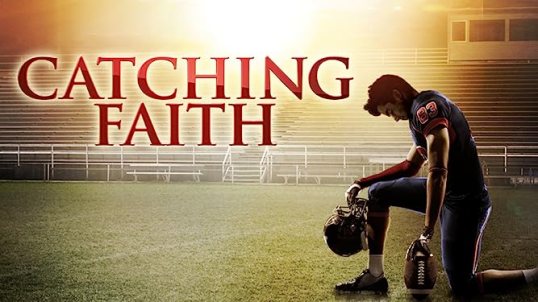
October Positivity: Catching Faith (dir by John K.D. Graham)


The 2015 film, Catching Faith, presents us with the following scenario.

You are the mother of a 17 year-old football star.  Your son is the reason why his school’s team is going to make the playoffs.  As a result, he’s the most popular kid in school.  In fact, he’s the most popular kid in the state.  Everyone loves him and you know what?  He’s actually handling it all pretty well.  He still works hard.  He still goes to practice.  He looks after his sister.  He treats you and your husband with respect.  Are his grades great?  Not really but is he passing and he’s certainly doing well enough that he’ll probably be able to get a football scholarship.

But then, you find out that your 17 year-old son went to a party after a game.  And he had a few beers, just as everyone else on the team did.  The police showed up but your son was allowed to leave.  In other words, he didn’t get caught.  He was also smart enough not to try to drive himself home in his intoxicated condition.  When, after a good deal of hesitation on your part, you ask him if he was drinking that night, he doesn’t lie to you.  He admits that he was drinking, as was everyone else on the team.

Do you sit down and have a talk with him, one in which you encourage him not to drink (especially since he’s not 21) while also making it clear that he can still call you if he ever does find himself in a situation where he has had too much?  Do you maybe ground him for a week or two, just so he understands that there are consequences for breaking the rules?

Or….

Do you whip out the rules and regulations book that he was given at the start of the semester and announce that if he doesn’t turn himself into the coach, you’ll do it yourself?  Keep in mind that, by doing this, you’ll be guaranteeing that your son doesn’t play in another regular game for the rest of the season.  You’ll be ruining his chance to impress the college scouts.  The football team will lose its best player and probably won’t win anymore games, which means that the other members of the team will probably lose whatever chance they had to get a football scholarship.  And, of course, your son will become a pariah at the time in his life when it’s really important to have friends?

If you are Alexa (Lorena Seguara York) and John Taylor (Dariush Moslemi), you go with the second option.  You explain that, as Christians, you’re not allowed to lie and you force your son, Beau (Garrett Westton), to confess to his coach (comedian Bill Engvall) that he had one or two beers at a party.  And then, of course, if your Alexa and John, you spend the rest of the school year wondering the entire town now hates you.

Of course, Beau is not the only member of the Taylor family who has to make a choice about being honest.  Alexa is torn over whether or not to tell John that she exchanged the necklace that he gave her for a better one.  Meanwhile, daughter Ravyn (Bethany Peterson) has to decide whether or not to cheat on her Latin exam so that she can be valedictorian and go to MIT.

Seriously, this is a dilemma?  Look, the world’s not going to end if you cheat on a Latin exam.  Who would pick their integrity over attending MIT?  And, for that matter, men are clueless when it comes to jewelry.  I kind of doubt John would have ever noticed that Alexa’s necklace was different from the one that he gave her.

I guess my point here is that this family is obsessed with creating drama where there really doesn’t need to be any.  Just be glad that your son didn’t go to jail and that he’s going to get a football scholarship.  (Seriously, do you want to pay for his college?)  And be happy your daughter is going to MIT.  And be happy with the pretty new necklace!

I wasn’t surprised to discover that it was set in Wisconsin because I can tell you right now that none of this would have ever happened in Texas.  A high school football player getting caught drinking?  That’s just a typical weeknight down here.  This was a deeply silly movie.  Parents, please don’t humiliate your 17 year-olds like this.

Late Night Retro Television Reviews: Highway to Heaven 1.2 “Pilot: Part Two”


Welcome to Late Night Retro Television Reviews, a feature where we review some of our favorite and least favorite shows of the past!  On Thursdays, I will be reviewing Highway to Heaven, which aired on NBC from 1984 to 1989.  The entire show is currently streaming on Tubi and several other services!


This week, we finish up the pilot for Highway to Heaven, with Jonathan revealing the true nature of his job to Mark and the old people heading to the horse races!

Episode 1.1 “Highway to Heaven: Part Two”

(Dir by Michael Landon, originally aired on September 19th, 1984)

The second half of the pilot for Highway to Heaven opens with things looking up at the retirement community.  Everyone is enjoying the new garden.  There’s a new sense of community amongst the residents.  Even Estelle (Helen Hayes) has finally come out of her room and is now taking care of the dog that Jonathan previously gave her.  Sidney Gould (John Bleifer) is especially happy to see Estelle out and about, especially after Estelle agrees to have dinner with him.

The only person who is not happy with the changes that Jonathan has brought to everyone’s lives is Mark Gordon.  Mark is still suspicious of Jonathan’s motives and he’s not happy that his sister, Leslie (Mary McCusker), is falling for a man who she really knows nothing about.  When Jonathan is having dinner at Leslie’s apartment, Mark breaks into Jonathan’s apartment and discovers that Jonathan owns nothing.  There’s not even a toothbrush in the bathroom.

Jonathan catches Mark in his apartment and, after Mark demands to know just who exactly Jonathan is, Jonathan explains that he works for “the Boss.”  He travels from location to location, helping people who need help.  When Mark demands to know who the Boss is, Jonathan can only look heaven-ward.

Needless to say, Mark is not at all convinced that Jonathan is an angel.  But there’s an even bigger problem to deal with!  Mr. Sinclair (Joe Dorsey), the owner of retirement home, has sold the land to a developer!  Everyone who worked there is now out of a job and everyone who lived there has been given just a few days to move out and find somewhere else to live.

When Jonathan pays Mr. Sinclair a visit, he discovers that Sinclair has spent his life making money in order to get over the shame of being rejected by his high school love.  Unfortunately, she’s now dead and Sinclair no longer cares about anyone.  Still, Jonathan is able to convince Mr. Sinclair to give him a chance to raise enough money to buy the retirement home.

Mark’s suggestion is that they take the money that they already have and bet it at the tracks.  Jonathan is not sure if the Boss would like him gambling but, in the end, he agrees to Mark’s plan.  At the tracks, it first appears that the horse that the old people put their money on has lost.  But then then Sidney discovers that the person at the betting window accidentally gave him the wrong ticket and — it’s a miracle!  They win the money!

The old people are able to buy their retirement home and Mark is now convinced that Jonathan is angel.  In fact, Mark is so convinced that he insists on driving Jonathan around the country and helping him out.

(Don’t worry about Leslie.  Though she’s upset when Jonathan leaves, a handsome and single man immediately moves in next door to her.)

This episode ends with Jonathan getting into Mark’s car and the two of them driving off, down the highway.

Wow, this was an earnest show.  Seriously, there’s not a hint of sarcasm or snarkiness to be found in this episode, which I imagine explains why this show is still airing on the retro stations and streaming on a hundred different sites.  To an extent, it’s easy to be dismissive of a show where a bunch of quirky old people got to the race track to win enough money to be able to stay together in their retirement home.  There’s nothing subtle not particularly surprising about any of it.  I mean, we know there’s no way Helen Hayes and that adorable dog are going to lose their home!  But this episode was so achingly sincere in its approach that it worked.

We’ll see if it continues to work next week!

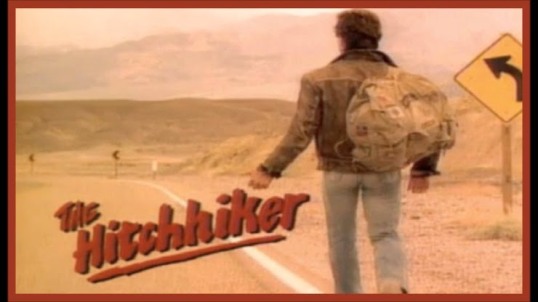
Horror on TV: The Hitchhiker 5.5 “Shadow Puppets” (dir by Roger Andrieux)


On tonight’s episode of The Hitchhiker, a psychologist (Brian Kerwin) learns about the dangers of manipulating a patient.  As you may be able to guess, The Hitchhiker dislikes psychologists almost as much as he dislikes tabloid journalists.  In fact, is there anyone that The Hitchhiker does like?

This episode originally aired on July 8th, 1989.

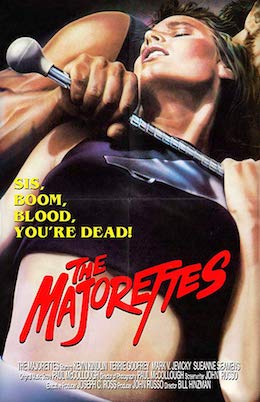
October Hacks: The Majorettes (dir by Bill Hinzman)


1987’s The Majorettes takes place in a small town in Pennsylvania.  It’s the type of town where everyone follows the high school football team, everyone goes to church on Sunday, and everyone admires the baton-twirling high school majorettes, even more so than the cheerleaders.

Unfortunately, it appears that someone is murdering the majorettes, one-by-one.  The first majorette victim is murdered while out on a date with Tommy, the class nerd.  (Poor old Tommy is killed as well.)  Her body is left in a creek.  The second victim is killed while lounging in front of her swimming pool.  The third victim is killed in the shower.  Detective Roland Martell (Cal Hetrick) thinks that the murders are linked to some sort of purification ritual.  Sheriff Braden (Mark V. Jivicky) says that he agrees but he doesn’t really have much time to worry about motives.  Braden’s dismissal of Martell could be due to the fact that Braden is a deeply religious man who we first see observing a creek baptism and singing a gospel song.  Meanwhile, Martell is an agnostic who is having an affair with a teenage girl named Nicole (Jacqueline Bowman).

Who could be the murderer?  Could it be Harry (Harold K. Keller), the slow-witted handyman who is always watching the majorettes while they’re practicing and who peeps on them and takes pictures while they’re changing in the locker room?

Could it be Harry’s mother, Helga (Denise Huot)?  Helga is a nurse who is plotting to murder both majorette Vicky McAlister (Terrie Godfrey) and her grandmother as a part of her plot to inherit the McAlister fortune.  But just because Helga is planning to kill one majorette, that doesn’t necessarily mean that she killed the others.

Or could the murderer be the school’s resident dope dealer, Mace (Tom E. Desrocher)?  Mace spends most of his time hanging out with his gang in their trailer, which is decorated with Confederate flags and 666 graffiti.  Mace was seen with the first victim and quarterback Jeff Holloway (Kevin Kindlin) is pretty sure that Mace was responsible for the murder.  When Jeff goes to the police, Mace decides to go after Jeff.

Anyone of them could be the murderer.  I won’t spoil the killer’s identity, beyond telling you that we learn who the killer is about halfway through the film.  And once the killer is known, The Majorettes goes from being a high school slasher film to being a backwoods action/revenge film, complete with shotguns being fired, vehicles blowing up, and Jeff the clean-cut quarterback suddenly running around with an arsenal of weapons.  Ultimately, The Majorettes feels like 3 different movies in one, with moments of horror balanced with scenes of Lifetime-style melodrama and Cannon-style action.  To be honest, the entire film is a bit silly but there’s enough twists and turns to hold one’s interest.  It’s hard not to enjoy the film’s “just toss it all in” approach to storytelling.

The Majorettes was based on a novel by John Russo, who is also credited as one of the screenwriters on Night of the Living Dead.  The film itself was directed by Bill Hinzman, who played the first zombie to show up in Romero’s classic film.  There’s not much visual flair to Hinzman’s direction but he keeps the action moving and really, that’s the most important thing that one can do with a film like The Majorettes.

The TSL Horror Grindhouse: Creature From Black Lake (dir by Joy N. Houck, Jr.)


It’s Bigfoot time!

1976’s Creature From Black Lake tells the story of two students at the University of Chicago.  Pahoo (Dennis Fimple) and Rives (John David Carson) decide that they want to spend their Spring Break on the Arkansas/Louisiana border, researching the legend that a Bigfoot-like creature that lives in the bayous.  (The creature is obviously based on the legendary Fouke Monster, who was also the subject of the 1972 documentary, The Legend of Boggy Creek.)

Pahoo and Rives head down South, looking to interview anyone who has seen the Creature From Black Lake.  Some people are willing to talk to them and they tell stories involving the Creature causing cars to crash, killing dogs, and attacking fisherman.  The Creature does not sound nice at all.  Still, the majority of the people in town don’t really feel like opening up to two Yankee monster hunters.  They’re worried that Pahoo and Rives are only in town because they want to portray everyone as being a bunch of ignorant rednecks who are scared of things that go bump in the night.

And really, they have every right to be concerned.  I grew up all over the South and the Southwest.  My family briefly lived in Fouke, the home of the Fouke Monster.  (No, I never saw or heard the monster, mostly because the monster doesn’t exist.)  When I was a kid, I lived in both Louisiana and Arkansas, among other states.  From my own personal experience, I can tell you that there is no one more condescending than a Northerner who is visiting the South for the very first time.   “Why is it so hot?”  “Why is everyone down here so polite?”  “Why can’t I find a Wawa!?”  Seriously, it gets old really quickly.  Now, to their credit, Pahoo and Rives are actually pretty polite and considerate when talking to the people who think that they have seen the Creature From Black Lake.  But still, one can understand why the town isn’t exactly thrilled to have them asking about monsters.

Anyway, after interviewing both Jack Elam and Dub Taylor about their experiences with the monster and getting yelled at by the local sheriff (played by Bill Thurman), Pahoo and Rives head out to the local swamp, hoping to find the creature themselves.  That, of course, turns out to be a huge mistake on their part.

Creature From Black Lake is a deliberately-paced film, which is a polite way of saying that it’s a bit slow.  Obviously inspired by The Legend of Boggy Creek, a good deal of the film is taken up with scenes of Pahoo and Rives interviewing people about their encounters with the monster.  That said, the film definitely picks up when Pahoo and Rives head into the swamp themselves and their eventual meeting with the monster is well-directed.  I have to admit that I spent this entire film dreading the moment when it would be revealed that the Monster was actually misunderstood and peaceful and I appreciated that the film did not go that route.  The creature turns out to be no one’s friend and is genuinely menacing.

The cast is full of familiar county character actors, all of whom do a good job bringing their characters to life.  Dennis Fimple and John David Carson are likable as the two students.  This film was also an early credit for cinematographer Dean Cudney and, just as he would later do for John Carpenter, Cudney creates a perfectly ominous atmosphere of isolation.  Creature From Black Lake may start out slow but, ultimately, it’s an effective creature feature.


Scary Bride (2020, directed by Dan Grin)


Anthony (Vitt Ray) is a loser living in Minnesota who cannot get over his ex-girlfriend.  He decides to do what his neighbor did and fly over to Russia so he can search for a woman who is desperate to get married.  Anthony’s trip to Russia starts out promising enough, with a meeting with a helpful cab driver and a trip to a dance club where Anthony meets the beautiful Nina (Evgeniya Yarushnikova).  But then Nina turns out to be a witch who literally wants to take way Anthony’s balls.  After putting a curse on him, Nina chases Anthony through Moscow, while Anthony searches for anyone who can remove the curse.

This film’s plot is pretty much a one-joke premise.  Anthony even breaks the fourth wall and says, “Sometimes, it’s better to look for a bride in your own country.”  The movie plays with the stereotype that you can get anything you’re looking for in Moscow, if you know the right people.  (Needless to say, this film was made before Russia’s invasion of Ukraine.)  What’s interesting is the film itself is a Russian film so the humor is less about Russia being a dangerous place and more about how stupid Americans like Anthony are for coming over in search of a bride.  This is a Russian film that tells the rest of the world to stay out of Russia.

Unfortunately, it doesn’t take long for that one-joke premise to get old.  Anthony is not a likable hero.  The witch could have done better.  The version that’s on Tubi is dubbed into English and it is some of the worst voicework that I’ve ever heard, with Anthony in particular getting a deep voice that does not at all go along with his character.  Even though they were supposed to be residents of Minnesota, Anthony’s neighbor is dubbed with a British accent and keeps calling everyone “mate.”  Evgeniya Yarushnikova is beautiful enough that it is easy to believe that any man would fall under her spell but the rest of the movie is just the same joke told over and over again.

Retro Television Reviews: Jennifer Slept Here 1.2 “Jennifer: The Movie”


Welcome to Retro Television Reviews, a feature where we review some of our favorite and least favorite shows of the past!  On Thursdays, I will be reviewing Jennifer Slept Here, which aired on NBC in 1983 and 1984.  The entire show is currently streaming on YouTube!

This week, the afterlife of film star Jennifer Farrell continues as a Hollywood production company comes to the house to shoot a scene for their Jennifer biopic!

Episode 1.2 “Jennifer: The Movie”

(Dir by John Bowab, originally aired on October 28th, 1983)

The second episode of Jennifer Slept Here opens with ghostly Jennifer in a good mood.  A movie is being made about her life and Joey has somehow gotten a hold of the script.  Jennifer reads the script and announces that the movie is going to be the “great biopic since Gandhi!  And I look a lot better under a sheet!”

(The audience loves that line.)

Jennifer’s main concern is who is going to be play her in the movie and, at her insistence, Joey asks his parents.  Since his parents are wacky sitcom parents, it takes them forever to finally reveal that not only is Jennifer going to be played by Sheila Drake (Lynnda Ferguson) but that a scene from the movie is going to be filmed at the house.  Jennifer is not a fan of Sheila Drake’s and she takes out her annoyance by playing the piano.  When his mother comes in the room to see who is so beautifully playing the piano, Joey is forced to pretend to be a talented musical prodigy.

Later, Jennifer is super-excited when the film crew shows up at the house to shoot a scene in which she talks to a producer.  This actually leads to a rather poignant moment in which Jennifer tries to talk to a few familiar members of the crew, just to be reminded that she’s dead and they can no longer hear her.  (When I say that the scene is poignant, it’s almost all totally due to the performance of Ann Jillian.)

However, Jennifer is not amused when she discovers that Sheila is planning on playing her as a “cheap tramp” who slept her way to the top.  Jennifer goes out of her way to disrupt filming, first by unplugging a power chord and then, after Sheila has gone up to Joey’s room to wait while the next scene is set up, spraying Sheila with water and then ripping off Sheila’s skirt.  Because Joey is in the room at the time, he gets blamed for both of these incidents.  So, I guess Joey’s going to jail and get booked on assault charges now, right?  Nope.  Instead, Sheila just walks off the picture.

The director (Luis Avalos) is freaking out because he’s got “a six million dollar picture” and no star when suddenly, Joey’s mom announces that there’s someone that the director should see.  The director says he doesn’t want to see anyone but then, Jennifer comes walking down the stairs.  AND EVERYONE CAN SEE HER!

It turns out that Jennifer has the ability to be seen when she wants to be seen.  She convinces the crew that she’s Sheila’s stand-in and then she shoots the scene the way that it really happened, revealing that she was a hard-worker who earned her roles with her talent.  Unfortunately, when the scene is later watched by the family, it turns out that the stand-in does not appear on camera.  (Instead, just as in The Invisible Man, the camera just picks up Jennifer’s dress moving around on its own.)  The family assumes that it was a problem with the camera while only Joey knows that it’s because Jennifer’s a ghost.

Accompanied by Jennifer (who is once again invisible to everyone but him), Joey heads down to a snooty restaurant where he confronts Sheila and, with Jennifer’s help, blackmails her to return to the film.  Joey threatens to reveal that Sheila steals her wardrobe from her movies and that she once spent a night in Madrid with a soccer team.  If I was Sheila, I would reply by calling the police and telling them that Joey was in the room when I was sprayed with water and had my skirt ripped off.  But apparently, everyone’s moved on from that.

Sheila returns to the film and shoots the scene, this time the way that it actually happened.  Jennifer wipes away a tear.  Awwwww!

Hey, this isn’t actually was not a bad episode.  It was certainly an improvement over the pilot and Ann Jillian did a great job playing up both Jennifer’s pride in her career and her anger that her accomplishments were being denigrated by a lesser actress.  The supporting characters continue to be the show’s biggest weakness but this episode largely worked, even if it never really made sense for the director to be okay with the family hanging out at the house while they were shooting the film.

Next week: Joey and his loser friend Marc both want to date the same girl!

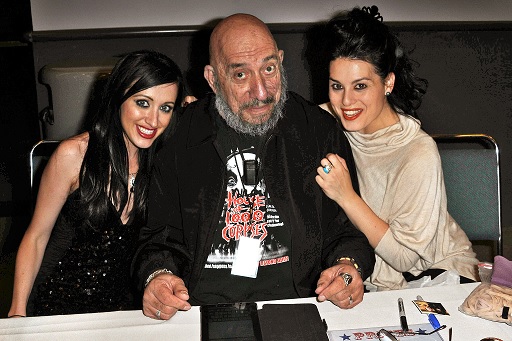
Horror Scenes That I Love: Sid Haig in House of 1000 Corpses


Rob Zombie’s 2003 directorial debut, House of 1000 Corpses, is a film for which I have somewhat mixed feelings but I do think it deserves some credit for reintroducing the character actor Sid Haig to audiences.

Haig started acting when he was in high school and attended the Pasadena Playhouse, the same acting school where Robert Preston, Gene Hackman, and Dustin Hoffman had trained.  He moved to Hollywood with his former roommate, actor Stuart Margolin, and Haig soon found himself being cast as criminals and occasionally revolutionaries.  Haig grew tired of playing simple-minded thugs and actually retired from acting in 1992 and worked as a hypnotherapist.  Quentin Tarantino tracked Haig down to offer him the role of Marcellus Wallace in Pulp Fiction.  Haig turned him down but then regretted his decision when he saw the film.  When Tarantino subsequently offered him a cameo in Jackie Brown, Haig accepted the role and returned to the big screen.

That said, it was his performance as the nightmarish clown, Captain Spaulding, in Rob Zombie’s House of 1000 Corpses and The Devil’s Rejects that definitely put Haig back on the pop cultural radar.  In this scene from House of 1000 Corpses, Haig shows that even a clown can defend himself.

Horror Book Review: The Visitor by Christopher Pike


The 1995 Christopher Pike novel, The Visitor, is a strange one, even by the very strange standards of Christopher Pike.

Mary is a high school student who has taken up smoking and general cynicism in response to the tragic death of her boyfriend Jerry.  Jerry was shot and killed by a school security guard who, it is believed, then shot himself out of guilt for having accidentally killed Jerry.  The truth of the matter is that the security guard came across Mary and Jerry while they were breaking into the school so that they could count the votes for homecoming queen to see whether or not Mary won.  (And, of course, Mary totally won.)  A struggle with the guard led to the guard shooting Jerry and then Mary shooting the guard!  No wonder Mary is struggling with guilt and now spends her time lying, half-undressed, on Jerry’s grave.

An attempt to contact Jerry via a séance goes terribly wrong after a spirit says that Mary has “lived before” and that she used to claim to have God-like powers.  Things get even stranger when Mary meets Tom, the new kid at school who has white-blonde hair and who has secrets of his own, all linking back to Mary’s past.  What are those secrets?  Well, let’s just say that it all links back to aliens and secret powers and there’s some “ancient astronauts as Gods” silliness and eventually, Jerry is brought back to life but he’s kind of whiny and leaking embalming fluid all over the place and Mary has to make a decision about how to deal with all of these weird complications.  But it also turns out that there’s more to Mary’s situation than even Mary originally realized and the entire book ends with a mind-screw that leaves you wondering who killed who and who might be an alien and who might be human….

Seriously, this is one weird book!  There’s a tendency among some to file Christopher Pike and R.L. Stine together but Pike’s books were always a hundred times darker and more macabre than Stine’s.  Whereas Stine’s books usually involved good kids in bad situations, Christopher Pike specialized in writing about bad kids dealing with uniquely Hellish problems.  If Stine’s books usually only featured one or two murders and a lot of misunderstandings, Pike specialized in books in which entire communities were destroyed and people really had absolutely no control over their fates.  In The Visitor, no one escapes unscathed.

The world of Christopher Pike was a dark one and that’s certainly the case with The Visitor.  Does the book always make sense?  Not really.  With its combination of aliens and zombies and ghosts and mysterious white-haired teenagers, the plot plays out like a uniquely demented dream.  It makes for an entertaining read.  And, in the end, the book provides an important lesson.  There’s nothing wrong with waiting a day to find out how the homecoming election went.  Don’t break into the school to count the votes yourself.  Nothing good ever comes from that!

October True Crime: Dahmer (dir by David Jacobson)


2002’s Dahmer opens in a chocolate factory.  As the opening credits role, the camera lingers over the machinery effectively pouring, molding, and wrapping chocolate.  Much like the human body, the machines are set to do everything efficiently and automatically.  The only reason anyone works at the factory is to keep an eye on the machines and to make sure that they don’t break down.

A new worker at the factory is introduced to a veteran of the machines, a friendly guy named Jeffrey (Jeremy Renner, in his first starring role).  Jeffrey shows the new guy how the machines work and he flashes a somewhat friendly smile.  He seems like a nice enough human being.

But, of course, we know different.  We know what the title of this film is and, therefore, we know that the smiling man at the factory is also an infamous serial killer and cannibal named Jeffrey Dahmer.  We know enough to be nervous when, in the very next scene, Dahmer is in a department store and asking a young man (Dion Basco) if he wants to come back to Dahmer’s apartment so that Dahmer can take some pictures of him.  The man agrees and we watch as Dahmer drugs the man and then drills into the man’s head.  When the man, in a dazed state, manages to get out of the apartment, the police respond by returning him to Dahmer.

The film flashes back and fourth, between Dahmer’s life as an alcoholic cannibal in Minneapolis and his adolescence as a gay teenager from a dysfunctional family.  In the past, Dahmer steals a mannequin from a department store, tries to hide his homicidal urges from his confused, if well-meaning, father (Bruce Davison), and picks up the hitchhiker who will become his first victim.  In the present, Dahmer invites a man named Rodney (Artel Great) back to his apartment but, instead of automatically killing him, Dahmer instead talks to him about being alienated and shunned by society, almost as if Dahmer is trying to justify his own abhorrent actions to a future victim.  Rodney proves to be a bit more intuitive than Dahmer realized.

In many ways, the structure is similar to Ryan Murphy’s recently Netflix miniseries about Dahmer.  Many of the same incidents are detailed, including the time that Dahmer’s father demanded to see what Dahmer was hiding in a box.  Of course, Dahmer manages to tell the complete story in under two hours while Murphy, for some reason, dragged things out to ten episodes.  If Murphy’s miniseries sometimes came dangerously close to making excuses for Dahmer’s crime, David Jacobson’s film leaves us with no doubt that Jeffrey Dahmer was a monster.  In the film, Dahmer spends his time with Rodney trying to justify his anger and his murderous impulses, just for Rodney to continually shoot him down.  If Murphy’s miniseries often seemed to be too stylized for its own good, Jacobson’s film is directed in a near-documentary fashion, with the grainy and harsh images creating a pervasive atmosphere of evil.  The film may explain the motives behind Dahmer’s crimes but it never attempts to excuse them.

Of course, today, Dahmer is mostly known for being an early film of Jeremy Renner’s.  This was Renner’s first starring role and he received an Independent Spirit nomination for his performance here.  (As well, Kathryn Bigelow cast Renner in The Hurt Locker on the basis of his performance.)  Renner gives a haunting and frightening peformance, playing Dahmer as someone who suspects that his murderous impulses are wrong but who has given up trying to control them.  As played by Renner, Dahmer is friendly and good-looking enough that one can understand why people were willing to go back to his apartment but, at the same time, there’s always something a bit off about him.  Even when he’s surrounded by people, Renner plays Dahmer as someone who knows that he’s destined to be forever alone.

Dahmer is a haunting portrayal of evil.