What was the highlight of this week? I finally watched Wes Anderson’s Asteroid City and I absolutely loved it.
What was the lowlight of this week? Some will undoubtedly say that it’s Dune Part 2 being pushed back to 2024 but, honestly, that’s not the end of the world. If nothing else, Dune will probably have the March box office to itself. For me, the lowlight continues to be the heat. I’ll be happy when winter arrives.
Here’s what I watched, read, and dance to this week!
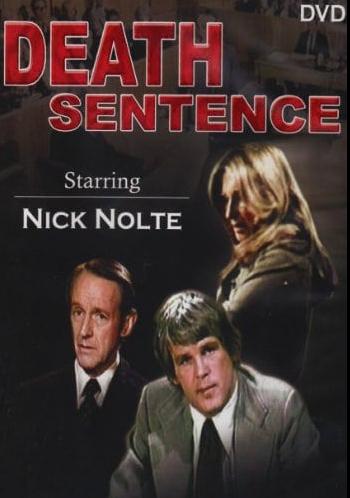
Welcome to Retro Television Reviews, a feature where we review some of our favorite and least favorite shows of the past! On Sundays, I will be reviewing the made-for-television movies that used to be a primetime mainstay. Today’s film is 1974’s Death Sentence! It can be viewed on YouTube!
There’s been a murder!
A young woman has been strangled in her own home. The nosy neighbor (Hope Summers) testifies that the woman often argued with her woman and that she heard the woman yelling on the night of the murder. The husband, John Healy (Nick Nolte), is found in a neighborhood bar and, when he’s brought back to his house, his drunken reaction to seeing his dead wife doesn’t do much to keep him from looking totally guilty.
However, the viewer knows that John is innocent because the viewer has already seen that the woman was murdered by Don Davies (Laurence Luckinbill), the man with whom she was having an affair. She demanded that he leave his wife for her and Don, realizing that his cheating was about to revealed, responded by strangling her.
Don’s wife is Susan Davies (Cloris Leachman), who knows that she and Don have been going through a rough patch but who certainly had no idea that Don was cheating on her. Shortly after the murder, Susan is called up for jury duty. She’s placed on the jury and told that she will be an important part of a major trial. As a result, she and the other jurors will be sequestered in a hotel….
And who is the defendant in this trial? John, of course!
As opposed to the other members of the jury, who are ready to convict John even before the first bit of testimony is heard, Susan pays attention to what is said in the courtroom. She listens to Lubell (Alan Oppenheimer), the prosecutor. She listens to Tanner (William Schallert), the defense attorney. She comes to believe that John is innocent but will she be able to hold her own against the rest of the jury? And will she ever figure out that the murder was actually committed by her husband?
It’s an intriguing premise, even if it is a bit far-fetched. I mean, it really is an amazing coincidence that Susan just happened to end up on the jury for a case involving a murder that was actually committed by her husband. However, this is a made-for-television movie and, as soon as “Produced by Aaron Spelling” appears on the screen, most viewers should be savvy enough to know what they’re getting into. Instead, the main problem with the film is that it opens by showing us who the murderer is. Therefore, there’s really zero suspense as to who actually committed the crime. Instead, the viewer spends the entire movie waiting for Susan to catch up. Since the majority of the film takes place in court, it’s a very talky film but there’s no joy to be found in paying close attention to every word said and picking up on the details that will allow you to solve the crime for yourself. This is a case where the film spoils its biggest twist and, despite good performances from Leachman and Luckinbill, it’s a bit dull.
(Nick Nolte, for his part, spends most of the movie silently sitting in the courtroom. He’s not bad and his look of anguish is believable but it’s hardly a starring role, regardless of what the film’s video packaging might otherwise claim.)
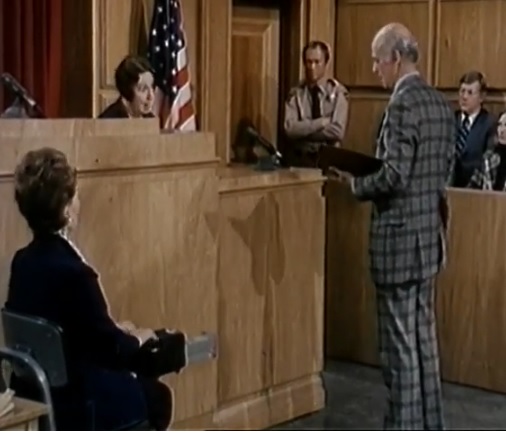
In the end, what I’ll mostly remember about Death Sentence were the atrocious fashion choices made by the prosecutor. Seriously, would you trust a man wearing this suit?
Asteroid City opens with black-and-white footage of Bryan Cranston, wearing a suit and speaking in the authoritative tones of someone who has made his living on television. Cranston informs us that we are about to see a televised production of a play by the famed but enigmatic playwright named Conrad Earp (Edward Norton).
The play, which is seen in stylized color, opens with Augie Steeback (Jason Schwartzman) driving his family through the desert. He is taking his son, Woodrow (Jake Ryan), to a Junior Stargazers convention that is being held at Asteroid City, a tiny town that is best-known for being the location of an impact crater. Along for the ride are Augie’s three daughters, who are all pretending to be witches. What Augie hasn’t told his children is that their mother has died, her cremated remains are in a Tupperware container, and that they will be moving in with their wealthy grandfather (Tom Hanks).
There’s not much to the town of Asteroid City. There’s a motel that’s managed by a man (Steve Carell) who sells land deeds out of a refurbished Coke machine. There’s a diner. There’s a group of helpful cowboys, led by the polite and helpful Montana (Rupert Friend). There’s a mechanic (Matt Dillon) who is called into duty when Augie’s car breaks down. The Junior Stargazer convention is the event of the year for Asteroid City. Young geniuses from all around the country have descended on the town and have brought their parents. One of them, Dinah (Grace Edwards), is the daughter of actress, Midge Campbell (Scarlett Johansson). When an alien (played, at one point in the film, by Jeff Goldblum) shows up and steals the town’s meteorite, General Gibson (Jeffrey Wright) declares a quarantine. Some people handle the lockdowns better than others. Augie takes pictures and thinks about his wife. Midge rehearses for her next role, one that is centered around her character dying. The genius children play a memory game that they realize will never end because they’re all geniuses. A teacher (Maya Hawke) tries to teach her students about the Milky Way, just to discover that the kids only want to talk about the alien. One of the fathers (Liev Schreiber) ends up with a useless plot of desert land and the death ray that his son recently invented.
Throughout it all, Bryan Cranston appears in black-and-white footage that gives us a look into what went on behind the scenes during the production of Asteroid City. The director (Adrien Brody) was a lech. The actor playing Augie struggled to understand what the play was about and who his character was meant to be while the actress (Margot Robie) hired to play his wife ended up in another play after her scenes were cut from Asteroid City. Only once does Bryan Cranston’s host appear in the color sections of Asteroid City, just to sheepishly admit that he’s not supposed to be there before ducking off camera.
Even if his name wasn’t in the opening credits, the viewer could probably easily guess that this is a Wes Anderson film. It features all of Anderson’s trademarks, all of the things that viewers will automatically love or hate depending on how they feel about Anderson’s quirky aesthetic. It’s a visually impressive, pop art-flavored, all-star comedy with an undercurrent of profound melancholy, one in which the fanciful strangeness of the alien’s “invasion” is compared and contrasted with the very real-life strangeness of how humans deal with life, loss, death, and uncertainty. Scenes of clever wordplay are mixed with scenes in which we see Augie still very much struggling to come to terms with the death of his wife and the actor Augie very much struggling to understand what is actually going on in his character’s head. As far as recent Anderson films go, Asteroid City is not quite as humanistic as Rushmore or Grand Budapest Hotel but, at the same time, it’s still more accessible than The French Dispatch.
If you’re not a fan of Anderson’s style, this film won’t convert you. That said, I am a fan of Anderson’s style and I absolutely loved Asteroid City. As with so many of Anderson’s films, the main focus is on how we try to deal with the uncertainties of life by trying to maintain an illusion of control over every aspect of our lives. Playwright Conrad Earp writes because that way he can have a world that follows his own rules. The actors follow a script that tells them how to react to everything that happens around them. In the play, the Junior Stargazers fall back on science while Augie’s father-in-law falls back on religion and Augie’s daughter convince themselves that spells will bring back or, at least, protect their mother. Even General Gibson falls back on his belief in the government and the military to deal with the sudden appearance by the alien. The alien is the unknowable and his arrival reminds everyone that life is unpredictable, regardless of how much you try to control your own story. Indeed, while the film takes place in the 50s and is full of comments about the Red Scare and atomic bomb testing, it’s hard not to see Asteroid City as being a commentary on the recent COVID lockdowns and the debate over whether people could ever go back to living the way that they did before the pandemic. Much as with the Coen Brothers’s similarly stylized A Serious Man, the ultimate message seems to be that the only way to deal with the unpredictability of life is to embrace it.
It’s also a very funny film, one that is full of small details that reward repeat viewing. If one focuses on the background characters, it quickly becomes apparent that there are actually several stories unfolding in the film and, much as with life, the viewer just has to be willing to look for them. (I particularly enjoyed the romance between The Teacher and Montana.) Jason Schwartzman is compelling as both Augie and the actor playing Augie and Scarlett Johansson plays both Midge and the actress playing Midge with the perfect amount of cool detachment. To the film’s credit, none of the character’s become caricatures. They remain individuals, regardless of how bizarre the film’s story may sometimes seem. Everyone gets a moment to reveal a little depth, from Jeffrey Wright’s sincere (if misplaced) faith in the lockdown policy to the moment when Tom Hanks’s previously unsympathetic father-in-law reveals that he’s as much in mourning as Augie. The all-star cast also includes Tilda Swinton, Liev Schrieber, Stephen Park, Willem DaFoe, Hong Chau, and Margot Robbie and all of them add to the film’s portrait of quirky but ultimately relatable humanity.
Again, with this film, it undoubtedly helps to already be familiar with and to like Wes Anderson’s way of doing things. If you’re not a fan of his film, this one probably won’t change your mind. That said, for those of us who do enjoy his style, this is Anderson at his best.
This video was shot at the Los Angeles City Hall and it played a big role of turning Jewel, who had been living in a van just a few years previously, into a star. Appropriately, this was also the first song that Jewel ever wrote, while she was 16 years old and hitchhiking through Mexico.
Director Geoff Moore is best-known as a photographer, whose work appeared in GQ, Elle, and Playboy. Along with directing commercials for Diesel, T-Mobile, Levis, and Converse. He has also shot videos for The Cardigans, Goo Goo Dolls, Suzanne Vega, Royal Crown Revue, NOFX, Reel Big Fish, and Blessid Union of Souls.


 Through the Shattered Lens