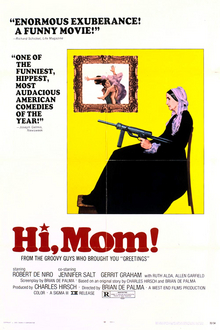
Film Review: Hi, Mom! (dir by Brian De Palma)


Released in 1970, Hi, Mom!, tells the story of Jon Rubin (played by a 26 year-old Robert De Niro).  The somewhat spacey and kind of creepy Jon has just returned to New York City from Vietnam.  After moving into a run-down apartment building and meeting the building’s superintendent (Charles Durning), Jon is hired to direct a pornographic film by producer Joe Banner (Allen Garfield).  Jon’s idea to simply point his camera at his building and to film his neighbors as they go about their day.  As quickly becomes apparent, Jon is mostly just looking for an excuse to watch and film Judy Bishop (Jennifer Salt).

Also living in the building is Gerrit Wood (Gerrit Graham), who is first seen triumphantly putting posters of Che Guevara and Malcolm X up in his apartment.  Gerrit is a freshly-minted political radical and the leader of a group of performance artists who put on a show called Be Black, Baby, in which the white audience members are forced to wear blackface and are then chased, attacked, and assaulted by black actors wearing whiteface.  (Gerrit himself is white.)  Jon is hired to play the police officer who beats and arrests the members of the audience at the end of the performance.  Of course, eventually, the real police show up….

An attempt at an episodic counter-culture comedy, Hi, Mom is definitely a product of the time in which it was made, both in its style and its thematic content.  Today, it’s best-known for being one of Brian De Palma’s early independent films and for featuring Robert De Niro in one of his first starring roles.  De Palma and De Niro aren’t exactly the first names that come to mind when one thinks about comedy and Hi, Mom shows that there’s a good reason for that.  As both a screenwriter who felt he had something important to say and a young director who was obviously eager to show off everything that he could do with a camera, Brian De Palma simply cannot get out of his own way.  Scenes are needlessly sped up.  Scenes are pointlessly slowed down.  The musical cues are obvious.  The dialogue is often so broad that it comes across as being cartoonish.  One gets the feeling that De Palma didn’t trust the audience to get the jokes so he went overboard to make sure everyone knew when to react.  All of the pointless camera trickery serves the same purpose that a laugh track would on an old sitcom.  Interestingly enough, the only sequence that really works as satire is the Be Black, Baby sequence and that’s because De Palma directs it in a semi-documentary fashion.  De Palma gets out of his own way and allow the sequence to develop a natural rhythm.  (Of course, seen today, the scene will bring to mind the upper class white liberals who pay money to have an activist lecture them about their privilege while having their friends over for dinner.)

As for Robert De Niro, he gives a typically nervy performance, one that feels like a dry run for his later work in Mean Streets, Taxi Driver, and King of Comedy.  Despite the reputation of those films, there are some genuinely funny moments to be found in all of them.  Most of them, like the classic Taxi Driver conversation between De Niro’s Travis and Peter Boyle’s Wizard, are funny because of how people react to De Niro’s obviously unhinged characters.  Both Taxi Driver and King of Comedy got mileage out of having normal people try to deal with De Niro’s unstable characters.  In Hi, Mom, everyone is equally wacky and, as such, De Niro doesn’t really have anyone to play off.  No one is really reacting to anything, De Niro-included.  (There is some spark to his scenes with Charles Durning and Allen Garfield but even those scenes seem to drag on forever.)

On the plus side, Hi, Mom! is was shot on the actual streets of New York City, guerilla-style.  (A “Re-Elect Mayor Lindsay” sign in the background confirms that the film was made on location in 1969.)  When De Palma isn’t getting in his own way with all of his fancy camera tricks, he manages to capture so memorably bleak images of New York City.  Hi, Mom! presents New York as being a dirty, crime-ridden, and menacing city but it also captures the odd grandeur of urban decay.  At its best, Hi, Mom! captures the love/hate relationship that many seem to have New York City.  The city feels both alive and dangerous at the same time.  Hi, Mom! is too uneven to work as a sustained satire but, as a documentary about New York at the end of the turbulent 60s, it’s worth watching.

I should mention that this was not the first time that De Palma and De Niro teamed up.  Indeed, De Niro was De Palma’s muse even before he met Martin Scorsese.  Hi, Mom! was a loose sequel to an earlier De Palma/De Niro film called Greetings.  (Like many of De Palma’s future films, both Greetings and Hi, Mom! were originally rated X but later re-rated R.)  De Palma and De Niro, of course, would both go onto have long Hollywood careers.  (They would later reunite for The Untouchables, a big-budget spectacle of a film that’s about as far from the grungy Hi, Mom! as one can get.)  De Palma’s career has had its ups and downs but, as of late, many of his films have been positively reevaluated.  As for De Niro, he can finally kind of play comedy.  That said, I’d rather watch Hi, Mom than Dirty Grandpa.
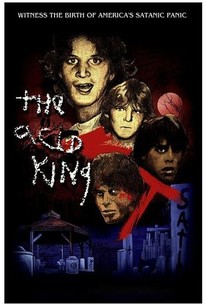
The Acid King (2019, directed by Dan Jones and Jesse B. Pollack)


In 1984, a Long Island-based teenage drug dealer and wannabe gangster named Ricky Kasso murdered a childhood friend named Gary Lauwers, reportedly because he was angry that Gary had stolen some drugs from him.  While tripping on LSD, Ricky brutally stabbed Gary to death in the woods.  Ricky later said that he demanded that Gary say “I love Satan,” while killing him.  Ricky claimed to be a Satanist, though he never actually learned how to spell the name of his supposed Dark Lord and instead would tag walls with graffiti exhorting the viewer to “Hail Satin.”

Not being the smartest drug dealer/Satanist to ever grace the state of New York, Ricky spent the next two weeks bragging about the murder and taking his friends to view Gary’s corpse.  While none of the people who saw Gary’s body ever called the police, rumors started to spread about what had happened.  Acting on an anonymous tip, the police arrested Ricky and two of his friends.  Ricky Kasso, the self-described “Acid King,” committed suicide in his jail cell a month after murdering Gary Lauwers.  Supposedly, the other inmates in the jail egged Ricky on while he hanged himself.  No one liked the Acid King.

Ricky Kasso had been in-and-out of trouble for the majority of his short life and, at the time of the murder, he was living on the streets because his family had kicked him out of the house.  What set Ricky apart from other murderous drug dealers was that he claimed to be a Satanist and that he demanded that Gary declare that he loved Satan before killing him.  This played right into the burgeoning Satanic Panic of the 80s and, in death, Ricky became a symbol of the Satanic conspiracy that many were convinced had taken hold of the teenagers.  (Especially teenagers who, like Ricky, listened to AC/DC.)  A book called Say You Love Satan was written about Kasso and his crimes.  Though the book has since been discredited, it was a best seller when initially published.  (I can still remember, when I was a kid, coming across a copy in Waldenbooks and reading a few pages.)  Ricky Kasso became a cult figure, inspiring both filmmakers and bands.  Meanwhile, all of Ricky and Gary’s former friends had to deal with the burden of being branded as Satanists by the rest of America.  Heavy metal music was blames for leading kids like Ricky into Satanism.  Tipper Gore campaigned for the labeling of offensive music.  Satin would have been proud.

The Acid King is an eye-opening documentary about the case, featuring interviews with the people who knew both Ricky and Gary.  While criticizing the way the case was reported on by the press, The Acid King also makes it clear that Ricky Kasso was a twisted individual.  (More than one interview subject describes him as being evil.)  The documentary takes a look at how Ricky and his friends were essentially abandoned by their parents in their privileged community, leaving them with next to no guidance on how to deal with the real-life consequences of their actions.  Of course, for the media, it was much easier to blame Satanism and heavy mental music than it was to ask where the parents were while Ricky Kasso was plotting to kill Gary Lauwers.

The first half of the documentary deals with Ricky and Gary.  The second half features interviews with the horror filmmakers and the musicians who were inspired by the sordid media coverage of Ricky’s crimes.  Lori S, the lead singer of Acid King, took the name of the band from a passage in Say You Love Satan while director Jim VanBebber, while being totally dismissive of the book’s claim that Ricky was directly inspired by Satan, still directed a short film about Ricky Kasso.  The second half is a less interesting than the first, until you consider that none of these people would have heard about Ricky Kasso if not for the attempts of people like Tipper Gore to turn him into the poster child for her crusade against heavy metal music.  Instead of scaring people away, the Tipper Gores of the world made Ricky Kasso, a barely literate idiot, into a cult figure.  Again, Satin would be proud.

The Acid King provides a valuable service by separating the fact from the rumors, revealing that the mundane truth is even more disturbing than the sordid fiction.

Retro Television Review: Hang Time 4.9 “Love Triangle” and 4.10 “Texas Rose”


Welcome to Retro Television Reviews, a feature where we review some of our favorite and least favorite shows of the past!  On Mondays, I will be reviewing Hang Time, which ran on NBC from 1995 to 2000.  The entire show is currently streaming on YouTube!

This week, we have one decent episode and one episode that …. well, just read the review.

Episode 4.9 “Love Triangle”

(Dir by Patrick Maloney, originally aired on October 10th, 1998)

Finally, a decent episode!

At the start of this episode, Kristy informs Mary Beth that she has a crush on Hammer but she’s too shy to talk to him.  Not surprisingly, Mary Beth takes it upon herself to set them up.  She tells Hammer to be at the Stadium at a certain time so that he can meet his blind date.  Hammer agrees but is shocked when the blind date turns out to be Kristy.  After the date, he approaches Mary Beth and tells her that, while he thinks Kristy is great, she’s not the girl that he’s interested in.  He’s interested in …. MARY BETH!

Now, you can probably guess that this leads to Mary Beth dating Hammer in secret.  And you can probably also guess that Kristy eventually figures out what’s happening while they’re all at the latest school dance.  Mary Beth and Kristy argue and then they make up and then everything’s fine.  Mary Beth has a boyfriend, Hammer has a girlfriend, and Kristy …. well, okay.  It kind of sucks for Kristy.  That said, Mary Beth and Hammer are a cute couple.

This was a pretty simple episode and it almost felt like a throwback to the type of episodes that dominated the show’s first season.  (Remember when Danny tried to date Julie before eventually realizing that Sam was perfect for him?)  But it was kind of nice to take a break from all the basketball stuff and Megan Parlen and Amber Barretto did a good job with both the dramatic and the comedic moments of the episode.  And, after a rough few episodes, Mark Famiglietti finally got to display some bad boy charm in the role of Hammer.

All in all, this wasn’t a bad episode.

Episode 4.10 “Texas Rose”

(Dir by Patrick Maloney, originally aired on October 10th, 1998)

*sigh*

This episode finds the team going to a basketball tournament in San Antonio, Texas so, of course, it opens up with stock footage of an oil derrick.  From the minute I saw that cliché, I knew this would be a difficult episode for me.  As a Texan, I’m very sensitive to all the silly stereotypes and clichés that television shows tend to fall back on whenever they try to tell a story about my part of the world.

The oil derricks were followed by a shot of the Alamo.  That was good.  The Alamo is a huge part of Texas culture.  This was followed by the Tornadoes checking into their San Antonio hotel and, of course, everyone in the lobby is wearing a cowboy hat.  I rolled my eyes so hard that I gave myself a headache.  “Is it me or does everyone around here look like Garth Brooks?” Mary Beth says.

Oh c’mon, I muttered for neither the first nor the last time.

“I can’t wait to get on the court and kick some cowboy butt!” Michael declares.

So, I guess the point of this episode was to make sure no one in Texas ever watched another episode of Hang Time.  I mean, we’ve got enough confidence down here to take a joke but that doesn’t mean we want to spend 30 minutes being made fun of by a bunch of people who think Indianapolis is a real city.

At the local restaurant, the boys go crazy watching some fat dude try to ride an electric bull while Kristy sees a handsome Latino and automatically assumes that he can’t speak English.  She speaks to him in Spanish and, as we can see from the subtitles, her Spanish sucks.  Still, Antonio (Jay Hernandez, of Crazy/Beautiful and Hostel fame) is so attracted to her that he doesn’t mention that he was born in America and he can speak English.  Myself, I just find it interesting that Kristy and her friends assume that just because someone has brown skin in San Antonio, they must have been born in Mexico or Latin America and that they must not be able to speak English.  I mean, did they not notice that the town itself is called San Antonio but it’s full of people who speak and understand both English and Spanish?  Did they somehow never learn that Texas has a strong and politically active Latino community?  Seriously, the whole world isn’t freaking Indiana.

(And they wonder why we dislike Yankee tourists down here….)

Meanwhile, Silk meets a girl named Rose and falls for her.  However, Silk thinks that Rose is rich so he pretends to be rich in order to impress her.  When Silk takes Rose to Coach K’s suite and tries to pretend that it’s actually his hotel room, it works until Coach K shows up.  Oh well, Silk — that’s what you get!

The next day, as the team gets ready for their first game, Kristy is shocked to discover that Antonio is on the rival team and he can speak English!  Kristy yells at him for not telling her that he could speak English.  You know, Kristy, maybe you should have given him a chance to speak English before assuming that he couldn’t.

Things work out in the end.  Silk discovers that Rose isn’t actually rich and then he commandeers the stage of the local country-western bar and sings her a country song.  Wow, that’s stupid.  The episode ends without any word as to whether or not The Tornadoes won their tournament.  I really hope this doesn’t mean that I’m going to have sit through four more episodes about the Tornadoes in San Antonio.

*shudder*

Monday Live Tweet Alert: Join Us For The Silencer and My Cousin Vinny!


As some of our regular readers undoubtedly know, I am involved in hosting a few weekly live tweets on twitter and occasion ally Mastodon.  I host #FridayNightFlix every Friday, I co-host #ScarySocial on Saturday, and I am one of the five hosts of Mastodon’s #MondayActionMovie!  Every week, we get together.  We watch a movie.  We snark our way through it.

Tonight, for #MondayActionMovie, the film will be 1999’s The Silencer!  Selected and hosted by Rev. Magdalen, this movie features Michael Dudikoff!  So, you know it has to be good!

Following #MondayActionMovie, Brad and Sierra will be hosting the #MondayMuggers live tweet.  We will be watching 1992’s My Cousin Vinny, starring Joe Pesci and Marisa Tomei!  The film is on Prime!

It should make for a night of fun viewing and I invite all of you to join in.  If you want to join the live tweets, just hop onto Mastodon, pull up The Silencer on YouTube, start the movie at 8 pm et, and use the #MondayActionMovie hashtag!  Then, at 10 pm et, switch over to Twitter and Prime, start My Cousin Vinny, and use the #MondayMuggers hashtag!  The live tweet community is a friendly group and welcoming of newcomers so don’t be shy.   


Music Video of the Day: Don’t Leave Me This Way, covered by The Communards and Sarah Jane Morris (1986, dir by ????)


I came across this band (and this cover) while watching an episode of an old television show called Night Flight last Friday.

It’s a good cover, one that pays tribute to the original while also establishing its own identity.  The video for this version adds a political element to the song by having the secret police show up to break up the performance.  Despite being named after a group of early communists, the Communards still took a stand against the secret police.  Good for them.  Of course, the secret police are still with us, in countries that are both left-wing and right-wing.  Unfortunately, modern people are a little bit less likely to take a stand against them than they once were.  Authoritarianism is today more popular than its ever been.

Enjoy!