
This is from 1953. The dirt farm never looked so good!
This is from 1953. The dirt farm never looked so good!
To be honest, I originally just picked this video because I liked the name of the song and it reminded me of how, for one semester, I was friends with a guy in college who had a cocaine connection. He was very popular during the fall semester but then he transferred to another college and he didn’t bother to tell anyone where he got his cocaine from before he left. On the whole, that was probably a good thing since I don’t anyone in my social circle really needed a raging cocaine addiction but still, I often wonder if he realizes that, to this very day, his former group of friends still debate where he got his cocaine from.
Anyway, after I picked this video, I actually watched it and you know what? I absolutely love it. I love both the video and the song. Alice Martin is a force of nature.
Enjoy!
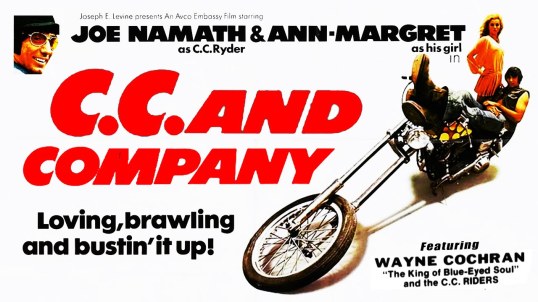
As our long-time readers know, I’ve seen my share of bad movies but it’s been a while since I’ve seen one as bad as 1970’s C.C. and Company.
C.C. and Company is about a drifter named C.C. Ryder (played by Joe Namath, who was a pro football quarterback at the time). Ryder rides through the desert on his dorky motorcycle. He doesn’t have a job. He doesn’t have much money. He does have a lot of hair and he also has a lot of teeth. We know that because it’s rare that there’s ever moment when C.C. isn’t smiling. C.C. is perhaps the most cheerful amateur criminal that I’ve ever seen. Even when C.C. really shouldn’t be smiling, he’s smiling. There are moments when people try to kill C.C. and he responds with a smile. This could be a sign of C.C.’s devil-may-care-attitude but I think it has more to do with Joe Namath being a really bad actor.
C.C. is apparently a member of a motorcycle gang. I say apparently because no one in the gang seems to like him and they’re constantly beating up on him. The leader of the gang is Moon (William Smith) and among the members of the gang is an intimidating figure named Crow (Sid Haig). Smith and Haig were both professional actors and genuine tough guys. They not only knew how to act on camera but they also knew how to throw a punch without faking it. Having them act opposite Namath doesn’t really accomplish much beyond emphasizing just how terrible an actor Namath was. Even though Moon is a Mansonesque creep, you still find yourself rooting for him whenever he and C.C. get into a fight because Smith creates an actual character whereas Namath…. well, he doesn’t. I sat through this entire film and never once did I find myself wondering what C.C.’s initials stood for. That’s how uninterested I was in C.C.’s life.
Anyway, C.C. meets the wealthy and chic Ann McCalley (Ann-Margaret) after Ann’s limo breaks down in the middle of the desert. C.C. not only fixes the limo but he also saves Ann from Crow and Lizard (Greg Mullaney). It’s love at first sight but, unfortunately, Ann has places to go so she drives off and C.C. returns to the biker camp and watches as Moon sends his girlfriend, Pom Pom (Jennifer Billingsley), out to make money on the highway. As I watched all of this, I found myself wondering how everyone else in the gang got stuck with names like Moon, Lizard, Crow, Rabbit, Pom Pom, and Zit-Zit (my favorite) but somehow C.C. was able to keep his innocent initials. The movie never explained the ritual behind receiving motorcycle gang names and I think that was a missed opportunity.
Eventually, C.C. trades in his dorky motorcycle for a Kawasaki, largely because Kawasaki apparently paid the film’s producers a lot of money. C.C. enters a race and wins. Ann sees him win and falls even more in love with him. C.C. gets into a fight with the gang and then he and Ann head to …. well, it looked a lot like Reno but honestly, who knows for sure? Eventually, Moon and the gang track C.C. and Ann down and it all leads to one last fight. We never do find out if the “company” of the title referred to Ann and her rich friends or Moon and the gang. Not even C.C. seems to know for sure.
So, there’s a lot of reasons why C.C. and Company doesn’t really work but mostly it all comes down to the lead non-performance of Joe Namath as C.C. There’s nothing tough or intimidating or rebellious about Namath. C.C. is the biker you can bring home to meet your parents. William Smith and Sid Haig are a lot more fun but they’re playing totally disreputable characters. Namath and Ann-Margaret have zero romantic chemistry and the entire film has the look of a cheap made-for-TV movie. Between C.C. and Company and Altamont, 1970 was not a good year to be a biker groupie.
That said, there is one good scene in C.C. and Company, where C.C. and Ann go out dancing. While Joe Namath awkwardly shakes his shoulders while flashing that ever-present grin, Ann-Margaret dances as if the fate of the world depended upon her. One year after the release of this movie, she would prove herself as dramatic actress and receive her first Oscar nomination for Carnal Knowledge.
KIMI, the latest addition to Steven Soderbergh’s interesting but frustratingly inconsistent filmography, stars Zoe Kravitz as Angela Childs. Angela is an agoraphobic tech worker who is living in Seattle during the COVID pandemic. A sexual assault survivor, Angela spends her days and nights safely locked away in her apartment. She works from home. She always keeps her mask some place near. Occasionally, she’ll have a video session with her therapist. Her mom calls and scolds her for not going outside. She exchanges texts and occasionally more with Terry Hughes (Byron Bowers), an attorney who lives across the street.
And, she’s watched by Kevin (Devin Ratray). Kevin also lives across the street and, throughout the film, he’s occasionally seen watching her from his top floor apartment. It’s creepy but it’s not surprising. KIMI is a film in which everyone is being watched by someone else. Sometimes, they realize it and often they don’t. Welcome to the Surveillance State, where privacy is the ultimate illusion.
Angela works for the Amygdala Corporation. Under the leadership of CEO Bradley Hasling (Derek DelGuado), Amygdala has created KIMI, the virtual assistant that is superior to Alexa because all of KIMI’s errors are corrected not by a pre-programmed algorithm but instead by human workers who are constantly listening to KIMI’s data stream and correcting errors. Angela is one of those engineers. Usually, her job consists of programming KIMIs to play individual Taylor Swift songs as opposed to building Taylor Swift playlists. When one owner calls KIMI a peckerwood, Angela programs the KIMI to understand that peckerwood is an “insult; vulgar.” However, one data stream contains the sounds of what Angela believes to be a sexual assault and a subsequent murder.
Uniquely, for a film like this, Angela’s struggle is not to get people to believe that she heard what she heard. Instead, her struggle is to get the evidence to the people who need to hear it for themselves. Angela is terrified of leaving her apartment and, once she finally does, the outside world confirms all of her fears. KIMI is a film about paranoia, a portrait of a world where everyone can be tracked and no one — from Angela’s too-helpful boss (Rita Wilson) to the man who casually walks by with an umbrella — can be trusted.
As I’ve said in the past, Steven Soderbergh has always been hit and miss for me. It’s remarkable how many Soderbergh films that I love but it’s equally remarkable just how many Soderbergh films I absolutely loathe. At his best, he can be a clever stylist and, at his worst, he can be painfully pretentious. And yet, regardless of anything else, you do have to respect Soderbergh’s willingness to experiment with different genres and styles. Soderbergh never stops working, despite the fact that he announced his retirement years ago. Despite getting off to a slow start, KIMI is one of Soderbergh’s more entertaining thrillers, one that does a great job creating an atmosphere of paranoia and one that is also blessed with excellent performances from Zoe Kravitz and Rita Wilson, who makes good use of her limited screen time. KIMI is a well-made Hitchcockian thriller and, along with No Sudden Move, it’s a return to form for Soderbergh after the two terrible movies that he made with Meryl Streep, The Laundromat and Let Them All Talk. Yes, Soderbergh can be inconsistent but when he’s good …. he’s very, very good. (Sometimes, he’s even brilliant.) Narratively, KIMI may be a relatively simple film by Soderbergh standards but it’s undeniably effective.
Along with being a portrait of our paranoid age, KIMI is very much a pandemic thriller. Angela mentions that her relationship with Terry started during the lockdowns, a time when no one found it strange that someone would be unwilling to leave their apartment. When Angela does finally step out of her apartment, she is, of course, fully masked up and her paranoia about being followed severs as a metaphor for the paranoia that many people felt (and continue to feel) during the pandemic. KIMI is not the first pandemic thriller and it certainly won’t be the last. Still, what’s interesting to me that the pandemic subtext will probably be more noticeable to those who lived in states with mask mandates and aggressively regulated lockdowns than it will be for those of us who live in states that never had mandates and which, for lack of a better term, re-opened last year. Half the people viewing KIMI will nod in recognition as Angela grabs her mask before walking up to her front door and as she quickly dashes down the street, careful not get too close to anyone else. The other half will feel as if they’re watching some sort of dystopian science fiction film. It all depends on where you’ve lived for the past two years.
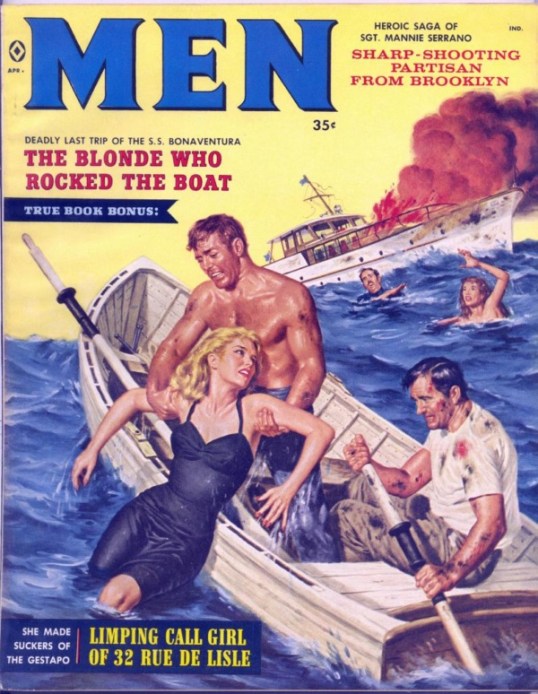
by James Elliott Bama
Hey, guys, there are other people in the water. Just look behind you for a second. The blonde has been saved but I don’t think things are going to go as well for the two other people in the water.
This cover is from 1959. The magazine is called Men, which I think is funny. (Real men save the blonde and leave everyone else to drown.) The cover was done by James Elliott Bama.
Oh, the goodbye hug. The tearful break-up. The understanding farewell. The moment when you watch someone walk away and it becomes clear that the two of you will probably never see each other again. We’ve all been through that type of pain and, more often than not, when we remember the moment, we remember it as being in black-and-white. Selena Gomez was the perfect choice for this song, bringing truthful sadness and emotion to the lyrics.
This video was directed by Dave Meyers. Dave Meyers has directed a lot of videos. How many Dave Meyers videos have we shared on this site? I don’t know, I’ve lost track. Whatever it is that it takes to make someone into a good music video director, Dave Meyers definitely has it. This, of course, is actually the second video for this song. The first video has a sort of sci-fi feel to it. I prefer Meyers’s more emotional approach.
Remember when Selena Gomez shows up in The Big Short and explained how some sort of stock market concept worked. And some old lady said, “I like Selena Gomez, I’ll invest in whatever she’s investing in.” That was a weird scene and I have to admit that I still have no idea how the stock market works.
I usually don’t follow or comment on celebrity gossip because I find it to be tacky but I was happy when Chris Martin divorced Gwyneth Paltrow. I was concerned that she was using all of his Coldplay money to invest in making candles. I will admit that I kind of pictured the “Dinner Party” episode of The Office whenever I imagined what it was like to visit Chris and Gwyneth. “Hey, babe? How about we take the beer sign down until our guests leave and then we can discuss it.”
Anyway, enjoy!
Shut In is not a political movie.
It’s important to point that out because much of the online reaction to Shut In will be totally political. That’s because it’s the second film to have been produced by The Daily Wire. And yes, Ben Shapiro is listed as one of the film’s producers. For many, it doesn’t matter that the film’s script appeared on The Black List of the best unproduced scripts in Hollywood. (Of course, some notoriously terrible movies have been made out of the scripts that appeared on The Blacklist — remember Cedar Rapids? — so maybe it’d be best not to call too much attention to that.) It won’t matter that the script was initially purchased by a major studio or that Jason Bateman (who is hardly a right-wing media figure) was originally set to direct it before the project was delayed by the pandemic. All that will matter is that the film was produced by the Daily Wire and therefore, it will be judged as being some sort of political statement.
Indeed, when the film’s premiere was streamed on YouTube earlier tonight, I kept one eye on the movie and another eye on the chat comments. About 80% of them were from people saying, “Let’s go Brandon!” 18% were from people saying, “Biden 2024 Harris 2028.” And 2% of the comments were from some group of weirdoes who were obsessed with Liz Cheney. The film itself might not be political but the film’s audience definitely was and probably will continue to be so. I imagine most hardcore online liberals will automatically hate the film because of who produced it while most hardcore online conservatives will be tempted to overpraise it and cite it as proof that a good film can be made outside of the Hollywood system. It’s tempting to say that’s just the way of the world nowadays but, to be honest, it’s really just the way of the extremely online world. Most people won’t care one way or the other. They’ll just view it as a being an effective thriller.
And, make not doubt about it, Shut In is not a bad film. It’s an effectively tense thriller, one that has plenty of suspense and which makes good use of its limited budget. If it’s never quite a great film, that’s because there’s a few pacing and plausibility issues, especially early on in the film.
Shut In stars Rainey Qualley as Jessica, a former dug addict who has escaped from her abusive ex and who is now trying to start a new life, with her young daughter and her newborn son, in an isolated farmhouse. Unfortunately, when her ex, Rob (Jake Horowitz), and his scummy friend, Sammy (Indie film legend Vincent Gallo, making his first film appearance in ten years), show up at the house, Jessica ends up getting locked in the pantry while Rob and Sammy ransack the house and, most importantly, steal her phone so she can’t call for help. Trapped in the pantry, Jessica tries to figure out a way to escape while also trying to instruct her young daughter on how to take care of her baby brother. The whole time, of course, she’s aware that Sammy and Rob could return at any minute.
Director D.J. Caruso does a good job of building and maintaining tension throughout the film. The majority of the film’s action takes place in that pantry and, just like Jessica, we find ourselves forced to try to interpret the sometimes random footsteps and snippets of conversation that we hear throughout the house. Rainey Qualley, who is the daughter of Andie MacDowell and who has a Southern accent that is almost as prominent as her mother’s, is sympathetic in the role of Jessica and does a good job of playing up not only her fear but her strength. Jessica is a survivor and it’s difficult not to admire her as she searches for a way to escape. Vincent Gallo is older but still as uniquely photogenic as he was during his indie heyday. He’s memorably creepy as Sammy.
As I said, it’s not a flawless film. It takes a while for things to really get going and, towards the end of the film, a few of the characters behave in ways that defy logic. One key moment depends on a character surviving something that, by all logic, should have easily killed them. It may not be a political film but there are a few bits of heavy-handed religious symbolism, including an injury that deliberately calls to mind stigmata. That said, when Jessica finally begins to fight back, it’s an enjoyably cathartic moment.
Shut In is an effective thriller and a determinedly non-political one. If nothing else, it’ll keep you out of the pantry.

I’m all for formalist experimentation — even for its own sake — but Kimball Anderson’s self-published mini Unfolding (which I think was released in the latter part of last year, but I could be wrong about that — in any case, that’s when I got it) is formalist experimentation with an added layer of purpose beyond “just” or “only” that tacked on : utilizing typed text and collage, it manages, in the space of just 12 pages, to interrogate the very nature of information-gathering and information-sharing on levels both practical and conceptual.
Consider : there is something about someone or something (or both) that’s written (whoops, typed, sorry) on a small piece of folded paper. As you slowly open it, you find out more, each outward unfolding offering up a fragment of a larger puzzle that is actually, all told, no puzzle at all. It only appears to be such due to the fragmented nature of the, to borrow a lame term, “reveal.” But what if said “reveal” was — errrmmm — revealed by other means?

Buckle up, because we’ve got to take things a couple steps further here, okay? Suppose the process I just laid out is actually reversed, and the slip of paper is being folded up, but is being read section by section as it’s folded, so that you’re well and truly learning more while seeing less — textually speaking, that is. On the other side of the paper, there’s an image, nominally related in some subtle way to what’s wri — typed! Caught myself that time! —and now suppose this process is being repeated four times over, with four different pieces of paper. Following me so far? Good, since we’re not quite done yet.
Now, further suppose that each of these paper scraps contains a discrete piece of information that tells a small “story” unto itself — but that all four descriptive passages are actually interconnected even though they’re separate. Starting to get the picture? I dearly hope so, because “getting the picture” is precisely what this innovative-yet-simple project is all about.

I’m also fully cognizant of the fact that I’m probably-to-definitely making the whole thing sound more convoluted than it really is, but perhaps the sample pages included with this review explain it all far better than my uncharacteristically (but then I would say that) linguistic fumbling is managing to accomplish. Language is a big part of what Anderson is experimenting with here (and by “a big part,” I mean half) — using it in fragmented form to draw attention to its shortcomings as a means of communication — but so are pictures, and while this may not be a traditional “comic” per se, its premise (by default and by design in fairly equal measure) teases out what comics do so well, which is to say : they convey information by means both verbal and visual. And by deconstructing the ability to do both in plain sight, this ‘zine gives readers a newfound appreciation for the inherent strengths and possibilities of illustrated sequential storytelling.

Are Anderson’s goals here ultimately — shudder! — ironic, then? Nah, I really don’t think so, I just think that there’s some “natural,” if you will, irony woven into the framework of the project’s metaphorical DNA. Sometimes you don’t know what you’ve got until it’s gone, and all that. In any case, this is a work that got me to thinking — about what it was, about what it was doing, and about how it was doing it. That’s more food for thought than you normally get out of 120 pages, let alone 12. Saying “highest possible recommendation” is a pretty formal note to end things on, admittedly, but hey, this is formalist stuff, so — if the shoe fits, right?
************************************************************
Unfolding is available for $5.00 from Austin English’s Domino Books distro at http://dominobooks.org/unfolding.html
Also, this review is “brought to you” by my Patreon site, where I serve up exclusive thrice-weekly rants and ramblings on the worlds of comics, films, television, literature, and politics for as little as a dollar a month. Subscribing is the best way to support my continuing work, so I’d be very appreciative if you’d take a moment to give it a look by directing your kind attention to https://www.patreon.com/fourcolorapocalypse
It looks like life found a way yet again to bring us another Jurassic World film. This time around, the dinosaurs appear to be out and everywhere on the planet. It’s like someone at Universal saw Mission Impossible: Fallout and said “How about we try all of that, but with Dinosaurs?!”
Motorcycle chases? Check, now with dinos.
Issues on a flight? Check, now with dinos.
I’ll admit though that I’m excited for this one. I’ve always wanted to see a Jurassic Park scenario where Dinosaurs reached the mainland, and The Lost World was possibly the closest we had there. It’s also cool to see that Blue (everyone’s favorite Raptor) has a little one of her own!
This third film brings back both Sam Neill and Laura Dern, reprising their roles as Alan Grant and Ellie Sattler. Jeff Goldblum and B.D. Wong are back as well with the Jurassic World cast, Bryce Dallas Howard, Chris Pratt, Isabella Sermon, Daniella Pineda, Justice Smith, and Omar Sy. Dichen Lachman (Netflix’s Altered Carbon) and Mamoudou Athie (Underwater) are new to the series.
Jurassic Park Dominion premieres in theatres June 10, with Colin Trevorrow returning as Director.
Ania (Sonia Mietielica) is the privileged daughter of a wealthy doctor. She’s graduated from an exclusive high school in Warsaw and now, she’s about to start studying medicine in London. The plan is that she’ll eventually take over her father’s medical practice and that she will, of course, marry someone from her upper class social circle. Ania is haunted by the death of her artist mother and still struggles to get along with her stepmother (Sonia Bohosiewicz).
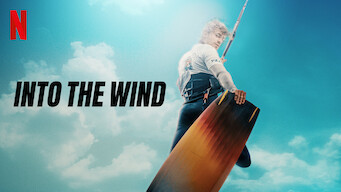
Michal (Jakub Sasak) is a handsome but poor athlete who works at the local beach resort. At night, he’s a waiter. During the day, he’s a kitesurfing instructor. He may not have money or an education but he’s sensitive and artistic. He likes good music, good weed, and hanging out good people. He’s laid back but he cares about his friends and he’s got a romantic soul.
Together …. they solve crimes!
No, actually, they don’t. There are no crimes to be solved in Into The Wind. Instead, they meet when Ania accompanies her father, her stepmother, and her new baby brother to the resort for the summer. While Ania listens to her father talk about how the pandemic has not really effected his practice (this is a 2022 film so, of course, there is talk of COVID in the background), Michal serves food and wine and is largely unseen by the other guests. (The wait staff, as he explains it, is meant to be invisible.) However, Ania sees him and he sees her. And soon, they’re in love, they’re hanging out on the beach, they’re listening to music, and they’re kitesurfing! But they’re also from two different worlds. Ania’s father does not want his daughter to end up with a waiter. And Michal’s friends are convinced that Ania will eventually return to her safe, upper class existence and Michal will be left heart-broken.
This Polish film is narratively predictable but visually stylish. The plot should be familiar to anyone who has ever seen Dirty Dancing but then again, it’s not exactly as if Dirty Dancing was the most original film ever made. That said, though the plot may be predictable, the film has enough lovely shots of the beach and the two leads have more than enough romantic chemistry to keep things watchable. This is a good film to watch after a long and exhausting day, when you just want a simple story, a happy ending, and some nice pictures to go along with it. Speaking for myself, as someone who spent last week dealing with below freezing temperatures and ice on the ground, the beach and the ocean looked very inviting and, for that matter, so did Jakub Sasak. The beach and the cast are pretty and that’s pretty much all that a film like this really needs to work.
That said, I did really like the Kitesurfing scenes. Kitesurfing is something that I personally would never do, seeing as how it would mean confronting not only my fear of drowning but also, potentially, my fear of heights but, even with that in mind, the film still made it a look like something that everyone should try at least once. The scenes of people skimming across and occasionally floating above the water take on an almost religious grandeur as the surfer becomes onr with the forces of nature and fate. Those scenes are exciting to watch, even if the story taking place around them is thoroughly predictable.
 Through the Shattered Lens