Book Review: A Time To Remember by Stanley Shapiro


My aunt has always been a prodigious reader and, when I was growing up, I always enjoyed looking through the stacks of books that she had sitting in the closets of her room. A few years ago, for medical reasons, my aunt had to move out of her house. Because she wouldn’t have room for all of her books in her new place, she gave the majority of them to me. So far, I’ve only read a few but, over the course of this year, I plan to read all of them and review the ones that I like or, at the very least, find interesting. That was one of the resolutions that I made on January 1st and I have to admit that I haven’t really been doing a great job keeping up with it.  Hopefully, I’ll do better during the second half of the year.

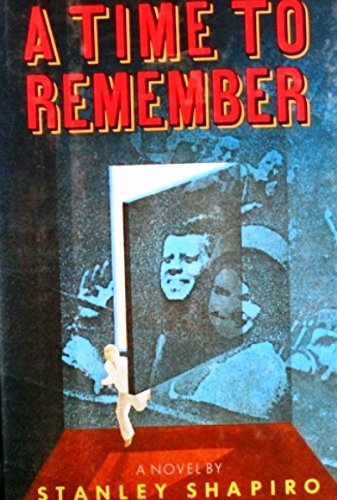
This week, from my aunt’s book collection, I read Stanley Shapiro’s A Time To Remember.

A Time To Remember was originally published in 1986 and it tells a story that might sound a little bit familiar.  David Russell is a school teacher in Dallas.  He is haunted by the death of his brother, who was killed in Vietnam.  David has convinced himself that, if John F. Kennedy had lived, America would have withdrawn from Vietnam and his brother would still be alive.  In fact, as far as David is concerned, America itself would be a better place if Kennedy had lived.  Not only would the Vietnam War have been prevented but the Watergate break-in would never have occurred.  Nixon would never have been president.  Martin Luther King would never have been assassinated.  Robert F. Kennedy would still be alive.  Americans would never have become disillusioned with their country or their government.  America would have kept its innocence.

Too bad that David can’t do anything to change history.

Or can he?  It turns out that David’s girlfriend is a reporter and she knows a scientist named Dr. Hendrik Koopman.  Koopman has created a time machine!  David uses the machine to go to the past, intent on preventing Lee Harvey Oswald from assassinating Kennedy.  (Sorry, conspiracy folks.  Like me, A Time To Remember is firmly in the Oswald Acted Alone camp.)  Unfortunately, David doesn’t succeed and he ends up getting arrested in Oswald’s place!  Now, David has to not only escape but he also still has to find a way to save Kennedy!

Obviously, the plot is a bit similar to Stephen King’s 11/23/63.  That’s not to say that King deliberately plagiarized or even knew of the existence of Shaprio’s earlier novel.  Not only do the two books take vastly different approaches to the material but the idea of saving America by saving JFK has long been a popular one amongst the boomers.  That said, it’s interesting that it was King, who plays the epitome of a committed 60s liberal on Twitter, who wrote the book that was more skeptical about whether or not saving Kennedy would truly save the world.  Shapiro takes a much simpler approach to the material, one that’s almost charmingly naïve.  I’m fairly agnostic on whether or not JFK would have been a transformative or even a well-remembered President if he had lived but one doesn’t necessarily have to buy into the mythology that’s sprung up around JFK to appreciate the sincerity of Shapiro’s idealization of the man and the era that he represented.  Just as 11/23/63 was redeemed by King’s cynicism, A Time To Remember is redeemed by Shapiro’s nostalgia.

Shapiro, it should be noted, also tells his story far more quickly and far more economically than King did.  11/23/63 runs for close to 900 pages.  A Time To Remember doesn’t even make it to 200.  It’s a book that you can read in one sitting and Shapiro keeps the story moving at a quick pace.  Though the characters aren’t particularly deep and one can certainly debate the book’s conclusion, Shapiro tells the story well.  Those who like to play “What If?” with history will appreciate the book.
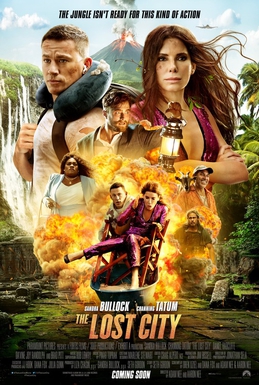
Film Review: The Lost City (dir by Adam and Aaron Nee)


Last month, when I finally watched The Lost City, I had two thoughts.

First off, I thought it was a perfectly charming little movie, a well-made and unpretentious film that went out of its way to entertain its audience and which, for the most part succeeded.  The film, which features Sandra Bullock as Loretta Sage, a reluctant writer of sex-filled romance/adventure novels, and Channing Tatum as Alan Caprison, an earnest but not terrible bright cover model, strikes just the right balance of adventure and comedy.  Bullock and Tatum are charming together.  Brad Pitt has a fun cameo as an ultra-macho wilderness guide who is hired to help track down Bullock after she’s kidnapped by a wealthy businessman who wants her to help him track down the fabled crown of fire.  Daniel Radcliffe gives a nicely eccentric performance as the villain and, for once in his post-Potter career, actually seems to be having fun with a role.  The jungle scenery is lovely to look at.  Bullock’s purple sequin jumpsuit is to die for.  Tatum shows off his physique.  The jokes come fast, the action is exciting, and we get to watch two people fall in love.  What more could one ask for?

My other thought is that The Lost City is a film that Sandra Bullock could have made at any point of her  career.  There’s never been a time when Bullock wouldn’t have been convincing in the role of Loretta Sage.  It’s easy to imagine The Lost City coming out in the aughts, starring Sandra Bullock as Loretta and Brendan Fraser as Alan.  Or perhaps even in the 90s, with Bullock and Matthew McConaughey as Alan.  Much as Top Gun: Maverick does for Tom Cruise, The Lost City serves to remind us that Sandra Bullock is one of the last true film stars, someone who can effortlessly move from genre to genre without losing any of their onscreen charisma in the process.  For audiences who have just spent the last two years being told that the world was collapsing and that nothing would ever be the same again, there is something undoubtedly comforting about films like Top Gun: Maverick and The Lost City.  They are a reminder that yes, it is permissible, possible, and even necessary to just have a good time.

And have no doubt about it, The Lost City is definitely a good time.  From the opening scene (which literally takes us into one of Loretta’s novels) to Loretta’s disastrous book tour to the eventual journey through the jungle, The Lost City is an entertaining film.  It’s not a film that asks for much from the audience.  There’s no complicated backstory.  It’s not necessary to have seen 10 earlier movies and a miniseries to understand everyone’s motivations.  There’s no bad CGI to challenge the audience’s willingness to buy into the story.  The film gets the job done in a relatively brisk 112 minutes and, at a time when even comedies are regularly running over two hours, it’s hard not to appreciate the efficiency with which The Lost City tells its story.  There is a mid-credits scene but it’s actually kind of funny.  For once, the promise of a sequel feels likes something for which to look forward.

If you missed The Lost City in theaters, it can currently be viewed on Paramount Plus.

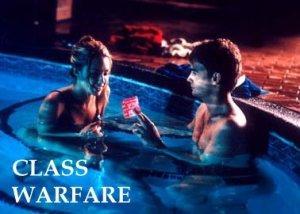
Class Warfare (2001, directed by Richard Shepard)


Kristen Marshall (Lindsey McKeon) is a rich high school girl with a problem.  She’s not rich anymore!  Her parents have lost all of their money due to a shady business deal and now, Kristen might not even be able to afford to go to Harvard!  Even the fact that she’s the senior class president and drives an expensive car might not be enough to convince those Boston brahmins to give her a scholarship.  Looking to get away from all of her problems, Kristen and her boyfriend, Jason (Wade Carpenter), decide to spend the weekend at their friend Graham’s (Dave McGowan) lakehouse.  Kristen, however, is upset to discover that Graham has also invited Richard Ashbury (Robin Dunne).

Richard is a high school activist, a self-professed Socialist who spends his time putting up flyers for a food and clothing drive.  Kristen first met Richard when she accidentally hits him with her car.  (Kristen was in a hurry and she didn’t notice Richard riding by on his bicycle.)  Though Richard was uninjured, Kristen’s car was slightly dented and Richard told her that he was sure that her family would be able to pay for it.  Now, Kristen is stuck spending the weekend with him and, to make things even worse, Richard looks at a newspaper and discovers that he has got a winning lottery ticket.  As soon as the weekend ends, he’ll turn in the ticket and get $25 million dollars!  Meanwhile, Kristen is having nightmares about her guidance counselor denying her application for a college loan while Richard lights a cigar with a hundred dollar bill!

Eager to that get that ticket for herself, Kristen first tries to seduce Richard.  When that doesn’t work, Kristen orders Jason to kill him.

Class Warfare definitely has a made-for-TV look about it but, when taken on its own terms, it’s not bad.  Lindsey McKeon is an effective villain and the other actors are all credible in their roles, even if it’s obvious that most of them haven’t been in high school for a good couple of years.  The movie’s class warfare theme was sometimes simplistic but the film still did a good job of ratcheting up the stakes as one mistake led to another.  Nowadays, people take the lottery for granted but Class Warfare does capture that moment when people really did feel like their lives could be changed in an instant.

Class Warfare was produced by the USA Network and originally aired on December 24th, 2001.  I guess that was USA’s way of saying, “Merry Christmas!”

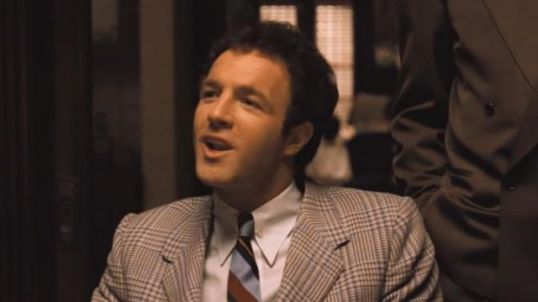
Scenes I Love: James Caan in The Godfather


James Caan has passed away, at the age of 82.  There are a lot of great James Caan performances to choose from and to highlight.  For me, though, he’ll always be Sonny Corleone, the temperamental son of the Don who remains oddly likable, even as he cheats on his wife and threatens to kill every other gangster in New York.  Sonny is a force of chaos, which ultimately leads to his untimely death.  But, at the same time, it also makes him someone who you definitely fighting for you instead of against you.

The scene below is mostly cited for Al Pacino’s quiet intensity as he reveals that he’s truly become a member of the family.  While Pacino’s great, Caan’s reaction is just as important.

In the scene below, Sonny discovers that Carol has been beating up Connie so Sonny beats up Carlo.  Carlo really deserved it.  Now this scene is often cited for featuring one shot where it’s clear that Caan didn’t actually hit Gianni Russo.  That’s fair.  But still, Caan actually did make contact enough times that Russo ended up with a broken rib.  Look past that one shot and you’ll see that, in this scene, Caan clearly shows why Sonny was such a feared figure.  Even more importantly, this scene shows how important his family was to Sonny.  Who doesn’t want someone who would beat someone up for them?

And finally, in this scene, Sonny tells off the FBI.  How can’t you love that?  Apparently, the smashing of the camera was something that Caan improvised on the spot.

That said, there was a lot more to Caan’s career than just The Godfather.  Watch all of his films.  He was one of the greats and perhaps the only celebrity who was actually worth following on twitter. RIP.

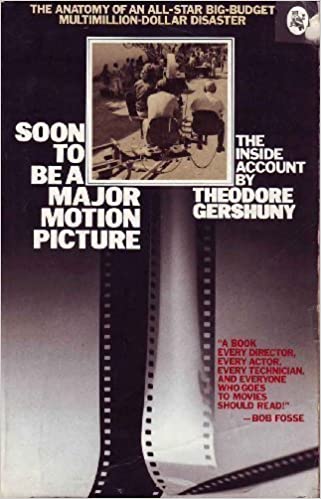
Book Review: Soon To Be A Major Motion Picture by Theodore Gershuny


In 1975, United Artists released a political thriller called Rosebud.

Rosebud was based on a best-selling novel.

Rosebud dealt with terrorism, an important topic both in 1975 and today.

Rosebud was directed by Otto Preminger, an acclaimed, award-winning filmmaker who was known for making controversial movies and who had a showman’s flair for publicity.

Rosebud had an international cast of screen veterans and up-and-coming stars.  Peter O’Toole, Richard Attenborough, Cliff Gorman, Peter Lawford, Raf Vallone, Adrienne Corri, Lalla Ward, Claude Dauphin, Isabelle Huppert, and Kim Cattrall all had key roles.  Former New York City Mayor and presidential candidate John V. Lindsay made his acting debut as a U.S. senator.

Rosebud was released with a good deal of publicity.

And, finally, Rosebud is almost totally forgotten today.  Not only did Rosebud receive less-than-stellar reviews, it’s box office failure pretty much spelled the end of Preminger’s directorial career.  (He directed one more film after Rosebud.)  Rosebud sunk into such obscurity that, for years, it wasn’t even available on anything other than VHS tape.  It was finally given a Blu-ray release in 2021 but, unlike some of Preminger’s other films, Rosebud isn’t going to end up getting a Criterion release anytime soon.  (That said, it can currently be streamed for free on a few sites.  So, go watch it after you finish this review.)

Having seen Rosebud, I can tell you that the film wasn’t forgotten because it was a disaster or anything like that.  Instead, Rosebud was forgotten because it was thoroughly mediocre.  There’s nothing particularly terrible about it but there’s nothing particularly good about it.  Instead, it’s a slowly-paced and flatly directed film.  There are a few interesting scenes, the majority of which involve Richard Attenborough’s terrorist.  But otherwise, it’s just a mediocre film from a director who was past his prime.

Interestingly enough, Rosebud’s mediocrity is what makes the 1980 book, Soon To Be A Major Motion Picture, such an interesting read.  While directing Rosebud, Otto Preminger allowed journalist and filmmaker Ted Gershuny to observe every detail of the production.  From Erik Lee Preminger’s attempt to write a workable script to the casting sessions to the film’s eventual release, Gershuny was there.  Soon To Be A Major Motion Picture tells the story of how a group of talented people ended up making a thoroughly forgettable film.  There have been plenty of books written about the production of terrible movies.  There’s been even more books written about the making of classic films.  But Soon To Be A Major Motion Picture is one of the few books to take a serious and detailed look at what it’s like to make a thoroughly mediocre film.  And let’s be honest, most films are mediocre.  Most films are more likely to be Rosebud than they are to be The Godfather, Goodfellas or Battlefield Earth.

The book, not surprisingly revolves around Otto Preminger.  The Preminger described in the book is a complex figure, a proud man and an occasionally sensitive artist who is also frequently a bully.  As the book makes clear, Preminger can be kind but he also came of age at a time when it was common place for directors to yell and be autocratic.  Preminger’s habit of shouting rubs more than a few crew and cast members the wrong way.  When he’s not yelling, Preminger comes across as thoughtful and witty but there’s also an undercurrent of sadness to him as Preminger realizes that the film industry is changing and that he’s getting left behind.  The fact that he directed films like Anatomy of a Murder, Laura, Exodus, and The Cardinal didn’t matter in the new Hollywood.  The same things that had once led to Preminger being branded a rebel and an innovator now led to him being branded as being out-of-touch.  Rosebud was Preminger’s attempt to remain relevant, both artistically and politically.  Unfortunately, the 70s were a brutal decade for the directors who previously defined Hollywood’s Golden Age.  Some, like John Huston, were eventually able to adjust and make a few more good films before their careers were ended by either retirement or death.  Most, however, were like Preminger, too engaged to quit but too old-fashioned to keep up with the younger filmmakers.  Still, even when it becomes obvious that Rosebud is not going to work as a film, Preminger refuses to give up or surrender.  He’s going to make his movie.

Also making a huge impression is Robert Mitchum.  Mitchum was originally cast in the film’s leading role and, having seen Rosebud, it’s easy to understand why Mitchum would seem like the ideal choice to be play Larry Martin, a cynical and hard-boiled journalist and CIA asset.  When Mitchum first appears in the book, he’s a breath of fresh air.  Even on the printed page, it’s easy to see that Mitchum’s no-nonsense style invigorated the disorganized production.  However, Mitchum quickly becomes disillusioned, walks off the film, and is hastily replaced by Peter O’Toole.  Not even Gershuny seems to be sure what specifically caused Mitchum quit the film, though it’s suggested that Mitchum felt that he had been personally slighted by Preminger.  (At one point, Mitchum claims that Preminger accused him of being drunk when he was sober.  At another point, it’s suggested that Mitchum walked because he realized that film wasn’t going to be any good and he felt he was wasting his time.)  O’Toole does his best to take Mitchum’s place, though his poor health proves to be almost as much of a challenge as Mitchum’s bad attitude.

(That said, O’Toole’s apparent frailty disappeared after the production received a bomb threat that is later revealed to have been a hoax.  The book suggests that O’Toole and his entourage tracked down the hoaxer and essentially beat the Hell out of him.)

It’s a highly interesting and well-written book, one that will make you appreciate the effort that goes into making even a forgettable film.  Used paperback copies can ordered off of Amazon for $22.00.  I found my copy at Recycled Books in Denton, Texas and paid $3.00 for it.  Support you local independent book stores, people.

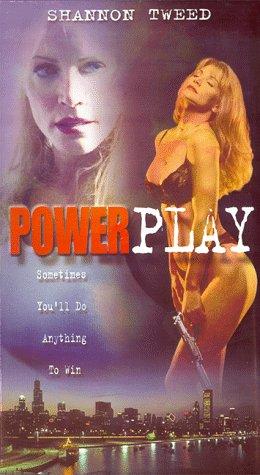
Powerplay (1999, directed by Chris Baugh)


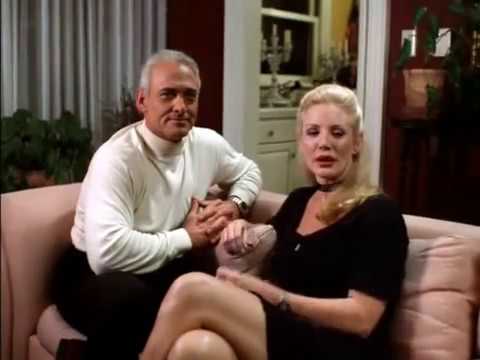
Shannon Tweed plays Jacqueline, a sexy con artist who seduces older men and then, after she poisons them, runs away with all of their money.  After her latest target, Benjamin Alcott (Bryan Kent), ends up floating dead in his swimming pool, Jacqueline heads off to find her next target.  Ben’s estranged daughter, Candice (Danielle Ciardi), is upset to learn that Ben only left her his library of book while leaving all of his money to Jacqueline.  Along with her sleazy boyfriend, Steve (Jim Richer), Candice tracks Jacqueline down and tries to con the con artist.

Shannon Tweed is top-billed in Powerplay but she’s not in much of the movie.  Both onscreen and off, this was clearly a take the money and run job for Tweed.  Still, a little bit of Tweed is better than no Tweed at all, especially where a film like Powerplay is concerned.  Of all the actresses who regularly appeared in late night Cinemax in the 90s, Tweed was definitely the most talented and she brings some needed energy to her scenes.  Tweed’s main strength as a star was always that she could be appealing and sexy even while she was smirking about killing someone and Powerplay makes good use of that ability.

The majority of the film, though, follows Candice and Steve as they try to track Jacqueline down.  In a nice twist, Candice is just as greedy, voracious, and cold-hearted as Jacqueline and Danielle Ciardi (who bore a probably not coincidental resemblance to Neve Campbell in Wild Things) does a good job of playing her.   This was Ciardi’s film debut and, according to the imdb, her only starring role.  That is too bad because it seems like she had the talent to do much more.  Unfortunately, Jim Richer is far less effective in the role of Steve.  In fact, all of the male performances in Powerplay are lousy and are not helped by an overly convoluted script that features a few plot twists that are incoherent even by the standards of the typical direct-to-video neonoir.  Powerplay ends with multiple cons and double-crosses but none of them feel earned.  There’s a difference between something like Stephen Frears’s The Grifters, where the con is obvious once you know what to look for, and Powerplay, where the con feels like a last minute addition to the script.

But who am I kidding?  This film wasn’t made for an audience that’s going to be watching for the plot.  They’re going to be watching because Shannon Tweed takes a shower while the man she poisoned dies nearby and because Candice is written and portrayed as almost being a nymphomaniac.  (Candice has a creative way of handling things when a hotel employee knock on the door of a room that she’s not supposed to be in.)  Powerplay has enough sex and nudity that it was undoubtedly popular when it showed up on late night Cinemax in 1999.  But it doesn’t have enough of a story to be memorable for any reason beyond that.

Film Review: American Siege (dir by Edward Drake)


For a few months, I’ve been going back and forth on whether or not I wanted to review American Siege.

On the one hand, I try to review every film that I see, regardless of how bad (or good) it might be.  I love movies.  I love talking about them.  I love writing about them.  I love sharing my opinions about them and hearing and reading the opinions of others.  That goes for all films, even really bad ones like American Siege.

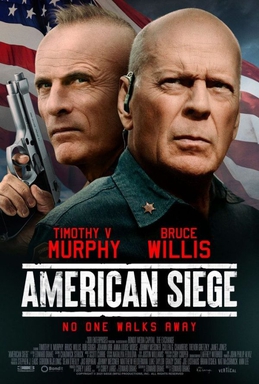
On the other hand, American Siege is also one of the films that Bruce Willis made shortly before announcing his retirement from acting.  Since his retirement was announced, there have been a lot of stories that have suggested that Bruce’s condition led to him accepting a lot of roles that he normally would not have even considered and that Willis was not always fully aware of what was happening on the sets of the films in which he appeared.  Regardless of how much of that is true or not, it’s a heart-breaking story and it makes it difficult to watch Willis in a film like American Siege.

In American Siege, Willis plays a sheriff in a small Georgia town.  When a group of loud rednecks take a local pharmacist hostage, Willis and his deputies drive out to the man’s house.  However, Willis is ordered to stand down by the richest man in town, who is played by Timothy V. Murphy.  It turns out that the pharmacist has evidence that links Murphy to an unsolved crime.  The rednecks might be loud and stupid and self-destructive but it turns out that they’re not actually the worst people in town.

American Siege is 90 minutes of people shouting at each other and pointing guns out of windows.  There’s not much of a story to be found and even the unsolved mystery is a bit of a dud.  As was typical of his last few films, Bruce Willis is only on screen for a few minutes and he delivers his lines in a heart-breakingly flat monotone.  The rest of the cast is actually okay, even if they do go bit a overboard with the fake Southern accents.  The rednecks are convincingly redneck-y and Murphy is convincingly condescending as the rich man who has never had to face any consequences for his actions.  But the main reason anyone is going to watch this film is because of Bruce Willis and, sadly, there’s none of the swagger that made Willis in a superstar.

So, why am I reviewing American Siege?  Mostly it’s so I can recommend that, if you are really determined to watch one Bruce Willis’s later films, you skip American Siege and watch Gasoline AlleyGasoline Alley was made by the same director and it also features Bruce Willis but it’s a hundred times better than American Siege and it actually gives Willis a decent role to go out on.

Of course, my ultimate recommendation, as far as all this is concerned, is that you go and rewatch the first three Die Hards.  They’re not just for Christmas!

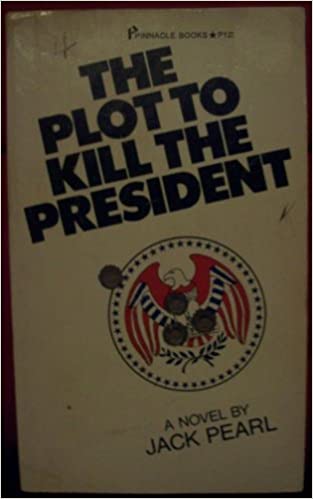
Novel Review: The Plot To Kill The President by Jack Pearl


President Harmon Stevens is a liberal who is looking to reign in the influence of the Military-Industrial complex and the CIA.  So, of course, it’s decided that the President must be taken care of.

Fortunately for the conspirators, back when Stevens was in the army, he took part in the court martial of a soldier named Paul.  Paul was given a dishonorable discharge on account of killing enemy POWs.  The reader is told that Stevens shouted, “You have the Mark of Cain on you!,” which …. okay.  I guess it’s possible that someone outside of 17th century Massachusetts spoke like that.  Now, Paul spends all of his time feeling bitter and watching cartoons.  He’s a Bugs Bunny fan because he believes that Bugs is a sociopath, just like him.  (Personally, I think Bugs is just a force of chaos.  Sociopath is a bit extreme.)  One day, Paul’s cartoon watching is interrupted by the opportunity to take part in a plan to take out Stevens.  However, Paul soon discovers that he’s being set up to be a patsy, much like Lee Harvey Oswald.  Will Paul risk his life to reveal the truth?

The Plot To Kill The President is one of the many paperbacks that I found in my aunt’s collection of old books.  It was originally published in 1972 and it’s very much a book that was inspired by the Kennedy assassination and the conspiracy theories surrounding it.  Paul is a disillusioned American.  It’s not just that he has a personal grudge against the President.  It’s that he no longer believes in the promise of America and, as a result, he has no problem with the idea of betraying it.  It’s not until an awkwardly written date with a recently naturalized citizen that Paul starts to realize that America can be saved.  (How awkward is the encounter?  At one point, Paul’s date recites the pledge of allegiance in the middle of a restaurant.)

Anyway, it’s a fairly silly and overheated book.  It’s written in the first person, so we’re not only subjected to Paul as a character but we’re also forced to spend way too much time in his head.  Paul is one of those people who has a lot of ideas but none of them are particularly interesting.  Before I started writing this review, I looked up the book online and I came across someone speculating that Jack Pearl was a pen name for Jack Ruby!  Actually, Jack Pearl was a journalist who wrote several paperback thrillers.  He also wrote a non-fiction book about the JFK assassination, in which he supported the idea that Oswald was a part of a larger conspiracy.  That’s not surprising.  The Plot To Kill The President was clearly written by a true believer, even if it’s never as convincing as it tries to be.

Probably the most interesting thing about the novel is that the copy that I read had a cigarette advertisement inserted into the middle of it.  It was for Kent cigarettes and featured attractive people laughing while holding cigarettes.  They all had perfectly white teeth, without a hint of nicotine staining.  I’ve noticed that quite a few 70s paperbacks came with cigarette ads.  I always wonder how effective they were.  In 1972, was anyone reading The Plot To Kill The President and thinking to themselves, “Damn, I need a cigarette?”