Music Video of the Day: You Think You’re Tough by Ratt (1983, directed by ????)


Before Tawny Kitaen became famous for appearing in Whitesnake videos, she dated Robbin Crosby, the lead guitarist of Ratt.  Those are Kitaen’s legs on the cover of Ratt’s first self-titled album.  Decorating those amazing legs with high heels and rats results in a classic 80s music image.

The video below is for one of the songs from that album, You Think You’re Tough.  You Think You’re Tough was Ratt’s first single and was released with a cover version of Rufus Thomas’s Walking The Dog.  The video keeps things simple, highlighting the band’s musicianship and saying, “These guys can really play!”

Enjoy!

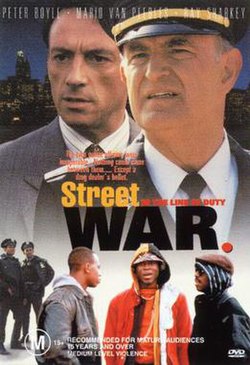
In the Line of Duty: Street War (1992, directed by Dick Lowry)


Street War, the fifth In The Line of Duty movie to be produced by NBC, takes place in Brooklyn.  Raymond Williams (Mario Van Peebles) and Robert Dayton (Michael Boatman) are two uniformed officers trying to keep the peace in the projects.  When Raymond is shot and killed in a stairwell, everyone knows that drug dealer Justice Butler (Courtney B. Vance) was responsible but no one can prove it.

The case is assigned to two detectives, Dan Reilly (Peter Boyle) and Victor Tomasino (Ray Sharkey).  Reilly is a veteran cop who is just a few months away from retirement.  Tomasino is the son of a “made man” who can’t understand why the drug lords in Brooklyn aren’t as interested in keeping the peace as the old Mafiosos were.

When Justice leaves Brooklyn so that he can hide out with his family in South Carolina, Reilly and Dayton follow him down there and discover that people in South Carolina distrust the cops just as much as people in Brooklyn.  Meanwhile, back in Brooklyn, Justice’s second-in-command, Prince (Morris Chestnut), tries to keep an all-out war from breaking out.

Prince and Tomasino take turns narrating the movie.  Prince talks about the reality of trying to restart your life after doing time in prison while Tomasino complains that “the animals” have taken over the city.  (Because this was made for television, “Animals” is Tomasino’s go-to label for anyone he dislikes.  Anyone with any experience with the police will know what word he is actually thinking.)  While Chestnut gives a restrained and thoughtful performance, Ray Sharkey shouts his lines and snarls whenever he’s onscreen.  Though it’s not always evident in this movie, Sharkey started out as a talented actor who played small roles in several independent films before starring in The Idolmaker.  Unfortunately, Sharkey was also a heroin addict whose once promising career was derailed by a series of arrests and jail sentences.  He looks thin and tired in Street Wars and, one year after the film aired, he would die of complications from AIDS.

With Sharkey yelling his lines, it falls on Peter Boyle to play the voice of reason in Street War.  Dan Reilly is a cliché, the weary cop who still wants to make the world a better place and who is just a few days away from retirement.  But Boyle does a good job playing him and brings his own natural gravitas to the movie.

Dick Lowry, who directed the first three In The Line of Duty movies, returns for this one and he keeps the action moving.  Street War is significantly more violent than the previous movies, with even two children getting shot onscreen.  The story itself is a predictable and Tomasino’s casual racism can be hard to take (even if he does eventually called out about it) but, thanks to the performances of Boyle, Boatman, Chestnut, and Vance, Street War is an improvement on Mob Justice and an adequate entry in the series.

Street War would be followed by two movies about FBI sieges, The Siege at Marion and Ambush in Waco.  Since I’ve already reviewed both of those, I will be moving onto In the Line of Duty: The Price of Vengeance tomorrow.

A Blast From The Past: Lucy (dir by Paul Glickman)


In the picture above, you can see Lucy (played by Olga Soler), the title character of the 1975 educational short, Lucy.  Lucy is 15 years old and she spends almost all of her time with her boyfriend, Joe (Michael D’Emidio).  As Lucy herself explains her narration (which is provided by an actress named Marilyn Gold), her entire life revolved around Joe.  Since Joe dropped out of school, Lucy dropped out of school too.  Since Joe wanted to spend all of his time walking around New York City, Lucy did the same.  They thought they were in love.  One discreet sex scene later and Lucy’s pregnant!

Lucy is a bit different from some of the other educational films that I’ve seen about teenage pregnancy.  Though initially shocked and angered, Lucy’s parents are eventually supportive.  Joe doesn’t run away but instead promises to do whatever he can to help, though Lucy ruefully acknowledges that it won’t be much as Joe doesn’t even have a high school diploma.  Though a friend offers to help Lucy get an abortion, Lucy decides to have her baby and social services shows up to help her.  At the end of the film, Lucy is still not sure whether she’s going to keep her baby or give it up for adoption.  She just knows that her life will never be the same.  Compared to just about every other educational film that I’ve seen about this subject, Lucy takes a rather low-key and matter-of-fact approach to its story.  It’s well-made but rather depressing.

It’s also a rather obscure film.  I couldn’t find much about the film on the IMDb.  Is the Paul Glickman who is credited as the film’s director the same Paul Glickman who edited some of Larry Cohen’s best films?  Who knows?

Now, I know I’ve probably made this film sound really depressing to sit through but there is a dance scene towards the start of the film.  That helps.

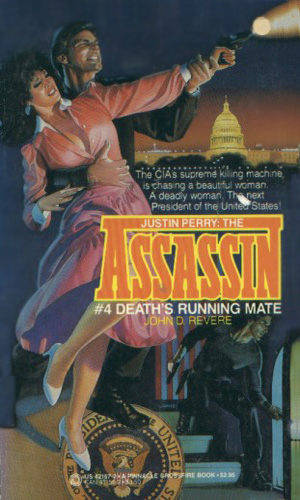
Book Review: Death’s Running Mate by John D. Revere


Having previously taken on mutant chickens and barnyard sex, the fourth Justin Perry novel takes on the American political system!

First published in 1985, Death’s Running Mate is all over the place.  Author John D. Revere plays with time in Death’s Running Mate, which means that the book opens minutes before the climax of oversexed super assassin Justin Perry’s latest mission and then flashes back to how Perry and the readers arrived at that moment but the flashbacks themselves contain their own flashbacks and even the occasional flash forward.  It leaves the plot so jumbled that it would probably require keeping extensive notes to really understand everything that happens and jotting down notes is a bit more effort than a Justin Perry novel deserves.  The previous three Justin Perry novels were surreal but the fourth one plays out like an extended fever dream.  And yet, because it’s so strange, it’s also probably the most compelling of all of the Perry novels.  You keep turning page after page, just to see how much stranger it can get.

The book deals with politics.  A 36 year-old woman named Andrea McKay has come out of nowhere and is running for President as the candidate of the Federalist-Liberal Party.  She’s running on a platform to “throw the rats out” and she proves her sincerity by eating rat meat at her campaign events.  Those who have read the previous volumes of the Justin Perry series will not be a surprised to learn that Andrea McKay is actually being backed by SADIF, an evil conspiracy that previously infiltrated the Vatican and developed mutant chickens.  And since a major theme of these books is that Justin Perry is somehow at the center of everything that happens on the planet, most readers will not be surprised to learn that Andrea’s political platform was developed by SADIF abducting Justin during an orgy, holding him captive in a mental hospital for several months, and then interviewing him about his thoughts on politics.  Justin is not only an expert killer who literally can’t leave the house with getting laid.  He’s also so in touch with the American people that his vague political opinions can serve as the basis of a successful third party presidential campaign.  Interestingly enough, it turns out that Andrea McKay is being as manipulated by SADIF as Justin is by The Old Man, his boss at the CIA.  The suggestion, of course, is that Andrea, Justin, and the voters are all in the same situation.  They’re all being manipulated and used like pawns on a chessboard.

As strange as the Andrea McKay presidential campaign is, it’s not the strangest part of the book.  This is a novel that starts with Justin bragging about how he’s going to kill the population of an entire town in Illinois and then flashes back to Justin disguising himself as a psychologist so that he can prevent SADIF from breaking into a mental hospital and releasing all of the patients.  (It turns out that the mental hospital uses sex therapy and, of course, Justin has to be carefully examined before he’s allowed to work there.)  Among other events, Justin gets attacked by a woman driving a pumpkin truck and then later, he discovers the truth of his parentage.  And I’m not even getting into the scenes of teenage Justin learning how to make love with a girl named Thelma who later turns out to be a spy herself.  Did Justin Perry ever know anyone who didn’t turn out to be a spy?

To be honest, I’m probably not communicating just how weird this book is.  I haven’t even gotten to the stuff about Illinois or the author’s apparent belief that a presidential vacancy is filled by a special election.  (I laugh out loud at that part of the book, if just because it reminded me of Sally Kohn’s theory that impeaching Trump and Pence would lead to a special election between Paul Ryan and Hillary Clinton.  “Straight forward from here,” as Sally put it.)  Earlier, I described the book as being a fever dream but it’s really like several hundred fever dreams, all crammed together to form one big epic.  Not a bit of it makes sense but the total lack of coherence is undeniably fascinating.  Justin’s as much of a sex-crazed misogynist as he was in the previous books but, at least in this case, it nearly leads to collapse of the United States (which, I might add, leads me to suspect that these books were meant to be satirical).  Will Justin learn a lesson from this?  I’ve read the final book in the series and no.  He does not.

Speaking of that fifth book, I’ll be reviewing that one on Saturday!  And then, we’ll be done with Justin Perry.

AMV of the Day: Teeth (Scissor Seven)


Today seems like a good day to share another anime of the day!

(See how that all kind of rhymes?)

Anime: Scissor Seven

Song: Teeth (5 Seconds of Summer)

Creator: Itzzly 爱 (as always, please subscribe to this creator’s channel)

Past AMVs of the Day

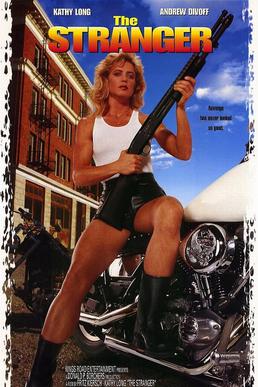
Film Review: The Stranger (dir by Fritz Kiersch)


In the desert of Arizona, there sits a town.

That town is named Lakeview, despite the fact that there is no lake nearby.  There aren’t many buildings in the town.  There’s a service station.  There’s a diner.  There’s a sheriff’s office.  There’s a general store.  There are a few houses.  Lakeview is a place that people rarely visit and which no one can escape.

There is a sheriff.  His name is Cole (Eric Pierpoint) and he spends most of his days in an alcoholic stupor.  He’s been depressed ever since his girlfriend, Bridget, was murdered.  Now, Bridget’s younger sister, Gordet (Robin Lyn Heath), is living like a feral animal while the local shopkeeper, Sally (Ginger Lynn Allen), is determined to have Cole for herself.  Cole’s deputy (Ash Adams) is in love with Sally and wants Cole’s job for his own.  That’s a lot of drama for a small town.

Of course, the real drama in Lakeview comes from the fact that the town is run by a group of bikers!  The head biker is named Angel (Andrew Divoff).  By terrorizing the citizens, Angel and his gang make their own wishes come true without ever asking anyone else if that’s something they would be interested in.  Cole is too drunk and depressed to stand up to them.  The other townspeople are …. well, I don’t know what their problem is.  One assumes that they have to be tough, as they’re living in a harsh and inhospitable desert.  But none of them them are willing to stand up for themselves.  Maybe they’ve recently moved to Arizona from California and they’re not used to the idea of self-defense.  But, for whatever reason, Angel controls Lakeview.

But then the Stranger (Kathy Long) rides up on her motorcycle.  Dressed in black leather and wearing a corset that looks like it would actually be really uncomfortable in the desert heat, The Stranger has no name but she does know how to kick ass.  She has come to kill all the members of Angel’s gang.  Unfortunately, the majority of the gang is out-of-town when The Stranger arrives.  So, the Stranger waits in Lakeview and kills who she can.  The townspeople, led by Sally, want her to leave before things get too violent.  Meanwhile, Cole comes out of his drunken stupor just long enough to notice that the Stranger looks a lot like his dead girlfriend….

1995’s The Stranger was an attempt to a modern-day spaghetti western, with a woman playing the type of mysterious figure who would traditionally have been played by Clint Eastwood or Charles Bronson.  That, in itself, is a pretty good idea.  Unfortunately, The Stranger itself is abysmally paced and the filmmakers seem to have overlooked that, in the best spaghetti westerns, the silent, nameless heroes were usually paired with a more talkative (and often much more amusing) partner.  The Good, The Bad, and the Ugly had Eli Wallach.  Once Upon A Time In The West had Jason Robards.  In The Stranger, there’s not really anyone around to fill that role.  (Cole is too full of self-pity to be amusing.  Gordet spends most of the movie running from one abandoned car to another.)  As such, The Stranger becomes fairly grim and slow.  Things are only livened up when The Stranger beats people up.  Kathy Long was a kickboxing champion and she’s strong enough in the action scenes that it makes up for the fact that she doesn’t have a particularly compelling screen presence.  She and Eric Pierpoint also have next to no romantic chemistry, making the whole question of whether or not she’s Bridget’s ghost seem a bit moot.

The best reason to see the film is to watch Andrew Divoff play Angel.  Divoff is always a good villain and he’s memorably unhinged in The Stranger.  Unfortunately, he’s not in the film as much as the viewer might hope.  Watching the film, I half expected the Wishmaster to ask if I wanted Andrew Divoff’s role to be larger.  I would have said no while thinking yes.  You know how that Wishmaster is.

Music Video of the Day: Atlas, Rise! by Metallica (2013, directed by Clark Eddy)


In Atlas, Rise!, Metallica sings about having the weight of the world on your shoulders and refusing to let it hold you down.  No matter how much Atlas has to carry, he will always rise and so will Metallica.

The video keeps things simple, focusing on the band’s skill.  The video was directed by Clark Eddy, who has also directed videos for Sublime, Crash Test Dummies, and Kid Rock.  Most of Eddy’s credits, though, are as an editor.  As an editor, he has worked on videos for Dua Lipa, Rihanna, Destiny’s Child, Iggy Pop, and Pitbull.  That is quite a collection.

Enjoy!

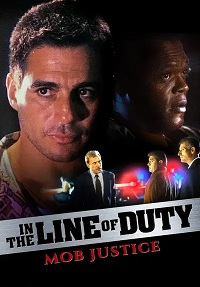
In The Line of Duty: Mob Justice (1991, directed by Peter Markle)


The fourth of NBC’s In The Line of Duty movies, Mob Justice opens with the murder of an undercover DEA agent by a low-level gangster who has just been released from prison.  While the gangster goes into hiding, the DEA mobilizes and starts to make life so difficult for all of the other mobsters in New York that soon, the Mafia is as determined to get justice as law enforcement.

This was the first In The Line Of Duty film not be directed by Dick Lowry.  Lowry’s fast-paced style is missed as Mob Justice takes forever to get going and regularly gets bogged down with scenes lifted from other mafia movies.  The old mobsters talk about the importance of family, play cards in the backroom, and eat big dinners.  Opera blares on the soundtrack when the DEA starts to harass them.  For a movie that is supposed to honor the work and the sacrifice of federal law enforcement, the DEA actually comes across as being thoroughly incompetent in Mob Justice.  A dumb mistake leads to the first murder.  A series of other misjudgments lead to the Mafia dispensing the own type of violent justice before the DEA can arrest their man.

The most interesting thing about Mob Justice is the cast.

The trigger-happy gangster is played by Tony Danza, who I guess was trying to prove himself as a dramatic actor after spending years on Taxi and Who’s The Boss but who still comes across like Tony Micelli having a bad day.  His best friend is played Nicholas Turturro, who later played a straight arrow detective on NYPD Blue.  Frank Vincent and Leonardo Cimino plays the mob bosses who knows that murdering a federal agent is bad for business.

The head of the investigation is played by Ted Levine, who has had a long career but will always be remembered as the killer from The Silence of the Lambs.  Working under him is Dan Lauria, who a generation will instantly recognize as being the long-suffering and frequently angry father from The Wonder Years.  You know that this is a big case is Buffalo Bill and Jack Arnold are working together.  (Dan Lauria actually appeared in several In The Line of Duty films, always playing different characters.)

And finally, the murdered DEA agent is played by none other than Samuel L. Jackson.  It’s never a good thing when the best actor in a movie is killed off after the first fifteen minutes.

The cast is great but Mob Justice is forgettable.  The main problem is that, after Jackson is taken out of the picture, the rest of the movie is just Danza hiding in different apartments while Levine and Lauria annoy Frank Vincent.  Danza’s murderer is never smart nor interesting enough to be a compelling antagonist and there’s never any doubt that, one way or another, he will pay for his stupidity.  There is one memorable scene where Danza freaks out while wearing a blonde wig but otherwise, Mob Justice doesn’t leave much of an impression.

Two Looks at the Office: The Office: The Untold Story of the Greatest Sitcom of the 2000s: An Oral History by Andy Greene and Welcome to Dunder Mifflin: The Ultimate Oral History of The Office by Brian Baumgartner and Ben Silverman


The American version of The Office was so good that it has led to not one but two oral histories!  And I’m such a fan that I’ve got both of them.

The first oral history that I read was Andy Greene’s The Office: The Untold Story of the Greatest Sitcom of the 2000s.  First published in 2020, Greene’s book was full of interesting facts and anecdotes, though a careful reading revealed that a lot of the “oral” part of the oral history was lifted from old interviews, DVD commentaries, and an article that Greene had previously written.  The book was notable for 1) establishing that Steve Carell is one of the nicest guys in show business, 2) putting the blame squarely on Jeff Zuker for Carell not returning after Season 7, and 3) getting some of the behind-the-scenes people to talk about why seasons 8 and, to a lesser extent, season 9 were so uneven.

The other oral history, which was published earlier this year, was Welcome to Dunder Mifflin.  It was written by Brian Baumgartner (who played Kevin Malone on the show) and Ben Silverman, one of the show’s producers.  Probably because Baumgartner and Silverman were both involved in the show, they apparently were able to get a lot more people to talk to them personally.  Unlike Greene’s book, which relied heavily on previously published interviews, Welcome to Dunder Mifflin features recent interviews with people like Steve Carell, Jenna Fischer, John Krasinski, Rainn Wilson, Angela Kinsey, Craig Robinson, Ed Helms, Amy Ryan and many others.  In fact, nearly the entire cast seems to have been interviewed for Welcome to Dunder Mifflin.  Presumably because their schedules wouldn’t allow it, neither BJ Novak or Mindy Kaling are interviewed and their absence is definitely felt.  Also not interviewed is James Spader but that’s not really a surprise.  (Spader played Robert California during the season of The Office that everyone seems to agree was the worst, Season 8.)  While everyone in both of the oral histories is quick to compliment Spader as an actor and a person, there’s a general agreement that the show never figured out what to do with the Robert California character and that Spader’s vibe didn’t quite meld with the show.  One gets the feeling that his time on The Office is something that Spader is more than happy to put behind him.

(Personally, of all the celebrities who were brought in to “interview” for the management position after Steve Carell left the show, I thought Ray Romano was the one who seemed like he would best fit in with the show’s ensemble.  Then again, I always felt that the best solution would have been to cast some total unknown for as Michael’s replacement and then keep him off-screen as much as possible.  But I’m getting distracted.  Someday, I’ll post my big ‘What the Office Should Have Done’ screed.  Of course, it’ll be like 20 years too late but whatever….)

The books are both full of love for The Office but they each take a somewhat different approach.  The Untold Story takes a very structured and very chronological look at the show and focuses a lot on what went on behind the scenes, both on set and with the network.  (If you didn’t already dislike Jeff Zucker, you will after reading Greene’s book.)  Welcome to Dunder Mifflin takes a far looser approach to the material and focuses more on what it was like to be a part of television’s funniest ensemble.  Welcome to Dunder Mifflin is full of interviews of people gushing about how much they loved working together and how proud they were to work on The Office and what’s interesting is that, even though you’re just reading their words on the printed page, you never doubt that they’re totally telling the truth.  Perhaps because it was Baumgartner who was doing the interview, the cast seems to let down their guard in a way that you really don’t see very often when it comes to performers talking about their time on a classic show.

Welcome to Dunder Mifflin focuses on the positive aspects of being on the show.  Whereas The Untold Story spends a lot of times on Seasons 8 and 9 and on the difficulty of integrating James Spader and Catherine Tate into the main cast, Welcome to Dunder Mifflin devotes only a few pages to those seasons and instead focuses on the Carell years.  One thing that both of these oral histories have in common is that Steve Carell comes across as being the nicest guy who ever lived.  How nice is Steve Carell?  I’d rather live next door to him than Tom Hanks.  Actually, I take that back.  I would want Carell next door and Tom Hanks living across the street.  It’s a big neighborhood.

Both of these oral histories nicely compliment each other.  If you want a chronological history of the show, Greene’s book is for you.  If you want a book that focuses on what it felt like to be a member of The Office crew, Welcome to Dunder Mifflin has you covered.  I would recommend buying both and getting the full Office experience.

And remember, there’s no party like a Scranton party.