In today’s episode of Circle of Fear, Martin Sheen plays a construction worker who finds a box at a site. He brings it home to show his wife, Kim Darby. When they open the box, they discover only a mirror and a toy horse. Hey, that doesn’t seem too bad, right? But then Darby starts to have nightmares that indicate that the horse might be cursed!
This episode aired on January 12th, 1973. It’s always a little bit jarring to see Martin Sheen playing a regular guy, back before The West Wing brought out his pompous side. Young Martin Sheen was quite a good actor. His resemblance to Emilio Estevez is uncanny. I wonder if they’re related.
It may have taken 18 innings to get there but the Astros are going to the American League Championship Series for the sixth consecutive season! Congratulations to the Astros and a big thank you to Jeremy Pena, whose 18th inning home run gave the Astros a 1-0 victory over the Mariners!
Genetic modification. Sure, it sounds like a good idea. But are the results ever worth it?
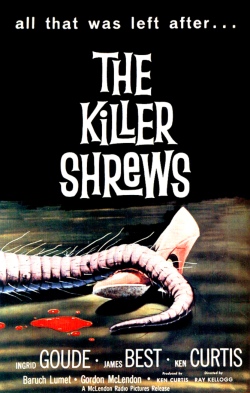
Dr. Marlowe Cragus (Baruch Lumet) thought it was a good idea. That why he and his daughter, Anne (Ingrid Goude), and Anne’s boyfriend, Jerry (Ken Curtis), all moved to an isolated island. Dr. Cragis though he could perform some experiments on some shrews and that he would unlock the secret of how to …. well, who knows what Dr. Cragis thought he was actually doing. (I mean, to be honest, who is really sure what a shrew really is?) Cragis claims that he was trying to end world hunger but that sounds like a convenient excuse. To be honest, it seems like Dr. Cragis was just experimenting for the sake of experimenting.
Unfortunately, Cragis’s experiments somehow led to the shrews turning into giant and carnivorous beasts. At first, the doctor kept them locked up. But then Anne broke up with Jerry and Jerry got drunk and he let all the shrews go free. Yep, it’s a mess. Now, the shrews are running around the island and the doctor and everyone else is trapped in the lab. Boat captain Thorne Sherman (James Best) has arrived to take everyone back to the mainland but, unfortunately, there’s a hurricane approaching. The humans will have to survive one more night on the island of …. THE KILLER SHREWS!
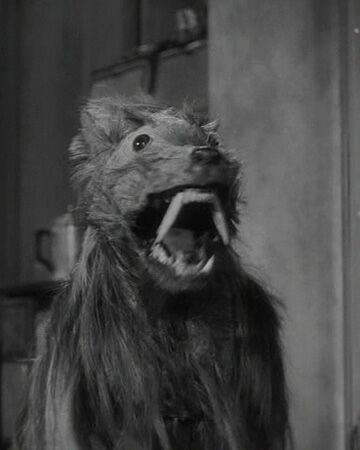
Directed by Ray Kellogg, The Killer Shrews was filmed in 1959. It was a regional production, filmed just outside of my hometown of Dallas and released to local drive-ins. It did well enough to get national distribution and it continues to be popular among aficionados of bad cinema. The main problem with The Killer Shrews is that the shrews themselves are obviously just dogs that are wearing shrew masks. For the most part, the dogs seem to be happy to be there. I’m pretty sure that I saw a few of them wagging their tails shortly before launching their attack on the humans. We’re told that the shrews are killers but they don’t look like they’ve ever killed anything. Instead, they look like very good boys. One gets the feeling that they were a lot of fun to play with between filming.
That said, The Killer Shrews is entertaining if you’re looking for a short movie that will inspire a good laugh or two. James Best and Ken Curtis play romantic rivals and the fact that they both attempt to give serious performances only serves to highlight the absurdity of a group of people being held prisoner by a pack of shrews. Baruch Lumet, the father of director Sidney Lumet, acts up a storm in the role of Dr. Cragis, yelling all of his dialogue like the stage veteran that he was. And, of course, the dogs playing the shrews appear to be having the time of their lives. Hopefully, someone tossed around a tennis ball with them after they finished their scenes because they definitely earned the reward.
The Killer Shrews is not exactly a killer movie but at least the dogs are cute!
Welcome to Retro Television Reviews, a feature where we review some of our favorite and least favorite shows of the past! On Saturdays, I will be reviewing California Dreams, which ran on NBC from 1992 to 1996. The entire show is currently streaming on YouTube!
This week, season one comes to an end and season two begins. And with season two, an important new character is introduced. With the start of the second season, we also get new opening credits.
But first, let’s get the end of season one out of the way.
Episode 1.13 “Where’s Dennis?”
(Directed by Don Barnhart, originally aired on December 5th, 1992)
With their parents out of town, Matt and Jenny throw a big party at the Garrison house and, naturally, the Dreams perform. A promoter comes by the party and tells the Dreams that they’re “sick.” (“That means good,” he adds as the Dreams breathe a sigh of 90s relief.) However, younger brother Dennis feels that his old siblings are neglecting him and he runs away. Can Matt and Jenny find Dennis before their parents come home?
Eh, who cares? The worst episodes of the first season of California Dreams were the ones that focused on the Garrison family.
Episode 2.1 “Jake’s Song”
(Directed by Don Barnhart, originally aired on September 11th, 1993)
In between the end of the first season and the start of the second season of California Dreams, NBC delivered an ultimatum to the show’s producers. If the show was going to continue, it would need to lose the adults and focus on the band. It would also need to add some more Saved By The Bell-style hijinks.
As such, the Garrison adults were largely dropped, as was younger brother Dennis. Whereas the first season didn’t feature a single scene that actually took place in a high school, the new California Dreams would feature clueless teachers, sputtering principles, and the same high school interiors that would later show up in Hang Time.
Most importantly, the first episode of the second season introduced viewers to Jake Summers (played by Jay Anthony Franke). Jake was a tough guy who rode a motorcycle, wore a leather jacket, and who never lost a fight. Jake was a rocking rebel with the soul of a poet and he was obviously added to the show to try to give the California Dreams some sort of edge. Of course, California Dreams was still a TNBC show so “edgy” really just meant that Jake looked like he might have smoked a cigarette at some point in his life. Jake wore a leather jacket and got a serious look on his face whenever it was time to play guitar but the music was still Disney-level pop. Jake was the toughest California Dream in the way that Joey Fatone used to be the toughest member of NSYNC.
Jake makes his first appearance in California Dreams when he walks into the high school, wearing a leather jacket and followed by several adoring girls. “Woooooooooo!” the audience yells, showing that they already know that the new star of the show has arrived.
Anyway, Jake says that he wants to talk to Matt. Everyone’s terrified that Jake is going to kill Matt but instead, Jake just likes some music that Matt wrote and he wants to offer him some lyrics for the song. Matt discovers that Jake can play guitar and he invites Jake to join the Dreams. The rest of the Dreams are like, “Jake’s too tough and scary!” Can’t they hear how crazy the live audience goes whenever Jake enters a scene? The Dreams need Jake! Of course, Jake isn’t even sure that he wants to join the Dreams but then they all play together at Sharkey’s. Jake becomes a Dream and immediately start to overshadow the star of the show. The future is set.
Jake would eventually become a bit of a neutered character, especially after Matt was written out of the show and Jake took over the band. But, in his first appearance, he actually has enough rebel charisma that it’s easy to understand why the show’s producers decided to build the new California Dreams around him. His surly attitude actually provided a nice contrast to Matt’s more vanilla style. In their first episode together, Jay Anthony Franke and Brent Gore brought out the best in each other.
Would Jake and Matt continue to bring out the best in each other? We’ll find out next week!
In this scene from 1982’s Poltergeist, JoBeth Williams not only falls in what was meant to be the family swimming pool but she also discovers that she’s not alone in that pool.
The skeletons were real. I would have screamed too.
The 1971 British film, The Night Digger, revolves around three people.
Maura Prince (Patricia Neal) lives in a dilapidated mansion out of London. She has never married and spends almost all of her time taking care of her blind mother, Edith (Pamela Brown). Edith goes out of her way to make sure that Maura will never have the courage to leave her and find happiness on her own. However, with the mansion falling apart around them, it’s becoming obvious that Maura cannot take care of the entire place on her own. That’s when a mysterious but handsome man named Billy Jarvis (Nichols Clay) rides up on his motorcycle and asks if the women need a handyman.
Billy has a dramatic story about his past, claiming that he lost almost everything that he owned as the result of a fire in a barn, one which also led to the death of his mother. Billy is charming and handsome and he ride a really impressive motorcycle and he looks good in a leather jacket. He represents youth but he’s also the epitome of the rebel without a cause, the sensitive but inarticulate Marlon Brando of The Wild One or the biker played by Peter Fonda in The Wild Angels. Some may look at him and only see a somewhat seedy character on a motorcycle but others look at him and see someone who is running from something and needs someone to take care of him. They see the soul of poet within the body of a drifter, someone who needs to escape from his past and who can also provide a better future. He’s the rebel without a cause, the one that everyone dreams about, even if some of those dreams are dreamt in secret. Though one may have rode a bicycle and the other was knight of the round table, there is much Nicholas Clay’s future performance as Lancelot in John Boorman’s Excalibur to be found in his performance in The Night Digger. Much like a groundkeeper in a D.H. Lawrence novel, he represents the secret and potentially dangerous earthy sensuality of Britain.
As a result, You certainly can not blame Maura for starting to fall in love with him. Nor can you blame Edith for wanting to have an athletic young man around as there have been stories about a madman who stalks the night, killing women. The Traveling Maniac, some have taken to calling him. Complicating the matter, though, is the fact that Billy just happens to be The Traveling Maniac. With Maura falling in love with him, will she discover the truth or will she become his next victim?
The Night Digger took me by surprise. I wasn’t expecting much from this film when I watched it last year but it turned out to be rather clever and suspenseful thriller, one that told its story with a good combination of black humor and emotional honesty. Atmospherically directed by Alistair Reid and featuring a trio of excellent lead performances, The Night Digger was compelling compelling thriller, a gothic horror story with a great ending. This is definitely one to keep an eye out for!
4 Or More Shots From 4 Or More Films is just what it says it is, 4 shots from 4 of our favorite films. As opposed to the reviews and recaps that we usually post, 4 Shots From 4 Films lets the visuals do the talking!
This October, I’m going to be doing something a little bit different with my contribution to 4 (or more) Shots From 4 (or more) Films. I’m going to be taking a little chronological tour of the history of horror cinema, moving from decade to decade.
Today, we take a look at 1981, 1982, and 1983!
10 Shots From 10 Horror Films: 1981 — 1983
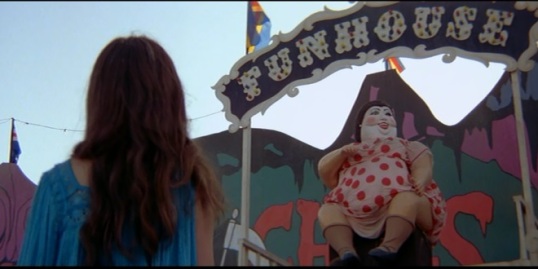
The Funhouse (1981, dir by Tobe Hooper. DP: Andrew Laszlo)
The Beyond (1981, dir by Lucio Fulci, DP: Sergio Salvati)
The House By The Cemetery (1981, dir by Lucio Fulci, DP: Sergio Salvati)
The Evil Dead (1981, dir by Sam Raimi, DP: Tim Philo)
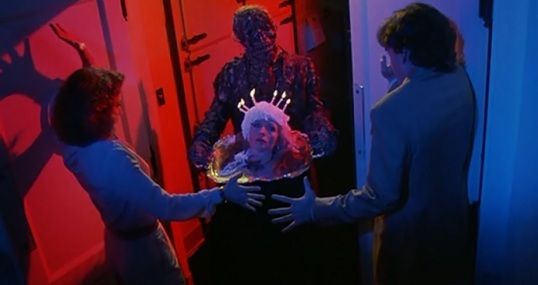
Creepshow (1982, dir by George Romero, written by Stephen King, DP: Michael Gornick)
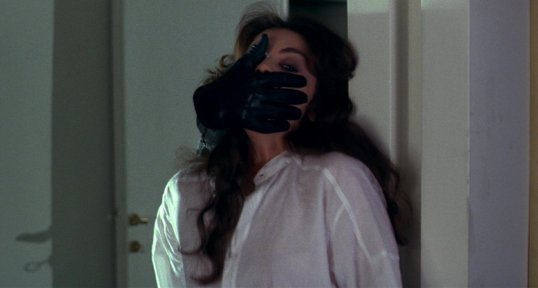
Tenebrae (1982, dir by Dario Argento, DP: Luciano Tovoli)
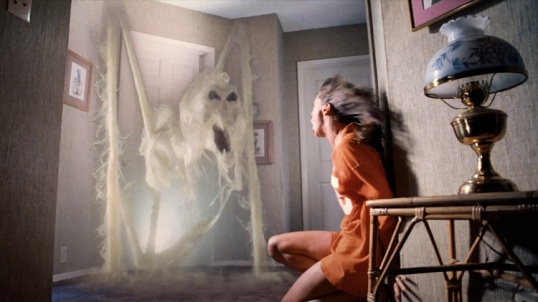
Poltergeist (1982, dir by Tobe Hooper, DP: Matthew F. Leonetti)
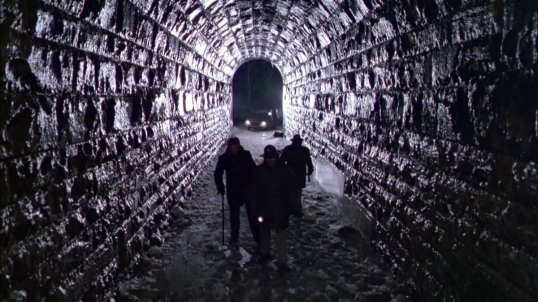
The Dead Zone (1983, dir by David Cronenberg, DP: Mark Irwin)
Christine (1983, dir. John Carpenter, DP: Donald M. Morgan)
Halloween III: Season of the Witch (dir by Tommy Lee Wallace, DP: Dean Cundey)
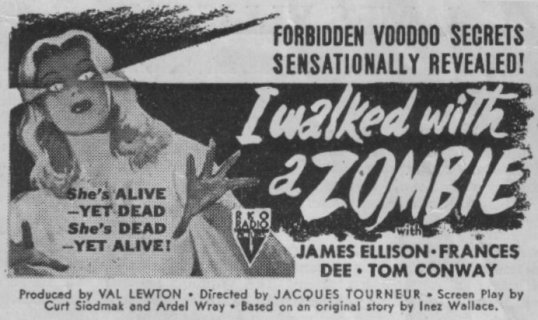
The 1943 horror film I Walked With A Zombie tells a zombie story that would probably seem strange to modern zombie fans. There’s no cannibalism. There’s no feasting on brains. There’s no talk about how the only way to stop a zombie is to shoot them in the head. In fact, the zombies in I Walked With A Zombie may be referred to as being the “living dead” but they’re not actually dead. Instead, if anything, they’ve been cursed. Maybe they’re possessed. Maybe they’ve been brainwashed. Maybe they’re lobotomized. Who can say for sure?
Instead of being the type of zombies that were made famous by George Romero’s Night of the Living Dead, the zombies in I Walked With A Zombie hew closer to the zombies of Haitian legend. These zombies suffer from a sort of mental paralysis. Unable to think for themselves, they wander about in a sort of permanent limbo, trapped between life and death and under control of the voodoo priests who transformed them.
This moody and, at time, rather dream-like film deals with Besty Connell (Frances Dee), a Canadian nurse who has been hired by Paul Holland (Tom Conway), who owns a sugar plantation on a Caribbean island. Paul’s wife, Jessica (Christine Gordon) has apparently been taken ill and, as a result, is behaving strangely. Often, she wanders about with a glazed look in her eyes, almost as if she’s trapped in a sort of dream-state. Paul believes that it’s the result of the severe fever that Jessica previously suffered with. The locals, meanwhile, gossip that, right before Jessica was taken ill, she was having an affair with Paul’s alcoholic half-brother, Wesley (James Ellison). Betsy’s attempts to care for Jessica and understand her condition will lead to Betsy exploring not only the island’s voodoo culture but also …. walking with a zombie!
I Walked With A Zombie is a deliberately paced film, one that focuses more on creating and maintaining an ominous mood than on going for the type of jump scares that we’ve come to expect from most horror movies. I Walked With A Zombie is all about atmosphere and ambiguity. Indeed, it’s never determined for certain whether or not Jessica’s condition is due to a voodoo curse or if perhaps it really is just due to her earlier fever. It’s left to the audience to decide.
Directed by Jacques Tourneur and produced by Val Lewton (the same time team behind the original Cat People), I Walked With A Zombie is an effective and well-acted film, one that also features some gorgeous black-and-white cinematography and an interesting subtext about colonialism. (Upon arriving on the island, Betsy discovers that the Holland family made their fortune through the slave trade and that they still have the figurehead of an old slave ship displayed in their courtyard.) It may not be frightening by today’s standards but it is still a thought-provoking film and one that should be seen by anyone who is a serious zombie fan.
As some of our regular readers undoubtedly know, I am involved in a few weekly live tweets on twitter. I host #FridayNightFlix every Friday, I co-host #ScarySocial on Saturday, and I am one of the five hosts of #MondayActionMovie! Every week, we get together. We watch a movie. We tweet our way through it.
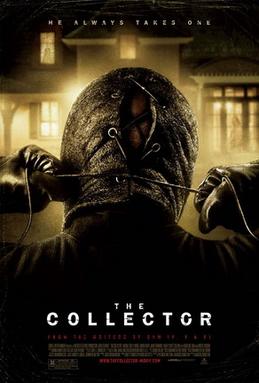
Tonight, for #ScarySocial, ArtAttackNYC will be hosting 2009’s The Collector!
Not to be confused with William Wyler’s classic film, 2009’s The Collector is about a serial killer doing serial killer things.
If you want to join us on Saturday night, just hop onto twitter, start the film at 9 pm et, and use the #ScarySocial hashtag! The film is available on Prime. I’ll be there co-hosting and I imagine some other members of the TSL Crew will be there as well. It’s a friendly group and welcoming of newcomers so don’t be shy.
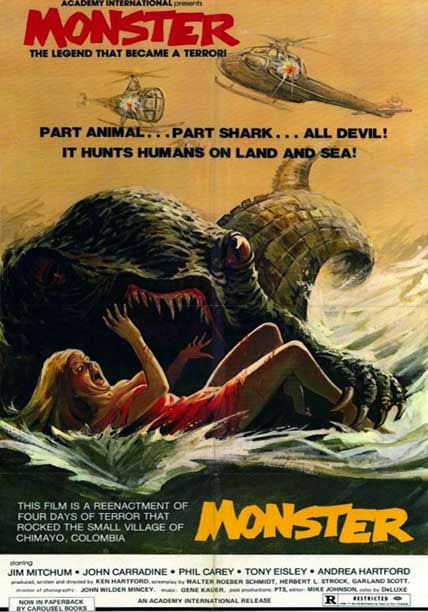
Today, we have a little indie film from 1980. This film was released under several names, including Monster. However, I prefer the title under which it has been included in several Mill Creek box sets: Monstroid: It Came From The Lake!
Monstroid tells the story of what happens when a monster emerges from a lake and starts killing people in Columbia. Superstitious villagers blame a local woman whom they believe to be a witch. Even though the town priest (and no horror fan should be surprised to discover that the priest is played by John Carradine) claims that he can exorcise the evil spirits that have possessed her, the villagers would rather burn her at the stake. Meanwhile, the local Big Evil Corporation has sent in Travis (James Mitchum) to take care of the monster!
And what a monster! Listen, there’s a lot of negative things that I could say about this low-budget film but the monster is simply adorable and must be seen by anyone who appreciates the rubber monsters that populated horror films in the days before CGI.
Plus, how can you resist a film that features not only Robert Mitchum’s son but John Carradine as well?








 Through the Shattered Lens