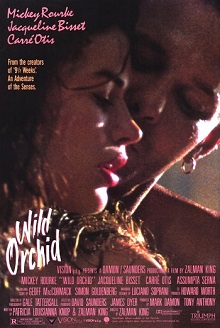
Cinemax Friday: Wild Orchid (1989, directed by Zalman King)


Emily (played by blank-faced model Carrie Otis) is a lawyer who can speak French, Spanish, Portuguese, Chinese, and Italian but who has never spoken the language of love.  A high-powered New York firm hires her away from her former employer in Chicago on the requirement that she immediately head down to Rio de Janeiro.  Claudia Dennis (Jacqueline Bisset) is trying to close the deal on buying a luxury hotel and she needs a lawyer now!

Claudia, however, has plans for Emily that go beyond real estate.  As soon as Emily arrives, Claudia arranges for her to go on a date with the wealthy and mysterious James Wheeler (Mikey Rourke).  Wheeler is single but he’s so far refused all of Claudia’s advances.  She wants to know if he’s adverse to all women or just her.  Wheeler is very taken with Emily but he’s been hurt so many times in the past that he can’t stand to be touched.  Instead, he gets his thrills by being a voyeur.

It leads to a trip through Rio, where everyone but Emily is comfortable with their sexuality.  When Wheeler isn’t encouraging her to watch a married couple have sex in the back seat of a limo, Claudia is encouraging Emily to disguise herself as a man and enjoy the nonstop carnival of life in Rio.  There’s a lot of business double-dealing, many shots of Mickey Rourke riding on his motorcycle, and a final sex scene between Rourke and Otis that is one of the most rumored about in history.  For all of the scenes of Wheeler explaining his philosophy of life, Wild Orchid doesn’t add up too much, though it certainly tries to.

Wild Orchid was a mainstay on late night Cinemax through most of the 90s.  This was Carrie Otis’s first film and to say that she gives a bad performance does a disservice to hard-working bad actors everywhere.  There’s bad and then there’s Carrie Otis in Wild Orchid bad.  She walks through the film with the same blank expression her face, playing a genius who can speak several languages but often seeming as if she’s struggling to handle speaking in just one language.  She looks good, though, and all the movie really requires her to do is to look awkward while Rourke and Bisset chew up the scenery.

On the one hand, Wild Orchid is the type of bad movie that squanders the talents of actors like Mickey Rourke, Jacqueline Bisset, and Bruce Greenwod (who has a small role as a sleazy lawyer) but, on the other hand, it’s a Zalman King film so it may be insanely pretentious but it’s also rarely boring.  Visually, King goes all out to portray Rio as being the world’s ultimate erotic city and the dialogue tries so hard to be profound that you’ll have to listen twice just to make sure you heard it correctly.  My favorite line?  “We all have to lose ourselves sometimes to find ourselves, don’t you think?”  Mickey Rourke says that and he delivers it as only he could.

Wild Orchid may have been a box office bust but it was popular on cable and on the rental market, largely because of that final scene between Rourke and Otis.  Mikey Rourke later married Carrie Otis.  Neither returned for Wild Orchid II: Two Shades of Blue.

Catching Up With “Ley Lines” : Alyssa Berg’s “Forget-Me-Not”


Ryan C. (fourcolorapocalypse)'s avatarRyan C.'s Four Color Apocalypse

There’s no more natural a fit for the Czap Books/Grindstone Comics visual poetry series Ley Lines than Alyssa Berg — as anyone who’s been fortunate enough to get their hands on her self-published Recollection and Soft Fascinations can tell you — so now that she has, in fact, gotten “on board” with the title, so to speak, my only question is : what took so long?

Admittedly, it’s unusual to see Berg’s soft watercolor work rendered in black-and-white, but prospective readers needn’t fear : Ley Lines #21, Forget-Me-Not, is absolutely gorgeous and shows that she’s every bit as adept with inkwashes as she is with paints. Every page has a lyrical rhythm that flows into the next, and that’s true before taking her sparse and emotive verse into account. This is Berg firing on all creative cylinders — but then, she never does anything halfway.

The historical figure…

View original post 451 more words

Terror at Black Falls (1959, directed by Richard C. Sarafian)


When Sheriff Cal (House Peters, Jr.) both fails to prevent the lynching of the son of Juan Avila (Peter Mamakos) and also manages to shoot off Avila’s hand, Avila swears vengeance.  After serving a prison sentence for horse theft, Avila returns to Cal’s hometown.  Avila and his two remaining sons enter the local saloon and take everyone hostage.  They announce that, until Cal comes down to the saloon, they’re going to kill one person every ten minutes.

Cal, who is still haunted by the death of Avila’s son, knows that if he goes to the saloon, he’ll be killed and then there won’t be anyone left to keep Avila from killing everyone in town.  Determined to try to wait Avila out, Cal stays in his office.  Avila, however, keeps his promise and starts to kill the people in the saloon one-by-one.  With everyone in town hiding behind closed doors, Cal’s son, Johnny (Gary Gray), heads down to the saloon to try to take care of things himself.

This low-budget, independent western was made in 1959 but it wasn’t released until 1962.  It was the directorial debut of Richard C. Sarafian, who would go on to direct the cult classic Vanishing Point in 1971.  It’s an attempt to create a thinking man’s western, with Sheriff Cal constantly regretting that Avila was turned into an outlaw by circumstances out ofAvila’s control.  Most of the towns people are portrayed as being just as bad, and in some cases even worse, than Avila.  The first man to die in the saloon, for instance, is a roughneck who angrily objects to a Mexican being allowed to drink indoors.  Though the film’s heroes may be Cal and Johnny, its sympathies are with Juan Avila.

Unfortunately, the message of Terror At Black Falls is often obscured by preachy dialogue and amateurish performances.  Peter Mamakos, especially, overacts to the extent that it’s hard to take him or his character seriously.  Even though it’s barely an hour long, the film is full of slow spots and it’s never a good sign when you need voice-over narration to explain to the audience how they’re supposed to feel about what they’re watching.  The story has potential and Sarafian later developed into a good director but Terror at Black Falls never really comes together.

Music Video of the Day: I Like (the idea of) You by Tessa Violet (2019, dir by Jade Ehlers)


I danced for like an hour after I watched this video.

This video pays homage to Nancy Sinatra’s video for These Boots Are Made For Walkin and was choreographed by Kayla Kalbfleisch.

Enjoy!

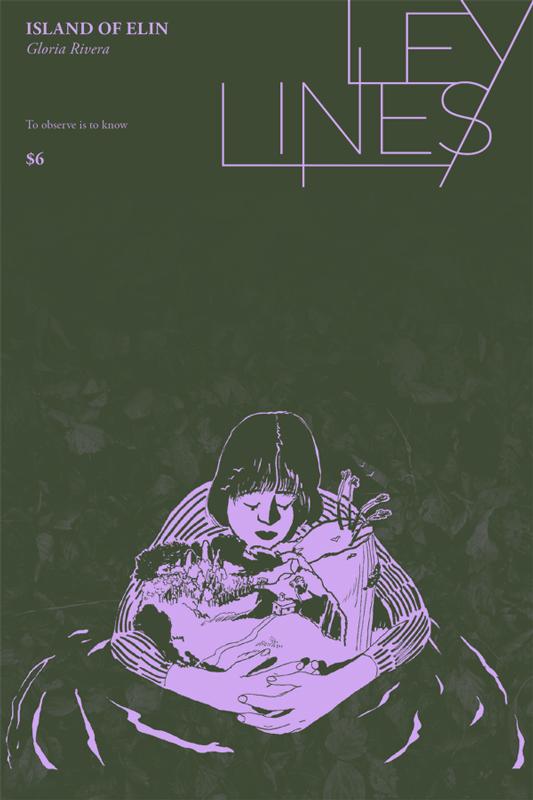
Catching Up With “Ley Lines” : Gloria Rivera’s “Island Of Elin”


Ryan C. (fourcolorapocalypse)'s avatarRyan C.'s Four Color Apocalypse

At first glance, issue number 20 of the Czap Books/Grindstone Comics series Ley Lines, Gloria Rivera’s Island Of Elin, is one of the most narratively straight-forward entries into this ever-developing “canon” — I mean, for the most part, it looks and reads very much like a “standard” (whatever that even means anymore) comic book. But don’t let its appearance deceive you — this is every bit as multi-faceted and interpretative a work as we’ve come to expect from these books.

Incorporating, as these things do, a variety of non-comics influences, Rivera — who is a uniquely perceptive and emotive cartoonist, using an economy of lines to communicate a wealth of visual fact and feeling — leans into the works of Jean Audubon, John Muir (especially), and the so-called “Hudson Valley painters” to tell the story of Plover the bird, his friend who’s on their last legs (err —…

View original post 499 more words

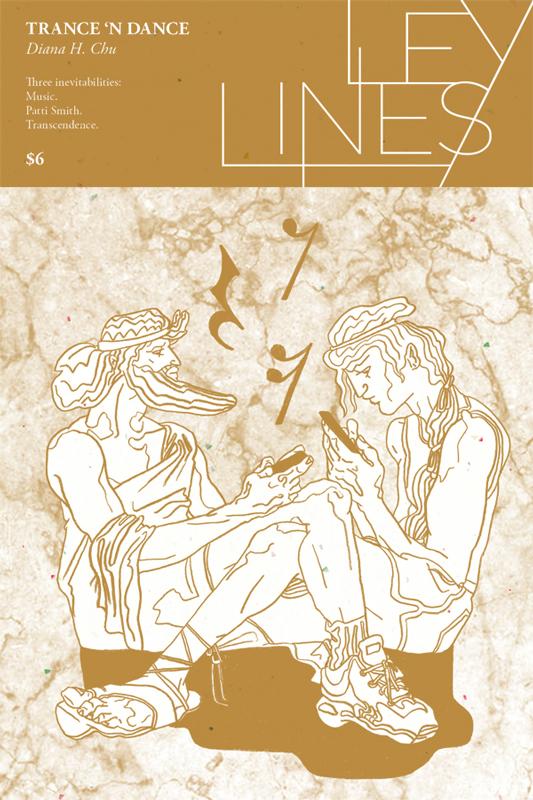
Catching Up With “Ley Lines” : Diana H. Chu’s “Trance ‘N Dance”


Ryan C. (fourcolorapocalypse)'s avatarRyan C.'s Four Color Apocalypse

All that glitters may not be gold — but Diana H. Chu’s Trance ‘N Dance, number 19 in the Czap Books/Grindstone Comics visual poetry series Ley Lines, is — although the riso printing doesn’t, in fact, glitter. So where does that leave us, besides with an admittedly gorgeous-looking mini?

I’m still in the process of answering that question myself, but there’s no question that Chu has created a de facto visual “museum guide” like no other here. The rub is that the exhibit that she’s offering up for display has a lot more to do with many more things than the book’s back-cover blurb would perhaps, at first glance, lead one to believe — but that may not be a bad thing. It’s up to you decide — it always is with this series, that’s one of the best things about it — so consider my role here…

View original post 586 more words

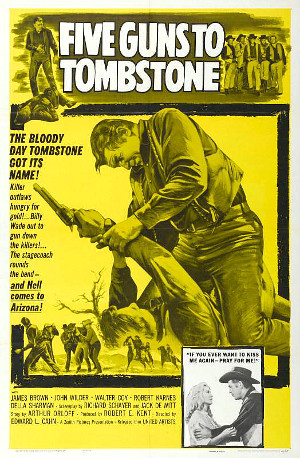
Five Guns To Tombstone (1960, directed by Edward L. Cahn)


Outlaw Matt Wade (Robert Karnes) escapes from prison and rejoins his old gang.  They ride out to Tombstone, Arizona, stopping off at the ranch of Matt’s brother, Billy Wade (James Brown).  Billy used to be an outlaw but eventually he hung up his guns, settled down, got married, and now he’s raising Matt’s teenage son, Ted (John Wilder).  Ted, who thinks that his father has just been paroled, is excited to see Matt but Billy doesn’t want Ted being led into a life of crime.  When Matt and the gang rob a bank, they frame Billy for the crime.  With the townspeople looking to lynch him and Ted drifting towards the wrong path in life, Billy has no choice but to pretend to be a part of the gang until he can dig up the evidence to clear his name.

If this sounds familiar, thank you for reading yesterday’s review of Gun Belt.  Released seven years after Gun Belt, Five Guns To Tombstone tells the exact same story as Gun Belt and, in many case, it features the exact same dialogue.  The only difference is that some of the names have been slightly changed.  The gang leader in Gun Belt was named Ike Clinton.  In this Five Guns To Tombstone, his name is Ike Garvey.  Billy Ringo becomes Billy Wade and Wyatt Earp because Marshal Sam Jennings.  Otherwise, it’s pretty much the exact same film.

Which one is the better film, Gun Belt or Five Guns To Tombstone?  Both films have plenty of two-fisted, gun-slinging action and a good cast of western character actors but I’d probably have to give the edge to Five Guns To Tombstone because John Wilder is more convincing in the role of the outlaw’s son than Tab Hunter was in Gun Belt.  Tab Hunter was young and callow and annoying but John Wilder is the type of confused kid that anyone could relate to.

Five Guns To Tombstone was one of the 9 films that Edward L. Cahn directed in 1960.  As with most of Cahn’s films, the action seems rushed but that’s appropriate for the story that Five Guns To Tombstone is telling.  (It’s also understandable.  When you’re directing 9 films a year, you don’t have the luxury of taking your time.)  Like Gun Belt, this is hardly a classic but western fans should enjoy it.