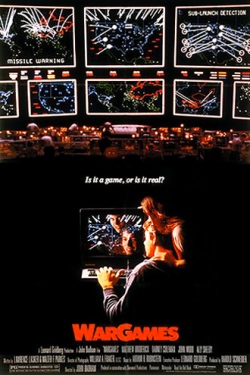
Film Review: Wargames (dir by John Badham)


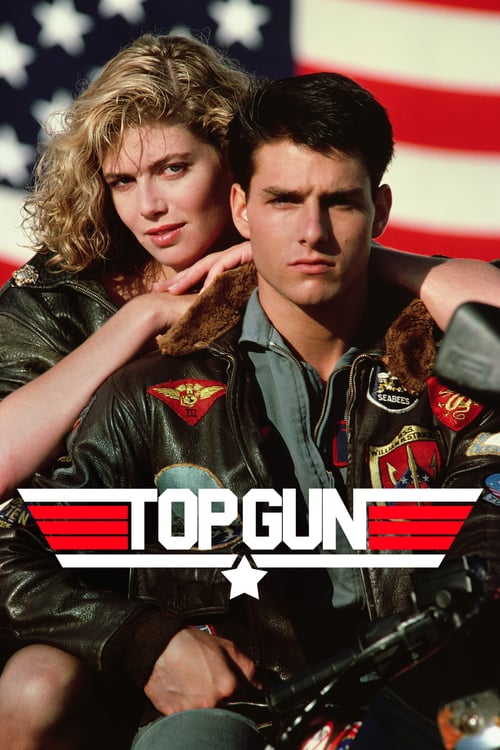
If you thought Tom Cruise nearly started a war in Top Gun, you should see what Matthew Broderick did three years earlier in Wargames!

In Wargames, Broderick plays David Lighter, a dorky but likable teenager who loves to play video games and who spends his spare time hacking into other computer systems.  (Of course, since this movie was made in 1983, all the computers are these gigantic, boxy monstrosities.)  Sometimes, he puts his skills to good use.  For instance, when both he and Jennifer (Ally Sheedy) are running the risk of failing their biology class, he hacks into the school and changes their grades.  (At first, Jennifer demands that he change her grade back but then, a day later, she asks him to change it again.  It’s kind of a sweet moment and it’s also probably the way I would have reacted if someone had done that for me in high school.)  Sometime, David’s skills get him into trouble.  For instance, he nearly destroys the world.

Now, keep in mind, David really didn’t know what he was doing.  He was just looking for games to play online.  He didn’t realize that he had hacked into NORAD and that Global Thermonuclear War was actually a program set up to allow a gigantic computer named WOPR to figure out how to properly wage a thermonuclear war.  David also doesn’t know that, because humans have proven themselves to be too hesitant to launch nuclear missiles, WOPR has, more or less, been given complete control over America’s nuclear arsenal.

(Wargames actually starts out with a chilling little mini-movie, in which John Spencer and Michael Madsen play two missile technicians who go from joking around to pulling guns on each other during a drill.  Of course, Madsen’s the one ready to destroy the world.)

Of course, the military folks at NORAD freak out when it suddenly appears as if the Russians have launched a nuclear strike against Las Vegas and Seattle.  (Not Vegas!  Though really, who could blame anyone for wanting to nuke Seattle?)  In fact, the only thing that prevents them from launching a retaliatory strike is David’s father demanding that David turn off his computer and take out the trash.  However, WOPR is determined to play through its simulation, which pushes the world closer and closer to war.  (One of the more clever — and disturbing — aspects of the film is that, even after the military learns that the Russians aren’t planning the attack them, they still can’t go off alert because the Russians themselves are now on alert.   Once the war starts, it can’t be stopped even if everyone knows that the whole thing was the result of a mistake.)

With the FBI looking for him, David tries to track down the man who created WOPR, Dr. Stephen Falken (John Wood).  However, Falken is not easy to find and not as enthusiastic about saving the world as one might hope….

Watching Wargames was an interesting experience.  On the one hand, it’s definitely a dated film.  (Again, just look at the computers.)  At the same time, its story still feels relevant.  In Wargames, the problem really isn’t that WOPR wants to play a game.  It’s that men like Dr. John McKittrick (well-played by Dabney Coleman) have attempted to remove the human element and have instead put all of their faith in machines.  The appeal of a machine like WOPR is that it has no self-doubt and does whatever needs to be done without worrying about the cost.  But that’s also the reason why human beings are necessary because the world cannot be run on just algorithms and cold logic.  That’s a theme that’s probably even more relevant today than it was in 1983.

Wargames is also an exceptionally likable film.  In fact, it’s probably about as likable as any film about nuclear war could be.  On the one hand, you’ve got everyone at NORAD panicking about incoming missiles and then, on the other hand, you’ve got David and Jennifer having fun on his computer and trading flirty and silly quips.  Matthew Broderick and Ally Sheedy are both likable in the two main roles.  Broderick brings a lot of vulnerability to the role of David.  (David Lightner is a far more believable teenager than Ferris Bueller.)  He handles the comedic scenes well but he’s even better as David grows increasingly desperate in his attempts to get the stubborn adults around him to actually listen to what he has to say.  When it appears the only way to save the world is to swim across a bay, David is forced to admit that he’s never learned how to swim because he always figured there would be time in the future.  Yes, it’s a funny scene but the way Broderick delivers the line, you understand that David has finally figured out that there’s probably not going to be a future.  It’s not that he doesn’t know how to swim.  It’s that he’ll never get the chance to learn or do anything else for that matter.

Wargames is definitely a film of its time but its themes are universal enough that it’s a film of our time as well.
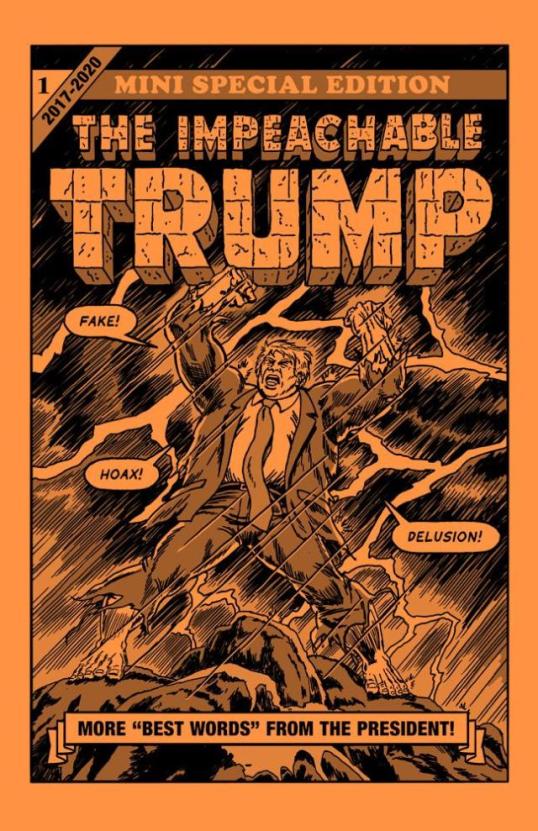
The Unimpeachable R. Sikoryak And “The Impeachable Trump”


Ryan C. (fourcolorapocalypse)'s avatarRyan C.'s Four Color Apocalypse

With his long-awaited Constitution Illustrated  having just been released by Drawn+Quarterly (which I would expect you’ll be able to see a critique of here on this site in the near future, given that I already reviewed the “preview” Constitution Illustrated Sampler mini), you’d think cartoonist R. Sikoryak would be busy enough, but apparently not — and hey, who doesn’t have a few spare minutes to trash our repugnant and incompetent current president, anyway? Here’s the rub, though — are you really “trashing” old, fat, syphilitic, orange, impotent, misogynist, and bigoted if you’re just quoting his own words?

Like his large-format (and also D+Q-published) The Unquotable Trump, Sikoryak isn’t “making anything up” but the illustrations in his new follow-up mini The Impeachable Trump, which he self-published in the “early days” of this pathetically mismanaged coronavirus pandemic. As the cover itself states, these are more of Donnie Dumbshit’s “best…

View original post 750 more words

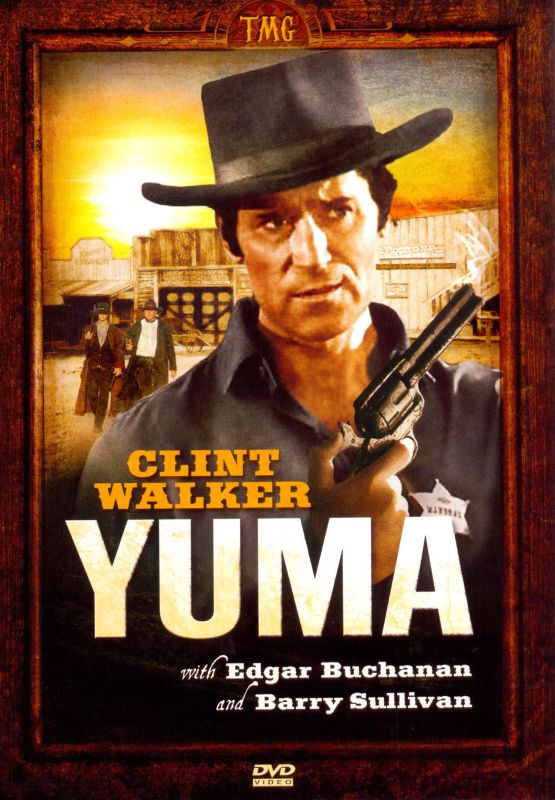
Yuma (1971, directed by Ted Post)


At the start of this made-for-TV western, experienced lawman Dave Harmon (Clint Walker) has just been appointed the new marshal of Yuma.  He’s served as the marshal of several towns, all of which were near rowdy army bases.  He’s a laconic, no-nonsense lawman who is quick with a gun and smart enough to negotiate with the local Indian tribes.

As soon as Harmon rides into town, he comes across the King Brothers (Bruce Glover and Bing Russell) making trouble.  He kills one of the brothers in a saloon and then takes the other one to jail, where he’s mysteriously gunned down during a midnight jailbreak.  It turns out that there’s a third Harmon brother, cattle baron Arch King (Morgan Woodward), and he rides into town looking for revenge.  He gives Harmon a set amount of time to find and arrest his brother’s killer or Arch and his men are going to return to town and kill Harmon.

Fortunately, Harmon has a witness to the jailbreak murder.  Andres (Miguel Alejandro) is a young, Mexican orphan who sleeps at the jail.  He witnessed the murder but he only saw that the killer was wearing what appeared to be army boots.  Harmon’s investigation brings him into conflict with the local army base’s commandant (Peter Mark Richman) and also leads to the discovery of a plot to defraud the local Indians.

The main problem with Yuma is that it was clearly designed to be a pilot for a weekly television series and, as a result, it introduces a lot of characters who don’t get much to do.  There’s a lot of talk about how Harmon is searching for the men who earlier killed his family but that subplot is never resolved.  (If Yuma had been picked up as a weekly show, maybe it would have been.)  Yuma has to set up the premise for a potential show and tell a complete story in just 70 minutes.  That’s a lot to handle and Yuma ends up feeling rushed and incomplete.

As a B-western for undemanding fans of the genre, it’s acceptable.  Clint Walker was a convincing lawman and the film was directed by Ted Post, who knew how to stage a gunfight.  But it’s not really a western that you’re going to remember for long after you watch it.

4 Shots From 4 Films: Special Alfred Hitchcock Edition


4 Shots From 4 Films is just what it says it is, 4 shots from 4 of our favorite films. As opposed to the reviews and recaps that we usually post, 4 Shots From 4 Films lets the visuals do the talking!

121 years ago today, the master of suspense, Alfred Hitchcock, was born!

In honor of the most influential director all time, here are….

4 Shots From 4 Films

Spellbound (1945, dir by Alfred Hitchcock)

Vertigo (1958, dir by Alfred Hitchcock)

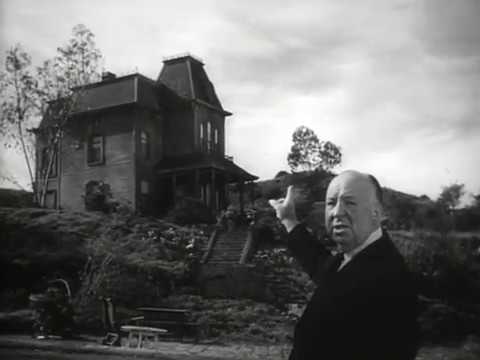
Psycho (1960, dir by Alfred Hitchcock)

The Birds (1963, dir by Alfred Hitchcock)

Film Review: Top Gun (dir by Tony Scott)


Oh, where to even begin with Top Gun?

First released in 1986, Top Gun is a film that pretty much epitomizes a certain style of filmmaking.  Before I wrote this review, I did a little research and I actually read some of the reviews that were published when Top Gun first came out.  Though it may be a considered a classic today, critics in 1986 didn’t care much for it.  The most common complaint was that the story was trite and predictable.  The film’s reliance on style over substance led to many critics complaining that the film was basically just a two-hour music video.  Some of the more left-wing critics complained that Top Gun was essentially just an expensive commercial for the military industrial complex.  Director Oliver Stone, who released the antiwar Platoon the same year as Top Gun, said in an interview with People magazine that the message of Top Gun was, “If I start a war, I’ll get a girlfriend.”

Oliver Stone was not necessarily wrong about that.  The film, as we all know, stars Tom Cruise as Pete “Maverick” Mitchell, a cocky young Navy flyer who attends the TOPGUN Academy, where he competes with Iceman (Val Kilmer) for the title of Top Gun and where he also spends a lot of time joking around with everyone’s favorite (and most obviously doomed) character, Goose (Anthony Edwards).  Maverick does get a girlfriend, Charlie (Kelly McGillis), but only after he’s had plenty of chances to show both how reckless and how skilled he can be while flying in a fighter plane.  Though the majority of the film is taken up with scenes of training and volleyball, the end of the film does give Maverick a chance to prove himself in combat when he and Iceman end up fighting a group of ill-defined enemies for ill-defined reasons.  It may not be an official war but it’s close enough.

That said, I think Oliver Stone was wrong about one key thing.  Maverick doesn’t get a girlfriend because he started a war.  He gets a girlfriend because he won a war.  Top Gun is all about winning.  Maverick and Iceman are two of the most absurdly competitive characters in film history and, as I watched the film last weekend, it was really hard not to laugh at just how much Cruise and Kilmer got into playing those two roles.  Iceman and Maverick can’t even greet each other without it becoming a competition over who gave the best “hello.”  By the time the two of them are facing each other in a totally savage beach volleyball match, it’s hard to look at either one of them without laughing.  And yet, regardless of how over-the-top it may be, you can’t help but get caught up in their rivalry.  Cruise and Kilmer are both at their most charismatic in Top Gun and watching the two of them when they were both young and fighting to steal each and every scene, it doesn’t matter that both of them would later become somewhat controversial for their off-screen personalities.  What matters, when you watch Top Gun, is that they’re both obviously stars.

“I’ve got the need for speed,” Tom Cruise and Anthony Edwards say as they walk away from their plane.  The same thing could be said about the entire movie.  Top Gun doesn’t waste any time getting to the good stuff.  We know that Maverick is cocky and has father issues because he’s played by Tom Cruise and Tom Cruise always plays cocky characters who have father issues.  We know that Iceman is arrogant because he’s played by Val Kilmer.  We know that Goose is goofy because his nickname is Goose and he’s married to Meg Ryan.  The film doesn’t waste much time on exploring why its characters are the way they are.  Instead, it just accepts them for being the paper-thin characters that they are.  The film understands that the the most important thing is to get them into their jets and sends them into the sky.  Does it matter that it’s sometimes confusing to keep track of who is chasing who?  Not at all.  The planes are sleek and loud.  The men flying them are sexy and dangerous.  The music never stops and the sun never goes down unless the film needs a soulful shot of Maverick deep in thought.  We’ve all got the need for speed.

In so many ways, Top Gun is a silly film but, to its credit, it also doesn’t make any apologies for being silly.  Instead, Top Gun embraces its hyperkinetic and flashy style.  That’s why critics lambasted it in 1986 and that’s why we all love it in 2020.  And if the pilots of Top Gun do start a war — well, it happens.  I mean, it’s Maverick and Iceman!  How can you hold it against them?  When you watch them fly those planes, you know that even if they start World War III, it’ll be worth it.  If the world’s going to end, Maverick’s the one we want to end it.


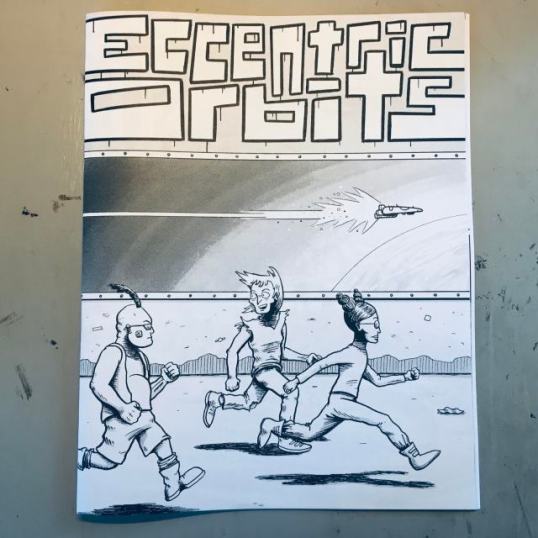
Josh Frankel Launches Readers Into Any Number Of “Eccentric Orbits”


Ryan C. (fourcolorapocalypse)'s avatarRyan C.'s Four Color Apocalypse

Hearkening back to the underground science fiction epics of everyone from George Metzger to Matt Howarth, to the more contemporary efforts of ambitious cartoonists like Joshua Cotter, Josh Frankel’s new self-published comics ‘zine (and that’s the right word — this is a magazine-sized publication that clocks in at 40 pages) Eccentric Orbits is nevertheless something new, different, and frankly pretty unique : a human-sized and often quite light-hearted and, dare I say it, fun take on tried and true genre tropes that draws you in immediately with the superb quality of its illustration and keeps your interest by dint of its strong characterization. Not that the art doesn’t stay great from start to finish, too, mind you, because it most assuredly does.

Frankel’s teenage protagonists, part of the crew of the ingeniously-named space station Indiscretion, are both entirely typical of kids their age and fully-fleshed-out individuals, and whether they’re being…

View original post 684 more words

Ghost (2020, directed by Anthony Z. James)


Tony Ward (Anthony Mark Streeter) is a former London gangster who, on the morning of his release from prison, discovers that his wife would rather hide in her flat than talk to him, that his son, Conor (Nathan Hamilton), is going to head down the same path as his father if he doesn’t learn to control his temper, and that his former partner in crime (Russell Barnett) has no interest in helping Tony go straight.

Bearing no resemblance to the Patrick Swayze/Demi Moore/Whoopi Goldberg Oscar nominee of the same name, Ghost is a British film that was shot, on location in London, with an iPhone.  Ghost is a deceptively simple film.  Until the final few minutes, there’s not even much violence.  Ghost, though, really isn’t about crime and gangsters.  It’s about a man who is trying to move on from his past and who can only watch as his son makes some of the same mistakes that he made.  Ghost is about whether or not anyone can ever start their lives over again.  It started out as a short film but director Anthony Z. James was so impressed with Streeter’s performance that he expanded the film to feature length.  As a result, there are a lot of scenes in Ghost that feel like they’re there to pad out the running time.  At the same time, James is proven correct in that Streeter gives a very strong performance as the haunted Tony.  Throughout the film, Tony is constantly struggling to not give into his old ways and Streeter does such a good job of communicating that conflict that even scenes of him nervously walking around London feel compelling.

Considering it was shot on an iPhone, Ghost looks great.  Anthony Z. James has a good visual eye and the movie was filmed in some of the most haunting areas of London.  Usually, I visit London two or three times a year.  In 2020, due to the COVID-19 outbreak, I have only been able to visit once and I don’t know when I’ll be able to visit again.  Watching Ghost made me homesick in the best way.


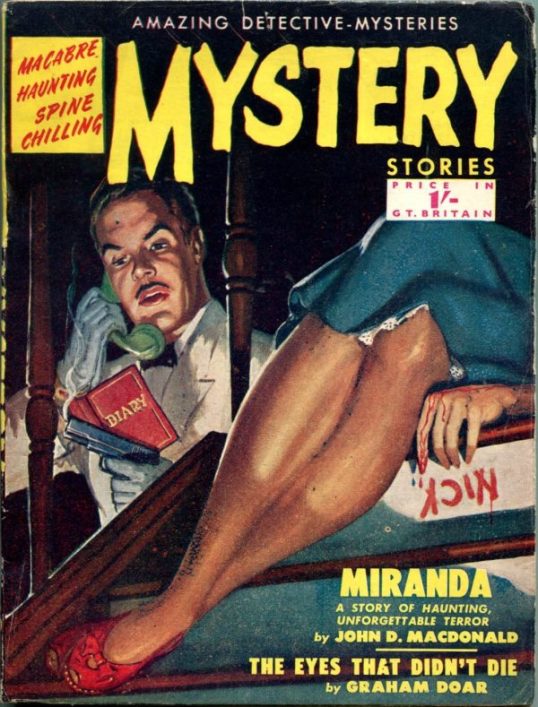
The Racy Covers of Silk Stocking Stories


by Peter Driben

Silk Stocking Stories was published from 1946 and 1939 and it specialized in stories that, back in its day, were considered to be racy.  By today’s standards, the stories may be tame but the covers remain popular with collectors.  I believe all of the covers below were done by Peter Driben.

Here are a few of the racy covers of Silk Stocking Stories!