Escape From New York (1981, directed by John Carpenter)


What’s your favorite John Carpenter film?

Halloween is an obvious choice.  It’s probably the film that John Carpenter is best-known for.  The Thing and Assault on Precinct 13 are two other popular choices.  Libertarians and anarchists have embraced They Live as a sacred text.  In The Mouth of Madness is one of the few films to capture the feel of a classic H.P. Lovecraft story.  Christine is one of the best of the Stephen King adaptations.  My techphobic father recently purchased a Blu-ray player just so he could watch Big Trouble In Little China whenever he felt like it.

For me, though, my favorite will always be Escape From New York.

Everything about this movie, from the premise to the execution to the darkly funny ending, is pure brilliance.  For those who have been living off the grid for the last 40 years, Escape From New York takes place in what was, at the time of the film’s initial release, the near future.  Due to a 400% increase in crime, Manhattan has been turned into a floating prison.  A wall has been built around the island.  The bridges are covered in mines.  All of the residents are prisoners who have been sentenced to a life term and the Chock Full O’Nuts is now literally full of nuts.

There’s a new resident of New York City.  He’s the President (Donald Pleasence!) and he was supposed to soon deliver a classified cassette tape to the Soviets.  Instead, with the world on the verge of war, Air Force One has crashed in Manhattan and the Duke of New York (Isaac Hayes!!) is holding him hostage.  Bob Hauk (Lee Van Cleef!!!) recruits notorious criminal Snake Plisskin (Kurt Russell!!!!) to sneak into the prison and retrieve the cassette and save the President, by any means necessary.  If Snake succeeds, he’ll get a pardon.  If Snake fails, he’ll die due to the microexplosives that have been injected into his system.
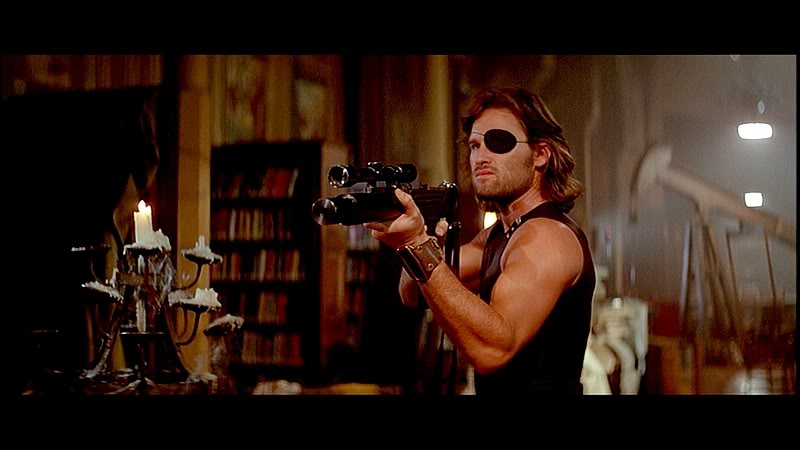
How unbelievably cool is Kurt Russell as Snake Plisskin?  Before fanfic was even known by that name, people were writing stories about Snake Plisskin’s past and how he lost his eye.  Delivering his lines in a Clint Eastwood-style rasp, Kurt Russell gives one of the best action hero performances of all time.  (Snake was the role that transformed Russell from being a clean-cut former Disney child star to being a cult film icon.)  Everything that Snake says is quotable and, even with tiny explosives circulating through his blood, Snake never loses his cool.  Sometimes, it doesn’t seem like Snake cares whether he lives or dies and that’s what makes Snake such a strong hero.  He’s wiling to take the risks that no one else would.  If he saves the President and the world, cool.  If he doesn’t, neither was probably worth saving anyways.  At the end of the film, Snake reveals that there are things that he does care about.  If you don’t appreciate the people who sacrificed their lives for you, don’t expect Snake to do you any favors.

Snake gets some help from a rogue’s gallery of familiar faces, all of whom have their own reasons for trying to save the President from the Duke.  Harry Dean Stanton is Brain while Adrienne Barbeau is Maggie.  Brain is the smartest man in Manhattan and Maggie’s good with a gun and it’s too bad that we never got a prequel about how they met.  My favorite of Escape from New York‘s supporting cast is Ernest Borgnine as Cabbie, who is the perfect New York taxi driver and whose taste in music plays off in an unexpectedly satisfying way.

Escape From New York is John Carpenter at his best, an exciting race against time full of memorable characters and thrilling action.  Whenever I go to New York and I cross over a bridge into Manhattan, I think about Snake, Cabbie, and the gang driving through a minefield.  Everyone who meets Snake says “I thought you were dead,” but we know better.  Snake Plisskin will never die and neither will my love for Escape From New York.

Once Upon A Time In Hollywood Wins in North Dakota


Here are the first inaugural winners of the North Dakota Film Critics Society!

Best Picture: Once Upon a Time…In Hollywood (Quentin Tarantino, David Heyman, Shannon McIntosh, producers)

Best Director: Bong Joon-ho, Parasite

Best Actor: Joaquin Phoenix, Joker
Best Actress: Florence Pugh, Midsommar
Best Supporting Actor: Willem Dafoe, The Lighthouse
Best Supporting Actress: Laura Dern, Marriage Story

Best Screenplay: Quentin Tarantino, Once Upon a Time…In Hollywood

Best Animated Feature: I Lost My Body (Jérémy Clapin, Marc du Pontavice)
Best Documentary Feature: Honeyland (Ljubo Stefanov, Tamara Kotevska, Atanas Georgiev)
Best International Feature: Parasite (South Korea)

Best Cinematography: Jarin Blaschke, The Lighthouse
Best Editing: Louise Ford, The Lighthouse
Best Production Design: Once Upon a Time…In Hollywood (Production Design: Barbara Ling, Set Decoration: Nancy Haigh)
Best Original Score: Hildur Gu∂nadóttir, Joker
Best Original Song: ”Glasgow (No Place Like Home)” from Wild Rose (Mary Steenburgen, Caitlin Smith, Kate York)

Special Achievement
1917 – Due to the release date of Sam Mendes’ 1917, many society members were unable to view the film in time for nomination or consideration. The society has voted to acknowledge the film with a Special Achievement Award.

Lisa Reviews An Oscar Nominee: Lady for A Day (dir by Frank Capra)


The 1933 film, Lady For A Day, tells the story of Apple Annie (May Robson) and Dave the Dude (Warren William), who is perhaps the nicest gangster that you could ever hope to meet.

Of course, when I refer to Dave the Dude as being a gangster, I should make clear that he’s not the type of gangster who guns down his rivals or sells drugs in back alleys.  I mean, I guess he might do that but we certainly don’t see much of evidence of it in the film.  Instead, Dave is just a dapper gambler who travels with a bodyguard named Happy McGuire (Ned Sparks) and whose girlfriend, Missouri Martin (Glenda Farrell), owns a nightclub where, since this is a pre-code film, the acts are slightly racy but not excessively salacious.  The country may be mired in a depression but Dave appears to be doing okay for himself.  Yes, Dave may be a criminal but at least he’s honest about it.

Surviving the Depression has proven to be far more difficult for Apple Annie.  She’s known as Apple Annie because she makes a meager living by selling fruit on the streets of New York City.  Dave is one of her regular customers, as he believes that her apples bring him good luck.  Annie has a daughter named Louise (Jean Parker).  Louise has never met her mother, having spent the majority of her life in a Spanish convict.  Annie regularly steals stationary from a high class hotel so that she can sends letters to Louise.  Not wanting her daughter to be ashamed of her, Annie has always presented herself as being a rich woman named Mrs. E. Worthington Manville.

However, it now appears that Annie’s charade is about to be exposed.  Louise is coming to New York with her fiance, Carlos (Barry Norton) and her prospective father-in-law, Count Romero (Walter Connolly).  Annie knows that when the Louise arrives, she’s going to discover that her mother is not wealthy and that the marriage will probably be called off.  So, led by Dave, Annie’s customers conspire to fool Louise into believing that her mother really is a member of high society.  And if that means that Dave is going to have to not only kidnap (but, let’s be clear, not harm) three nosy reporters and then make a deal with not just the mayor but also the governor to pull of the deception, that’s exactly what he’s going to do.

Though it may be disguised as a sweet and rather simple comedy, Lady For A Day is actually a rather melancholy little film.  Even when Annie and her friends are pretending to be wealthy members of high society, the film is aware that their escape from reality is only temporary.  Eventually, they’ll have to return to the reality of being poor in 1930s America.  At heart, it’s a sad story but May Robson, Warren William, Glenda Farrell, and Guy Kibbee (who plays the pool hustler who is recruited to pretend to be Annie’s husband) all bring such sincerity to their roles that you can’t help but smile while watching it.  Rejected by “polite” society, Annie and her friends have formed a community of outsiders and, throughout the film, the audience is happy that, no matter what, they have each other.

Lady for a Day was the first Frank Capra film to ever be nominated for Best Picture.  Capra was also nominated, for the first time, for best director but he had the misfortune to be competing with Frank Lloyd, who directed Cavalcade.  At the awards ceremony, when host Will Rogers, announced the winner for best director, he said, “Come on up here, Frank!”  An excited Capra ran down to the podium, just to discover that Rogers had actually been talking to Frank Lloyd.  Rogers, seeing what had happened, quickly invited the other nominated director, Little Women‘s George Cukor, to come join Lloyd and Capra at the podium.  Fortunately, one year later, Capra would win the directing Oscar for It Happened One Night.

Cavalcade would go on to win Best Picture but Capra retained so much affection for Lady For A Day that it was the only one of his films that he would subsequently remake.  A Pocketful Of Miracles came out in 1961 and featured Bette Davis in the lead role.  It would be Capra’s final theatrical film.

4 Shots From 4 John Carpenter Films: Starman, Prince of Darkness, They Live, In The Mouth of Madness


4 Shots From 4 Films is just what it says it is, 4 shots from 4 of our favorite films. As opposed to the reviews and recaps that we usually post, 4 Shots From 4 Films lets the visuals do the talking!

From the day that this site first came online, John Carpenter has been a bit of a mainstay here at the Shattered Lens.  Arleigh has written extensively about Carpenter’s films.  Every October, we seem to have, at the very least, a handful of posts that are somehow connected to the filmography of John Carpenter.  Hell, Carpenter and I were once both interviewed for the same article about the future of horror!

I guess my point is that we really love John Carpenter here at the Shattered Lens.  I’ve lost track of how many editions of 4 Shots From 4 Films we’ve devoted to Carpenter and his films.  However many there are, here’s one more.  Today is John Carpenter’s birthday and that means that it is time for….

4 Shots From 4 John Carpenter Films

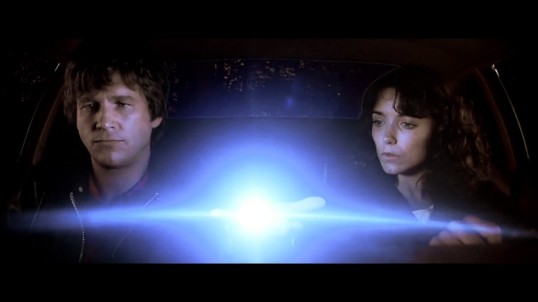
Starman (1984, dir by John Carpenter)

Prince of Darkness (1987, dir by John Carpenter)

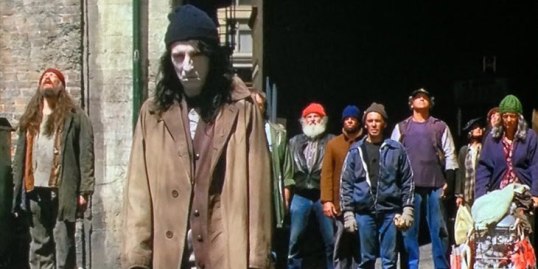
They Live (1988, dir by John Carpenter)

In The Mouth of Madness (1994, dir by John Carpenter)

Music Video of the Day: Utopian Facade by John Carpenter (2016, dir by Gavin Hignight and Ben Verhulst)


Let us all come together now to wish a happy 72nd birthday to John Carpenter!

John Carpenter is not only one of the greatest horror and sci-fi directors of all time, he’s also an acclaimed composer.  We all know, of course, that he was responsible for the iconic theme song of Halloween.  However, he’s also released two albums of his own original, non-soundtrack music, Lost Themes and Lost Themes II.  Utopian Facade, today’s music video of the day, is the last track on Lost Themes II.

This video features a running android.  As you might be able to guess, utopia isn’t quite as utopian as it has perhaps been advertised to have been.  The android is played by Erika Angel while Stuart Morales is credited as playing “Avatar.”

It’s a very atmospheric piece of music and proof that John Carpenter is as brilliant a musician as he is a filmmaker.

Enjoy!

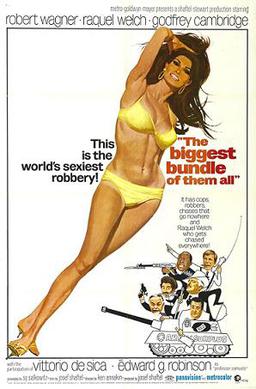
The Biggest Bundle Of Them All (1968, directed by Ken Annakin)


Harry Price (Robert Wagner) is a small-time tough guy with big plans.  He and his gang of accomplices fly over to Italy and plot to kidnap Cesare Celli (Vittorio De Sica), a retired mafia don who is reputed to be worth millions.  However, after snatching Celli from a wedding, Harry discovers that Celli is actually flat broke.  Trying to be helpful, Celli suggests that Harry call up the local gangsters and demand that they pay a ransom for Celli’s release.  When everyone refuses to pay, Celli comes up with another plan.  Celli takes over Harry’s gang and, with the help of Celli’s old friend, Prof. Samuels (Edward G. Robinson), plots to steal $5,000,000 worth of platinum ingots from a train.

Complicating matters is that Harry and his gang are not exactly master criminals.  Benny (Godfrey Cambridge) is a violinist who has moral objections to carrying a gun and who also refuses to cross a picket line, even in the course of a robbery.  (“I’m a union man!”)  Tozzi (Francesco Mule) is more interested in having a good dinner than pulling off the perfect heist.  Davey (Davy Kaye) is short, which is apparently a problem for some reason.  Finally, Harry’s girlfriend, Juliana (Raquel Welch), is more interested in dancing than in committing crimes.  Still, Celli is determined to use them to pull off the heist of the century and, even more importantly, to help prove that this old criminal has still got what it takes.

The Biggest Bundle of Them All was an attempt at a wacky heist film.  Unfortunately, at the time that the film was made, Robert Wagner and “wacky” didn’t belong anywhere near each other.  Wagner stiffly delivers lines like, “I’ve had it, baby.  Can you dig it?” and looks thoroughly out-of-place.  Godfrey Cambridge and Edward G. Robinson have a few funny scenes but both Kaye and Mule are wasted in one-note role while De Sica looks like he’s trying to figure out how he went from Bicycle Thieves to this.  Everyone in the movie just goes through the motions.  Even while they’re robbing the train, the cast seems to be indifferent.

It almost doesn’t matter, though, because this is a Raquel Welch film.  Welch doesn’t have much of a character to play but she looks amazing while doing it and that really is the appeal of any film that Welch made in the late 60s and early 70s.  Welch spends a good deal of the film in a bikini and is undeniably sexy, particularly in the scene where Wagner sends her to seduce De Sica.  She also gets to share a dance with Edward G. Robinson, which is such a goofy and fun scene that it’s almost worth the price of admission.  (Regardless of what fun they may have been having on-screen, Robert Wagner later wrote in his autobiography that, off-screen, Robinson grew so annoyed with Welch’s chronic lateness on the set that he yelled at her until she was in tears.)

Even Raquel Welch in a bikini can only carry a film so far and The Biggest Bundle of Them All is ultimately too disjointed to work.  Director Ken Annakin tries to recreate the same sort of frantic comedy that was at the heart of his previous film, Those Magnificent Men in Their Flying Machines, but the end result falls flatter than 5 million dollars worth of platinum ingots sliding out of an airplane.

Lisa Reviews An Oscar Winner: In the Heat of the Night (dir by Norman Jewison)


The 1967 film, In the Heat of the Night, tells the story of two very different men.

Chief Gillespie (Rod Steiger) is the police chief of the small town of Sparta, Mississippi.  In many ways, Gillespie appears to the epitome of the bigoted Southern cop.  He’s overweight.  He loses his temper easily.  He chews a lot of gum.  He knows everyone in town and automatically distrusts anyone who he hasn’t seen before, especially if that person happens to be a black man or from the north.

Virgil Tibbs (Sidney Poitier) is a black man from the north.  He’s a detective with the Philadelphia Police Department and he’s as cool and controlled as Gillespie is temperamental and uncouth.  Tibbs has no patience for the casual racism that is epitomized by lawmen like Chief Gillespie.  When Gillespie says that Virgil is a “fancy name” for a black and asks what people call Virgil in Philadelphia, Virgil declares, “They call me Mister Tibbs!,” with an authority that leaves no doubt that he expects Gillespie to do the same.

Together …. THEY SOLVE CRIMES!

For once, that old joke is correct.  When a Chicago industrialist named Phillip Colbert is discover murdered in Sparta, Chief Gillespie heads up the investigation and, assuming that the murderer must be an outsider, orders Deputy Wood (Warren Oates) to check out the train station for any suspicious characters.  When Wood arrives at the station, he discovers Virgil standing on the platform.  Virgil is simply waiting for his train so that he can get back home to Philadelphia.  However, Wood promptly arrests him.  Gilespie accuses him of murdering Colbert, just to discover that Virgil’s a police detective from Philadelphia.

Though neither wants to work with the other, that’s exactly what Gillespie and Virgil are forced to do as they investigate Colbert’s murder.  Colbert was planning on building a factory in Sparta and his wife (Lee Grant) makes it clear that, if Sparta wants the factory and the money that comes with it, Virgil must be kept on the case.  Over the course of the investigation, Gillespie and Virgil come to a weary understanding as both of them are forced to confront their own preconceived notions about both the murder and life in Sparta.  In the end, if it’s impossible for them to truly become friends, they do develop a weary respect for each other.  That is perhaps the best that one could have hoped for in 1967.

I have to admit that it took me a few viewings before I really appreciated In the Heat of the Night.  Though this film won the Oscar for Best Picture of 1967, it’s always suffered when compared to some of the films that it beat.  One can certainly see that the film was superior to Doctor Dolittle and Guess Who’s Coming to Dinner.  But was it a better film than The Graduate or Bonnie and Clyde?  Did Rod Steiger really deserve to win Best Actor over Dustin Hoffman and Warren Beatty?  (Amazingly, Poitier wasn’t even nominated.)

To be honest, I still feel that In The Heat of the Night was probably the 3rd best of the 5 films nominated that year, superior to the condescending Guess Who’s Coming To Dinner but nowhere near as groundbreaking as Bonnie and Clyde or The Graduate.  The first time I watched In the Heat of the Night, I thought Steiger blustered a bit too much and the film’s central mystery didn’t really hold together and, to a large extent, I still feel like that.

But, at the same time, there’s a lot to appreciate about In the Heat of the Night.  On subsequent viewings, I came to better appreciate the way that director Norman Jewison, editor Hal Ashby, and cinematographer Haskwell Wexler created and maintained an atmosphere that was so thick that you can literally feel the Mississippi humidity while watching the film.  I came to appreciate the supporting cast, especially Warren Oates, Lee Grant, Scott Wilson, Anthony James, and Larry Gates.  (Gates especially makes an impression in his one scene, playing an outwardly genteel racist who nearly cries when Tibbs reacts to his slap by slapping him back.)  I also came to appreciate the fact that, while the white cop/black cop partnership has subsequently become a bit of a cliche, it was new and even controversial concept in 1967.

And finally, I came to better appreciate Sidney Poitier’s performance as Virgil.  Poitier underplays Virgil, giving a performance of tightly controlled rage.  While Steiger yells his way through the film, Poitier emphasizes that Virgil is always thinking.  As in the same year’s Guess Who’s Coming To Dinner, Poitier plays a dignified character but, here, that dignity is Virgil’s way of defying the demands and expectations of men like Gillespie.  When Virgil does strike back, it’s a cathartic moment because we understand how many times he’s had to hold back.

In the Heat of the Night may not have been the best film of 1967 but it’s still one worth watching.

The Covers of Jungle Stories


Unknown Artist

Published by Fiction House, Jungle Stories ran from 1938 to 1950, for a total of 59 issues.  Judging from the covers below (and, of course, the title of the magazine), Jungle Stories dealt with the adventurous of life in the jungle.  It appears that several issues featured the adventures of Ki-Gor, the lord of the jungle.  I haven’t read any of them but I’m sure Ki-Gor was probably a totally original creation and had nothing in common with Tarzan.  There’s probably a world of difference between being the king of the jungle and being the lord of the jungle.

Here are a few covers from Jungle Stories.  Where known, the artist has been credited.

Unknown Artist

Unknown Artist

Unknown Artist

by George Gross

by George Gross

by George Gross

by George Gross

by George Gross

by George Gross

Unknown Artist