This film was produced as a direct result of the box office success of I Was A Teenage Werewolf. Just as in Teenage Werewolf, Whit Bissell plays a mad scientist who makes the mistake of trying to play God. (He also makes the mistake of keeping an alligator in his lap but that’s another story.) The end result …. Teenage Frankenstein!
The makeup on the Teenage Frankenstein is probably the best thing about this film. If nothing else, this film features a monster who actually looks like he was stitched together in a lab.
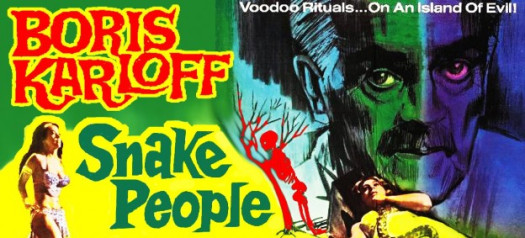
Boris Karloff frightened the nation in 1931’s FRANKENSTEIN , and continued to terrify audiences for over three decades. In 1968, at the age of 81 and suffering from emphysema and crippling arthritis, Boris signed on to do four low-budget horror films for a Mexican production company. Unable to travel, Karloff’s scenes were shot in Hollywood by Jack Hill (SPIDER BABY, THE BIG DOLL HOUSE, SWITCHBLADE SISTERS). These films had a limited release here in the U.S. in 1971, two years after Karloff’s death, then went straight to late night TV.
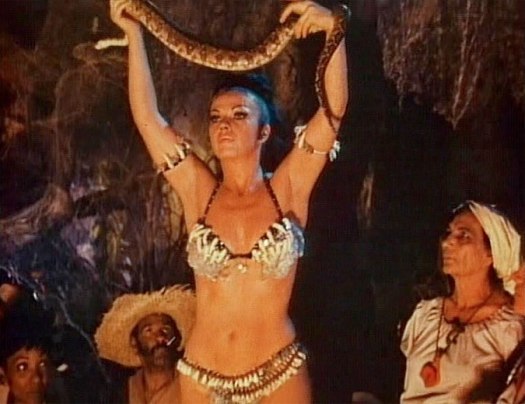
THE SNAKE PEOPLE is probably the best of the quartet (which admittedly isn’t saying much!), featuring some bizarre imagery, flesh-eating zombies, voodoo rituals, human sacrifice, and other cool stuff! Karloff looks ill (and he was), but still manages to command every scene he’s in. Enjoy a last visit with the King of Horror, Boris Karloff, in THE SNAKE PEOPLE!:
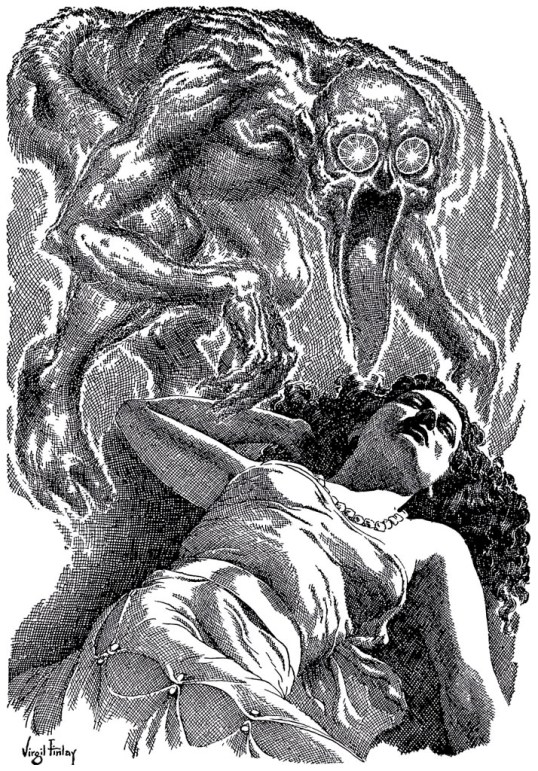
“Even if she be not harmed, her heart may fail her in so much and so many horrors; and hereafter she may suffer–both in waking, from her nerves, and in sleep, from her dreams.” ― Bram Stoker, Dracula
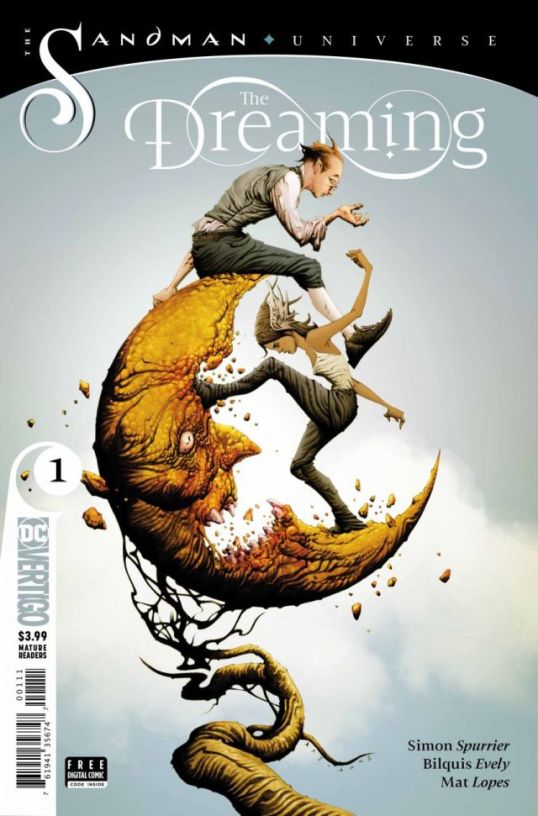
At the risk of losing an untold number of “cool points,” I’m gonna come right out and admit that Neil Gaiman’s The Sandman remains one of my all-time favorite extended series in comics, and even though I smelled a cash grab right away with DC/Vertigo’s new slew of spin-off titles (purportedly “curated” by Gaiman himself, whatever that even means) gathered under the umbrella of The Sandman Universe, the extra-length “special” introducing the line (reviewed in one of these very “Weekly Reading Round-Up” columns, if memory serves me correctly — which it does) was just barely good enough to convince me to give the first issues of each series a go. Now that they’ve all been released as of this past Wednesday, this seems as good a time as any to give some “capsule review”-style appraisals of each, it seems to me, so without any further ado, that’s exactly what…
Today’s music video of the day is for another song from Thom Yorke’s soundtrack to the upcoming Suspiria remake or rehash or reboot or whatever it is. I’m not really happy about the movie but I do like what I’ve heard of the soundtrack.
Count Dracula (played by Udo Kier) has a problem. In order to stay strong and healthy, he needs a constant supply of virgin blood. (Or, as Kier puts in, “weergen blood.”) Unfortunately, he lives in 1920s Romania and apparently, there just aren’t many virgins left in Eastern Europe.
However, Dracula’s assistant, Anton (Arno Juerging) has a solution. Dracula just needs to move to Italy! After all, Italy is the home of the Vatican and it’s just been taken over by Mussolini and the fascists. Surely, no one in Italy is having sex! Dracula should be able to find all the virgins that he needs in Italy!
So, Dracula climbs into his coffin and Anton drives him to Italy. Once they arrive, they meet an Italian land owner, Il Marchese di Fiore (played by Italian neorealist director Vittorio De Sica). The Marchese is convinced that Dracula is a wealthy nobleman and he says that Dracula can marry any of his four daughters. He assures Dracula that they’re all virgins but Dracula soon discovers that two of them are not. It turns out that, thanks to the estate’s Marxist handyman, Mario (Joe Dallesandro), it’s getting as difficult to find a virgin in Italy as it was in Romania!
After completing work on Flesh For Frankenstein, director Paul Morrissey and actors Udo Kier, Joe Dallesandro, and Arno Juerging immediately started work on Blood for Dracula. Though Blood for Dracula never quite matches the excesses of Flesh for Frankenstein, it still taps into the same satiric vein that provided the lifeblood that gave life to Flesh for Frankenstein. Once again, the sets and costumes are ornate. Once again, the frequently ludicrous dialogue is delivered with the straightest of faces. Once again, Udo Kier goes over-the-top as a famous monster. And, once again, Joe Dallesandro plays his role with a thick and anachronistic New York accent and he looks damn good doing it.
Ironically, one of the differences between Flesh for Frankenstein and Blood for Dracula is that there’s quite a bit less blood in the Dracula film. Then again, that’s also kind of the point. Dracula literally can’t find any blood to drink and, as a result, he’s become weak and anemic. Udo Kier is perhaps the sickliest-looking Dracula in the history of Dracula movies. By the time that he meets the Marchese’s four daughters, he’s so sick that he literally seems like he might fade away at any second. As ludicrous as the film sometimes is, you can’t help but sympathize with Dracula. All he wants is some virgin blood and the communists aren’t even willing to let him have that. Blood for Dracula is, in its own twisted way, a much more melancholy film than Flesh For Frankenstein. Or, at least it is until the finale, at which point one character gets violently dismembered but still continues to rant and rave even after losing the majority of their limbs.
When Blood for Dracula was released in 1974, it was originally called Andy Warhol’s Dracula, though Warhol had little to do with the movie beyond allowing his name to be used. As with Flesh for Frankenstein, Antonio Margheriti was credited in some prints as a co-director, largely so the film could receive financial support from the Italian government.
Sadly, there would be no Andy Warhol’s The Mummy or Andy Warhol’s Wolfman. One can only imagine what wonders Kier, Dallesandro, and Morrissey could have worked with those.
Here are just a few things to be experienced in 1973’s Flesh For Frankenstein:
A fanatical Baron von Frankenstein (Udo Kier) needs a brain for his latest creation so his assistant, Otto (Arno Jurging) goes out with a giant pair of hedge clippers, snips off a divinity student’s head, and then runs off with it.
An incredibly sexy farmhand named Nicholas (Joe Dallesandro) speaks with a thick and very modern New York accent, despite living in Germany in the 19th century. Meanwhile, everyone around him speaks with an extra-thick German accent.
The Baron announces to Otto, “To know life, you must fuck death in the gall bladder!”
Nicholas has an affair the Baroness von Frankenstein (Monique van Voreen), who in one scene loudly sucks on Nicolas’s armpit.
The Baron gets rather obviously turned on while removing organs from a body.
The Baron’s children decapitate their dolls and take a perverse pleasure in being cruel. Some of this could possibly be because the Baron and the Baroness are also brother and sister.
The Baron rants and raves about how, by bringing the dead back to life, he will be able to create the perfect Serbian race, one that will only take orders from him and which will …. well, do something. The Baron has a lot of plans but he’s not always clear on just what exactly the point of it all is.
Speaking of points, one character eventually gets a spear driven through his back an out of his chest. Despite the fact that his heart is literally hanging off the tip of the spear, he still manages to get out a very long and very emotional monologue before dying.
Now, of course, you have to remember about that scene with the heart is that Flesh for Frankenstein was originally shot in 3D, which means that audiences in 1973 would have literally had that heart dangling over their heads while waiting for that endless monologue to stop. How the audience would react to that would have a lot to do with whether or not they were in on the joke.
And make no mistake, Flesh For Frankenstein is not a film that’s meant to be taken too seriously. It’s a satire of …. well, just about everything. Baron Frankenstein, with his sexual hang-ups and his obsession with creating a perfect male and a perfect female so that they can have perfect Serbian children, is the ultimate parody of the mad scientists who usually populate these films and Udo Keir gives a truly mad performance in the role. One need only compare Keir’s Frankenstein to the coldly cruel version that Peter Cushing played in Hammer’s “serious” Frankenstein films to see just how much Keir embraced the concept of pure batshit insanity. Whereas Keir joyfully overacts every moment that he’s on-screen, Joe Dallesandro pokes fun at the traditional image of the strong, silent hero by barely reacting to anything at all. The film’s nonstop flow of blood parodies the excesses of the horror genre while Nicholas’s affair with the Baroness satirizes not only Marxism but also an infinite number of European art films. Flesh for Frankenstein is a film that is so deliberately excessive that it often feels as if it’s daring you to stop watching. Of course, you don’t stop watching because you know the movie will probably start making fun of you as soon as you turn your back on it.
Flesh For Frankenstein is also known as Andy Warhol’s Frankenstein. Warhol actually had little do with the movie, beyond lending his name. The film was directed by Paul Morrissey, who served as Warhol’s “house director” during the Factory years. The best Factory films were defined by the combination of Warhol’s detachment with Morrissey’s political and religious conservatism. With Flesh For Frankenstein, Morrissey not only satirizes what he viewed as being the excesses of European and horor cinema but he also satirizes the fact that there’s an audience for his satire. Flesh For Frankenstein is definitely not a film for everyone but, in this case, that can be considered a compliment. It’s an audacious and wonderfully over-the-top movie, one that would be followed by Blood for Dracula.
One final note: Because the film was made in Italy, Antonio Margheriti was credited as being a co-director on the film with Morrissey. While Margheriti did do some second unit work, it is generally agreed that he was not, in any way, a co-director. Apparently, Margheriti was credited as being a co-director so that the film could receive financial aid from the Italian government. This scheme later led to both Margheriti and producer Carlo Ponti being charged with criminal fraud.
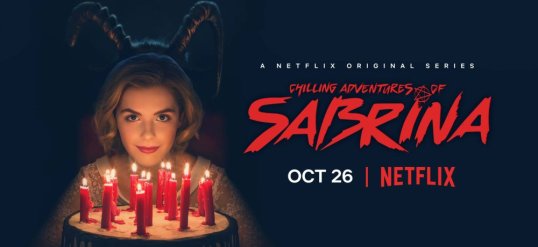
Having run out on her Dark Baptism, Sabrina Spellman (Kiernan Shipka) finds herself put on trial. She’s been accused of breaking her promise, which is one of the worst things of which a witch can be accused (Especially when that promise was made to Satan.) Even worse, she’s been informed that, in witch court, you are considered to be guilty until proven innocent. The prosecution has her signature in the Book of The Beast. Sabrina has an attorney named Daniel Webster (John Rubinstein).
As soon as I heard the name Daniel Webster, I got excited because I assumed that Sabrina’s attorney was going to turn out to be the great Massachusetts political leader who served 19 years in the U.S. Senate and as Secretary of State under three different U.S. presidents. (Webster was also the subject of a short story and film called The Devil and Daniel Webster, which is briefly referenced when Sabrina is told that Webster once beat the Devil at his own game.) But no, it turned out that Sabrina’s lawyer was just a mortal named Daniel Webster, a guilt-ridden man who once sold his soul to the Devil and asked to be made the world’s greatest attorney. As Webster explains it, he used his powers to win acquittals for the worst of the worst and it wasn’t until one of them murdered his daughter that Webster realized that everything came with a cost. At first, Webster, who is played with a haunting sadness by Rubinstein, refuses to take on Sabrina’s case but then he changes his mind. Of course, this leads to Madam Satan assuming the form of Webster’s dead daughter and trying to manipulate him into dropping the case.
Speaking of manipulation, Harvey (Ross Lynch) is being manipulated by his abusive father to abandon art and work in the mines. As Harvey explained to Sabrina, he once saw a creature of unbelievable evil living underground. Ross Lynch gave an especially good performance in this episode and he and Shipka have an amazing chemistry, as displayed in a scene in which Harvey rather sweetly checked to see if Sabrina had the Spellman “family birthmark.”
That “family birthmark” is one of the key plot points of The Trial of Sabrina Spellman. With her attorney demanding that Sabrina, as a half-human, be tried by human law, Father Blackwood (Richard Coyle) suggests that if Sabrina wants to be tried as a human then perhaps she should be forced to endure the degradation that humans have forced on witches over the years. Perhaps, he suggests, she should be tossed in a lake and she can judged by whether or not she floats. Or perhaps, she should be forced to strip naked so that she can be inspected for a witch’s mark. And, at that moment, Sabrina is every woman who has ever had her words or his wishes casually dismissed or who has ever been told that the burden of proof is on her and her alone. Sabrina is told that she can either be humiliated and degraded as a part of the mortal world or she can be a witch and essentially lose all of her freedom. For much of this episode, it appears that there is no middle ground.
Meanwhile, in the moral world, Rosalind (Jaz Walker) fights against school censorship and reveals that she’s losing her eyesight. Rosalind’s bravery inspires Sabrina but it also inspires Ms. Wardwell (who, of course, is actually Madam Satan). Ms. Wardwell announces the formation of a secret book society, which will allow her to continue to manipulate Sabrina.
Toward the end of the The Trial of Sabrina Spellman, Aunt Zelda (played by Miranda Otto) announced, “Praise Satan! I’m young again!” and again, I was reminded that I was no longer watching Melissa Joan Hart and Beth Broderick in Sabrina, The Teenage Witch. That’s not bad thing, of course. When I was growing up, I loved Sabrina, The Teenage Witch and now that I’m an adult, I’m enjoying Chilling Adventures of Sabrina. Kiernan Shipka, Mirando Otto, and Lucy Davis are all perfectly cast and Richard Coyle and Michelle Gomez are wonderfully hissable villains.
Up next is Episode 4, which is called Witch Academy. Look for my review either later tonight or tomorrow!
Young college students are dying of heart attacks and Carl Kolchak is on the case! Could it be just a coincidence? Could it be drugs? Could it be anything other than a Sumerian demon? Well, if you know Kolchak, you already know the answer to that question!
This episode originally aired on February 7th, 1975.





 Through the Shattered Lens