This song seems like a good one for Super Bowl Sunday. One team is going to win. The other team is going to have these boots walking all over them. Actually, I guess football player don’t wear boots. But maybe they’ll slip into some boots after the game is over. Who knows?
This song was written be Lee Hazlewood, who was originally planning on singing the song himself. Apparently, his version was meant to be even more aggressive than the version that was ultimately recorded by Nancy Sinatra. From Songfacts:
Hazlewood often drew inspiration for his songs from regular people. In a Blender magazine interview, he said he was in a Texas bar when some patrons started razzing an older guy about his younger girlfriend and how she controlled him. The man responded by putting his feet on a barstool and saying, “I know what you think – that she might be the boss. But I am the boss of my house, and these boots will walk all over her the day that I’m not.”
Lee had written the song for himself: “It was a party song I had written two or three years before that. It was a joke to begin with. I had written a beautiful song for her, ‘The City Never Sleeps At Night,’ and she wondered if it would sell. I replied, ‘Three times more than ‘So Long Babe,’ and that did 60,000. We’re building up your career.’ I changed my mind and put it on the back of ‘Boots’ and that sold 6 million.”
Nancy Sinatra recalled in the documentary The Wrecking Crew that Lee Hazlewood was going to record the song himself, but she talked him out of it. Said Sinatra, “When a guy sings it, the song sounds harsh and abusive, but it’s perfect for a little girl.”
Tomorrow’s the big night, as my New England Patriots go up against the tough defense of the Philadelphia Eagles in Super Bowl LII. Tom Brady and company will be going for Ring #6, and everyone here in Southern New England is super excited, looking forward to another victory celebration! I’ll be attending a huge party with plenty of food, big screen TV’s, raffles, squares, and like-minded fans, but before the festivities begin, let’s take a look at TROUBLE ALONG THE WAY, a football-themed film starring none other than Big John Wayne !
St. Anthony’s College is a struggling Catholic university run by sweet old Father Burke, who’s getting to be as decrepit as the school itself. The powers-that-be want to close his beloved St. Anthony’s, seeing how the school’s $170,000 in debt, but old Father Burke comes up with an idea. Citing Deuteronomy 32:15 (“The beloved grew fat and kicked”)…
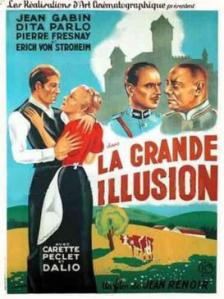
(With the Oscars scheduled to be awarded on March 4th, I have decided to review at least one Oscar-nominated film a day. These films could be nominees or they could be winners. They could be from this year’s Oscars or they could be a previous year’s nominee! We’ll see how things play out. Today, I take a look at the 1937 best picture nominee, Grand Illusion!)
A few things to consider when watching Jean Renoir’s La Grande Illusion:
It is considered to be one of the greatest French films of all time and yet, at the outbreak of World War II, it was banned by France pour la durée des hostilités. It was also banned by Nazi Germany, with Joseph Goebbles declaring it to be “Cinematic Public Enemy No, 1.” Italy followed suit, banning the film as well.
It’s a pacifist film but all of the main characters are soldiers.
It’s a war film but we never see any battles. We hear about them, of course. Characters cheer when they hear that their country has taken another town. Towards the end of the film, when a gun finally is fired, it’s jarring because it’s the first gunshot that we’ve heard throughout the entire film.
It’s a film about change, specifically the change brought about by the First World War. Captain de Boeldieu (Pierre Fresnay) may be French and Major von Rauffenstein (Erich van Stroheim) may be German but they both share the bond of being aristocrats. (After Rauffenstein captures Boeldieu, the two of them have a friendly conversation about their shared acquaintances.) Both of them serve in the army, not for ideological reasons but because they consider themselves to be patriots and tradition holds that aristocrats go to war for their countries. At the start of the film, both Boeldieu and Rauffenstein seem to be above the fighting but, in the end, both realize that the old ways — their ways — will not survive in the new world that’s being created by the Great War.
(In another scene, a group of Russian soldiers are excited to receive a care package from “the Czarina,” just to open up the box and discover that, instead of Vodka, they’ve been sent used textbooks. The soldiers respond by setting the box on fire. For audiences in 1937, it would be impossible to watch this scene without reflecting on the fact that the Czarina herself would soon be dead, executed by revolutionaries.)
Grand Illusion tells the story of three French officers, prisoners of war who hope to somehow escape and make their way to neutral Switzerland. Unlike the aristocratic Boeldieu, Marechal (Jean Gabin) is a member of the working class, a mechanic. Lt. Rosnethal (Marcel Dalio) comes from a wealthy family but, as a Jew, he is still viewed as an outsider. (Reportedly, Renoir specifically made Grand Illusion‘s most sympathetic and generous character Jewish as a specific rebuke to Nazi Germany and their policies.) It’s Rosenthal who gives meaning to the film’s title when he says, regarding the belief that the great war will end all other wars, “That’s just an illusion.”
All three of them are moved from prison camp to prison camp, until they eventually find themselves at the camp commanded by the man who first captured both Boeldieu and Marechal, Major van Rauffenstein. Rauffenstein explains that he was given his new post after being seriously wounded in combat and his movements are sometimes so stiff that he almost resembles a marionette, suggesting that war has reduced this proud man to merely being a puppet for his government’s war machine.
Grand Illusion is a film about the forgotten people who get caught up in the madness of war. The French POWs may say they want to return to the front but, when they meet a woman who has lost her husband and three brothers to the war, they are reminded that even “victory” comes with a steep price. Rauffenstein and Boeldiue may share much in common but ultimately, the only thing that the world cares about is that one is French and one is German. Grand Illusion was Jean Renoir’s eloquent plea for peace, issued a mere two years before Europe plunged into World War II.
In 1938, Grand Illusion was the first foreign-language film to receive an Oscar nomination for best picture. However, it lost to Frank Capra’s You Can’t Take It With You.
Anyone who knows me in “real life” knows that if there’s one thing I absolutely despise, it’s so-called “foodie culture.” Sure, I can appreciate the fact that there is a fair amount of artistry involved in good cooking and that a lot of chefs are doing their level best to promote worthwhile causes such as “farm to table,” eating local, etc., but come on — anyone with any sense of proportionality has to admit that the whole thing has gone too far. We’ve gone from having a couple of celebrity chefs on TV to having hundreds of the bastards, high-priced restaurants are popping up in every major city in the country in numbers that can’t possibly be sustained, food bloggers are tripping over each other for frankly lame “scoops” on the insular-bordering-on-incestuous culinary “scenes” in their towns — it’s absolutely out of control, and that’s before we even get into…
With the Super Bowl coming up tomorrow and everyone in this country currently obsessed with competition and victory, today seems like a good time to share this music video for Sleigh Bells!
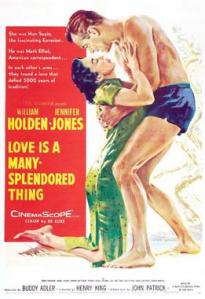
(With the Oscars scheduled to be awarded on March 4th, I have decided to review at least one Oscar-nominated film a day. These films could be nominees or they could be winners. They could be from this year’s Oscars or they could be a previous year’s nominee! We’ll see how things play out. Today, I take a look at the 1955 best picture nominee, Love Is A Many-Splendored Thing!)
Before I talk about Love Is A Many-Splendored Thing, let’s play a little trivia game.
I’m going to list ten films. Your job is to guess what they all have in common:
Did you guess? All ten of these films came out in 1955 and not a single one of them was nominated for best picture. That’s something that I found myself thinking about quite a bit as I watched Love Is A Many-Splendored Thing on TCM last night. Of course, at this point, everyone knows that deserving films are often ignored by the Academy and that what seems like a great film during one year can often seem to be rather forgettable in subsequent years.
So, you can probably guess that I wasn’t terribly impressed with Love Is A Many-Splendored Thing but, before I get too critical, I want to start things off on a positive note. William Holden was, without a doubt, one of the best actors to ever appear in the movies. He started his film career in the 1930s and worked regularly until his death in 1981. Just consider some of the films in which Holden appeared: Golden Boy, Our Town, Sunset Boulevard, Stalag 17, Sabrina, Picnic, Network, and so many others. Of course, not every film in which Holden appeared was a masterpiece. He made his share of films like Damien: Omen II and When Time Ran Out. But the thing is that, regardless of the film, Holden was always good.
That’s certainly the case with Love Is A Many-Splendored Thing. It’s not one of Holden’s better films but William Holden is his usual dependable self. He plays Mark Elliott, a rugged American correspondent who is living in Hong Kong in the 1940s. While the Chinese Civil War rages nearby, Mark deals with his failing marriage. His wife is back in the States. They’re separated but not quite divorced. Mark owns a really nice car and, since he’s played by William Holden, he delivers the most world-weary of lines with an undeniable panache. He also appears shirtless for a good deal of the film. Between this and Picnic, 1955 was the year of the shirtless Holden.
The problem with Love Is A Many-Splendored Thing is not with William Holden. Instead, the problem is with the miscasting of Jennifer Jones as Han Suyin, the woman with whom Mark Elliott falls in love. Han Suyin was a real-life person, a doctor who wrote the autobiographical novel on which Love Is A Many-Splendored Thing was based. Han Suyin was Eurasian. Jennifer Jones most definitely was not. Throughout the film, Han Suyin and Mark often discuss what it’s like to be Eurasian and to be in the middle of two very different cultures. There’s even a discussion about whether Han Suying should try to pass as European. It all has the potential to be very interesting except for the fact that Jennifer Jones, who was so good in so many films, is in no way convincing in her role. Whenever she mentions being Eurasian, which she does frequently, the film come to a halt as we all stare at Jennifer Jones, one of the first film stars to ever come out of Tulsa, Oklahoma.
It all leads to a rather strained movie, one that never really drew me into its cinematic world or story. (For the record, a lot of people on twitter disagreed with me on this point.) Ultimately, the main reason to watch it was for William Holden. According to the film’s Wikipedia entry (how’s that for in-depth research), Holden and Jones reportedly did not get along during filming, with Jones apparently chewing garlic before their love scenes and there was a definite lack of chemistry between them. Maybe I got spoiled by William Holden and Kim Novak dancing in Picnic but I never believed that Mark and Han Suyin were attracted to each other. Interestingly, Jones and Holden would later both appear in another best picture nominee, 1974’s The Towering Inferno. However, they didn’t share any scenes.
Love Is A Many-Splendored Thing was nominated for best picture but it lost to a far different love story, Marty. This was also the final film directed by Henry King to be nominated for best picture. Previous King films to be nominated included State Fair, In Old Chicago, Alexander’s Ragtime Band, The Song of Bernadette, Wilson, and Twelve O’Clock High.
I have to admit that when this video started, I assumed that everyone would eventually turn out to be a vampire. I’ve seen enough horror movies to know that vampires always dance in clubs where the lights are tinted red.
Well, regardless of whether the video directly confirmed my suspicions or not, I still believe everyone in this video is meant to be undead. That’s my interpretation and when have I ever been willing to change my mind about anything?
On a serious note, I like this video. It has a dream-like feel to it. As far as I can tell, this is first video that Ryan Ford is credited with directing and visually, it’s very impressive. I look forward to more work from this director.
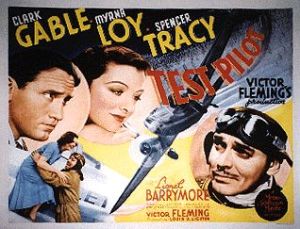
(With the Oscars scheduled to be awarded on March 4th, I have decided to review at least one Oscar-nominated film a day. These films could be nominees or they could be winners. They could be from this year’s Oscars or or they could be a previous year’s nominee! We’ll see how things play out. Today, I take a look at the 1938 best picture nominee, Test Pilot!)
Test Pilot is all about charisma.
It tells a fairly simple story. I imagine that the plot seemed just as familiar in 1938 as it does in 2018. Jim Lane (Clark Gable) is a test pilot. In the early days of aviation, long before people took the idea of flight for granted, Jim Lane is a hero and celebrity. Whenever a new aviation technique is developed, Jim is the one who tests it. He’s the one who makes sure that it’s safe. Every day, when Jim goes to work for Mr. Drake (Lionel Barrymore), there’s a chance that he might not make it home. Not surprisingly, he’s cocky, reckless, and not prone to commitment. He’s also handsome, charming, manly, and quick with a quip. In short, he’s Clark Gable.
When the movie starts, Jim has only one real friend. Gunner (Spencer Tracy) is his mechanic. Gunner is a by-the-book, no-nonsense professional. He might enjoy a drink every now and then but Gunner knows his job and he knows his planes and, even more importantly, he knows Jim. Gunner’s a man of unimpeachable integrity, the type who will always call things as he sees them. In short, he’s Spencer Tracy.
One day, while on a test flight, Jim is forced to make an emergency landing on a farm in Kansas. That’s where he meets Ann Barton (Myrna Loy). Ann is beautiful and outspoken. She quickly proves that she can keep up with Jim, quip-for-quip. In short, she’s Myrna Loy and, before you know it, she and Jim are in love. Just as quickly, Jim and Ann are married.
The movie starts out as a bit of domestic comedy. Jim may know how to fly a plane but it quickly becomes obvious that he doesn’t know much about commitment or being a husband. When Jim attempts to buy his wife a nightgown, he doesn’t even know how to pronounce the word lingerie. (He asks a store clerk for help in finding the “lonjur department.”) However, Jim soon starts to find that married life agrees with him.
Of course, that’s a problem when your job requires you to defy death on a daily basis. Ann worries that Jim is going to go to work and never come home, fears that are intensified after a race with another airplane ends in a terrible and (for the other pilot) fatal crash. Gunner, meanwhile, starts to fear that there’s only so many times that Jim can cheat fate. Both Ann and Gunner promise that they will never leave Jim’s side.
Well, you can probably already guess everything that’s going to happen. Test Pilot is not exactly the most narratively adventurous movie ever made but, when you’ve got Gable, Tracy, Loy, and Barrymore all in the same film, you don’t really need to break any new ground, storywise. Test Pilot is an example of the power of pure movie star charisma. It’s watchable because the performances are just as entertaining today as they were in 1938. The film features Gable doing what he did best and Tracy doing what he did best and Loy and Barrymore all doing what they did best. In this case, that’s more than enough.
When it comes to the film’s numerous flight sequences, it’s perhaps best to try to put yourself in the shoes of someone seeing the film in 1938. Today, of course, we’ve been spoiled by CGI. We tend to assume that literally anything can happen in a movie. In the 30s, however, people couldn’t take special effects for granted. When they watched the flight footage in Test Pilot, they did it with the knowledge that it was filmed by people who actually were putting their lives at risk to get it. At a time when commercial aviation was considered to be a luxury, Test Pilot provided audiences with a view of the world in the sky and of the world below, a view that they probably wouldn’t have gotten a chance to see otherwise.
A huge box office success, Test Pilot was nominated for best picture but lost to another film featuring Lionel Barrymore, Frank Capra’s You Can’t Take It With You.






 Through the Shattered Lens