
Artist Unknown
Artist Unknown
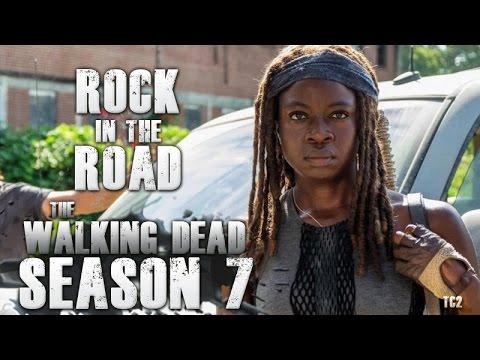
Well, The Walking Dead is back and again, I am going to try to watch and review each episode for the Shattered Lens. You may remember that I attempted to do this during the first half of season 7. I reviewed the first five episodes of the new season and then…
Well, how to put this?
I got bored.
Seriously, I tried to make excuses for the glacial pace of season 7. I kept telling myself that it was actually a brilliant narrative decision. I defended the controversial first episode and I’ll continue to do so. I enjoyed the second episode, largely because of the tiger. But, after that, I started to get bored. Each episode introduced us to a new community of boring people. Each episode featured a lot of conversation but little action. And what little action there was regularly interrupted by Negan popping up and screaming for half an hour. As much as I like character development and conversation, this is a show about the end of the world. There’s only so much time that I can spend watching Rick look depressed.
And so, after five episodes, I gave up on the first half of season 7. It was just too slow and the show was spending so much time on what a badass Negan supposedly was that the zombies had become an afterthought. Did season 7 really need a special 90 minute episode of Negan acting like a dick? I still watched the show but mentally, I checked out. And, judging by how the ratings cratered between the 1st episode (8.7 million viewers) and the 8th episode (5 million viewers), I was not alone in being dissatisfied.
But, in the break between the end of the first half of season 7 and tonight’s return, I’ve had time to recover. Today, as I debated whether to actually watch the new episode of The Walking Dead, I considered that this show has hit rough spots in the past. It’s never been a perfect show. I wasn’t a huge fan of season 1 and, in later seasons, I thought they spent way too much time at Herschel’s farm. But, in the past, when The Walking Dead has needed to deliver, that’s exactly what it’s done. In short, I decided to give The Walking Dead a second chance.
And, having just watched tonight’s episode, I’m glad that I did. Rock in the Road was a good episode. In fact, it may have been the best episode since The Well. There were still flaws, of course. As any true Walking Dead fan knows, this show has always been uneven. The Walking Dead is a gloriously imperfect show but, at its best, it’s the type of show that can almost make those flaws seem admirable. It’s easy to get frustrated with The Walking Dead‘s leisurely pace and rambling narrative. But, ultimately, that leisurely pace has also led to some of The Walking Dead‘s most resonant moments.
Much like every other episode so far in season 7, Rock in the Road told its story slowly but, at the same time, it at least had a destination in mind. Rick has finally snapped out of his self-pity and is now trying to build an alliance to fight Negan and the Saviors. As this episode showed, it won’t necessarily be easy. But, at least Rick is actually trying to do something!
There are several reasons why Rock in the Road was a noticeable improvement over the first half of the season. Here’s a few:
I was really happy with Rock in the Road. In fact, I’m happy enough to actually watch next week as well. Hopefully, this episode will be the start of season 7’s redemption.
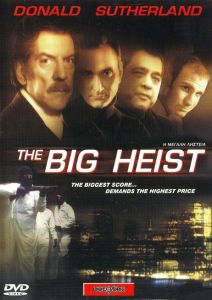 In 1978, low-level mob associate Jimmy Burke (Donald Sutherland) is released after serving a six years in prison. As soon as he arrives home, he discovers that his son, Frank (Jamie Harris), has failed to keep up with the family business and that the Burke Crew is close to becoming a joke. Looking for a big score, Jimmy masterminds a robbery at John F. Kennedy International Airport. The so-called Lufthansa Heist becomes the largest cash robbery committed on American soil at that time. Growing paranoid, Burke decides it would be easier to just kill all the members of his crew than to give them their cut of the robbery. What Burke doesn’t realize is that his closest associates are destined to be his downfall. Tommy DeSimone (Rocco Sisto) has offended John Gotti (Steven Randazzo) while Henry Hill (Nick Sandow) has become hooked on drugs and is considering turning informant.
If all this sounds familiar, that’s because part of this story was already told in Goodfellas. The Big Heist was made for TNT and, because it focuses exclusively on the robbery, it goes into far more detail than Martin Scorsese’s film. For instance, the character of Frank Burke was entirely left out of Goodfellas and it’s interesting to see how much more negatively Henry Hill is portrayed in The Big Heist. Since it’s told from the viewpoint of Jimmy Burke instead of Henry Hill, The Big Heist makes for an interesting companion piece to Goodfellas but, at the same time, it never escapes the shadow of the other film. With both movies employing voice over narration and frequent freeze frames, it’s impossible to watch The Big Heist without comparing it to Goodfellas. Since Goodfellas was made by Martin Scorsese and The Big Heist was made for TNT, the former comes out on top.
It’s also hard to watch Donald Sutherland as Jimmy Burke without comparing his performance to Robert De Niro’s Jimmy Conway. Though he never reaches the heights of De Niro’s performance, Sutherland is convincing as a sociopathic criminal mastermind. Less convincing are Rocco Sisto and Nick Sandow, who both struggle to make an impression in roles previously made famous by Joe Pesci and Ray Liotta.

If you’re a regular reader of this site, it will not take you by surprise to learn that the 1933 Best Picture Nominee, 42nd Street, is one of my favorite films of all time.
I mean, how couldn’t it be? Not only is it a pre-Code film (and we all know that pre-Code films were the best) and one the features both Ginger Rogers and Dick Powell in early roles but it’s also a film that depicts the backstage world of a stage musical with such a combination of love and snark that it will be familiar to everyone from community theater nerds to Broadway veterans. 42nd Street is a classic musical, though I have to admit that I think the majority of the songs are a bit overrated. Even more importantly, 42nd Street is the ultimate dance film. The film’s big production number, choreographed and filmed in the brilliant and flamboyant Busby Berkeley style, is such an iconic moment that it’s still being imitated and lovingly parodied to this day.
Every dance movie owes a debt to 42nd Street but few have come close to matching it. Remember how much we all hated Smash? There were a lot of reasons to hate Smash but the main reason was because it tried to be 42nd Street and it failed. There can only be one 42nd Street.
It’s hard to estimate the number of show business clichés that currently exist as a result of 42nd Street. Then again, it can be argued that they were clichés before they showed up in 42nd Street but 42nd Street handled them in such an expert fashion that they were transformed from being urban legends to immortal mythology.
42nd Street takes place in the backstage world, following the production of a Broadway musical through casting to rehearsals to opening night. It’s an ensemble piece, one populated by all the usual suspects. Julian Marsh (Warner Baxter) is the down-on-his-luck producer who desperately needs a hit. Dorothy Brock (Bebe Daniels) is the celebrated star who is dating a rich, older man (Guy Kibbee, who made quite the career out playing rich, older men) while secretly seeing her ex, a down-on-his-luck Vaudevillian (George Brent). From the minute that we first see Dorothy, we know that she’s eventually going to end up with a boken ankle. It’s just a question of which chorus girl will be promoted to take her place. Will it be “Anytime” Annie (Ginger Rogers) or will it be the naive and wholesome Peggy (Ruby Keeler)? You already know the answer but it’s still fun to watch.
If you had any doubts that this was a pre-code film, the fact that Ginger Rogers is playing a character named “Anytime” Annie should answer them. 42nd Street is often described as being a light-hearted camp spectacle but there’s a cynicism to the film, a cynicism that could only be expressed during the pre-code era. The dialogue is full of lines that, just a few years later, would never have gotten past the censors.
(This is the film where it’s said that Anytime Annie “only said no once and then she didn’t hear the question!” This is also the film where Guy Kibbee cheerfully tells Annie that what he does for her will depend on what she does for him. Just try to get away with openly acknowleding the casting couch in 1936!)
The menacing shadow of the Great Depression looms over every glossy production number. Julian needs a hit because he lost all of his money when the Stock Market crashed and if the show is not a hit, everyone involved in the production will be out on the streets. The chorus isn’t just dancing because it’s their job. They’re dancing because it’s an escape from the grim reality of the Great Depression and, for the audience watching, the production numbers provided a similar escape. 42nd Street said, “Yes, life is tough. But sometimes life is fun. Sometimes life is sexy. Sometimes, life is worth the trouble.” Someday, 42nd Street promises, all the misery will be worth it.
Ultimately, 42nd Street is all about that iconic, 20-minute production number:
42nd Street was nominated for best picture but it lost to the nearly forgotten Cavalcade.
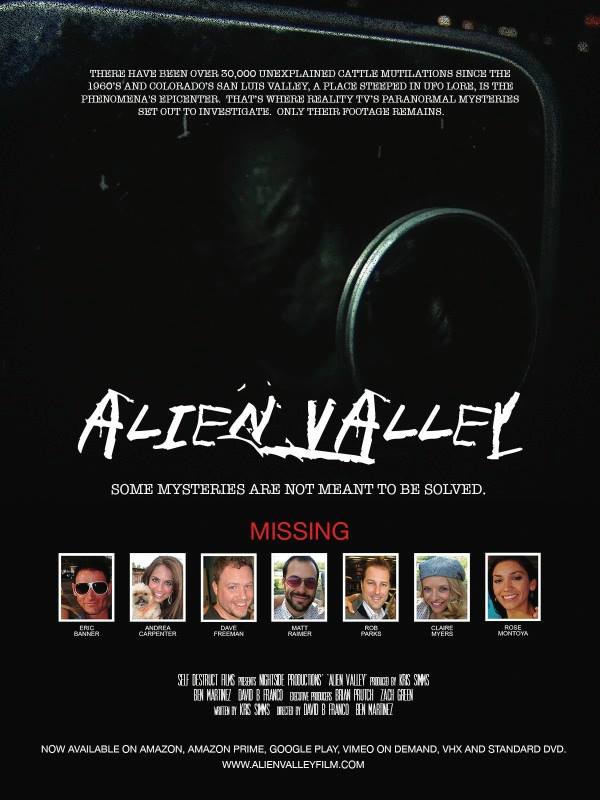
I’m noticing something of a trend in some of the “found footage” horrors I’ve been watching lately — a rather hum-drum and predictable (if not dull as dry toast) opening two acts, appended by a surprising, perhaps even amazing, third act that almost makes putting up with all the earlier crap worth it. Such was certainly the case with Adam Wingard’s 2016-released Blair Witch, and the pattern largely holds for the next film in the subgenre that I watched (courtesy of Amazon Prime streaming, although I understand it’s also available on standard DVD), 2012’s micro-budget effort from co-directors Ben Martinez and David Benjamin Franco, Alien Valley.
As far as set-ups go, they don’t come much more bog-standard than this : the crew from the supposedly-popular “reality” TV show “Paranormal Mysteries” (hence this film’s alternate — and thoroughly uninspired — title, P.M.) have “gone missing” after heading…
View original post 571 more words
I can’t disagree with Bo Diddley. He was in Rockula (1990) after all. Then again, Toni Basil and Thomas Dolby were in it too, so he was in good company.
As far as I know, this is the only music video that Bo Diddley ever did. Those are The Shirelles singing backup vocals. I like that Bo Diddley didn’t do the typical old musician music video. You know, those videos that show some 20-40 year-olds acting out the meaning of the lyrics with occasional cutaways to the older musicians. Bo Diddley is right up front and as nutty as ever. I love the color scheme too. This would have been right at home with the bright color music videos of the mid-1990s. I also appreciate the little history lesson with the old photos of Bo and the Apollo Theater.
Yes, I did notice Diddley’s square guitar fly between the Twin Towers. It’s hard to miss.
This music video was directed and edited by Simeon Soffer. He did the same for about 15 other videos. This doesn’t happen often when I do these posts, but Soffer went on to be nominated for an Oscar for Best Documentary, Short Subjects for the film The Wildest Show In The South: The Angola Prison Rodeo (1999).
This was produced by Mike Alfieri. I can’t find any other work he has done.
Enjoy!

Artist Unknown
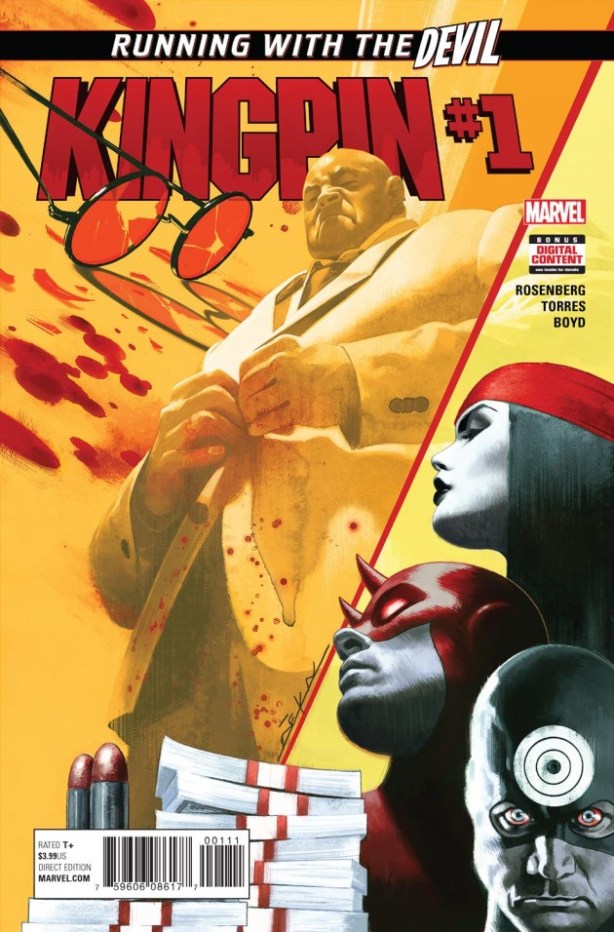
After giving Bullseye #1 a richly-deserved rough time of it in my review last week, I was leaning pretty heavily towards giving the rest of Marvel’s “Running With The Devil” titles a pass, but some nagging little voice in my head told me that Kingpin would probably be worth at least an initial $3.99 investment. Okay, fair enough, Matthew Rosenberg’s earlier Civil War II : Kingpin series was generally savaged by critics (to the point where I stayed away), but I chalk that up to the fact that all “event” tie-ins are garbage weighed down by a shit-ton of editorial mandates — surely free of these constraints, the writer behind 4 Kids Walk Into A Bank and We Can Never Go Home can give us a decent crime story, don’tcha think?
Jeff Dekal’s cover doesn’t necessarily inspire a ton of confidence — he’s been absolutely killing it over on Hulk
View original post 540 more words

I just finished watching the latest Lifetime original film, From Straight A’s to XXX.
Like many Lifetime films, it’s based on a true story. In this case, it tells the story of Miriam Weeks (Haley Pullos), who briefly became notorious for paying her tuition to Duke University by appearing in adult films under the name Belle Knox. Her story became notorious because it touched on almost every important cultural issue of the past twenty years. Stuffy pundits acted as if Belle Knox was somehow a sign of the collapse of civilization. The story was regularly held up as a sign that my generation was spoiled and entitled, which was interesting since Miriam wouldn’t have ever made her first movie if college was actually affordable. That’s one issue that, interestingly enough, was rarely brought up in all the discussions about the Duke porn star. If students are having to do pornography to pay for college, shouldn’t the question be why it costs so much to get an education?
As for Belle Knox herself, she became a media celebrity. She was interviewed by people like Piers Morgan and she proved herself to be quite adroit at putting that windbag in his place. Rather than asking for sympathy, Belle defended herself and asked a very important question: why was the stigma of porn on her, as opposed to the men who watched her?
From Straight A’s to XXX does a good job telling Belle’s story. Interestingly enough, it actually goes out of its way to be fair and evenhanded. While the film is on Belle’s side, it doesn’t dismiss those who had concerns about how she was paying her way through college. While Belle is shown defending herself to the media and explaining how her career has empowered her, the film also makes a point to show that not every porn actress is Belle Knox. At one convention, she’s confronted by two veteran porn actresses who point out that they work just as hard as she does but, unlike her, they will never be invited to appear on CNN, suggesting that the only reason anyone cares about her or what she thinks is because of the novelty of her being a student at Duke. And while this may be the most pro-porn film to ever appear on Lifetime, it doesn’t shy away from the dark side of the industry. Belle’s first job is a genuinely disturbing nightmare of abuse and serves as a valuable warning. Make sure you know who you’re working with before you show up for the job. As a producer later explains to Belle, there are professionals and unprofessionals in every industry and porn is no different.
As for Duke University — well, let’s just say that Duke doesn’t come across as looking all that good by the end of From Straight A’s to XXX. With a few notable exceptions, all of the students are portrayed as being rich snobs. When Belle’s secret life is discovered, she finds herself harassed by every man on campus. In one particularly disturbing scene, she returns to her dorm room just to discover that her door has been defaced. When she tries to sleep, drunk frat boys try to break into her room. When she reports that she’s being harassed, she gets little help. Her roommate remains supportive throughout the entire film but otherwise, Duke does not come across well.
From Straight A’s to XXX is well-directed by Vanessa Parise, who has also directed such Lifetime films as Perfect High and The Unauthorized Beverly Hills 90210 Story. Much like The Unauthorized Beverly Hills 90210 Story, From Straight A’s to XXX is a tribute to a strong woman who was ultimately punished for being stronger than others were comfortable with. (That From Straight A’s to XXX was written and directed by women goes a long way to keeping potentially salacious material from becoming sordid.) Haley Pullos is sympathetic as Miriam/Belle and a bearded Judd Nelson does a good job in the role of a porn producer who shows the difference between professionals and unprofessionals in the industry.
Finally, From Straight A’s to XXX ends with Belle becoming a Libertarian activist and that fact alone makes this one of the best Lifetime films of the year so far! You can’t go wrong with any film that ends with a Libertarian political rally.
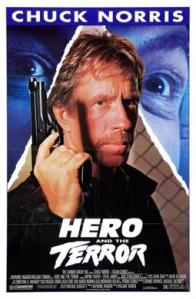 Danny O’Brien (Chuck Fucking Norris!) is a tough Los Angeles cop who has been nicknamed Hero. Danny hates it when people call him “Hero.” Maybe if Danny knew what people usually call cops, he would not complain so much about his nickname. Three years ago, Danny captured Simon Moon (Jack O’Halloran), a neck-breaking serial killer nicknamed “The Terror.” After he was captured, The Terror faked his own death and disappeared. He ended up living in a deserted theater and not bothering anyone until the Mayor of Los Angeles (Ron O’Neal, Superfly himself!) decides to tear down his new home. The Terror does not take kindly to urban renewal and goes on another killing spree. Can Hero track down and beat the The Terror while also making it to the hospital in time to see his girlfriend give birth to their baby?
Not surprisingly, Hero and the Terror is one of the films that Chuck made for Cannon Films in the late 80s and, along with Chuck and Ron O’Neal, it features Cannon regulars Steve James and Billy Drago. (Billy Drago actually plays a good guy, for a change.) It’s obvious that Chuck was trying to broaden his horizons with Hero and the Terror: with the exception of the final confrontation between Hero and the Terror, there’s less kung fu action than in his previous films and a lot of the movie is dedicated to his relationship with his girlfriend and his struggle to handle her pregnancy. That’s all good and well and the Chuck Norris of Hero and The Terror is a much better actor than the Chuck Norris who could barely deliver his lines in Breaker, Breaker but, ultimately, a Chuck Norris movie with more human interest and less roundhouse kicks just feels wrong.
(On Netflix, there’s a whole documentary about how Chuck Norris’s roundhouse kicks led to the collapse of Nicolae Ceaușescu’s communist dictatorship in Romania. It’s called Chuck Norris vs. Communism. Communism didn’t have a chance. Hopefully, Chuck will never turn against capitalism because, if he does, it’ll probably lead to another stock market crash.)
I once read an interview with Gene Hackman, in which he was asked to name his least favorite of the movies that he had made. Hackman selected March or Die. “I can’t believe I was in something called March or Die,” Hackman said. If he thought March or Die was a bad title, he should be happy that he didn’t end up in Hero and The Terror. Give Chuck Norris credit. Even if he’s not Gene Hackman and even if the movie does not really work, he is the only actor who could credibly star in something called Hero and the Terror.

 Through the Shattered Lens