This October, I’m going to be doing something a little bit different with my contribution to 4 Shots From 4 Films. I’m going to be taking a little chronological tour of the history of horror cinema, moving from decade to decade.
Today’s Horror on the Lens is the 1959 Roger Corman film, Wasp Woman!
In this film, Janice Starlin (Susan Cabot) is the head of a cosmetic company. When she discovers that her sales are suffering because the public has noticed that she is getting older, Janice does what any dedicated CEO would do! She agrees to undergo a radical treatment involving the royal jelly taken from a queen wasp.
Do you think this treatment will make Janice look younger?
Or will it lead to her periodically transforming into a monstrous creature?
We had some fun the past couple of days watching Carman kill Satan and banish movie monsters from his house, but now it’s time for the Rapture.
I’m sure people know the historical significance of this particular music video by now, but I’ll restate it anyways. In the very early days of MTV, they rarely let blacks appear on the network. They of course had accusations of racism thrown at them. Thinking about it now, it was probably that they were operating on the fringe so much that they figured what little audience they had would go away, and they’d go under based on the demographics information they had. That’s my best guess considering it just took Michael Jackson having a big hit with them to get rid of that. However, during that period, this meant that Rapture by Blondie wound up being the first rap music video aired on the network.
As is often the case, Wikipedia has some good information. The music video was set in the East Village section of Manhattan. That’s exactly what it says over on Wikipedia. I’m not sure if that means it was actually shot there or not.
William Barnes was the guy in the long white suit referred to as the “Man from Mars”. According to IMDb, he went on to work on localizing video games such as Mario Party 5. He also choreographed the music video.
Graffiti artists Lee Quinones and Jean-Michel Basquiat make cameo appearances. Basquiat was hired after Grandmaster Flash didn’t show up for the filming.
Rapper Fab Five Freddy not only is mentioned in the lyrics of the song, but also made a cameo in the music video.
Wikipedia also mentions that much of the outside portions of the music video were shot in one take.
Keith MacMillan directed and John Weaver produced this music video. They both seem to have primarily worked on music videos for Kate Bush, but also did some work for Motörhead. The two as a team went by the name Keef. You can find Keith MacMillan under that name on IMDb. He has also used the name Marcus Keef. John Weaver on the other hand is buried under so many people with his name that I don’t even know if he is there. There are only two that have anything of note in their credits. One worked in the art department on three Playboy movies, and another was a director on the TV Show Dark Shadows.
Enjoy! I always do anytime we get somebody predicting the world will end on a particular day and time.
For tonight’s excursion into the world of televised horror, we have the 10th episode of the 2nd season of Tales From The Crypt! This episode, which originally aired on June 5th, 1990, is called The Ventriloquist’s Dummy!
Who doesn’t love a creepy ventriloquist story? And this is certainly a creepy one, with an ending that you’ll either love or hate.
This episode was directed by Richard Donner and written by future Shawshank Redemption director and Walking Dead showrunner, Frank Darabont!
First off, the 1973 Spanish horror film, The Return of the Evil Dead, is in no way connected to Sam Raimi’s Evil Dead films. Bruce Campbell never shows up in The Return of the Evil Dead and that’s unfortunate because the villagers who are menaced in this film probably could have used some help from Ashley James Williams.
Instead, The Return of the Evil Dead is a film that, over the years, has been known by many names: Attack of the Blind Dead, Return of the Blind Dead, Mark of the Devil 5: Return of the Blind Dead, and Night of Blind Terror. It’s usually referred to as being a sequel toTombs of the Blind Dead but that’s not quite true. Instead, it’s more of a reimagining.
The film opens, as do almost all of the entries in this franchise, with a retelling of the origin of the Blind Dead. In Tombs of the Blind Dead, the Knights Templar were accused of heresy and hung, just to then have a bunch birds peck out their eyes. In Return of the Evil Dead, the Templars are once again pillaging Europe, sacrificing virgins, and practicing witchcraft. However, this time, they are captured by a group of Portuguese peasants. After being bound in the village square, the Templar leader announces that someday, he and his compatriots will return from the dead and seek vengeance on the village. The villagers respond by using a torch to burn out his eyes.
Jump forward 500 years. The village is preparing to celebrate the anniversary of what they call “the Burning.” We watch as they prepare for the festival and joke about the legend that the Templars will rise from their graves and spend the night seeking revenge. Murdo (José Canalejas), who is known as being the town pervert, watches the preparations and is suddenly attacked by a group of rock-throwing children. When Murdo falls to the ground, the children start to kick him. When Monica (Loreta Tovar) steps in and runs off the children, her boyfriend asks her why she’s wasting her time defending Murdo. Murdo, meanwhile, scurries off.
Meanwhile, the town’s mayor (Fernando Sancho) meets with Jack Marlowe (Tony Kendall). Jack has been hired to supervise the festival’s firework show and the mayor promptly tries to cheat him out of his payment. Jack discovers that the Mayor’s fiancée is his ex-girlfriend, Vivian (Esperenza Roy). Meanwhile, the mayor’s henchmen stand in the background and grimly watch.
In short, it appears that the village is cursed even before the inevitable return of the Blind Dead. And, in these scenes, it’s important to remember that, for the first half of the 1970s, Spain was still ruled by a dictator named Francisco Franco. It’s not difficult to see the village and its villagers as a metaphor for the Franco regime. Director Amando de Ossorio admitted as much when, in an interview before his death, he described Return of the Evil Dead as being the most political of all the Blind Dead films.
Naturally, the Templars do eventually return. Tired and bitter after years of being persecuted by the other villagers, Murdo sacrifices a young townswoman. As her blood pours over the graves of the Templars, the ground starts to shake and the Blind Dead come back to life and, once again, lay siege on the town.
The Blind Dead are still moving in slow motion and are just as decayed and deadly here as they were in Tombs of the Blind Dead. Interestingly enough, the scene where they ominously knock on the door of an isolated house was later recreated in John Carpenter’s The Fog. In fact, the entire film has quite a lot in common with The Fog, right down to the final siege on the church.
So, which is better? Tombs of the Blind Dead or Return of the Evil Dead? To a certain extent, it depends on what you’re looking for. Return of the Evil Dead is faster paced than Tombs of the Blind Dead and Jack and Vivian are far more likable than the leads from Tombs. As previously mentioned, Return has a stronger political subtext than Tombs. However, speaking for myself, I prefer the more atmospheric and fatalistic Tombs.
But ultimately, both Tombs of the Blind Dead and Return of the Evil Dead are superior horror films, perfect for Halloween viewing.
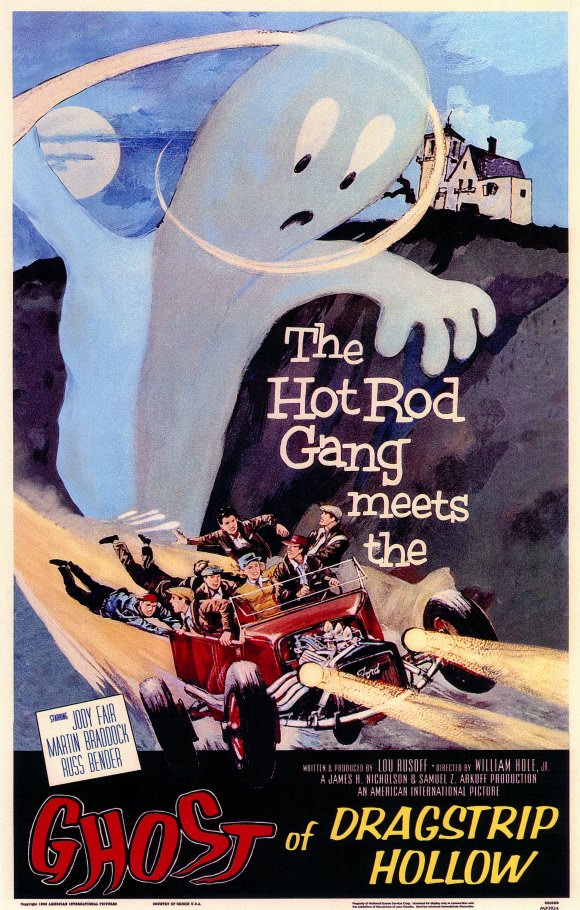
Hey all you Halloween hepcats and creepy chicks! Are you ready for THE GHOST OF DRAGSTRIP HOLLOW? And by ready I mean prepared to watch a really lousy movie redeemed only by the in-joke twist ending that’s sure to please horror fans. All you’ve got to do is slog through the rest of this nonsense… so let’s slog on!
THE GHOST OF DRAGSTRIP HOLLOW is a sequel of sorts to HOT ROD GIRL, and starts off as your basic hot rod drive-in flick. Pretty young Lois Cavendish is a member of the Zenith Club, a group of hot rod enthusiasts being interviewed by magazine writer Mr. Hedley. Lois gets busted drag racing against her rival Nita, and her parents (who just don’t understand) ground her. This means she’s gonna miss the big wing-ding at the club Saturday night, but not to worry… Mom suggests moving the party to their house…
No, not Victor von Frankenstein, though he certainly suffered greatly for playing God. How much he suffered depends on which version of the story you see or read. If you’ve read the book, you know that Victor lost his family, his love, his mentor, his best friend, and eventually his own life. Victor is usually a bit more resilient in the films. For instance, if you go by what we’ve seen in the Hammer films, Baron Frankenstein was pretty much indestructible. The only thing he lost was his sanity, sacrificed as he continually insisted on making the same mistake over and over again.
And when I say “Pity poor Frankenstein,” I’m not referring to the monster either, though he certainly deserves some sympathy as well. The monster never asked to be brought to life. He may have destroyed castles and killed people and tossed little girls into a lake but Frankenstein’s Monster rarely seemed to mean any harm. He was just scared, confused, and often abused.
Instead, when I say pity poor Frankenstein, I’m referring to the 1931 film. It’s a classic horror film, one that, after 85 years, still holds up remarkably well. It’s probably the best directed of all the Universal horror films, with James Whale bringing his own dark wit and idiosyncratic style to the film. As was often the case with films of the era, some of the performances are better than others but no one can find fault with Boris Karloff’s definitive portrayal of Frankenstein’s monster.
And yet, for a lot of filmgoers, Frankenstein will always just be that movie where Colin Clive rants, “It’s alive! IT’S ALIVE!” That scene is justifiably famous but it always bothers me when it shows up as an isolated clip, devoid of context. I’ve seen it used in documentaries. I’ve seen it used on snarky news programs where it’s almost always used to poke fun at someone. I’ve even seen it used in a car commercial.
You’ve seen it too. It’s one of those scenes that everyone has seen, regardless of whether or not they’ve sat through the entire movie:
When you watch this scene without any context, it’s easy to smirk. You might assume that the entire film is Colin Clive ranting and Dwight Frye snorting. It’s only after you’ve seen the entire film that you appreciate Clive’s performance. Throughout the entire first part of the film, Colin Clive plays Henry Frankenstein as being unstable but also rather withdrawn. He’s almost vampiric, hiding inside of his laboratory all day and only coming out at night to rob graves with the hunchbacked Fritz (Dwight Frye). He’s almost a recluse, which is why his fiancée, Elizabeth (Mae Clarke) asks his best friend, Victor (John Boles), and his mentor, Dr. Waldman (Edward Van Sloan, who also played Van Helsing in Dracula) to check in on him.
When the monster does move its hand and Clive shouts, “It’s alive!,” it’s the first sign of true emotion that Frankenstein has shown through the entire film. He’s spent a lifetime dreaming of playing God and, now that he has, it overwhelms his mind. Much like poor Ralph Norton in The Mummy, Clive sees something that defies all reason and he has a breakdown.
I have to admit that, for me, the first third of the film drags. That may not have been as much of a problem in 1931, when audiences were seeing the story for the first time and didn’t already know what was going to happen. In 1931, the slow start undoubtedly helped to build up suspense. But, when seen today, there is a temptation to say, “Get on with it!”
(Of course, I tend to say that with all Frankenstein movies, because I’m impatient and there always seems to be an endless number of scenes people digging graves and stealing brains until we finally get to the good part. If anything, the 1931 Frankenstein doesn’t take as long to get going as some of the later Hammer films, many of which treated the monster as almost an afterthought.)
Fortunately, Frankenstein does get on with it. When the monster finally comes to life and Colin Clive has his moment of divine madness (“This is what it feels like to be God!”), the film shifts in tone. If anything it becomes a bit of a dark comedy. Henry (who is noticeably more subdued after his outburst, a bit like a drug addict who is only now starting to come down after being awake for a week) and his friends now have to not only hide the monster but try to figure out how to deal with it. Every few minutes, it seems like another villager or Frankenstein relative is dropping by the castle. Having created life, Henry now has no idea what to do with it. Being God isn’t as easy as it looks. Having created life, all Henry can now do is keep the doors locked and attempt to go back to living a relatively normal life. In this case, that means preparing for his wedding.
It’s not until the sadistic Fritz torments the frightened monster with a torch that this horror classic truly becomes a horror film. And it’s significant that the true monster here is not Frankenstein’s Monster but instead Fritz. When the monster kills Fritz, he does it out of self-defense. When he strangles Dr. Waldman, it’s because Waldman was about to cut into him with scapel.
And then there’s the little girl. How this scene must have shocked audiences in 1931! It’s still shocking today, because we’re not used to children dying in movies, not even horror movies. Of course, the monster doesn’t mean to hurt the girl. The girl is the first person to show the monster any sort of kindness. It’s just that the monster doesn’t understand that the girl won’t float like the flowers.
The sequence where the girl’s father carries her body into the town square is perhaps one of the most devastating ever filmed. Not only does the father’s grief contrast with the happiness of the villagers but it also contrasts with the attitude of Henry and Elizabeth who are busy preparing from their wedding, ignorant of what Henry’s creation has done.
Or, at least, they are until the monster confronts Elizabeth in her bedroom.
I love that dress.
It all ends, of course, with a confrontation between Henry and his monster and a windmill being set aflame. There’s also a happy coda that, in the best tradition of horror, feels a bit tacked on. Fortunately, those of us who know our film history know that the story didn’t end with this film. It continued with The Bride of Frankenstein, which I’ll be reviewing tomorrow.
As for Frankenstein, it’s a classic and it’s pretty much required viewing for any film lover. Boris Karloff’s performance as the confused and often child-like monster is both poignant and menacing. Watching the film, you just wish that the world had been nicer to him.
(Then again, that approach didn’t exactly work out well for the little girl with the flowers…)
Frankenstein is so much more than just Colin Clive shouting, “It’s alive!” If you haven’t actually sat down watched the entire movie from beginning to end, you owe it to yourself to do so today.
This October, I’m going to be doing something a little bit different with my contribution to 4 Shots From 4 Films. I’m going to be taking a little chronological tour of the history of horror cinema, moving from decade to decade.
Today, we take a look at the latter half of the 1920s.
4 Shots From 4 Films
The Phantom of the Opera (1925, dir by Rupert Julian)
Faust (1926, dir by F.W. Murnau)
London After Midnight (1927, dir by Tod Browning)
The Fall of the House of Usher (1928, dir by Jean Epstein)




 Through the Shattered Lens