After I finished writing my review of Rolling Thunder, I continued the process of cleaning out my DVR by watching the 1969 film, Anne of the Thousand Days. How does a film like Anne of the Thousand Days compare to a film like Rolling Thunder?
They might as well have been conceived, written, directed, and released on different planets.
I recorded Anne of The Thousand Days off of TCM on March 26th. The main reason that I set the DVR to record it was because Anne was a best picture nominee. It may seem strange to think that this rather conventional film was nominated the same year as Butch Cassidy and the Sundance Kid, Z, and Midnight Cowboy. It gets even stranger when you consider what wasn’t nominated that year: Medium Cool, If…, Last Summer, They Shoot Horses, Don’t They?, Alice’s Restaurant, The Wild Bunch, Once Upon A Time In The West, and a long list of other films. In fact, if I wanted to, I could probably spend this entire review listing all of the 1969 films that feel like a more appropriate best picture nominee than Anne of the Thousand Days.
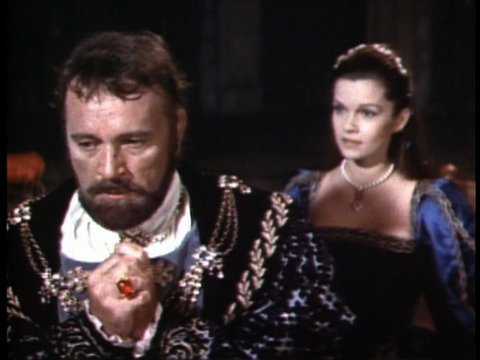
And yet, Anne was nominated for best picture. In fact, it received a total of 10 Oscar nominations, the most of any film that year. Tellingly most of the nominations were in the technical categories and the only Oscar that it won was for its costumes. Genevieve Bujold received a nomination for playing the title character and Richard Burton became the third actor to receive a nomination for playing King Henry VIII.
As for the film, Anne of the Thousand Days tells the oft-told story of King Henry VIII and his marriage to Anne Boleyn. Told in flashback as both Henry and Anne wait for her to be executed on charges of adultery, the film shows us how middle-aged Henry VIII first met and fell in love with 18 year-old Anne Boleyn. Standing in the way of Henry’s pursuit of Anne was the fact that 1) Anne intensely disliked him, 2) Anne was already engaged, 3) Anne’s sister was already Henry’s mistress, and 4) Henry was already married to Catherine of Aragon (Irene Papas).
Fortunately, Henry happens to be king and being king comes with its perks.
For instance, as king, he can order Anne and her fiancée to break up. As king, he can casually dismiss his former mistress. And, as king, Henry has the power that Anne finds to be the ultimate aphrodisiac. At first, Anne merely loves the fact that Henry is obsessed with her. But slowly, she comes to love Henry as a man as well…
The only problem is that Henry is still married and Catherine is still popular with the people. Even after Henry divorces her and marries Anne, the common people refuse to accept Anne as their queen. When Sir Thomas More (William Squire) refuses to recognize Anne as queen, Anne demands that More be executed. When Henry initially shows reluctance, Anne announces that she will not sleep with him until More is dead.
Needless to say, Thomas More is quickly executed.
However, Henry’s attention has already moved on to Jane Seymour (Lesley Paterson) and, desperate to get Anne out of his life, he arranges for Cardinal Cromwell (John Colicos) to frame Anne on charges of adultery and incest. With Anne facing a humiliating trial and the possibility of execution, Henry makes her an offer. If she agrees to an annulment, he’ll free her. However, their daughter — Elizabeth — will lose her claim to the throne…
It’s telling that Charles Jarrott did not receive an Oscar nomination for his work as Anne of the Thousand Day‘s director. There are a lot of technically good things about Anne of the Thousand Days but, despite all of the melodrama and sex and historical detail to be found in Anne, it never comes to life as a movie. The costumes are to die for, the sets are impressive, and the cast is full of talented British character actors but the whole movie just feels oddly flat. Try as it may, it can never convince us that either Henry VIII or Anne Boleyn is worth all the trouble.
Anne of the Thousand Days was obviously a big production, which probably explains all the Oscar nominations. But otherwise, it’s one of the more forgettable best picture nominees.
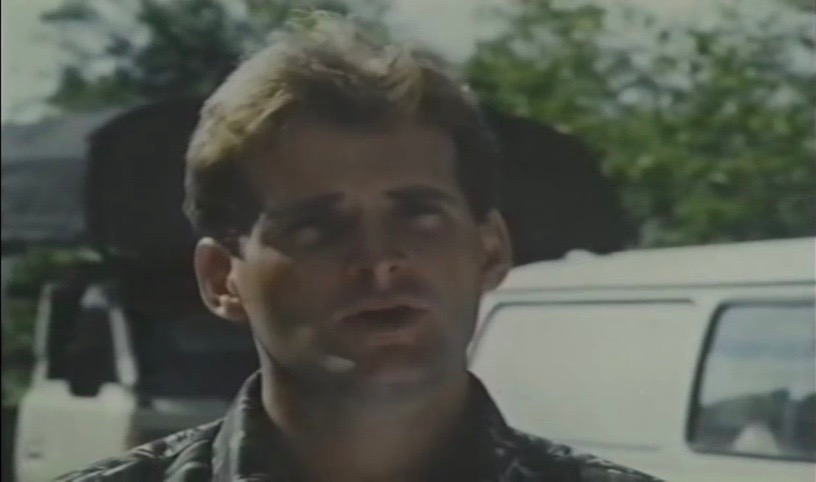
Maybe one of these days I’ll actually get around to reviewing all the films of Pierre Kirby. But for now, here’s four iconic and varied examples of his work as the world’s most obscure action star whose career was cut very short.
Thunder of Gigantic Serpent (1988, dir. Godfrey Ho)
We remember Kirby one-liners like, “What a useless guy,” but usually not the names of the characters he played. Realistically, there is only one character’s name that people consistently remember. That’s because of his James Bond introduction in that shot above: Fast, Ted Fast.
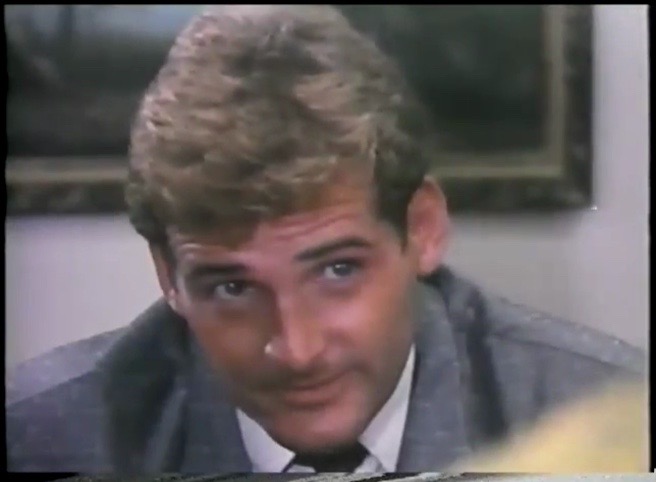
Dressed to Fire (1988, dir. Godfrey Ho)
Pierre Kirby crying. There’s nothing else that needs to be said. Even in his 9 movie career, Kirby showed that he could probably have played just about any role.
Hunting Express (1988, dir. Phillip Ko)
Pierre Kirby as the villain. It’s the one and only time he did this, but he did it well. Those good looks and smile could just as easily be paired with evil as Sergio Leone did with Henry Fonda in Once Upon a Time in the West (1968). Little bit of additional trivia. The film that Thunder of Gigantic Serpent spliced Pierre Kirby into actual used not only the theme from The Terminator (1984), but Morricone’s main theme to Once Upon a Time in the West (1968) for its’ tragic end.
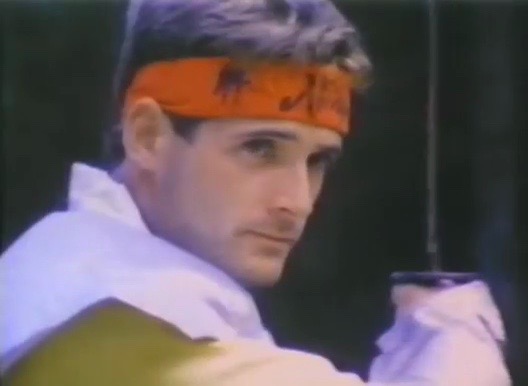
Zombie vs. Ninja (1989, dir. Godfrey Ho)
Despite the fact that Kirby certainly played other roles, he is most remembered as the ninja who wanders the endless forest battling other multi-colored ninjas.
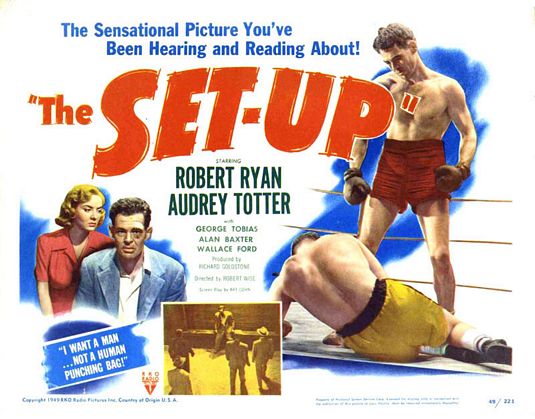
The seedy worlds of professional boxing and film noir were made for each other. Both are filled with corruption, crime, and desperate characters trapped in situations beyond their control. Movies like CHAMPION, BODY AND SOUL, and THE HARDER THEY FALL expose the dark underbelly of pugilism. One of the best of this sub-genre is THE SET-UP, Robert Wise’s last film for RKO studios. He doesn’t fail to deliver the goods, directing a noir that packs a wallop!
THE SET-UP follows one night in the life of aging, washed up fighter Stoker Thompson ( Robert Ryan ). Stoker’s 35 now, ancient in boxing terms, but still has delusions of making the big time. Wife Julie (Audrey Totter ) is tired of going from one tank town to the next, and fears for Stoker’s safety. She refuses to go to tonight’s fight, a matchup with up and coming young contender Tiger…
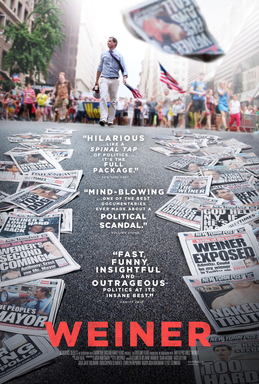
I just finished watching Weiner, the new documentary about Anthony Weiner, the very creepy former Congressman from New York.
I know it may seem strange for me, the girl who launches into at least one “I’m sick of hearing about politics” rant a day, to watch Weiner but this documentary has been getting considerable acclaim. In a year when very few Oscar contenders have yet to emerge, Weiner has already been declared by many to the be the front-runner for this year’s Oscar for Best Documentary Feature Film. So, really — what choice did I have but to watch?
Then again, even if it wasn’t a potential Oscar contender, I would probably still want to watch Weiner. Anthony Weiner’s story is a fascinatingly awful one and how people react to it seems to largely depend on whether they lean to the right or to the left. To those on the left, Anthony Weiner is almost a tragic figure, a forceful advocate who was undone by his personal weaknesses. To those on the right, Weiner is a symbol of liberal hypocrisy. And, for those in the apathetic middle (like me), he’s a creepy and somewhat pathetic perv who used to serve in Congress and who is now lucky if he can get a cameo in a Sharknado sequel.
Of course, when it comes to Anthony Weiner, the thing that we can all agree on is that, regardless of what happened, it was all his fault. Weiner opens with a montage of Antony Weiner’s rise and fall. We see him screaming on the house floor and taunting Republicans on a news program. We then see him being asked if he posted a picture of his “bulge” on twitter. We watch as Weiner denies posting the picture and then admits to posting the picture. Weiner says he will never resign from Congress. Obama pops up for a second to tell an interviewer that he thinks Weiner should resign. And then, Weiner does resign.
The documentary picks up two years later. Anthony Weiner is running for Mayor of New York and, despite lingering questions about his online activities, Weiner has emerged as the front runner. In fact, Weiner is so confident that he’s going to win the Democratic nomination that he even invites a documentary film crew to follow him during the campaign. It’s obvious that, initially, both Weiner and the documentarian believe that this documentary is going to be a story of redemption.
And so, we follow Weiner as he campaigns. We see his enthusiastic volunteers, all talking about why they want Anthony Weiner to be the next mayor of New York. We meet Weiner’s wife, Huma Abedin, and we listen as people gush about how close she is to Hillary Clinton. Everything seems to be perfect…
…And then, suddenly, things change. It turns out that Weiner has not stopped his online activities. Instead, it appears that he’s become even more reckless than before. The press discovers that Weiner’s online name was “Carlos Danger.” One of Weiner’s sexting partners, Sydney Leathers, emerges as a celebrity. Thought Huma stands with her husband in public, the documentary cameras catch her in private, often sitting alone and looking like she can’t believe that, out of all the available men in D.C., she ended up married to someone who thought Carlos Danger sounded like a plausible name.
And through it all, Anthony Weiner seems blissfully unaware. He continues to campaign for mayor and cannot seem to understand why people keep asking him about the scandal. He gets angry. He snaps at hecklers. Suddenly, nobody is returning his phone calls. Nobody is taking him seriously as a candidate. And yet, Weiner still seems to be convinced that he’s going to win. One of the documentary’s best scenes takes place on election night, when Weiner watches the results and realizes that, in a matter of days, he’s gone from being the front runner to coming in dead last. Making matters even worse, of course, is that both the press and Sydney Leathers have gathered outside of Weiner’s campaign headquarters, waiting for him and Huma to emerge so that they can literally pounce on them.
It makes for a fascinating documentary, though perhaps not in the way that the documentarians originally intended. As much as the film attempts to paint Weiner as being a tragic character, a talented man brought down by his own mistakes, the real Anthony Weiner comes across as being a shallow narcissist who, through a combination of arrogance and stupidity, actually thought it would be a good idea to have a documentary crew follow him around despite knowing that there was a potential scandal hanging over his head. It makes for a memorable portrait of what happens with ambition meets compulsion.
The film’s getting a lot attention because it provides a behind-the-scenes look at Huma Abedin. With Hillary Clinton pretty much guaranteed to be our next President, Huma is also guaranteed to soon become one of the most powerful people in the country. Unlike Weiner, who sometimes comes across as being almost compulsive in his need to be the center of attention, Huma is a far more reticent figure. Whereas Weiner frequently talks straight to the camera and answers questions from the filmmakers, Huma is usually seen in the background, smiling when Weiner is doing well and glaring when he’s not. There’s not a single scene in the movie where she doesn’t seem to have up her guard but then again, can you blame her? Unlike her husband, Huma instinctively understands that there’s no coming back from being outed as Carlos Danger. When Huma eventually leaves Weiner’s campaign so that she can travel with Hillary Clinton, you feel almost relieved for her. At least she won’t have to put up with Anthony’s bullshit for a while.
Weiner may have originally be envisioned as tale of redemption but instead, it became a story of how a narcissist self-destructed. Whether that narcissist deserves a third or fourth chance to live up to his potential is a question that the audience will have to answer for themselves.
One of the most common arguments I’ve seen about why music videos aren’t actually films is that they are just advertisements for a song. Right now Gary has just finished reading that sentence and is digging out his copy of Dewar’s-It’s Scotch (1898), Warner Bros. Silver Jubilee (1930), and other examples that destroy the illusion that even ads aren’t films. I think The Smashing Pumpkins video for Tonight, Tonight is one of the finest examples of why that argument is a bunch of BS. Why? Because it’s a remake of Georges Méliès’ A Trip To The Moon (1902). Even IMDb Data Editors agreed with me when I submitted it as such about a year ago. Tom Kenny and Jill Talley play the man and woman who go through their incredible journey. One that ends with them even being rescued by the S.S. Méliès. Not only have more people probably seen short films since the launch of MTV then since the pre-1915 days of cinema, but this video introduced many kids to Georges Méliès long before Martin Scorsese did with Hugo (2011).
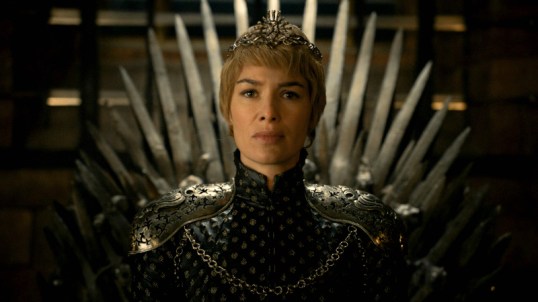
“Cersei of the House Lannister, the First of Her Name, Queen of the Andals and the First Men, Protector of the Seven Kingdoms….Long may she reign.” — Qyburn
To all of those who watch each new episode of Game of Thrones, last night’s episode was a classic in the making. It was the sort of episode that convinced millions 6 years ago to take a chance and watch an HBO series about a medieval fantasy series about royal politics, dragons, living dead, royal incest and lots and lots of sex and violence.
The series is based on the ongoing epic fantasy novel series by novelist George R.R. Martin. A series called A Song of Ice and Fire, tonight’s episode delivered on both the fire and ice. As we see the players on the Great Game cut down violently by the machinations of one Dowager Queen (and now Queen and first of her name), the fantasy realm of Westeros is now down to three Great Houses as the show finishes it’s sixth season with just two more to go.
One thing the series has always had to complement the outstanding performances of the ensemble cast, the epic work of directors in the singularly classic episodes 9’s (names such as Neil Marshall and Miguel Sapochnik come to mind) and the very good to great writing, it would be the series composer Ramin Djawadi and the work he has brought onto the show.
The show’s main theme is as recognizable nowadays as any John Williams, Howard Shore and James Horner piece. It’s a theme that’s become part of pop culture lexicon. There’s been other themes in the show that has been just as good. Yet, with the season finale of season 6 a new theme comes to the forefront that will be put on repeat as loyal viewers young and old watch and re-watch this season finale.
It’s a subtle theme of a single piano playing a solemn, melancholy lullaby. It’s soon to be joined by a single cello before another transition that adds the singular voice of a choirboy (the better to accentuate that this theme is one of the Seven Gods of Westeros). The song goes from that solemn lullaby and into a climactic dirge as the organ joins in to almost drown the piano and cello.
For those who saw that opening sequence of the season finale should appreciate just how well “Light of the Seven” made everything so much better once the dust settled and the world of Game of Thrones was changed forever once again.
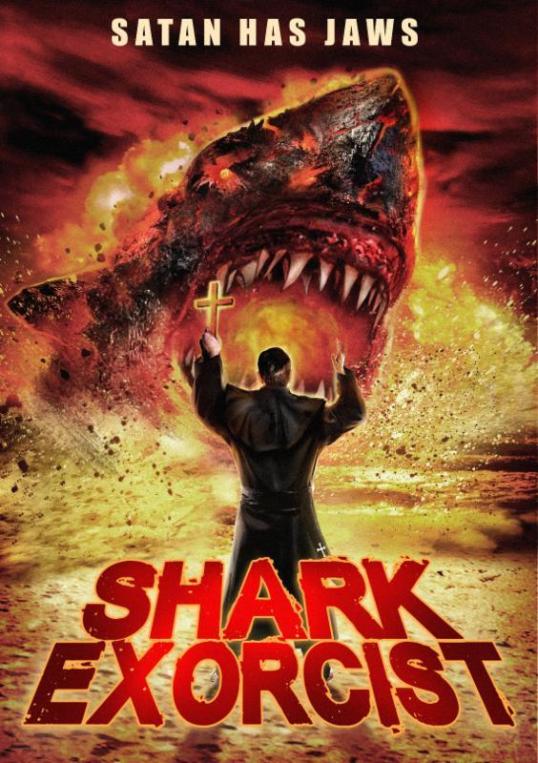
I just found about this movie today and my first thought was “Why hasn’t somebody thought of this before?!?” And then went, “Whoever thought of it, why!?!”
But, yes, this is an actual movie coming out straight to DVD / Blu-ray, and I can’t wait to get to watch it! My love of cheesy, bad, b-rated horror movies and all!
Premise:
A Nun summons Satan to inhabit the body of a Great White shark; which, in turn … well, a priest, an exorcism…who knows, who cares! A Shark Exorcism!
Who is behind it?
This is a WildEye Releasing movie. Who have had a couple of fun movies like “Walking Dead in the West” and “Killersaurus”
Who is in it?
Angela Kerecz: “Dumb and Dumber to” “Hot Tub Time Machine 2”
Bobby Kerecz: “Hot Tub Time Machine 2”
See a pattern?…any way, I digress.
I have not seen the movie yet; but the poster looks great!
And if you want to see the trailer, and you really do…you can here!
Shark Exorcist will be on DVD / Blu-ray June 28th and I may or may not be already standing in line, with a Crucifix around my neck!
I’m currently in the process of watching the 36 films that I’ve recorded on my DVR since March. Last night, I was extremely excited as I looked up the 7th film on the DVR and I discovered that I was about to watch the 1977 revenge classic, Rolling Thunder!
Among those of us who love old grindhouse and exploitation film, Rolling Thunder has achieved legendary status. Based on a script by Paul Schrader (though I should point out that Schrader’s script was rewritten by Heywood Gould and Schrader himself has been very critical of the actual film) and directed by John Flynn, Rolling Thunder is quite literally one of the best revenge films ever made. It’s also a great Texas film, taking place and filmed in San Antonio. Quentin Tarantino has frequently cited Rolling Thunder as being one of his favorite films and he even used the name for his short-lived distribution company, Rolling Thunder Pictures.
Rolling Thunder also has one of the greatest trailers of all time. In fact, if not for the trailer, I probably would never have set the DVR to record it off of Retroplex on March 25th. The Rolling Thunder trailer is included in one of the 42nd Street Forever compilation DVDs and, from the minute I first watched it, I knew that Rolling Thunder was a film that I had to see.
Watch the trailer below:
Everything about that trailer — from the somewhat portentous narration at the beginning to the way that Tommy Lee Jones calmly says, “I’ll get my gear,” at the end, is pure genius.
But what about the film itself? Well, having finally seen the film, I can say that Rolling Thunder is indeed a classic. It’s also one of the most brutal films that I’ve ever seen, containing scenes of truly shocking and jarring violence. In fact, the violence is so shocking that it’s also, at times, rather overwhelming. This is one of those films that you will probably remember as being far more violent than it actually is. Because, while Rolling Thunder features its share of shoot-outs and garbage disposal limb manglings, it’s actually a very deliberately paced character study.
When we first meet Maj. Charles Rane (William Devane), he’s sitting on a plane and looking down on San Antonio. He’s in full military dress uniform. Setting across from him, also in uniform, is John Vohden (Tommy Lee Jones). The year is 1973 and Rane and Vohden have both just spent the past seven years as prisoners in a Vietnamese camp. While they were prisoners, they were tortured every day. Now, they’re returning home and neither one of them is quite sure what’s going to be waiting for them.
Over the imdb, you can find a few complaints from people who feel that Rolling Thunder gets off to a slow start. And it’s true that it takes over 30 minutes to get to the pivotal scene where Maj. Rane loses both his hand and his family. But that deliberate pace is what makes Rolling Thunder more than just a revenge flick with a kickass name. That first half-hour may seem to meander but what it’s actually doing is setting both Rane and Vohden up as strangers in their own country.
The film gets a lot of mileage out of comparing Rane to Vohden. Rane is good with words. When he gets off the plane, he gives a perfect (and perfectly empty) speech about how the whole war experience has made a better American out of him. Rane knows how to fool people but it quickly becomes apparent that, on the inside, Rane feels empty.
Vohden, meanwhile, is not an articulate man. He’s not invited to give a speech when the plane lands. Vohden cannot fake the emotions that he does not feel. At first, Rane and Vohden seem to be complete opposites (and the film wisely contrasts Jones’s trademark taciturn style of acting with Devane’s more expressive technique) but eventually, we learn that they’re actually two sides of the same coin. Both of them have been left empty as a result of their wartime experiences and, in the end, Vohden is the only one who can truly understand what’s going on in Rane’s head while Rane is the only one who can understand Vohden. When Rane needs help getting revenge, Vohden is the one that he turns to. It’s not just because Vohden knows how to kill. It’s also because John Vodhen is literally the only man to whom Charles Rane can relate.
Why does Rane need revenge? After the local bank awards him with 2,000 silver dollars (“One silver dollar for every day you spent in the Hell of Hanoi!,” he is told at the presentation), Rane returns home to discover that a group of men have broken into his house. One of them, known as the Texan (an absolutely chilling performance from James Best), demands that Rane tell them where the silver dollars are hidden. When Rane responds by giving only his name, rank, and serial number, Slim (Luke Askew) reacts by forcing Rane’s arm into the kitchen sink and then turning on the garbage disposal. (A scene was apparently shot that literally showed Rane’s hand getting ripped off by the garbage disposal but it was judged to be too graphic even for this grim little movie.) Even as the disposal mangles Rane’s arm, Rane refuses to tell them where the money is. Instead, he just flashes back to being tortured at the camp and we realize that Rane’s experiences have left him immune to pain.
Of course, the Texan doesn’t realize this. Instead, he glares at Rane and mocks him by declaring him to be “one macho motherfucker.”
When Rane’s wife and son walk in on the men, Slim and the Texan murder them and leave Rane for dead. However, Charles Rane isn’t dead. He survives but he claims that he can’t remember anything about the men who attacked him. It’s only after Rane is released from the hospital and starts to practice firing a shotgun with the hook that has replaced his hand that we realize that Rane does remember. Recruiting a local waitress who also happens to be an amateur beauty queen (Linda Haynes, giving the type of great performance that makes me wonder why I’ve never seen her in any move other than Rolling Thunder) to help, Rane sets out to track down “the men who killed my boy.”
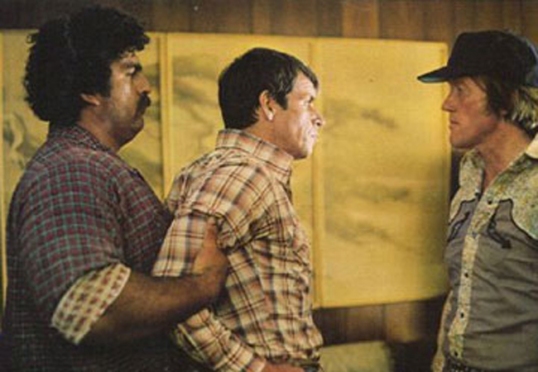
Linda Hayes in Rolling Thunder, giving a great performance in a somewhat underdeveloped role
It’s very telling that Rane continually says that he’s after the men who “killed my boy” but he never mentions his wife. When Rane first arrived home, he had one conversation with his wife. He complained that she had changed her hair and that she wasn’t wearing a bra. “Nobody wears them anymore,” She replied before telling him that, during his seven year absence, she had fallen in love with another man, Cliff (Lawrason Driscoll). And, up until she’s murdered by the Texan, that’s the last conversation that we see Rane have with his wife. Rane still lives in the house and he still tries to talk to his son (even though his son seems more comfortable around Cliff than around Rane) but Rane becomes a stranger to his family. While his wife sleeps in the house, Rane insists on staying out in the garage and continuing to go through the daily routine of calisthenics that he used to maintain his sanity while he was a prisoner.
(When Cliff asks Rane what it was like to be tortured, Rane literally forces Cliff to pull back on his arms in the same way that his Vietnamese captors had to. As I watched these scenes, I was reminded that 2008 presidential candidate John McCain cannot lift his arms above his shoulders as a result of the torture he suffered while a POW.)
When Rane goes to El Paso to recruit Vohden for his mission of revenge, we notice that Vohden also appears to be incapable of speaking to his wife. When Vohden leaves, he says goodbye to his father but not his wife. It’s probably not a coincidence that, when Vohden and Rane find Slim and the Texan, they’re at a brothel, a place where men are in charge, women are subservient, and primal needs are satisfied without the risk of emotional attachment. (It’s also probably not a coincidence that Slim is also identified as having recently returned from Vietnam. He complains that, unlike Rane and Vohden, he was never captured by the enemy and, as a result, he didn’t get a parade when he came back home.) Rolling Thunder is a film about emotionally stunted men who are incapable of interacting in any way other than violence. By the end of the film, you’re left wondering whether Rane’s mission was about revenge or about his own need to destroy.
And what an ending! When I say that the violence in Rolling Thunder is overwhelming, I’m talking about two scenes in particular. There’s the scene where Rane loses his hand and watches as The Texan casually executes his wife and son. And then there’s the ending. The final shootout was quick but it was also so brutal that I was literally shaking by the end of it.
(The scenes leading up the final shootout also featured one of the few humorous moments to be found in this otherwise grim film. When Vohden — who is inside the brothel with a prostitute — starts to put his rifle together, the prostitute asks him what he’s doing. “Oh,” Vohden says, in that perfectly weary way that only Tommy Lee Jones can do, “just going to kill a bunch of folks.”)
I mentioned earlier that Paul Schrader is reportedly not a fan of Rolling Thunder. Apparently, in his original script, Charles Rane was portrayed as being a poorly educated racist, a bit of a prototype for the character that Robert De Niro played in Taxi Driver. Ranes’s final rampage was meant to be an example of the war in Vietnam coming home and it was made much clearer that Rane’s violence was as much fueled by his own racism as by a desire for revenge. Schrader has said that his anti-fascist script was turned into a fascist movie.
A scene from Paul Schrader’s original script
With all due respect to Mr. Schrader (who I think is a very underrated filmmaker), Rolling Thunder is anything but a fascist movie. Instead, it’s a brutal and somewhat disturbing character study of a man who will never truly escape the war in which he fought. The fact that Rane is played by super smooth William Devane (as opposed to the redneck that Schrader apparently envisioned) only serves to make the film’s critique of hyper masculinity all the more disturbing. It’s interesting to note that, on their own, Rane and Vohden are never presented as being particularly likable or heroic. Instead, we root for them because the people who have hurt them are even worse.
This was how Schrader envisioned Johnny and Rane.
Though it may be far different from what Paul Schrader originally envisioned, John Flynn’s Rolling Thunder is a film that works on every level. It is both a visceral revenge film and a character study of a disturbed man. It’s a powerful film that will leave you shaken and it’s one that I will probably never erase from my DVR.
There are some movies that you just don’t dare delete.
Greg Manchess is an illustrator from Kentucky, who has been an active and prolific cover artist ever since he received his BFA from the Minneapolis College of Art and Design in 1977. Below are several covers that he did for the Hard Case Crime’s line of pulp reprints.







 Through the Shattered Lens