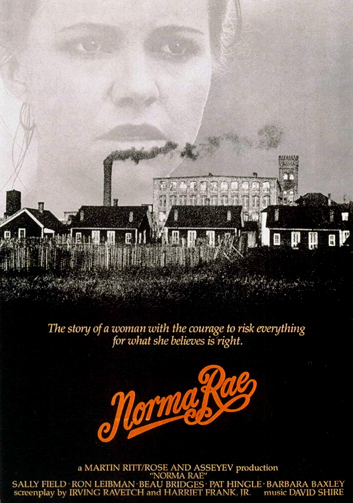
Earlier, in honor of Labor Day, I reviewed one of the most anti-labor union films ever made, the 1954 Oscar winner On The Waterfront. In the interest of fairness, it only seems right to now take a look at one of the most pro-union films ever made, the 1979 best picture nominee Norma Rae.
Norma Rae takes place in one of those small Southern towns that is defined by just one industry. In this case, almost everyone in town works for minimum wage at the local textile mill. Conditions are terrible, with the employees working long and brutal shifts in a hot and poorly ventilated factory. The overwhelming roar of the machines have left the majority of the workers deaf to reality, both figuratively and literally. The mill is run by the usual collection of slow-talking, tie-wearing rednecks who always seem to show up in movies like this.
One day, a union organizer from New York shows up in town. Brash and cocky, Ruben Warshowsky (Ron Leibman) is determined to unionize the mill but, at first, he struggles. Nobody wants to risk their job by being seen with him and his Yankee manners rub many of the townspeople the wrong way.
Eventually, Ruben does find one ally. Norma Rae (Sally Field) has worked at the mill her entire life. She’s tough and determined but she’s also regularly shunned because of her past. A widow who has three children (“She’s had a child out of wedlock!” a judgmental union organizer tells Ruben in a near panic), Norma channels her frustration into drinking too much and having an affair with a married (and abusive) salesman.
Two things happen that give Norma Rae a new purpose in life. First off, she meets and marries the well-meaning but chauvinistic Sonny (Beau Bridges). Secondly, she helps Ruben in his efforts to unionize the plant, even at the risk of going to jail and losing her job. With the mill’s management spreading untrue rumors about Norma’s relationship with Ruben, her dedication to the union soon starts to threaten her marriage to Sonny.
I have to admit that I have mixed feelings about Norma Rae. In many ways, Ruben is an annoying character. He’s so brash and so smugly out-of-place that I actually found it difficult to consider any of the points that he was making. I suppose that was partly intentional. Ruben can’t accomplish anything until he gets Norma Rae on his side. But, at the same time, there was something very condescending about Ruben as a character. Much like the villainous rednecks in charge of the mill, Ruben felt like a stock character. He was Super Yankee, bravely venturing below the Mason-Dixon Line to bring the truth to all of us stupid Southerners. Whenever Ruben smirked and started to complain about how dumb everyone else was, I was reminded of why I never wanted much to do with the whole Occupy Movement.
As well, Norma Rae is one of those films that technically takes place in the South but it’s the South of the Northern imagination. The accents were inconsistent and the dialogue often tried way too hard to sound “authentic.” Ultimately, Norma Rae lacked the artistry necessary to disguise its more heavy-handed moments.
And yet, I still liked Norma Rae. It had nothing to do with the film’s political message and everything to do with the character of Norma Rae. Sally Field gives such a good performance as Norma, making her both strong and vulnerable. The film’s best moments are the ones where Norma stands up for herself and does what she feels is right, despite the opposition from the mill’s management, Sonny, and her father (Pat Hingle). Towards the end of the film, there’s a simply incredible scene where Norma finally tells her children about her past and, at that moment, Norma Rae reveals itself to be a great and heartfelt tribute to the strength and resilience of women everywhere. At that moment, Norma’s strength reminded me of the greatest woman that I’ve ever known, my mom. It made me appreciate the struggles that my mom went through as she raised four strong-willed daughters on her own, while working crappy jobs and dealing with a society that is always threatened by and cruelly judges a woman who refuses to settle. Personally, I think Norma could have done better than Sonny and that Ruben should have been called out for constantly talking to down to her but what’s important, in the end, is that Norma never stopped standing up for what she believed. By the end of the film, Norma is standing in for every woman who has ever been underestimated or judged or told that her opinions didn’t matter. Norma is standing up for all of us.
Sally Field won an Oscar for her role in Norma Rae. Off the top of my head, I have no idea who she defeated for the award. (Yes, I know that I could just look it up on wikipedia but that’s not the point.) But, regardless of her competition, it’s an honor that she definitely deserved.
 Through the Shattered Lens
Pingback: 17 Movies That Portray The Power Of A Woman’s Spirit
Pingback: 12 Things You May Or May Not Have Known About Friday the 13th! | Through the Shattered Lens
Pingback: Celebrate Labor Day With These 14 Films! | Through the Shattered Lens
Pingback: Lisa Marie’s First Review of 2025: Beyond the Poseidon Adventure (dir by Irwin Allen) | Through the Shattered Lens
Pingback: Scenes That I Love: Gregory Walcott in Plan 9 From Outer Space | Through the Shattered Lens
Pingback: Scenes That I Love: Gregory Walcott Defends Earth In Plan 9 From Outer Space | Through the Shattered Lens
Pingback: The Best Picture Race: The 1970s | Through the Shattered Lens